How to Build a B2B SaaS Go-to-Market Strategy That Ships, Not Stalls

TLDR
- Most B2B SaaS GTM strategies fail at execution, not planning. The root cause is a low shipping cadence, where backlogs grow faster than teams can deploy changes.
- Validate GTM fit before you scale. Confirm that your chosen acquisition motion can reach your ICP at a sustainable CAC, separate from validating product-market fit.
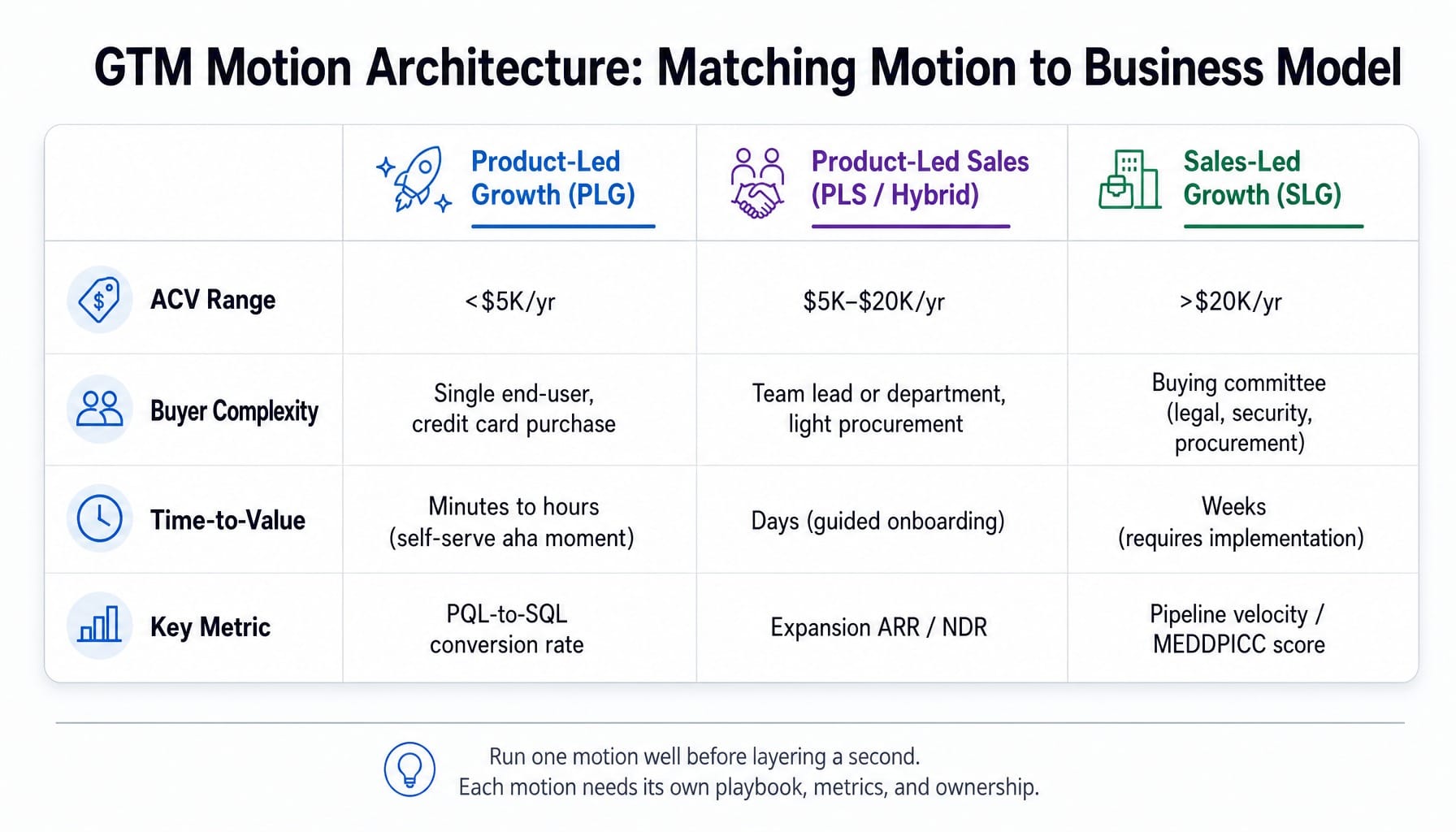
- Design your GTM motion as an architecture (PLG, SLG, or a hybrid), not a philosophical choice. The right motion is a function of your ACV, buyer complexity, and product's time-to-value.
- A functional GTM strategy is a weekly execution system built on five layers: ICP-anchored prioritization, deployed messaging, cross-channel orchestration, shared funnel SLAs, and continuous measurement.
- Track leading indicators like speed-to-lead, PQL-to-SQL conversion, and segmented LTV:CAC. These metrics expose GTM dysfunction months before lagging indicators like revenue.
We've all seen it. The Series A SaaS company emerges from a two-week offsite with a 40-slide go-to-market deck. The ideal customer profile (ICP) is defined. The positioning statement, workshopped to perfection in Figma, is crisp. The channel plan spans content, outbound, and paid media. The launch is celebrated.
Three months later, the pipeline is anemic. The sales team improvises messaging on every call because the official talk track doesn't land. The marketing site, a monument to the launch-week strategy, hasn't been updated since.
The strategy was sound. The execution never shipped.
This is the central failure mode of the modern B2B SaaS go-to-market strategy. It isn't a lack of strategic thinking; the internet is saturated with frameworks. The failure is operational. The latency between deciding what to do and actually doing it stretches into weeks, then months. The gap between strategy and execution is where GTM dies.
This is not another guide to building a GTM planning deck. This is a framework for designing the execution architecture that turns your plan into a weekly shipping system—from validating GTM fit before you scale, to designing a multi-motion architecture, to building the five execution layers that actually compound.
Why most B2B SaaS GTM strategies collapse at execution, not planning
The B2B SaaS industry has more GTM frameworks, templates, and playbooks than ever. Yet, average website conversion rates remain stuck around 2%, and most Series A and B companies burn through 12-18 months of runway before finding a repeatable motion. The problem isn't strategic ignorance; it's an execution bottleneck.
Consider a common scenario: a three-person marketing team identifies 14 high-impact changes across their website, SEO, and outbound messaging in Q1. By the end of Q2, only three have shipped. Each change required cross-functional coordination, engineering tickets, design reviews, and stakeholder approvals. The backlog of known improvements grew faster than the team could execute. This is GTM bloat—accumulating strategic ambition faster than execution capacity.
This collapse in velocity stems from three systemic bottlenecks:
- Channel Fragmentation: SEO, CRO, paid media, and outbound operate as separate workstreams with separate tools and no unified prioritization. The team knows a dozen things could be improved, but lacks a system to identify the one thing that should be improved this week.
- The Specialist Gap: Lean teams carry specialist expectations across four or five disciplines. A single marketer is expected to be a CRO expert, an SEO strategist, and a paid media analyst simultaneously, without the depth any single discipline demands.
- Shipping Latency: The time from "we know what to change" to "it's live" averages three to six weeks in most organizations. This latency compresses a year's worth of potential experiments into just a handful of major pushes, killing any chance of compounding gains.
Your GTM problem is almost certainly not a strategy problem. It's a throughput problem. The rest of this guide addresses how to build a GTM system that can actually ship.
Read more: How to Prioritize Marketing Tasks for Lean Teams: A Framework That Actually Works
Validate GTM fit before you invest in GTM scale
The most expensive mistake in B2B SaaS is scaling a GTM motion that hasn't been validated. Most teams treat product-market fit (PMF) as a green light to hire SDRs and pour capital into acquisition. But PMF only tells you that your product solves a real problem for someone. It tells you nothing about whether your chosen acquisition motion can reach those people at a sustainable cost.
This is the crucial, often-skipped stage: GTM fit. It sits between PMF and GTM scale. It's the validation that your chosen motion—be it outbound, content, or product-led—can reliably connect with your ICP and generate a pipeline with positive unit economics.
For example, a SaaS company validates PMF with 30 design-partner customers acquired through the founder's personal network. Believing they have a repeatable model, they hire five SDRs and launch an aggressive outbound motion. The result is a near-zero response rate. They later discover their ICP, compliance officers, never respond to cold outreach because their buying trigger is an internal deadline, not an external sales email. The product was right, but the motion was wrong. They had PMF, but not GTM fit.
What GTM fit actually means and how to test it
GTM fit is the evidence that your acquisition motion, ICP, and revenue model are aligned. It's the proof that your chosen channel can reach your target buyer at a Customer Acquisition Cost (CAC) that your Average Contract Value (ACV) and retention can sustain. It is not the same as PMF.
Here's a practical test: take your last 10-20 closed-won deals and reverse-engineer their entire journey. How did each buyer really find you? What triggered their search? What messaging resonated? What convinced them to buy? Use tools like Gong to analyze call transcripts for patterns in pain points and objections, and use enrichment tools like Clay to find common firmographic or technographic DNA across those winning accounts.
If the acquisition pattern is inconsistent, founder-dependent, or relies on one-off channels, you don't have GTM fit. You have founder-led sales masquerading as a repeatable motion.
You can quantify this with a simple GTM fit score: the ratio of repeatable, non-founder-sourced deals to total deals. If that score is below 40%, you are not ready to scale. You are ready to continue validating.
Why founder-led selling should remain a GTM layer, not just a startup phase
Conventional wisdom dictates that founder-led sales is a startup phase you graduate from. This is a mistake. Founder-led selling is the highest-signal GTM channel a B2B SaaS company has. It generates the tightest feedback loop between the market, the product, and the positioning. The goal isn't to eliminate it, but to build a system that encodes its learnings into repeatable motions.
Consider the CEO who personally closes 60% of enterprise deals they touch, while their sales team closes at 15%. The gap isn't a talent deficit. It's a systems deficit. The founder's deep contextual knowledge, intuitive objection handling, and ability to sell the vision hasn't been systematically translated into messaging frameworks, sales enablement materials, and champion enablement playbooks.
The mistake isn't doing founder-led sales; it's treating it as your only motion and never building scalable layers alongside it. Keep the founder in the deal flow for high-value accounts, but use their expertise to build the system around them. This means instrumenting their process for multi-threading deals and equipping internal champions to sell on your behalf when you're not in the room.
Designing your GTM motion architecture: PLG, SLG, or both
Choosing a GTM motion is not a philosophical preference for "modern" or "traditional" growth. It's an architecture decision dictated by your ACV, the complexity of your buyer's problem, and your product's ability to deliver value before a sales conversation. The wrong choice creates structural friction that no amount of marketing spend can overcome.
The goal is motion mapping: matching your GTM motion to your ACV segmentation and buyer behavior. A bottom-up PLG motion works for a tool like Slack, where individual teams can adopt it and see value instantly, prompting enterprise sales to engage only after usage hits a critical mass. That same motion would be structurally impossible for a vertical SaaS company selling an $80,000 ACV compliance platform, where the buyer is a committee and the product is never touched before procurement.
The most common failure is not choosing the wrong motion, but attempting to run a multi-motion GTM without the resources to execute either one properly, creating execution chaos.
When product-led growth (PLG) is structurally viable
A product-led growth motion works when three conditions are met simultaneously:
- Rapid Time-to-Value: The product delivers a measurable "aha!" moment within a free trial or freemium tier, without requiring extensive setup or sales guidance.
- End-User Agency: The initial user has the authority or influence to adopt the tool for their own work and, ideally, expand its usage to their team.
- Low-Friction Adoption: The ACV is low enough (typically sub-$5k/year) that an individual or team lead can purchase it on a credit card without involving a formal procurement process.
If any of these are missing, PLG becomes a lead generation channel for your sales team, not a self-sufficient growth engine. The key metric to watch is the PQL-to-SQL conversion rate—the percentage of Product-Qualified Leads that signal enough usage or organizational adoption to warrant a sales conversation. If this rate is below 10%, your PQL definition is likely too broad, or your product isn't a natural fit for a pure PLG motion. Tools like Koala or Common Room are essential for tracking these product usage signals.
When sales-led growth (SLG) is the only rational motion
Sales-led growth isn't the "old way"; it's the correct and necessary motion when:
- The ACV is high (typically >$20,000), requiring budget approval from multiple stakeholders.
- The buying process is complex, involving legal, security, and procurement reviews.
- The product solves a business-level problem, and the end-user is not the economic buyer.
The mistake isn't choosing SLG; it's running it with a 2015 playbook based on static lead lists and cold calling. A modern SLG motion is an execution system built on signal-based selling. It uses intent data from tools like 6sense to identify accounts actively researching solutions, outbound sequencing from platforms like Apollo.io to engage them with relevant messaging, and call intelligence from Gong to refine the pitch.
For complex B2B deals, this motion requires a rigorous qualification methodology like MEDDPICC to ensure sales resources are focused on deals that can realistically close.
Running multi-motion GTM without creating execution chaos
Should a B2B SaaS company run product-led and sales-led motions simultaneously? Eventually, yes. But only when each motion has its own validated playbook, its own metrics, and its own dedicated ownership. The most common failure mode is running two half-built motions instead of one fully operational one.
The bridge between the two is often product-led sales (PLS). In this hybrid model, the PLG motion acquires users and generates product usage data. That data then feeds the sales team with highly qualified signals, allowing them to engage with accounts that are already demonstrating buying intent. This is the model that powers companies like HubSpot and Notion: PLG for user acquisition and initial adoption, SLG for expansion ARR and enterprise contracts.
Multi-motion GTM is an architecture decision, not a resource allocation decision. If you can't staff and instrument each motion independently with its own clear goals and metrics, you're better off running one motion well. The economic justification for layering motions is the creation of negative churn loops, where expansion revenue from existing customers outpaces any revenue lost from churn.
The five execution layers that turn GTM strategy into weekly shipping
A GTM strategy is only as good as the cadence at which it ships changes. Most teams operate in quarterly planning cycles, but the market, competitors, and buyer behavior shift weekly. The system that wins is the one with the highest execution throughput.
The five layers below create a system where the highest-impact GTM action is identified, prioritized, and deployed every week—not every quarter. A B2B SaaS company that shifted from quarterly website redesigns to weekly conversion optimizations saw pipeline contribution from organic search increase 3x in two quarters. The strategy didn't change; the shipping cadence did.
Layer 1: ICP-anchored prioritization
Every GTM action—a new blog post, an outbound sequence, a landing page test—must be prioritized by its expected impact on qualified pipeline, not by channel preference or team availability. This requires defining clear ICP tiers (e.g., Tier 1: best-fit accounts with highest ACV potential; Tier 2: good fit, lower ACV) and routing all GTM investment through this filter. This isn't a one-time planning exercise; it's a weekly triage decision.
- Ownership: RevOps + Marketing Leadership
- Instrumentation: Use tools like Clearbit or Hightouch for enriching leads and segmenting your CRM by ICP tier.
Read more: The Marketing Prioritization Framework That Replaces Gut Feel With Compounding Wins
Layer 2: Messaging and positioning that ships, not sits in a deck
Positioning is not a document; it's a deployment. Most teams workshop positioning in Figma or Notion, produce a messaging framework, and then never update their website, email sequences, or sales scripts to reflect it. If your last messaging workshop didn't result in a live website change within a week, it was theater. The execution layer here is a commitment: every messaging decision results in a shipped change—a headline rewrite, an updated ad creative, a revised demo script—within one week.
- Ownership: Product Marketing
- Instrumentation: Use platforms like Wynter to get quantitative feedback on messaging from your target audience before you deploy it widely.
Layer 3: Channel orchestration across SEO, CRO, and paid
Most GTM teams run SEO, CRO, and paid media as separate workstreams with separate tools and owners. This fragmentation means no one can answer the most critical question: "What is the single highest-impact action we can take this week to move the needle on pipeline?" Channel orchestration creates a unified view of performance, identifying the biggest conversion gap across the entire funnel and routing execution resources to that gap. This is where a system like Spike AI becomes critical, diagnosing cross-channel issues and prioritizing fixes that a fragmented, manual system would miss.
- Ownership: Growth/Performance Marketing Lead
- Instrumentation: A unified intelligence layer that connects website analytics, ad platform data, and SEO performance to identify systemic bottlenecks.
Layer 4: Sales-marketing alignment through shared funnel SLAs
Alignment isn't a weekly meeting; it's a shared set of definitions and service-level agreements (SLAs) instrumented in your CRM. The execution is specific: define what constitutes an MQL, PQL, and SQL with quantitative criteria (e.g., "viewed pricing page + fits ICP firmographics"). Then, set and enforce SLAs for speed-to-lead (how quickly sales follows up on a qualified signal) and feedback loops (sales must report back on lead quality within 48 hours). This turns alignment from a culture problem into an instrumentation problem.
- Ownership: RevOps
- Instrumentation: Use HubSpot or Salesforce for CRM-based SLA tracking and Gong to analyze whether sales messaging aligns with marketing's positioning.
Layer 5: Continuous measurement and weekly re-prioritization
The final layer closes the loop. After every shipped change, measure its impact immediately and feed the result back into the prioritization engine for the next week's sprint. This is the compounding mechanism that separates high-growth companies from the rest. Each week's data makes the next week's decision smarter. Key metrics for this layer include pipeline velocity, CAC by channel and ICP tier, and conversion rate by funnel stage. This focus on compounding small, weekly gains is what generates second-order revenue—the massive downstream impact that heroic quarterly pushes can never achieve.
- Ownership: Head of Growth/Marketing
- Instrumentation: A dashboard that tracks leading indicators and the performance of weekly releases, connecting execution to pipeline impact.
Six metrics that expose GTM dysfunction before pipeline does
Most GTM teams track lagging indicators like revenue, pipeline, and MQLs. By the time those numbers dip, the dysfunction started 60-90 days ago. Leading indicators are the GTM's early warning system, exposing problems while they're still fixable.
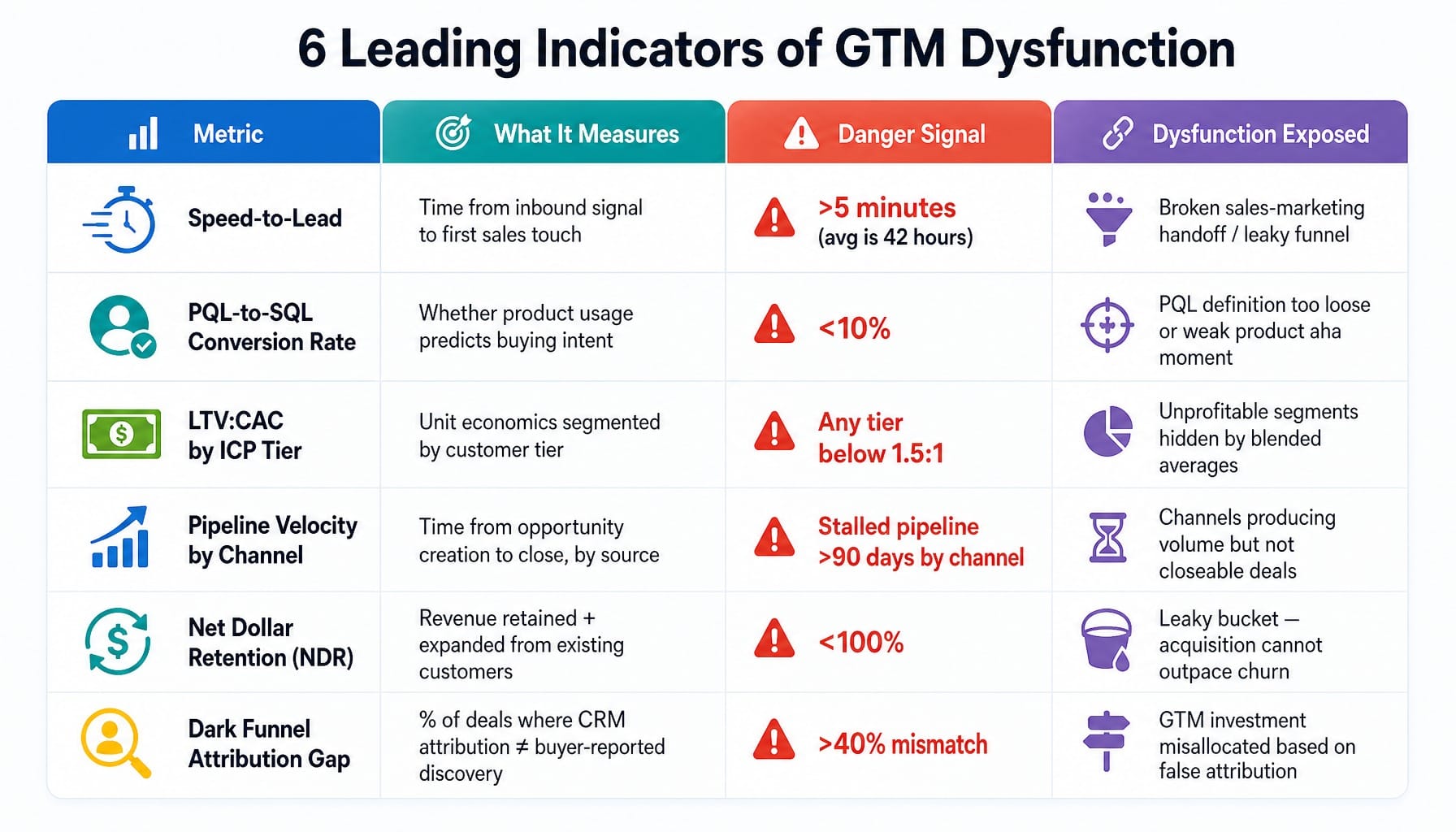
Here are six metrics that act as a diagnostic tool for your GTM health:
- Speed-to-Lead: The time from an inbound intent signal (e.g., demo request) to the first sales touch. While the average B2B SaaS response time is a staggering 42 hours, the optimal window for conversion is under 5 minutes. A high speed-to-lead is a direct indicator of a leaky funnel and a broken sales-marketing handoff.
- PQL-to-SQL Conversion Rate: This measures whether your product usage actually predicts buying intent. If this rate is below 10%, it signals that your PQL definition is too loose or your product's "aha" moment isn't strong enough to drive commercial interest.
- LTV:CAC Ratio by ICP Tier: A healthy overall LTV:CAC ratio (e.g., 4:1) can mask unprofitable segments. A company might find its overall ratio is strong, but upon segmentation, discovers that Tier 3 accounts have a 1.2:1 ratio—meaning 30% of their GTM spend is generating near-zero returns.
- Pipeline Velocity by Channel: This measures the time it takes for an opportunity to move from creation to close, segmented by its source channel. This reveals which channels produce pipeline that moves versus pipeline that stalls in the CRM for months, helping you prioritize marketing channels toward velocity, not just volume.
- Net Dollar Retention (NDR): The ultimate GTM health metric. If your NDR is below 100%, your GTM is a leaky bucket. No amount of top-of-funnel acquisition can fix a product or post-sale experience that fails to retain and expand customers. The goal is a negative churn loop, where NDR exceeds 100%.
- Dark Funnel Attribution Gap: The percentage of closed-won deals where the first attributed touchpoint in your CRM (e.g., a Google Ad click) doesn't match what the buyer reports as their discovery channel in a sales call (e.g., "I heard your CEO on a podcast"). A large gap indicates your attribution model is misallocating GTM investment.
When your GTM bottleneck is shipping, not strategy
The GTM strategy you have is likely good enough. The constraint is your ability to execute it. The five execution layers—prioritization, messaging, orchestration, alignment, and measurement—demand a continuous cadence that most lean marketing teams are structurally unable to maintain manually. The backlog of known fixes across your website, SEO, and conversion funnels grows, while shipping latency eats your runway.
This is the execution gap Spike AI was built to close.
Spike AI is not another dashboard that gives you more insights to add to your backlog. It's a marketing execution engine that turns that backlog into weekly releases. Every week, Spike AI identifies the single highest-impact move across your website, SEO content, and conversion paths—then executes it.
Where other tools diagnose problems and hand you homework, Spike AI deploys solutions. It fuses SEO, CRO, and analytics into a single closed-loop system: detect what's constraining growth, model the revenue impact of a fix, ship the change, and measure the result immediately. This re-prioritizes the queue for the next release.
The cadence itself becomes the growth engine. This system allows you to move from an operator buried in tasks to an orchestrator who directs and approves. Your GTM strategy finally reaches your website, your content, and your conversion funnel—every week, not every quarter.
See how Spike AI turns your GTM backlog into weekly releases
Conclusion
Your B2B SaaS go-to-market strategy is probably fine. The constraint is not strategic clarity; it's execution throughput.
Success is no longer determined by the quality of your positioning deck or the sophistication of your ICP framework. It's determined by the number of high-impact changes you can ship per week across your website, content, and conversion funnel—and whether each week's results make the next week's priorities smarter.
The teams that win in 2026 won't be the ones with the best GTM slides. They will be the ones with the tightest execution loops, where the distance between "we should change this" and "it's live" is measured in days, not months. The challenge isn't to plan better; it's to build a system that ships.
Frequently Asked Questions
How do you choose between a freemium model and a free trial for a B2B SaaS GTM launch?
Freemium works when your product delivers standalone value with limited scope, and users naturally hit expansion triggers. Free trials are better when value requires configuration or team adoption. If your median time-to-value exceeds seven days, a 14-day trial with guided onboarding typically outperforms freemium, which risks creating a large, non-converting user base.
How should a B2B SaaS company approach multi-segment GTM without spreading too thin?
Sequence, don't parallelize. Master one segment first—the one with the strongest GTM fit signals (high win rate, short sales cycle). Only add a second segment once the first motion is repeatable without founder involvement. Each segment needs its own ICP definition and messaging; shared infrastructure is fine, but shared positioning creates noise.
What does a realistic timeline look like from positioning to first repeatable revenue?
For a B2B SaaS company with early traction, expect 7-10 months total: 3-4 months to validate messaging on live prospects, another 2-3 months to establish a repeatable acquisition channel, and 2-3 months more to achieve a consistent pipeline. Teams that rush this by scaling spend before validating the motion typically burn 2-3x more capital.
How do you build a partner channel into your SaaS GTM strategy from day one?
You don't. A partner channel requires a working direct motion first, as partners need case studies and a proven sales process. Start by identifying 2-3 integration partners whose products your ICP already uses (tools like Crossbeam find this overlap). Co-create content to test demand, and only formalize a program once you've validated that partner-sourced leads convert at comparable rates.
What role does AI-driven intent data play in B2B SaaS GTM strategy in 2025-2026?
Intent data has evolved from a simple lead scoring input to a signal orchestration layer. Tools like 6sense or Koala aggregate buying signals across product usage, content engagement, and third-party research. This enables signal-based selling—routing effort to accounts showing active evaluation. The risk is over-reliance, as intent signals should inform prioritization, not replace qualification.
What are the most common GTM mistakes that don't show up until 6-12 months later?
Three delayed-impact mistakes are common. First, optimizing for MQL volume instead of pipeline quality, which creates a busy sales team that doesn't close. Second, skipping ICP segmentation in your CRM, making it impossible to diagnose which segments are profitable. Third, not instrumenting dark funnel touchpoints, which leads to misattributing pipeline and compounding misallocated spend over time.