
B2B SEO Audit: A Revenue-First Framework for SaaS Teams (2026)

TLDR
- Stop prioritizing SEO audit findings by technical severity (critical/high/low). Instead, score them by their direct impact on the pipeline using a simple revenue-weighted formula.
- The most damaging SEO issue for B2B SaaS sites is often keyword cannibalization, where your product, blog, and comparison pages all compete for the same high-intent keyword.
- A B2B SEO audit is different from B2C. It must account for low-volume, high-intent keywords, complex multi-stakeholder buyer journeys, and gated content that creates crawl paradoxes.
- Your audit is incomplete if it doesn't evaluate for AI Overview defensibility. Check if your pages are citable by auditing for entity salience and passage-level extractability.
- An audit's value has a half-life. Findings that sit in a backlog for weeks decay in relevance. The goal isn't a perfect audit; it's a consistent shipping cadence.
Your team just finished its quarterly B2B SEO audit. You ran a full crawl in Screaming Frog, cross-referenced it with Ahrefs data, and now you're staring at an 87-item spreadsheet of findings. You triage it, create the Jira tickets, and file them into the marketing backlog.
Three months later, you've shipped exactly four of those fixes. None of them targeted your highest-revenue keyword cluster.
This scenario is the default for most B2B SaaS marketing teams. And it reveals a difficult truth: B2B SEO audits almost never fail at the diagnostic stage. The tools are too good. The failure point is systemic. Findings are scored by generic severity labels—critical, warning, notice—instead of pipeline impact. The gap between an 'identified' issue and a 'shipped' fix stretches into weeks or months, rendering the audit obsolete before it's even half-implemented.
This isn't a strategy problem; it's an execution system failure.
This guide provides a six-step audit framework designed for lean B2B SaaS teams. It's built to prioritize technical SEO fixes by pipeline influence and structure them so fixes can be shipped weekly, not quarterly.
What a B2B SEO Audit Actually Diagnoses
A B2B SEO audit is a structured evaluation of a business-to-business website's technical health, content relevance, and off-page authority—scored against the specific intent patterns of B2B buyers, not general consumer search behavior.
Unlike a generic site audit that treats all traffic equally, a B2B SEO audit must account for low-volume, high-intent keywords where a single ranking improvement can influence more pipeline than a 10-position jump on a high-traffic blog post. This is the fundamental distinction. For instance, a SaaS company ranking #14 for "enterprise data integration platform pricing" (a bottom-funnel query) is leaving significantly more revenue on the table than one ranking #4 for "what is data integration" (a top-funnel query). Yet most standard audit tools would flag the technical issues on both pages with equal urgency.
A proper B2B SEO audit isn't a site health check; it's a revenue diagnostic. It re-maps technical issues and content gaps to their potential impact on qualified leads and sales pipeline, forcing a more commercially-aware prioritization.
How a B2B SEO Audit Differs from a B2C Audit
A B2B SEO audit evaluates keyword strategy against multi-stakeholder buying committees and 3–9 month sales cycles, while a B2C audit optimizes for individual purchase decisions that often resolve in a single session. Applying a B2C framework to a B2B site produces systematically wrong priorities.
Here are three structural differences that change how you audit:
- Keyword Volume Thresholds: In B2C ecommerce, a keyword with 90 monthly searches is often ignored. In B2B, that same keyword could be a primary target. A query like "SOC 2 compliance software for fintech" at 90 searches/month is worth more than "cybersecurity tips" at 12,000 because its intent is commercial and its audience is specific. A B2B audit must weigh intent and ICP alignment more heavily than raw search volume.
- Content Architecture & Gated Assets: B2B sites rely on gated assets like whitepapers, webinars, and ROI calculators. These create crawl and indexation paradoxes a B2C audit rarely encounters. An auditor must assess if the ungated landing page for a gated asset has enough substance to rank on its own, a common failure point that makes high-value content invisible to search engines.
- Conversion Path Complexity: The B2B conversion isn't "add to cart"; it's "request a demo" or "talk to sales." This means the audit must evaluate how organic landing pages feed multi-touch attribution models and pipeline stages. It's not about bounce rate; it's about whether a page is successfully handing off a qualified prospect to the next stage of a long consideration journey.
The 6-Step B2B SEO Audit Framework
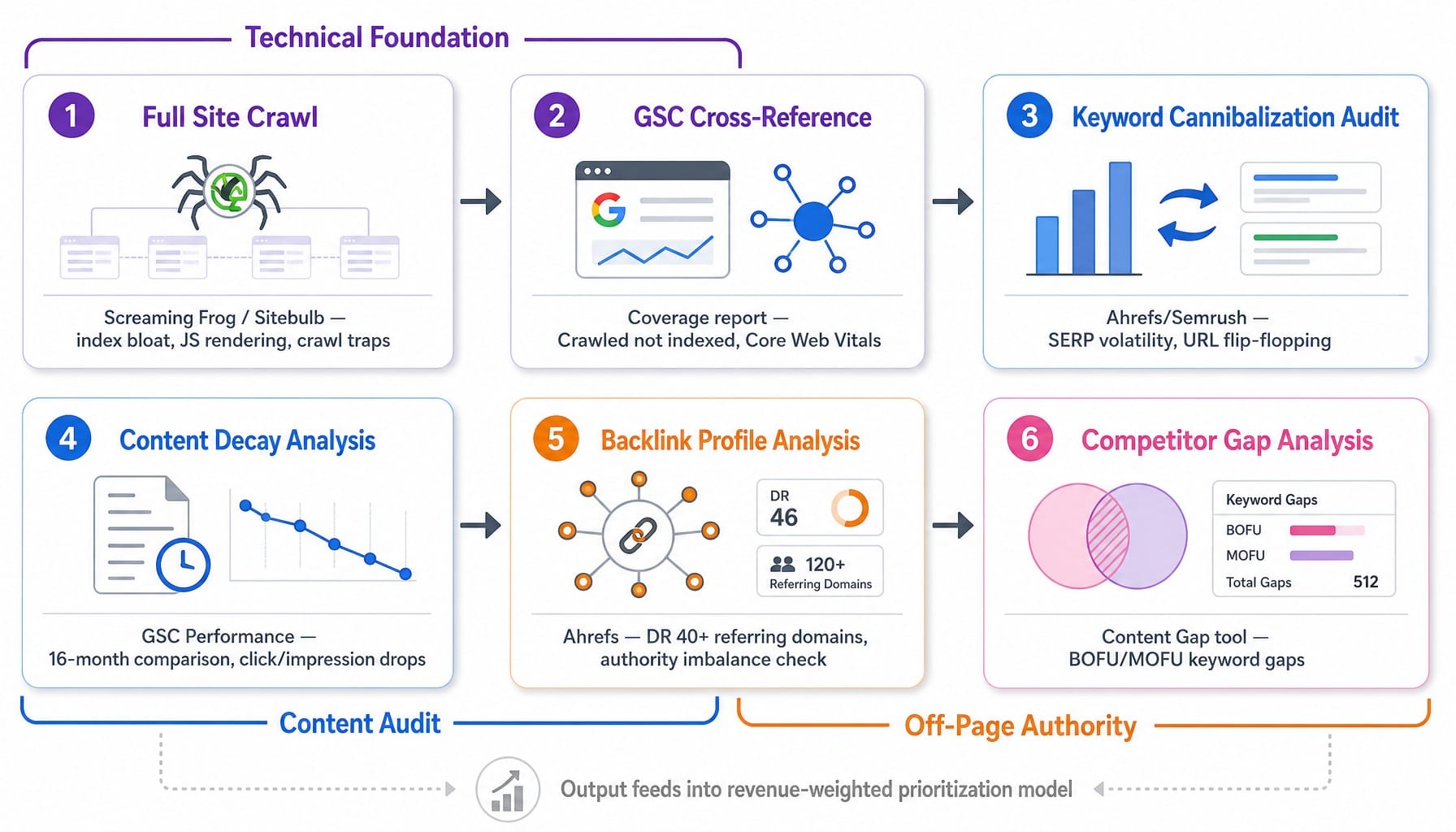
A successful audit moves sequentially. You start with the technical foundation to ensure Google can find and render your pages. Then you audit the content to see if what Google finds actually matches buyer intent. Finally, you audit off-page authority to determine if Google trusts what it sees.
According to data from Lumar (formerly Deepcrawl), the average enterprise site has 15-25% of its pages plagued by indexation issues, which underscores why the technical audit must come first. Each step below outlines the tool workflow, the common failure mode that catches most B2B teams, and the output that feeds into the revenue-weighted prioritization model that follows.
Steps 1–2: Technical Foundation — Crawlability, Indexation, and Page Experience
Step 1: Run a Full Site Crawl
Use a tool like Screaming Frog or Sitebulb to crawl your entire site. For a B2B SaaS platform, you're looking for specific issues beyond broken links. Pay close attention to index bloat from thousands of auto-generated integration or comparison pages, faceted navigation crawl traps in your resource library, and JS rendering deltas where a client-side rendered demo request form is invisible to Googlebot.
The common failure mode here is exporting the crawl's CSV and treating every "warning" row as equally important. A soft 404 on a deprecated blog post gets the same attention as an orphan page for a high-intent solution. This is where prioritization begins to break down.
Step 2: Cross-Reference with Google Search Console
Your crawl shows you what could be indexed; GSC's Coverage report shows you what Google chooses to index. Focus on the "Crawled — currently not indexed" bucket. If you see your core solution pages here, the problem is rarely a simple technical block. It's usually a signal from Google that your content is too thin or too similar to other pages on your site.
While you're at it, check Core Web Vitals with PageSpeed Insights, but be practical. For most B2B sites with moderate traffic, CWV is not the primary ranking bottleneck. If your LCP is over 4 seconds, fix it. But don't burn a sprint shaving 200ms when your entire content architecture is suffering from keyword cannibalization.
Steps 3–4: Content Audit — Cannibalization, Decay, and Intent Alignment
Step 3: Audit for Keyword Cannibalization
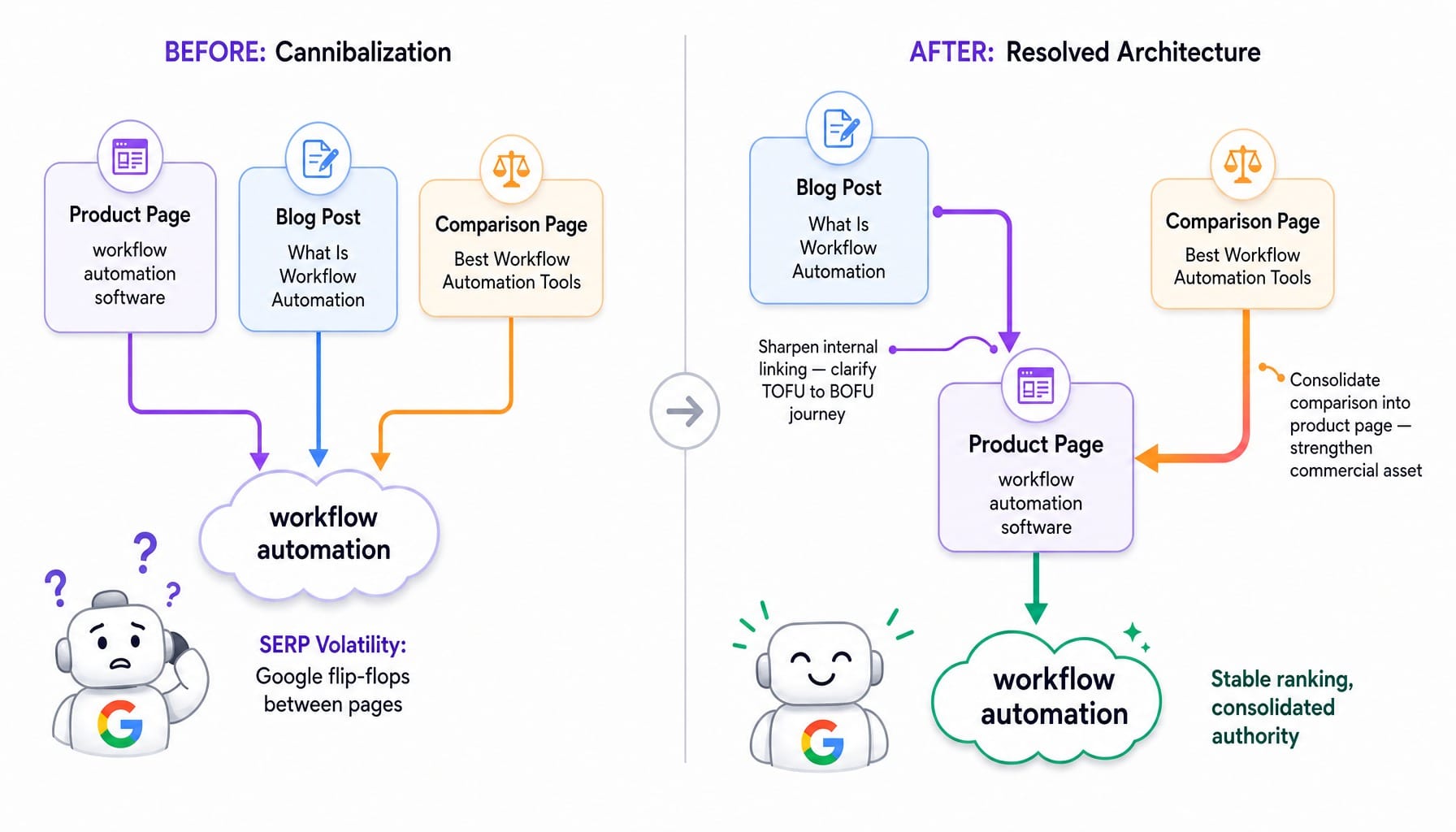
This is the single most damaging and common content issue on B2B SaaS websites. The pattern is predictable: a product page targeting "workflow automation software," a blog post titled "What Is Workflow Automation," and a comparison page titled "Best Workflow Automation Tools" all compete for the same keyword cluster, confusing Google and diluting your authority.
To detect this, use Ahrefs or Semrush. Export all URLs ranking for your target keyword cluster and look for where Google is flip-flopping between pages month-to-month—a sign of SERP volatility. The right move is almost never to just merge everything. A better approach is often to consolidate the comparison page into the product page (strengthening the commercial asset) and sharpen the internal linking from the blog post (the TOFU asset) to the product page, clarifying the user journey for Google.
Step 4: Conduct a Content Decay Analysis
Content doesn't live forever. Use GSC's Performance report, set the date range to the last 16 months, and compare performance to the prior period. Identify pages with a significant drop in clicks and impressions—these are your decay candidates. For B2B SaaS, decay is rampant on "state of the industry" reports, annual benchmarks, and integration pages where a partner's product has evolved. These pages are prime candidates for a refresh or a strategic redirect.
Steps 5–6: Off-Page Authority and Backlink Profile Analysis
Step 5: Analyze Your Backlink Profile
Using Ahrefs, audit your backlink profile with a B2B-specific question in mind: "Do we have topical authority links from sources our buyers actually trust?" Export your referring domains, filter for a Domain Rating of 40+, and categorize them: industry publications, partner sites, review platforms (like G2 or Capterra), and directories.
The most common problem you'll find is a severe authority imbalance. Many SaaS companies have a strong backlink profile pointing to their blog but almost no high-quality links pointing to their actual product, solution, or pricing pages. This imbalance signals to Google that your expertise is informational, not commercial, which can suppress rankings for your most valuable pages.
Step 6: Run a Competitor Gap Analysis
Use Ahrefs' Content Gap or Semrush's Keyword Gap tool to find high-intent keywords where two or more of your direct competitors rank but you don't. The key is to filter this analysis for bottom-of-funnel (BOFU) and middle-of-funnel (MOFU) terms. Gaps in top-of-funnel (TOFU) keywords are a lower priority unless they are part of a documented content cluster strategy. This analysis hands you a prioritized list of content to create that is already proven to attract qualified buyers in your market.
Read more: Mangools vs Semrush: Which SEO Tool Actually Fits Your Workflow in 2026?
How to Prioritize Audit Findings by Revenue Impact
An audit that produces 60 findings scored by technical severity is operationally useless. It tells you what's broken, not what's costing you money. The "critical" label from a crawler doesn't know if a page is tied to a $100k ACV sales motion or a forgotten blog post from 2018.
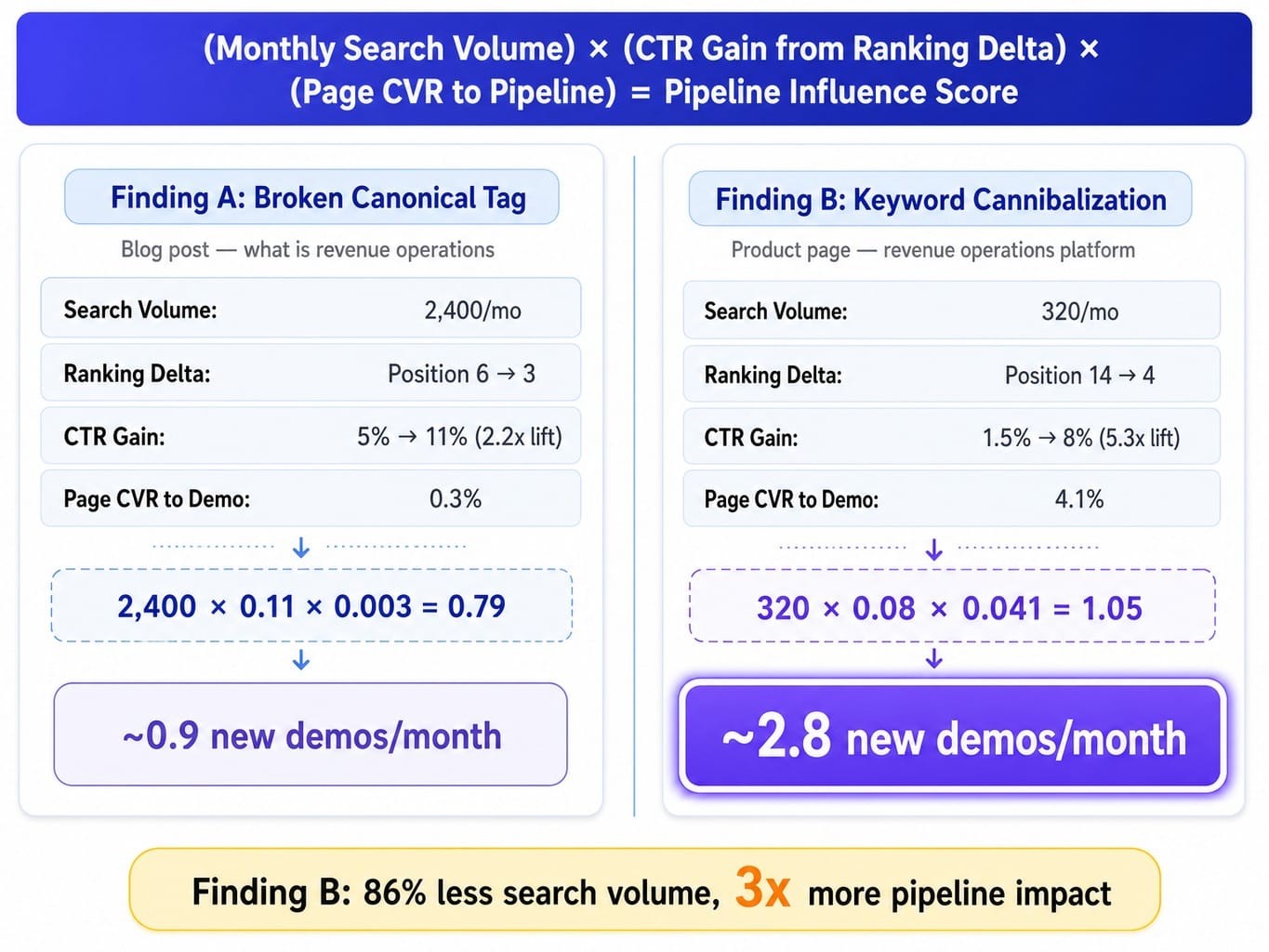
To fix this, use a simple revenue-weighted scoring model. For each finding, multiply three variables:
(Estimated Monthly Search Volume) x (CTR Gain from Ranking Delta) x (Page's Historical CVR to Pipeline)
The product gives you a rough monthly pipeline-influence score for fixing that issue.
Let's walk through a concrete example.
- Finding A: A broken canonical tag on a blog post targeting "what is revenue operations."
Volume: 2,400/mo
Ranking Delta: Position 6 -> 3 (CTR improves from ~5% to ~11%, a 2.2x lift)
Page CVR to Demo: 0.3%
Potential Pipeline Impact: ~0.9 new demos/month.
- Finding B: Keyword cannibalization between a product page and a comparison page for "revenue operations platform."
Volume: 320/mo
Ranking Delta: Position 14 -> 4 (CTR improves from ~1.5% to ~8%, a 5.3x lift)
Page CVR to Demo: 4.1%
Potential Pipeline Impact: ~2.8 new demos/month.
Finding B is over 3x more valuable to fix, despite having 86% less search volume and a less "critical" technical severity label. This is how you escape the trap of fixing things that are technically broken but commercially irrelevant.
When the Audit Is Done but the Fixes Never Ship
You now have a perfectly prioritized list. But even this has a half-life. The value of an audit decays every week it sits in a backlog. The competitive landscape shifts, algorithms update, and the opportunity cost of inaction compounds.
This is the execution gap most marketing teams can't cross. They have the right strategy but lack the shipping cadence.
Read more: Stop Syncing Strategy and Execution: Platforms That Unify Marketing Goals With Task Management
Spike AI is built to close that gap. It's not another audit tool; it's the execution layer that takes prioritized findings and gets them shipped. Every week, Spike AI's engine identifies the single highest-impact move across your SEO, content, and CRO—then deploys the fix. No engineering tickets. No agency briefs. No backlog anxiety.
That cannibalization fix with 3x the pipeline influence doesn't have to wait for the next sprint planning meeting. It gets shipped this week. Each release feeds the next prioritization cycle, turning your audit from a static PDF into a living growth system that compounds weekly.
See how Spike AI turns audit findings into weekly shipped fixes
Auditing for AI Overview Defensibility and Zero-Click Erosion
A B2B SEO audit in 2026 is incomplete if it does not evaluate how your pages perform when Google's AI Overview synthesizes answers instead of listing links. While these AI-powered summaries aren't triggered for every B2B query yet, they are increasingly common for the high-volume informational terms that feed the top of your funnel. When an AI Overview appears, studies from firms like Seer Interactive show that the #1 organic position can lose 30-60% of its clicks.
Your audit must evolve to account for this. Here are three specific actions to add to your process:
- Entity Salience Audit: Use an NLP tool or even manual analysis to check if your product pages clearly and repeatedly establish your brand and product as the primary entity in your category. If Google cannot confidently identify what your page is about in entity terms, it will not cite you.
- Passage Extractability Review: For your top 20 pages by traffic, review each H2 section. Does it open with a self-contained, declarative sentence that could be lifted directly into an AI Overview without needing the surrounding paragraphs for context? If your answers are buried three paragraphs deep, your content is structurally uncitable.
- SERP Feature Ownership Mapping: Use a tool like Semrush to identify which of your target keywords already trigger AI Overviews, Featured Snippets, or "People Also Ask" boxes. Are you owning any of them? The gap between what's available and what you own is your immediate AEO opportunity.
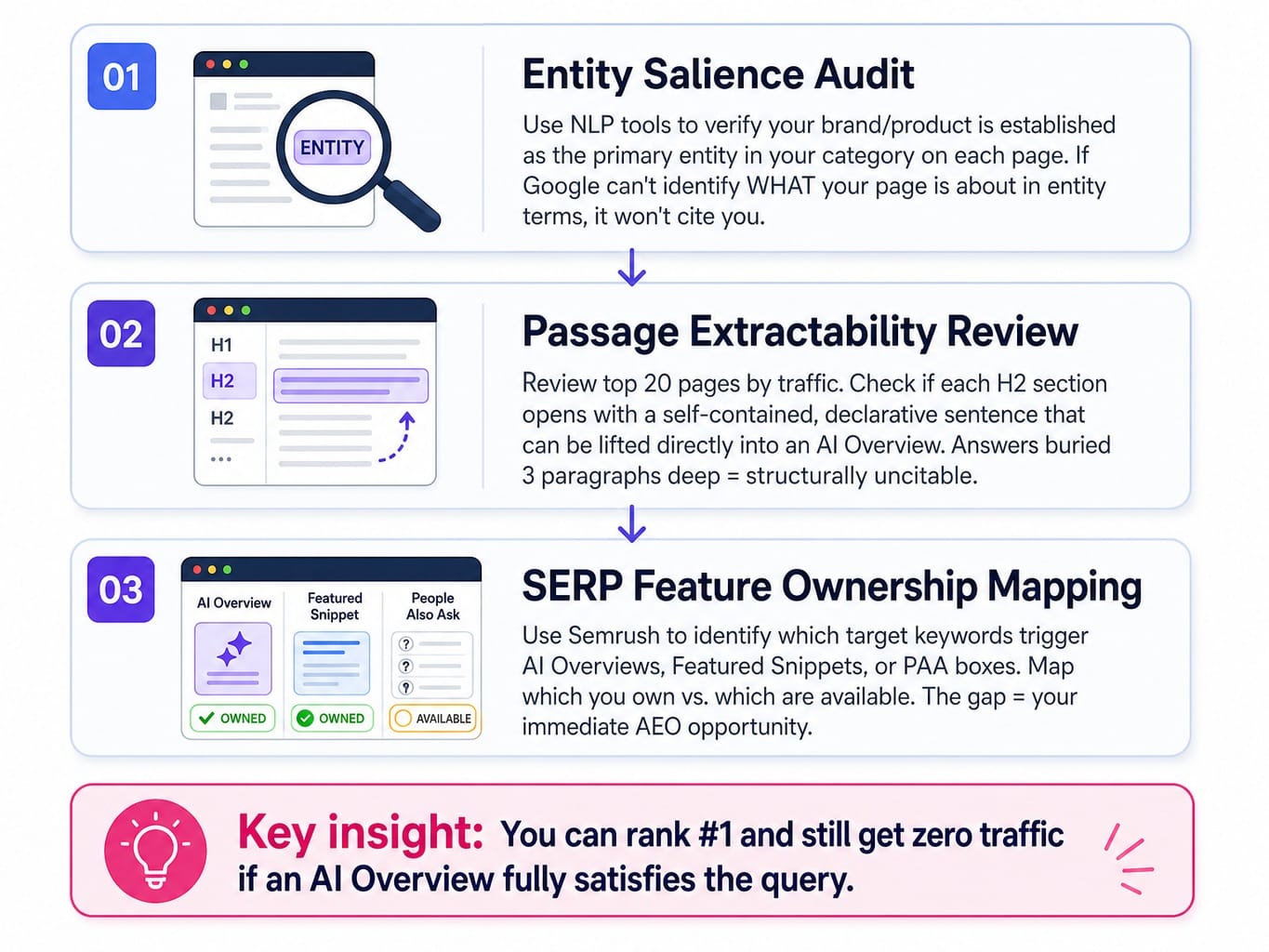
Traditional rank tracking is no longer enough. You can rank #1 and still get zero traffic if an AI Overview fully satisfies the user's query.
The Real Bottleneck Isn't the Audit
The B2B SEO audit is a solved problem. Dozens of tools can crawl your site, flag your errors, and export a spreadsheet. That part is easy.
What separates teams that grow organic pipeline from teams that produce quarterly audit decks is two things: a system for scoring findings by revenue impact instead of technical severity, and a relentless shipping cadence that turns those findings into deployed fixes before the market shifts.
If your last audit produced more than 30 findings and you shipped fewer than 10 of them within 30 days, the audit wasn't the problem. The execution system around it was.
Frequently Asked Questions
How often should a B2B SaaS company run a full SEO audit?
A full technical crawl and content audit should run quarterly, but your prioritization layer should update monthly as rankings shift. Teams that audit annually are working with stale data; cannibalization and content decay can emerge within 60 days. The exception is post-migration: run a full audit within 72 hours of a domain move or replatform, and again at 30 days.
How should a B2B SEO audit handle gated content behind login walls?
Gated content requiring authentication is invisible to Googlebot. Audit the ungated preview page to see if it has enough substance to rank on its own—most don't. The best fix is often to ungate the first 30-40% of the asset as indexable HTML, preserving both SEO value and lead capture by keeping the full download behind a form.
What schema types matter most for B2B SaaS websites during an audit?
Prioritize FAQPage schema on product and pricing pages, Article schema on blog content, and Organization schema with sameAs references to your LinkedIn and G2 profiles to strengthen entity recognition. SoftwareApplication schema is also relevant. But don't over-invest here; schema improves SERP appearance but won't fix thin content or weak authority.
What crawl budget issues are unique to B2B SaaS platforms with dynamic pages?
SaaS platforms that auto-generate thousands of integration or comparison pages often create near-duplicate URLs that consume crawl budget without adding value. Check Screaming Frog's "Near Duplicates" report and GSC's crawl stats for pages with high crawl frequency but zero impressions. The fix is usually a mix of noindex tags and consolidating thin pages into a richer hub.
How do you measure the ROI of fixing issues found in a B2B SEO audit?
Track three metrics per fix: ranking change on the target keyword, organic click delta on the affected page in GSC, and downstream pipeline attribution from your CRM. The mistake is measuring only traffic, which ignores whether the fix moved revenue-relevant pages. Use a tool like Google Looker Studio to connect GSC data to CRM lead sources.