Best B2B SaaS Marketing Campaigns in 2026: What Separates Pipeline from Noise
TLDR
- The best B2B SaaS campaigns are not creative moments; they are repeatable execution systems designed to generate pipeline.
- High-performing campaigns are architected for buying committees, not individual leads, and deliberately layer both demand capture and demand creation motions.
- The unifying pattern behind top campaigns is a shift from calendar-based launches to always-on, signal-based orchestration that responds to buyer behavior in real-time.
- Most marketing teams fail to replicate these campaigns not due to a lack of strategy, but because of an execution gap—the human bandwidth required to ship at the necessary cadence.
- The highest-ROI campaigns you're likely ignoring are customer expansion (driving NRR) and competitive displacement (redirecting existing demand).

Most articles about the "best B2B SaaS marketing campaigns" celebrate the wrong thing. They highlight a clever video, a viral stunt, or a celebrity-hosted podcast, but quietly ignore whether the campaign actually moved the pipeline. Every listicle published since 2018 recycles the Dropbox referral program or Slack's freemium model—neither of which is a replicable campaign for a three-person marketing team with a real budget.
The campaigns worth studying in 2026 are not the ones that won awards. They are the ones designed as repeatable execution systems that compound over time. They don't just target a single persona; they are architected to influence the entire buying committee. They orchestrate across channels simultaneously, not sequentially. And they are built to run continuously, not as one-off launches that lose momentum after two weeks.
This isn't another list of creative ideas. It's a breakdown of campaign architectures that work. We'll dissect six real examples, not for their creative flair, but for their execution mechanics. You will see the system-level pattern that connects them and understand the one constraint that prevents most teams from shipping them.
What Actually Separates Pipeline-Generating Campaigns from Noise
Before looking at examples, we need a better evaluation framework. High-impact campaigns are not a monolith. They are purpose-built systems designed for a specific job. Most underperforming campaigns fail because they are built on a flawed or incomplete architecture from the start. Two distinctions matter more than any other: understanding the job to be done and knowing who you're building for.
Demand Capture vs. Demand Creation: Most Teams Only Run One
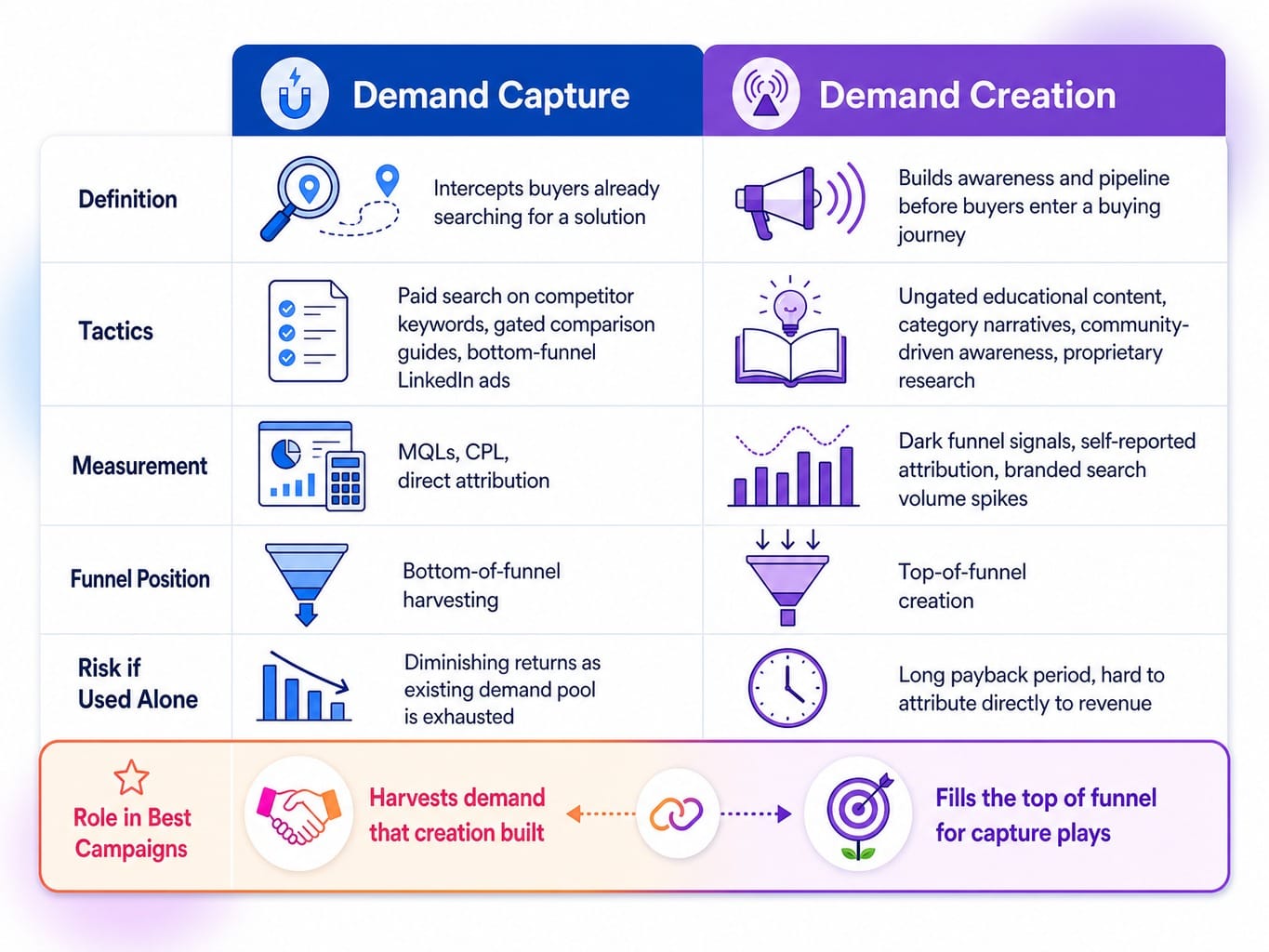
Most B2B SaaS campaigns are demand capture disguised as demand creation. A team runs paid search on competitor keywords, gates a comparison guide, and calls it a "campaign." But they are only intercepting buyers who already know they have a problem and are actively looking for a solution. This is a critical function, but it is not a growth strategy. It is harvesting demand that already exists.
Demand creation campaigns—ungated educational content, category narratives, community-driven awareness—build the pipeline that demand capture later harvests. A CRM startup spending its entire budget on bottom-funnel LinkedIn ads will see diminishing returns because they never invested in creating new demand upstream. The best campaign portfolios layer both motions deliberately. They measure demand creation's impact not through MQLs, but through the dark funnel—tracking signals via self-reported attribution and spikes in branded search volume—and understand that it's the engine that fills the top of the funnel for their capture-focused plays.
Read more: How to Prioritize Marketing Channels With a Limited Budget And Resources (Framework for Lean Teams)
Campaigns Built for Buying Committees, Not Individual Leads
Enterprise and mid-market SaaS deals involve, on average, 6-10 stakeholders. Yet most campaigns are still designed to convert a single persona. An MQL is generated, an SDR qualifies them, and only then does the sales team begin the slow work of mapping the rest of the account.
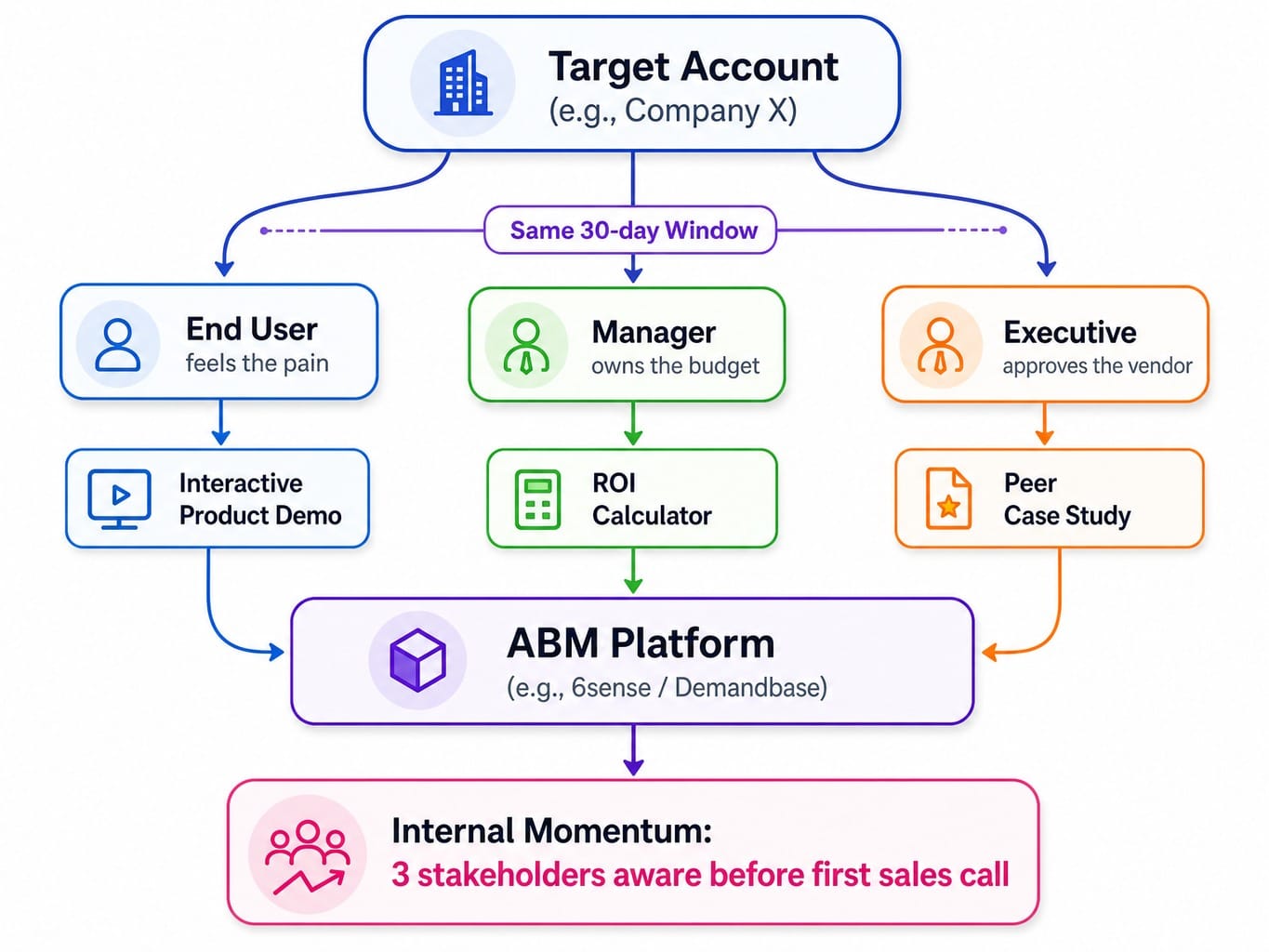
The best B2B SaaS campaigns in 2026 are architected to reach the entire buying committee simultaneously. Imagine an Account-Based Marketing (ABM) campaign that serves different assets to different roles at the same target account within the same 30-day window. The end user who feels the pain sees a technical, interactive product demo. Their manager, who owns the budget, is targeted with an ROI calculator. The executive who approves the vendor sees a peer case study from a similar-sized company. This isn't three separate campaigns; it's one coordinated, surround-sound strategy orchestrated by a platform like 6sense or Demandbase. The goal is not to generate a single lead but to create internal momentum within the account, so that when the first sales call happens, three people in the room have already heard of you.
Six B2B SaaS Campaigns Worth Reverse-Engineering
The following campaigns are not famous for being viral. They are notable because their underlying architecture is sound, replicable, and designed for pipeline impact. Each one demonstrates a system-level principle that separates it from the noise.
Navattic: Interactive Demos Replacing Gated Content as the Primary Conversion Asset
- What they did: Companies using tools like Navattic and Storylane are systematically replacing their bottom-of-funnel (BOFU) gated PDFs with interactive product demos embedded directly on campaign landing pages. Instead of asking for an email in exchange for a whitepaper, they offer immediate, hands-on access to a guided version of their product.
- Why it worked structurally: This mechanic shortens the sales cycle by letting prospects self-qualify. It answers the buyer's most critical question—"Will this actually work for me?"—before they ever talk to sales. This dramatically increases the MQL-to-SQL conversion rate because the leads who do raise their hand have already confirmed the product's relevance to their problem. It moves the "product discovery" phase from the first sales call to the first website visit.
- The transferable principle: The most valuable BOFU asset in 2026 is not a 20-page PDF. It's a guided product experience that provides instant value and proves the product's capability without requiring a 30-minute demo call.
Read more: Landing Page Conversion Rate Optimization: A Revenue-Weighted Playbook
Gong: Content-Led Demand Creation That Owns an Entire Category Conversation
- What they did: Gong's content engine didn't just target the "revenue intelligence" category; it created it. Their campaign architecture is a masterclass in demand creation, combining proprietary data reports (analyzing millions of anonymized sales calls), completely ungated research, and a top-ranking podcast.
- Why it worked structurally: By publishing original data that no competitor can replicate, Gong established an information moat. They became the default citation source for an entire topic cluster, feeding both their long-term SEO/AEO visibility and creating massive dark-funnel brand awareness. Journalists, analysts, and other content creators reference Gong's data, giving them authoritative backlinks and mentions without a single outreach email. This is not "content marketing"; it's a data-driven thought leadership campaign.
- The transferable principle: The highest-ROI demand creation campaigns are built on proprietary data or a unique point of view that competitors cannot easily copy. Commodity content gets commodity results.
Loom: ABM with Personalized LinkedIn Ads That Reached the Whole Account
- What they did: Loom ran hyper-personalized LinkedIn ABM campaigns that dynamically inserted a target account's logo directly into the ad creative. This wasn't a single ad but a coordinated surround-sound play, hitting multiple stakeholders within the same hand-picked accounts simultaneously.
- Why it worked structurally: Personalization at the account level, not just the individual level, triggers pattern recognition and creates internal conversation. When three people at the same company see an ad with their own logo on it in the same week, it creates the illusion of inevitability. According to data from Metadata.io, which powered the campaign, this approach yielded CTRs of 2-3.5% and CPCs of $4-$10—significantly outperforming generic B2B LinkedIn benchmarks. It's the difference between running ads at an account and orchestrating a conversation within an account.
- The transferable principle: The most effective ABM campaigns create a feeling of "we're seeing this everywhere" inside a target account, turning cold outreach into a warm conversation.
Common Room: Community Signals as the Campaign Targeting Backbone
- What they did: Common Room built its go-to-market motion around community-led signals. Instead of starting with a list buy or third-party intent data, their campaigns are triggered by first-party engagement data from sources like Slack communities, GitHub repositories, and Discord servers. They track who is asking relevant questions, contributing to projects, or engaging with peers, then use those signals to trigger targeted ad campaigns and outbound sequences.
- Why it worked structurally: In a post-cookie world where third-party data is becoming less reliable, first-party behavioral signals are gold. Community engagement is a high-fidelity indicator of interest and pain that precedes a formal buying journey. This signal-based marketing approach allows them to engage prospects based on their actual behavior, not just their firmographic profile. Tools like Clay can then be used to enrich these signals for hyper-personalized outreach.
- The transferable principle: Your best campaign targeting data isn't on a vendor's platform; it's in the communities where your ideal customers are already talking about their problems.
Klue: Competitive Displacement Campaigns That Turn Competitor Customers into Pipeline
- What they did: Klue, a competitive intelligence platform, runs structured competitive displacement campaigns. They don't just create generic "Klue vs. Competitor X" pages. They launch coordinated campaigns targeting users of specific competitors with battle cards, "switch" landing pages, and tailored ad messaging, often timed to coincide with a competitor's price increase, product sunset, or wave of negative G2 reviews.
- Why it worked structurally: This campaign architecture targets the most capital-efficient segment imaginable: buyers who are already product-aware, budget-approved, and actively dissatisfied with their current solution. Instead of spending resources creating new demand from scratch, Klue focuses on redirecting existing demand. This results in a much higher pipeline velocity and lower cost-per-opportunity compared to traditional top-of-funnel campaigns.
- The transferable principle: Your competitor's unhappy customers are your highest-intent leads. A dedicated competitive displacement campaign is one of the highest-leverage plays a B2B SaaS marketer can run.
Gainsight: Customer Expansion Campaigns as the Highest-ROI Play Most Teams Ignore
- What they did: While most "best campaign" lists focus exclusively on new logo acquisition, Gainsight has operationalized customer expansion. They run structured campaigns targeting their existing customer base, using product usage data as the trigger. When an account hits a certain feature adoption threshold or seat utilization rate, it automatically triggers a personalized sequence about upgrading to a higher tier or adding a new product module.
- Why it worked structurally: Acquiring a new customer is 5-25 times more expensive than retaining an existing one. Expansion revenue has a near-zero customer acquisition cost (CAC). For SaaS companies, a Net Revenue Retention (NRR) rate above 120% is one of the strongest predictors of high valuation. Gainsight's campaigns directly target this metric, turning the marketing function into a profit center, not just a cost center.
- The transferable principle: If your marketing team's mandate and campaign portfolio are 100% focused on net-new acquisition, you are leaving the highest-ROI pipeline on the table.
The Pattern Behind the Best Campaigns: Signal-Based Orchestration Replacing Static Segmentation
Every campaign above shares a structural trait that separates it from a traditional marketing plan: they are triggered by signals, not schedules.
Loom's ABM campaign doesn't fire on the first of the month; it fires when an account shows a specific pattern of engagement. Gainsight's expansion play isn't part of a "Q3 upsell push"; it's an always-on system that triggers when product usage data indicates readiness. This is a fundamental departure from how most B2B SaaS teams operate, with their quarterly planning cycles, static audience lists, and calendar-driven launches.
The best campaigns in 2026 are not "campaigns" at all. They are continuous orchestration systems that detect signals, match them to the right message and channel, and execute immediately.
Consider a mid-market SaaS team that replaces its quarterly "big push" with a signal-based system. They monitor intent signals from a platform like 6sense, community engagement from Common Room, and product usage data from their own backend.
- Signal: A target account's employees suddenly research a competitor. → Response: Trigger a competitive displacement ad on LinkedIn.
- Signal: An engineer at a prospect company asks a relevant technical question in a public Slack community. → Response: Add them to a low-touch, high-value content sequence.
- Signal: A current customer uses a specific feature 10 times in one week. → Response: Trigger an in-app notification about an advanced use case for that feature.
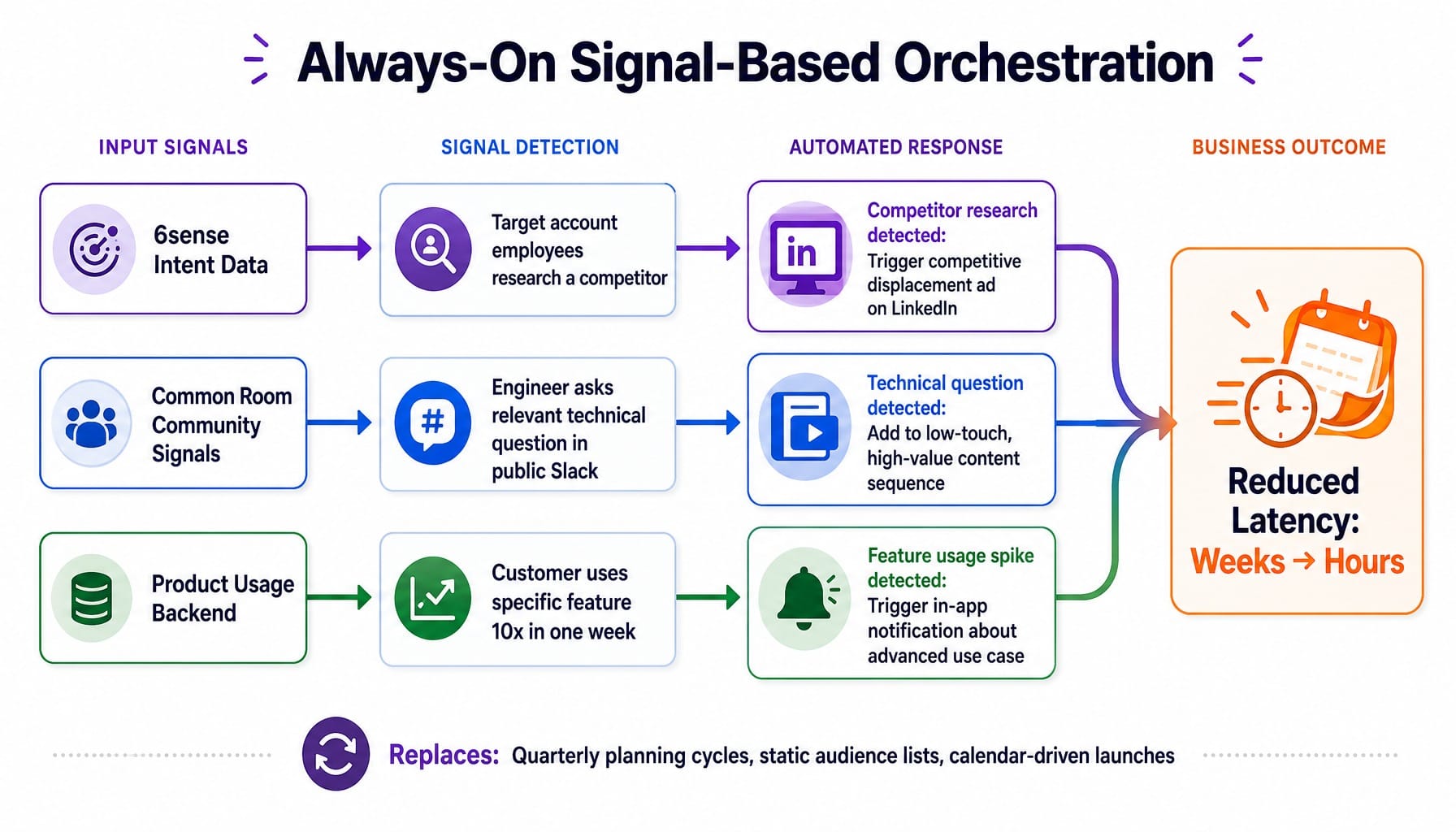
The team's pipeline velocity increases not because their creative got better, but because the latency between a buyer's signal and their response dropped from weeks to hours. The competitive advantage has shifted from creative quality to execution speed.
Why Most Teams Cannot Replicate These Campaigns—and What Actually Needs to Change
The logic behind these campaigns is not complex. Any competent marketing leader can read these examples and understand the strategy. The problem is not a lack of ideas; it's a lack of execution bandwidth.
A three-person marketing team at a $10M ARR SaaS company cannot simultaneously run signal-based ABM, maintain a proprietary research engine, build interactive product demos, and orchestrate competitive displacement sequences. They know the playbook. They simply cannot ship it.
Think of a Head of Growth who identifies three high-impact campaign improvements in their January planning session. By the end of March, one is partially launched, another is stuck waiting for engineering resources, and the third is still a bullet point in a Google Doc. The team was buried in the day-to-day work of writing blog posts, managing social media, and updating landing pages.
The real constraint is not strategic clarity. It's the latency between identifying what needs to be done and actually shipping the change. Every week that a high-impact website optimization or landing page fix sits in a backlog is compounding opportunity cost. The knowledge of what to do is useless without a system to execute it.
What Changes When Execution Runs Continuously Instead of Quarterly
The core tension is clear: the best campaigns are always-on, signal-driven execution systems, but lean marketing teams are bottlenecked by human bandwidth, creating a painful gap between insight and action.
This is not a strategy problem; it's a shipping problem. Spike AI is designed to close that gap. It functions as a marketing execution engine that turns your backlog of optimizations into a weekly release cycle.
Instead of waiting for quarterly pushes, Spike AI continuously identifies the highest-impact move across your website, SEO infrastructure, or landing pages, and then executes it. This isn't just about diagnostics; it's about deployment. While your team focuses on the high-level campaign strategy and creative—the "what" and "why"—Spike AI handles the relentless, continuous optimization of the foundational assets all campaigns depend on. It applies the same "always-on" principle of the best campaigns to your core conversion funnels. This is how you close the gap between knowing what high-impact campaigns look like and having the execution velocity to build the foundation for them.
See how Spike AI turns your marketing backlog into weekly shipped improvements
The Shift from Creative Moments to Execution Architecture
The campaigns that generate real pipeline in 2026 are not defined by their creative brilliance or budget size. They are defined by their execution architecture. They are signal-driven, buying-committee-aware, and designed as continuous systems, not one-off launches.
We've redefined "best" as pipeline impact, dissected six campaigns that embody that definition, and identified the unifying pattern of signal-based orchestration. We've also diagnosed the core reason most teams can't replicate them: a bottleneck in execution bandwidth, not a failure of strategy.
The gap between the teams that study great campaigns and the teams that ship them is not insight. It's execution velocity. The critical question for your team is no longer "Which campaign should we run?" but "How do we build a system that can actually ship the one we already know we need?"
Frequently Asked Questions
How do you measure the ROI of a B2B SaaS marketing campaign when deals take months to close?
Use multi-touch attribution models (like W-shaped in HubSpot) to assign credit across the journey, but supplement it with self-reported attribution ("How did you hear about us?") to capture dark funnel influence. Measure campaign influence on pipeline generated and pipeline velocity, not just MQLs or CPL. When deal cycles are 90+ days, lead-based metrics are misleading.
What budget allocation works best for multi-channel B2B SaaS campaigns?
There is no universal split. Allocation should follow signal density: invest more where you can detect and act on high-intent signals (e.g., paid search on competitor terms, targeted LinkedIn ABM) and less where measurement is opaque. A common framework for mid-market SaaS is 40% demand capture, 30% demand creation, 20% customer expansion, and 10% experimentation, adjusted quarterly based on pipeline source data.
How do you run an effective ABM campaign with a small marketing team and limited budget?
Focus on a narrow, high-fit account list (25-50 accounts, not 500). The bottleneck for small teams is coordination, not budget. Run one highly coordinated play per quarter against that tight list using tools like Clay for enrichment and LinkedIn for delivery. Achievable personalization at the account level (e.g., using the company's industry in copy) is more effective than trying to personalize for 500 individuals.
What role does ungated content play in B2B SaaS campaigns compared to gated assets?
Ungated content drives demand creation by maximizing reach and building trust before a buyer enters a sales process. Gated content captures existing demand by exchanging high value for contact info. In 2026, high-performing teams use ungated content for top-of-funnel awareness and reserve gating for BOFU assets like interactive demos or ROI calculators—not generic whitepapers that could have been a blog post.
How do signal-based campaigns differ from traditional lead scoring in B2B SaaS?
Lead scoring assigns points for actions (e.g., downloaded PDF = 10 points) and triggers a generic sales handoff at a threshold. Signal-based campaigns are different; they detect specific behavioral patterns across multiple sources (community engagement, intent data, product usage) and trigger a specific, context-aware response matched to that signal—not just a "sales-ready" flag. It's about responding to context, not just activity volume.