BrightEdge Pricing Breakdown: Enterprise Costs, Modules & What to Negotiate
TL;DR
- Real Cost: BrightEdge pricing typically ranges from $25,000 to $150,000+ per year. Mid-market deals often land near $50,000, while full enterprise deployments exceed $100,000.
- Total Cost of Ownership: The platform license is only 40-60% of the true cost. A $50K license requires a dedicated analyst (another $90K+) to operate, making it a $140K+ annual program, not a $50K tool.
- Key Negotiation Levers: Your price is determined by tracked keywords, domains, user seats, and licensed modules. Right-sizing your keyword universe before the sales call is your single biggest point of leverage.
- Base vs. Add-On: The base license is a powerful rank tracker, but the AI-driven features shown in demos (DataMind, ContentIQ, Autopilot) are premium add-on modules that can double the cost.
- The Shelfware Problem: Many teams over-provision keywords or get bundled into modules they don't use. Auditing actual feature utilization before renewal is critical to avoid paying for shelfware that pads the vendor's profit margin.
You search for "BrightEdge pricing" and land on their website, only to be met with a "Request a Demo" form. It's a familiar frustration. Every third-party source offers a different number—$21K, $50K, $119K—with no context for the massive variance or where your company might fall.
This isn't an accident. BrightEdge, like most enterprise SaaS platforms, uses a custom-quote model deliberately designed to maximize deal size based on perceived value. The buyer who walks into a sales call uninformed will pay more than the buyer who understands the pricing architecture.
This article provides the straight answer. We'll break down what BrightEdge actually costs based on aggregated market data, what drives your specific price up or down, what's included versus what costs extra, the hidden fees to expect, how it compares to real competitors, and how to negotiate your contract.
What BrightEdge Actually Costs in 2026
Based on aggregated procurement data and user reports, BrightEdge typically costs between $25,000 and $150,000+ per year. The median annual contract value (ACV) for a mid-market deployment hovers around $50,000, while large enterprises with multiple domains and full module access can expect to pay $100,000 to $150,000 or more.
Why the wide range? It's not one product at one price. BrightEdge is a modular platform where cost scales with several variables: the volume of keywords you track, the number of domains you manage, your user seat count, and which premium modules you license.
Market data provides useful reference points. Vendr reports a median of $50,000 from 44 transactions, with most deals falling between $42K and $69K. SpendHound's analysis of 32 customers shows a split, with an average of $21,000 for SMBs and $119,000 for enterprises. While the sample sizes are small, they confirm the general range.
Let's make this concrete with two scenarios:
- Mid-Market SaaS: A company tracking 5,000 keywords across one primary domain with three users on the core platform might pay $30,000 - $50,000 per year.
- Global Enterprise: A retailer tracking 50,000 keywords across 15 country-specific domains with ten users and full access to DataMind, ContentIQ, and Autopilot could easily see a contract of $150,000+ per year.
A few things are certain: BrightEdge does not offer monthly billing. Contracts are annual minimum, with multi-year commitments often required to unlock discounts. There is no free tier, no self-serve plan, and no public pricing page. Every deal is a custom negotiation.
What Drives Your BrightEdge Price Up or Down
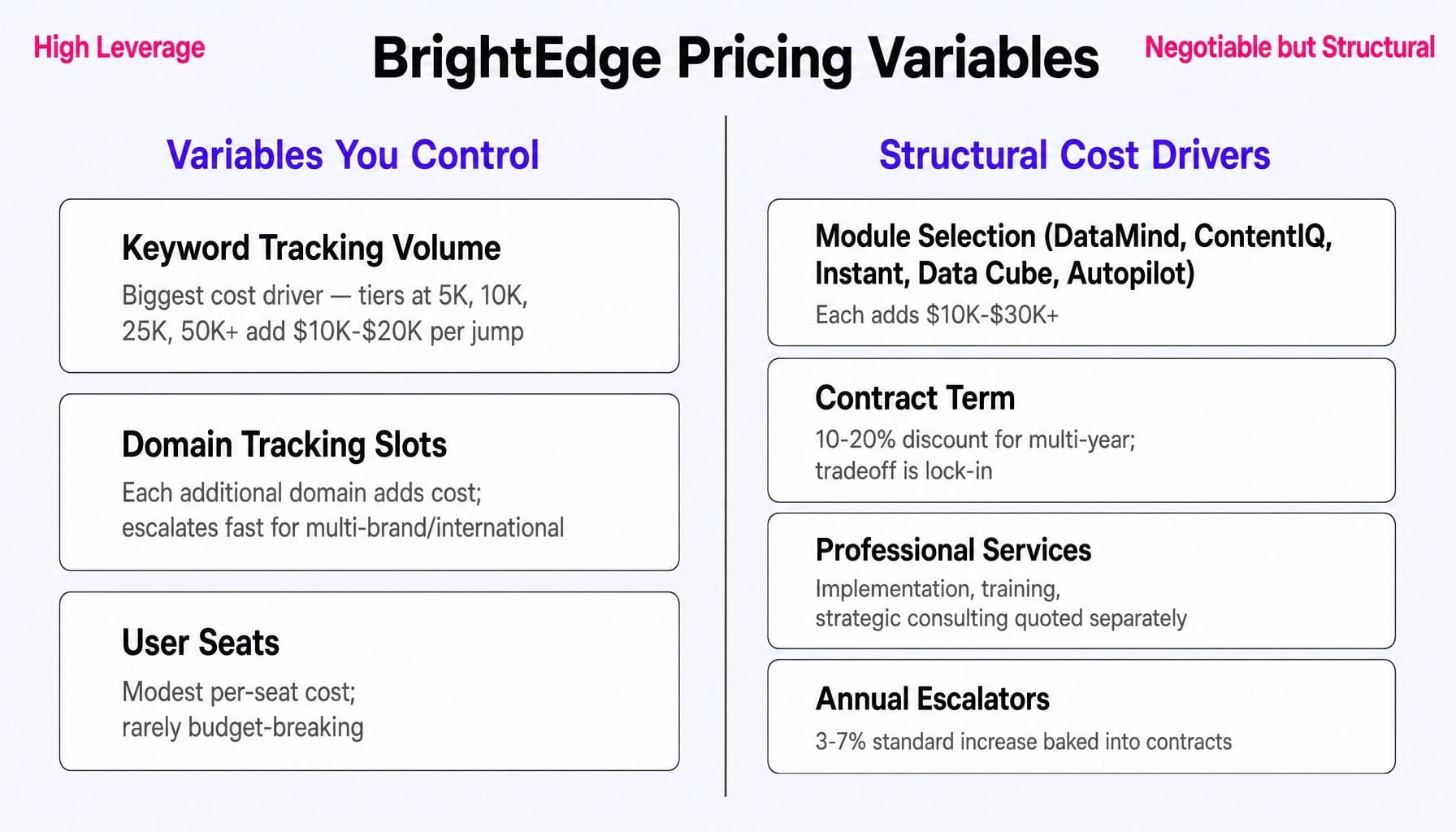
Your final BrightEdge cost is determined by a handful of variables. Think of this as your pricing calculator—understanding these levers is the first step to controlling your ACV. They fall into two categories: variables you can directly control during negotiation and structural drivers that are harder to change.
Variables You Control: Keywords, Domains, and Seats
These are the three primary scaling factors you can directly influence before and during a negotiation.
- Keyword Tracking Volume: This is the single biggest driver of your BrightEdge cost. The platform is priced in tiers (e.g., 5,000, 10,000, 25,000, 50,000+ keywords), and jumping from one tier to the next can add $10,000-$20,000 to your annual bill. The biggest mistake teams make is over-provisioning. You might request tracking for 25,000 keywords but only actively build reports and strategy around 8,000. That 17,000-keyword gap is pure platform shelfware you're paying for.
- Domain Tracking Slots: Each additional domain you track adds cost. For companies managing a portfolio of brands or numerous international ccTLDs, this is where pricing can escalate quickly. For agencies, the cost to manage multiple client domains on the platform can become prohibitive without a specific agency-focused plan.
- User Seats: BrightEdge uses a standard seat-based licensing model. While each seat has a cost, the per-seat price is relatively modest compared to the impact of keyword and domain volume. It's a factor, but it's rarely the one that breaks the budget.
The most practical advice is to right-size your keyword universe and domain count before your first sales call. Know exactly what you need, because these are the levers with the most pricing impact.
Structural Cost Drivers: Modules, Contract Length, and Services
These variables are part of the deal structure and often used by sales teams to increase ACV, especially at renewal.
- Module Selection: The core platform—rank tracking, keyword research, competitive analysis—is the base. The real cost escalation comes from bolt-on modules. DataMind (AI insights), ContentIQ (technical auditing), Instant (real-time trends), and Data Cube (API access) can each add $10,000-$30,000 or more to your contract. Sales teams often bundle these into SKU packages to increase the deal size.
- Contract Term: An annual contract is standard. You can often secure a 10-20% discount by signing a multi-year (two or three-year) deal. The obvious tradeoff is vendor lock-in and reduced flexibility if your needs change or the platform underperforms.
- Professional Services: Implementation, training, and ongoing strategic consulting are almost always quoted separately from the platform license. A dedicated Customer Success Manager (CSM) may be included in top-tier enterprise contracts, but for most, the CSM-to-account ratio is high, and meaningful strategic support requires a paid professional services engagement.
Read more: SaaS Pricing Strategy That Compounds: Models, Value Metrics, and Governance for 2026 | Spike AI
What's Included in the Base License vs. What Costs Extra
A common buyer mistake is assuming the demo they saw reflects the product they're buying. With BrightEdge, the slickest features—AI-powered recommendations, automated site audits, real-time opportunity detection—are often premium modules not included in the base license.
Imagine signing a $45,000/year contract expecting the full suite of content optimization capabilities, only to discover that ContentIQ (for technical audits) and Copilot (for AI content creation) are separate add-ons. The "real" cost to get the functionality you evaluated during the sales process is actually $65,000. Understanding this module architecture is critical for procurement planning.
Core Platform: What You Get at the Base Price
The standard BrightEdge license provides a solid foundation for enterprise-level monitoring and competitive intelligence. Typically, this includes:
- Keyword Research & Rank Tracking: The core functionality of tracking your keyword performance against competitors.
- Competitive Analysis: Share of voice (SOV) reporting, competitor discovery, and market-level trend analysis.
- On-Page Recommendations: Basic recommendations for content optimization based on tracked keywords.
- StoryBuilder Dashboards: The platform's customizable reporting interface for building and sharing performance dashboards.
- Standard Integrations: Connectivity with Google Analytics 4, Google Search Console, and Adobe Analytics.
This base package is a powerful enterprise rank tracker. It tells you where you stand. However, it offers limited guidance on why you're standing there or what to do next. That intelligence is housed in the premium modules.
Premium Modules: DataMind, ContentIQ, Instant, Data Cube, and Autopilot
This is where the bulk of the platform's advanced capabilities—and costs—reside.
- DataMind: BrightEdge's AI engine that provides anomaly detection, predictive insights, and automated opportunity identification. It's often bundled at the highest enterprise tiers but is a significant upsell for mid-market customers.
- ContentIQ: The technical site auditing module. It functions like an enterprise-grade crawler, identifying technical SEO issues across your site. Pricing scales with crawl limits and the number of pages audited.
- Instant: Provides real-time search trend data, particularly for mobile and local intent. Useful for agile content teams, but an add-on for most license tiers.
- Data Cube: The gateway to advanced data and API access. If you need to export bulk data or feed BrightEdge metrics into internal BI tools, you'll need to license Data Cube. API access tiers are a common source of overage billing.
- Autopilot: The newest and most aggressively upsold module, positioned as an SEO automation layer that can implement changes directly.
- AI Catalyst & Copilot: Newer additions focused on AI search visibility and content generation. Pricing for these is less standardized and highly negotiable.
The "full suite" BrightEdge experience shown in demos can easily cost two to three times the price of the core platform alone.
Hidden Costs Beyond the BrightEdge Platform Fee
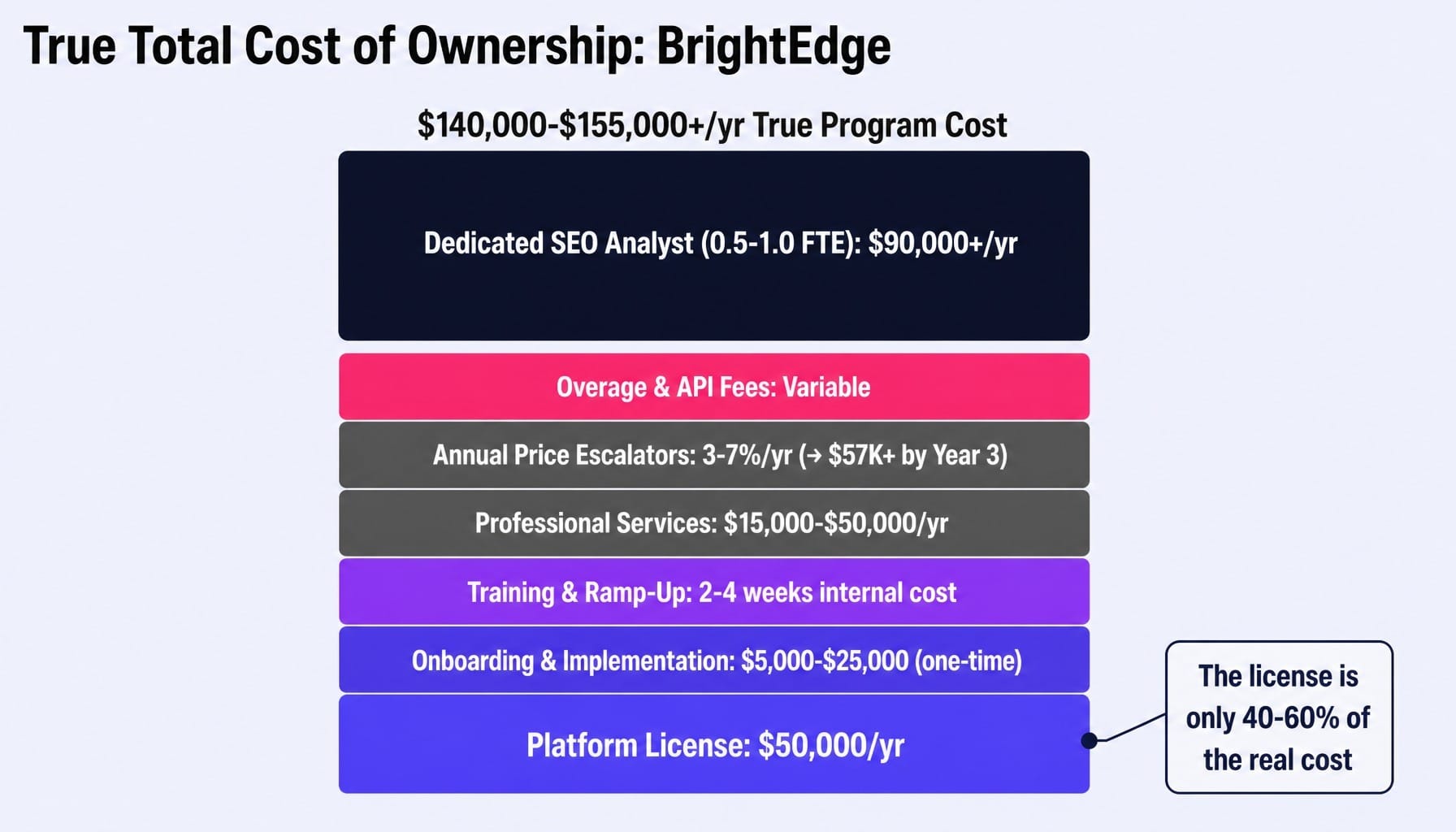
The license fee on your contract is only 40-60% of the true cost of running BrightEdge. The rest of your investment comes from implementation fees, annual price hikes, and, most significantly, the internal headcount required to make the tool produce any value.
- Onboarding & Implementation: Expect a one-time fee of $5,000 - $25,000, depending on the complexity of your setup. This is sometimes waived on multi-year deals as a negotiation tactic.
- Training & Enablement: BrightEdge is a complex platform. Even if the vendor provides training, plan on 2-4 weeks of your team's time for ramp-up. This is a real internal cost.
- Professional Services: If you want a BrightEdge strategist to help you interpret the data and build a roadmap, budget an additional $15,000 - $50,000 per year.
- Annual Price Escalators: Standard contracts include a 3-7% annual price increase. Your $50K contract automatically becomes over $57K by year three without adding a single feature.
- Overage Billing: Exceeding your limits on tracked pages, Data Cube queries, or API calls can trigger expensive overage fees.
- True-Up Clauses: Some contracts contain clauses that allow the vendor to adjust your price mid-term if your usage dramatically exceeds what was projected during the sale.
- Data Export & API Fees: As mentioned, higher-tier API access for feeding data into your own systems is often a separate, costly line item.
But the biggest hidden cost, the one no sales rep will mention, is this: BrightEdge requires at least 0.5 to 1.0 FTE of a skilled SEO practitioner to operate effectively. The platform generates data and recommendations; it does not interpret them, prioritize them against business goals, or implement them.
A $50,000 platform that requires a $90,000 analyst to run is really a $140,000 program. This total cost of ownership is the only number that matters.
How BrightEdge Pricing Compares to Real Alternatives
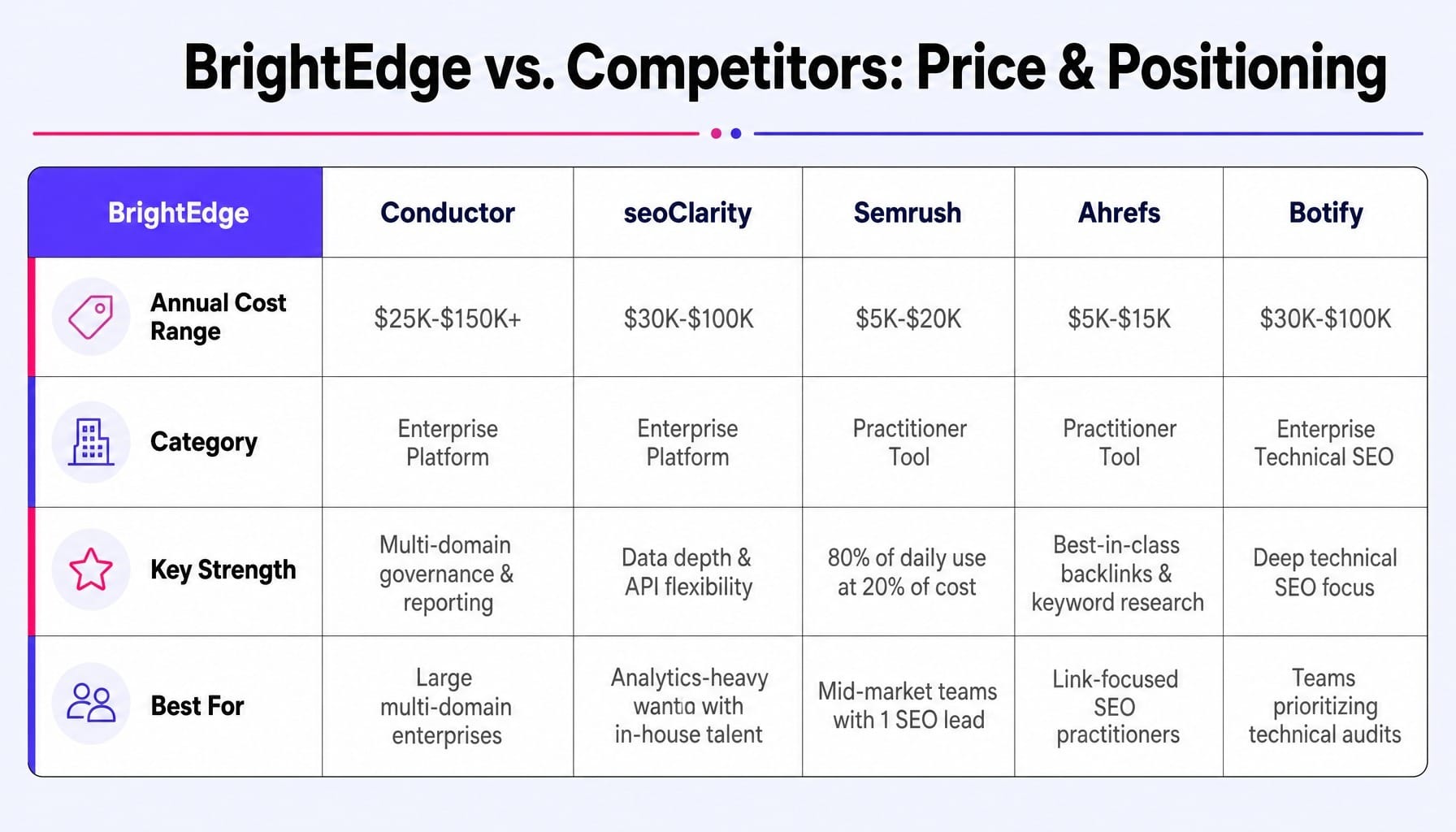
Comparing BrightEdge pricing requires comparing what you're actually getting. A $20K/year Semrush subscription and a $120K/year BrightEdge license are not in the same product category. One is a practitioner tool; the other is an enterprise platform designed for governance and multi-team reporting.
Here's how BrightEdge stacks up against the competitors a buyer is actually evaluating:
- Conductor ($30K - $100K/year): BrightEdge's closest direct competitor. They offer similar enterprise positioning, a comparable module structure, and are often 10-20% less expensive for a similar feature set. The decision between BrightEdge and Conductor frequently comes down to UI preference and the perceived quality of the CSM team.
- seoClarity ($25K - $80K/year): Strong on raw data depth, custom reporting, and API flexibility. For teams that prioritize data exports and have the in-house analytics talent to build their own models, seoClarity can offer better value and more flexible contract terms than BrightEdge.
- Semrush ($5K - $20K/year): Not a direct competitor. Semrush is an excellent practitioner toolkit, but it lacks the enterprise-level governance, role-based permissions, and large-scale reporting features that justify BrightEdge's price tag. For a mid-market team with one SEO lead, Semrush pricing often covers 80% of the daily use case at 20% of the cost.
- Ahrefs ($5K - $15K/year): Similar to Semrush. It's a best-in-class tool for backlink analysis and keyword research, but it is not built for the scale of enterprise reporting, multi-domain management, or complex team collaboration that BrightEdge is designed to handle. Understanding Ahrefs pricing helps contextualize the gap.
- Botify ($30K - $100K/year): A specialized competitor focused on enterprise-scale technical SEO. If your primary need is the functionality found in BrightEdge's ContentIQ module, Botify is arguably a stronger, more focused platform at a comparable price point.
The takeaway is that BrightEdge's premium price is most justifiable for large, complex enterprises managing multiple domains, teams, and regions. Mid-market teams often find themselves overbuying—paying for an enterprise architecture when a more agile practitioner tool or a more focused competitor would suffice.
How to Negotiate a BrightEdge Contract
BrightEdge's custom-quote model means every deal is negotiable, but only if you know the leverage points. Here are five specific tactics to use in your next negotiation.
- Start Early and Create Competition. Begin the conversation 90 days before your decision deadline or renewal date. This gives you time to get competing quotes from Conductor and seoClarity. You don't have to prefer them; you just need the SSP deck for procurement to prove you have viable alternatives. Mention the competitors by name in your calls.
- Right-Size Your Keyword Universe First. Before you even talk to the sales rep, audit your needs. If you're renewing, check your usage data. Are you paying for a 25,000 keyword tier but only actively using 8,000? Downgrading your tier is the fastest way to reduce your ACV. Don't let them sell you capacity you won't use.
- Push Back on SKU Bundling. At renewal, a common tactic is to propose a new "discounted" package that bundles in new modules like Autopilot, but still results in a higher total ACV. This is a classic bolt-on module upsell. Insist on evaluating and pricing each module independently. If you don't have a clear use case for it, decline it.
- Negotiate the Annual Escalator. The standard 3-7% annual price increase is not fixed. It's a negotiable term. For multi-year deals, push for flat pricing or a capped escalator of 1-2%. This is an easy win, especially if you're negotiating at the end of a quarter when the sales team is trying to close deals.
- Focus on Total Contract Value (TCV). If you're signing a multi-year deal, vendors are most flexible on year-one pricing. Push for a steeper discount upfront. Also, get any implementation or professional services fees waived or heavily discounted as part of the initial TCV negotiation, not as a separate line item later.
A renewal scenario: Your current contract is $55K/year. The rep proposes bundling Autopilot for a "discounted" renewal of $72K. You counter by auditing usage and dropping a keyword tier, declining the Autopilot bundle, and negotiating a 2% cap on future escalators. You could realistically land at a renewal of $48K/year—a net decrease, despite the vendor's attempt to drive a net retention squeeze.
When the Real Question Isn't 'How Much Does BrightEdge Cost?' — It's 'What Am I Actually Paying For?'
You've done the math. A $50,000 platform fee, a $90,000 analyst to run it, and $15,000 in professional services. You're looking at a $155,000/year program that delivers dashboards, alerts, and a backlog of recommendations your team doesn't have the bandwidth to ship.
The fundamental problem with enterprise SEO platforms is that they are expensive intelligence layers that still leave the execution gap entirely on your plate. You pay for a tool that tells you what to fix, and then you pay a team to do the fixing.
This is a system architecture problem. The real question isn't about finding a cheaper tool; it's about finding a different model.
Spike AI was built to solve this. We fused the intelligence layer with an execution layer. Instead of delivering a dashboard of insights, Spike AI identifies the highest-impact move across your website, SEO, or ads, and then deploys the fix. Every week. The marketer moves from operator to approver. The backlog shrinks into an approval queue. If you've calculated the total cost of ownership for a platform like BrightEdge and realized you're spending six figures for a system that diagnoses but doesn't act, you're paying for the wrong thing.
See how Spike AI replaces your SEO tool stack and the headcount to run it
Is BrightEdge Worth the Price?
BrightEdge pricing isn't just a number; it's a reflection of a total program cost that includes the platform, the skilled headcount to operate it, the hidden fees, and the opportunity cost of using a tool that diagnoses but doesn't execute.
This analysis moved from "what does it cost?" to "what are you really paying for?" and finally, "is this the right model for your team?"
Before you request that BrightEdge quote, calculate your total projected program cost—platform plus people plus services. Then ask yourself whether that investment is buying you insights or outcomes. The answer determines if an enterprise SEO platform is the right architecture for your growth, or if a different model would deliver more impact for your investment.
Read more: SaaS Marketing Metrics That Actually Inform Decisions (Not Just Dashboards) | Spike AI
Frequently Asked Questions
Does BrightEdge offer a proof-of-concept pilot before requiring a full annual commitment?
BrightEdge occasionally offers 30-60 day pilots for large enterprise prospects, but they are not standard and require executive sponsorship from their sales team. Pilots are more common for net-new logos than renewals and typically cover only the core platform, not premium modules.
Does BrightEdge charge separately for API access and data exports?
Yes. Basic reporting exports are included, but programmatic API access via BrightEdge Connect is tiered and usually costs extra, especially for mid-market contracts. Data Cube access, which powers custom reporting and bulk data pulls, is also a separately priced module.
How does the number of tracked keywords affect BrightEdge pricing in practice?
Keyword tracking volume is the largest variable in most contracts. Pricing jumps at tier boundaries (e.g., 5K, 10K, 25K), and crossing a threshold can add $10K-$20K to your annual cost. The biggest risk is over-provisioning at signing and paying a premium for tracking ceiling you never use.
Is there a BrightEdge pricing tier designed for mid-market companies under 500 employees?
While there's no formal mid-market tier, contracts for companies under 500 employees often land in the $25K-$50K/year range for the core platform. The challenge is that BrightEdge's sales motion and complexity are enterprise-grade, so mid-market teams can find the platform overbuilt and underutilized.
What ROI metrics should I use to justify BrightEdge cost to leadership?
Tie the cost to organic search revenue attribution—specifically, incremental organic traffic multiplied by your conversion rate and average deal value. Build the business case around share of voice (SOV) gains and a lower cost-per-organic-lead compared to paid channels, not vanity metrics like keyword rankings.