SaaS Pricing Strategy: The Definitive Guide for B2B Teams (2026)

TL;DR
- Your pricing strategy fails or succeeds based on your value metric—the unit you charge for. If it doesn't scale with the value customers receive, your revenue is capped.
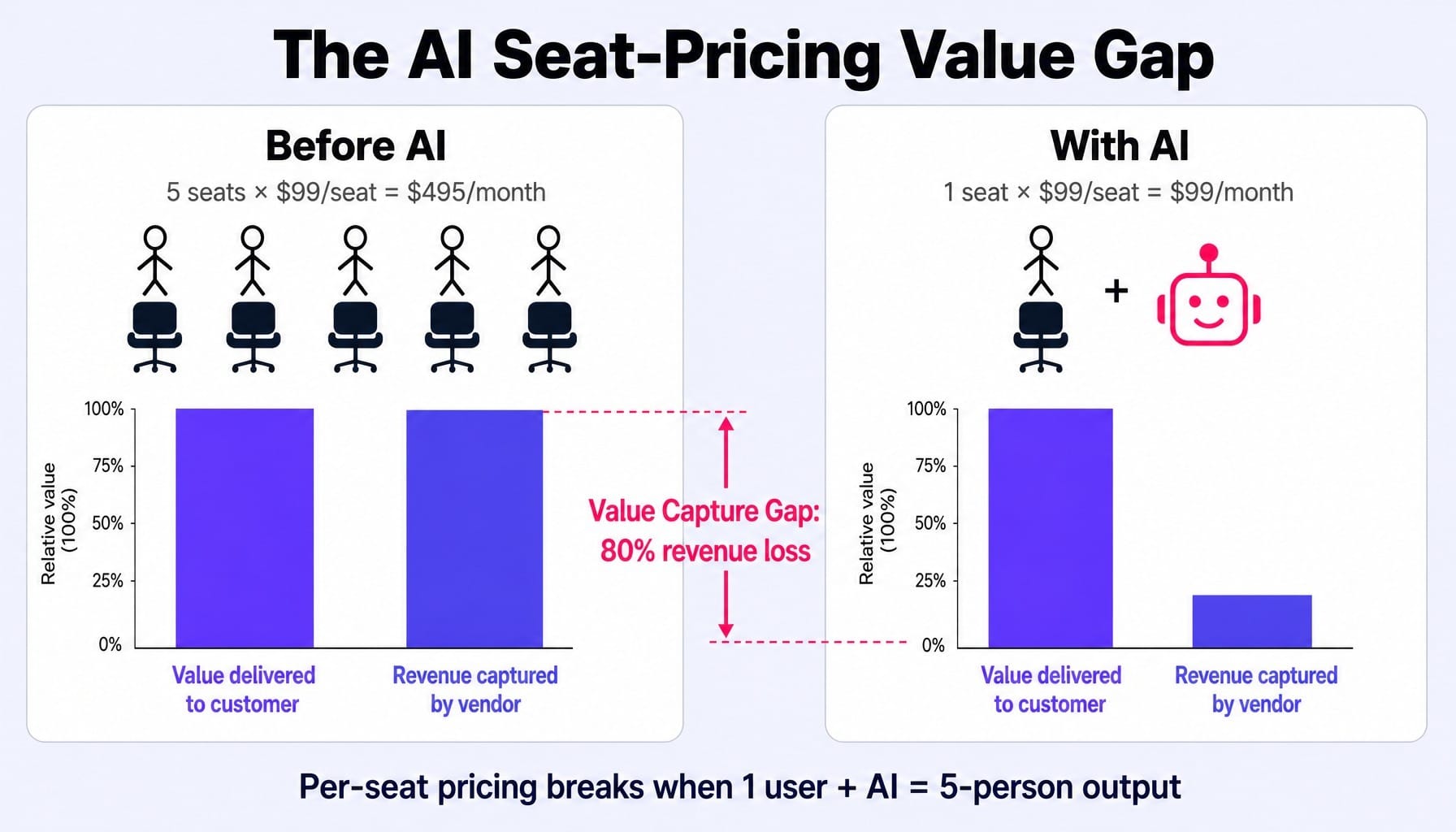
- Per-seat pricing is collapsing in the age of AI. A single user with an AI assistant can deliver the output of a five-person team, breaking the link between seats and value.
- The best pricing models for B2B SaaS in 2026 are hybrid models that combine a stable subscription base with a usage-based component for expansion revenue.
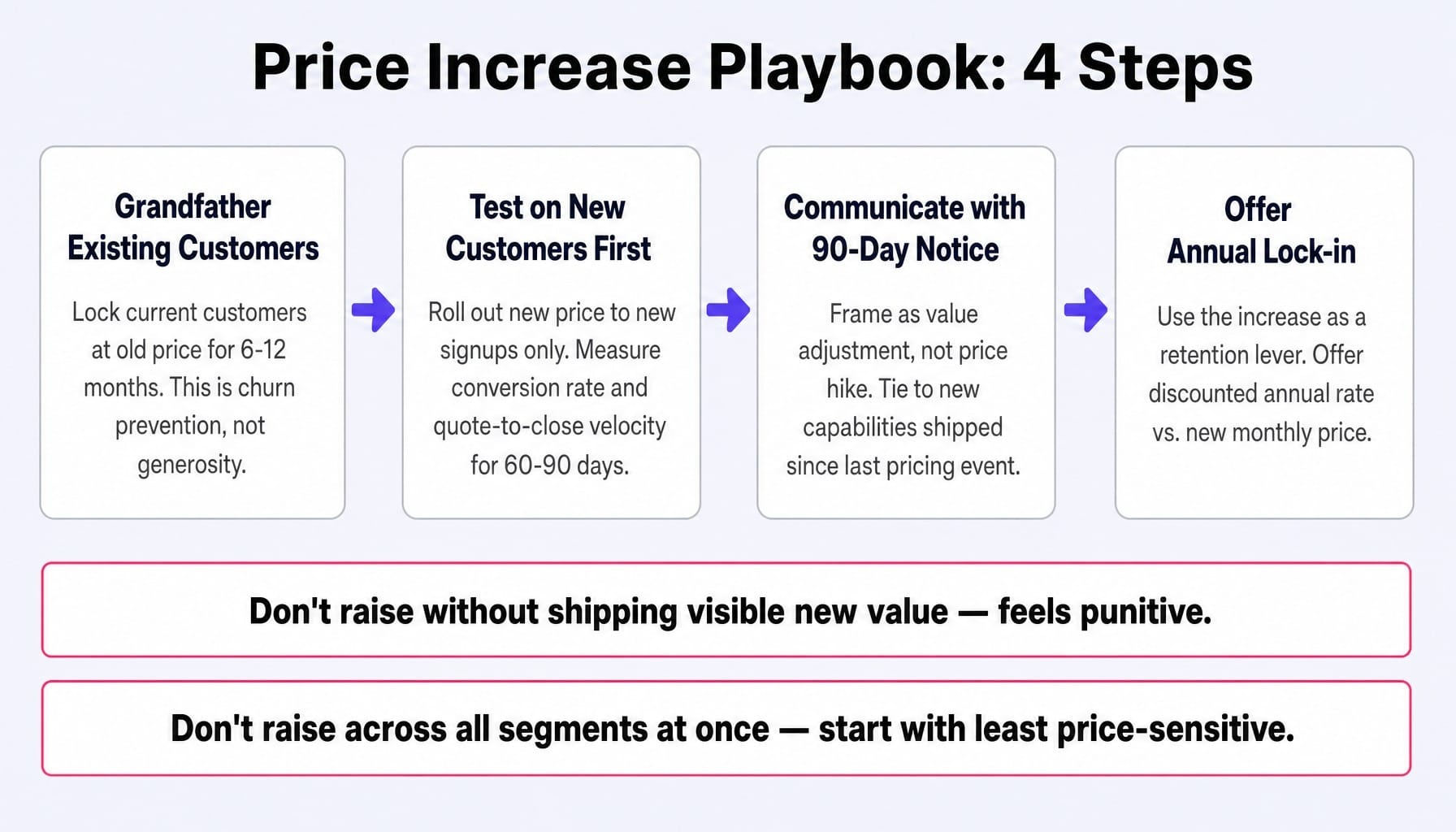
- Raise prices by grandfathering existing customers for 6-12 months, testing the new price on new customers first, and communicating the change with a 90-day notice tied to new value.
- Your pricing page is a conversion lever, not a static menu. Continuously test its layout, tier architecture (using decoy tiers), and feature descriptions to optimize conversions.
Most SaaS companies spend weeks debating whether to use tiered vs. usage-based pricing, set the price based on what competitors charge, and then never touch it again. This is not a pricing strategy—it is a pricing guess with a spreadsheet attached. If your best customer and your worst customer pay the same monthly fee, your pricing model is leaving money on the table, and you probably already know it.
The core problem is that teams treat pricing as a model-selection exercise. It's not. A successful SaaS pricing strategy is about identifying the single unit of value your customer actually pays for (the value metric), aligning your model to that metric, and then treating pricing as a continuous optimization loop.
This isn't another list of pricing models. This is a framework for building a pricing system that drives net dollar retention (NDR) and compounds revenue. We will cover why most pricing underperforms, how to find and validate your value metric, which models are collapsing, how to raise prices without destroying retention, and why your pricing page is a conversion lever most teams ignore.
Why Most SaaS Pricing Underperforms (And It's Not the Model)
Imagine a B2B SaaS company prices its product at $99/seat/month because its two closest competitors charge $89 and $119. They pick the middle. Revenue grows linearly as customers add users, but a deeper look at the cohorts reveals a problem. Their best customers—the ones getting 10x value by automating entire workflows—pay the same per-seat rate as the customers who log in twice a month.
Average revenue per user (ARPU) starts to compress. Net dollar retention hovers around 100%, meaning expansion revenue is negligible. The company is growing, but only by adding new logos. They are not growing with their customers.
The problem isn't the $99 price point or even the per-seat model itself. It's that the pricing metric (seats) has no relationship to the value the customer actually receives. This is value metric misalignment, and it is the silent cap on SaaS growth.
Research from Price Intelligently (now part of Paddle) confirms this monetization gap analysis: companies with a well-aligned value metric grow at roughly double the rate and see half the churn of those with misaligned metrics. Yet most teams skip this foundational step. It requires customer research, so they jump straight to debating models. It's like choosing a vehicle before you know the destination. The result is a pricing structure that covers costs but never unlocks compounding revenue.
How to Identify and Validate Your Value Metric
A value metric is the unit you charge for that scales naturally as the customer receives more value. The closer your metric tracks to customer outcomes, the more your pricing becomes a growth engine rather than a point of friction. HubSpot charges for contacts, Twilio for API calls, and Slack for active users. Each of these is a proxy for the value delivered.
Finding yours is the foundational step that determines whether your entire pricing strategy works. The process has two parts: finding candidate metrics, then validating them with real customers.
Finding Candidate Value Metrics: The Proxy Test
Most SaaS products cannot charge for the pure value metric (e.g., "revenue generated for the customer") because attribution is too complex. Instead, you need to identify proxy metrics—measurable units that correlate strongly with the value your customers receive.
Start by brainstorming 5-10 possible metrics for your product. Think about everything that can be counted: API calls, active users, records processed, workflows automated, GB of storage, messages sent.
Now, filter that list using three criteria from the OpenView Partners value metric framework:
- Does it scale with customer value? As your customer's business grows and they get more value from your product, does this metric naturally increase?
- Is it easy to understand and predict? Can a customer easily grasp how their bill will change? Unpredictable bills create churn.
- Does it drive expansion revenue? Does the metric allow for growth without requiring a new sales conversation?
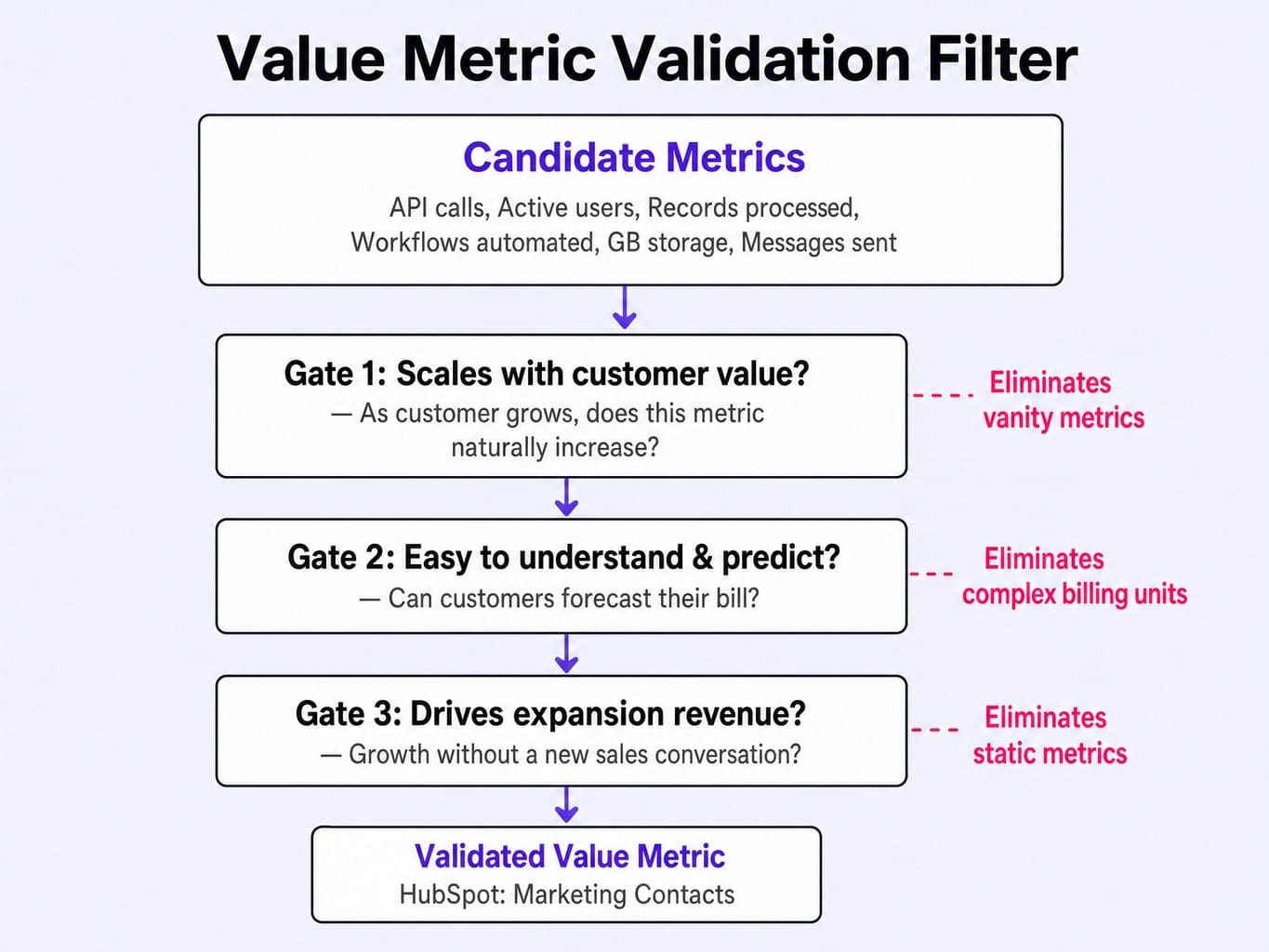
Consider HubSpot. They famously moved from per-seat pricing to a model based on marketing contacts. Why? Because the number of contacts a company manages scales directly with their marketing success—a team running bigger campaigns needs more contacts, and that growth directly correlates with the value HubSpot delivers. Seats did not have this property. For teams with the budget, formal methods like a Van Westendorp price sensitivity meter or a conjoint analysis can provide data. But you can start this week by just interviewing 15-20 customers and asking, "What success in your business would make you feel this product is worth more to you?"
Validating Before You Commit: Willingness-to-Pay Research That Actually Works
Once you have a candidate for your value metric, the biggest mistake is skipping validation and going straight to implementation. You need to confirm it resonates with how customers think about your product's worth.
A lightweight validation process involves running willingness-to-pay conversations with 15-20 customers, segmented by your ideal customer profiles (e.g., SMB, mid-market). Use a simplified version of the Van Westendorp four-question framework to establish a price corridor:
- At what price would this be so cheap you'd question its quality?
- At what price would this be a bargain?
- At what price would this start to feel expensive?
- At what price would it be so expensive you wouldn't consider it?
The goal isn't to find a single "perfect" price. It's to map the acceptable price corridor and confirm the order of magnitude ($10 vs. $100 vs. $1,000). This research also surfaces crucial nuances, like the need for price localization. Proprietary data from Paddle shows that willingness to pay can vary by up to 28% depending on the region.
A word of caution: avoid A/B testing prices on live traffic. It creates trust issues and can alienate existing customers. Instead, test new pricing through sales conversations with new prospects or by rolling it out to a new customer cohort.
Three Pricing Models That Work for B2B SaaS in 2026
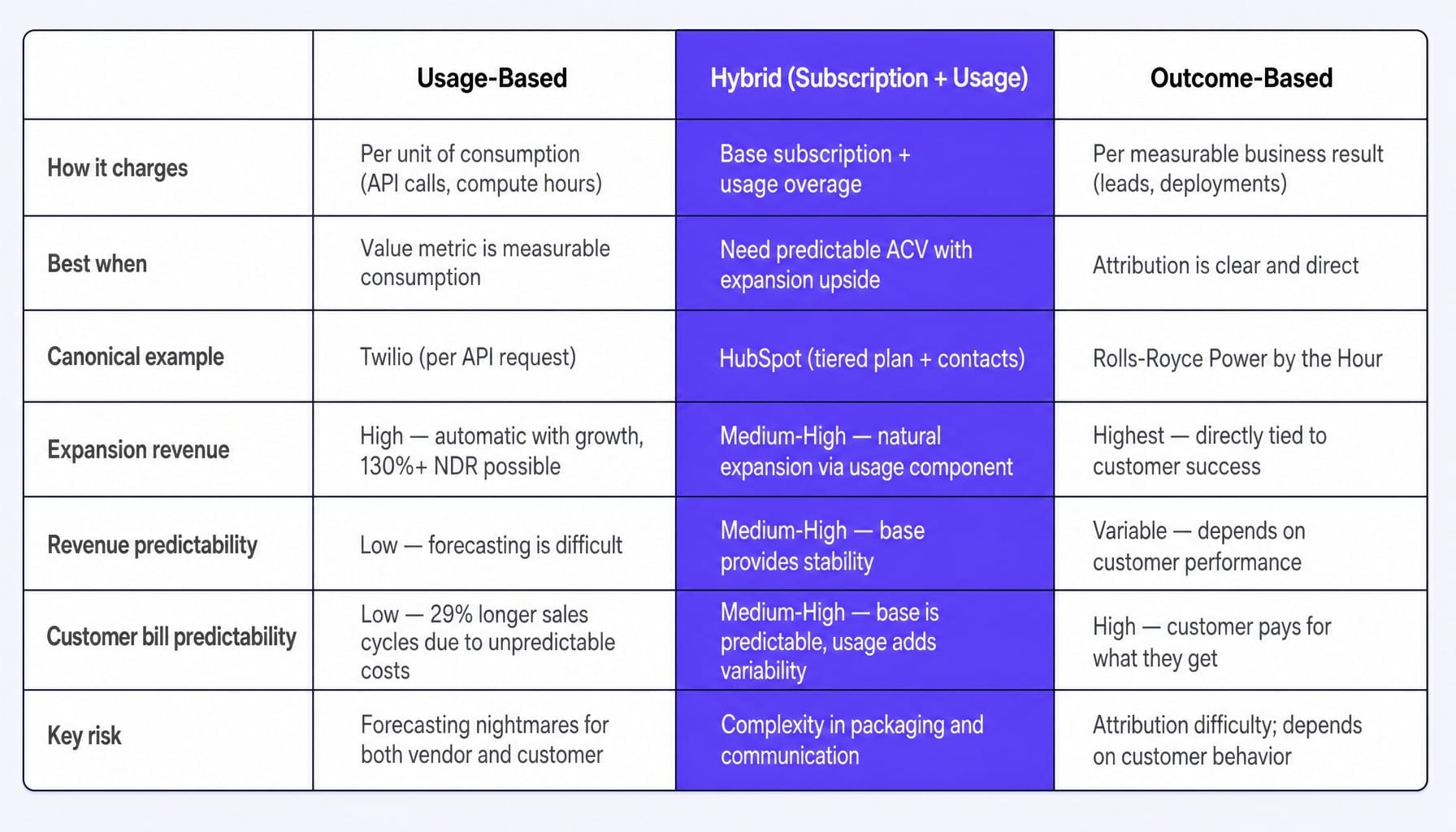
Once you know what you charge for (your value metric), you can decide how to structure the charge. Most guides list six or more models, but for B2B SaaS in 2026, the trend is toward hybrid approaches. Three models dominate the conversation.
Usage-Based Pricing: When Your Value Metric Is Measurable Consumption
Usage-based pricing is the most powerful model when your value metric is a measurable unit of consumption like API calls, data processed, or compute hours. Twilio is the canonical example. By pricing per API request, their revenue grew automatically as their customers' businesses grew, driving their famous 130%+ net dollar retention and creating negative churn mechanics without needing a single upsell conversation.
But this model comes with a hidden cost: forecasting nightmares for both you and your customer. Customers struggle to predict their monthly bills, and your finance team struggles to forecast revenue. In fact, data shows that companies with pure consumption-based billing models experienced 29% longer sales cycles in 2023 as finance departments scrutinized unpredictable costs.
Pure usage-based pricing is powerful, but it demands significant investment in tooling—like usage dashboards, spend alerts, and committed spend tiers—to reduce customer anxiety and provide some level of predictability.
Hybrid Models: Combining Subscription Stability with Usage Upside
Hybrid models—a base subscription fee plus a usage-based component—are rapidly becoming the default for B2B SaaS. They solve the forecasting problem of pure usage-based pricing while preserving the mechanics of expansion revenue.
HubSpot is the perfect example: a tiered subscription (Starter, Professional, Enterprise) provides predictable, recurring revenue, while the contacts-based usage component creates natural expansion. This is a classic "two-part tariff," combining a committed baseline with overage pricing. Even Twilio, the poster child for usage-based pricing, has evolved toward offering committed usage contracts, moving them firmly into the hybrid camp.
A hybrid model isn't a compromise; it's an optimization. It balances your need for predictable annual contract value (ACV) with the customer's need for cost transparency, while ensuring you capture a fair share of the value as their usage grows. It's the best of both worlds.
Outcome-Based Pricing: Charging for Results, Not Access
Outcome-based pricing, where the customer pays based on measurable business results (e.g., leads generated, revenue influenced, tickets resolved), is the logical endpoint of value metric alignment. It is the purest form of value-based pricing.
Rolls-Royce's "Power by the Hour" for jet engines is the classic non-SaaS example. Airlines don't buy engines; they pay for hours of thrust. In SaaS, this model is emerging in niches where attribution is clear. Performance marketing platforms might charge per qualified lead. AI coding assistants could charge per successful deployment.
The challenge, and why this model isn't more common, is attribution. It works best when the vendor can directly measure and attribute the outcome. It fails when the result depends on customer behaviors you can't control. While you may not be able to implement a pure outcome-based model today, thinking about it forces you to get brutally honest about the real-world value you deliver, which is a critical input for selecting your value metric.
Read more: How to Build SaaS Marketing Attribution That Actually Drives Pipeline (Not Just Dashboards)
Why Per-Seat Pricing Is Collapsing in the Age of AI Agents
The logic of per-seat pricing rests on a simple assumption: value scales with the number of humans using the product. For decades, this held true. But AI agents and embedded automation features are breaking this assumption.
Consider this scenario, which is playing out across B2B SaaS right now: a single marketer, armed with an AI-powered platform, produces the output of a five-person team. They generate more campaigns, analyze more data, and drive more pipeline. The value delivered to their company has skyrocketed. But under a traditional per-seat model, the vendor still only gets paid for one seat. The vendor captures a tiny fraction of the value they helped create.
This isn't a hypothetical. Companies like Salesforce and Intercom are scrambling to restructure their pricing as AI features make seat counts increasingly irrelevant to value delivered. Paddle's industry analysis confirms this trend, noting that AI is fundamentally weakening the logic of seat-based models. If you try to solve this by making the AI agent its own "seat," customers revolt at paying human-equivalent prices for software.
This creates a pricing time bomb. If you are still on a per-seat model and are adding powerful AI capabilities, you must proactively plan your migration to a usage-based or hybrid model. Otherwise, the growing mismatch between the price your customers pay and the value they receive will become a major retention risk.
How to Raise Your SaaS Price Without Spiking Churn
Most SaaS teams know they are underpriced. They also live in fear of raising prices, assuming it will trigger a wave of churn. The reality, backed by consistent research, is that most SaaS companies underestimate their customers' willingness to pay by 20-40%. A well-executed price increase typically results in less than 2% incremental churn while driving a 10-20% lift in revenue.
The key is execution. Here is a step-by-step playbook:
- Grandfather Existing Customers: This is the most critical step. Allow all existing customers to remain on their current plan and price for a generous period, typically 6-12 months. This is not generosity; it is a churn prevention mechanism that eliminates the immediate risk and gives you time to demonstrate the new value that justifies the new price.
- Test on New Customers First: Roll out the new pricing only to new signups. Measure the impact on conversion rates and quote-to-close velocity over a 60-90 day period. This de-risks the change by confirming its market viability before you involve your existing customer base.
- Communicate with Ample Notice: When it's time to transition your grandfathered customers, provide at least 90 days' notice. Frame the communication around the new capabilities and value you've added since their last pricing event. This isn't a price hike; it's a value adjustment.
- Offer an Annual Lock-in: Use the price increase as a retention lever. Offer customers the chance to lock in for a year at a discounted rate compared to the new monthly price. This can improve cash flow and secure commitment through the transition.
The two most common mistakes are raising prices without shipping visible new value (which feels punitive) and raising them across all segments simultaneously. Start with your least price-sensitive segment to test the waters.
Your Pricing Page Is a Conversion Lever, Not a Menu
Most SaaS teams treat their pricing page as a static menu: list the tiers, list the features, add a CTA button. This is a massive missed opportunity. Your pricing page is often the highest-intent page in your entire marketing funnel, and it should be optimized as aggressively as your homepage. It is not a menu; it is a conversion mechanism.
Here are three principles most teams ignore:
- Tier Architecture is Psychology: The structure of your tiers matters more than the specific price points. Use a decoy tier—a middle option that is deliberately less attractive—to make your target tier look like the obvious, high-value choice. This works because of price anchoring: the high price of an "Enterprise" tier makes the "Professional" tier feel reasonable by comparison.
- Organize Features by Outcome: Customers don't buy "SSO" or "API access." They buy "security for my team" and "the ability to connect to my existing tools." Your feature comparison table shouldn't be a list of technical jargon. It should be a map that connects features to the outcomes your customers are trying to achieve.
- Test Layout, Not Just Price: Most teams never A/B test their pricing page for fear of confusing customers. But you can test layout, tier naming, feature presentation, and CTA copy without ever changing the underlying prices. This is zero-risk optimization that directly impacts conversion rates.
If you've never run an A/B test on your pricing page, you are almost certainly leaving conversions on the table.
Read more: Data-Driven CRO: Evolve Your Marketing Strategy for Revenue
When Pricing Page Optimization Needs to Happen Every Week, Not Every Quarter
This brings us to the core tension of a modern pricing strategy. It is not a one-time project but a continuous discipline—from value metric validation to pricing page conversion testing. The companies that win are those that build pricing into their operating rhythm.
But here is the operational reality: most lean SaaS marketing teams do not have the bandwidth for this. You know your pricing page needs optimization. You have a backlog of A/B tests you want to run. But the gap between knowing what to do and having the resources to ship it is where progress stalls.
This is the execution gap Spike AI is built to close. Spike continuously identifies the highest-impact conversion opportunities on your site—often on high-intent pages like your pricing page—prioritizes the change that will move the needle most, and helps deploy it. It's the system that turns your optimization backlog into a weekly release cadence. If pricing strategy is a continuous discipline, you need a continuous optimization system to power it.
See how Spike AI continuously optimizes your highest-converting pages
Conclusion: Pricing Is a System, Not a Project
The single most important shift in building a winning SaaS pricing strategy is moving from treating it as a model-selection exercise to treating it as a continuous system. This system starts with value metric alignment and compounds through ongoing optimization.
Most SaaS pricing underperforms because teams skip the hard work of customer research, pick a model based on competitors, set a price, and then walk away. But the companies that build pricing into their operating rhythm—validating metrics, testing models, raising prices deliberately, and optimizing their pricing pages—compound a revenue advantage that widens every quarter.
In 2026, as AI reshapes what a "user" even means, this discipline becomes non-negotiable. The teams that treat pricing as a living system will dramatically outpace those still debating flat-rate vs. tiered in a spreadsheet.
Frequently Asked Questions
How many pricing tiers should a SaaS product have?
Three tiers is the most effective default for B2B SaaS because it enables price anchoring and a decoy effect, making the middle tier feel like the obvious choice. More than four tiers often creates decision paralysis and increases bounce rates. Start with three, and only add a fourth if you have a genuinely distinct enterprise segment with custom needs that cannot be served by self-serve tiers.
What conversion rate should a freemium SaaS product target?
Industry benchmarks for freemium-to-paid conversion range from 2-5% for broad-market products to 10-15% for niche B2B tools. If your conversion is below 2%, your free tier likely gives away too much value or attracts the wrong users. If it's over 15%, your free tier may be too restrictive, limiting your top-of-funnel growth.
What role does net dollar retention play in SaaS pricing decisions?
NDR over 120% signals your pricing has built-in expansion mechanics; customers naturally pay more as they use more. If NDR is below 100%, your model is leaking revenue. Reverse-engineering your pricing from a high NDR target (e.g., 130%) forces you to choose value metrics and models that create natural upsell paths without requiring constant sales intervention.
When should a SaaS company switch from flat-rate to usage-based pricing?
Switch when you see high variance in the value different customers get. If your highest-value power user and your lowest-value casual user pay the same flat rate, you are subsidizing light users with revenue from heavy users. The trigger is often visible in support tickets or feature usage data showing that power users feel they're getting a bargain while light users feel overcharged.
What is the difference between packaging and pricing in SaaS?
Packaging is what you include in each tier (features, limits, support). Pricing is what you charge for that package. They are separate levers. You can change packaging without changing price—for example, moving a key feature to a higher tier to drive upgrades. Packaging changes are often higher-impact and lower-risk than price changes because they reshape perceived value without triggering price sensitivity.