Conductor Alternatives: What to Actually Evaluate Before You Switch in 2026

TL;DR
- Most teams don't leave Conductor for better features; they leave because the platform surfaces more work than their team has the bandwidth to execute.
- Evaluate alternatives based on operational fit, not feature lists. Focus on Time-to-First-Action, Prioritization Intelligence, Execution Proximity, and Total Cost of Ownership.
- seoClarity offers enterprise depth, Semrush provides mid-market breadth, Ahrefs delivers practitioner-grade data, and Botify excels at technical SEO. Brightedge is often a lateral move, not an upgrade.
- Every Conductor alternative, regardless of its strengths, stops at recommendations. The real bottleneck is the execution gap—the latency between knowing what to fix and shipping the fix.
- The next generation of platforms won't just surface insights; they will close the execution gap by integrating prioritized recommendations with implementation.
You spent six months on Conductor. Your three-person marketing team built the dashboards, tracked share of voice, and ran the content gap analyses. The result? A backlog of 200+ recommendations and fewer than ten meaningful optimizations shipped in the last quarter. The platform's data quality wasn't the problem. The problem was that the platform surfaced more work than the team could possibly execute.
This scenario is why most teams start searching for Conductor alternatives. It's rarely about bad data or a missing feature. It's a search for a better operational fit—a system that matches the team's actual capacity to act on the intelligence it provides. A platform that generates a mountain of recommendations for a team without the headcount to climb it isn't a solution; it's a source of prioritization paralysis.
This guide evaluates five top Conductor competitors not by their feature count, but by the criteria that determine their real-world value: workflow friction, team adoption speed, and whether the platform truly closes the gap between insight and implementation.
Why B2B Teams Actually Leave Conductor
Most teams don't leave Conductor because it lacks features. They leave because the platform's value proposition is built on an operational assumption that most lean B2B companies don't meet: that a dedicated team of SEO analysts, content operators, and technical specialists is waiting to execute on its outputs.
For the typical 1-5 person marketing team, this assumption creates four specific friction points that lead them to seek alternatives.
- Pricing Opacity and Mid-Market Mismatch: Conductor is an enterprise platform with enterprise pricing. Contracts require custom quotes, creating budget uncertainty for mid-market teams scaling from $5M-$30M ARR. While competitors like Semrush and Ahrefs offer transparent, self-serve pricing tiers, Conductor's model assumes a procurement process and budget that many lean teams simply don't have.
- Implementation Latency: The time-to-first-insight on Conductor is often measured in months, not days. Onboarding can take weeks of configuration and training. For a small team under pressure to deliver quarterly results, the upfront investment in time and resources before the platform generates actionable intelligence can feel prohibitive. The system's depth becomes a barrier to entry.
- Workflow Density and Prioritization Paralysis: This is the core operational failure. Conductor is excellent at identifying what could be fixed. It surfaces hundreds of opportunities, from content decay alerts to keyword cannibalization issues. For a team without dedicated SEO headcount, this isn't helpful; it's overwhelming. A mid-market SaaS team can easily accumulate 200+ recommendations in six months but only implement 15 because each change requires engineering tickets, content briefs, and cross-functional approvals. The platform creates work but provides no system to manage the throughput.
- AI Visibility and AEO Gaps: As search evolves into a conversational answer engine, tracking SERP positions is no longer enough. Teams need to understand their visibility within AI Overviews and other generative experiences. While Conductor has started to address this, some competitors have moved faster, offering more mature Answer Engine Optimization (AEO) and Generative Engine Optimization (GEO) capabilities.
Despite heavy investment in SEO and CRO tools, average website conversion rates remain stuck around 2%. The problem isn't a lack of insights. It's a failure of execution.
How to Evaluate a Conductor Alternative Without Getting Distracted by Feature Lists
Feature comparison tables are the least useful way to evaluate enterprise SEO platforms. At this level of maturity, every tool checks the same fundamental boxes: rank tracking, content optimization, technical auditing, and reporting. The real differentiators are operational, not functional. They reveal how the platform integrates with your team's actual workflow.
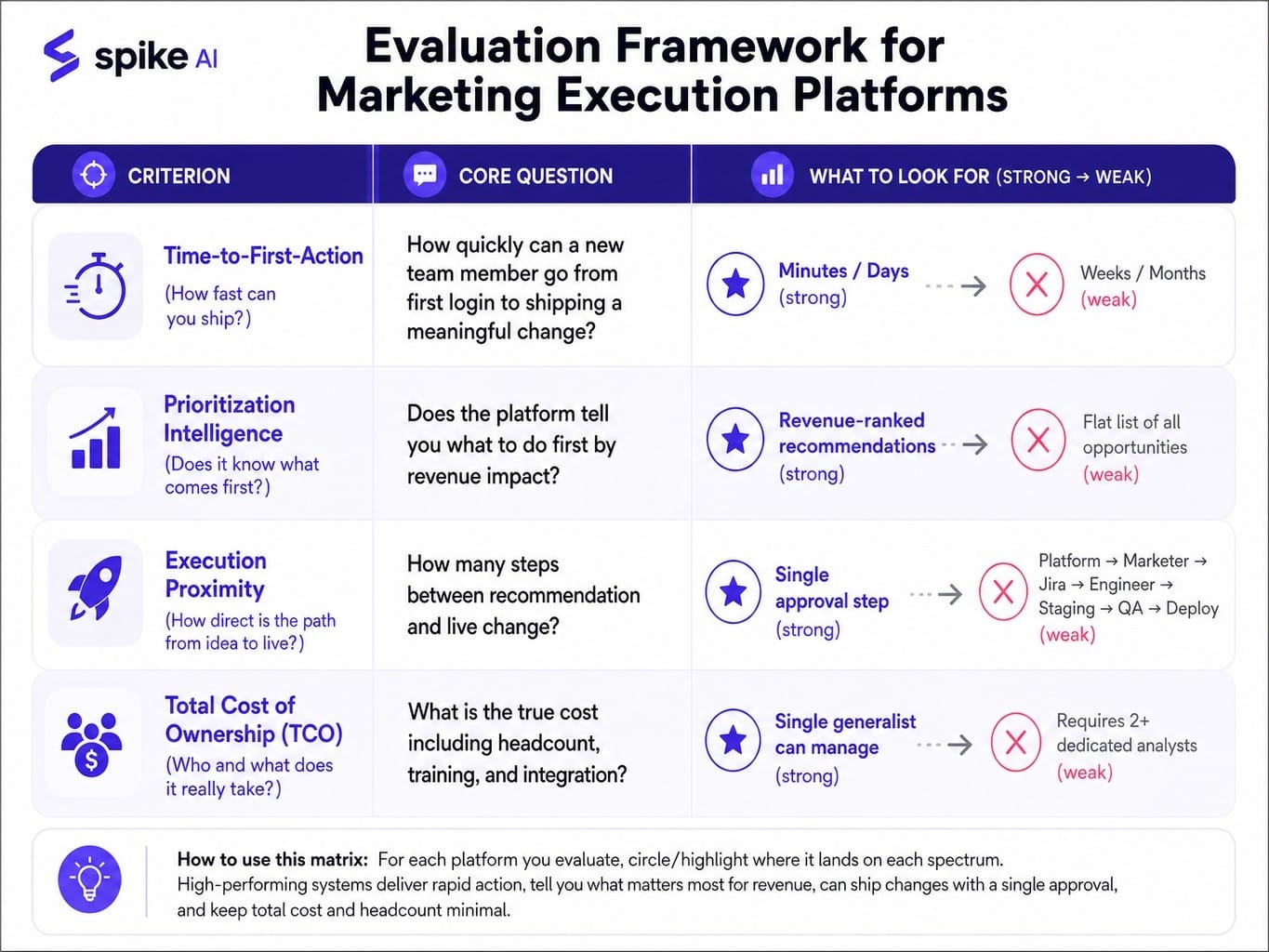
Before you look at a single demo, use these four criteria as your evaluation lens. These are the questions to ask vendors, not the ones they want to answer.
- Time-to-First-Action: How quickly can a new team member go from their first login to shipping a meaningful change? Is it minutes, days, or weeks? A platform that requires a month of onboarding before delivering value is a cost center, not a growth driver.
- Prioritization Intelligence: Does the platform simply present a list of all possible optimizations, or does it tell you what to do first? True intelligence isn't about volume; it's about impact. The system should provide a clear, data-backed model for which change will most effectively move qualified leads or revenue.
- Execution Proximity: How many steps, tools, and people exist between the platform's recommendation and that change going live on your site? If the workflow is platform -> marketer -> Jira ticket -> engineer -> staging -> QA -> deploy, the platform itself is only a small part of a long and inefficient process.
- Total Cost of Ownership (TCO): This isn't just the license fee. TCO includes onboarding time, training costs, integration effort, and, most importantly, the internal headcount required to extract consistent value from the platform. A cheaper tool that requires two full-time analysts is more expensive than a pricier one that a single generalist can manage.
Read more: Stop Syncing Strategy and Execution: Platforms That Unify Marketing Goals With Task Management
5 Conductor Alternatives Worth Evaluating in 2026
These five platforms were selected based on the operational criteria above, not by market share or feature count. They represent the most realistic Conductor competitors for enterprise and mid-market B2B teams, each solving a different dimension of the operational challenges Conductor can present.
seoClarity — For Teams That Need Conductor-Level Depth With Better AI Visibility
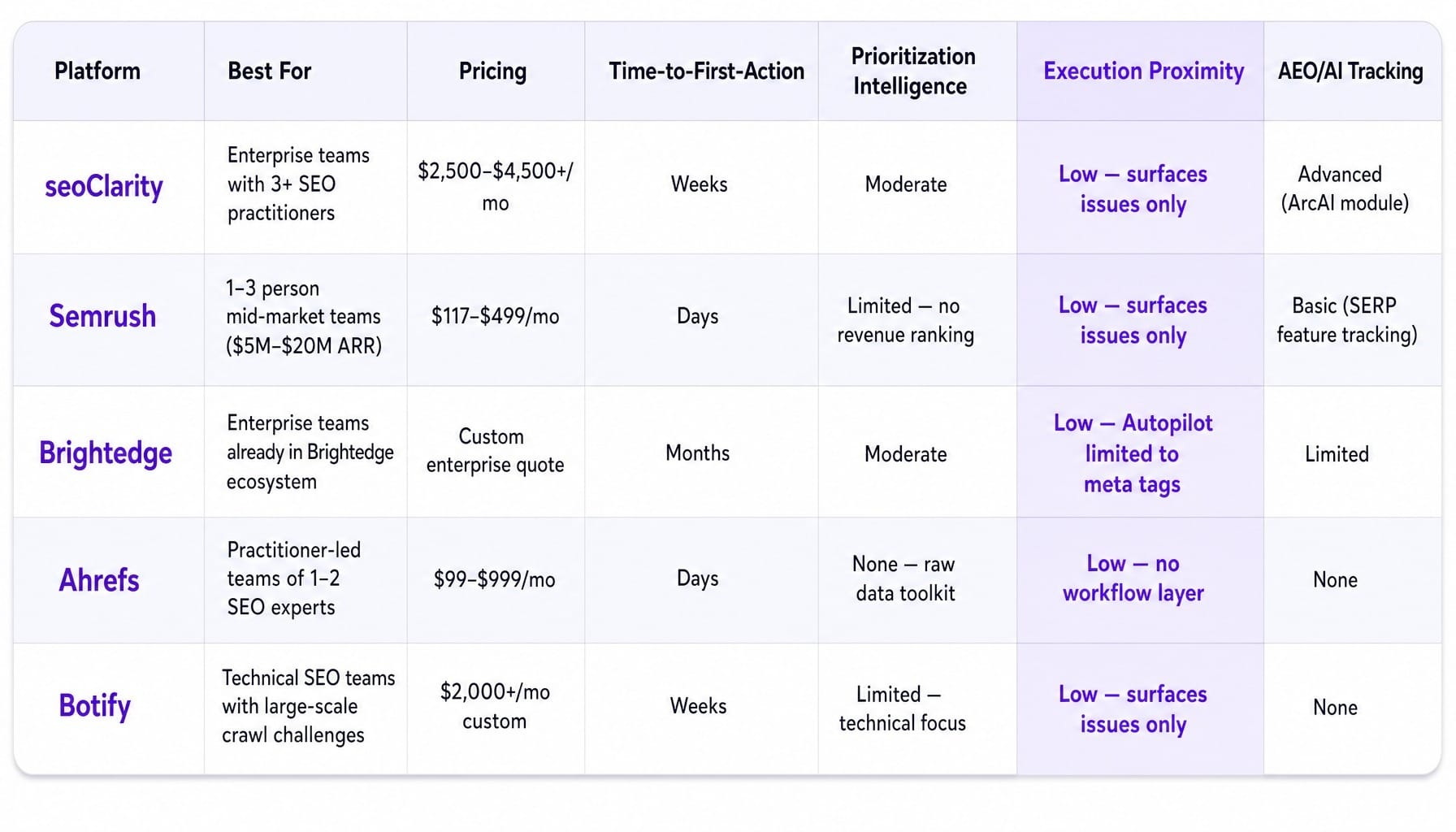
seoClarity is the closest functional equivalent to Conductor for large enterprise SEO teams. It offers comparable depth in global rank tracking, content optimization workflows, and technical auditing. Its primary advantage is that it has moved faster to integrate AI visibility features. Its ArcAI module provides citation tracking in AI Overviews, prompt research capabilities, and hallucination monitoring, giving teams a clearer view of their performance in generative search experiences.
However, the operational limitations are similar to Conductor's. Pricing starts around $2,500/mo and can scale to $4,500/mo or more for enterprise contracts, placing it out of reach for most mid-market teams. Time-to-first-action is measured in weeks; this is a complex platform that requires dedicated SEO headcount to configure and manage. Like Conductor, its execution proximity is low—seoClarity excels at telling you what to fix but offers no mechanism to implement the fix.
Verdict: The strongest choice for enterprise teams with three or more dedicated SEO practitioners who need granular, global control and are willing to invest significant time in onboarding to gain advanced AEO insights. It is not the right fit for lean teams who need to move faster than their headcount allows.
Semrush — For Mid-Market Teams That Need Breadth Without Enterprise Procurement
Semrush is the most accessible Conductor alternative for teams that need a unified platform for SEO, competitive intelligence, content marketing, and paid search. Its key operational advantage is accessibility. With transparent, published pricing ($117–$499/mo for standard plans) and self-serve onboarding, a team can be up and running in days, not months. A single marketing generalist can manage multiple channels from one login without requiring a dedicated analyst.
The trade-off for this breadth is a lack of depth. Semrush's enterprise-level rank tracking and share of voice measurement don't match the granularity of Conductor or seoClarity. Its content optimization features are functional but less sophisticated than dedicated tools like MarketMuse. Most critically, its prioritization intelligence is limited. The platform surfaces thousands of opportunities but does little to rank them by potential revenue impact, leaving the user to sort through the noise.
Verdict: Best for 1-3 person marketing teams at companies in the $5M-$20M ARR range. It's a pragmatic choice for teams that value "good enough" across multiple channels over best-in-class depth in one. Not a fit for enterprise teams managing large domain portfolios or requiring custom crawl segmentation.
Read more: Semrush vs Ubersuggest (2026): Data Accuracy, Real Costs, and When Each Tool Stops Being Enough
Brightedge — For Enterprise Teams Already Embedded in the Brightedge Ecosystem
Brightedge is Conductor's most direct enterprise rival. The platforms share a similar pricing tier, target the same enterprise buyer, and have comparable implementation complexity. The honest assessment is that for most teams, switching from Conductor to Brightedge is a lateral move, not a strategic upgrade. The move is only justifiable if your team has a specific need for a feature where Brightedge has an edge, such as its Data Cube for real-time search intelligence or its ContentIQ technical crawler.
While Brightedge's Autopilot feature attempts to close the execution gap with AI-driven recommendations, in practice these are mostly limited to simple meta tag and content suggestions, not comprehensive implementation. Pricing is opaque and requires a custom enterprise quote. Onboarding takes months, and the platform is built with the assumption that dedicated SEO headcount will be operating it.
Verdict: Only worth evaluating if your team has definitively outgrown a specific technical limitation in Conductor (e.g., crawl depth, international SEO support) and has the budget, headcount, and executive buy-in to justify another complex enterprise platform migration. For most, the switching cost will outweigh the marginal benefit.
Ahrefs — For Practitioner-Led Teams That Prioritize Data Quality Over Workflow Automation
Ahrefs is the strongest choice for teams where the SEO lead is a hands-on practitioner who trusts their own judgment over platform-generated recommendations. What Ahrefs does better than Conductor is provide clean, high-quality raw data. Its backlink index is widely considered the largest and most frequently updated. Its Keyword Explorer provides CTR estimates that help gauge traffic potential. Its Site Audit tool is fast and actionable for technical SEO specialists.
The gap is that Ahrefs is a toolkit, not an enterprise workflow platform. It lacks multi-user collaboration features, share of voice trending across a portfolio of domains, and the kind of organic revenue attribution that enterprise stakeholders demand. There is no dedicated AI visibility or AEO tracking. While pricing is transparent ($99–$999/mo), per-user costs can become a factor for larger teams.
Verdict: The best platform for teams of one or two SEO practitioners who want the highest-fidelity data to inform their own strategies. It empowers experts but doesn't guide generalists. It is not a fit for teams that need the platform to provide prioritization intelligence and manage cross-functional workflows. Teams outgrowing Ahrefs may also want to explore Ahrefs alternatives for broader workflow coverage.
Botify — For Technical SEO Teams Managing Large-Scale Crawl and Indexation Challenges
Botify is the Conductor alternative for teams whose primary pain point is technical SEO at enterprise scale. This includes challenges like crawl budget optimization, JavaScript rendering analysis, and indexation management across sites with millions of pages. Botify's unique strength is its ability to unify data from its own full-site crawler, server log files, and Google Search Console. This gives technical SEOs an unparalleled view of how search engines actually discover and process their site—a capability gap in Conductor.
However, this focus is also its limitation. Botify is not a content intelligence platform. It provides little to no support for content gap analysis, keyword research, or on-page optimization workflows. It's also enterprise-priced, with custom quotes typically starting at $2,000+/mo, and requires deep technical SEO expertise to extract value.
Verdict: The right choice only if your team's primary reason for leaving Conductor is a need for deeper technical SEO analysis, such as advanced crawl segmentation or rendering troubleshooting. If your core problem is content strategy, prioritization, or execution velocity, Botify will not solve it.
The Problem Every Conductor Alternative Shares—And None of Them Solve
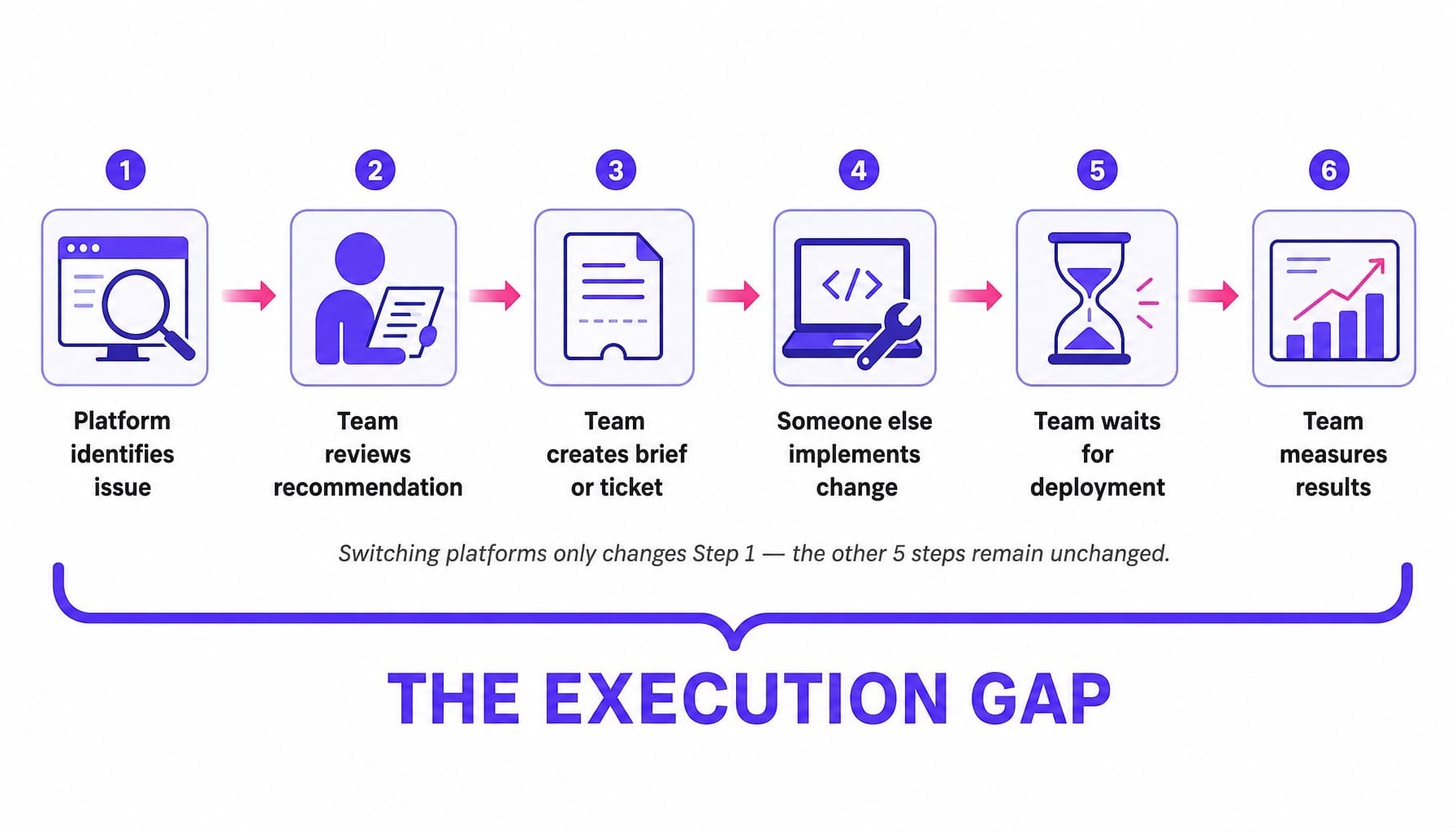
After evaluating five platforms, a clear pattern emerges: every single Conductor alternative excels at surfacing what needs to change, but not a single one actually changes it. The workflow is fundamentally the same across the board.
Platform identifies issue → Team reviews recommendation → Team creates a brief or ticket → Someone else implements the change → Team waits for deployment → Team measures results
This sequence is the bottleneck. Switching platforms doesn't eliminate it; it just changes the user interface where your backlog accumulates.
Consider the growth marketer who migrates from Conductor to Semrush. They gain faster access to competitive data and a more intuitive UI. But they still ship the same number of meaningful optimizations per quarter. Why? Because the constraint was never the speed of insight. It was the distance between that insight and a live implementation on the website.
This is the execution gap. It's the latency between knowing what to do and getting it done. Every platform reviewed in this article widens the top of the funnel—more insights, more recommendations, more dashboards—without addressing the systemic constraint: shipping. Despite all this investment, B2B conversion rates hover around 2%, proving that more data doesn't translate to more growth.
You've been evaluating the wrong dimension. The platform isn't the constraint. The workflow is.
What Changes When the Platform Ships the Fix, Not Just the Recommendation
The entire discussion around SEO platforms is predicated on a broken model: that the platform's job is to deliver homework, and the marketer's job is to do it. Spike AI is built on a different premise. It's a marketing execution engine designed to close the execution gap.
Spike AI doesn't just identify the highest-impact move across your website, SEO, AEO, and ads—it deploys it. Every week. Without engineering tickets, agency briefs, or cross-functional approval chains.
Let's apply the evaluation framework from earlier:
- Time-to-First-Action: Measured in days, not months.
- Prioritization Intelligence: Built-in. Spike AI's system determines what will move qualified leads most, replacing guesswork with a revenue-focused model.
- Execution Proximity: Zero. The distance between recommendation and live change collapses into a single approval step.
Where Conductor and its alternatives give you a backlog, Spike AI gives you a weekly release cadence. Each shipped improvement feeds the next, creating a compounding loop that replaces sporadic quarterly pushes with continuous, measurable momentum. You move from operator to orchestrator. You stay in control by approving, not executing.
See how Spike AI turns your marketing backlog into weekly shipped improvements →
Moving Beyond the Platform Debate
Choosing the right Conductor alternative depends less on which platform has the most features and more on which system best matches your team's capacity to act. Most teams don't leave Conductor due to bad data; they leave because the gap between insight and implementation grows wider than their bandwidth can close.
The five alternatives reviewed here each solve a specific dimension of that problem—offering greater depth, breadth, technical precision, data quality, or accessibility. But none of them eliminate the execution gap itself. They are all systems for identifying work, not systems for getting work done.
As marketing becomes more complex, the platforms that win won't be measured by how many insights they can surface. They will be measured by how many high-impact changes they can ship. The focus is shifting from intelligence to execution. The right question isn't "Which platform gives me the best recommendations?" but "Which system gets the most important thing done this week?"
Frequently Asked Questions
How much do Conductor alternatives typically cost compared to Conductor's enterprise pricing?
Conductor requires custom enterprise quotes, typically starting above $3,000/mo. Alternatives range widely: Semrush begins at $117/mo and Ahrefs at $99/mo for self-serve plans. Enterprise-focused tools like seoClarity start around $2,500/mo, while Brightedge and Botify require custom quotes in a similar range to Conductor. Your TCO analysis must include onboarding time and the internal headcount required to operate the platform.
Can I migrate historical data from Conductor to another SEO platform?
Direct data import is rarely supported. You can export rank tracking history, reports, and content inventories as CSVs, but historical trending data like share of voice or content performance attribution generally does not transfer cleanly. Plan for a 2-3 month overlap period where you run both platforms simultaneously to establish new performance baselines in the chosen alternative.
Which Conductor alternatives support AI Overview and answer engine tracking?
As of mid-2026, seoClarity is the most advanced with its ArcAI module for citation tracking and prompt research. Conductor has also added AEO capabilities. Semrush tracks appearances in AI Overviews as a SERP feature. Ahrefs, Brightedge, and Botify have limited or no dedicated AEO tracking. This is a fast-moving space, so evaluate current capabilities, not just roadmap promises.
Is it worth switching from Conductor if my team is already trained on it?
Switching costs are significant: retraining, rebuilding dashboards, and a productivity dip during migration. A switch is only justified if the pain point is structural—a fundamental pricing misalignment, missing capabilities you need daily, or a deep mismatch between the platform's complexity and your team's capacity. If the core frustration is "we're not using it enough," the problem may be execution bandwidth, not the platform itself.
Which Conductor competitors are best for managing SEO across multiple international domains?
For enterprise-level portfolio management, seoClarity and Brightedge offer strong multi-domain and international SEO features, including hreflang validation and geo-targeted rank tracking. Semrush supports international tracking but with less portfolio-level granularity. Ahrefs handles multi-language keyword research well but lacks the overarching management layer. Botify excels at international technical site architecture analysis but not content-level workflows.