The 8 Ahrefs Alternatives Worth Your Budget in 2026: A Practitioner's Comparison

TL;DR
- Teams rarely leave Ahrefs over features; they leave due to credit-based pricing traps that make the real monthly cost far higher than advertised, keyword difficulty (KD) scores that don't reflect SERP reality, and a lack of affordable AI search visibility data.
- Backlink index size is a vanity metric. A tool's recrawl cadence and its policy for handling dead links are far more important for accurate competitive analysis. Ahrefs' live-link index is often fresher than competitors with larger raw counts.
- Keyword difficulty scores disagree across all tools because they use different methodologies. Ahrefs is backlink-centric, Semrush blends SERP features, and Moz leans on its DA metric. Calibrate any tool's KD against your own GSC data.
- The best alternative depends on your workflow: Semrush for all-in-one channel management, SE Ranking for agency reporting, Mangools for simplicity, Majestic for pure link quality analysis, or SpyFu for historical PPC data.
- For many, stacking two cheaper, specialized tools (e.g., Mangools + Majestic) can provide better data coverage for specific workflows at a lower total cost than a single Ahrefs subscription.
Most people searching for Ahrefs alternatives assume they need a cheaper version of the same tool. They're looking for a 1:1 feature match at a lower price point. But the teams that successfully switch platforms are almost never solving a feature problem. They're solving a workflow problem.
Ahrefs is a powerful, comprehensive SEO platform. The dissatisfaction that leads teams to look elsewhere is structural, not functional. It stems from three distinct friction points:
- The Pricing Model: The credit-based system makes the advertised entry price functionally unusable for active teams, forcing them into much higher tiers.
- The Data Model: Keyword Difficulty (KD) scores can feel disconnected from the reality of the SERPs, leading to misallocated content resources.
- The Visibility Gap: As search expands into AI Overviews and conversational answers, getting clear visibility data requires expensive add-ons.
Instead of ranking 15 tools by feature count, this guide analyzes 8 genuine ahrefs alternatives through the lens of workflow fit. We'll cover the data methodology differences most comparisons skip and identify which tool is the right choice for specific use cases—from solo operators to multi-client agencies. This is for the practitioner who has used Ahrefs for years and is asking a simple question: is renewing the right decision?
Why Teams Actually Leave Ahrefs (It's Rarely About Features)
The feature set in Ahrefs is undeniably strong. Content Explorer, Site Audit, and the core backlink index are best-in-class for many workflows. The friction isn't about what the tool can do; it's about the constraints it places on how you do it.
First, there's the credit system. The credit system in Ahrefs doesn't just limit volume; it subtly reshapes analyst behavior by discouraging speculative exploration. Teams on credit-constrained plans tend to validate existing assumptions rather than discover new opportunities. I once designed a quarterly SEO audit workflow for a B2B SaaS team that burned through their entire month of Ahrefs credits in the first nine days of the billing cycle. The growth marketer was pulling Site Explorer reports on competitor subfolders to map content gaps, a standard exploratory task. This activity, fundamental to SEO strategy, made the $29/mo Lite plan instantly obsolete and forced an upgrade to the $129/mo Standard plan. The real monthly cost for any active user isn't $29; it's $129 or $249 for the Advanced plan.
Second is the erosion of trust in the Keyword Difficulty score. A content team might spend a quarter targeting keywords with a KD between 15-25, only to find half their articles are stuck on page three, facing SERP competition far fiercer than the score suggested. This happens because Ahrefs' KD is heavily weighted toward the number of referring domains to the top-ranking pages. It's a backlink-centric metric that often fails to account for SERP feature compression, deep topical authority, or complex search intent classification, leading to wasted effort.
Finally, there's the growing blindness to AI search surfaces. As Google's AI Overviews and other LLM-driven experiences consume more traffic, tracking visibility there is critical. Ahrefs' solution, Brand Radar, is a powerful add-on, but it costs $199 per month for each AI system you want to track. For a team needing to monitor Google, Bing, and Perplexity, that's nearly $600/mo on top of their base subscription. For many, this makes comprehensive AI search monitoring prohibitively expensive.
The right alternative depends entirely on which of these three problems is your primary driver for change.
How Backlink Index Freshness Distorts Tool Comparisons
When you evaluate ahrefs competitors, you'll see many claim to have a larger backlink index. Semrush, for instance, cites an index of 43 trillion backlinks compared to Ahrefs' 35 trillion live backlinks. But these numbers are almost meaningless without knowing the tool's link decay policy. A larger number can simply mean the index is bloated with dead or redirected links that the crawler hasn't revisited in months.
The more important metric is recrawl cadence. How often does a tool's bot revisit known URLs to verify that a link still exists? A faster cadence means a fresher, more accurate "live" index. This isn't just a theoretical distinction; it has direct workflow consequences.
Consider a link builder who exports a list of referring domains for a competitor's key landing page from two different tools. Tool A returns 2,400 domains, while Tool B shows 1,800. The link builder proceeds to run an outreach campaign to 50 prospects from Tool A's list, only to discover that 15 of those domains no longer link to the target page. The links decayed weeks ago, but Tool A's index hadn't been updated. The "larger" index was actually less efficient.
This is where Ahrefs often maintains an edge. Cloudflare Radar consistently ranks AhrefsBot as the most active SEO crawler globally, which helps explain why its live-link data tends to be more current.
A practical rule of thumb when evaluating any tool's backlink data: look for the "last seen" or "first seen" date on individual backlink reports. If a tool doesn't surface this data, its index freshness is unverifiable, and its total index size should be treated with skepticism.
Why Keyword Difficulty Scores Disagree Across Every Tool
A keyword showing a KD of 12 in Ahrefs, 45 in Semrush, and 31 in Moz isn't a bug. It's the result of three fundamentally different methodologies. Understanding the "why" behind the numbers is more valuable than just picking the tool with the lowest score. When a scaling SaaS team picks the wrong SEO toolset, the damage is not the subscription cost but the months of misallocated content and link-building effort driven by keyword difficulty scores that did not reflect actual competitive conditions, which is precisely the kind of compounding execution error that Spike AI's continuous optimization model is designed to catch before it propagates across a full quarter's pipeline.
There are three primary approaches to calculating KD:
- Ahrefs (Backlink-Centric): Ahrefs' KD is primarily based on the number of referring domains pointing to the pages in the top 10 search results. It's a powerful proxy for link-building effort but systematically underestimates difficulty for queries where Google rewards topical depth, entity coverage, or on-page user experience over raw link counts.
- Semrush (Blended SERP Model): Semrush's KD blends backlink data with other SERP signals. It analyzes the authority of ranking domains but also accounts for the presence of SERP features like featured snippets, knowledge panels, and local packs that can compress organic click-through rates.
- Moz (DA-Centric): Moz's Keyword Difficulty leans heavily on its proprietary Domain Authority (DA) metric. This can be useful if DA is your core metric, but it can also inflate difficulty for keywords where high-DA sites rank incidentally without strong intent alignment.
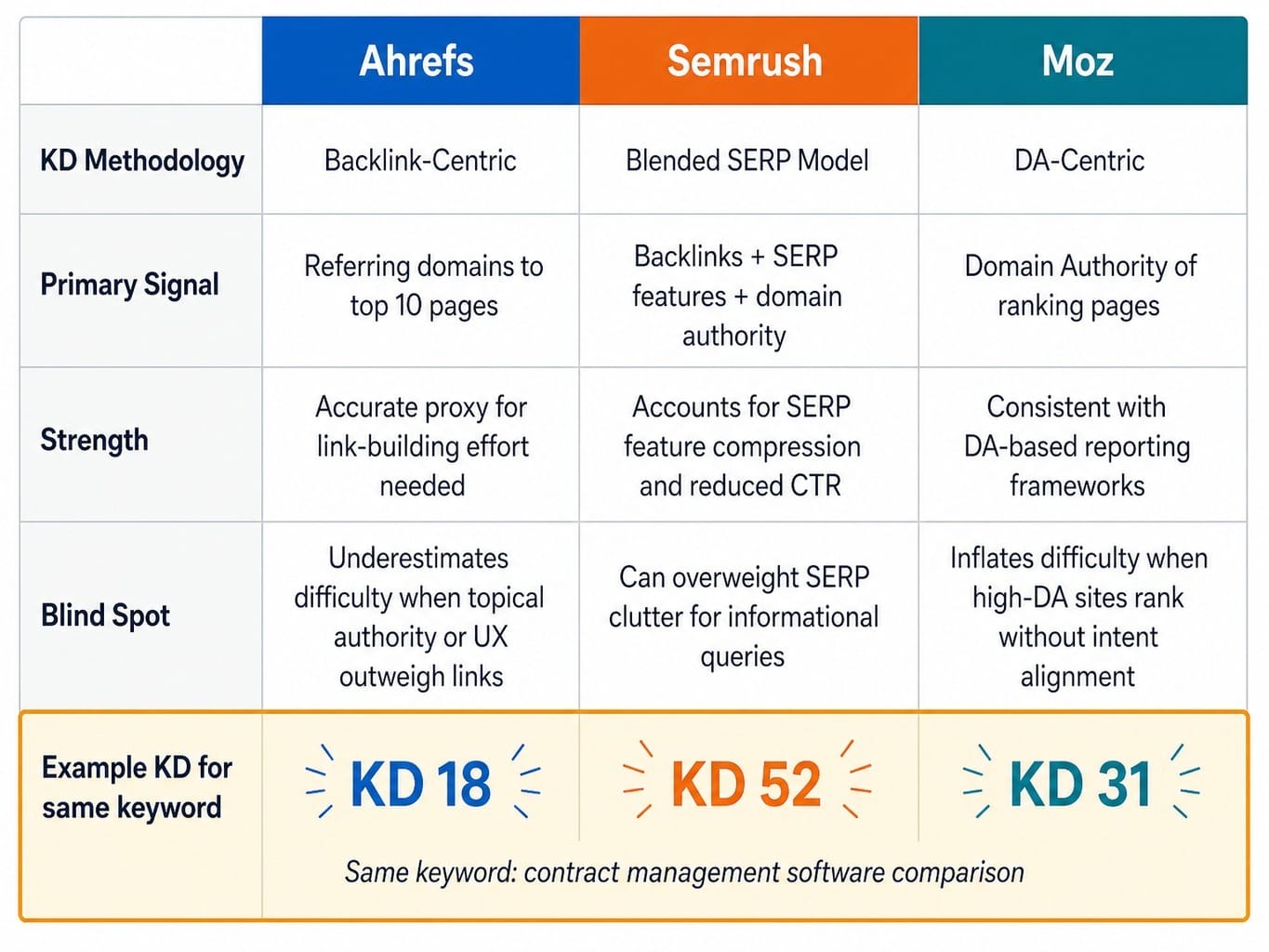
Imagine a B2B SaaS team targeting the keyword 'contract management software comparison'. Ahrefs might show a KD of 18, suggesting it's relatively easy. Semrush might show a KD of 52. The Semrush score is higher because it sees a SERP crowded with four ads, a featured snippet, and a 'People Also Ask' box—all of which reduce the available clicks for organic results, making the keyword functionally harder to profit from, regardless of backlink profiles.
The only way to trust any KD score is to calibrate it. Export your own Google Search Console data for keywords where you already rank on page one. Compare their clicks, impressions, and CTR to the KD scores provided by the tool you're evaluating. This will give you a baseline for what a KD of 20, 40, or 60 actually means for your domain.
Read more: SaaS Keyword Research: The Revenue-First Framework for Pipeline, Not Just Pageviews
8 Ahrefs Alternatives Worth Evaluating in 2026
These eight tools are selected for their distinct workflow fits, not ranked by a generic feature list. This is a decision framework to help you find the right tool for the job you actually need to do.
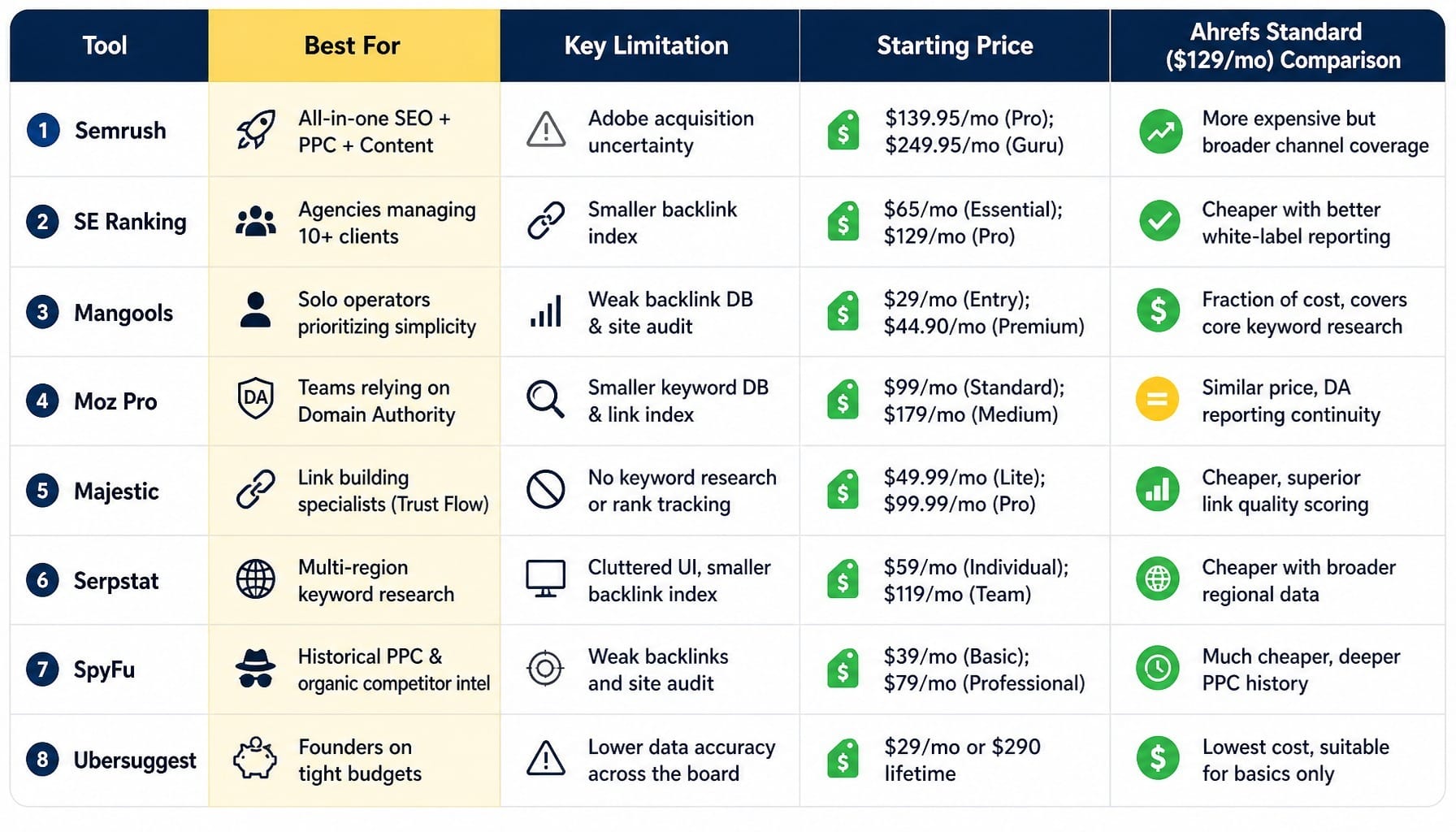
Semrush: Best for Teams That Need SEO, PPC, and Content in One Platform
Positioning: Semrush is the most direct Ahrefs competitor, but its true advantage lies in integrating SEO, PPC, social media, and content marketing intelligence into a single, unified platform.
Best for this scenario: A B2B marketing team is currently using Ahrefs for SEO and a separate tool like SpyFu for PPC keyword research and ad copy analysis. By switching to Semrush, they consolidate their stack, eliminate a subscription, and gain the ability to see how organic and paid strategies influence each other on a single dashboard. The workflow for analyzing a competitor's entire digital footprint—from top organic keywords to their best-performing Google Ads—is more seamless in Semrush. For a deeper dive into how these two platforms compare head-to-head, see our Ahrefs vs Semrush comparison.
Limitation: The recent acquisition by Adobe introduces significant uncertainty around future product direction, integration strategy, and pricing stability. Teams choosing Semrush today are betting on an unknown roadmap.
Pricing: The Pro plan starts at $139.95/mo, but most active teams will need the Guru plan at $249.95/mo to access historical data and the Content Marketing Toolkit.
SE Ranking: Best for Agencies Managing 10+ Client Reports Monthly
Positioning: SE Ranking is the strongest value proposition for agencies and consultants who need robust rank tracking, site auditing, and white-label reporting across many client projects without per-seat or per-project add-on costs.
Best for this scenario: A three-person SEO agency manages 15 client websites. They need daily rank tracking, automated weekly PDF reports branded with their logo, and a client-facing dashboard where clients can log in to see their own data. In Ahrefs, this would require multiple subscriptions or expensive add-ons. SE Ranking includes unlimited reports and flexible user roles in its core plans, dramatically reducing the operational cost of client management. Its AI Search Toolkit also provides a cost-effective way to monitor AI visibility.
Limitation: The backlink index is smaller and less fresh than Ahrefs or Semrush. For workflows heavily dependent on deep link prospecting or analyzing link velocity curves, teams may find gaps in referring domain coverage.
Pricing: The Essential plan is $65/mo, but the Pro plan at $129/mo is the sweet spot for agencies, offering more tracked keywords and deeper crawl limits.
Also Read: SE Ranking vs Semrush comparison.
Mangools (KWFinder): Best for Solo Operators Who Prioritize Simplicity
Positioning: Mangools is designed for the practitioner who finds Ahrefs overwhelming and realistically only uses 20% of its feature set.
Best for this scenario: A freelance content strategist is responsible for keyword research, on-page optimization, and basic rank tracking for five client websites. They don't need deep technical site audits, Content Explorer, or batch analysis of thousands of keywords. Mangools' suite—especially KWFinder—provides an elegant, fast interface for keyword research with accurate SERP previews and a reliable KD score, covering this core workflow at a fraction of the cost and cognitive overhead of Ahrefs. It's not a lesser Ahrefs; it's a different tool for a simpler job, and that simplicity is its main feature.
Limitation: The backlink database (LinkMiner) is significantly smaller than the major platforms, and the site audit tool (SiteProfiler) is rudimentary. It is not suitable for complex technical SEO diagnostics or large-scale link-building campaigns.
Pricing: The Entry plan is $29/mo, with the Premium plan at $44.90/mo offering higher limits for active freelancers. For a full breakdown of what each tier includes, see our guide to Mangools pricing plans.
Moz Pro: Best for Teams That Rely on Domain Authority as a Core Metric
Positioning: Moz Pro is the default choice for teams whose reporting frameworks, client expectations, or internal KPIs are built around the Domain Authority (DA) metric, which Moz invented and maintains.
Best for this scenario: An in-house SEO lead at an established company presents quarterly board reports that track DA growth as a primary success metric. Switching to a tool that uses a different authority score, like Ahrefs' Domain Rating (DR) or Semrush's Authority Score, would break historical reporting continuity and require re-educating stakeholders on a new metric. Ahrefs' DR is a logarithmic scale, making a shift from DR 30 to 40 a much larger leap than 70 to 80, a nuance that's hard to explain to a board. Sticking with Moz Pro maintains consistency.
Limitation: Moz's keyword database and backlink index are smaller than both Ahrefs and Semrush. The crawl depth ceiling of its Link Explorer means it can miss links from deeper site structures that Ahrefs or Majestic would identify.
Pricing: The Standard plan is $99/mo, with the Medium plan at $179/mo being the most common choice for small teams.
Read more: Semrush vs Moz (2026): Which SEO Tool Fits Your Team's Actual Workflow
Majestic: Best for Link Building Specialists Who Need Trust Flow Analysis
Positioning: Majestic is a pure-play specialist tool for practitioners who care more about link quality scoring than any other single metric.
Best for this scenario: A link-building consultant is evaluating a list of 200 prospective link targets. They need to quickly filter out low-quality sites. Majestic's proprietary Trust Flow (TF) and Citation Flow (CF) metrics are built for this. The TF-CF ratio provides a fast, reliable proxy for link quality; a site with high CF but low TF is likely spammy or has low editorial standards. This allows the consultant to triage opportunities far more quickly than by manually reviewing each domain or relying on a single metric like DR. For a detailed comparison of these two backlink-focused tools, see our Majestic vs Ahrefs breakdown.
Limitation: Majestic is exclusively a backlink analysis tool. It has no keyword research, no rank tracking, and no site audit capabilities. It is a powerful complement to another SEO tool, not a standalone replacement for Ahrefs.
Pricing: The Lite plan starts at $49.99/mo, while the Pro plan at $99.99/mo is required for historical index access and deeper analysis tools.
Serpstat: Best for Teams Doing Multi-Region Keyword Research
Positioning: Serpstat is the strongest Ahrefs alternative for teams executing SEO strategies across multiple countries and languages, especially outside of North America and Western Europe.
Best for this scenario: A global B2B SaaS company is expanding into the DACH, Nordic, and Southeast Asian markets. They need reliable keyword volume, KD scores, and SERP analysis across more than 15 different regional Google databases. Serpstat includes broad multi-region data access in its base plans, whereas competitors often have thinner data in non-English markets or require more expensive plans for full access. This makes Serpstat the most practical and cost-effective choice for international SEO teams on a constrained budget. If you're evaluating other options in this price range, our guide to Serpstat alternatives covers the tradeoffs.
Limitation: The user interface can feel cluttered and less intuitive than more polished tools like Ahrefs or Mangools. The backlink index is also noticeably smaller than the top-tier players, which can be a constraint for competitive link analysis.
Pricing: The Individual plan is $59/mo, with the Team plan at $119/mo providing higher limits and API access for small teams.
SpyFu: Best for Competitor PPC and Organic History Research
Positioning: SpyFu excels at one specific task that Ahrefs doesn't prioritize: providing deep, historical competitive intelligence for both paid and organic search.
Best for this scenario: A demand generation manager is preparing a competitive positioning brief. They need to see which keywords a key competitor has been bidding on for the past five years, what ad copy variations they tested, and how their organic rankings for commercial terms have shifted over that same period. SpyFu's historical database for PPC campaigns, in particular, goes back further and is more detailed than what's available in Ahrefs or Semrush, making it invaluable for strategic competitive analysis. For a broader look at tools in this category, see our SpyFu alternatives comparison.
Limitation: SpyFu is not a comprehensive SEO platform. Its backlink data is weak, and its site audit capabilities are minimal. It is a competitive intelligence tool first and an SEO tool second.
Pricing: The Basic plan is $39/mo, with the Professional plan at $79/mo offering unlimited data exports and API access.
Ubersuggest: Best for Founders Running Their Own SEO on a Tight Budget
Positioning: Ubersuggest is the accessible entry point for business owners and early-stage marketers who need to cover the basics of SEO without committing to a $100+/month subscription.
Best for this scenario: A SaaS founder, currently acting as their own marketing department, needs to identify 20-30 core target keywords, run a basic technical health check on their website, and track rankings for their domain and three main competitors. Ubersuggest provides all this functionality in a simple interface for $29/mo or via a $290 lifetime deal. It lowers the barrier to entry for fundamental SEO tasks. For a data-driven comparison of how it stacks up, see our Ahrefs vs Ubersuggest analysis.
Limitation: You get what you pay for. The data accuracy, particularly for keyword volume and backlink counts, is noticeably lower than Ahrefs. Clickstream-adjusted volume estimates can diverge significantly from reality, and the backlink database is a fraction of the size. It is not suitable for teams making high-stakes content investment decisions.
Pricing: Individual plan at $29/mo or a lifetime deal for $290.
When Stacking Two Cheaper Tools Outperforms a Single Ahrefs Subscription
Most comparison articles operate on the assumption that you must replace Ahrefs with another single, all-in-one platform. But for many workflows, a better approach is to stack two specialized, best-in-class tools. This often provides superior data for specific tasks at a lower total cost. The tradeoff, of course, is workflow friction—two logins, two data models, and no unified dashboard. Optimizing your martech stack to avoid redundancy while maximizing coverage is a discipline in itself.
Here are two effective stacks:
Stack 1: The Content & Link Building Stack
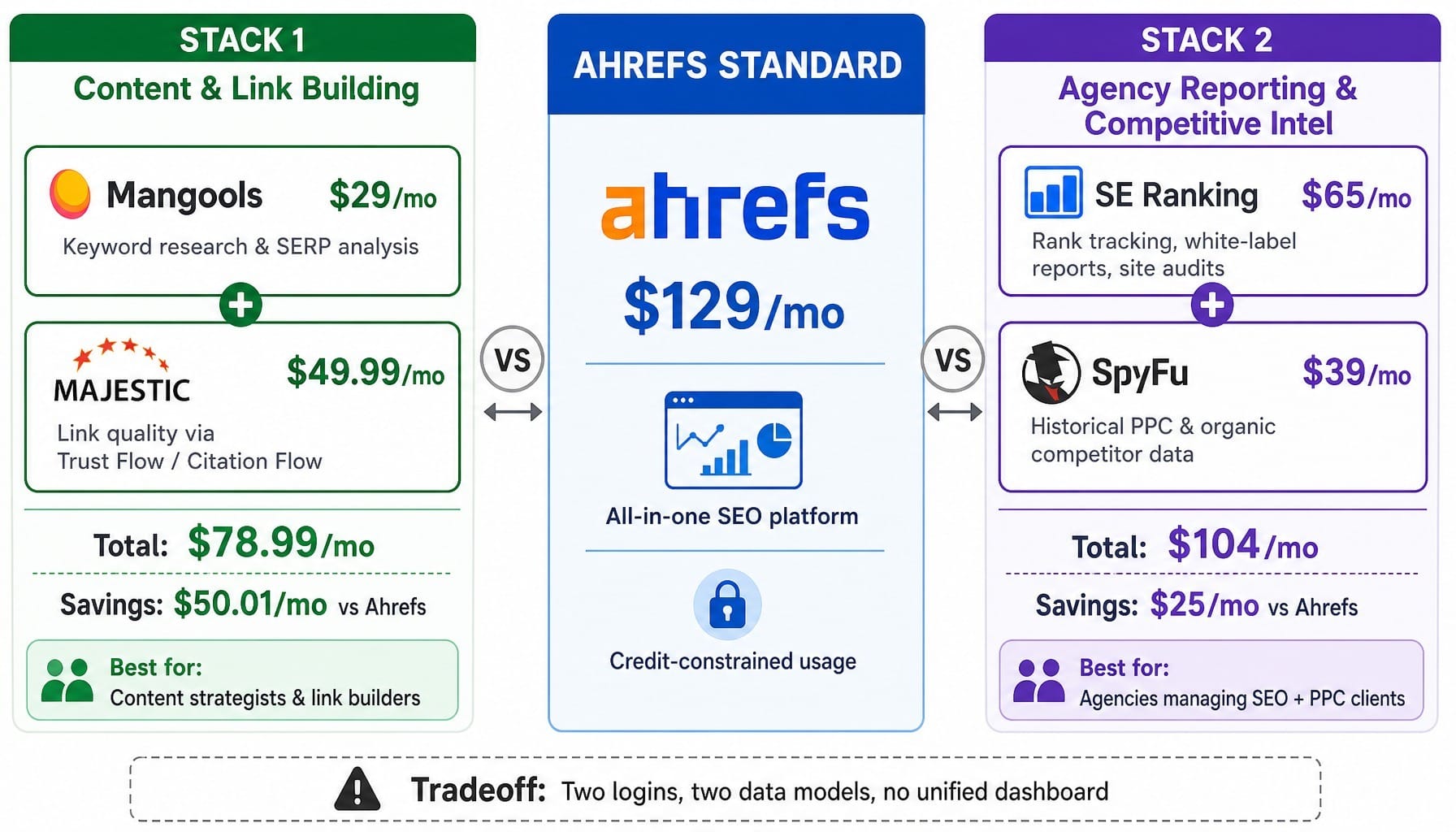
- Tools: Mangools ($29/mo) + Majestic ($49.99/mo)
- Total Cost: $78.99/mo vs. Ahrefs Standard at $129/mo
- Workflow: Use Mangools for its clean, simple keyword research and SERP analysis interface. Use Majestic for its deep backlink index and superior link quality metrics (Trust Flow / Citation Flow). This stack gives you a more nuanced view of link quality than Ahrefs' DR metric alone, paired with a keyword research tool that's faster and less cluttered for daily use. It's ideal for content strategists and link builders who don't need Ahrefs' technical site audit or Content Explorer features.
Stack 2: The Agency Reporting & Competitive Intel Stack
- Tools: SE Ranking ($65/mo) + SpyFu ($39/mo)
- Total Cost: $104/mo vs. Ahrefs Standard at $129/mo
- Workflow: Use SE Ranking for its excellent client management features—daily rank tracking, white-label reporting, and site auditing across dozens of projects. Use SpyFu for its deep historical competitive intelligence on both the organic and PPC side. This combination is far stronger for an agency that manages both SEO and paid search campaigns for clients and needs to provide insights on competitor ad spend and history.
Stacking is worth the friction only when each tool genuinely outperforms Ahrefs in its specific, designated function for your core workflow.
What If the Problem Isn't Which Tool You Pick, But What Happens After You Pick It?
You've spent weeks evaluating ahrefs alternatives. You've compared backlink indexes, debated KD scores, and maybe even settled on a two-tool stack. You finally make a choice. The result? A new dashboard. A new set of reports. A new list of prioritized actions that joins your ever-growing marketing backlog.
The core bottleneck for lean B2B marketing teams is not a lack of insight. It's the latency—the weeks or months between identifying what needs to change and actually shipping the fix. Whether it's Ahrefs, Semrush, or SE Ranking telling you to update a title tag, optimize a landing page, or build a new content cluster, the gap between the recommendation and the implementation remains entirely on your plate.
This is the execution gap that Spike AI is built to close. Instead of adding another analytics layer to your stack, Spike AI functions as the execution layer that turns insights from any tool into shipped improvements. Every week, our platform identifies the single highest-impact move across your website, SEO, and ads—and then helps you deploy it. The insight-to-implementation cycle shrinks from quarters to days. The question shifts from "What does the data say?" to "What did we ship this week?"
See how Spike AI turns SEO insights into weekly shipped improvements
Conclusion
The search for the best Ahrefs alternative is not a hunt for the tool with the most features or the lowest price. It's a search for the tool that best fits your team's specific workflow, budget, and data priorities.
As we've seen, most teams leave Ahrefs due to friction in its pricing model, a lack of trust in its KD scores for certain query types, or its expensive approach to AI search visibility—not because its core features are weak. The right replacement depends entirely on your primary pain point. Do you need the all-in-one breadth of Semrush, the agency-focused efficiency of SE Ranking, the elegant simplicity of Mangools, or the specialist depth of Majestic?
For many, the most effective solution isn't a single tool at all, but a carefully chosen stack. Ultimately, however, the real constraint on growth is rarely the tool itself. It's the gap between the insights a tool provides and your team's capacity to act on them. As search continues to fragment across traditional SERPs, AI Overviews, and conversational LLMs, the platforms that win will be those that help you execute, not just analyze.
Frequently Asked Questions
Are there any genuinely free alternatives to Ahrefs for backlink checking?
Google Search Console provides free backlink data for your own verified site but cannot be used for competitor analysis. For that, Ahrefs Webmaster Tools offers a limited free version. Beyond that, no free tool truly matches the data quality of a paid platform. Ubersuggest's free tier and Moz's Link Explorer offer a handful of free daily or monthly queries, but expect significant data gaps and limitations compared to any paid subscription.
Which Ahrefs competitors offer API access at a lower cost?
Semrush includes API on its Guru plan ($249.95/mo) with usage-based pricing. Serpstat provides API access starting from its Team plan ($119/mo), making it one of the more affordable options. SE Ranking offers API on its Business plan. While Ahrefs includes API access on all paid plans, it charges per row of data returned, which can escalate costs quickly. Always compare the per-call or per-row pricing, not just the plan cost, to understand the true expense.
Does any Ahrefs alternative support keyword research for Bing and YouTube?
Yes. Semrush offers the broadest multi-engine support, with keyword research capabilities for Google, Bing, YouTube, and Amazon. SE Ranking covers Google and Bing, with YouTube keyword tracking. Ahrefs itself also supports Google, YouTube, Bing, and Amazon. Most smaller tools, like Mangools, are Google-only. If your strategy extends beyond Google, Semrush is currently the most comprehensive option.
How difficult is it to migrate historical data from Ahrefs to another tool?
You cannot directly import Ahrefs project data, saved reports, or rank tracking history into a new platform. Migration involves exporting CSV files of your keyword lists, backlink profiles, and site audit issues before you cancel your subscription. The real cost is re-baselining your metrics. Your Domain Rating, keyword difficulty scores, and traffic estimates will all change in the new tool, breaking historical trend analysis. Plan for a 2-4 week period to establish new benchmarks.
Which Ahrefs alternative is best for enterprise SEO teams managing 50+ domains?
For enterprise-scale work, Semrush and Sistrix are the strongest contenders. Semrush's Business plan is built for large project volumes, offering multi-user permissions and robust API access. Sistrix is particularly powerful in European markets, with deep SERP visibility data and a modular pricing structure that scales well. At this level, a switch from Ahrefs Enterprise should be driven by a specific feature gap or a need for better multi-region data, not purely by cost savings.