Majestic vs Ahrefs: Which Backlink Tool Matches Your Actual Workflow (2026)

TL;DR
- Choose Ahrefs if you're a multi-channel operator needing an all-in-one SEO platform for keyword research, site audits, and directional backlink data.
- Choose Majestic if you're a link intelligence specialist needing forensic depth, unparalleled topical analysis via Topical Trust Flow, and cost-effective bulk processing.
- Trust Majestic's Trust Flow (TF) over Ahrefs' Domain Rating (DR) for assessing link quality. A low TF-to-Citation Flow (CF) ratio is a reliable spam signal that DR often misses.
- For high-volume API access and bulk data pulls, Majestic's pricing model is structurally more cost-effective than Ahrefs' credit-based system.
- Many agencies run both: Ahrefs as the general SEO platform and Majestic as the specialist layer for deep link intelligence.
Most Majestic vs Ahrefs comparisons commit a category error. They treat these as interchangeable tools competing for the same job, but they are not. Ahrefs is a broad SEO platform that includes backlink data. Majestic is a link graph intelligence system that does almost nothing else.
Comparing them feature-for-feature is like comparing a Swiss Army knife to a scalpel—the comparison only makes sense once you know what operation you're performing. The real question isn't "which is better?" It's "which surgeon are you?"
The right choice depends on your workflow identity, not on which tool has a longer feature list. This guide moves beyond vanity metrics to compare what actually matters: who each tool is built for, how their index architectures differ operationally, where their proprietary metrics can mislead you, what capabilities are truly exclusive, and what the real cost looks like at scale.
Who Each Tool Is Actually Built For
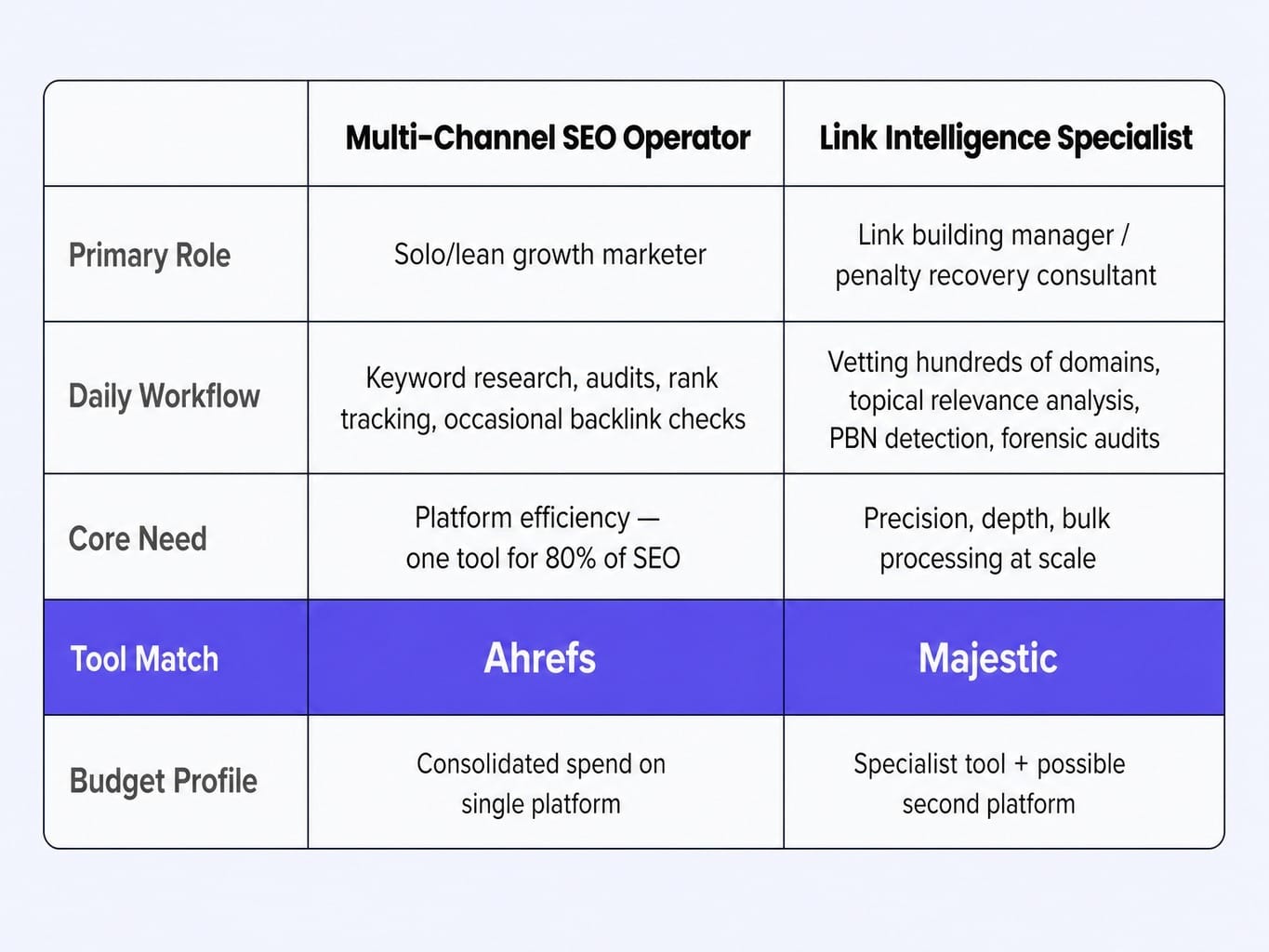
The decision between Majestic and Ahrefs is an identity question before it's a feature question. To make the right choice, you first need to identify which of two practitioner archetypes you most resemble. Are you a solo growth marketer juggling multiple channels, or a link building manager vetting hundreds of domains a week? Your answer changes everything.
The Multi-Channel SEO Operator
This is the marketer who needs directional backlink data alongside keyword research, site audits, rank tracking, and content gap analysis. You might be a solo marketer at a B2B SaaS company or part of a lean growth team where you manage SEO, content, and sometimes paid search simultaneously. You don't evaluate 200 domains a day; you check competitor backlink profiles a few times a month, monitor your own link acquisition, and need one platform that covers 80% of your SEO workflow.
For this person, Ahrefs is the default choice. It eliminates the need for 3-4 separate tools, consolidating core SEO functions into a single interface. The goal here is platform efficiency. You trade the specialist depth of a tool like Majestic for the convenience of having everything in one place. For budget-constrained teams, Ahrefs Webmaster Tools even offers a free tier for basic backlink monitoring.
The Link Intelligence Specialist
This is the link building manager, penalty recovery consultant, or agency link prospector whose daily workflow revolves around evaluating link quality at scale. Your job is to vet hundreds of domains per week, assess the topical relevance of linking sites, detect PBN patterns, and run forensic audits on link histories going back years. Precision, depth, and bulk processing are non-negotiable.
For this specialist, Majestic is the core workflow tool. Its link graph depth, peerless Topical Trust Flow categorization, and bulk analysis capabilities are purpose-built for this job. You aren't just looking at a referring domain count; you're modeling link equity and assessing risk. Many of the most sophisticated agencies run both tools—Ahrefs for broad SEO operations and Majestic for the irreplaceable depth of its link intelligence. If your job title has "link" in it, Majestic belongs in your stack.
Read more: Ahrefs vs Majestic: Which Backlink Tool Fits Your Actual Workflow (2026 Comparison)
Backlink Index Architecture: Why Raw Numbers Are Misleading
Raw index size comparisons are marketing copy. Both tools cite billions of URLs crawled, but the numbers aren't directly comparable because they measure different things. The real question is architectural: how does each tool discover, store, and surface link data? This distinction determines which tool is reliable for which job.
Imagine two scenarios. First, you're running a disavow audit for a site that received a manual penalty 18 months ago. You need to see the links that existed then, even if they've since been removed. Second, you're monitoring a competitor's digital PR campaign and need to see new links within 48 hours of publication. These two jobs require fundamentally different index architectures. "Which tool has more backlinks?" is the wrong question. The right one is, "Which tool's index matches my use case?"
Ahrefs' Crawl-First Model: Speed Over Depth
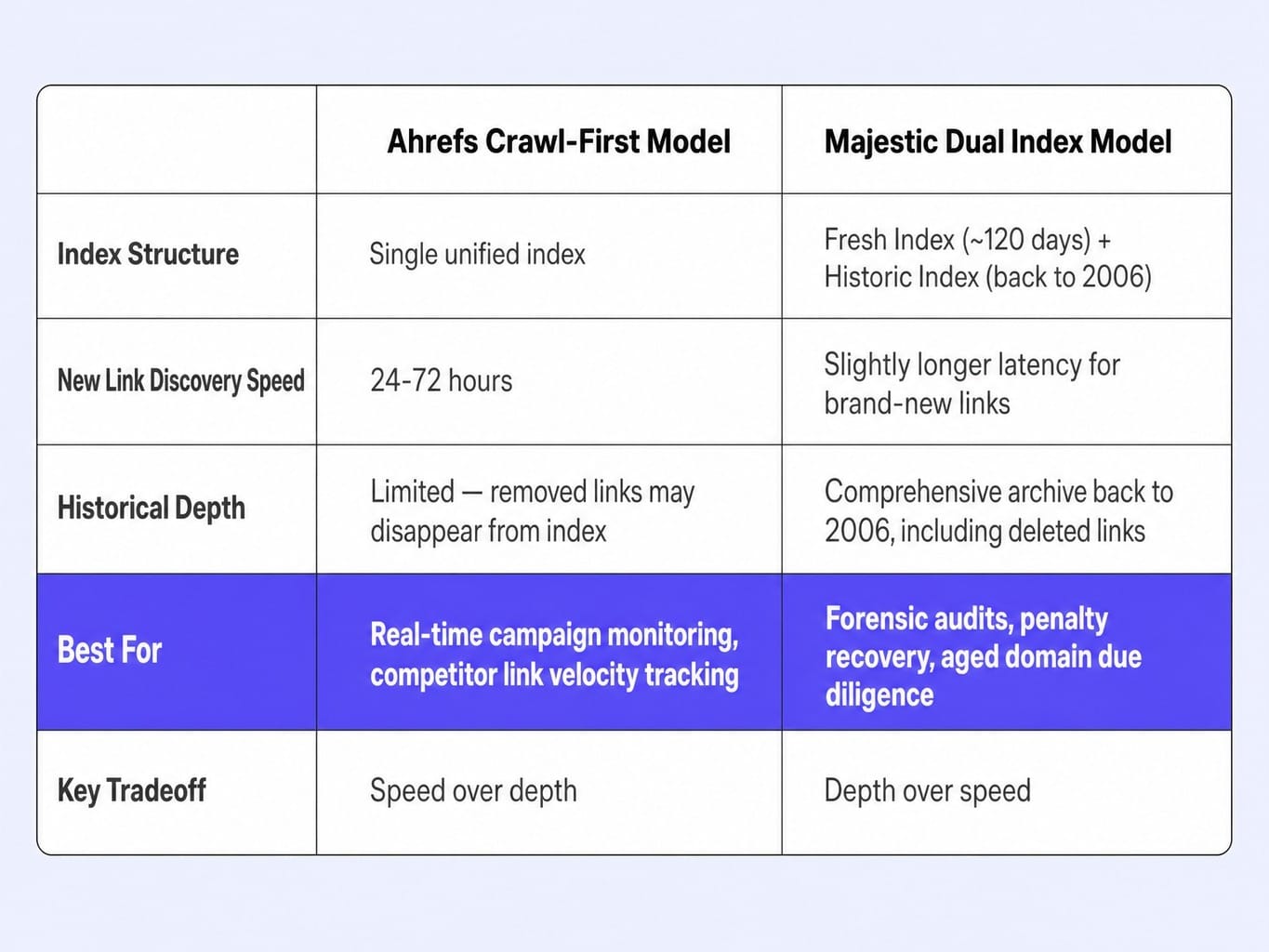
Ahrefs prioritizes crawl frequency and recency, making its index a live feed of the web's link graph. New links are typically discovered and indexed within 24-72 hours. The index is unified—there is no separate historical archive. This architecture makes Ahrefs the stronger choice for monitoring active link building campaigns, tracking competitor link velocity, and spotting new referring domains as they appear. If you're tracking a competitor's new digital PR placement, Ahrefs will likely show you the resulting links before Majestic does.
The tradeoff, however, is shallower historical coverage. Links that existed two years ago but have since been removed may not appear in Ahrefs' index. For the real-time monitoring scenario, Ahrefs delivers exactly what you need. But for a forensic audit requiring a deep look into the past, it can leave critical gaps in the data.
Majestic's Dual Index: The Historic and Fresh Split
Majestic uses a two-index architecture: the Fresh Index, which holds data from approximately the last 120 days and is updated frequently, and the Historic Index, an archive of link data going back to 2006. This is the most comprehensive link archive available anywhere.
This dual structure is irreplaceable for forensic link analysis. Whether you're performing penalty recovery, conducting due diligence on an aged domain, or understanding how a site's link profile evolved over a decade, the Historic Index is essential. It catches links that no longer exist on the live web, which is critical for building a comprehensive disavow file. The tradeoff is that Majestic's Fresh Index can have a slightly longer latency than Ahrefs' crawler for brand-new links. For the penalty audit scenario, Majestic isn't just a good option; it's the only one that provides the necessary historical depth.
Trust Flow vs Domain Rating: Where Each Metric Lies to You
Practitioners who treat Majestic's Trust Flow (TF) and Ahrefs' Domain Rating (DR) as interchangeable make expensive mistakes. They are not competing answers to the same question. DR primarily measures link popularity (quantity), while TF measures link quality (trust).
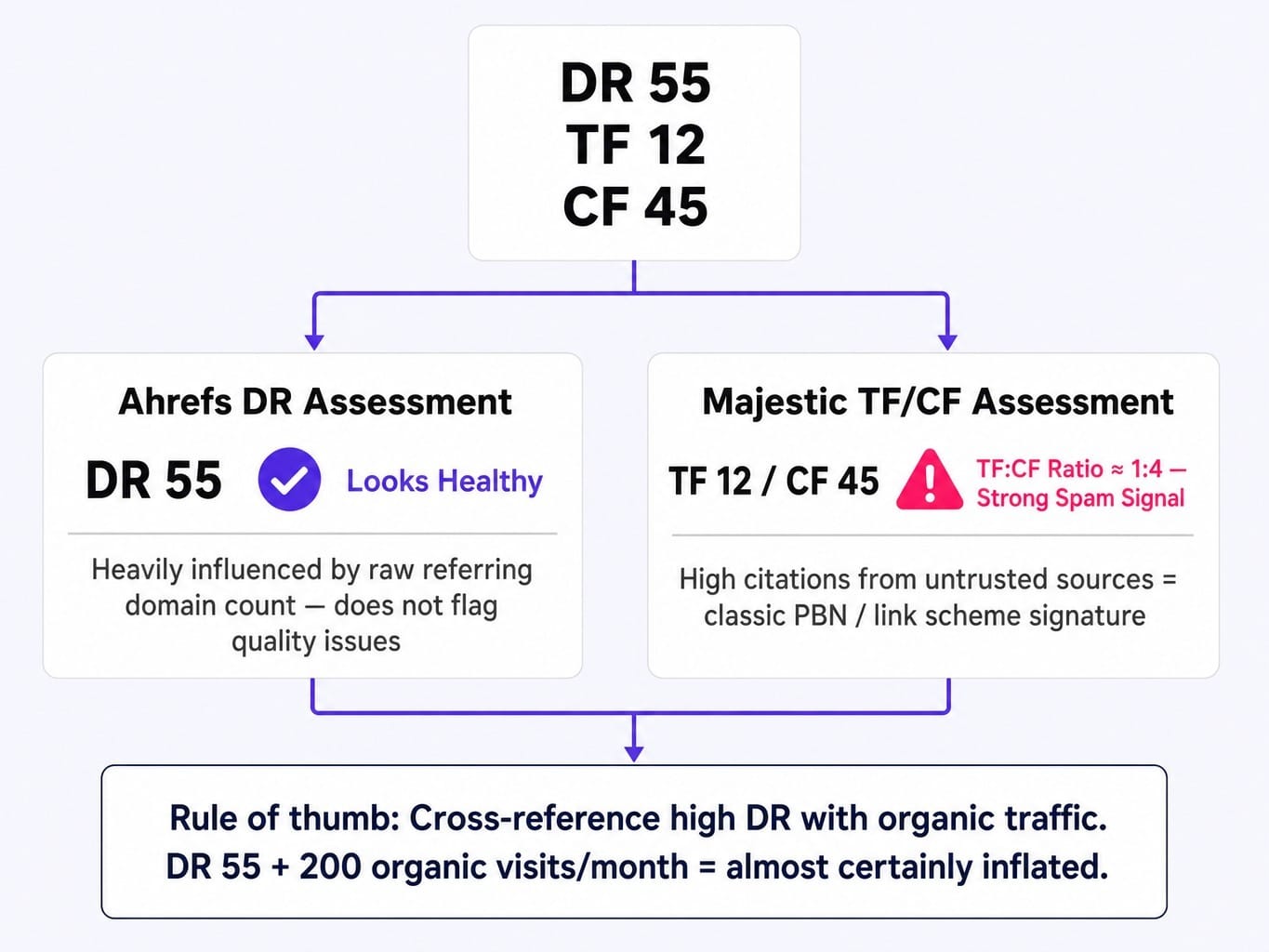
Consider this real-world example: a domain with DR 55, TF 12, and CF 45.
The DR 55 looks healthy. Most outreach teams would approve this prospect. But the TF/CF ratio of roughly 1:4 is a massive spam signal. It means the domain receives many citations (Citation Flow of 45) but almost none from trusted sources (Trust Flow of 12). This is the classic signature of a PBN or an expired domain that was rebuilt with low-quality link exchange networks. Ahrefs' DR, which is heavily influenced by the raw referring domain count, would not flag this. Majestic's TF/CF ratio catches it immediately.
DR inflation is common on expired domains, sites participating in link schemes, and any domain with a high volume of links from low-quality sources. A simple rule of thumb for any practitioner: always cross-reference a high DR with organic traffic estimates. A DR 55 site with 200 organic visits per month is almost certainly inflated.
This is where Majestic's single most defensible feature comes in: Topical Trust Flow. Majestic classifies linking domains into over 800 topical categories. For a cybersecurity SaaS company, a link from a site with a high TF in "Computers/Security" is far more valuable than a link from a site with an equally high TF in "Sports/Baseball." DR counts both links equally. Topical Trust Flow allows you to measure topical relevance at the link graph level. There is no equivalent to this granular topical link classification in Ahrefs.
Read more: Majestic vs Moz: Which Metric Actually Predicts Link Value in 2026?
Capabilities That Exist in Only One Tool
Generic feature comparisons bury the most important details. Instead of a laundry list, here are the exclusive capabilities that have no direct equivalent in the other tool—the features that justify running both platforms simultaneously.
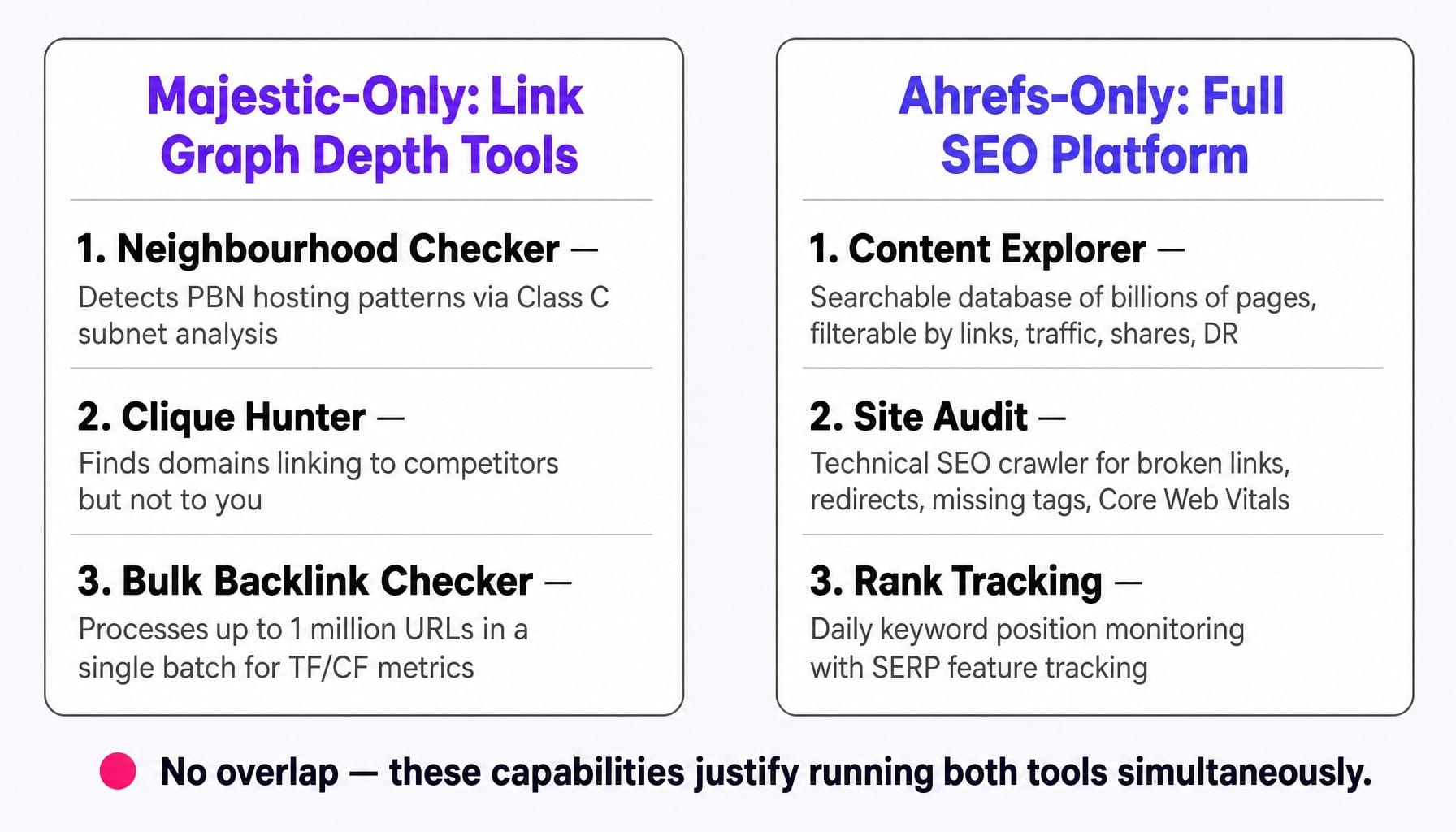
Majestic-Only: Link Graph Depth Tools
Majestic provides several forensic tools designed for deep link graph analysis that Ahrefs lacks.
- Neighbourhood Checker: Analyzes other sites sharing your IP address and, more importantly, your Class C subnet. This is essential for detecting PBN hosting patterns and understanding your "link neighbourhood" in a way no other tool can.
- Clique Hunter: Identifies domains that link to multiple competitors but not to you. This is a powerful way to find high-relevance link sources and uncover link networks across a competitive set.
- Bulk Backlink Checker: Processes up to 1 million URLs in a single batch to retrieve core metrics like Trust Flow and Citation Flow. For agencies vetting large prospect lists, this scale of batch analysis is an operational necessity not available in Ahrefs.
Ahrefs-Only: The Full SEO Platform
Ahrefs' exclusive capabilities are tied to its identity as an all-in-one platform. These features exist because Ahrefs does more than just link analysis.
- Content Explorer: A searchable database of billions of web pages, filterable by links, traffic, social shares, and DR. It's Ahrefs' strongest tool for content strategy, topic research, and digital PR ideation, with no Majestic equivalent.
- Site Audit: A technical SEO crawler that identifies broken links, redirect chains, missing tags, and Core Web Vitals issues. It functions as a built-in alternative to Screaming Frog for teams wanting everything in one platform.
- Rank Tracking: Daily keyword position monitoring with SERP feature tracking and competitor comparisons. Majestic has no keyword research or rank tracking capabilities whatsoever.
API and Bulk Economics: The Cost Calculation That Changes the Decision
Sticker price comparisons—Majestic Lite at $49.99/mo vs Ahrefs Lite at $129/mo—are misleading. They don't account for what each dollar buys at scale. For practitioners who need programmatic access to backlink data, the API economics change the calculation entirely.
Majestic's API plan starts at $399.99/month and provides a massive volume of analysis units. Ahrefs' API access begins with their Advanced plan at $449/month and operates on a credit-based system with stricter rate limiting.
Let's run the numbers for an agency needing to vet 5,000 prospect domains per month. On Majestic, this volume is easily handled within the API plan's limits, resulting in a very low cost-per-domain. On Ahrefs, the same workflow would consume API credits rapidly, likely requiring a more expensive plan or facing throttling that creates operational bottlenecks. Sticker price comparisons are one thing, but hitting an API rate limit in the middle of a critical data pull is another kind of expensive entirely.
The conclusion is clear: for pure, high-volume backlink data pulls, Majestic's pricing model is structurally more advantageous. Ahrefs returns a broader dataset per query (including keywords and traffic estimates) but at a higher cost-per-row and with export limits that punish scale.
When the Tool Decision Is Solved but the Execution Bottleneck Remains
Choosing between Majestic and Ahrefs—or even running both—solves the data access problem. It does not solve the execution problem.
You now have Trust Flow data, Domain Rating signals, backlink gap analyses, and API exports. But turning that intelligence into shipped improvements on your website still requires manual interpretation, prioritization, and implementation. For lean marketing teams, the real bottleneck was never which backlink tool to subscribe to. The bottleneck is the latency between identifying what needs to change and actually shipping that change.
This is the execution gap that even the best data tools can't close on their own. They hand you a pile of insights that still need to be translated into action, adding to a backlog that grows faster than your team can ship. This is where Spike AI operates: it ingests signals across SEO, backlink intelligence, CRO, and paid channels, identifies the single highest-impact move for qualified leads, and then executes it—weekly. Instead of exporting Majestic data into a spreadsheet, Spike AI closes the loop from insight to implementation.
See how Spike AI turns backlink intelligence into shipped improvements — weekly.
Conclusion
Majestic and Ahrefs are not direct competitors. They are different tools for different workflows, and the decision is about your operational identity, not a feature checklist.
If your workflow is multi-channel SEO operations where you need one platform to do 80% of the job, Ahrefs consolidates your stack. If your workflow is link intelligence at depth and scale, where precision and forensic capability are paramount, Majestic is purpose-built for you. Many of the most effective teams run both.
But the harder question isn't which tool to subscribe to. It's whether your team has the execution bandwidth to act on what either tool reveals. Access to data is a solved problem; turning that data into weekly releases is not.
Frequently Asked Questions
Can I use Majestic and Ahrefs together in the same SEO workflow?
Yes, and many agencies do. A common setup is using Ahrefs as the primary SEO platform (for keywords, audits, and rank tracking) and Majestic as the specialist layer for deep link quality assessment, Topical Trust Flow analysis, and bulk prospect vetting via its API.
How do Majestic's historic and fresh indexes compare to Ahrefs' single unified index?
Majestic uses two indexes: a Fresh Index (last ~120 days) and a Historic Index (data back to 2006). Ahrefs uses a single, unified index optimized for crawl speed, finding new links in 24-72 hours but with less historical depth. For forensic audits, Majestic's Historic Index is irreplaceable; for real-time monitoring, Ahrefs is faster.
Does Majestic still offer value over Ahrefs for pure link analysis in 2026?
Yes, specifically in three key areas: Topical Trust Flow categorization (800+ topics with no Ahrefs equivalent), the Neighbourhood Checker for detecting PBN hosting patterns via Class C subnet analysis, and superior API cost-effectiveness for high-volume bulk data pulls. For link-exclusive workflows, Majestic's depth remains unmatched.
Which tool is better for identifying toxic or spammy backlinks?
Majestic's TF/CF ratio is the more reliable spam signal. A domain with high Citation Flow but low Trust Flow (e.g., CF 45 / TF 12) strongly indicates manipulative link patterns. Ahrefs' DR can be inflated by the same spam that TF/CF catches, making Majestic's metrics more granular for toxicity assessment.
How do Majestic and Ahrefs pricing plans compare for a small agency in 2026?
Majestic Lite is $49.99/mo (links only), while Ahrefs Lite is $129/mo (links, keywords, audits). If an agency already uses a tool like Semrush for keywords and audits, adding Majestic for deep link intelligence is more cost-effective than switching entirely to Ahrefs. The comparison depends on your existing tool stack.