
Frase Pricing 2026: Plans, Real Costs, and Where Teams Overspend
TL;DR
- Frase Plans (Annual): Starter ($39/mo), Professional ($103/mo), and Scale ($239/mo). Pricing is volume-based, not feature-gated; all tiers get the same core workflow.
- The Real Cost: The sticker price is predictable; credit consumption is not. Overage fees for extra articles ($4-$5 each) and audits ($0.40-$0.50 each) can inflate your bill if you use Frase for both new content and refreshing old posts.
- Annual vs. Monthly: Annual billing saves 20% ($312/year on Professional), but it's a trap if your content volume is volatile. Use the trial, run one month on a monthly plan to gauge your credit burn rate, then commit to annual.
- Competitor Value: Frase's value isn't being the cheapest (NeuronWriter is), but in consolidating your stack. It replaces a separate SEO tool, AI writer, and content editor, often for a lower total cost.
- Cost-Per-Article: On the Professional plan, the tool cost is ~$2.58 per article. A manual workflow using ChatGPT + an SEO tool can cost over $16 per article in subscriptions alone, before accounting for the extra hours of manual research.
Frase's pricing page shows three clean tiers starting at $39 per month, and that's the easy part. The harder question—and the one most content teams get wrong—is what Frase actually costs. The real price emerges once you factor in credit consumption rates, the monthly-versus-annual billing decision, and whether Frase replaces enough of your existing stack to deliver a net saving.
This is not a restatement of Frase's marketing page. It's a cost analysis built for teams deciding if the tool fits their budget and, more importantly, their workflow.
We'll break down the exact plan limits, the credit and overage mechanics that catch teams by surprise, a true cost-per-article calculation, and a head-to-head pricing comparison against Surfer SEO, Clearscope, and MarketMuse. The goal is to give you a clear model for calculating your actual Frase price before you commit.
Frase Pricing Plans in 2026: Every Tier, Both Billing Cycles
Frase structures its pricing around volume—the number of articles you can create or refresh, the number of users, and the number of pages you can audit. The core feature set is consistent across all plans.
Here is a full breakdown of the plans as of 2026, including both monthly and annual billing options.
The Professional plan is flagged as "most popular" by Frase, and it's easy to see why. The jump from 1 to 3 seats and from 10 to 40 articles per month is where most in-house teams land. A solo content marketer or freelancer might find the Starter plan's 10-article limit adequate, but that number is deceptive. If you're using Frase for content audits and refreshes, those 10 "doc slots" fill up fast, because every refresh of an existing article consumes one slot. A solo marketer publishing two new articles a week could hit their limit by week three just by refreshing two older posts.
The Scale plan's primary value is the unlimited articles and audit pages, which serves high-velocity content teams and agencies managing multiple clients. The Enterprise tier is a custom-quoted solution for larger organizations needing features like white-labeling, API access, and dedicated support.
What Changes Between Plans (and What Doesn't)
Frase's pricing model is refreshingly simple in one key respect: it's volume-based, not feature-gated. This is a meaningful differentiator from competitors like Surfer SEO, where lower tiers can lose access to core capabilities.
With Frase, every plan gets the same fundamental workflow:
- Content Brief Generator
- SERP Analysis & Topic Scoring
- AI-Powered Drafting
- CMS Publishing (WordPress & HubSpot)
- Content Guard Monitoring
The levers that change between tiers are purely about scale:
- User Seats: How many people can be in the account.
- Domains: How many websites you can connect and monitor.
- Article Slots: The number of new documents or refreshes you can run per month.
- Audit Pages: The number of pages you can add to Content Guard for monitoring.
- AI Credits: The volume of AI-generated text.
This simplifies the buying decision. You're not trying to figure out if you need a specific feature; you're just forecasting your team's content velocity and choosing the plan that provides enough capacity.
How Frase Credit Economics Actually Work (and Where Teams Overspend)
Frase's monthly price is predictable, but your actual cost can diverge from the sticker price based on your credit consumption. This is where teams miscalculate their budget. The platform has three primary resources with monthly limits:
- Articles: Each new document you create or import for a refresh counts as one.
- Audit Pages: Each page you add to the Content Guard monitoring tool counts as one.
- AI Generation Credits: Used for drafting, rewriting, and other AI-powered suggestions.
On the Starter plan, you simply hit a hard stop when you reach your limits. There's no pay-as-you-go option. On the Professional and Scale plans, overage is available but must be manually enabled. Here are the rates:
- Professional Overage: $5 per extra article, $0.50 per extra audit page.
- Scale Overage: $4 per extra article, $0.40 per extra audit page.
The most common overspend pattern happens when teams use Frase for both new content creation and their content decay refresh workflow. A three-person team on the Professional plan (40 article slots) feels comfortable planning for 8 new articles a month. But then they start running Content Guard on their existing library and realize 20 refreshes are needed. Suddenly, their monthly credit burn rate jumps to 28 articles, eating up 70% of their allocation and leaving little room for ad-hoc projects. This is how a $103/month plan can quietly become a $150/month plan.
Monthly vs Annual Billing: When the Discount Is Worth It (and When It's Not)
The math is straightforward: annual billing saves you a flat 20% across all tiers. On the Professional plan, that's a discount of $26 per month ($129 monthly vs. $103 annual), adding up to $312 per year. For the Scale plan, the savings are even more significant at $60 per month, or $720 annually.
But committing to a year upfront can be a trap. The discount is only worth it if you've used Frase for at least one full billing cycle and confirmed two things:
- Your team's content velocity and credit burn rate fit comfortably within the plan's limits.
- You are unlikely to need to upgrade or downgrade within the next 12 months.
If you're still evaluating Frase's fit or if your content volume is volatile, annual billing locks you into a plan that might not be right in six months. It's a classic intentional imperfection of SaaS pricing; the discount looks great, but it removes flexibility.
Here's a simple rule of thumb: Use the 7-day free trial for a single project. Then, run one full month on a monthly plan to get a realistic measure of your team's usage. If your consumption is stable and you're not bumping against the limits, switch to annual billing in month two to lock in the savings.
Frase Pricing vs. Surfer SEO, Clearscope, and MarketMuse
Comparing sticker prices for content optimization tools is misleading because they don't all solve the same problem. Frase bundles research, AI drafting, NLP scoring, publishing, and monitoring into one subscription. Others are more specialized.
This table frames the comparison not just on price, but on the scope of the workflow each tool covers.
Frase's value proposition isn't that it's the cheapest—NeuronWriter clearly wins on that front. Its value is in workflow consolidation. A team currently paying for Surfer SEO ($99/mo) plus an AI writer like Jasper ($49/mo) is already spending $148 per month on a fragmented stack. Frase Professional at $103/month (on annual billing) consolidates that into a single, more efficient brief-to-draft pipeline. The decision isn't just about cost, but about the efficiency gained by reducing context-switching between tools.
Read more: Frase vs Clearscope in 2026: Which Tool Actually Improves Content Performance?
The Real Cost Per Article: Frase vs. a Manual ChatGPT + SEO Tool Workflow
The most common alternative to a tool like Frase isn't another direct competitor; it's a manual workflow using ChatGPT Plus ($20/month) plus a general SEO tool like Ahrefs or Semrush ($99-$129/month). This stack costs $119-$149 per month in subscriptions before you even account for the human time involved.
Let's calculate the cost-per-article for both approaches, focusing only on tool costs:
- Frase Workflow: The Professional plan at $103/month with a 40-article limit comes out to $2.58 per article.
- Manual Workflow: A stack costing $129/month that produces 8 high-quality SEO articles (a realistic velocity for a solo marketer doing manual research, outlining, drafting, and optimization) comes out to $16.13 per article in tool costs alone.
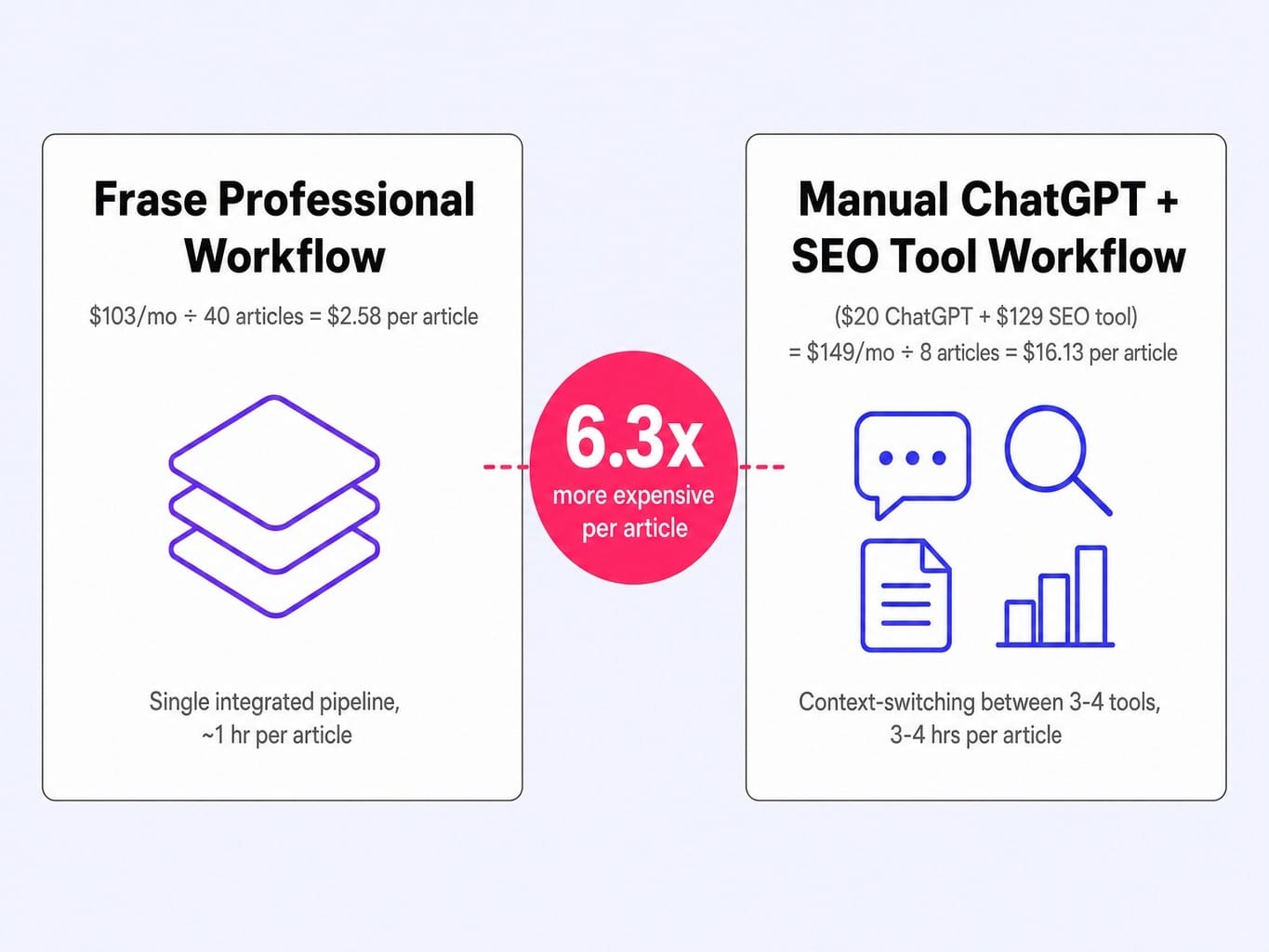
And that doesn't even touch on the time. The manual process involves bouncing between your SEO tool for keyword and SERP data, a Google Doc for outlining, ChatGPT for drafting, and then back to the Doc for editing and formatting—a 3-4 hour process per article is common. Frase's integrated pipeline compresses the research, outline, and drafting stages into a single interface, often reducing the hands-on time to under an hour.
The savings come from eliminating the friction between tools, not from removing the writer. The AI drafts still require significant human editing, judgment, and expertise to be valuable.
Read more: Frase vs MarketMuse (2026): An Honest Comparison for Teams That Actually Ship Content
When the Bottleneck Isn't the Tool — It's Shipping the Output
Content optimization tools like Frase are designed to solve the drafting problem. They reduce the cost and time required to produce a high-quality, scored document. But for most lean marketing teams, the real bottleneck isn't getting a draft; it's the execution gap between having that optimized content and shipping meaningful changes to the live website.
Frase gets you to a finished document. But the critical work of prioritizing which page to fix first, implementing changes across your site, and continuously re-measuring results still falls entirely on your plate.
This is the system failure Spike AI is built to fix. It picks up where content optimization tools stop. Instead of handing you a scored document and waiting for you to act, Spike AI identifies the highest-impact change across your entire marketing system—be it on the website, in SEO, or in ads—and then executes it. We turn your backlog of "should-fix" items into a weekly release cadence that compounds over time. It's the execution layer that turns optimized content into measurable results.
See how Spike AI ships your highest-impact changes weekly →
Your Final Decision on Frase Pricing
Frase's pricing is transparent, but calculating the true cost requires looking beyond the sticker price. The real cost-benefit analysis depends on three variables you must calculate for your own team: your actual credit consumption pattern, your choice of billing cycle, and whether Frase genuinely replaces enough of your existing tool stack to deliver a net saving.
We've walked through every plan tier, exposed the credit mechanics that can inflate costs, calculated the cost-per-article against manual workflows, and benchmarked Frase against four key competitors.
Your final action step is simple: use the 7-day free trial to run one real content project from brief to draft. That single test will tell you more about Frase's true cost and workflow fit than any pricing page ever could.
Frequently Asked Questions
Does Frase offer a free plan, or only a free trial?
Frase does not offer a permanent free plan. It provides a 7-day free trial with no credit card required, giving full access to the Starter tier's features and limits. After the trial, you must choose a paid plan to continue; there is no freemium option.
Can I downgrade my Frase plan without losing saved content?
Yes, you can downgrade your plan. All existing documents and content briefs remain accessible. However, if your number of saved documents exceeds the lower tier's monthly limit, you won't be able to create new ones until your allocation resets at the next billing cycle.
Does Frase offer agency or white-label pricing?
White-label capabilities, including branded client portals and custom domains, are only available on the Enterprise plan, which requires a custom quote. The Scale plan supports multi-domain management and role-based access, which covers most typical agency workflows short of full white-labeling.
Does Frase charge per user or per workspace?
Frase charges per plan, but each plan includes a set number of user seats (1 on Starter, 3 on Professional, 5 on Scale). Additional seats can be purchased as an add-on. There is no separate workspace fee; you manage all your domains within a single account.
Does Frase offer discounts for startups or nonprofits?
As of 2026, Frase does not publicly advertise special discounts for startups, nonprofits, or educational institutions. The only standard discount is the 20% savings for annual billing. Teams with specific budget constraints should contact Frase's sales team to discuss Enterprise options.