Your GTM Tech Stack Wasn't Built, It Accumulated. Here's How to Fix It.

TL;DR
- Your go-to-market tech stack isn't a tool problem; it's a process visibility problem. The friction killing your pipeline lives in the manual handoffs between systems, not inside the tools themselves.
- At companies between $5M and $30M in revenue, GTM stacks are rarely designed. They are accidental accumulations of individually rational tool choices made over time by different people.
- The three most common friction points are the marketing-to-sales handoff, lead scoring disagreements between tools, and attribution gaps that make it impossible to know what's actually driving revenue.
- To fix your stack, map your GTM process as a flowchart first, then identify which tool owns each step. The manual handoffs you discover are the highest-ROI places to focus your optimization efforts.
- The first and most critical handoff is from anonymous website visitor to known lead. Optimizing this conversion layer ensures every downstream tool in your stack receives higher-quality, higher-intent signals.
Picture the GTM tech stack at a typical $12M ARR B2B SaaS company. The CRM is Salesforce, chosen by the first sales hire five years ago. Marketing automation is a legacy Mailchimp account the founder set up before there was a marketing team. Analytics is whatever came bundled with Webflow. The content marketer uses a free-tier SEO tool. Someone championed a trial of 6sense for buyer intent data, but only two people know how to use it.
Nobody has ever looked at these tools as a system. They exist as line items on a budget sheet.
The result is a process held together by manual work. Leads enter the funnel through one tool, get scored by another, are handed off to sales via a Slack message, and arrive in the CRM stripped of all context about the content they engaged with or the buying signals they showed. This isn't a hypothetical—it is the default state of the go-to-market tech stack at most companies between $5M and $30M in revenue.
Your stack wasn't built; it accumulated. This article provides a framework to see it as a process flow, not a tool list, and find the exact points where deals die quietly between systems.
A GTM Tech Stack Is Not a Martech Stack and the Difference Matters
A martech stack serves the marketing function. A go-to-market tech stack spans every function involved in acquiring and retaining a customer: marketing, sales, customer success, and sometimes product. The distinction is critical.
At a 200-person company, these functions have separate budgets, tool owners, and evaluation cycles. But at a 30-person company in the $5M–$30M range, the same small group of people owns tools across the entire GTM motion. The Head of Marketing also manages the CRM. The founder still has admin access to the billing integration. The first SDR chose the outbound sequencing tool they were most comfortable with.
This cross-functional ownership is exactly why the stack becomes an accident. Nobody has the role of "GTM Architect," so nobody sees the whole picture. This is the seed of point solution sprawl—not from bad purchasing decisions, but from the absence of anyone whose job it is to see the entire flow.
Think of it this way: draw a line from the first time a prospect visits your website to the moment they are a closed-won customer. Every tool that touches that line is part of your GTM tech stack. If you can only name the marketing tools, you're looking at half the system and missing most of the friction. While the average enterprise juggles hundreds of applications, the real problem for a lean team isn't the number of tools, but the lack of a map connecting them.
Read more: B2B SaaS Marketing in 2026: The Execution Gap Most Teams Never Close
How GTM Stacks Actually Get Built at $5M–$30M Companies
At this stage of growth, GTM stacks aren't architectures; they are archaeological layers. Each tool was the right choice at the moment it was adopted, but the collection has never been evaluated as a coherent system. This creates significant tech debt in the stack, which remains invisible until it starts dragging down pipeline velocity.
The Accumulation Pattern: Right Tool, Wrong System
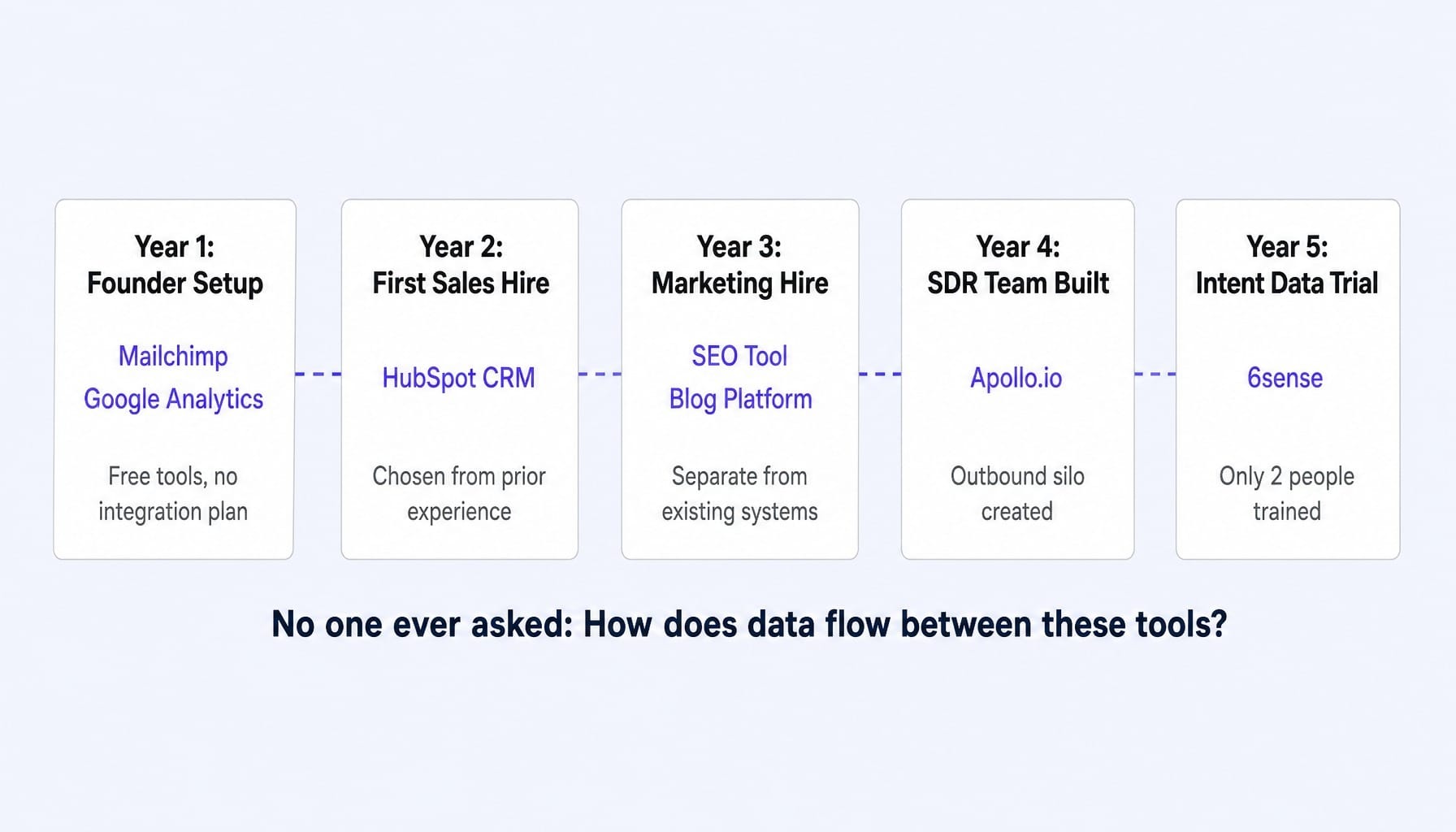
The history of your stack probably looks something like this:
- Year 1: The founder set up Mailchimp and Google Analytics because they were free.
- Year 2: The first sales hire brought in HubSpot CRM because it was what they used at their last job.
- Year 3: A new marketing hire added an SEO tool and started a blog on a separate platform.
- Year 4: An SDR team was built, and they chose Apollo.io for outbound prospecting.
- Year 5: Someone read about signal-based selling and started a trial with an intent data provider.
Each of these decisions was individually rational. The founder needed to send emails. The sales hire needed a pipeline view. The SDR needed contact data. The problem is that nobody ever asked, "How does data flow from our blog to HubSpot to Apollo.io and back again?" The dysfunction isn't caused by bad tools; it's caused by the absence of a system-level view. Each tool solved a point problem, but in doing so, created invisible handoffs between them.
Why Nobody Notices Until Pipeline Stalls
In the early days, this accidental stack works well enough. When you only have 20 leads a week, a founder can manually check if a person who downloaded a whitepaper also attended a webinar. The process gaps are bridged by human effort.
But when volume grows to 200 leads a week, that manual check disappears. The handoff between the marketing automation tool and the CRM becomes a black box. This is the operational equivalent of the dark funnel—not the unmeasurable channels, but the unmonitored space between your tools where visibility goes dark.
The symptoms appear downstream. The MQL-to-SQL conversion rate drops. Speed to lead stretches from minutes to days. Attribution becomes a matter of opinion. The team, lacking process visibility, inevitably blames the tools or the quality of the leads. The real issue, a process gap, remains hidden.
The Three Friction Points Where Deals Die Quietly
These process gaps are where revenue leaks. In our experience auditing GTM stacks, the friction consistently concentrates in three areas. These are not tool problems; they are process failures that happen in the space between tools, where ownership is ambiguous.
Friction Point 1: The Marketing-to-Sales Handoff
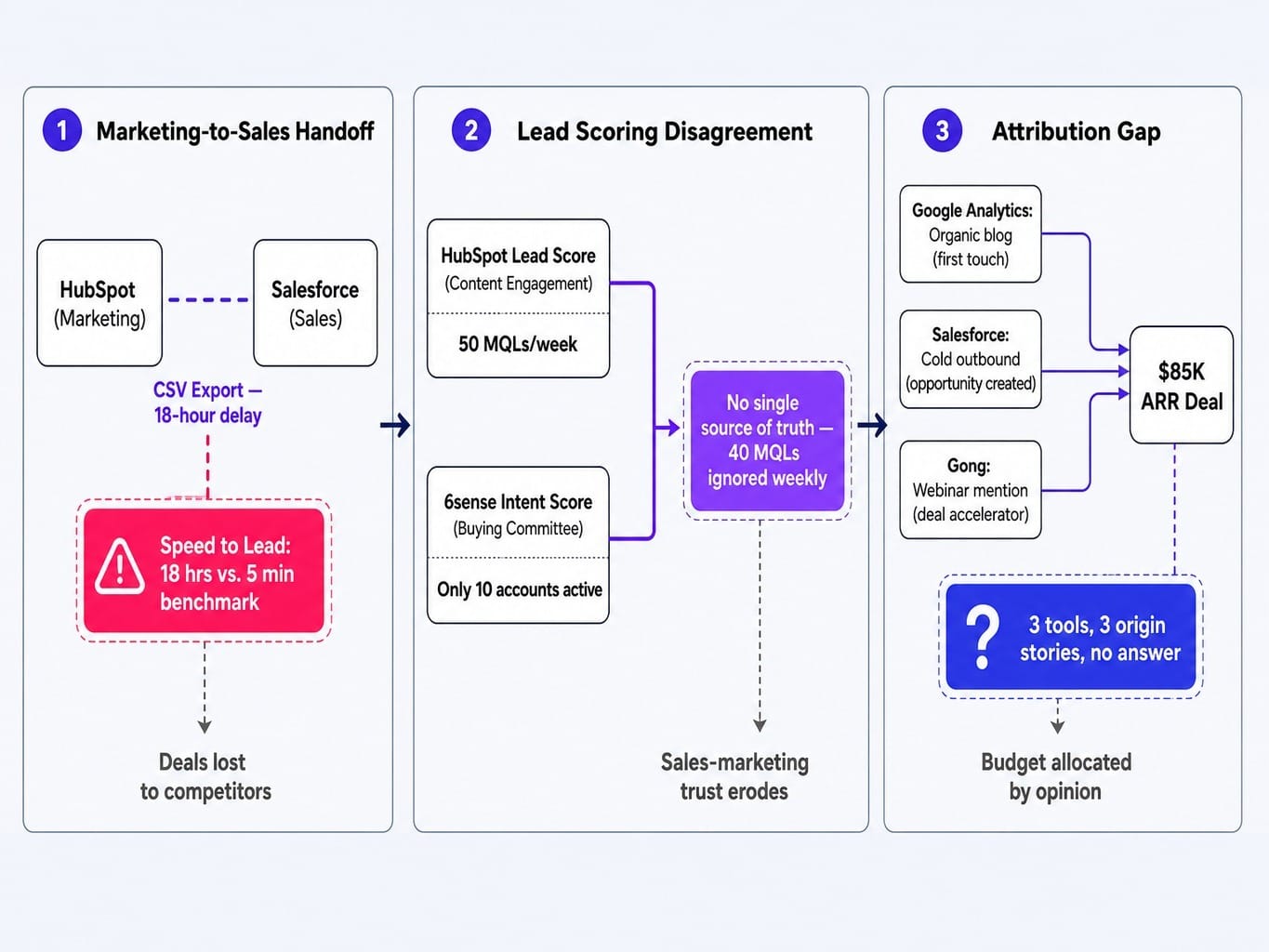
A lead fills out a demo request on your website. That submission lands in HubSpot. But your SDR team lives in Salesforce. In many organizations, the handoff is a person who manually exports a CSV from HubSpot and imports it into Salesforce every morning.
This means a high-intent lead who requests a demo at 2:00 PM on Tuesday doesn't appear in an SDR's queue until 10:00 AM on Wednesday. The speed to lead is 18 hours, not five minutes. By then, the prospect has already spoken to two competitors. As research has shown for years, responding to a lead within five minutes makes you 21 times more likely to qualify them.
This delay isn't a technology limitation; it's a process gap. Often, the integration is a simple Zapier connection that someone set up once and never monitored again. When it breaks silently—a common occurrence—it's a single point of failure that can halt your B2B sales pipeline for weeks before anyone notices. The process sits between two teams' responsibilities, so nobody truly owns it.
Friction Point 2: Lead Scoring Disagreements Between Tools
I once audited a stack where the marketing team used HubSpot's lead scoring to define MQLs based on content engagement. Their model was simple: download three assets and visit the pricing page, and you're an MQL. The sales team, however, used 6sense to prioritize accounts showing active buying committee intent.
The result was a quiet conflict. Marketing would send over 50 MQLs a week, and sales would ignore 40 of them because the 6sense panel for those accounts was cold. Marketing reported high MQL volume; sales reported low-quality leads and weak pipeline coverage. Both teams were right, according to the logic of their chosen tool.
When two different systems score the same leads using different signals, the outcome isn't "more data." It's disagreement that erodes trust. The fix isn't a more complex lead scoring model; it's a business decision about which tool and which signals represent the authoritative source for ICP fit scoring and pipeline priority. Without that decision, your teams are working from two different maps.
Friction Point 3: Attribution Gaps Across the Funnel
An $85K ARR deal closes. The CEO asks, "What marketing activity drove this?"
- Marketing checks Google Analytics: The lead's first touch was an organic blog post six months ago.
- Sales checks Salesforce: The opportunity was created after a cold outbound sequence from Apollo.io.
- The SDR checks Gong: The deal accelerated after a call where the prospect mentioned a webinar they attended.
Three tools, three origin stories, and no single source of truth.
This isn't just a reporting problem; it's a budget allocation problem. When you can't connect revenue back to specific activities, you can't make rational decisions about where to invest. You end up funding everything equally, which means you fund nothing adequately. Achieving perfect multi-touch attribution modeling is a complex goal, but establishing a single system of record for the buyer journey is an essential first step that most companies at this stage have never taken.
Read more: SaaS Marketing Metrics That Actually Inform Decisions (Not Just Dashboards)
The GTM Stack Friction Map: A Framework for Finding Where Deals Leak
The first step to fixing your stack is to see it clearly. The GTM Stack Friction Map is a 90-minute diagnostic exercise, not a technology evaluation. The goal is to see your GTM process as a system for the first time and identify precisely where it depends on manual handoffs.
We've created a GTM Stack Friction Map template you can download to guide your team through this exercise.
Step 1: Draw the Process Before You List the Tools
Most stack audits start by listing tools. This is backward. You cannot evaluate a tool's value without knowing what process step it serves.
Start by drawing your GTM process as a flowchart on a whiteboard. Be granular. Don't write "Lead Generation." Write "Prospect visits blog post via organic search," then "Prospect fills out gated content form," then "Prospect data enters HubSpot." Map every step from first touch to closed deal.
Only then, in a second pass, write the name of the tool that owns each step.
This is where the first insights emerge. You will find steps that have no tool owner (they happen in someone's head or a spreadsheet). You will find steps where two tools overlap (e.g., both your sales engagement platform and your CRM claim to own outbound sequencing). The distinction between a "tool gap" and a "process gap" is critical: a tool gap means no software covers a function, while a process gap means the function exists in multiple tools but no defined trigger moves data or ownership from one to the next. This exercise makes those gaps visible.
Step 2: Find the Manual Handoffs—That's Where Deals Die
Now, circle every transition between steps where data moves manually. This includes CSV exports, Slack messages, email forwards, or a weekly sync meeting where marketing "reviews leads with sales." These manual handoffs are the points of highest leverage.
They introduce two things that kill deals:
- Latency: The handoff takes hours or days, not seconds.
- Data Loss: Context from the previous step doesn't travel with the lead.
Imagine our hypothetical $12M company completes this map. They discover their demo request handoff is a morning CSV import (18-hour delay). Their MQL-to-opportunity creation depends on a weekly meeting (up to a 7-day delay). Their closed-won to customer success handoff is a Slack message that sometimes gets missed.
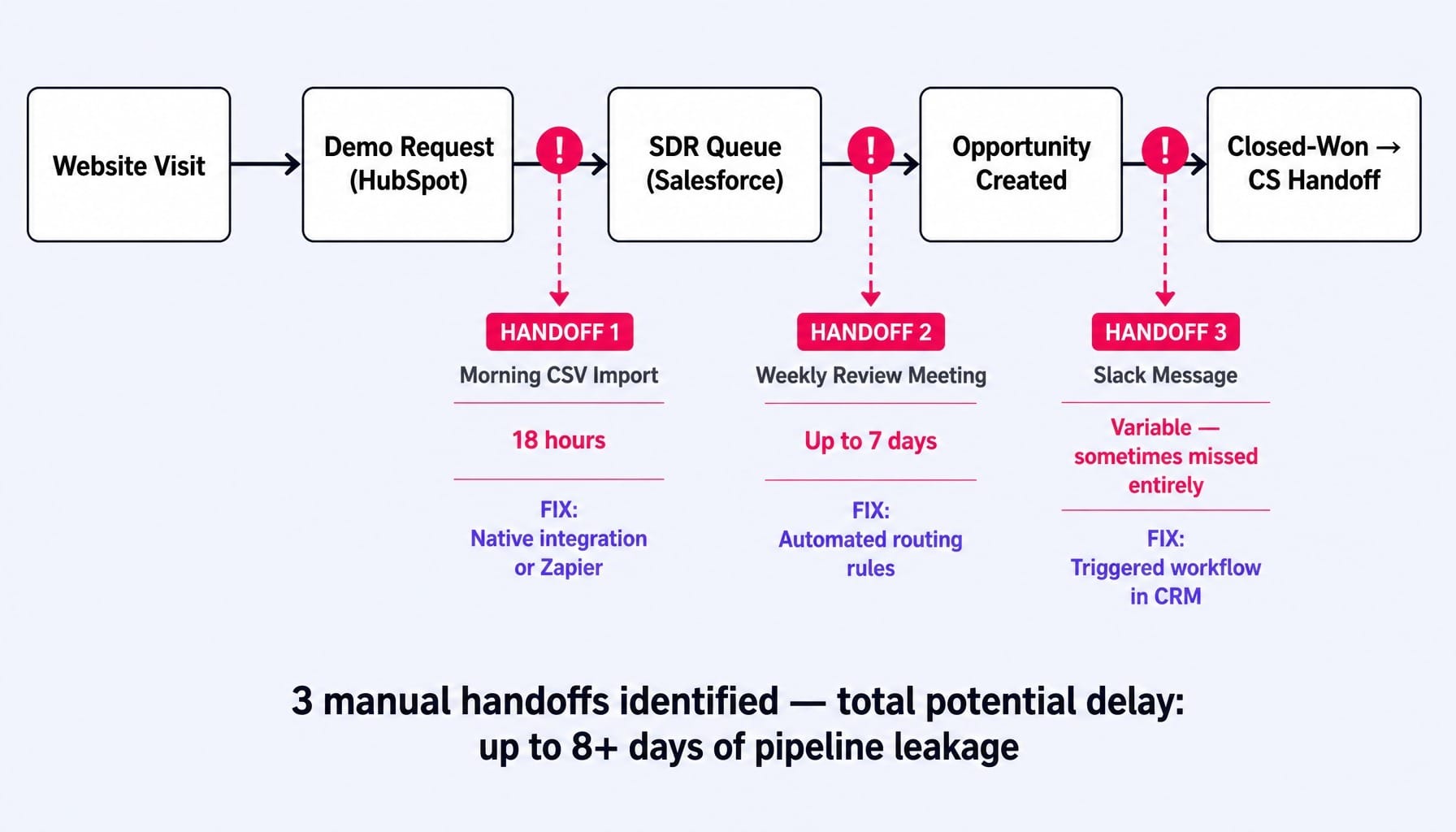
Three manual handoffs, three places where pipeline value silently leaks. Fixing these—through native integrations, reverse ETL tools like Hightouch or Census, or better workflow automation—is almost always higher ROI than buying another new tool.
When the Friction Is on the Website Itself
Your Friction Map will surface the broken handoffs between your internal systems. But it will also highlight the single most important handoff in your entire GTM motion: the one between an anonymous visitor arriving on your website and that visitor converting into a known lead. This is the top of the funnel, the entry point for your entire GTM process.
When your GTM stack has unmonitored handoff points, conversion value leaks at every seam. The losses compound silently because no single dashboard spans the full buyer journey. This is especially true for the website conversion layer, which is often running on defaults. The landing page copy hasn't been tested in months. The CTA placement was chosen by a designer, not by conversion data. Page load speed was never re-evaluated after the last redesign.
This is where Spike AI fits. It's not another point solution to add to your accidental stack. Spike AI is the system that continuously optimizes the website conversion layer, ensuring every downstream tool—your CRM, your marketing automation, your sales engagement platform—receives a higher volume of cleaner, higher-intent leads. It fixes the first and most impactful handoff by turning your website from a static brochure into a dynamic, self-optimizing conversion engine.
See how Spike AI optimizes the conversion layer of your GTM stack. Book a discovery call.
Your Stack Is a Process, Not a Purchase Order
The most important shift is to stop seeing your go-to-market tech stack as a list of tools to be procured and start seeing it as a process to be mapped. For most teams at the $5M–$30M stage, the friction isn't in the tools themselves; it's in the unmonitored, manual handoffs between them.
Your stack accumulated accidentally, driven by a series of individually logical decisions. The GTM Stack Friction Map exercise is the first step toward treating that stack as a deliberate system. It replaces guesswork with visibility.
The next time someone on your team proposes adding a new tool, ask them to draw where it fits in the process flow first. Ask what manual handoff it eliminates or what new handoff it creates. If they can't answer, the tool won't add capability; it will only add complexity.
Frequently Asked Questions
How much should a $5M–$30M company spend on its GTM tech stack?
There's no universal benchmark, but a common range is 5–10% of revenue allocated across all GTM tooling. The more important metric is pipeline-per-dollar: divide your total stack cost by the pipeline value it generates. If adding a $500/month tool doesn't measurably increase pipeline or reduce a manual handoff, it's adding cost without value.
Should you consolidate onto a platform like HubSpot or Salesforce, or use best-of-breed tools?
At this stage, platform consolidation reduces the integration burden, which is a major benefit when a small team manages the entire stack. Best-of-breed wins only when a specific function, like outbound sequencing or intent data, is a core competitive advantage and the platform's native version is materially weaker. Default to consolidation unless you can name the specific capability gap.
What GTM stack changes are needed when moving from PLG to a sales-assisted motion?
The biggest change is adding a lead qualification and routing layer between product usage signals and sales engagement. In a pure PLG motion, the product is the funnel. In a hybrid motion, you need a system that watches product behavior, scores accounts by ICP fit and usage depth, and routes high-intent accounts to sales—without requiring sales to manually monitor a dashboard.
What is signal-based selling and what tools enable it?
Signal-based selling replaces static lists with real-time buying signals—like job changes, funding events, or product usage spikes—to trigger outreach at the moment of highest relevance. Tools like Common Room, Koala, and Unify aggregate these signals. The key is ensuring signals flow directly into your sales engagement tool, not into another dashboard someone has to check.
How do you measure ROI on individual tools in a GTM stack?
Isolating ROI per tool is nearly impossible because they operate as a chain. A better approach is to identify which process step each tool owns, then measure the conversion rate and latency at that step. If your outbound tool sends 1,000 emails and generates 12 meetings, that's a measurable output. If your CRM can't tell you how long leads sit before first contact, the tool is failing its process role.
How do AI agents fit into a go-to-market tech stack?
AI agents are emerging as a new layer that automates the manual handoffs the Friction Map identifies—like data enrichment, lead routing, and CRM hygiene. The risk is adding an AI layer on top of a process you haven't mapped, which just automates the wrong things faster. Map your process first, then identify which handoffs an agent can own.