Hotjar Pricing 2026: A Breakdown of Real Costs & Hidden Trade-offs
TL;DR
- Hotjar uses modular pricing for three products: Observe (heatmaps/recordings), Ask (surveys), and Engage (interviews). Costs compound quickly if you need more than one module.
- The free plan is generous for low-traffic sites, but paid plans scale by session/response volume. When you hit your daily cap, Hotjar stops recording data; it does not charge overages.
- The real cost isn't the subscription; it's the quality of insight you get. Low-tier plans have low session sampling ratios (e.g., 3-5%), which can lead to decisions based on unrepresentative data.
- Microsoft Clarity offers unlimited free recordings and heatmaps. It's a strong replacement for Hotjar's Observe module if your budget is zero and you don't need surveys or funnels.
- Evaluate Hotjar based on your "cost-per-shipped-improvement." If data piles up in backlogs, your bottleneck is execution, not insight, and a different tool might not solve the core problem.
Hotjar pricing starts at €0 on its free plan and scales to €213+/month per module across three separate products—Observe, Ask, and Engage—with annual billing cutting costs by roughly 20%. Since Hotjar merged into Contentsquare in mid-2025, pricing now lives under the Contentsquare umbrella, though the familiar Hotjar plan names persist through 2026.
Most pricing guides list the tiers and stop there. This is a mistake. The subscription price is the smaller number; the real cost is the human bandwidth required to turn Hotjar's behavioral data into shipped improvements on your site. This guide covers every tier, the actual combined costs for real team profiles, and the scenarios where Hotjar is the wrong investment entirely.
Hotjar Pricing by Module: Observe, Ask, and Engage in One Table
Hotjar charges per module, per site—you buy Observe, Ask, and Engage independently, and each has four tiers: Basic (free), Plus, Business, and Scale. The price you pay is determined by the session or response volume you need for each specific module.
Here is a unified breakdown of all plans, tiers, and limits for 2026.
A few critical factors shape your final bill:
- Modular selection: You can buy just one module (e.g., Observe for heatmaps) without the others. This prevents paying for bloated all-in-one features you don't use.
- Per-site billing: Each domain or property is billed separately. If you manage three websites, you'll need three separate subscriptions, multiplying your total cost.
- Annual billing discount: Paying for a year upfront reduces each module's cost by approximately 20%, a significant saving for teams committed to the platform.
What Happens When You Exceed Your Hotjar Session or Response Limit
Hotjar does not charge overages. When you hit your daily session recording cap for the Observe module, it simply stops recording for the rest of the day. The same behavior applies to the Ask module's monthly response limit: data collection pauses, it doesn't trigger a higher bill.
The practical consequence of this is significant. A mid-traffic SaaS site on the €39/month Plus plan gets 100 daily sessions. If your site receives 2,000 sessions per day, you will hit your cap by 10 AM, rendering you blind to user behavior for the remaining 14 hours.
This introduces the concept of session cap burn rate. You can calculate your effective sampling ratio by dividing your plan's daily cap by your average daily sessions. In the scenario above, 100 ÷ 2,000 gives you a 5% sampling ratio. This means you are making CRO decisions based on a tiny, often unrepresentative, fraction of your traffic. As a rule of thumb, if your sampling ratio is below 20%, your recordings and heatmaps are directionally useful but statistically unreliable for high-stakes conversion decisions.
What Changed After the Contentsquare Acquisition
Hotjar merged into its parent company, Contentsquare, in July 2025. While the Hotjar brand and familiar product names persist through 2026, the underlying platform, billing, and feature roadmap now sit entirely under Contentsquare.
This has resulted in a few key changes:
- Confusing Plan Names: On the main Contentsquare pricing page, plans are now named Free, Growth, Pro, and Enterprise. However, many Hotjar-branded pages and in-app billing sections still refer to the old Basic, Plus, Business, and Scale tiers. For 2026, the Growth/Pro/Enterprise naming is the forward-looking convention.
- New Modules & Higher Spend: Contentsquare's Product Analytics was introduced as a new, separately priced module, increasing the total potential spend for teams wanting a complete analytics suite.
- Opaque Enterprise Pricing: Pro and Enterprise pricing for all modules is now hidden behind a "Contact Sales" wall. This makes it difficult for mid-market teams to budget and compare costs without engaging in a sales cycle.
Existing customers on legacy Hotjar plans are being migrated to the new Contentsquare-based plans throughout 2026, so the pricing you see today may not be what you pay in six months.
What Hotjar Actually Costs: 4 Real-World Scenarios
Hotjar's per-module pricing makes it impossible to answer "how much does Hotjar cost?" without knowing which modules you need and your site's traffic. Here are four real scenarios with their actual combined monthly costs, billed annually.
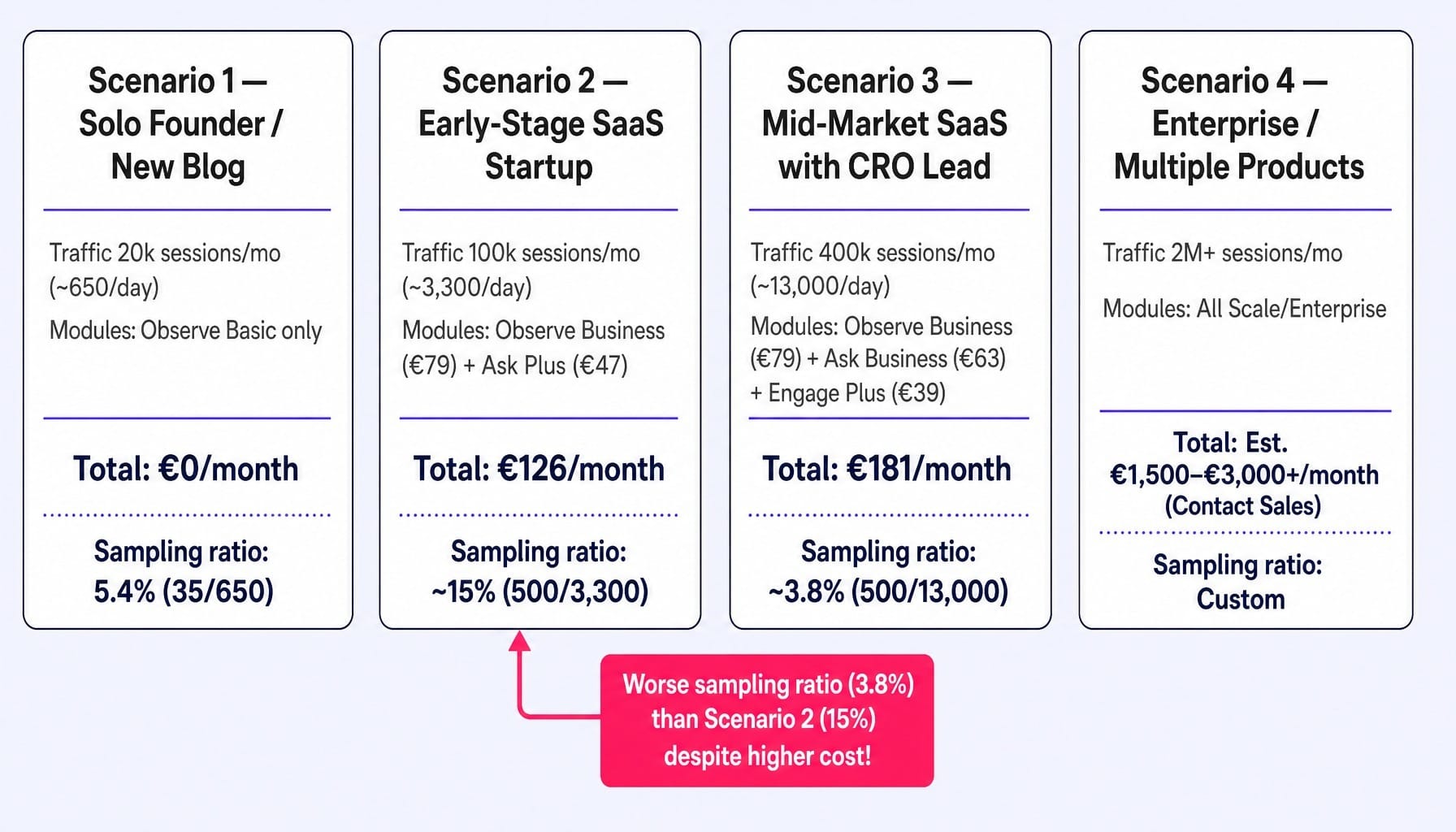
1. The Solo Founder with a New Blog
- Traffic: 20,000 monthly sessions (~650/day)
- Needs: Basic heatmaps to see where people are clicking.
- Modules: Observe only.
- Plan: Observe Basic (Free)
- Total Annual Cost: €0/month
- Verdict: The free plan is perfect. It provides unlimited heatmaps and enough session recordings (35/day) for initial validation. At this scale, paying is unnecessary.
2. The Early-Stage SaaS Startup
- Traffic: 100,000 monthly sessions (~3,300/day)
- Needs: Recordings to debug user issues and surveys to gather NPS.
- Modules: Observe + Ask
- Plans: Observe Business (€79/month) + Ask Plus (€47/month)
- Total Annual Cost: €126/month
- Verdict: This combination provides a solid foundation. The team gets 500 daily sessions (a ~15% sampling ratio) and 250 survey responses per month. They are still missing the people and processes to act on this data consistently.
3. The Mid-Market SaaS with a CRO Lead
- Traffic: 400,000 monthly sessions (~13,000/day)
- Needs: Deeper behavioral analytics, funnel analysis, and regular user interviews.
- Modules: Observe + Ask + Engage
- Plans: Observe Business (€79/month) + Ask Business (€63/month) + Engage Plus (€39/month)
- Total Annual Cost: €181/month
- Verdict: This setup unlocks funnels and higher limits. The Observe Business plan's 500 daily session cap, however, results in a low 3.8% sampling ratio, a significant data quality issue. The insight quality is questionable for the price.
4. The Enterprise with Multiple Product Lines
- Traffic: 2,000,000+ monthly sessions
- Needs: Advanced security (SSO), custom data retention, and API access.
- Modules: All three, plus Product Analytics.
- Plans: All Scale/Enterprise Tiers
- Total Annual Cost: Contact Sales (Est. €1,500 - €3,000+/month)
- Verdict: At this scale, pricing is fully bespoke. The negotiation will center on session volume, data retention periods, and the number of properties, with the final price often bundled into a larger Contentsquare platform deal.
Why the Engage Scale Price Jumps to €352/Month
You might notice the dramatic price jump from Engage Business (€79/month) to Engage Scale (€352/month). This isn't a typo. The Scale tier includes access to Contentsquare's moderated user testing participant recruitment pool.
You're no longer just paying for scheduling software; you're paying for a service that finds, screens, and schedules external users for your interviews. If you only need to schedule interviews with your own existing customers, you do not need the Engage Scale plan. It's a fundamentally different product bundled into a SaaS pricing strategy subscription.
The Hidden Cost of Low-Tier Session Sampling
The price on Hotjar's website is not the real cost. The real cost is the quality of insight you get per euro spent, and on lower tiers, session sampling degrades that quality significantly.
Consider a SaaS site with 3,000 daily sessions on the €39/month Plus plan, which includes 100 daily recordings. That's a 3.3% sampling ratio. Worse, these are not randomly sampled sessions; they are typically the first 100 sessions of the day. If your highest-intent traffic arrives in the afternoon from paid campaigns, your recordings may never capture their behavior. You're optimizing your site based on early-morning organic visitors from a single timezone.
While retroactive heatmap rendering helps (aggregating all pageviews, not just recorded ones), critical metrics like scroll depth percentiles and rage click density maps are only as good as the sessions they capture. This forces us to reframe the pricing question around a cost-per-insight framework.
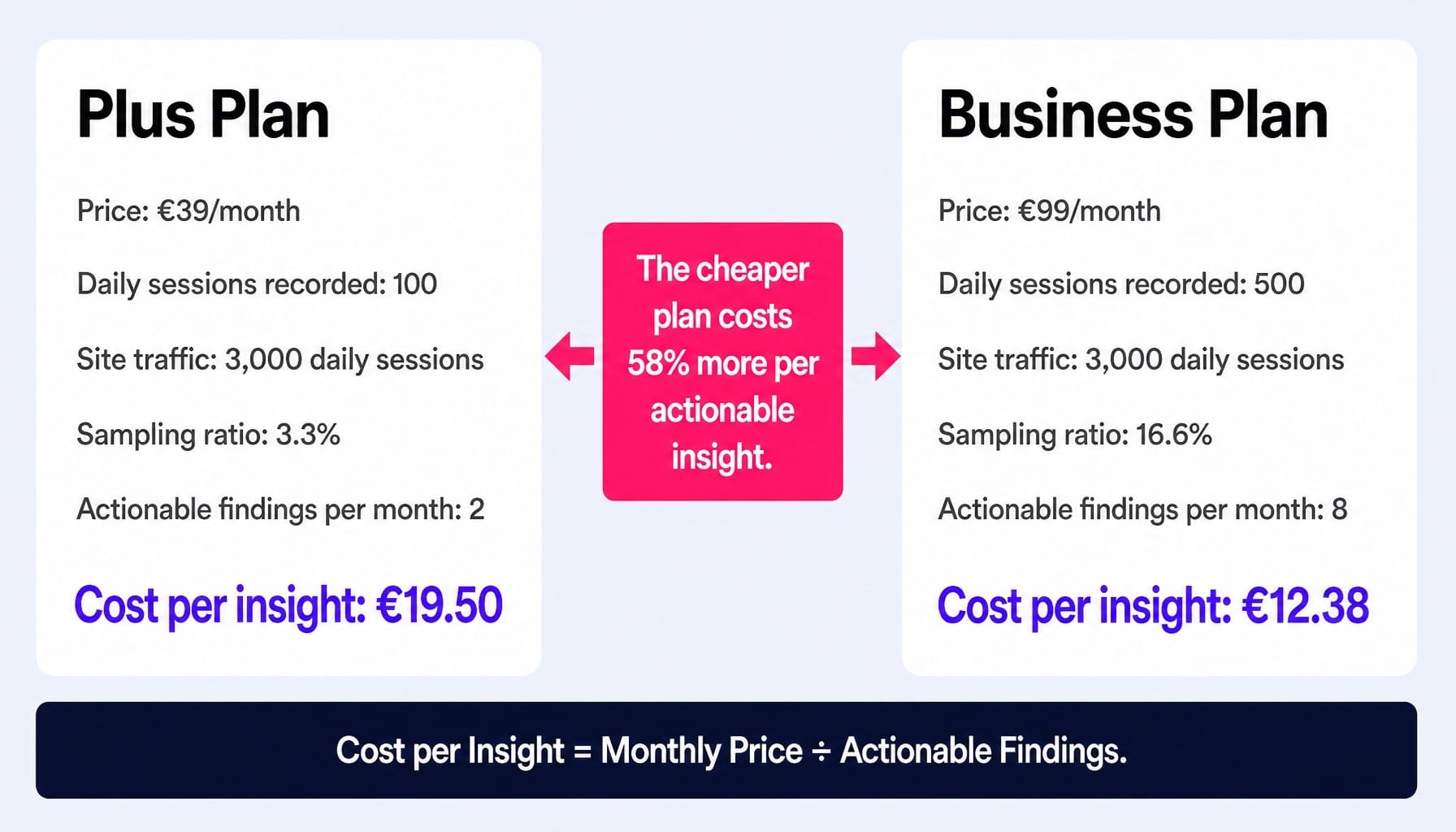
- If you pay €39/month (Plus) and the low-quality data yields 2 actionable findings, your cost-per-insight is €19.50.
- If you upgrade to €99/month (Business) and the improved sampling ratio (from 3.3% to 16.6%) gives you 8 actionable findings, your cost-per-insight drops to €12.38.
The cheaper plan was actually more expensive per outcome. The subscription fee is a distraction; the true cost is the value of the decisions you make based on the data you're allowed to see.
Read more: SaaS Marketing Metrics That Actually Inform Decisions (Not Just Dashboards)
When the Bottleneck Is Not Data — It Is Shipping Fixes
The cost-per-insight framework reveals a difficult truth for most marketing teams. The subscription fee is the smaller expense. The larger, hidden cost is the human time required to watch recordings, connect the dots, prioritize findings, and lobby for engineering resources to ship a fix.
Most teams using Hotjar end up with a growing backlog of "things we noticed in recordings" that never get implemented. The bottleneck isn't a lack of data; it's a lack of execution.
This is the exact gap Spike AI is built to close. It's not a Hotjar replacement; it's the execution layer that makes Hotjar's data actionable. Where Hotjar shows you rage clicks and funnel drop-offs, Spike AI's prioritization engine identifies which fix will move qualified leads most. Then, its execution layer ships it—every week, without engineering tickets or agency briefs.
If your real cost problem is the latency between insight and implementation, the solution isn't a cheaper analytics tool. It's a system that closes the shipping gap.
See how Spike AI turns behavioral insights into shipped improvements — every week
Who Should Choose Which Hotjar Plan
The right Hotjar plan depends on two variables: your monthly traffic volume and whether you need qualitative feedback (surveys, interviews) alongside behavioral data (recordings, heatmaps).
- For Solo Bloggers & Early Founders (<50k sessions/month):
Recommendation: Use the Observe Basic (Free) plan only.
Rationale: It provides unlimited heatmaps and 35 daily recordings, which is more than enough for initial validation.
Disqualifying Condition: Do not pay for a Plus plan. Microsoft Clarity offers unlimited recordings for free, making it a better choice if you outgrow the free tier's limits.
- For Startup SaaS Teams (1-3 people, 50k-200k sessions/month):
Recommendation: Combine Observe Business (€79/mo) and Ask Plus (€47/mo).
Rationale: This gets you a respectable session sampling rate and the ability to run NPS surveys. Skip Engage entirely.
Disqualifying Condition: If your primary need is debugging user journeys with complete data, the sampling on this plan is still a risk. You might be better off with a full-session replay tool like FullStory.
- For Growth-Stage SaaS (200k-500k sessions, dedicated CRO person):
Recommendation: Observe Business (€79/mo) + Ask Business (€63/mo).
Rationale: This unlocks funnel analysis and higher limits. The team has the expertise to analyze the data, but the low sampling ratio (~4%) remains a major concern.
Disqualifying Condition: If the team is already struggling to act on insights, upgrading their Hotjar plan will only increase the data backlog. The problem is execution, not data volume.
- For Enterprise (>500k sessions, multiple stakeholders):
Recommendation: Contact sales for a Scale/Enterprise contract.
Rationale: You need SSO, custom data retention, and dedicated support. Published plans are not designed for your scale or security needs.
Disqualifying Condition: Do not try to fit your needs into the self-serve Business plans. You will burn through session caps instantly and lack the necessary compliance features.
When Microsoft Clarity Replaces Hotjar — and When It Cannot
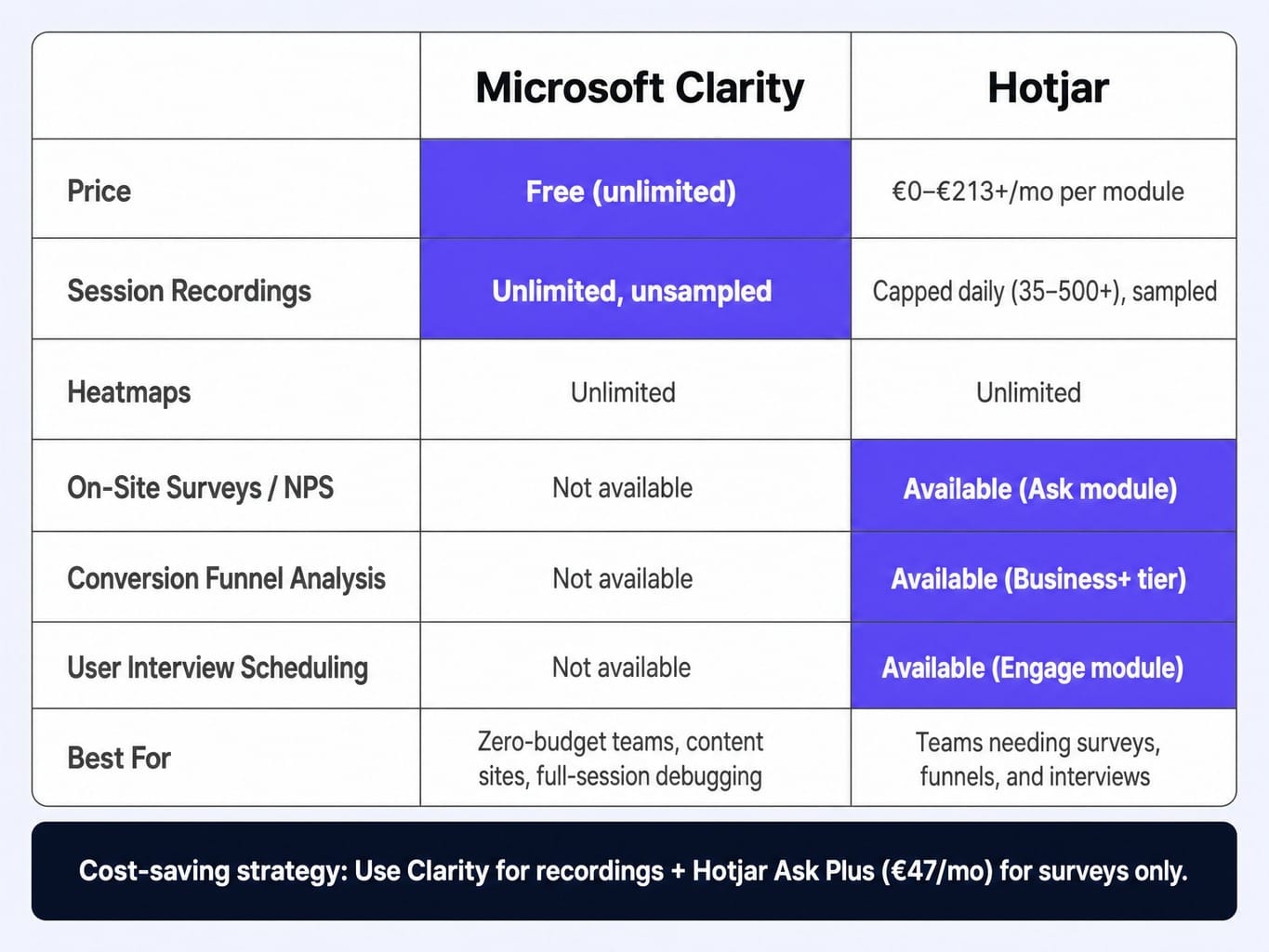
Microsoft Clarity is free, unlimited, and genuinely good—but it only replaces Hotjar if you don't need surveys, feedback widgets, or funnel analysis. It is an alternative to the Observe module, not the entire Hotjar platform.
Clarity is the better choice when:
- Your budget is zero. You get unlimited heatmaps and session recordings without daily caps or sampling concerns.
- You need 100% session capture. For debugging complex user flows or tracking intermittent bugs, seeing every session is non-negotiable.
- You run a content site. If your goal is simply to understand reading behavior and engagement, Clarity's behavioral data is often sufficient.
Hotjar is necessary when:
- You need on-site surveys. Clarity has no survey, poll, or NPS functionality. This is the biggest gap.
- You need conversion funnel analysis. Hotjar's funnels provide a structured way to visualize drop-offs between key steps. Clarity lacks this feature.
- You need to recruit and schedule user interviews. Clarity has no equivalent to Hotjar's Engage module.
A common cost-saving strategy is to run both tools in parallel: use Clarity for its unlimited, unsampled recordings, and pay for Hotjar's Ask Basic (Free) or Ask Plus (€47/mo) plan just for its survey capabilities. Teams building out their SaaS marketing tools stack should evaluate this combination before committing to a single platform.
Hotjar Pricing: Pros and Cons
Pros
- Generous free tier: The Basic plan offers unlimited heatmaps and 35 daily recordings, which is sufficient for many small projects and early-stage validation.
- Modular flexibility: Paying only for the modules you need (Observe, Ask, or Engage) avoids the bloated cost of all-in-one platforms if you only need one specific tool.
- Low onboarding friction: The installation snippet is simple, and heatmaps can render retroactively, meaning you can get value within minutes of signing up without complex configuration.
Cons
- Costs compound across modules: A team needing all three products at the Business tier will pay over €200/month, significantly more than the entry-level pricing suggests.
- Aggressive session sampling: The Plus plan's 100 daily recordings is functionally a 3-5% sample for most SaaS sites, making the data statistically questionable for CRO.
- Data retention drops sharply: The free plan's 30-day data retention makes month-over-month trend analysis impossible. You need a paid plan for any meaningful historical comparison.
- Opaque enterprise pricing: Since the Contentsquare merger, all Pro and Enterprise pricing is hidden behind a "Contact Sales" gate, making it hard for mid-market teams to budget.
Conclusion
Hotjar's pricing is straightforward at the tier level but complex in reality. The combination of modular billing, aggressive session sampling on lower tiers, and variable data retention means the sticker price rarely reflects your true cost or the value you receive.
The more important question is not "how much does Hotjar cost?" but "how much does each actionable improvement cost me, including the human time to interpret the data and ship a fix?" As Contentsquare continues to integrate Hotjar into its enterprise platform through 2026, expect pricing to shift further toward bundled contracts. Teams that calculate their true cost-per-insight now will be in the best position to negotiate, switch, or find a system that closes the gap between data and execution.
Frequently Asked Questions
Does Hotjar offer nonprofit, startup, or education discounts in 2026?
Hotjar does not publicly advertise any specific nonprofit or startup discount programs as of 2026. Its parent company, Contentsquare, has an enterprise partnership program, but this doesn't typically apply to smaller organizations. It is always worth contacting their sales team directly, as custom contracts can sometimes include discounts not listed publicly.
Does Hotjar charge per seat or per session volume?
Hotjar's pricing is based on session and response volume, not user seats. All plans include unlimited team members at no extra charge. Your cost is determined by how many daily sessions are recorded (Observe), monthly survey responses are collected (Ask), or interviews are scheduled (Engage), not by how many people access the dashboard.
Is Hotjar enterprise pricing negotiable for annual contracts?
Yes. Pro and Enterprise tiers require contacting Contentsquare sales, and pricing is highly negotiable. Levers for negotiation typically include multi-year commitments, bundling multiple modules (like Product Analytics), and committing to a higher session volume upfront. Features like SAML SSO and custom data retention also factor into the final contract price.
What data retention do you get on each Hotjar pricing tier?
Data retention varies significantly by plan. The Basic (Free) tier offers 30 days. The Plus/Growth tiers provide 3 months. The Business/Pro tiers offer 12 months. Scale/Enterprise plans come with custom, negotiable retention periods. This is critical, as any team wanting to perform quarter-over-quarter analysis needs at least a Business/Pro plan.
How does Hotjar Engage pricing work for user interview recruitment?
The lower Engage tiers (Basic, Plus, Business) provide software to help you schedule interviews with your own participants. The Engage Scale plan, at €352/month (annual), is fundamentally different. It includes access to Contentsquare's participant pool, allowing you to recruit, screen, and schedule interviews with external users, which is why it costs significantly more.