
How to Prioritize Keywords for SEO: A Scoring Framework That Replaces Gut Feel

TLDR
- Stop sorting keywords by search volume. Prioritization is a resource allocation decision, not a sorting exercise.
- Use a weighted scoring matrix to evaluate keywords across five inputs: revenue potential, conversion intent, content fit, ranking feasibility, and true traffic potential.
- Disqualify keywords before you even score them. If a SERP is saturated with AI Overviews or zero-click features, the keyword has no traffic value, regardless of volume.
- For international SEO, add three layers to your scoring: native search behavior research (not direct translation), search engine diversity, and cross-market keyword overlap.
- Your prioritization framework is not a one-time project. Treat it as a monthly operating rhythm, re-scoring keywords as your rankings and the competitive landscape change.
A marketing team exports 400+ keywords from Ahrefs, drops them into a spreadsheet, sorts by search volume, highlights the top 20, and calls it a strategy. Three months later, they've published content for eight of those keywords, ranked for two, and generated zero pipeline.
This isn't a hypothetical; it's the default operating procedure for countless teams. The system is broken. The failure isn't the research—it's the absence of a decision framework that connects keyword selection to business outcomes.
Keyword prioritization is a resource allocation problem, not a sorting exercise. The inputs that matter most are not volume and difficulty alone. They are business value, ranking feasibility, SERP economics, and your competitive position. This article provides a weighted scoring system you can apply to your next keyword list to stop guessing and start targeting keywords that actually build the business.
Why Most Keyword Lists Never Become Rankings
The default method for how to prioritize keywords for SEO—sorting a spreadsheet by search volume, descending—is the root cause of most wasted SEO effort. It systematically favors high-competition, low-intent keywords that a business has no realistic chance of winning.
Consider a common failure pattern: a B2B SaaS team targets 'project management software' (volume: 40,000, KD: 85) instead of 'project management for remote engineering teams' (volume: 800, KD: 22). They spend six months producing content for the high-volume term, never crack page two, and conclude that 'SEO doesn't work for us.'
The real failure was prioritization. Volume-first sorting ignores three critical variables:
- Business Alignment: Does the keyword align with what the business actually sells?
- Ranking Feasibility: Does the domain have the topical authority and backlink profile to compete?
- SERP Economics: Do the click-through rates, after accounting for SERP features, justify the investment?
According to an Ahrefs study of over one billion pages, 90.63% of content gets zero organic traffic from Google. A significant driver is targeting keywords the domain cannot realistically rank for. Your keyword list is not a to-do list; it's raw material that requires a decision framework based on a realistic KD-to-volume ratio and sober click curve modeling.
The Five Inputs That Actually Determine Keyword Priority
A robust keyword prioritization framework moves beyond a simple checklist of 'volume, difficulty, relevance.' It requires a complete scoring system. Most guides fail because they never explain how to weigh these factors against each other, leading to endless debate.
This framework groups five inputs into two categories: business alignment and ranking economics. Both must score well. A keyword with perfect business alignment but impossible ranking economics is a resource sink. One that's easy to rank for but drives no business value is a vanity metric. This approach borrows from portfolio theory in finance: you balance expected return against risk across your keyword portfolio, not bet everything on one high-volume lottery ticket.
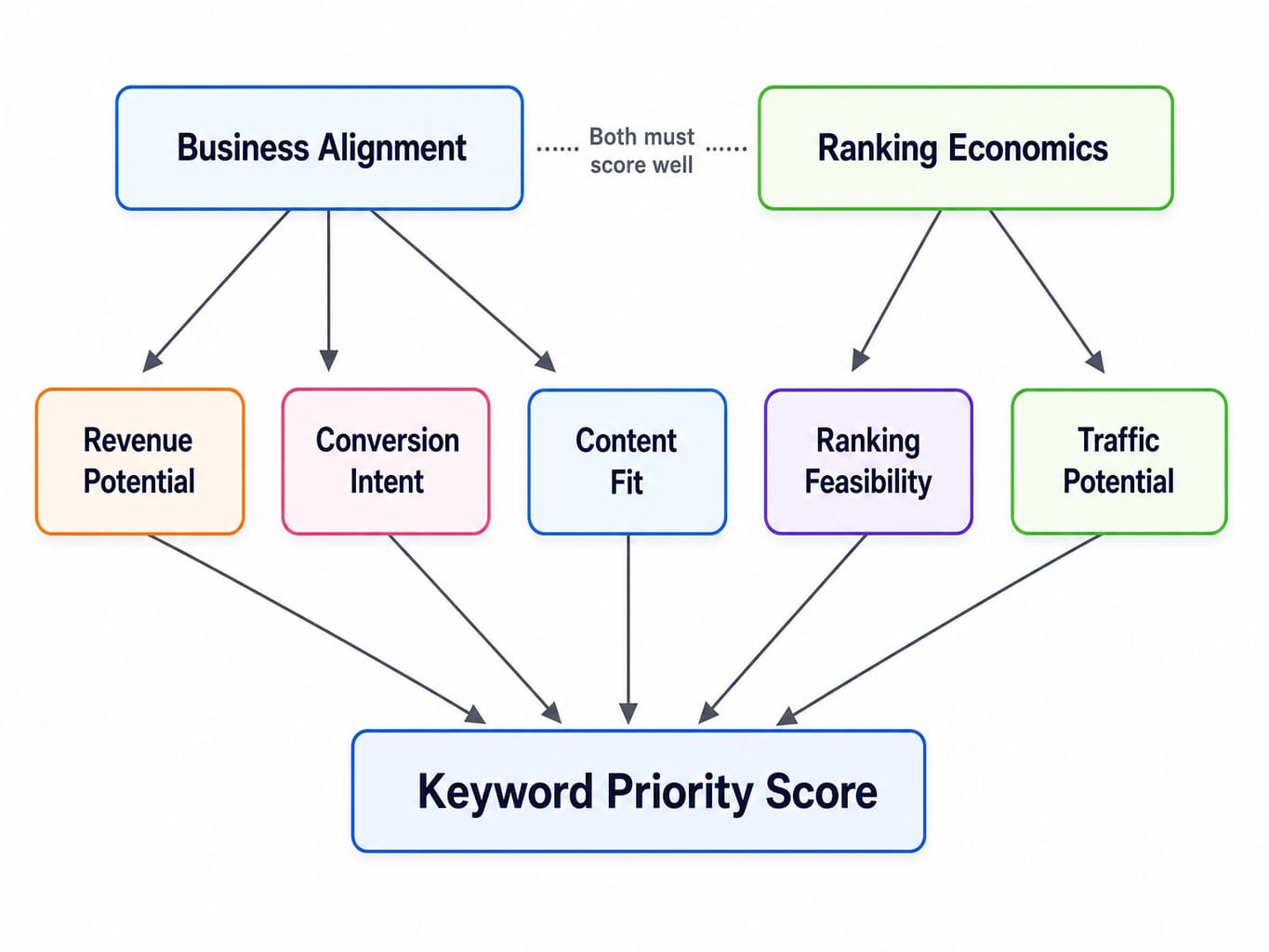
Business Alignment: Revenue Potential, Conversion Intent, and Content Fit
These three inputs determine whether a keyword matters to the business. Keywords that fail this initial filter should be deprioritized before you even look at search metrics.
First is revenue potential. Score keywords based on how directly they connect to a product or service. For a B2B analytics platform, a keyword like 'what is data analytics' scores low; it's purely informational with no buying signal. In contrast, 'best analytics platform for SaaS metrics' scores high because it signals commercial intent and aligns directly with the product. The best proxy for this is your own first-party data. If Google Search Console and your CRM show that you already generate pipeline from similar terms, adjacent keywords in that cluster get a higher revenue potential score.
Second is conversion intent. Using intent bucket tagging (Informational, Commercial Investigation, Transactional) is a start, but you must weigh them. Commercial and transactional keywords should be weighted 2-3x higher than informational ones unless your business has a documented, high-performing content-to-pipeline nurture path.
Third is content fit. Can your team create genuinely authoritative, differentiated content for this keyword? If you have no unique angle, data, or expertise on the topic, the keyword scores low. You're just creating commodity content.
Ranking Economics: Feasibility, Traffic Potential, and SERP Value
These inputs determine whether winning a keyword is realistic and worthwhile.
First is ranking feasibility. Keyword difficulty (KD) scores from tools like Ahrefs and Semrush are directional but insufficient. They primarily measure the backlink strength of current rankers but often ignore topical authority, content quality gaps, and SERP volatility. A practical feasibility check is more robust:
- Pull the top 5 results for the keyword.
- Examine their referring domain counts to assess the referring domain gap.
- Assess whether your domain has established topical relevance in that cluster.
- Check the SERP volatility index to see if rankings are stable or churning.
If the top 5 results all have 200+ referring domains and your site has 15, the keyword is not feasible in the next six months, regardless of what the KD score says.
Second is traffic potential. Raw search volume is a deeply misleading metric. You need to calculate the traffic value delta—the gap between stated volume and actual clicks after accounting for zero-click searches, AI Overviews, and other SERP features. A keyword showing 5,000 monthly searches but a 60% zero-click rate only has a pool of 2,000 potential clicks. If position #1 captures 25% of those, the realistic traffic ceiling is 500 visits, not 5,000. A SERP real estate audit is non-negotiable.
How to Build a Weighted Scoring Matrix You'll Actually Use
Knowing the inputs is one thing; having a repeatable process is another. Most teams get stuck in debate because they haven't formalized how they weight each factor. A weighted scoring matrix, similar to the PIE framework used in CRO, solves this by turning subjective debate into a structured decision.
Read more: Data-Driven CRO Strategies: Identifying Marketing Opportunities for True Conversion Optimization
It's a simple spreadsheet. Each candidate keyword gets a row. Each of the five inputs gets a column, scored on a 1-5 scale. You then apply a weight to each input based on your business's current maturity.
Let's use our B2B analytics platform example. Assume a weighting where Business Alignment and Conversion Intent are most important (Weight: 2.0), followed by Feasibility (Weight: 1.5), and finally Content Fit and Traffic Potential (Weight: 1.0).
Suddenly, the choice is clear. The highest-volume informational term is the lowest priority. The commercial investigation keyword, despite lower volume, presents a far better investment.
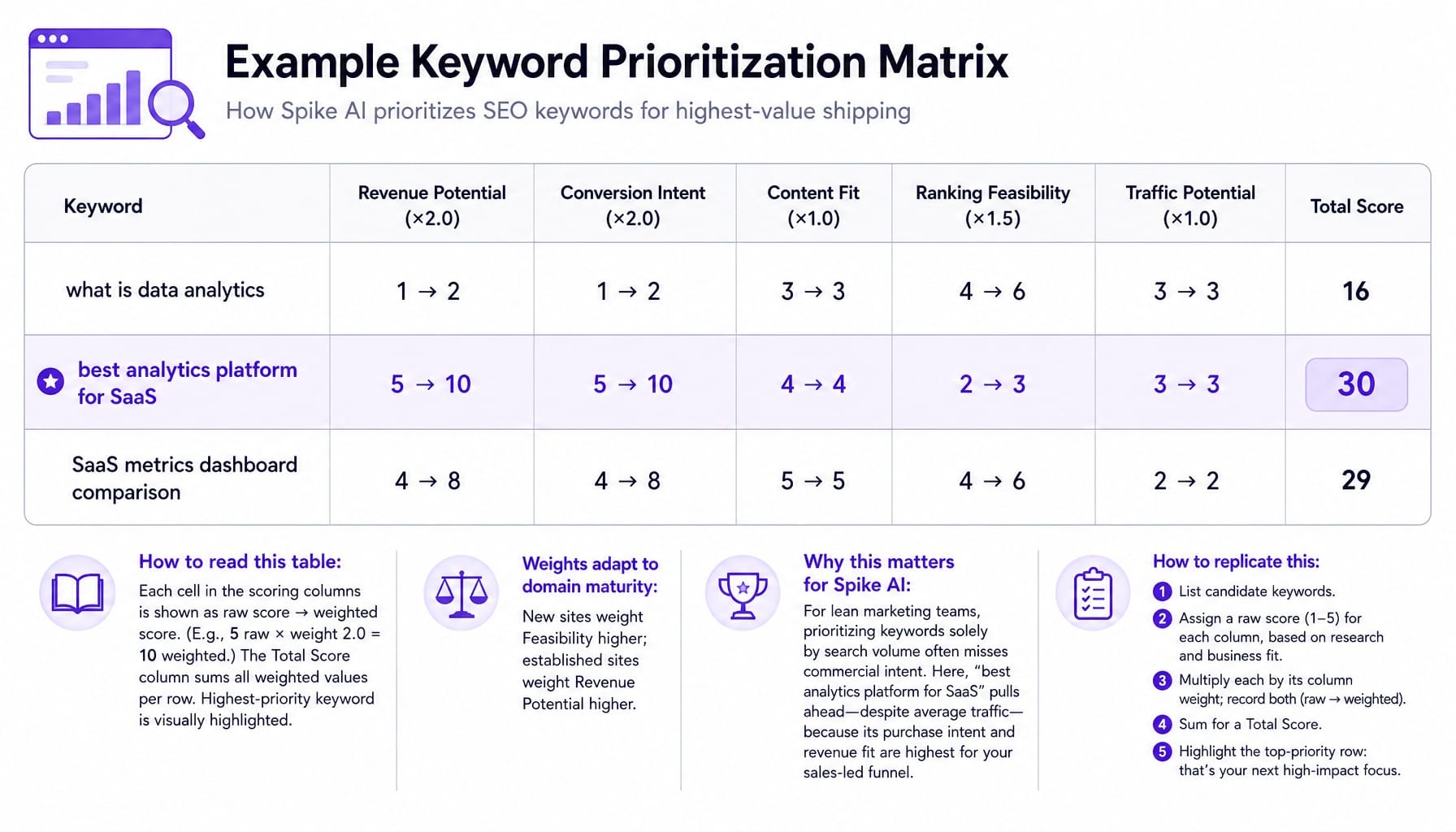
These weights must adapt. A new site should weight Ranking Feasibility higher (e.g., 2.0x) because any win builds momentum. An established site with strong authority should weight Revenue Potential higher (e.g., 2.5x) because it can afford to compete for more valuable terms. This isn't a one-time exercise; re-score your keyword list monthly as rankings and GSC data change.
Disqualify Keywords Before You Score Them
The most underrated prioritization move is subtraction. Before you even build a scoring matrix, you should remove the keywords that cannot deliver value, no matter how well you rank. This pre-scoring filter can eliminate 15-30% of your list, saving significant analytical effort.
Apply three disqualification criteria:
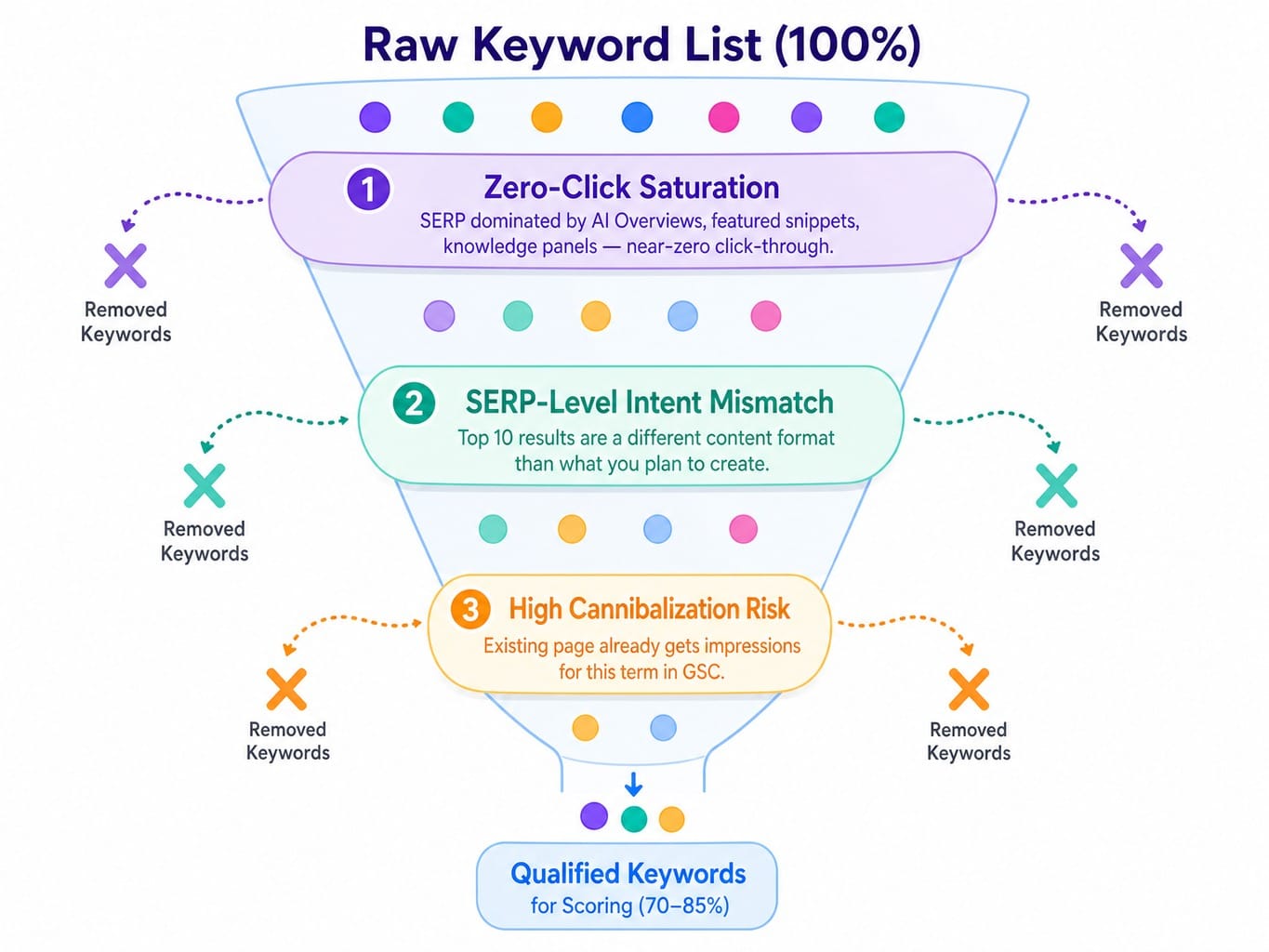
- Zero-Click Saturation. If a keyword's SERP is dominated by an AI Overview, featured snippets, knowledge panels, and "People Also Ask" boxes that fully answer the query, the traffic ceiling is near zero. A keyword like 'what is keyword difficulty' is a classic example. Google's generative response answers it completely. As research from SparkToro and Datos shows, with around 60% of Google searches ending without a click, this analysis is essential. This is zero-click cannibalization; the SERP itself is your biggest competitor.
- SERP-Level Intent Mismatch. If the top 10 results for your target keyword are all e-commerce category pages and you're planning a blog post, stop. Google has classified the intent differently than your content format. Don't fight the SERP.
- High Keyword Cannibalization Risk. Before creating new content, check Google Search Console to see if you already have a page getting impressions for that term. If an existing page is already in the running, targeting a near-synonym on a new page will split authority and hurt both. Optimize the existing asset instead.
Adapting Your Prioritization Framework for International and Multi-Market SEO
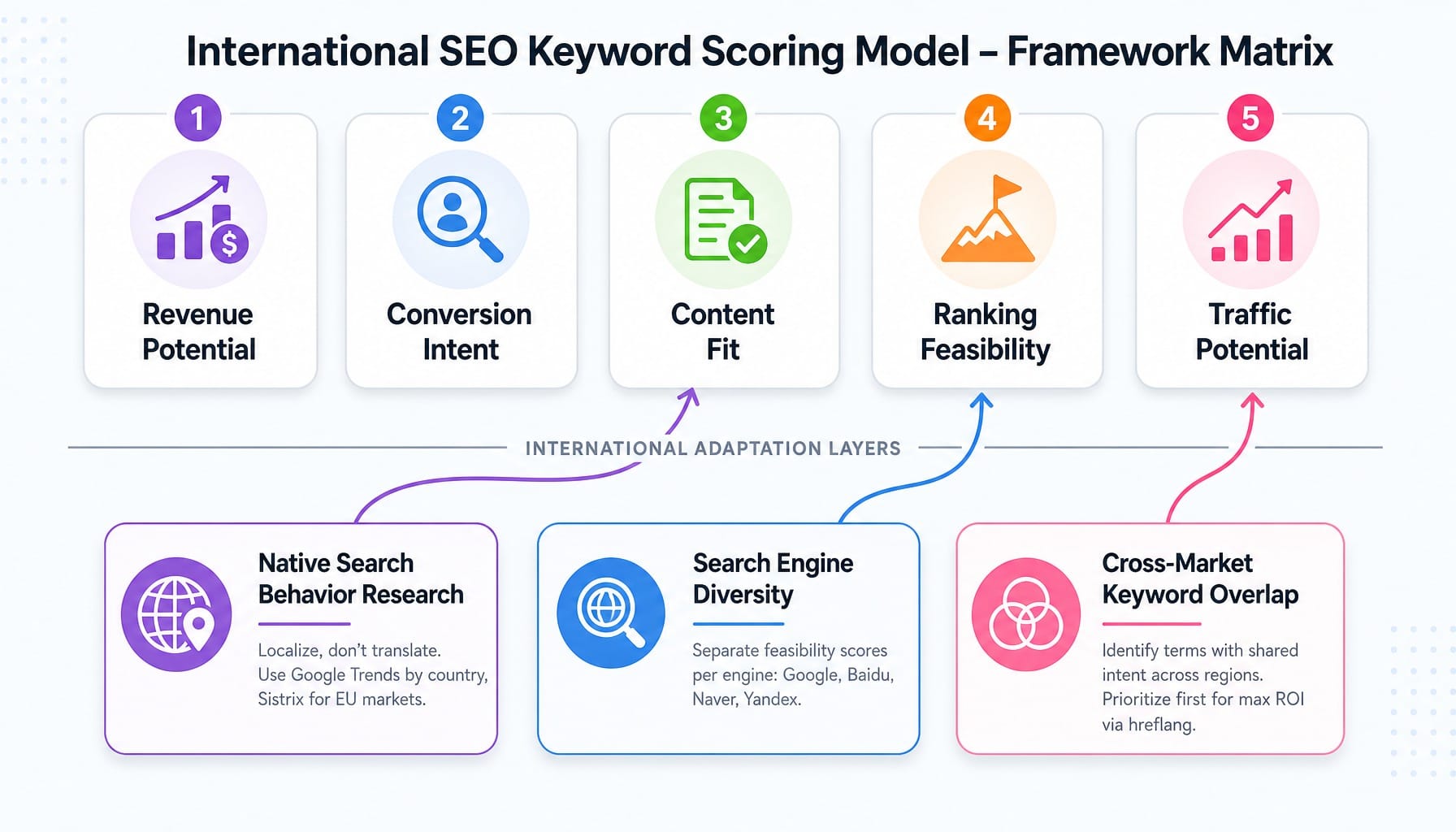
When you need to prioritize geo-specific SEO keywords for international markets, the same scoring framework applies, but with three additional layers of complexity.
First, prioritize localization over translation. Direct keyword translation fails because search behavior is culturally shaped. A B2B SaaS company expanding from the US to Germany won't find success by simply translating 'project management tool.' Native search behavior research using tools like Google Trends (filtered by country) and Sistrix (for European markets) is required to understand local phrasing and modifiers. You might find the highest-intent queries are structured completely differently.
Second, account for search engine diversity. If you're entering markets where Baidu, Naver, or Yandex dominate, your ranking feasibility assessment changes entirely. These engines have different algorithms, ranking factors, and SERP layouts. A keyword with high feasibility on Google may be nearly impossible on Baidu. You need separate feasibility columns in your scoring matrix for each target search engine, informed by data from platforms like Baidu Webmaster Tools or Naver Search Advisor.
Third, look for cross-market keyword overlap. Some keywords, especially technical terms or universal product categories, have near-identical intent across multiple markets. Prioritizing these first maximizes ROI, as one core piece of content (supported by correct hreflang implementation and a sound subdirectory vs. subdomain strategy) can serve several regions simultaneously.
When the Prioritization Is Clear but the Shipping Isn't
The framework in this article creates clarity. It replaces gut feel with a repeatable system for allocating resources. But it also reveals a new bottleneck. The scoring matrix tells you which keywords to target, but someone still has to produce the content, optimize the pages, build the internal links, monitor the SERPs, and re-run this entire analysis every month.
For lean marketing teams, this robust prioritization process can become one more thing on an already overflowing backlog. The gap between "we know what to do" and "it's done" remains.
Read more: Stop Syncing Strategy and Execution: Platforms That Unify Marketing Goals With Task Management
This is the execution gap Spike AI is built to close. It's a system that continuously identifies the highest-impact SEO moves across your keyword portfolio and helps ship them weekly. The latency between identifying the right keyword and having live, optimized content collapses from weeks to days. Spike AI acts as the execution layer that turns a prioritized strategy into compounding results.
See how Spike AI turns your keyword priorities into weekly shipped improvements
From Spreadsheet to System
The most critical shift is this: keyword prioritization is a resource allocation decision, not a sorting exercise. The teams that treat it as a repeatable scoring system—rather than a gut-feel debate—will consistently outperform those with bigger budgets and more content.
The process is clear. Start by disqualifying keywords that can't deliver value. Score the rest across business alignment and ranking economics. Weight those scores based on your domain's maturity and strategic goals. This framework only works if it's applied consistently. The compounding advantage comes from the rhythm of re-prioritizing and shipping every week, not from building the perfect spreadsheet once.
Frequently Asked Questions
Should I prioritize low-difficulty keywords or high-volume keywords first?
Neither in isolation. Prioritize keywords where high business alignment and realistic ranking feasibility overlap. For newer domains, weight feasibility higher to build early momentum and topical authority. For established domains with existing authority, weight business value higher to maximize revenue impact from your SEO efforts.
How often should I re-prioritize my keyword list as rankings change?
A monthly cadence is the minimum for the process to be useful. Pull updated ranking data from Google Search Console, identify keywords that have moved into striking distance (positions 5-15), and re-score their feasibility. A keyword that was a low priority three months ago may become a top target as your site's authority in a topic cluster grows.
What is the difference between keyword difficulty scores and actual ranking feasibility?
Keyword difficulty (KD) from tools like Ahrefs and Semrush primarily measures the backlink strength of the current top-ranking pages. Actual ranking feasibility is more holistic. It also accounts for your domain's topical authority in that specific cluster, content quality gaps you can exploit, and SERP volatility. A KD of 40 might be easy for a domain with strong topical relevance but impossible for one without it.
How do I avoid keyword cannibalization when targeting similar terms across multiple pages?
Before creating a new page, check Google Search Console to see if an existing page already gets impressions for the target term. If it does, your best move is to optimize the existing page rather than creating a new, competing one. For groups of very similar keywords, use keyword clustering to target the entire semantic group with a single, comprehensive page.
Should I localize keywords or translate them directly for international SEO?
Always localize. Direct translation preserves the words but completely misses the cultural context of how people in that market actually search. Use native-language keyword research tools and Google Trends filtered by country to discover how local users phrase their queries. A high-volume term in English may have a different phrasing or no search demand at all in another language.