
How to Prioritize Pages for SEO Optimization: A Scoring Framework That Actually Works

TLDR
- Stop prioritizing pages by type (homepage, product, blog). Instead, score every URL using a four-variable framework: Ranking Proximity, Revenue Weight, Content Gap, and Implementation Cost.
- Your highest-ROI starting point is "striking distance" pages—those ranking in positions 5-15 with high impressions but low clicks. You can find these in Google Search Console in under five minutes.
- Don't just optimize; sometimes the best move is to consolidate or remove pages. Run a cannibalization audit to find URLs competing for the same query and merge them into a single, authoritative piece.
- Factor in "AI Overview risk." Pages targeting informational queries now frequently answered by Google AI may have lower click-through potential, reducing their optimization ROI compared to commercial or transactional queries.
- Effective prioritization isn't a one-time audit; it's a continuous system. Re-run your analysis monthly as rankings shift, competitors publish, and your own content decays.
You're staring at a Screaming Frog export with 1,200 URLs. Your last SEO audit produced a backlog of 40+ recommendations. You know you need to optimize pages, but you have no system for deciding which ones first. So you default to what you've always heard: start with the homepage, then the main product pages, then maybe whatever the VP mentioned in the last meeting.
This is the prioritization problem. It's not a lack of work to do, but a lack of a repeatable system for deciding where your limited effort will compound fastest. Most teams are flying blind, guided by gut feel and generic advice.
This article provides the system you're missing. It's a scoring framework that uses data you already have in Google Search Console and Google Analytics to rank every page on your site by its actual business impact—not by what type of page it is.
Why Most SEO Prioritization Defaults to Gut Feel (and Why That Costs You)
Most teams prioritize SEO pages using one of two broken heuristics. They either follow a generic page-type hierarchy (homepage → product pages → blog posts) copied from every SEO 101 article, or they chase whichever page the loudest stakeholder mentioned last. Both approaches ignore the data that actually predicts ROI.
Consider this scenario: a SaaS marketing lead spends Q1 optimizing their homepage and top three product pages because "that's what you're supposed to do." In Q2, they discover a single comparison blog post, ranking at position 11 for a keyword with 2,400 monthly searches, was driving three times more demo requests per session than the homepage ever did. The work in Q1 wasn't wasted, but it wasn't the highest-impact work. The team focused on the pages they thought were important instead of the pages the data proved were valuable.
Page-type hierarchies are a dangerously simple proxy for what actually matters: current ranking position, conversion proximity, keyword difficulty, and revenue per session. The logic elite CRO agencies use isn't about page types; it's about modeling the expected return of each change and sequencing accordingly. Predictive conversion optimization tools formalize this same principle—forecasting the revenue impact of changes before committing resources.
Instead of asking "What type of page is this?" you need a system that asks, "What is the expected revenue delta if this page moves from position X to position Y, and how much effort does that require?" The data to answer this is already sitting in your Google Search Console and GA4 accounts. You just need a framework to interpret it.
The Four-Variable Scoring Framework for SEO Page Prioritization
Effective page prioritization isn't a dark art; it's a simple scoring system. You score each URL across four variables, then sort by the composite score. That's your priority list.
The four variables are:
- Ranking Proximity: How close is the page to a position that drives meaningful click-through?
- Revenue Weight: How much business value does the page's target query carry?
- Content Gap Magnitude: How much improvement does the page need to compete with the current SERP winner?
- Effort Estimate: How much work does the optimization actually require?
Variables 1 and 2 determine the opportunity size. Variables 3 and 4 determine the execution cost. The ratio of opportunity to cost is your priority score. This is how you move from a random backlog to a revenue-driven roadmap. Let's break down how to score each variable.
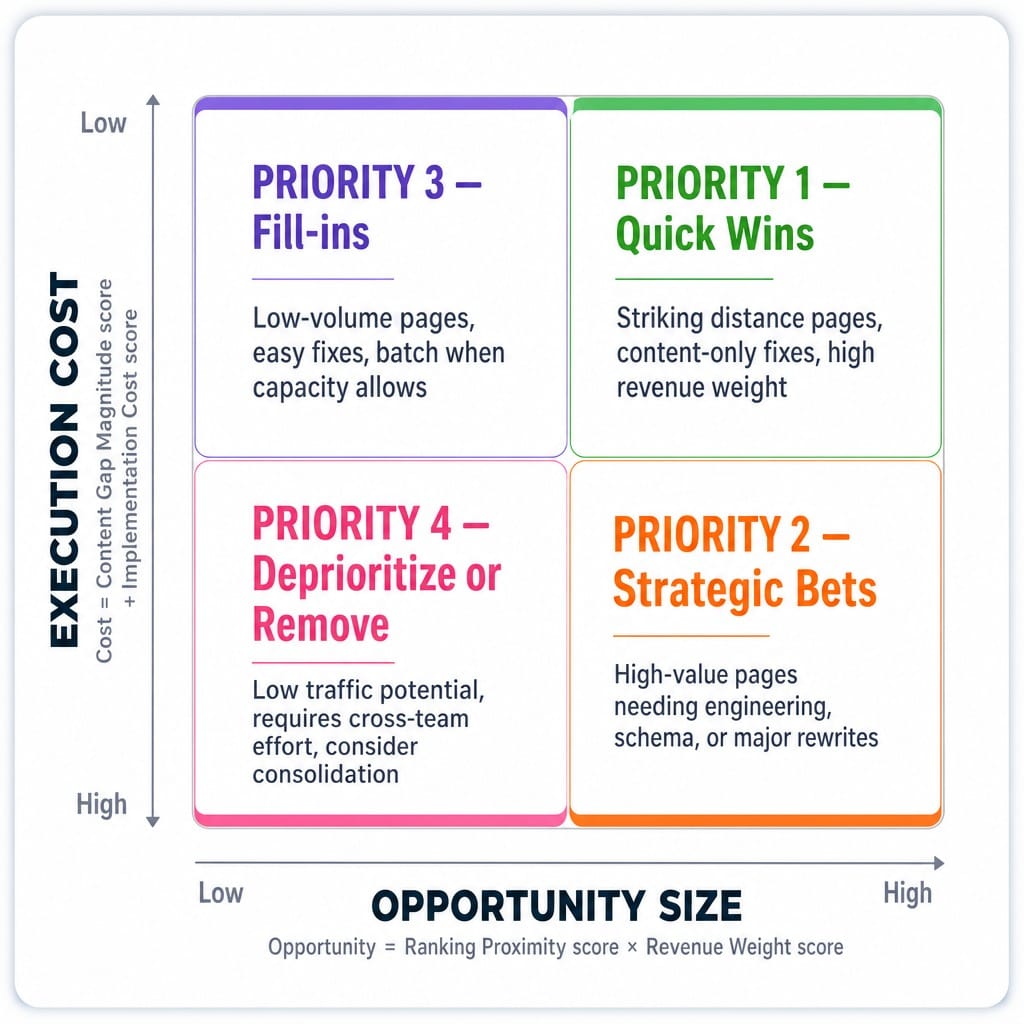
Scoring Opportunity: Ranking Proximity and Revenue Weight
Ranking proximity is the most predictive variable for short-term SEO ROI. A page moving from position 8 to position 3 sees a far greater traffic increase than a page moving from position 38 to position 33. The sweet spot, the position 4-15 bucket, is your highest-opportunity zone. These pages are on the cusp of page one or at the bottom of it, where the effort-to-traffic ratio is most favorable. You can pull this list from Google Search Console in under five minutes: filter by average position > 4 and < 15, then sort by impressions.
Next, you layer on revenue weight. A page ranking at position 6 for "enterprise project management software" (high deal value, bottom-funnel intent) should score higher than a page at position 6 for "what is project management" (informational, top-funnel). If you have GA4 configured, you can use revenue per session by landing page. If not, use the funnel stage as a proxy: give bottom-funnel pages a 3x weight, mid-funnel a 2x, and top-funnel a 1x.
Scoring Effort: Content Gap Magnitude and Implementation Cost
Opportunity without an effort estimate leads to prioritizing pages that look promising but take months to move. First, assess the content gap magnitude: the delta between your page and the current top-3 SERP results. Are you missing a 200-word section and a better title, or do you need a full 3,000-word rewrite with original research? Tools like Surfer SEO or Clearscope can score this gap, or you can manually compare your page's topical completeness and E-E-A-T signals against the winners.
Then, address the implementation cost. Does this page only need content changes that your team can ship, or does it require technical fixes like schema markup, page speed improvements, or URL restructuring? The latter involves engineering tickets and cross-team coordination, dramatically increasing the "cost" of the optimization. A good rule of thumb is to score pages where the fix is content-only and the gap is moderate highest for effort efficiency. Pages requiring engineering should be batched and planned separately.
Striking Distance Pages: The Highest-ROI Starting Point
If you do nothing else from this article, pull your striking distance report from GSC and optimize those pages first. Striking distance keywords are queries where your page ranks in positions 5-15, receives 100+ monthly impressions, but has a click-through rate (CTR) below 3%. These pages have already earned Google's trust enough to appear near page one; they just need a nudge, not a miracle.
Here's the exact GSC workflow:
- Go to the Performance report.
- Click "+ NEW" and filter by "Page."
- Click "+ NEW" again and filter by "Average position" > 4.9 and < 15.1.
- Sort the table by "Impressions" descending.
- Export this list. This is your immediate action plan.
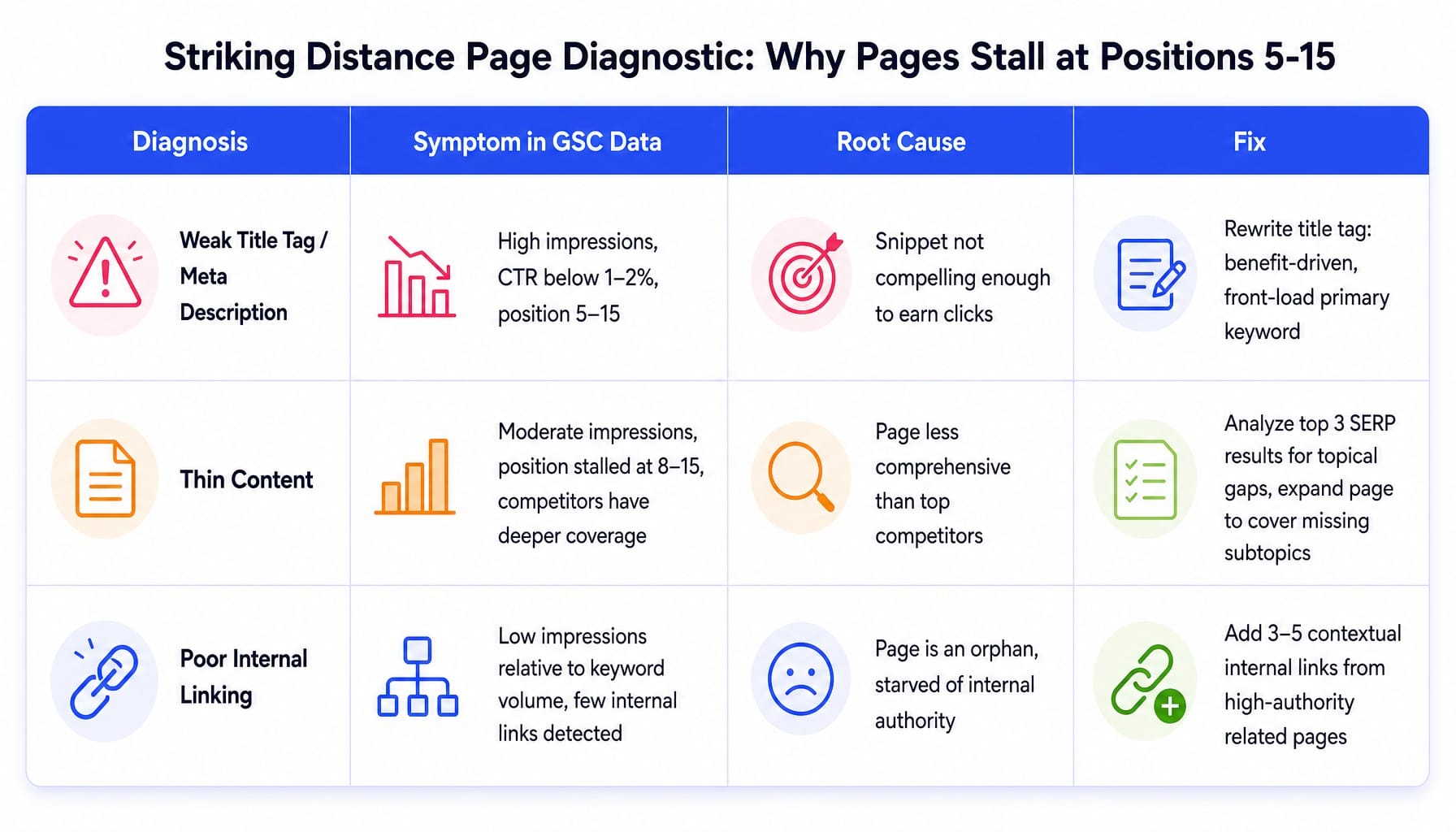
Pages stall in this range for three common reasons. Your job is to diagnose and fix the right one:
- Weak Title Tag / Meta Description: The page has high impressions but a low CTR (e.g., 1%). This isn't an authority problem; it's a marketing problem. Your snippet isn't compelling enough to earn the click. Fix: Rewrite the title tag to be benefit-driven and front-load the primary keyword.
- Thin Content: The page ranks, but users and Google see it as less comprehensive than competitors. Fix: Use a tool like Clearscope or manually analyze the top-ranking pages to identify the topical gaps your content is missing. Expand the page to cover those subtopics.
- Poor Internal Linking: The page is an "orphan" with few internal links pointing to it, starving it of authority. Fix: Find 3-5 other topically related, high-authority pages on your site and add a contextual internal link to your striking distance page.
The impression-to-click ratio is your best diagnostic tool here. A page with 5,000 impressions and 50 clicks (1% CTR) at position 9 is screaming for a better title tag or a more comprehensive answer to the query.
When to Deprioritize or Remove Pages Instead of Optimizing Them
Sometimes the highest-impact SEO move is not optimizing a page—it's removing or consolidating it. This is the angle every generic prioritization guide misses because deleting content feels wrong.
Imagine a B2B company with 15 separate blog posts all targeting minor variations of "how to reduce customer churn." None of them rank above position 30. They are cannibalizing each other, splitting link equity and confusing Google about which URL is the true authority. The fix isn't to optimize all 15 pages; it's to consolidate the best content into 2-3 definitive pillar pages and 301 redirect the rest.
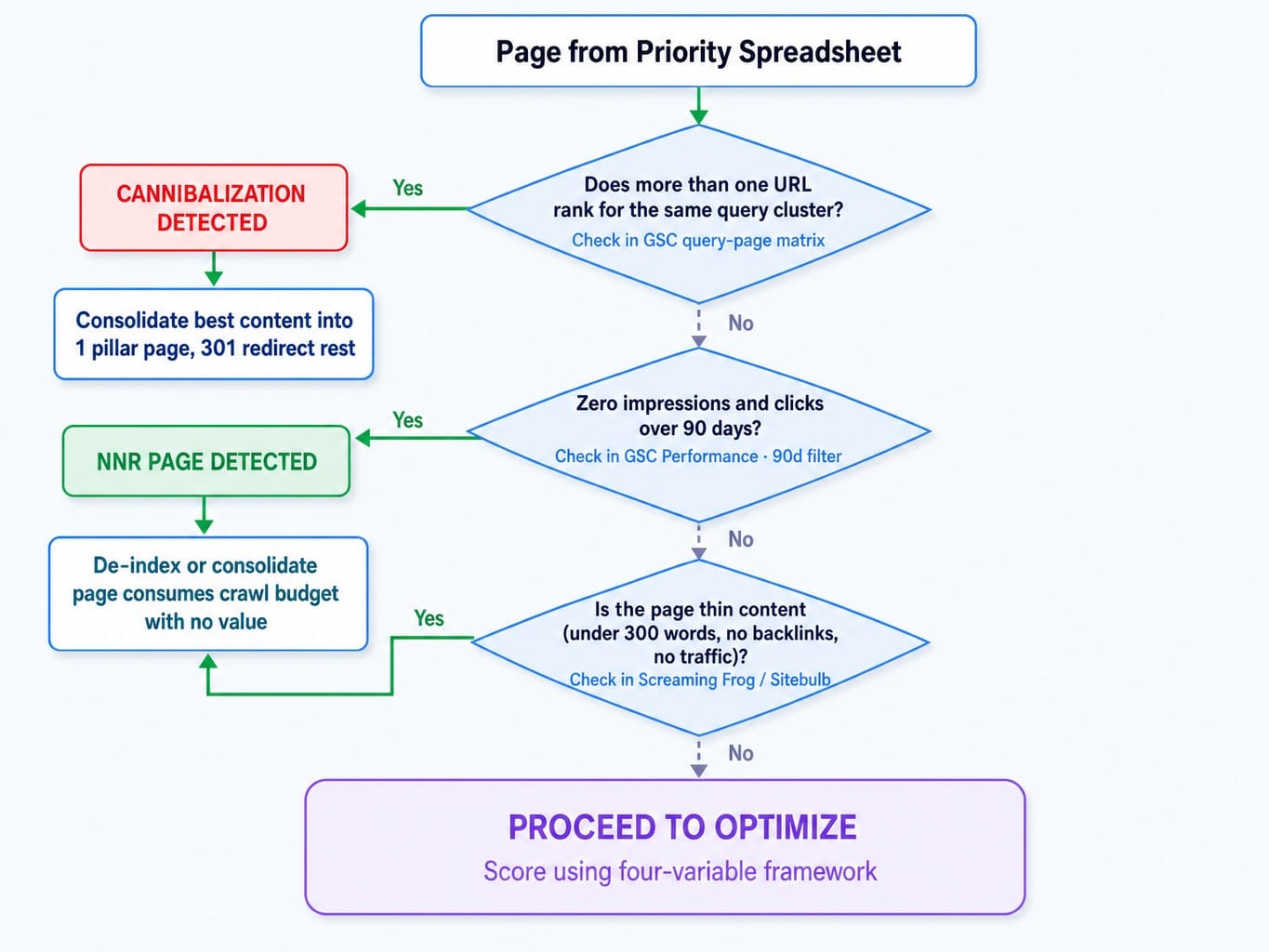
Your prioritization spreadsheet needs a "remove/consolidate" column. Two signals tell you when to use it:
- Cannibalization: Multiple URLs on your site are competing for the same query cluster. You can spot this in GSC's query-page matrix: filter by a specific query and see if more than one URL appears in the "Pages" tab.
- NNR Pages (No Next Result): These are pages that receive zero impressions and zero clicks over a 90-day period. They provide no user value, add no topical authority, and consume your crawl budget. Use a tool like Screaming Frog or Sitebulb to identify thin content (e.g., under 300 words with no traffic and no backlinks) and consider de-indexing or consolidating it.
Before you start optimizing, run a quick cannibalization audit. Cleaning up your existing content is often a faster path to ranking gains than improving a single page.
How AI Overviews Change Which Pages Are Worth Optimizing in 2025-2026
Your prioritization framework needs a new variable for 2025-2026: AI Overview exposure risk. Google AI Overviews now appear for a significant percentage of informational queries. When they do, the organic CTR for positions 1-3 can drop measurably because the answer is synthesized for the user above the traditional blue links.
This changes your ROI calculation. A page targeting a purely informational query where an AI Overview consistently triggers may have lower traffic potential than your scoring model predicts, even if you rank #1.
The practical adjustment is simple: before finalizing your priority list, manually search your target queries. Flag whether an AI Overview appears.
- For queries where AI Overviews dominate, deprioritize the page unless you believe it has a realistic chance of being cited within the overview. This requires highly structured, extractable, authoritative content that directly answers a specific question.
- For queries where AI Overviews do not appear (often commercial, transactional, or highly specific long-tail queries), the traditional CTR curve still holds, and these pages should score higher in your model.
This isn't about abandoning SEO for informational topics. As Google's own guidance states, foundational SEO best practices are what get you cited in AI features. But you must acknowledge that the click-share distribution has shifted and adjust your priorities accordingly.
What Happens When Prioritization Needs to Be Continuous, Not Quarterly
You now have the logic to build a powerful prioritization model. But a new problem emerges. This analysis—pulling data from GSC, GA4, and SERP tools, scoring URLs, flagging cannibalization, checking AI Overview exposure—isn't a one-time task. To be effective, it has to be a continuous system. Rankings shift, content decays, and competitors move. A spreadsheet built in January is stale by March.
For most lean teams, this is where the system breaks down. You have the framework but not the bandwidth to run it continuously and act on the output. The challenge is not just strategy but unifying marketing goals with task execution so that insights translate into shipped work.
This is the exact execution gap Spike AI is built to close. We don't just give you a dashboard with priorities; Spike AI continuously identifies the single highest-impact move to make across your entire marketing funnel—whether it's an SEO fix for a striking distance page, a CRO tweak on a landing page, or a content update—and then deploys the change. You now have the scoring logic. Spike AI runs it for you, every week, and ships the fix.
See how Spike AI identifies and ships your highest-impact SEO changes weekly
From Backlog to Roadmap: A System for SEO Prioritization
The most critical shift in your approach to SEO is this: page prioritization is not about picking page types from a list. It is about building a scoring system that weights ranking proximity, revenue impact, content gaps, and effort—then re-running it as conditions change.
Most teams default to gut feel because they lack a repeatable model. The four-variable framework gives you that model. The teams that compound SEO results quarter after quarter are not the ones who optimize the most pages. They are the ones who consistently optimize the right pages first.
Frequently Asked Questions
Should I prioritize new content creation or updating existing pages for SEO?
Almost always update existing pages first. Pages that already have impressions, backlinks, or ranking history possess an authority head start that new content lacks. Create new content only when your site has a clear topical gap where no existing URL can reasonably be optimized to cover the target query.
How often should I re-evaluate which pages to prioritize for SEO?
Re-evaluate monthly at a minimum, using fresh Google Search Console data from the trailing 28 days. Rankings shift, competitors launch new content, and your own pages experience content decay. A page that was low-priority last month may have entered striking distance this month. Quarterly re-evaluation is too slow for competitive SERPs.
Should I focus SEO efforts on high-traffic pages or high-converting pages?
High-converting pages almost always deserve priority because they directly impact revenue. A page converting at 5% with 200 visits is more valuable than a page converting at 0.3% with 5,000 visits. Use revenue per session by landing page in GA4 to make this comparison concrete rather than relying on traffic volume alone.
How do I prioritize SEO across hundreds of URLs without spending weeks on analysis?
You don't need to score every URL. Export your GSC data, filter to pages with positions 4-20 and 100+ impressions, add a revenue-weight column based on funnel stage, and sort. This 30-minute exercise will surface your top 10-15 priorities. Most pages on any given site are not worth actively optimizing.
Should product pages or blog posts be prioritized for SEO optimization?
Neither category inherently deserves priority. It depends on which specific URLs have the best combination of ranking proximity, search volume, and conversion potential. A blog post ranking at position 7 for a high-intent comparison query often outperforms a product page ranking at position 25 for a generic category term. Score individual URLs, not page types.