Is AB Tasty Worth It? A Practitioner's Review for 2026

TL;DR
- Strong for Marketing Teams: AB Tasty's visual editor and widget library are genuinely good, enabling non-technical teams to run client-side tests without engineering support.
- Real Weaknesses: Pricing is opaque, the client-side script can impact site performance and cause flicker, and its statistical engine may become a ceiling for highly mature experimentation programs.
- Server-Side is Limited: While AB Tasty supports server-side testing and feature flagging via SDKs, it's not a replacement for dedicated platforms like LaunchDarkly or Statsig for product-led experimentation.
- Team Fit is Everything: AB Tasty is best for mid-market marketing teams. Product-led teams often prefer Optimizely, while VWO offers similar ease of use with more pricing transparency.
- The Real Cost is Operational: The license fee is a fraction of the total cost. The real expense is the team bandwidth required to design, run, interpret, and implement tests—a bottleneck manual tools don't solve.
If you've searched for AB tasty reviews, you've probably noticed a frustrating pattern. The top results are a mix of AB Tasty's own marketing, thinly-veiled affiliate pages, and marketplace listings with a handful of reviews in French. There is almost no independent, practitioner-level analysis available, which makes a confident buying decision feel nearly impossible.
This isn't to say AB Tasty is a bad tool. It's a legitimate experimentation platform used by recognizable brands, and it holds a solid reputation. But the absence of honest, balanced analysis means most teams either over-invest based on a polished sales demo or dismiss it based on incomplete information. Choosing the wrong experimentation platform locks a team into twelve or more months of sunk integration cost and organizational habit, making the switching cost far higher than the subscription price.
This article is the review I wish I'd had.
It's a balanced assessment from a practitioner's perspective, covering what AB Tasty genuinely does well, where it consistently falls short, how it compares to key competitors like Optimizely and VWO, and—most importantly—the hidden costs that most evaluations completely ignore.
What AB Tasty Actually Does Well
Before diving into limitations, it's important to acknowledge where AB Tasty earns its reputation. It has genuine strengths, reflected in AB Tasty's 4.4/5 G2 rating across 400+ reviews, that make it the right choice for a specific type of team. While G2 scores often skew positive, the consistent themes point to two areas where the platform delivers real, differentiated value: the visual editor and the bundled personalization capabilities.
The Visual Editor Is Genuinely Good for Marketing-Led Teams
AB Tasty's visual editor is one of the strongest in the market for non-technical users. It's more than a gimmick; it's a tool that empowers marketing teams to run meaningful client-side tests—headline changes, CTA variations, image swaps, and simple layout shifts—without writing code or filing engineering tickets.
Consider a three-person marketing team at a mid-market SaaS company. Before, they were limited to one test per quarter because every change required a developer. With AB Tasty's editor, they could move to three or four tests per month, dramatically increasing their learning velocity. This is the platform's core value proposition in action.
Of course, there are limits. The editor handles simple element-level changes well, but the moment you need to restructure a page layout or inject dynamic content blocks, you're often writing custom JavaScript inside the editor anyway, which negates the "no-code" promise for any test more complex than a headline swap. It's comparable in quality to VWO's editor but easier to learn than Optimizely's more powerful (and complex) equivalent. For marketing-led teams needing speed on client-side tests, this is a real strength.
The Widget Library and Personalization Engine Save Real Time
The platform's pre-built widget library is an underrated feature that saves significant implementation time. Components like slide-ins, pop-ups, countdown timers, and social proof notifications can be deployed and tested in minutes. For an e-commerce team, this can eliminate the need for separate pop-up and urgency-messaging tools, reducing both subscription costs and integration maintenance.
Likewise, the personalization engine allows for straightforward audience segmentation based on behavior (e.g., pages visited, time on site) and context (e.g., device, location). This works well for creating broad personalized experiences, like showing a different hero message to first-time visitors versus returning customers.
This bundled approach is a genuine time-saver for teams that don't need the granular, data-rich personalization offered by warehouse-native platforms like Amplitude Experiment or Dynamic Yield. It provides 80% of the value for 20% of the implementation effort, which is a smart trade-off for many mid-market teams.
Where AB Tasty Falls Short: Honest Weaknesses
No experimentation platform is perfect. The most useful thing a review can do is help you understand whether a tool's weaknesses will actually affect your team or if they are just edge cases. Based on practitioner conversations and recurring themes in user reviews, three patterns consistently surface with AB Tasty.
Pricing Opacity Makes Budget Planning Difficult
One of the most common complaints among evaluators is AB Tasty's pricing model. There is no public pricing page. Costs are based on traffic and negotiated per contract, and teams frequently report being surprised by significant renewal increases.
This creates a practical frustration for any growth marketer trying to get budget approval. You need a number for a spreadsheet, but the "contact sales" model means the evaluation process can take weeks longer than it would with competitors like VWO or Convert Experiences, which publish clear pricing tiers. This opacity also makes it difficult to compare the total cost of ownership against alternatives, turning a straightforward evaluation into a prolonged negotiation. For teams that value procurement speed and transparency, this is a real friction point.
Client-Side Script Weight and Flicker Are Real Concerns
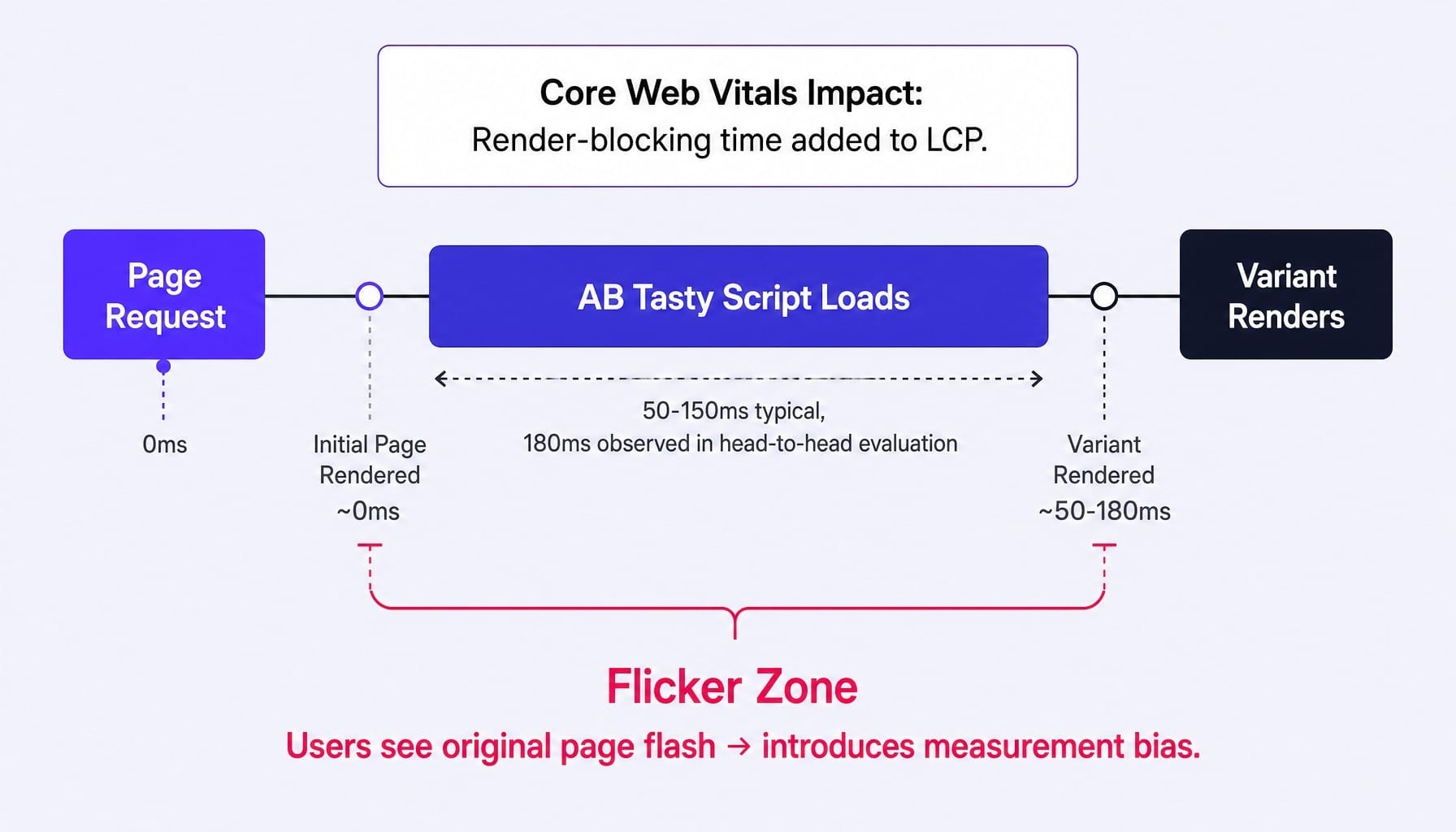
Any client-side testing tool introduces a performance trade-off, and AB Tasty is no exception. Its JavaScript snippet, as performance engineers will attest, can add anywhere from 50-150ms of script load time, which is a material concern for sites where Core Web Vitals are already tight.
During one head-to-head evaluation I ran, we found the AB Tasty snippet added 180ms of render-blocking time on key landing pages—a detail that never came up in the sales demo and only surfaced during a staged rollout with synthetic monitoring.
More visibly, users can experience "flicker," where the original page flashes briefly before the test variant loads. AB Tasty offers flicker mitigation options, but they require technical configuration that marketing-only teams often skip. It's crucial to understand that flicker isn't just a UX annoyance; it's a measurement confounder. Users who perceive the flash behave differently, introducing a systematic bias into your results that can invalidate a test. This is manageable, but it requires technical attention that the "no-code" positioning doesn't prepare you for.
The Experimentation Maturity Ceiling
AB Tasty is an excellent platform for teams in the early-to-mid stages of their experimentation journey—running their first 10-50 tests, building a testing culture, and learning the basics of statistical analysis.
However, for teams that mature and start needing more sophisticated capabilities, the platform can become a constraint. Power users consistently note that while the default Bayesian engine is intuitive for standard A/B tests, it lacks the configurability for advanced use cases. If your program evolves to require deep analysis of interaction effects, running tests with mutual exclusion groups, applying CUPED for variance reduction, or using advanced sequential testing corrections, you will likely hit a ceiling. Platforms like Optimizely Feature Experimentation or dedicated stats engines like Statsig offer far more control for these scenarios. AB Tasty is a strong accelerator, but be aware that high-velocity teams may eventually outgrow it.
Server-Side Experimentation and Feature Flagging: A Reality Check
AB Tasty does support server-side experimentation and feature flagging through SDKs for languages like Node.js, Python, and Java. However, it would be misleading to call it a native server-side platform. Its architecture is client-side first, with server-side capabilities added later to compete with product-focused tools like Optimizely and LaunchDarkly.
This distinction isn't just technical; it determines who owns the testing workflow. Client-side tests can be deployed by marketers, while server-side tests almost always require engineering sprint allocation. A product team I advised learned this the hard way. They tried to consolidate their testing and feature flagging into AB Tasty to save on tooling costs, but quickly found the feature management capabilities were too basic for their release process. It lacked the advanced targeting rules, flag dependency management, and lifecycle tooling needed to prevent accumulating "flag debt."
For teams whose primary need is marketing-led CRO with the occasional need for a feature flag, AB Tasty can work. But if your main use case is product experimentation or engineering-led feature management, dedicated platforms like LaunchDarkly, Statsig, or Split are a much better fit.
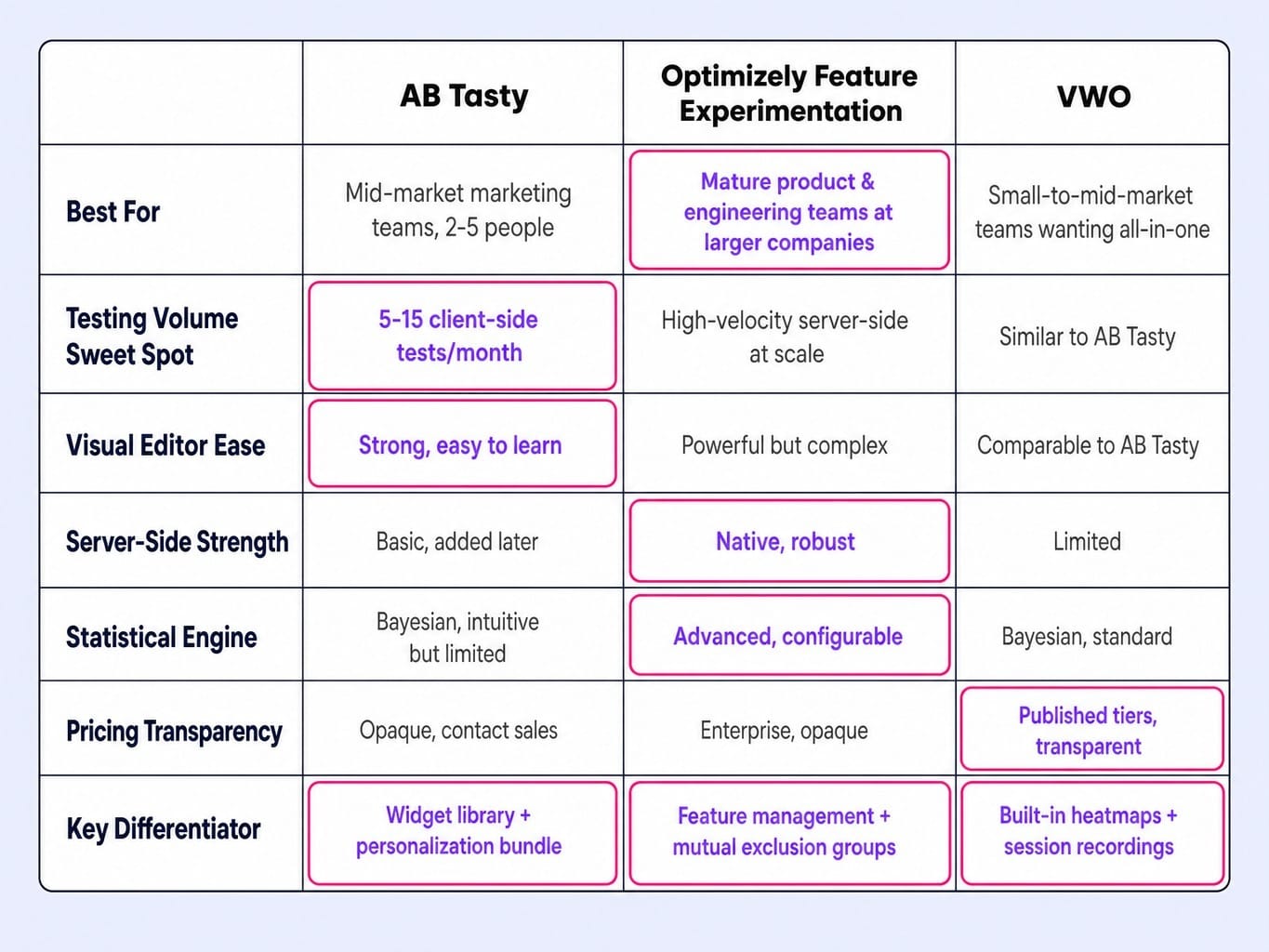
AB Tasty vs. Optimizely vs. VWO: Which Fits Your Team
The right tool depends less on a feature checklist and more on your team's profile: who runs experiments, how many you run, and whether your focus is marketing CRO or product experimentation.
- AB Tasty fits best for: Mid-market marketing teams (2-5 people) running 5-15 client-side tests per month. They value the easy-to-use visual editor and bundled widget/personalization features over deep statistical sophistication. They need to move fast without constant engineering support.
- Optimizely Feature Experimentation fits best for: Mature product and engineering teams at larger companies running server-side experiments at scale. They need robust feature management, mutual exclusion groups, and advanced statistical controls. They have the budget for a premium price point and the engineering resources to manage a more complex implementation.
- VWO fits best for: Small-to-mid-market teams that want AB Tasty-level ease of use but with greater pricing transparency and tighter integration with session recording and heatmaps. It's a strong all-in-one choice for teams that want analytics and testing in one platform.
A critical factor in this comparison is the recent market consolidation. Everstone Capital, the private equity firm that owns AB Tasty, is merging it with Wingify (VWO's parent company), as reported by publications like Mint. While the product roadmaps haven't fully converged, anyone evaluating these tools today must factor in that their long-term futures are now intertwined.
Read more: Optimizely vs AB Tasty (2026): A Practitioner's Guide to Choosing the Right Platform | Spike
The Hidden Cost Most AB Tasty Reviews Don't Mention
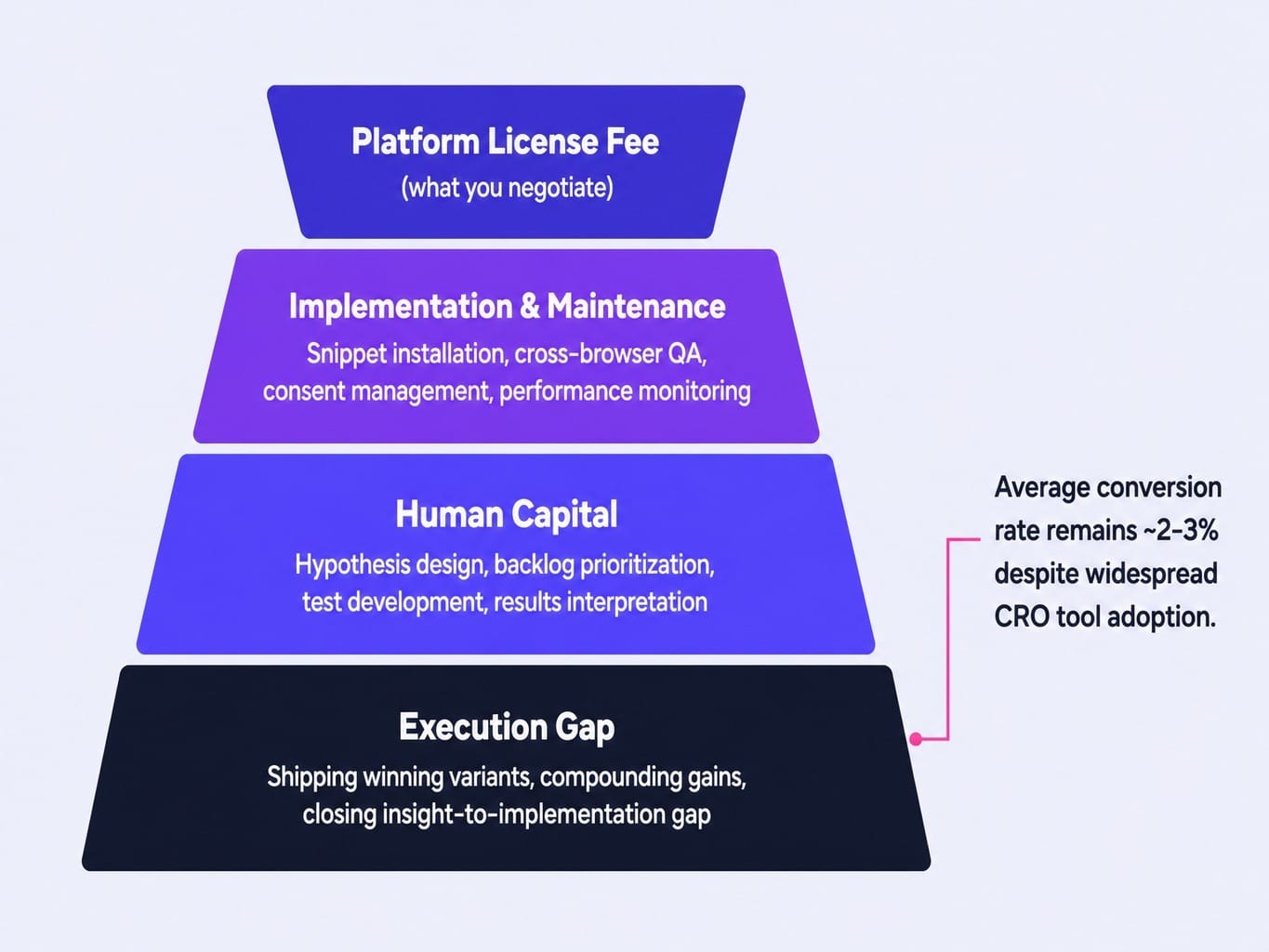
The license fee for any experimentation platform is the smallest part of the total cost. The real, hidden costs are operational.
First is the implementation and maintenance burden—the hours spent installing the snippet, QA'ing it across browsers, managing consent banners, and monitoring performance. Second is the human capital required to run a program: the analyst who designs hypotheses, the manager who prioritizes the backlog, and the developer who implements winning variants. The interpretive step after a test concludes—deciding if a result is trustworthy and what to do next—is the real bottleneck in most programs, and it scales linearly with headcount.
This creates a paradox. Despite widespread adoption of CRO tools, average website conversion rates remain stubbornly low, often around 2-3%. The tools surface insights, but for lean teams, those insights just join a backlog that grows faster than they can ship. A small marketing team might buy AB Tasty expecting to "just start testing," only to find that after all the overhead, they can only run two meaningful tests a month.
The question isn't whether AB Tasty is a good tool. It is. The real question is whether your team has the operational capacity to extract value from any manual experimentation platform.
When the Bottleneck Isn't the Tool — It's the Operating Model
Experimentation platforms like AB Tasty are built on a fundamental assumption: that your team has the time and expertise to design experiments, implement them, interpret the results, and then ship the winning changes. For lean teams, this assumption often breaks down. The platform becomes another source of work, not a solution to it.
This is the execution gap Spike AI was built to close. Instead of giving you a platform to run manual tests, Spike AI functions as a marketing execution engine. It continuously identifies the highest-impact optimization opportunities across your website, SEO, and ads—and then executes them for you, shipping weekly releases that compound over time.
If the real cost of a manual testing platform is the operational overhead of running it, the logical next question is whether you can get the outcomes of a rigorous optimization program without having to staff and operate it yourself. Spike AI is the answer for teams that want continuous improvement and compounding gains but lack the bandwidth to manage a manual experimentation process. It shifts the marketer from operator to orchestrator.
See how Spike AI ships weekly optimizations without the experimentation overhead
The Final Verdict: Is AB Tasty Worth It?
Whether AB Tasty is "worth it" depends less on its features and more on your team's operational capacity.
It is a genuinely strong mid-market experimentation platform. Its visual editor empowers marketing teams, and its bundled capabilities offer real value. However, its opaque pricing, client-side performance trade-offs, and the maturity ceiling of its statistical engine mean it fits a specific profile: a marketing-led team focused on client-side testing that is not yet running a high-velocity, statistically complex program.
For many lean teams, the deeper question this review should surface is whether the manual experimentation model itself is the right approach. The teams that compound conversion improvements fastest aren't always the ones with the most sophisticated testing tools. They're the ones that most consistently close the gap between insight and implementation. Your choice of platform should be based on which one best helps you close that gap.
Frequently Asked Questions
How long does AB Tasty onboarding typically take from contract to first live experiment?
Most teams report 2-4 weeks from contract signing to the first live experiment. While the snippet installation is straightforward, QA testing across all page templates, configuring consent management for GDPR/CCPA, and training the team on the editor typically extend the timeline beyond the "15-minute setup" shown in demos.
Does AB Tasty use Bayesian or frequentist statistics, and does it matter?
AB Tasty uses a Bayesian statistical engine by default, which provides intuitive "probability to be best" estimates instead of traditional p-values. For most marketing teams running standard A/B tests, this is more actionable. However, mature teams needing frequentist controls or complex sequential testing corrections may find the engine limiting compared to Optimizely or Statsig.
What integrations does AB Tasty support with CDPs and analytics platforms?
AB Tasty offers native integrations with Segment, Google Analytics 4, Amplitude, Contentsquare, Salesforce, and BigQuery, among others. These work well for sending experiment data downstream for analysis. However, pulling audience segments from a CDP into AB Tasty for targeting is less seamless than with warehouse-native platforms like Eppo that query your data layer directly.
What happens to your data and experiments if you decide to leave AB Tasty?
While AB Tasty allows for data export, your experiment configurations, personalization rules, and widget setups are platform-specific and cannot be migrated. Teams that have built extensive personalization campaigns face a significant switching cost, not in data loss, but in the manual effort required to rebuild that logic in a new platform.
How does the AB Tasty and VWO merger affect existing customers?
Everstone Capital is merging Wingify (VWO's parent) with AB Tasty to create a single, larger entity. As of mid-2026, the product roadmaps have not yet converged, but customers of both platforms should monitor for potential pricing changes, feature consolidation, and eventual platform migration requirements. The long-term competitive relationship is ending.
Can AB Tasty run experiments on single-page applications and dynamic content?
AB Tasty's visual editor can struggle with single-page applications (SPAs) built with frameworks like React, Vue, or Angular because it relies on DOM manipulation at page load. To test dynamic content effectively, you will likely need to use AB Tasty's code editor or server-side SDK, which reintroduces the engineering dependency many teams choose the platform to avoid.