
Is Ahrefs Worth It for B2B? A Practitioner's Evaluation for 2026

TL;DR
- Ahrefs' primary value is its best-in-class backlink index and competitor intelligence; if these are not central to your strategy, its cost is hard to justify.
- The sticker price is misleading. Due to credit limits on lower tiers, the real cost for an active B2B team is often closer to the Standard plan ($249/mo) plus add-ons.
- Do not trust Ahrefs' traffic estimates or Keyword Difficulty (KD) scores blindly. For B2B, cross-reference all traffic data with Google Search Console and evaluate keyword feasibility manually.
- Ahrefs is worth it for B2B if it replaces at least two other paid tools in your stack. If it only replaces one, the math rarely works.
- The biggest factor isn't the tool's quality but your team's execution bandwidth. If insights from Ahrefs sit in a backlog, you're paying for an expensive dashboard, not a growth engine.
Most articles asking "is Ahrefs worth it?" answer the wrong question. They review features and create pros-and-cons lists, but the real question isn't whether the tool is good—it is. The question is whether the intelligence Ahrefs provides can be translated into revenue-generating outcomes for your specific business.
Ahrefs is arguably the strongest SEO data platform available. But its value is a function of three variables most reviews ignore:
- Data Trust: Can you trust the specific data points you'll rely on for strategic decisions, and which ones are known to be misleading?
- Actual Cost: What does the tool really cost under your team's real-world usage patterns, not just the sticker price?
- Execution Bandwidth: Does your team have the capacity to act on the intelligence Ahrefs surfaces?
This is not another feature walkthrough. This is an evaluation of Ahrefs through those three lenses to help you decide if it's a necessary investment for your B2B marketing system or an expensive distraction.
Where Ahrefs Data Is Genuinely Best-in-Class
Ahrefs earns its reputation and premium price in three specific areas where its data is unmatched: backlink intelligence, crawl freshness, and historical SERP data. This is what you are actually paying for.
First, its backlink index is the most comprehensive in the industry. With a crawler second only to Google in activity, Ahrefs discovers and indexes new referring domains and links faster and more deeply than competitors. It claims over 35 trillion known links, but the practical impact is what matters. When a B2B SaaS marketer runs a link intersect analysis against three competitors, Ahrefs consistently surfaces dozens of high-authority referring domains from relevant class C subnets that Semrush and Moz simply miss due to index lag. This isn't a minor edge; for competitive intelligence and link gap analysis, it's the entire game.
Second is crawl freshness. Ahrefs often detects new backlinks to your domain within minutes, whereas Google Search Console can take days to report them. For a team running active link building campaigns, this near-real-time feedback loop is critical for verifying placements and measuring the immediate impact of their efforts. You can validate a guest post's link went live and see it in your backlink profile before you've even closed the tab.
Finally, its historical SERP data provides a layer of analysis that goes beyond simple rank tracking. Features like the position distribution histogram allow you to visualize your site's overall search visibility and diagnose issues like widespread content decay. You can see not just that a single keyword dropped, but that your entire site's footing on page one is eroding. This SERP volatility data is invaluable for understanding whether a rank fluctuation is a site-wide issue or a page-specific one.
Where Ahrefs Data Misleads—and How Practitioners Work Around It
Every SEO platform has data blind spots. Acknowledging them isn't a criticism; it's a prerequisite for using the tool effectively. Ahrefs has three well-known issues that can derail your strategy if you take the numbers at face value.
- Organic Traffic Estimation: Ahrefs estimates traffic based on keyword rankings and a generic click-through rate curve. For B2B sites with high branded search, niche long-tail queries, and low-volume keywords, this model breaks down. It's common to see a traffic value delta of 40–60% between Ahrefs' estimate and the ground truth in Google Analytics. A marketing lead presenting Ahrefs traffic gains to their VP, only to have the numbers contradicted by GA4, learns this lesson the hard way. The workaround: treat Ahrefs traffic data as a relative directional metric for competitors, but always use Google Search Console for your own site's performance reporting.
- Keyword Difficulty (KD) Mismatch: The KD score is based almost entirely on the number of referring domains pointing to the top-ranking pages. This formula ignores critical factors like content quality, topical authority, and SERP intent alignment. A keyword with a KD of 20 might be impossible for a new site to rank for, while a site with deep topical authority might easily rank for a KD 50 term. Practitioners learn to ignore the KD score and instead perform manual SERP analysis to assess the actual difficulty.
- Domain Rating (DR) Inflation: DR is a measure of a site's backlink profile strength, but it's easily gamed. A site can achieve a high DR through a large volume of low-quality, irrelevant links. This DR inflation means you can't trust the number as a proxy for genuine authority. The workaround is to never judge a link prospect by its DR alone; always click through to inspect the quality and relevance of its top referring domains.
What Ahrefs Actually Costs Under Real Workflows
Ahrefs' pricing page advertises plans from $129 to $449 per month for most teams, but this sticker price dramatically understates the tool's real cost of ownership. The culprit is the credit system, which throttles core workflows on lower-tier plans.
Let's model a typical weekly workflow for a lean two-person B2B marketing team on the $129/mo Lite plan, which includes 1,000 credits.
- Running Site Explorer on 5 competitor domains: ~50 credits
- Exporting backlink data for 2 top competitors: ~200 credits
- Running a Content Gap analysis: ~30 credits
- Researching 10 keyword clusters in Keywords Explorer: ~100 credits
- Running a Site Audit on your own domain: ~100 credits
This conservative weekly usage burns through nearly 500 credits. Within ten working days, the team exhausts their monthly allotment. They now face a choice: either severely ration their workflows for the rest of the month, crippling their productivity, or upgrade to the Standard plan ($249/mo) where most core features have unlimited credits.
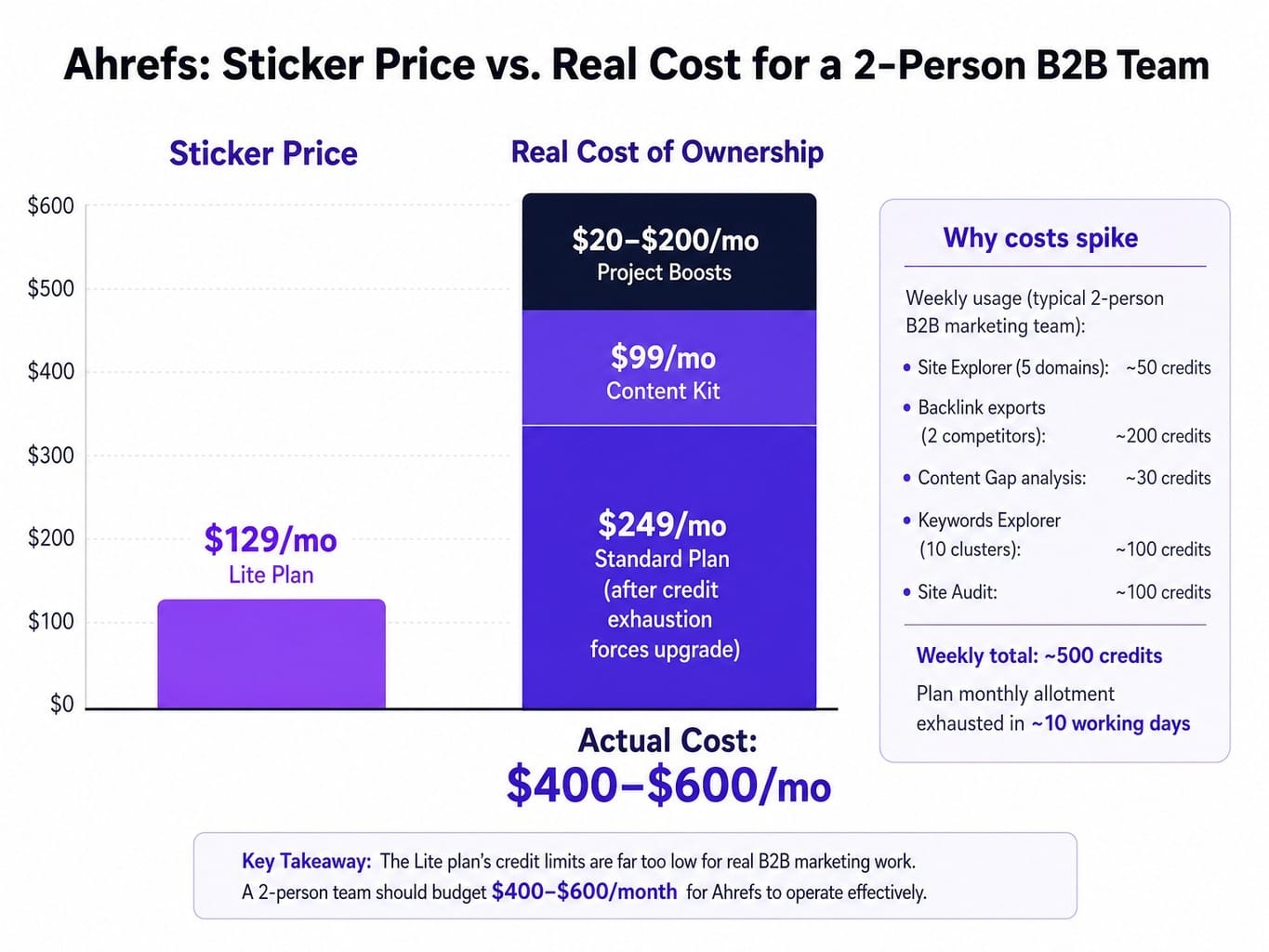
This isn't even the full picture. Add-on costs for features like the Content Kit ($99/mo) or Project Boosts ($20-$200/mo) mean the total cost of ownership for a team using Ahrefs as their primary SEO platform is often closer to $400-$600/mo. The $129 plan is a trial, not a sustainable solution for an active team.
Can Ahrefs Replace Your Other SEO Tools?
The strongest ROI argument for Ahrefs isn't a single feature; it's whether it can consolidate your tech stack and eliminate enough point solutions to justify its premium cost.
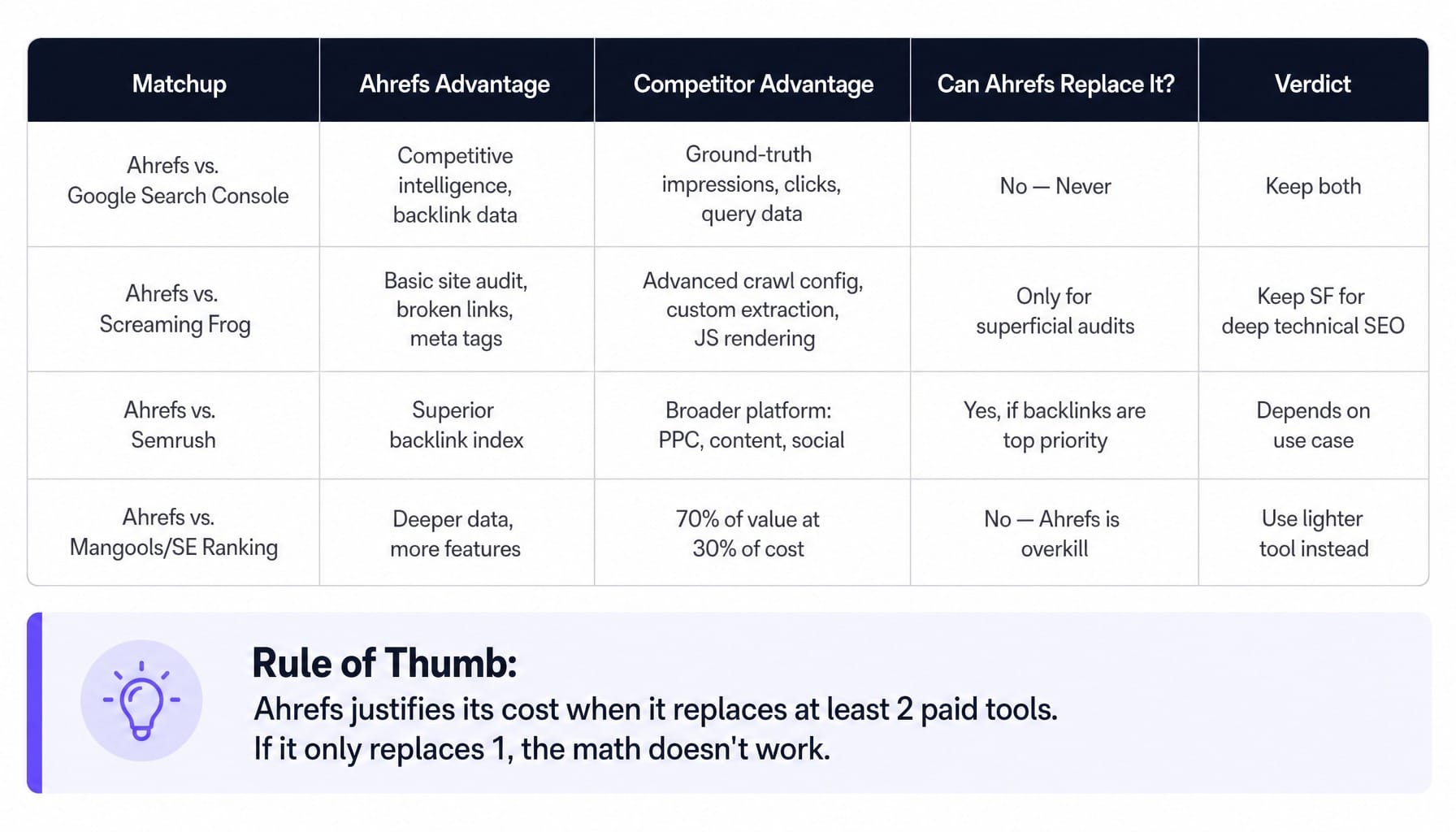
Here's the verdict on four common replacement scenarios:
- Ahrefs vs. Google Search Console: No. GSC is non-negotiable. It provides ground-truth data on impressions, clicks, and queries that Ahrefs can only estimate. Ahrefs supplements GSC with competitive intelligence; it never replaces it. Keep both.
- Ahrefs vs. Screaming Frog: For basic needs, yes. Ahrefs' Site Audit can find broken links, identify missing meta tags, and detect some crawl traps. But for deep technical SEO, Screaming Frog's advanced crawl configuration, custom extraction, and superior JavaScript rendering analysis are irreplaceable. Ahrefs replaces Screaming Frog only if your audit needs are superficial.
- Ahrefs vs. Semrush: This is the classic matchup. They have significant feature overlap, but different centers of gravity. Ahrefs has a superior backlink index. Semrush offers a more robust all-in-one platform with stronger PPC, content marketing, and social media tools. If backlink intelligence is your absolute priority, Ahrefs wins. If you need a single platform for broader digital marketing, Semrush is often the better choice.
- Ahrefs vs. Mangools/SE Ranking: No. These tools are in a different category. For teams whose primary needs are keyword research and rank tracking, they deliver 70% of the value at 30% of the cost. Ahrefs is overkill.
Read more: Mangools vs Ahrefs (2026): Which SEO Tool Fits Your Actual Workflow
The consolidation rule of thumb: Ahrefs justifies its cost when it replaces at least two paid tools you're currently subscribed to. If it only replaces one, the math doesn't work at the Lite or Standard pricing tiers.
Is Ahrefs Worth It for B2B Companies Specifically?
The value proposition for Ahrefs changes significantly in a B2B context. B2B marketing operates under different rules than B2C content marketing, and these differences directly impact whether the tool is a wise investment.
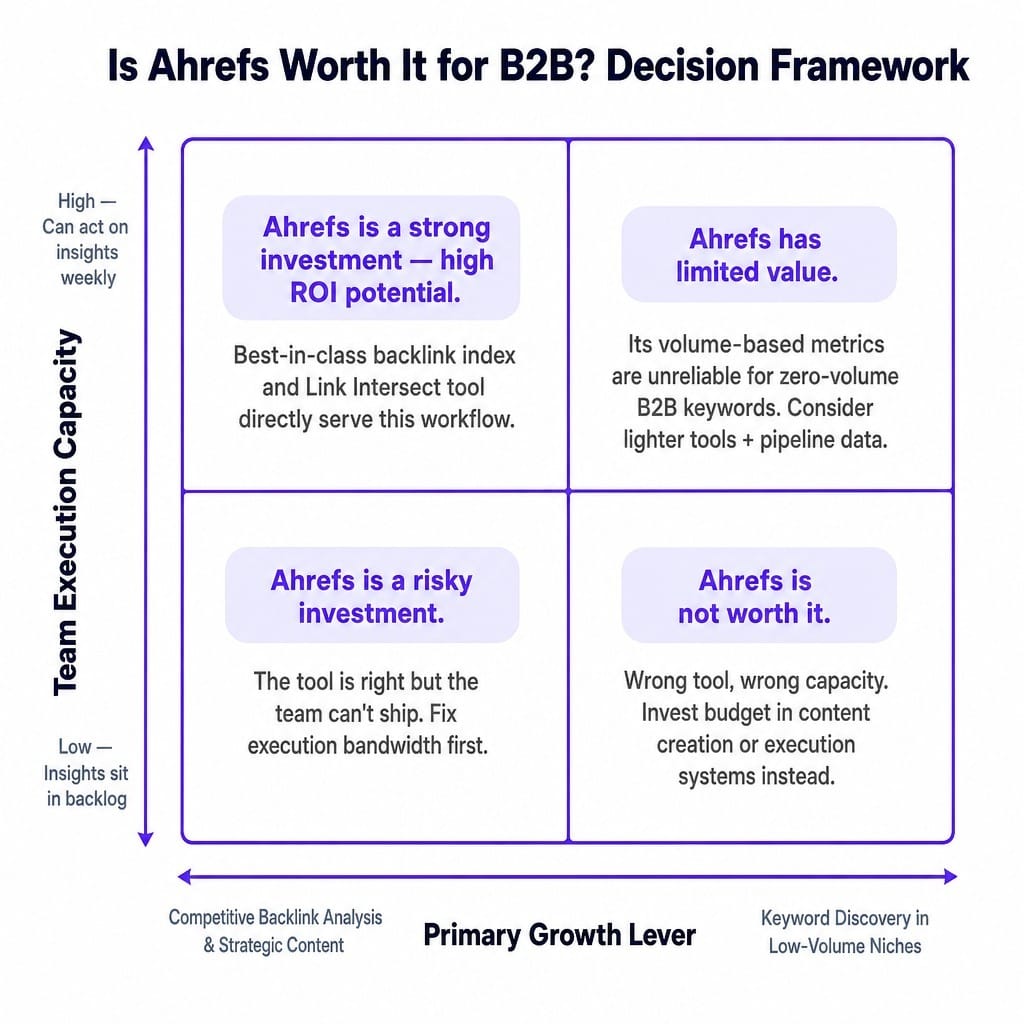
First, B2B is the land of zero-volume keyword mining. High-intent, buying-cycle keywords often show 0-50 monthly searches in Ahrefs. A term with 20 searches targeting VPs evaluating a $100K software purchase is infinitely more valuable than a 10,000-search informational query. Ahrefs' volume-based metrics are misleading here; they can't distinguish between low volume and low value. You need your own pipeline data for that.
Second, content gap analysis struggles in niche verticals. The tool works brilliantly when your competitors have large, established organic footprints. But in highly specialized B2B industries where every player has thin content, the analysis returns noise or suggests mimicking poor strategies.
However, there's one area where Ahrefs is indispensable for B2B: competitor intelligence and backlink prospecting. B2B link building is less about volume and more about precision—emulating the backlink profiles of established competitors and finding strategic placements. Ahrefs' best-in-class backlink index and Link Intersect tool are purpose-built for this workflow.
The verdict: Ahrefs is absolutely worth it for B2B if your primary growth lever is competitive backlink analysis and strategic content development based on proven SERP winners. It is far less valuable if your main task is keyword discovery in low-volume niches where its data is least reliable.
When Ahrefs Is Not Worth It
Honesty is more useful than a qualified recommendation. In some scenarios, paying for Ahrefs is a poor use of a lean team's budget.
- You have a small site and no active growth program. If your blog has fewer than 50 pages and you aren't actively building links or publishing content, Ahrefs Webmaster Tools (free) combined with Google Search Console provides all the diagnostic data you need.
- Your primary job is content writing. If your main workflow is creating and optimizing articles, a tool like Surfer SEO or Clearscope, paired with GSC for performance data, is a more focused and cost-effective solution.
- Your team lacks execution bandwidth. If Ahrefs reports are generated, discussed, and then added to a sprawling backlog, the tool is an expensive dashboard that creates the illusion of progress. The value is in the action, not the insight.
- You operate in a "blue ocean" niche. If your B2B vertical has no meaningful competitors with an organic presence, Ahrefs' powerful competitive intelligence features have nothing to analyze.
In these cases, you are better off investing the $2,000-$5,000 annual cost of Ahrefs into content creation or a different part of your marketing system.
When the Bottleneck Isn't the Tool—It's the Bandwidth to Act
This brings us to the core of the problem. Ahrefs is brilliant at surfacing intelligence: backlink gaps, technical debt, content opportunities, competitor weaknesses. But the value of that intelligence is zero if your team can't convert it into shipped changes. The latency between identifying what needs to be fixed and actually deploying the fix is where marketing ROI goes to die.
Most marketing teams don't have a strategy problem; they have a shipping problem. A 200-item Ahrefs site audit creates paralysis, not progress. Deciding what to fix first, getting buy-in, and managing the execution is a full-time job.
Read more: The B2B SaaS Growth Strategy That Actually Ships: From Planning Paralysis to Compounding Execution
This is the exact execution gap Spike AI is designed to close. We function as the execution layer that makes intelligence from tools like Ahrefs actually pay off. Instead of handing you a backlog, Spike AI identifies the single highest-impact move across your entire marketing system—SEO, CRO, or ads—and then executes it. Every week. The insight-to-action gap drops from weeks to days. Ahrefs tells you what is broken. Spike AI ships the fix.
See how Spike AI turns SEO intelligence into weekly shipped improvements
Conclusion: It's an Execution Question, Not a Feature Question
Ultimately, asking if Ahrefs is "worth it" is a proxy for a deeper question: "Will this tool help my system produce more revenue?"
The answer depends entirely on your operational reality. Ahrefs possesses the industry's strongest backlink index and competitive intelligence capabilities. But its value is unlocked only when you know which data to trust, can justify its real cost under your team's usage, and—most importantly—have a system to turn its insights into shipped improvements.
The teams that get a 10x ROI from Ahrefs don't see it as a solution. They see it as a high-quality input to their execution engine. If you don't have that engine, Ahrefs is just an expensive steering wheel on a car with no motor.
Frequently Asked Questions
Is Ahrefs Webmaster Tools good enough to skip the paid plan entirely?
For sites with fewer than 50 pages and no active link building, yes. AWT provides core site audit and backlink data. You lose the advanced keyword research, competitor analysis, and content gap tools that justify paid plans for active growth teams.
How quickly does Ahrefs detect new backlinks compared to Google Search Console?
Ahrefs often surfaces new links within minutes for well-crawled domains, while GSC can take several days. This speed is most valuable for time-sensitive link building verification. For general monitoring, the delay in GSC is rarely a critical issue.
Does Ahrefs' AI Content Grader actually improve rankings?
No, not directly. The tool analyzes top-ranking content to flag gaps in your own, but it's a diagnostic input, not a ranking lever. It surfaces opportunities that still require your team's manual implementation, editorial judgment, and strategic oversight to be effective.
What ROI benchmarks should I set before committing to an annual Ahrefs plan?
Before committing, identify one measurable outcome Ahrefs will drive in 90 days—a specific number of qualified link prospects, a set of content gaps actioned, or critical technical issues resolved. If you can't name a workflow that justifies the $1,500–$3,000 annual cost, stick with monthly billing.
Is Ahrefs overkill for a B2B company with limited SEO resources?
If your team publishes fewer than four articles a month and has no active link building program, yes. Ahrefs' depth will exceed your capacity to use it. A lighter tool like Mangools or SE Ranking, paired with Google Search Console, is a more resource-appropriate choice.