
Mangools vs Ahrefs (2026): Which SEO Tool Actually Fits Your Workflow?

TL;DR
- Ahrefs wins on depth, Mangools wins on value. Ahrefs is a comprehensive SEO platform with superior backlink data and technical audit capabilities. Mangools is a focused, affordable tool for keyword research and rank tracking.
- Keyword Difficulty (KD) scores are not interchangeable. Mangools' KD often runs lower than Ahrefs' for the same keyword due to different methodologies, which can lead to targeting unwinnable terms if you're not careful.
- Ahrefs' real cost is higher than its sticker price. The entry-level $99 plan has credit limits that active users will burn through quickly, pushing the effective monthly cost closer to $130-$160.
- Mangools has a hidden edge in rank tracking. It includes daily updates on all plans, while Ahrefs charges a hefty $100-$250/month add-on for the same frequency.
- The best tool is the one your team has the bandwidth to act on. Both tools create backlogs; neither executes the fixes. Your team's execution capacity is a more important constraint than any tool's feature set.
Your two-person B2B marketing team pays $99 a month for Ahrefs. You live in Keywords Explorer and Site Explorer, pulling reports that identify dozens of opportunities. But those opportunities land in a backlog that grows while you focus on shipping this week's blog post. You're paying for a firehose of data when you only have the bandwidth to drink from a straw.
You could switch. Pay just $29.90 a month for Mangools, get 80% of the keyword research capability, and save over $800 a year. But you'd lose the industry's best backlink index and have no site audit tool at all.
The Mangools vs Ahrefs decision isn't about which tool has more features—Ahrefs wins that contest without breaking a sweat. The real decision is about which tool matches the depth your workflow can actually absorb. This comparison cuts through the feature lists to focus on the operational realities, hidden costs, and workflow constraints that determine which tool is the right investment for your team.
Quick Verdict: Ahrefs Wins on Depth, Mangools Wins on Efficiency per Dollar
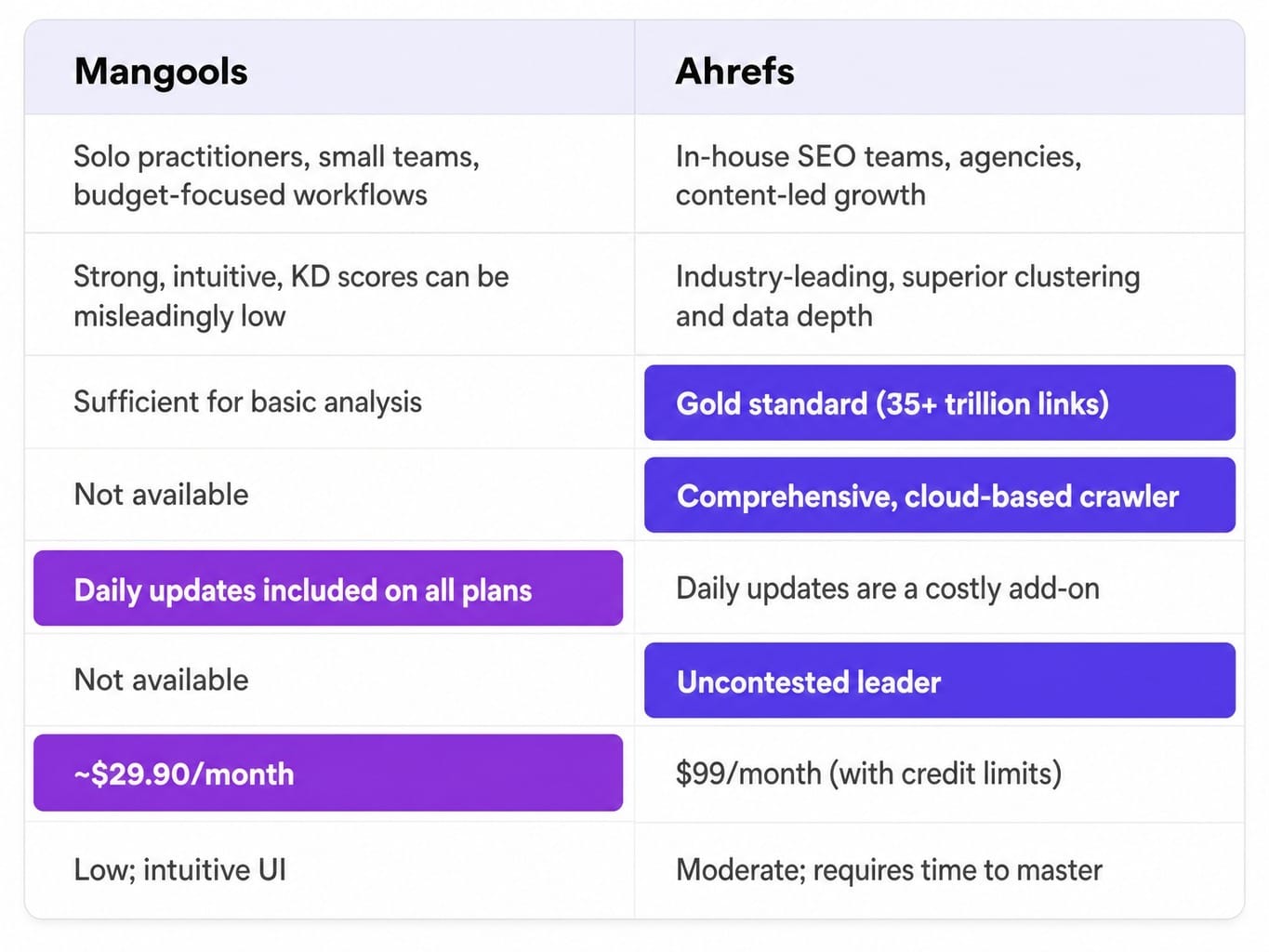
Ahrefs is the more capable SEO platform across nearly every dimension. It has a larger backlink index, deeper site audit functionality, and content research capabilities that Mangools lacks entirely. But capability is not the same as fit.
Mangools is the better investment if your primary use cases are keyword research and rank tracking, your budget is under $50/month, and you don't require deep competitive backlink analysis or technical audits. For solo practitioners and freelancers, its simplicity is a feature, not a bug.
Ahrefs is the necessary investment if you run competitive backlink analysis, need integrated site audit functionality, manage content strategy at scale, or operate in a high-DR competitive niche. Its data depth is the industry standard for a reason.
Keyword Research: Where the KD Score Gap Misleads You
Keyword research is the one area where Mangools and Ahrefs appear closest in capability—and the one area where the difference in data quality matters most. Both offer robust tools, but a fundamental misunderstanding of their data can lead your content strategy down a very expensive, zero-ROI path.
The core problem is that a keyword difficulty score is not a universal metric. It's a proprietary calculation, and the methodology behind it determines whether your team targets winnable keywords or wastes months on impossible ones.
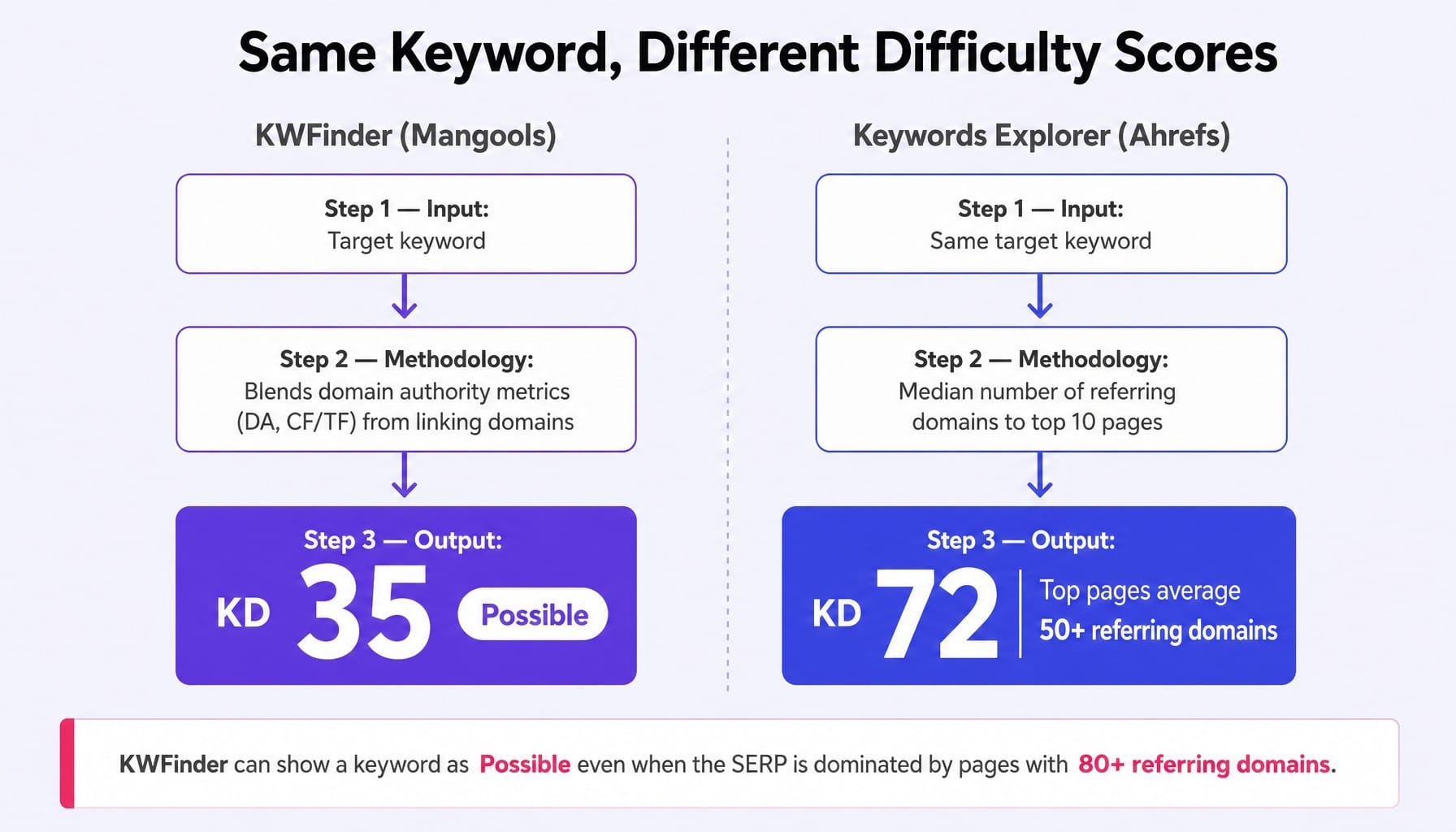
Imagine a B2B SaaS marketer using Mangools' KWFinder. They find a high-intent commercial keyword with a "Possible" KD score of 35. It looks like a perfect target. They invest in a 2,000-word article, build internal links, and wait. Nothing happens. Puzzled, they run the same keyword in Ahrefs and discover it has a KD of 72, with the top-ranking pages averaging 50+ referring domains.
The work wasn't wasted because the content was bad. It was wasted because the initial data set up an unwinnable fight.
Why KWFinder's Difficulty Scores Run Lower Than Ahrefs
The discrepancy comes down to methodology. KWFinder calculates its difficulty score using a blend of domain authority metrics (like Moz's DA and Majestic's CF/TF) from the linking domains. Ahrefs, in contrast, calculates its KD score based almost entirely on one thing: the median number of referring domains pointing to the pages currently in the top 10.
This means KWFinder can show a keyword as "possible" even if the SERP is dominated by pages with 80+ referring domains, simply because those domains have moderate authority scores. For a practitioner, this is a critical distinction. Ahrefs' methodology is a blunter, more direct reflection of the off-page effort required to rank. If you're using KWFinder's KD to plan your content calendar, you must cross-reference it against the actual backlink profiles in the SERP before committing resources. This isn't a flaw in Mangools; it's a feature of its design you need to account for in your workflow.
Workflow Differences: Suggestions Volume, Clustering, and Zero-Volume Mining
Beyond accuracy, the tools offer different workflows. KWFinder is built for speed and simplicity. A seed term returns around 700 keyword suggestions with a clean, intuitive interface for filtering. For a solo marketer building a content calendar, it's fast.
Ahrefs' Keywords Explorer is built for depth. It returns thousands of suggestions but adds critical layers for strategic teams. The "Parent Topic" feature shows if your keyword is part of a larger topic, preventing keyword cannibalization. The "Traffic Potential" metric estimates the total traffic you could get from all related long-tail keywords, giving a truer picture of a topic's value. And its ability to handle keyword clustering at scale is essential for teams mapping out topical authority or building programmatic SEO plays.
More data is only better if your system can process it. For a freelancer writing four posts a month, KWFinder's simplicity reduces decision fatigue. For a team trying to own a category, Ahrefs' structural data is non-negotiable.
Backlink Analysis: The Gap That Actually Determines Your Ceiling
Backlink analysis is where the difference between Mangools and Ahrefs stops being a matter of preference and becomes a matter of capability. This is Ahrefs' most defensible moat.
Mangools' LinkMiner provides basic backlink data: referring domains, anchor text, and third-party metrics like Citation Flow and Trust Flow. It's functional for a quick look at a site's link profile. But its index is a fraction of the size of Ahrefs', which crawls over 8 billion pages a day and maintains a database of over 35 trillion known links.
Here's what that gap means in practice. An SEO lead wants to find websites that link to three of their main competitors but not to them—a classic link-building tactic. In Ahrefs, this is a 60-second operation using the Link Intersect tool. It instantly surfaces dozens or hundreds of high-relevance prospects. In Mangools, this workflow doesn't exist. You can only view backlinks for one domain at a time.
However, let's be honest: if your SEO strategy doesn't involve active link building or deep competitive intelligence, this gap is irrelevant. If your work is primarily on-page optimization and content creation, paying for Ahrefs' backlink index is like owning a race car to drive to the grocery store. You're paying a premium for a capability your workflow never calls upon.
Mangools shows you your backlinks. Ahrefs provides the system—with data on link velocity, referring class C subnets, and anchor text distribution—to build a link strategy. If you don't build links, the gap doesn't matter.
Site Audits and Technical SEO: A Binary Comparison
This is the simplest part of the comparison. Mangools does not have a site audit tool. If you need a crawler to diagnose technical SEO issues like broken links, redirect chains, orphan pages, or crawl budget inefficiencies, Mangools cannot be your only tool.
Ahrefs' Site Audit is a competent, cloud-based crawler that scores your site's health, categorizes issues by severity, and helps you track improvements over time. It's a powerful part of the platform, especially for monitoring large sites without running desktop software. Is it the absolute best-in-class technical crawler? No. Specialists will argue that tools like Screaming Frog or Sitebulb offer deeper configuration and more granular data.
But for an in-house team, having a scheduled, automated audit integrated with the rest of your SEO data is a massive workflow advantage.
The takeaway is straightforward: if technical SEO auditing is a core part of your job, you'll need to supplement Mangools with a dedicated tool like Screaming Frog. If you're already using those tools, the absence of a site audit in the Mangools suite isn't a dealbreaker.
Rank Tracking: Where Mangools Quietly Matches Ahrefs
Counterintuitively, rank tracking is one of the few areas where Mangools' SERPWatcher can deliver better value for money than Ahrefs' Rank Tracker, especially for teams that need high-frequency data.
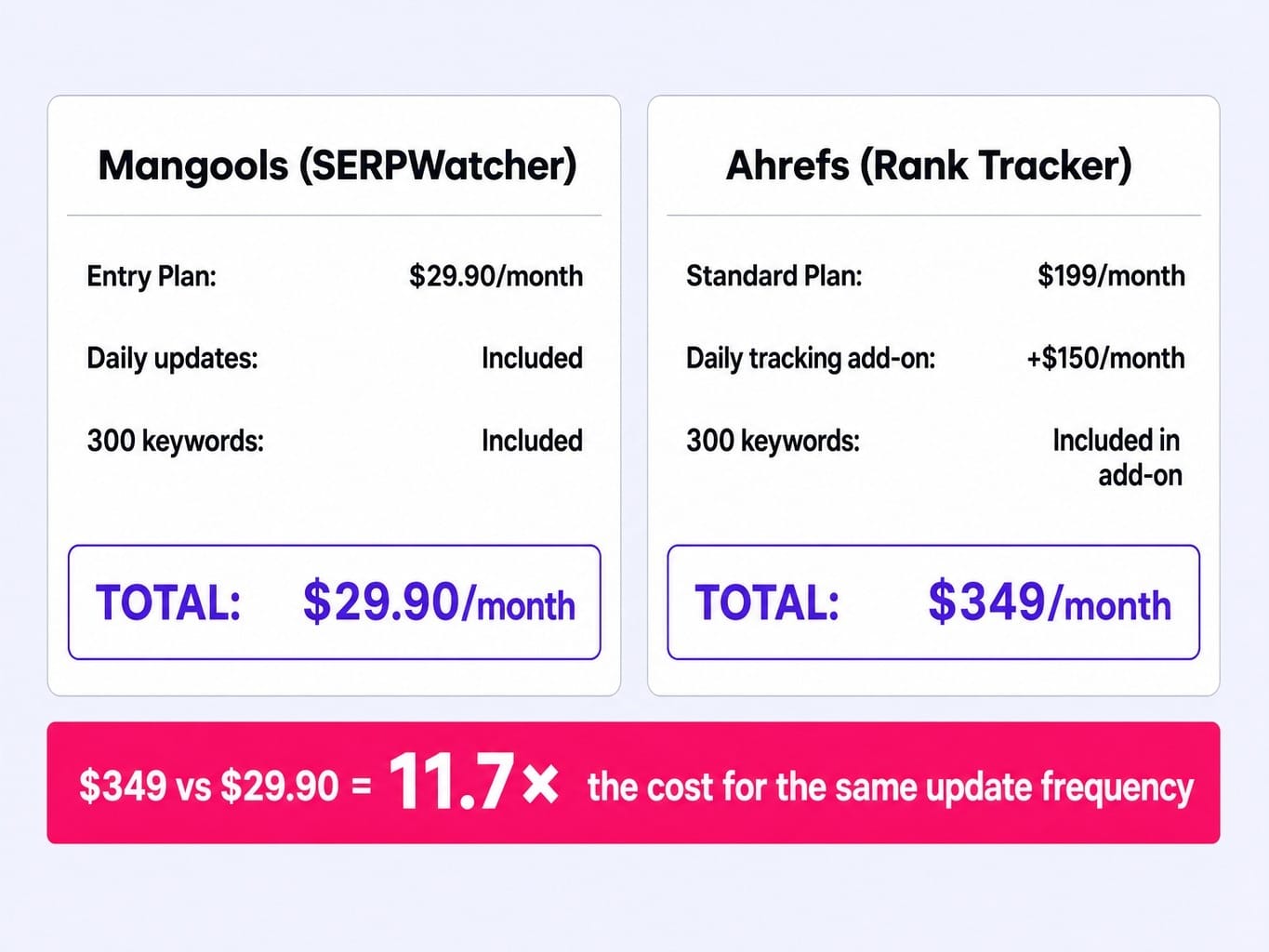
SERPWatcher provides daily ranking updates, a proprietary Performance Index score, keyword position distribution charts, and customizable alerts. Crucially, daily updates are included in every Mangools plan, starting at $29.90/month.
Ahrefs' Rank Tracker, by default, updates weekly. If you want daily updates, you need to purchase an add-on. That add-on costs between $100 and $250 per month, depending on the number of keywords you track.
Let's run the numbers. A team tracking 300 keywords with daily updates would pay $29.90/month on Mangools' entry plan. On Ahrefs, they would need the $199/month Standard plan plus the $150/month daily tracking add-on for that keyword volume, for a total of $349/month. That's more than 10x the cost for the same update frequency.
Ahrefs does offer more advanced features—like Share of Voice metrics, tracking for 15+ SERP features, and deep GSC integration—that may justify the cost for enterprise teams. But for most, rank tracking is not a reason to choose Ahrefs over Mangools. It might even be a reason to run Mangools for tracking while using Ahrefs for everything else.
Content Research and Gap Analysis: Ahrefs' Uncontested Territory
Mangools has no equivalent to Ahrefs' Content Explorer or Content Gap analysis tools. This is another binary difference.
Ahrefs' Content Explorer is a searchable database of billions of web pages. You can find proven content angles by searching a topic and filtering by organic traffic, referring domains, social shares, or publish date. The Content Gap tool is even more direct: it shows you the keywords your competitors rank for that you don't.
For a B2B SaaS team running a content-led growth strategy, these features are a direct line to reducing risk. Instead of guessing what to write about, you can identify topics with proven traffic potential and a clear competitive landscape. A content strategist can use Content Gap to find 40 keywords three competitors rank for, then prioritize the 8 with the highest traffic potential and lowest KD. That's a data-driven content plan.
But again, capability requires execution. Many teams that have access to Content Explorer don't use it systematically. If your content cadence is just a few posts a month and you aren't doing rigorous competitive analysis, you're paying for an advanced feature that sits idle.
Pricing Reality: What You Actually Pay After Month One
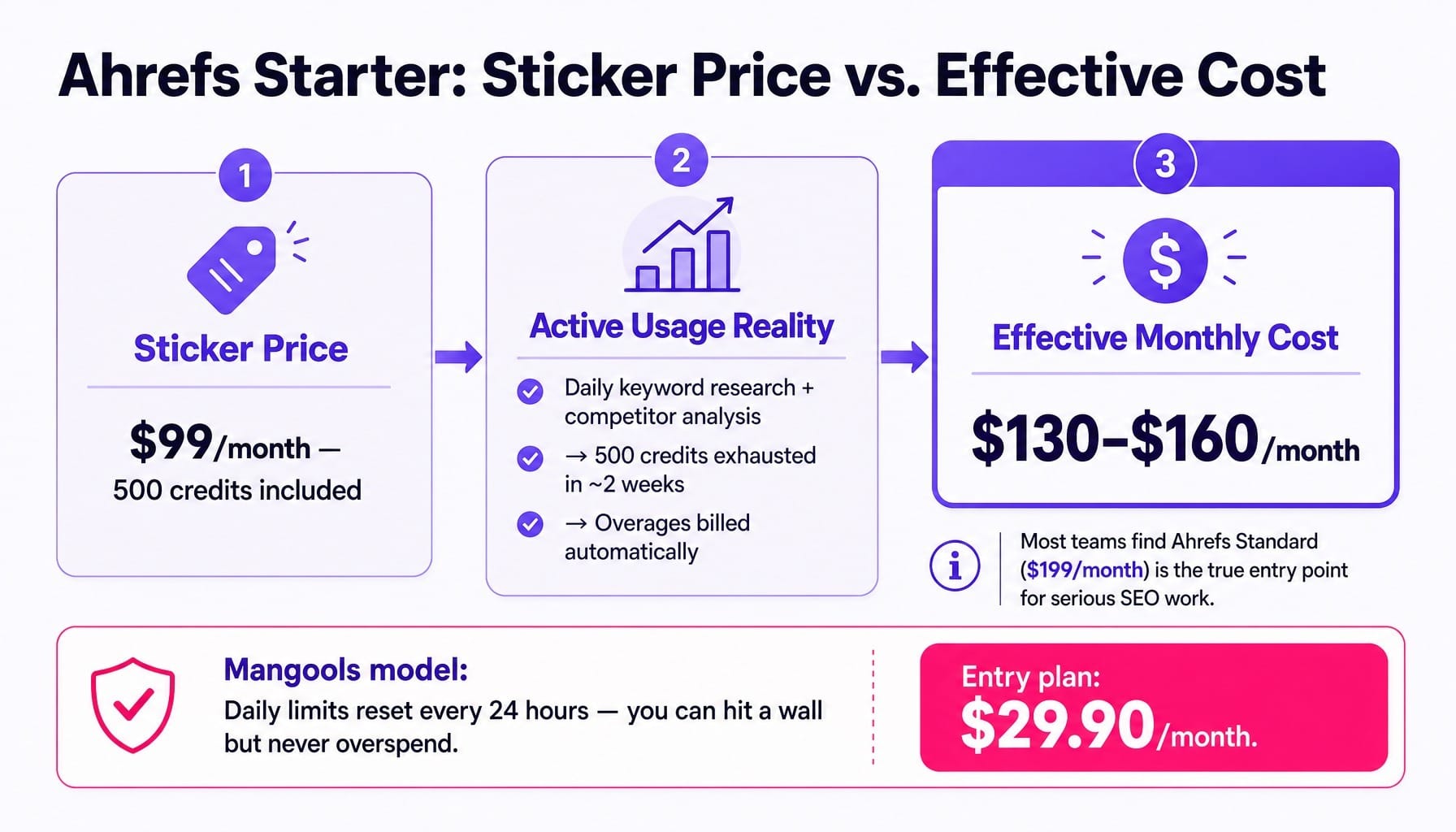
Every comparison article cites the headline prices: Mangools from ~$29.90/month, Ahrefs from $99/month. Few explain what happens when your workflow collides with usage limits.
Ahrefs' pricing is built around a monthly pool of credits. The $99/month Starter plan includes 500 credits. A keyword search costs 1 credit. A Site Explorer lookup costs 1 credit. Exporting rows of data costs credits. A single batch analysis can burn hundreds of credits. For an active user doing daily keyword research and competitor analysis, it's easy to exhaust those 500 credits in under two weeks. Overages are billed automatically. This means the effective monthly cost of Ahrefs Starter for an active user is often closer to $130-$160, not $99.
Mangools uses a different model: daily limits that reset every 24 hours. The Basic plan gives you 100 keyword lookups and 200 keyword suggestions per search, per day. You can't overspend, but you can hit a wall and have to wait until tomorrow. It's a model built for disciplined, daily use rather than intensive, project-based sprints.
For serious SEO work, most teams find Ahrefs' Standard plan ($199/month) to be the true entry point, as it provides a more realistic credit allowance. The pricing page tells one story; your monthly invoice tells the real one.
Who Should Use Which: A Decision Framework by Team Type
This isn't an "it depends" situation. The right tool is determined by your team structure, budget, and—most importantly—your execution capacity.
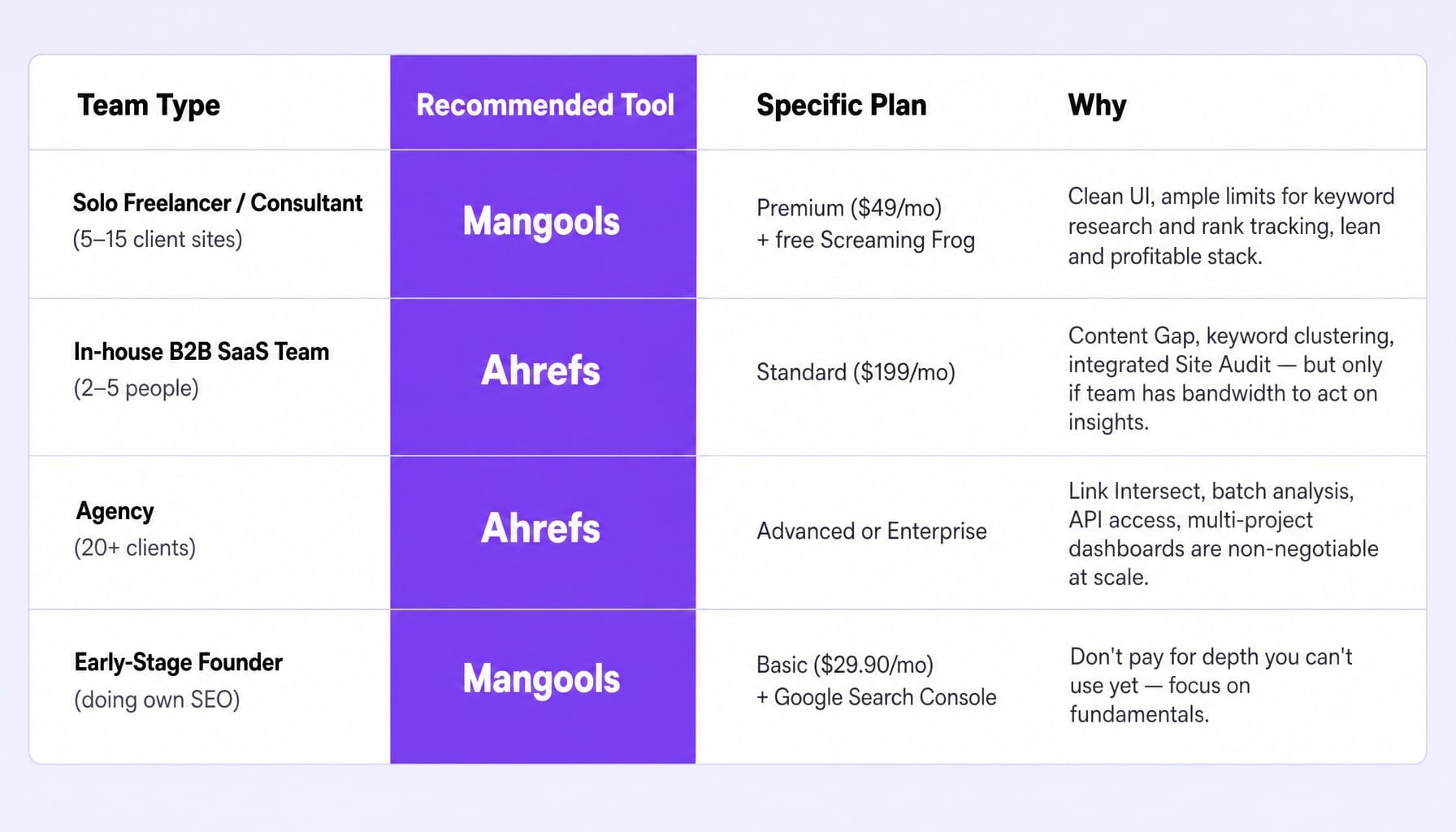
- Solo Freelancer or Consultant (managing 5-15 client sites): Go with Mangools. The Premium plan ($49/month) provides ample limits for keyword research and rank tracking. The UI is clean, fast, and lets you get answers without getting lost in data. Supplement with a free Screaming Frog license for technical audits, and you have a lean, effective, and profitable stack.
- In-house B2B SaaS Marketing Team (2-5 people): Go with Ahrefs Standard ($199/month). Your goal is to build topical authority and outmaneuver competitors. The Content Gap, Keywords Explorer clustering, and integrated Site Audit features are designed for this exact purpose. But this is only true if your team has the bandwidth to act on the insights. If the tool's output just feeds a stagnant backlog, you're better off with a simpler tool and a smaller bill.
- Agency (managing 20+ clients): Go with Ahrefs. At this scale, features like Link Intersect, batch analysis, API access, and multi-project dashboards are non-negotiable. Mangools' per-seat pricing and daily lookup limits become a workflow bottleneck when you're managing dozens of accounts.
- Early-Stage Founder (doing their own SEO): Go with Mangools Basic + Google Search Console. Don't pay for depth you can't use yet. Learn the fundamentals of keyword research and track a core set of terms. Your biggest levers for growth are product and positioning, not advanced link analysis.
Ultimately, the tool you choose matters less than whether you have a system to consistently act on what it tells you. Most teams don't have a data problem; they have a shipping problem.
Read more: SaaS Marketing Tools in 2026: How to Build a Stack That Ships, Not Just Reports
When the Tool Isn't the Bottleneck—Your Execution Bandwidth Is
Both Mangools and Ahrefs are diagnostic systems. They excel at identifying what needs to be fixed, what content needs to be written, and what links need to be built. They generate a backlog of high-value tasks. And then they stop. The execution is left entirely on your plate.
For the lean marketing team that identifies 30 keyword opportunities in Ahrefs but only has the bandwidth to publish three posts per quarter, the tool isn't the constraint—the execution system is. This is the gap Spike AI was built to close.
Spike AI functions as the execution layer that turns the output from your SEO tools into shipped improvements. We don't just identify the highest-impact move across your website, SEO, and ads; we execute it. Our weekly release cadence replaces the sporadic pushes and growing backlogs with a consistent rhythm of compounding gains. Spike AI fixes the shipping problem by running your marketing like software: prioritize, deploy, measure, and repeat.
See how Spike AI turns your SEO backlog into weekly shipped improvements
Conclusion
Mangools and Ahrefs are built for different operational realities. Mangools is a sharp, focused, and highly efficient tool for keyword research and rank tracking, offered at a price that respects a lean team's budget. Ahrefs is a comprehensive SEO platform, providing an industry-leading data advantage in backlinks, content research, and technical audits that Mangools cannot match.
The right choice depends less on a feature-by-feature comparison and more on your team's capacity to absorb and act on the data provided. The harder, more important question isn't which tool to buy. It's whether your team has the execution system in place to consistently ship what either tool tells you to fix.
Frequently Asked Questions
Is it worth running both Mangools and Ahrefs simultaneously?
For most teams, no; the overlap is too great. The one exception is using Mangools for its cost-effective daily rank tracking while leveraging Ahrefs for its superior backlink and content analysis, thereby avoiding Ahrefs' expensive daily tracking add-on.
How do Ahrefs and Mangools compare on search volume accuracy against Google Search Console?
Both estimate volume, but Ahrefs' clickstream-adjusted data, which accounts for zero-click searches, often correlates more closely with actual GSC impressions. Its "Traffic Potential" metric is a better proxy for a topic's true value than raw search volume figures from either tool.
How do the API limits compare between Mangools and Ahrefs for automation workflows?
Ahrefs offers a far more comprehensive API for building automated reports and integrating data into dashboards, drawing from its deep backlink and keyword indexes. Mangools' API is more basic, focused on keyword and SERP data pulls, and is less suited for large-scale automation.
Do agencies typically standardize on Ahrefs or do some use Mangools at scale?
The vast majority of agencies managing 10+ clients standardize on Ahrefs or Semrush. The need for batch analysis, robust API access, and scalable project management makes tools with daily lookup limits like Mangools impractical for large-scale agency workflows.
Which tool is better for local SEO keyword research—Mangools or Ahrefs?
Mangools' KWFinder has a slight edge with its clean, city-level filtering. However, for serious local SEO, neither is a perfect solution. Practitioners often rely on dedicated local SEO tools like BrightLocal or Semrush's local features for more granular, GMB-integrated data.