Is SE Ranking Worth It? A Practitioner's Verdict for 2026

TL;DR
- SE Ranking's rank tracker offers the best cost-per-keyword value on the market, making it ideal for budget-conscious freelancers and small agencies focused on reporting.
- The tool's primary weaknesses are data-layer issues: a slow backlink index, shallow site audit crawls on large sites, and less reliable keyword difficulty scores compared to Ahrefs or Semrush.
- It's a strong choice for solo consultants and small agencies, but in-house B2B teams will likely outgrow it due to data accuracy gaps that create operational friction.
- The sticker price is misleading. The "real cost" includes supplementary tools (like Screaming Frog) and the manual hours spent cross-referencing its data against Google Search Console.
- The choice isn't just about features; it's about workflow. SE Ranking saves money but adds manual work. Premium tools cost more but consolidate workflows, reducing operational drag.
Every SE Ranking review you find online follows a predictable script. It lists the features, shows some screenshots, notes that it's cheaper than Semrush, and lands on a resounding recommendation. But asking "is SE Ranking worth it" isn't a feature question—it's a workflow question. The real answer depends on what you're trying to accomplish, how accurate your data needs to be, and whether your execution system can afford to supplement it when it falls short.
This isn't another feature checklist. We're evaluating SE Ranking not by its marketing pages, but by what practitioners actually experience after the first 90 days. This is where the novelty fades and the data-layer realities set in.
We'll break down where the tool genuinely delivers value, where it quietly underperforms, and who should subscribe versus who should invest more in Semrush or Ahrefs. This is an assessment from the perspective of a systems designer—someone who evaluates SaaS marketing tools by their operational output, not their price tag alone.
Where SE Ranking Genuinely Delivers Value
SE Ranking does several things remarkably well—and in a few cases, better than tools costing three or four times as much. The point isn't to dismiss the platform but to identify where its value is real versus where it's just marketing. For many teams, these three capabilities alone justify the subscription.
Rank tracking flexibility that premium tools don't match at this price
SE Ranking's rank tracker is its strongest feature. It's not necessarily more accurate than its premium counterparts, but its pricing structure and flexibility let you track more keywords across more locations for less money. A single keyword tracked on desktop and mobile across Google and Bing only counts as one keyword against your limit. For a freelance SEO consultant managing eight client projects, this means tracking keywords across multiple geolocations with postcode-level granularity becomes operationally viable at $65/month, a task that would push into the $130+ tier on Semrush.
You also get control over the rank tracker polling frequency, with options for daily, every three days, or weekly updates. While Semrush offers fixed daily updates, this flexibility allows budget-conscious teams managing thousands of keywords to reduce costs without losing critical visibility. If rank tracking is your primary use case, SE Ranking offers the best cost-per-keyword ratio in the market.
Competitive research that punches above its weight class
The competitive research module provides a level of insight you'd typically expect from a tool in a higher price bracket. It delivers organic traffic estimates, keyword overlap analysis, and search intent classification that are genuinely useful. In some areas, it even pulls ahead; one test by TargetInternet found SE Ranking returned two to three times more PPC keyword data than Semrush for the same domain.
Is the data perfect? No. It's best used for directional analysis and identifying strategic opportunities, not for precise traffic forecasting. But as a tool for quickly mapping a competitor's footprint and identifying content gaps, it's a legitimate strength, not just a checkbox feature.
White-label reporting that makes it agency-viable
For agencies and consultants billing clients on SEO retainers, SE Ranking's white-label reporting is a significant workflow accelerator. Where Semrush requires a higher-tier plan for full white-labeling, SE Ranking includes it at a much lower price point. The ability to build custom report templates—combining rank tracking data, site audit results, and integrated Google Analytics metrics—and schedule automated PDF delivery can save hours of manual report assembly each month.
For an agency managing five to fifteen clients, this feature alone can justify the subscription cost. It's a practical, well-executed tool that directly addresses a core agency pain point.
Where SE Ranking Quietly Falls Short
The limitations of SE Ranking are not the ones you'll find in most affiliate reviews, which tend to focus on thin social media modules or minor UI quirks. The real limitations are data-layer issues that directly affect the quality of the decisions you make based on the tool's output. These are the gaps practitioners discover after month three, once you start cross-referencing SE Ranking's data against Google Search Console or actual analytics.
And this is where the frustration sets in.
Backlink index freshness lags behind Ahrefs and Majestic by weeks
SE Ranking's backlink data is directionally useful for a one-off audit, but it's operationally slow for active campaigns. For teams running link-building initiatives, the lag on new backlink discovery—which practitioners report can be two to four weeks—means you cannot use it as your primary monitoring tool. While Ahrefs updates its index continuously (with a claimed 15-minute refresh for popular domains) and Majestic updates its Fresh Index daily, SE Ranking's data is simply too stale for real-time ROI tracking.
Imagine your content team lands 12 guest posts in a month. In Ahrefs, you might see ten of those links appear within a week. In SE Ranking, you might only see four after two weeks, making it impossible to report on link-building velocity to stakeholders. If backlink analysis is a core workflow, you will need a supplementary tool.
Read more: Ahrefs vs Majestic: Which Backlink Tool Fits Your Actual Workflow (2026 Comparison)
Site audit crawl depth doesn't match Screaming Frog or Semrush on large sites
The platform's site audit is perfectly adequate for websites under 5,000 pages. It reliably flags surface-level problems like missing meta descriptions, broken images, and slow-loading pages. However, on larger, more complex sites, its limitations become apparent. The crawler can struggle with JavaScript rendering and often fails to identify deeper technical issues like crawl budget waste from parameter URLs, index bloat, or orphaned pages buried deep in faceted navigation.
For serious technical SEO on a site with 10,000+ pages, you're not getting the same level of diagnostic power as you would from a dedicated tool like Screaming Frog, which can crawl hundreds of thousands of URLs with custom extraction rules. SE Ranking's audit is a solid starting point, but it's not a complete solution for identifying systemic technical debt.
Keyword difficulty scores diverge from actual ranking difficulty
Every SEO tool's keyword difficulty (KD) metric is a proxy, usually based on the backlink profiles of the current top-ranking pages. However, SE Ranking's version correlates less reliably with actual ranking outcomes than Ahrefs' KD or Semrush's KD%. The issue seems to be that the score doesn't adequately weight critical factors like topical authority, domain age patterns, or SERP feature dominance.
A keyword scored at a "manageable" 35 might be functionally impossible for a new domain to rank for if the SERP is dominated by established editorial sites with deep, interconnected content clusters. This means you have to spend more time on manual SERP verification for every keyword you target. The score is a signal, but it's a noisier one that requires more validation than its premium competitors.
Who SE Ranking Is Actually Built For—And Who Should Look Elsewhere
So, is SE Ranking good enough? The answer depends entirely on who's asking. The tool's value proposition changes dramatically based on your team structure, budget, and operational needs.
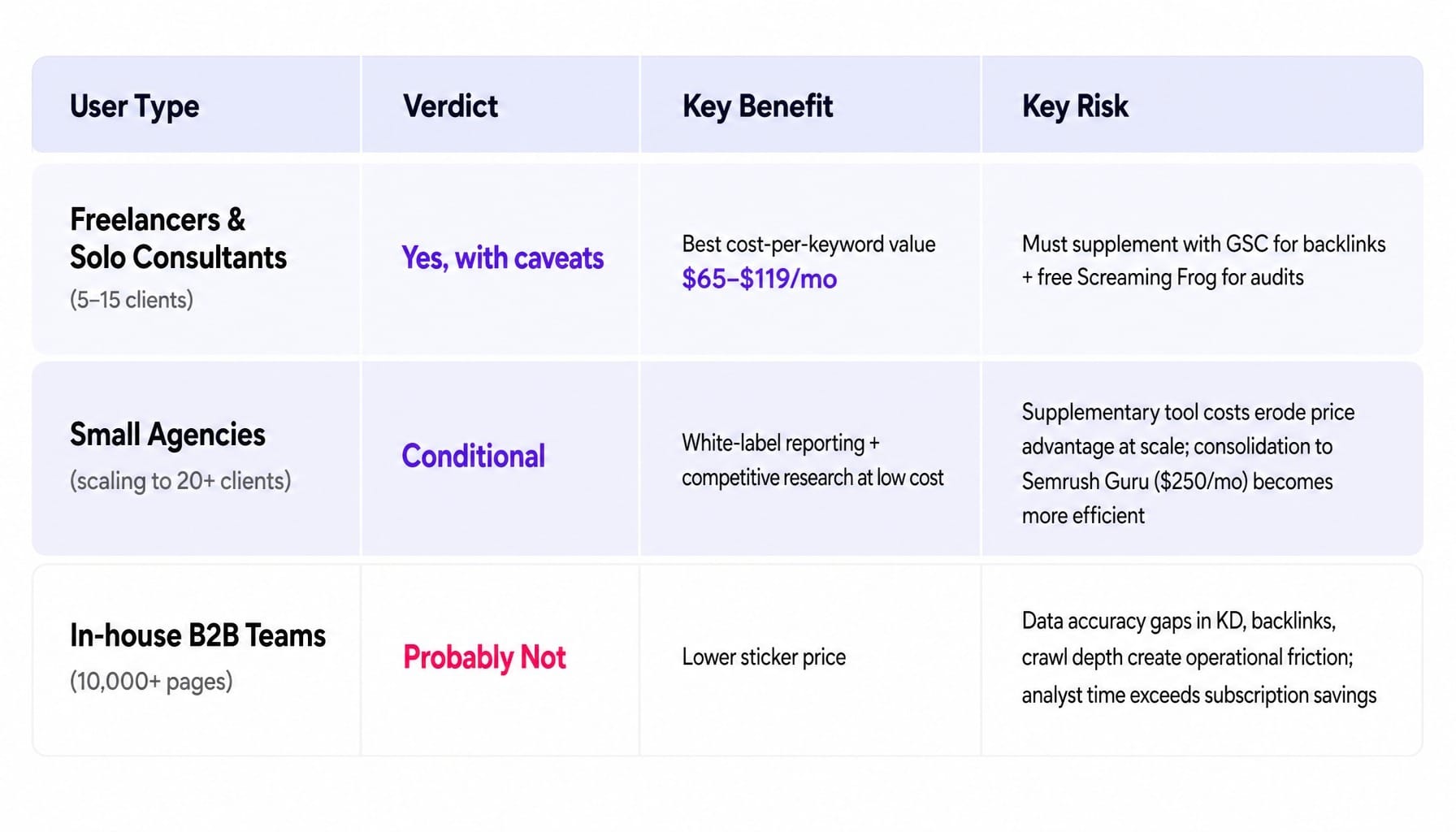
Freelancers and solo consultants: yes, with caveats
For a freelance SEO consultant managing 5-15 client projects, SE Ranking is arguably the best value option on the market. At $65-$119/month, it replaces about 70% of the functionality you'd use in Semrush's $140/month Pro plan for nearly half the cost. The caveats are real: you'll still need to rely on Google Search Console for accurate, timely backlink data and the free version of Screaming Frog (up to 500 URLs) for deeper technical spot-checks. But if your primary client deliverable is rank tracking and high-level competitive analysis, SE Ranking is worth it.
Small agencies scaling to 20+ clients: conditional
SE Ranking is an effective growth-stage tool for agencies. It works well until you hit the ceiling on sub-account seat allocation, API call rate limits, and the point where the white-label reporting capabilities of the Business plan are no longer sufficient. As an agency scales past 20 clients with more diverse technical SEO needs, the costs of supplementary tools—Ahrefs for backlinks, a paid Screaming Frog license for audits—begin to erode the price advantage. At that scale, consolidating workflows onto a single platform like Semrush's Guru plan ($250/month) often becomes more cost-effective and operationally efficient.
In-house B2B marketing teams: probably not
For most in-house marketing teams at B2B SaaS companies, especially those with 10,000+ page websites and active content programs, the answer is no. These teams typically outgrow SE Ranking within six months. The data accuracy gaps in keyword difficulty, backlink freshness, and crawl depth create operational friction that costs more in analyst time than the subscription saves. When your team spends hours every month cross-referencing data against other sources to build confidence in their decisions, the savings are a false economy. These teams require the data depth and workflow consolidation of Semrush or Ahrefs.
SE Ranking vs Semrush and Ahrefs: What the Price Gap Actually Buys You
The monthly price difference between SE Ranking's Pro plan and a comparable tier from Semrush or Ahrefs is around $60-$80. Most reviews frame this as a feature comparison, but that misses the point. The price gap buys you three things: data depth, data freshness, and workflow consolidation.
- A Larger, Fresher Data Index: Semrush's keyword database is over 26 billion keywords; SE Ranking's is around 5.5 billion. This 5x difference directly impacts the depth of long-tail keyword discovery and content gap analysis. For backlinks, the gap is about freshness. Ahrefs can show you referring domain velocity trends in near real-time; SE Ranking shows you a snapshot that's weeks old.
- More Reliable Proxy Metrics: The extra cost contributes to more sophisticated modeling for metrics like keyword difficulty. When a content team runs a gap analysis in Semrush, it might return 200 keyword clusters with reliable intent classification. A similar analysis in SE Ranking might return 60 clusters, requiring more manual SERP verification to confirm intent and true difficulty.
- Deeper Native Tooling: Premium platforms have more mature, integrated modules. Semrush's site audit catches hreflang conflicts and crawl budget waste that SE Ranking misses. Ahrefs' content explorer provides historical performance data that SE Ranking's tools don't.
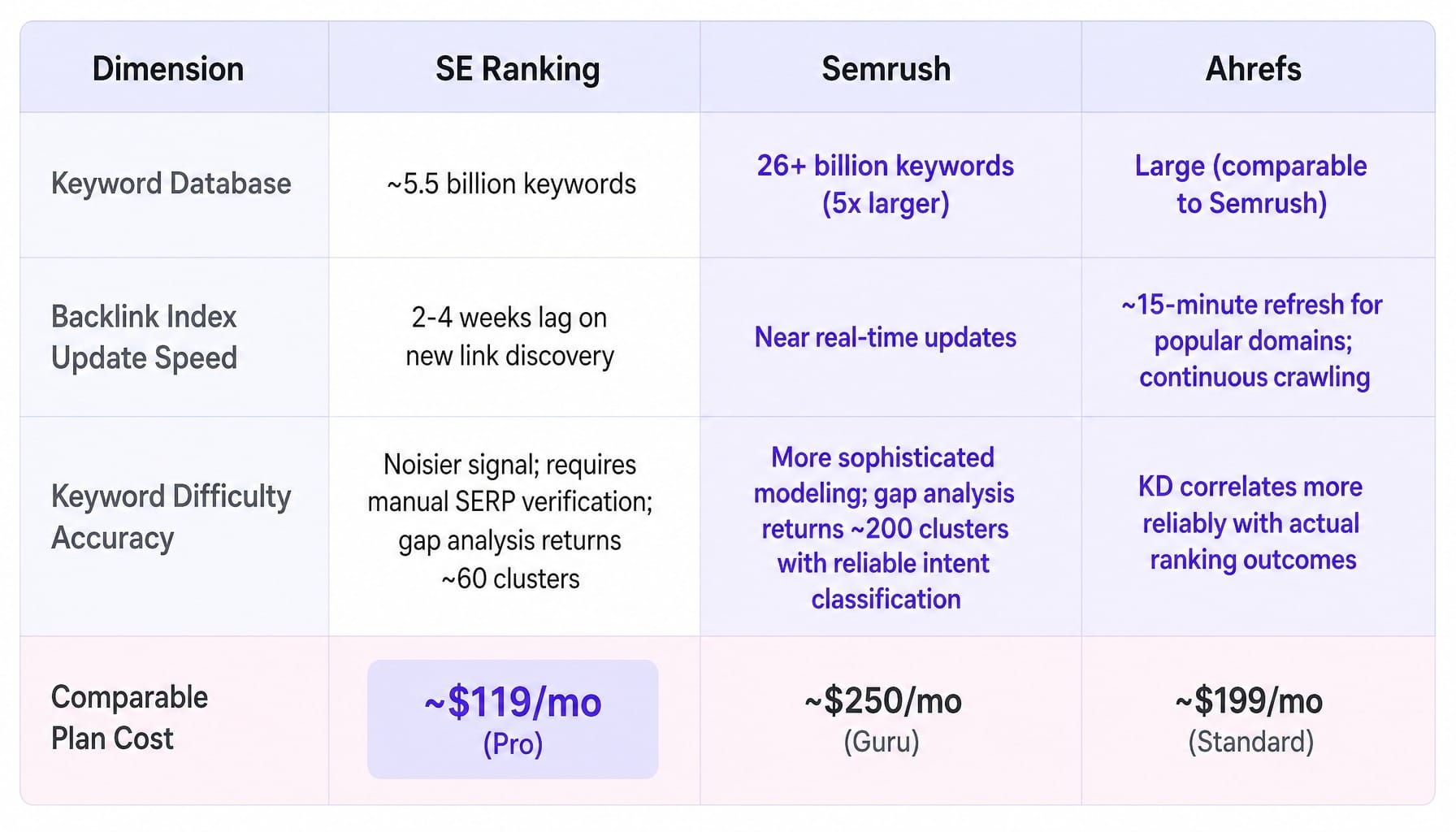
The price difference isn't about having more features on a checklist. It's about paying for a higher degree of data confidence and operational self-sufficiency that reduces your dependency on other tools. If your workflow can tolerate supplementary tools and manual verification, SE Ranking saves money. If you need a single, reliable system, you pay more.
Read more: SE Ranking vs Semrush (2026): Real Tests, Hidden Costs, and Who Should Use Which
The Real Cost of SE Ranking: Supplementary Tools and Manual Verification
No review of SE Ranking is complete without accounting for the tools you'll still need. This is the hidden cost that makes a simple '$119 vs $250' comparison misleading. The total cost of ownership is a measure of subscription fees plus the cost of supplementary tools and the analyst time spent managing a fragmented workflow.
A typical SE Ranking user ends up assembling a supplementary stack:
- Google Search Console: Free, but requires manual time to export, clean, and analyze data.
- Screaming Frog: The paid version is $259/year, necessary for deep crawls on sites over 500 URLs.
- Ahrefs' Free Backlink Checker: For spot-checking new links that haven't appeared in SE Ranking yet.
- A Content Optimization Tool (e.g., Surfer SEO): SE Ranking's content editor lacks the sophisticated TF-IDF and NLP analysis of dedicated tools.
Let's model the effective monthly cost for a small team: SE Ranking Pro ($119) + Screaming Frog ($22 amortized) + just three hours of analyst time spent cross-referencing data ($225 at a blended rate of $75/hr) brings the total cost to ~$366. This is significantly more than the $250 for a Semrush Guru plan that consolidates most of these workflows.
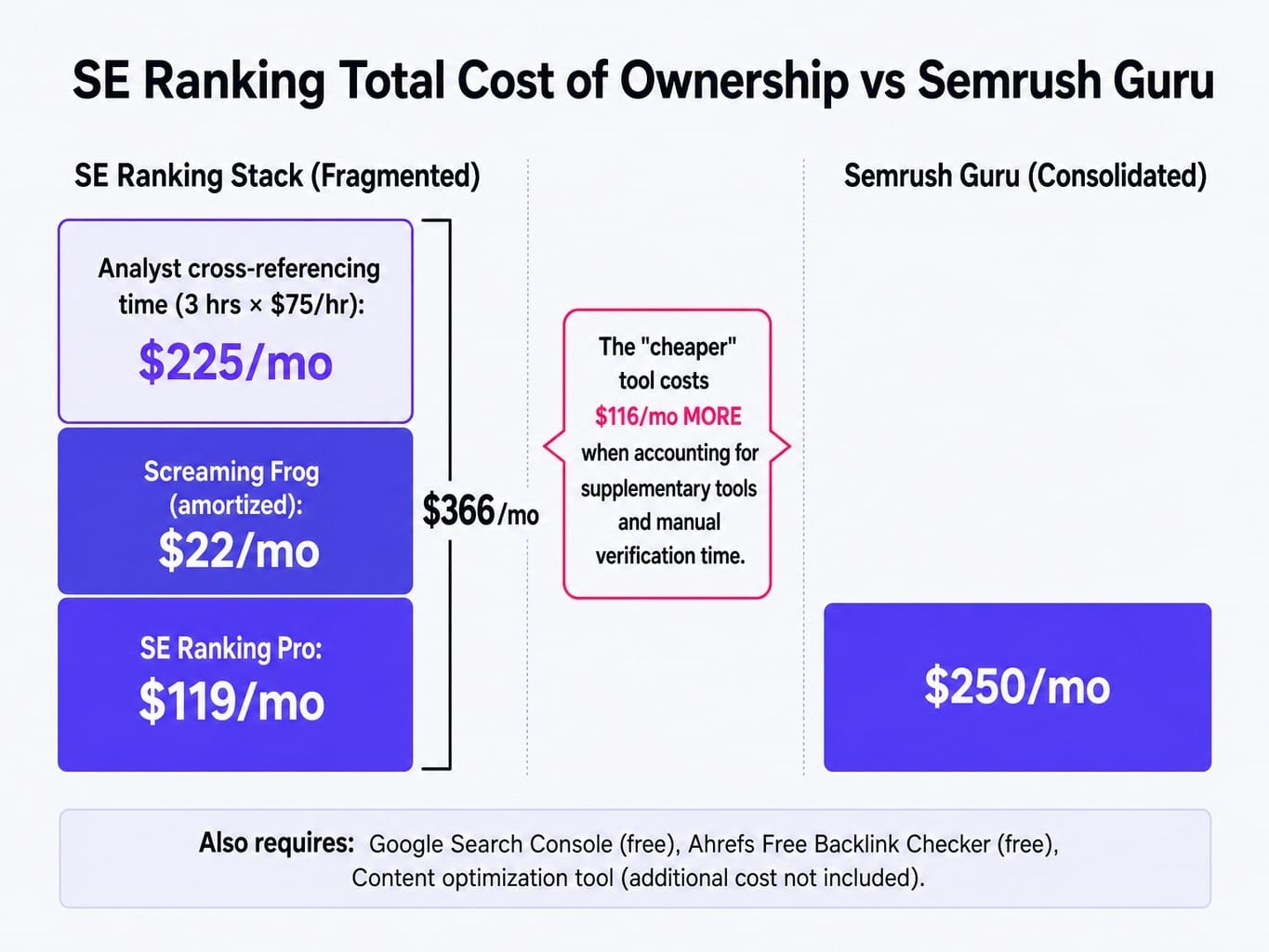
This is the hidden tax on "cheaper" tools. The sticker price is lower, but the total cost of ownership—in both cash and time—narrows the gap considerably.
When the Real Problem Isn't Which SEO Tool to Pick
The tension is clear: SE Ranking saves subscription costs but adds operational overhead. Semrush consolidates workflows but costs more. Both systems, however, stop at the dashboard. They deliver data and insights, but still require a human to interpret that data, prioritize actions, fight for developer resources, and manually execute changes.
The real bottleneck isn't which tool you choose; it's the latency between identifying what needs to change and actually shipping that change.
This is the execution gap that marketing systems were not designed to solve. Whether you use SE Ranking or Semrush, the output is still a backlog of homework. Spike AI is designed as the execution layer that closes this gap. It ingests the signals from your marketing stack, identifies the single highest-impact move across your website, SEO content, or ads, and then executes it. The cadence shifts from quarterly planning to weekly releases, compounding gains over time. If you spend more time managing tools than shipping improvements, the problem isn't the tool—it's the absence of an execution system.
See how Spike AI turns your SEO insights into weekly shipped improvements
The Verdict: Is SE Ranking Worth It?
'Worth it' is not a feature question; it's a workflow question. SE Ranking is a capable, well-priced tool, but its value is determined entirely by whether your operational system can absorb its data gaps without creating more friction than the subscription savings are worth.
For freelancers and small agencies with straightforward rank-tracking and reporting needs, it is genuinely worth it. The cost-per-keyword value is unmatched.
For in-house B2B teams running complex SEO programs, the total cost of ownership—factoring in supplementary tools and the manual hours spent validating its data—makes premium platforms like Semrush or Ahrefs a more efficient investment.
Ultimately, the tool you choose matters less than your ability to act on what it surfaces. As search becomes more complex, the bottleneck is never the dashboard. It's the distance between insight and execution.
Frequently Asked Questions
Is SE Ranking accurate enough for enterprise-level rank tracking?
Its accuracy for standard SERP positions is comparable to premium tools. However, enterprise teams tracking 10,000+ keywords across many geolocations may find inconsistencies in local pack and AI Overview tracking. Always validate a sample of its data against Google Search Console before committing.
Does SE Ranking's AI writer produce content worth publishing?
The AI tools can generate serviceable first drafts for meta descriptions or social posts. For long-form articles, the output is generic and lacks the topical depth scoring and SERP-based optimization of dedicated tools like Surfer SEO. Use it as a drafting assistant, not a content strategist.
Can agencies use SE Ranking white-label reports for enterprise client deliverables?
Yes, for standard monthly reports covering rankings and audit summaries. However, the customization depth falls short for enterprise clients; you cannot embed custom data visualizations or integrate third-party data with the flexibility of a tool like Looker Studio connected to a premium API.
How does SE Ranking handle AI Overview and SERP feature tracking in 2026?
SE Ranking has added AI Visibility tracking for Google AI Overviews, ChatGPT, and Perplexity. However, practitioner testing suggests its data reliability and mention volume accuracy lag behind Semrush's more mature AI visibility module. Use it for directional awareness, not precise measurement.
Is SE Ranking's free trial long enough to properly evaluate the tool?
The 14-day trial is sufficient for testing rank tracking setup and running a basic site audit. It is not long enough to assess backlink index freshness or keyword difficulty accuracy, which require 30-60 days of cross-referencing against actual ranking outcomes and other data sources.