
Is Semrush Worth It in 2026? A Decision Framework for B2B Marketing Teams

TL;DR
- Semrush is worth it if you have dedicated execution capacity—like an agency or an in-house SEO with engineering support—to act on the data it provides.
- The real cost of Semrush isn't the subscription; it's the hidden onboarding time (15-20 hours) and the per-user seat licensing that penalizes collaborative B2B teams.
- For low-volume B2B keywords, Semrush traffic estimates are unreliable. Use it for directional insights and content gap analysis, but verify all data against Google Search Console.
- If your team is already proficient in Ahrefs, or if you're a solo marketer on a small site, Semrush is rarely worth the cost. The feature overlap is too high, and free tools cover the basics.
- The primary determinant of Semrush ROI is your team's ability to ship changes. If insights pile up in a backlog, the tool is an expensive dashboard, not a growth engine.
A three-person B2B SaaS marketing team signs up for Semrush Guru at $249 a month. Three months later, they have 47 high-intent keyword opportunities, a site audit with 312 technical issues, and a competitive gap analysis showing eight content pillars their rivals own. They have shipped exactly zero changes.
The tool is working perfectly. The team isn't. They lack the bandwidth to act on what Semrush surfaces.
This scenario gets to the heart of the matter. The question "Is Semrush worth it?" is actually two questions in disguise. First: is the intelligence Semrush provides valuable? Almost always, yes. Its database is massive and its analytics are powerful. The second, more important question is: can your team convert that intelligence into shipped changes fast enough to generate a positive ROI on the subscription? For many lean teams, the honest answer is no.
This is not another feature walkthrough. This is a decision framework. We'll analyze who gets value from Semrush, who doesn't, what the real costs are, and where the tool's utility ends.
When Semrush Is Worth Every Dollar
Semrush delivers clear ROI when your team has the bandwidth to act on what it surfaces. This typically means you have either a dedicated SEO headcount or an agency executing on its findings. If your team fits one of these three profiles, the investment is likely justified.
1. The Agency or Consultant Managing 5+ Client Domains
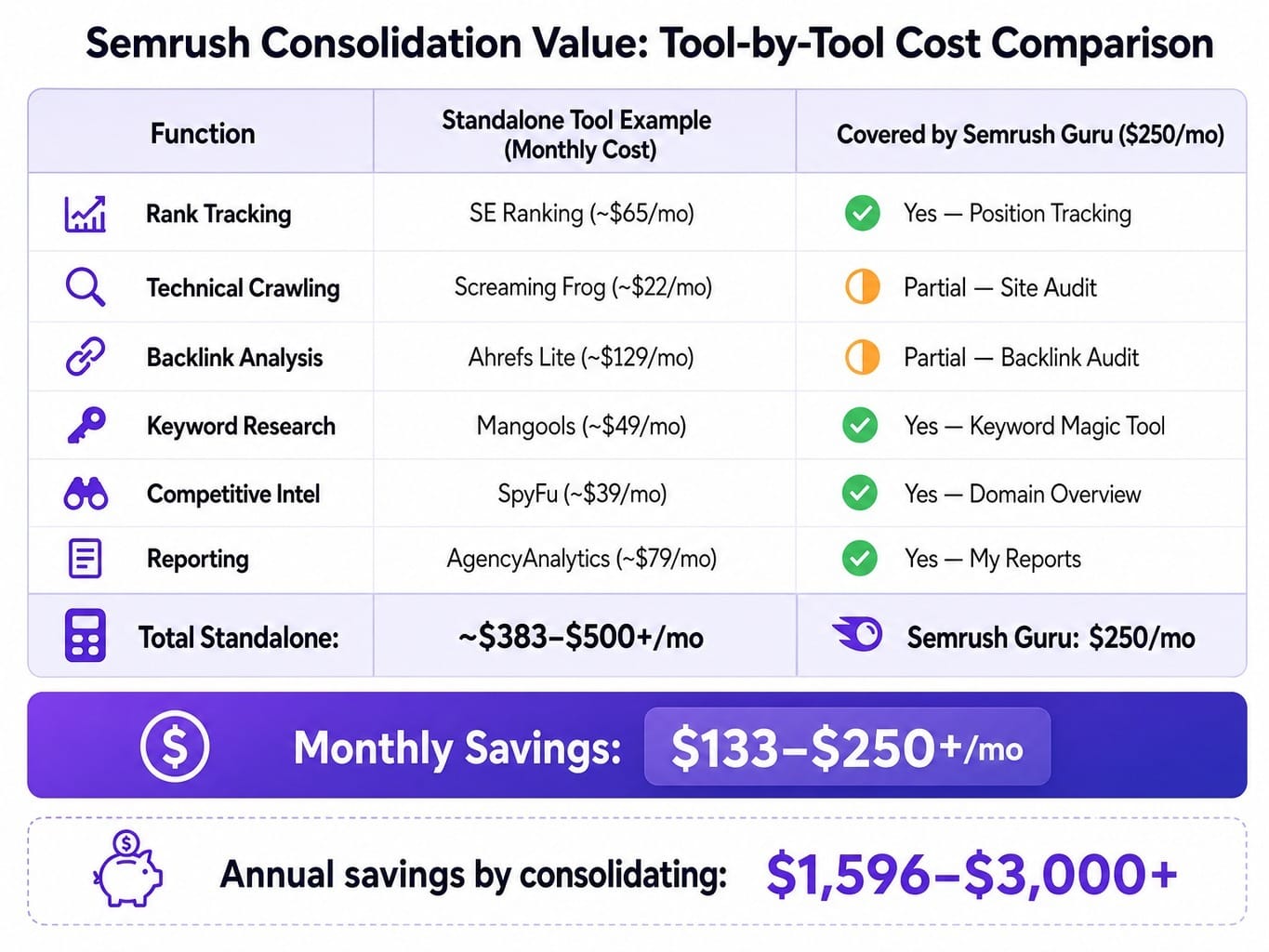
For agencies, Semrush is a consolidation play. The Guru plan's competitive positioning maps, share of voice dashboards, and white-label reporting are essential for client management. The alternative is patching together 3-4 separate tools. The math is simple: Semrush Guru at ~$250/mo replaces a rank tracker like SE Ranking (~$65/mo), a technical crawler like Screaming Frog (~$259/yr), a backlink tool, and a reporting platform. The total cost of standalone tools easily hits $400-$500 a month. Here, Semrush isn't just a tool; it's an operational efficiency.
2. The In-House SEO Lead with Engineering Support
When you have a direct line to developers, Semrush's technical SEO toolkit becomes a goldmine. The site audit's crawl budget analysis, index bloat detection, and log file analyzer move from theoretical problems to actionable tickets. A report flagging a critical cannibalization issue isn't just another notification; it's the start of a sprint ticket that gets resolved. With a database of over 43 trillion backlinks and 27 billion keywords, the intelligence layer is robust. This profile has the organizational structure to turn that intelligence into implementation.
3. The Content Team Running a Keyword-Driven Editorial Calendar
For content teams focused on capturing organic demand, Semrush's Keyword Magic Tool is a powerful engine. Its ability to perform topic cluster mapping and classify search intent directly feeds a production pipeline. Identifying a keyword gap delta isn't an academic exercise; it's the brief for next quarter's content. This team uses Semrush not just for research, but as a system for planning and prioritizing content that aligns with business goals.
Read more: SaaS Keyword Research: A Revenue-First Framework for 2026
When Semrush Is Not Worth It—and What to Use Instead
Most reviews soften the cons. We won't. For certain teams, Semrush is a net-negative investment that drains budget and creates a backlog of guilt.
1. The Solo Marketer on a Single, Small Website
If you're managing one website with under 5,000 monthly sessions, Semrush is overkill. The Pro plan at ~$140/mo comes to over $1,600 a year. For that price, you get a flood of data you'll likely look at once a month but act on once a quarter. The cost per insight acted upon is enormous.
What to use instead: Google Search Console (free) gives you the most accurate performance data. A free Screaming Frog license (crawls up to 500 URLs) handles basic technical audits. This combination delivers 80% of the value for 0% of the cost.
2. The Team Already Proficient in Ahrefs
The functional overlap between Ahrefs and Semrush is around 75-80%. Both offer robust keyword research, backlink analysis, site audits, and rank tracking. If your team has already built its workflows, dashboards, and institutional knowledge around Ahrefs, switching to Semrush introduces massive friction for marginal gains. The cost of retraining, rebuilding reports, and migrating projects almost always outweighs the benefit of a few unique features.
What to use instead: Stick with Ahrefs. Doubling down on one platform is more effective than splitting your budget and attention across two nearly identical toolsets.
3. The Lean B2B Team Without Execution Capacity
This is the most common failure mode. If nobody on your team has the time or technical skill to implement site audit fixes, write the content for keyword gaps, or build links from prospecting lists, Semrush becomes an expensive dashboard. It's a recurring reminder of everything you know you should be doing but can't get to. The tool generates a to-do list your team doesn't have the capacity to execute.
What to use instead: An execution-focused platform or service that closes the execution gap between insight and implementation. The problem isn't a lack of data; it's a lack of shipping.
The Real Cost of Semrush Beyond the Subscription Price
Every Semrush review quotes the monthly subscription. None of them calculate the Total Cost of Ownership (TCO). The sticker price is the smallest part of the investment. The real costs are hidden in your team's time, feature bloat, and a pricing model that punishes collaboration.
The Onboarding and Feature Bloat Tax
Semrush boasts over 55 distinct tools across SEO, PPC, content, and social media. For a lean team, this breadth is a liability, not an asset. Most B2B marketing teams use the same 6-10 features consistently: keyword research, position tracking, site audit, competitive analysis, and backlink auditing. The other 45+ features create cognitive overhead—more dashboards to learn, more notifications to ignore, more reports that go unread.
This "feature bloat" comes with a steep onboarding cost. A typical marketer needs 15-20 hours of focused use to become proficient in just the core SEO workflows. At a blended rate of $75/hour for a mid-level marketer, that's $1,125-$1,500 in hidden onboarding costs before the tool generates a single dollar of value. With a feature utilization rate often below 15%, you're paying for an entire suite but living in one small corner of it.
The Seat-Licensing Problem for Collaborative Teams
Semrush's per-user pricing model disproportionately penalizes collaborative B2B SaaS marketing teams. SEO intelligence is most valuable when it flows freely between content, product marketing, and growth. Semrush's pricing actively creates silos.
Let's do the math. The Guru plan ($249.95/mo) includes one user. Each additional seat costs another $80/mo.
- A 3-person team (SEO lead, content manager, growth lead) pays $249.95 + $80 + $80 = $409.95/mo.
- A 5-person team pays $249.95 + ($80 x 4) = $569.95/mo.
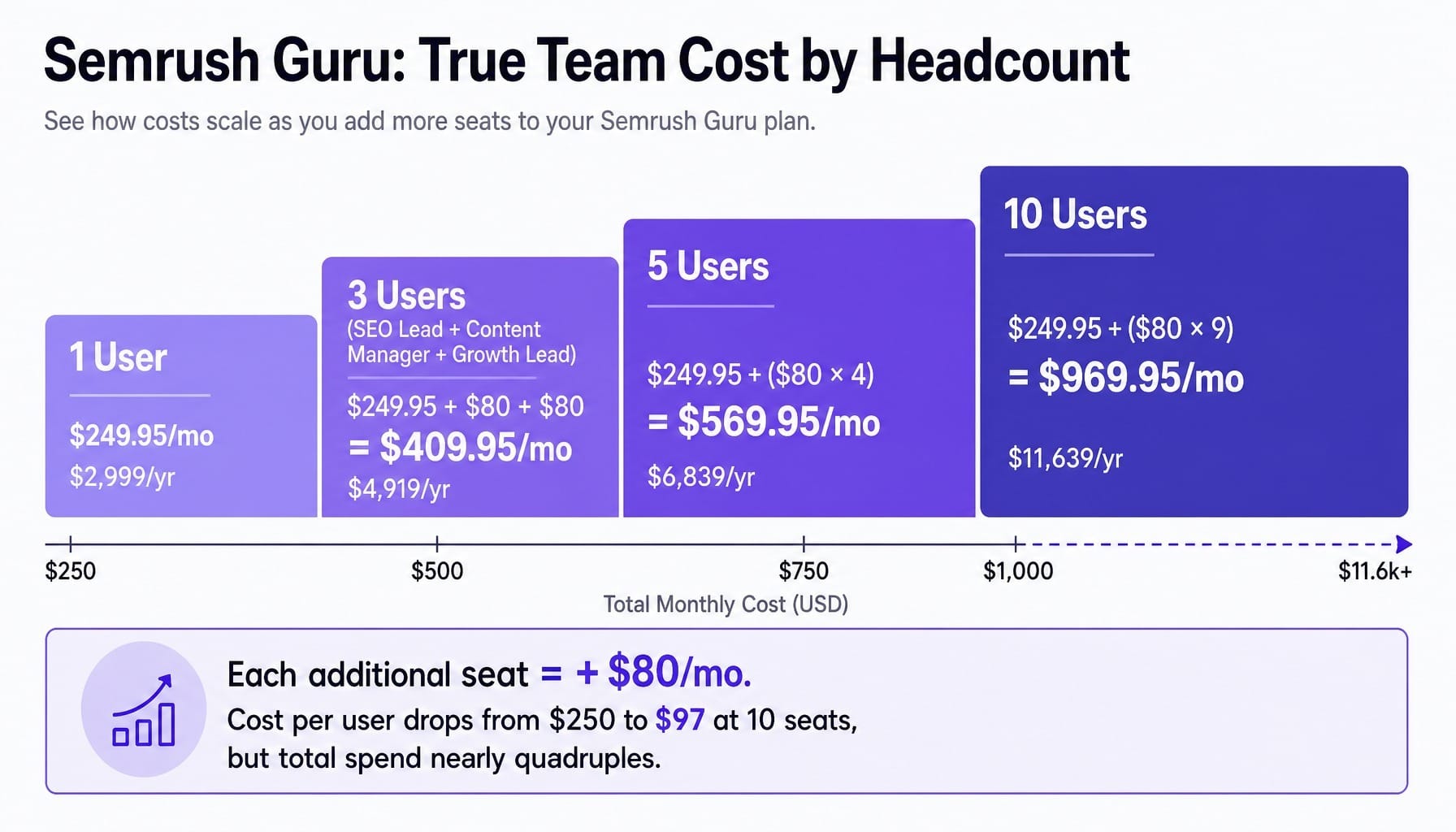
The practical result is predictable. Teams either overpay, violate the terms of service by sharing a single login (creating workflow chaos and security risks), or lock SEO knowledge in one person's head. For a B2B SaaS team where a content gap analysis needs to inform the editorial calendar and a technical audit needs to inform the engineering backlog, this pricing model is a structural impediment to growth.
How Accurate Is Semrush for B2B Keywords?
For B2B SaaS companies, keywords live in low-volume territory. Terms like "enterprise data governance platform" or "SOC 2 compliance automation" might only get 50-200 searches per month. This is where all-in-one SaaS marketing tools, including Semrush, start to break down.
Semrush builds its massive keyword database from clickstream data and search engine APIs. This model is reliable for high-volume, consumer-focused terms. But its accuracy degrades significantly for queries below ~100 monthly searches. It's common to see Semrush's traffic estimates for a B2B domain be 50-70% higher than the actuals reported in Google Search Console. The gap widens the more niche your vertical becomes.
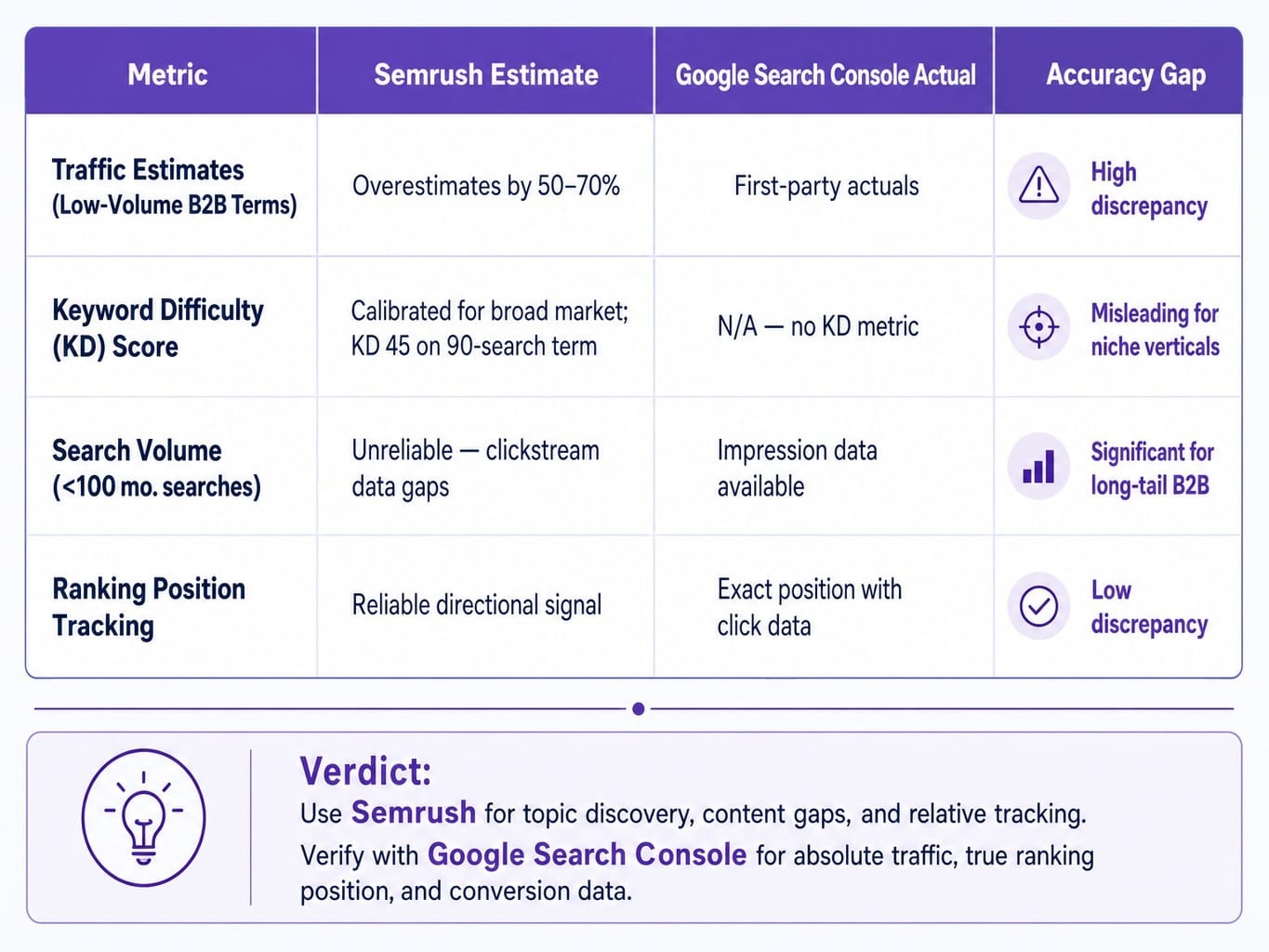
This leads to the "KD inflation" problem. Semrush's Keyword Difficulty (KD) score is calibrated for a broad market. A KD of 45 for a B2B term with 90 monthly searches is not the same as a KD of 45 for a consumer term with 12,000 searches. The competitive landscape is smaller, the search intent is more specific, and the ranking feasibility is often higher than the generic score suggests.
Verdict: Semrush is a directional tool for B2B keyword research. Use it to discover topic clusters, perform content gap analysis, and track relative position changes. Do not trust its absolute traffic estimates or KD scores for low-volume keywords. Always cross-reference with your Google Search Console data before committing resources.
What Semrush Actually Replaces—and the Gap It Leaves Open
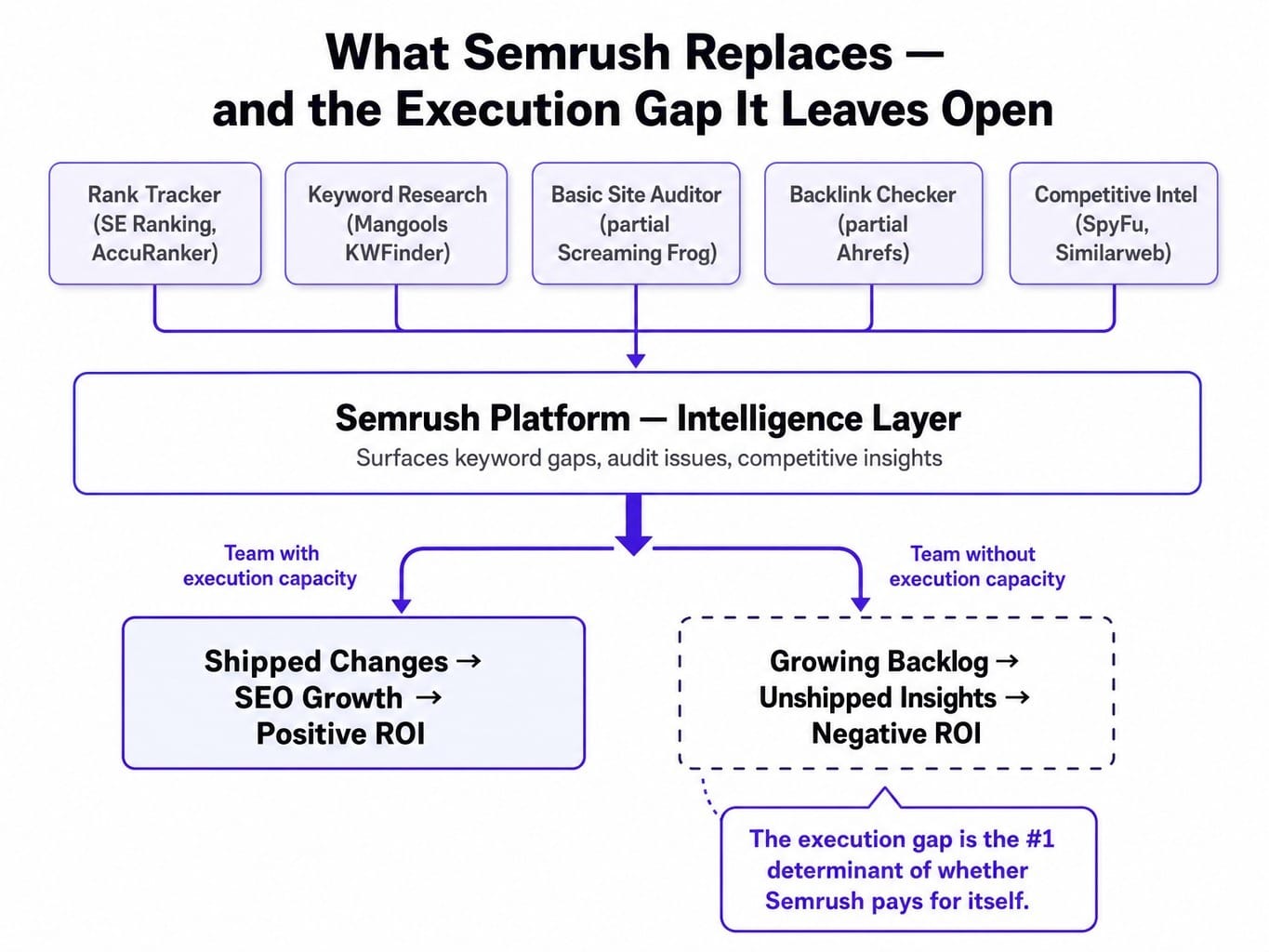
Semrush's strongest value proposition is consolidation. For teams paying for multiple standalone tools, it can genuinely reduce complexity and total spend. But the most important gap it leaves open is the one between intelligence and implementation.
First, what it genuinely replaces. A Semrush subscription can take the place of:
- A rank tracker (e.g., SE Ranking, AccuRanker)
- A keyword research tool (e.g., Mangools KWFinder)
- A basic site auditor (a partial replacement for Screaming Frog's deep crawls)
- A backlink checker (a partial replacement for Ahrefs' deeper index)
- A competitive intelligence dashboard (e.g., SpyFu, Similarweb)
If you're currently spending $200-$400 a month across these categories, a Semrush Pro or Guru plan offers real savings.
Now, what it doesn't replace: execution. Semrush cannot implement the changes it recommends. It identifies 312 site audit issues but doesn't fix them. It surfaces 47 keyword gaps but doesn't write the content. It flags page cannibalization but doesn't restructure your site architecture.
The output of every Semrush workflow is a to-do list that lands on a human's desk. For a team with ample execution bandwidth, this is a perfect system. But for a lean B2B team, this is precisely where the tool's value proposition breaks down. The intelligence is excellent; the execution gap is the bottleneck.
When the Bottleneck Isn't Intelligence—It's Shipping
The central tension is clear: Semrush is a powerful intelligence tool, but for lean B2B teams, the bottleneck isn't knowing what to fix—it's having the bandwidth to ship those fixes.
The site audit surfaces hundreds of issues. The keyword gap analysis identifies dozens of content opportunities. The competitive report shows exactly where you're losing ground. None of it matters until someone implements a change. This is the execution gap that stalls growth, and it's the exact problem Spike AI is designed to solve.
Spike AI isn't another intelligence tool; it's the execution layer that makes your existing tools pay off. It identifies the single highest-impact move across your website, SEO, and ads—and then executes it. Every week. A continuous weekly cadence replaces heroic quarterly pushes.
Where Semrush hands you a backlog, Spike AI ships it. If you've been paying for intelligence tools but struggling to act on them, the problem isn't the tool. It's the execution model. Spike AI changes the model from manual and sporadic to autonomous and compounding.
See how Spike AI turns your SEO backlog into weekly shipped improvements
Conclusion
"Is Semrush worth it?" is the wrong question for most lean B2B teams. The right question is, "Can my team convert Semrush's intelligence into shipped changes fast enough to justify the subscription?"
The tool's data and competitive intelligence are genuinely best-in-class. For teams with dedicated SEO headcount or agency support, Semrush often pays for itself through tool consolidation and analytical depth.
But for the growing number of lean, multi-disciplinary marketing teams, the subscription becomes a recurring reminder of an ever-growing execution backlog. Data without action is an expensive dashboard.
Before you evaluate any SEO tool, audit your execution capacity first. The most expensive tool you can buy isn't the one with the highest monthly fee. It's the one that surfaces an endless stream of work you never ship.
Frequently Asked Questions
Can Semrush replace multiple standalone SEO tools to save money?
Yes, partially. It effectively replaces a standalone rank tracker, keyword research tool, and basic backlink checker. However, it doesn't fully replace Screaming Frog for deep technical crawls or Ahrefs for backlink index depth. Consolidation savings are most significant for teams spending $300+/mo across 3-4 separate tools.
Is the Semrush Guru plan worth upgrading from Pro?
Guru is worth it if you need the Content Marketing Toolkit, historical data, or manage more than 5 projects. For a single-site B2B team focused on keyword research and site audits, Pro covers 90% of daily workflows. The $110/mo price jump is hard to justify without a clear need for Guru's specific features.
How long does it typically take to see ROI from a Semrush subscription?
If measuring ROI as traffic gains from SEO changes, expect 3-6 months. The tool surfaces opportunities immediately, but SEO is a long game. Teams that see ROI fastest are those who act on site audit fixes and content opportunities within the first 30 days, not those who spend months exploring dashboards.
Does Semrush's AI content tooling reduce the need for separate writing platforms?
Semrush's ContentShake AI and SEO Writing Assistant provide useful starting points and basic optimization scoring. However, they don't match the semantic depth of dedicated platforms like Clearscope or Surfer SEO. For teams where content optimization is a core workflow, a specialized tool is still necessary.
Is Semrush worth it if I already have Google Search Console and Ahrefs?
Rarely. GSC provides the most accurate first-party data, and Ahrefs covers the core SEO toolset with comparable depth. The marginal features Semrush adds—like PPC keyword data or its social media toolkit—seldom justify a second $140-$250 monthly subscription unless you have a specific need for its advertising intelligence.