
Is Surfer SEO Worth It in 2026? A B2B Marketer's Honest Assessment

TL;DR
- Surfer SEO is a strong on-page optimization tool, particularly its Content Editor for identifying topical gaps and its Audit tool for refreshing old content. Its value is in providing a structured workflow for content alignment.
- The primary risk is "content score obsession"—chasing a high score can harm readability and conversion by encouraging keyword stuffing. A high score does not guarantee rankings, especially if the underlying search intent alignment is wrong.
- For B2B teams targeting niche, low-volume keywords, Surfer's data model often breaks down. Its recommendations are based on analyzing top-ranking pages, and if the SERP is thin or low-quality, the suggestions become noise, not signal.
- Calculate your ROI by dividing the monthly cost by the number of articles you actually optimize. If the resulting cost-per-ranking-improvement is less than the value of the leads generated, it's worth it. If not, you're paying for a workflow, not results.
- Surfer SEO is not a strategy. If your growth is stalled despite high content scores, your bottleneck isn't optimization—it's execution throughput. The real problem is likely the latency between identifying what to do and actually shipping changes across all your marketing channels.
A B2B marketing manager subscribes to Surfer SEO after reading a dozen glowing reviews. For three months, the team diligently chases content scores above 80 on every article. The dashboards are green. The checklists are complete. The content looks perfectly optimized. But the pipeline hasn't moved. Qualified traffic is flat.
This scenario isn't a failure of Surfer SEO. It's a failure of expectation.
The tool is legitimately good at what it does: aligning a piece of content with the on-page SEO signals of pages that already rank. But asking is Surfer SEO worth it is the wrong question. The right questions are: does that specific job—on-page content optimization—actually move business outcomes for your team? Or does it just make your content workflow feel more productive?
This article evaluates Surfer SEO through the lens that matters for B2B marketing and RevOps leaders. We'll cover what it does well, where its model falls short (especially for B2B), and provide a real ROI framework to decide if it justifies the monthly cost.
What Surfer SEO Actually Does Well
Surfer SEO is an effective on-page content optimization layer, not a comprehensive SEO platform. It excels at one primary job: analyzing the current SERP for a target keyword and providing a data-driven checklist to help you align your content with the pages that are already winning. For teams without a dedicated SEO strategist, this provides crucial guardrails. When used correctly, it systematizes the process of ensuring topical completeness and structural alignment, which are foundational elements of on-page SEO.
Think of it as a SERP analyzer that translates its findings into a real-time, actionable brief. This is a valuable function, but it's important to recognize that its recommendations are based on correlation, not causation. It shows you what top pages have in common; it's up to you to decide which of those patterns actually matter.
The Content Editor Is Genuinely Useful for On-Page Alignment
The Content Editor is Surfer SEO's core value proposition. Its NLP-driven term suggestions, structural guidelines, and real-time content scoring give writers a concrete checklist for achieving topical completeness. Imagine a content writer producing a 2,000-word article on "CRM implementation best practices." They might cover the basics, but Surfer's analysis of the top 10 results could reveal that every high-ranking page also discusses data migration strategies, user adoption timelines, and integration complexity with other SaaS tools.
These aren't just keywords; they are sub-topics that signal expertise and comprehensiveness to both users and search engines. Surfer's value isn't the score itself, but its ability to surface these topical map coverage gaps you would otherwise miss without tedious manual SERP analysis. The seamless integrations with Google Docs, WordPress, and Jasper further embed this workflow, making it a practical tool for content ops.
Content Audits Save Time on Existing Pages
Surfer's Audit tool is its second most valuable feature, especially for teams with an existing content library. By connecting to your Google Search Console, it compares your published pages against the current SERP leaders for the keywords they rank for. This is a powerful starting point for any content refresh workflow.
For a B2B SaaS company with hundreds of blog posts from 2022 and 2023, the Audit tool quickly identifies content decay. It pinpoints which pages are now missing critical NLP terms that have become common in the SERP, where word count expectations have changed, or where internal linking is weak. It provides a structured, prioritized list of optimization opportunities that is significantly faster than manual analysis. The caveat, of course, is that these recommendations are directional. The audit tells you what's different about your page versus competitors, not whether those differences are the actual reason for a performance gap.
Where Surfer SEO Falls Short—and Most Reviews Won't Tell You
Surfer's design incentivizes a behavior—chasing content scores—that can actively harm content quality and business outcomes. While most reviews mention "don't over-optimize" as a throwaway line, it's a central risk of the platform. Furthermore, for teams already invested in a comprehensive SEO suite like Ahrefs or Semrush, Surfer introduces significant stack redundancy, forcing you to question if you're paying a premium for a single feature. A high content score on a page targeting the wrong intent or lacking domain authority is just an expensive green checkmark.
Content Score Obsession Can Hurt More Than It Helps
The most common failure mode for teams using Surfer is treating the content score as a KPI rather than a diagnostic signal. The score measures topical alignment with current SERP leaders; it does not measure readability, conversion potential, information gain, or E-E-A-T. We've seen teams systematically push every article's score above 85 by forcing NLP term suggestions into paragraphs where they don't naturally fit. The result is content that reads like a term-density exercise, not a helpful guide written for a human.
This is the path to over-optimization penalty signals. Readability and user engagement suffer, time-on-page drops, and conversion rates worsen. The page might be perfectly optimized for Surfer's algorithm, but it's now de-optimized for your reader and, consequently, for Google's Helpful Content System. The moment your writing starts to sound unnatural to satisfy a tool, you've crossed a line. The goal is to create content that ranks; often, that means knowing when to ignore a tool's suggestions and accept a score of 75.
If You Already Pay for Ahrefs or Semrush, You're Paying Twice
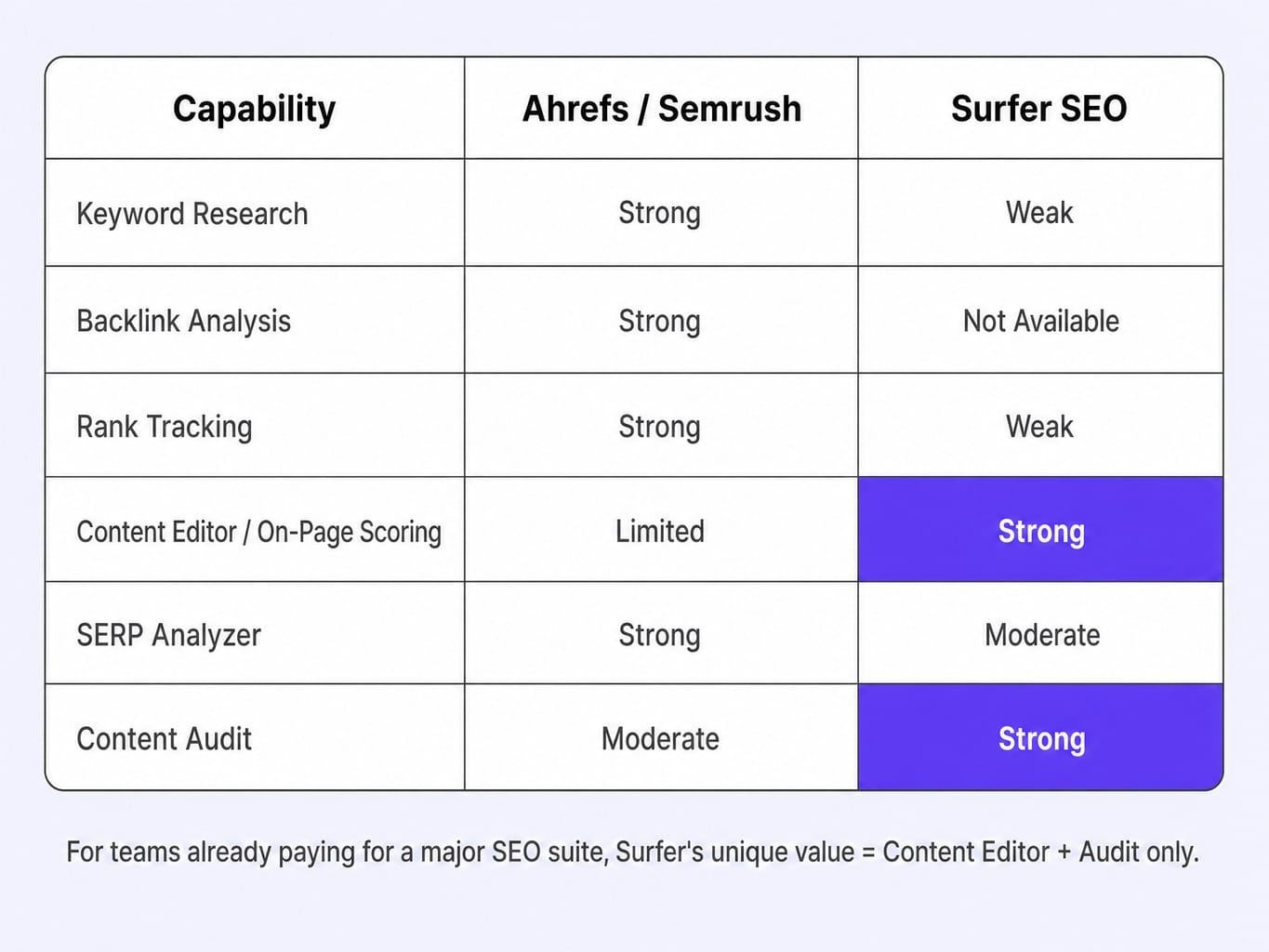
Most B2B marketing teams already have a subscription to Ahrefs or Semrush for keyword research, backlink analysis, and rank tracking. Surfer's features in these areas—Keyword Research, SERP Analyzer, and competitive analysis—are materially weaker than what the major platforms provide. This means the real question isn't whether Surfer is worth its monthly fee, but whether the Content Editor alone is worth that fee.
For a team paying for Ahrefs and Surfer, the workflow often involves doing keyword research in Ahrefs, then plugging that keyword into Surfer to generate a brief. You are paying for a redundant, less powerful set of features. A mature content team can often replicate Surfer's core function by using Ahrefs' Content Explorer and manual SERP analysis to build an internal content scoring rubric in Notion. For teams without a structured content workflow, Surfer provides valuable guardrails. But for teams with established processes, it can become an expensive, single-feature utility.
Read more: Surfer SEO vs Clearscope: Which Tool Fits Your Team's Actual Workflow in 2026
The B2B Problem: Surfer Struggles When Search Volume Is Thin
Surfer's entire content scoring model is built on analyzing the top-ranking pages for a given keyword to extract common patterns. This model works well when a keyword has healthy search volume and a SERP populated with at least 10 strong, relevant competitors. The data set is rich enough to produce a useful signal.
But this is not the reality for most high-intent B2B SaaS keywords.
B2B content marketers live in a world of low-volume, high-specificity queries. Think "SIEM implementation timeline for mid-market" (30 searches/month) or "best PDM software for aerospace engineering" (10 searches/month). The SERPs for these terms are often thin, featuring fewer than ten quality results. The top spots might be occupied by a Gartner report behind a paywall, two Reddit threads, a vendor's technical documentation, and a tangentially related comparison post from three years ago.
When Surfer analyzes this weak, noisy corpus, its NLP term suggestions and structural guidelines are garbage in, garbage out. The SERP similarity score is low, and the recommendations can lead you to create content that mimics the flawed structure of the existing weak results. The tool's value is inversely correlated with how niche and technical your B2B topic is. For broad, high-volume head terms, it provides a solid baseline. For the long-tail, high-intent keywords that actually drive B2B pipeline, its signal-to-noise ratio drops dramatically.
The ROI Math Most Reviews Skip: Cost Per Ranking Improvement
Every review states Surfer SEO's price, but none provide a framework for calculating its actual return on investment. Here's a simple model you can apply to your own subscription.
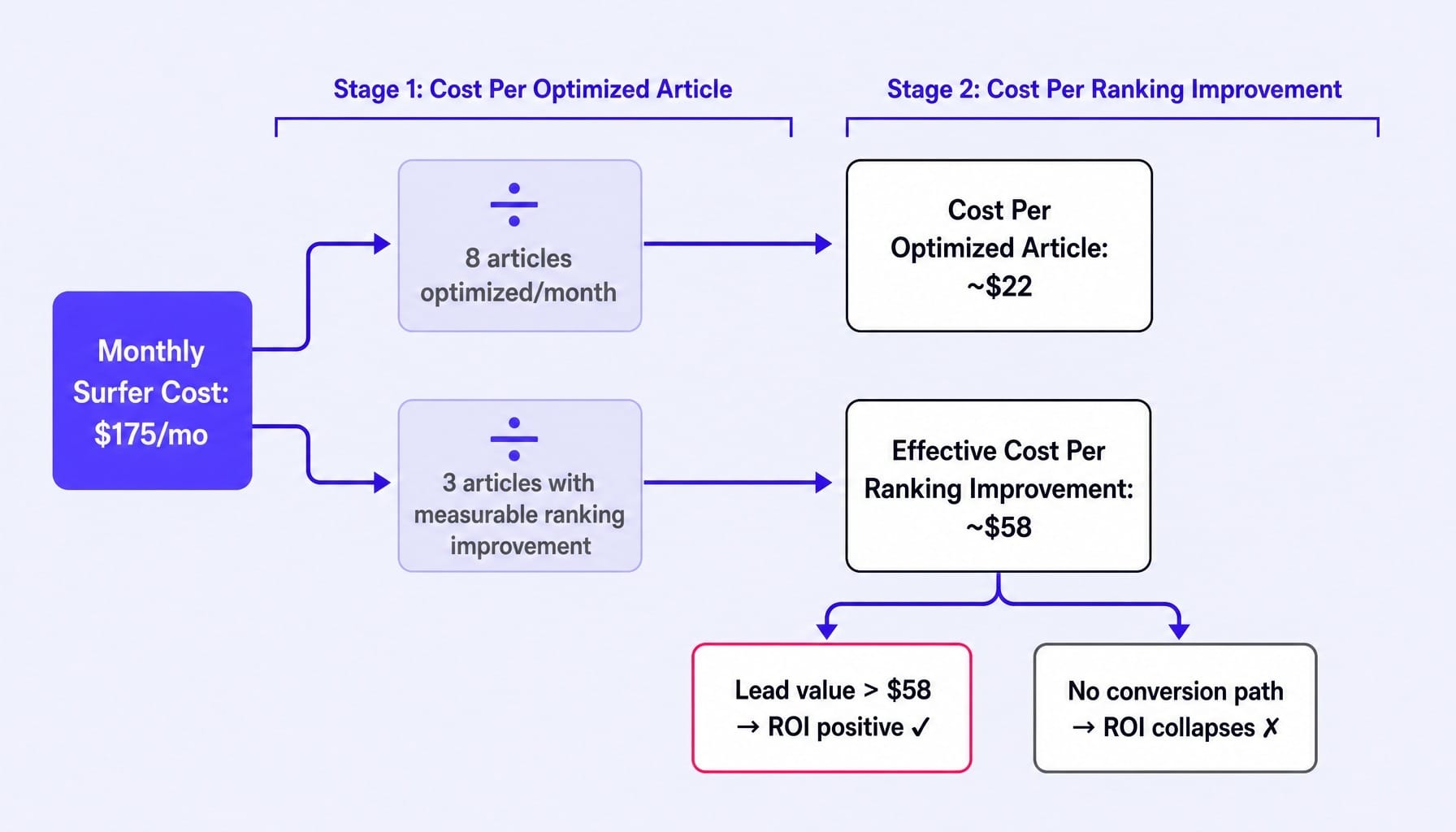
Take your monthly Surfer cost and divide it by the number of articles you actually optimize per month. Not the number of credits you have, but the number of content editor workflows you complete.
Let's use a realistic scenario:
- Plan: Surfer's Scale plan at ~$175/month.
- Team Output: You optimize 8 articles per month.
- Cost Per Optimized Article: $175 / 8 = ~$22 per article.
Now, the critical question: did that optimization produce a measurable ranking improvement? Not all optimizations will. Let's say 3 of those 8 articles see meaningful movement (e.g., moving from page 2 to page 1, or from position 8 to position 3).
- Effective Cost Per Ranking Improvement: $175 / 3 = ~$58 per success.
For a B2B SaaS company where a single qualified lead from organic search can be worth $500 or more, a $58 cost to secure a ranking that generates even one extra lead per month makes the ROI a no-brainer. However, if you're optimizing articles that target purely informational keywords with no conversion path, or if your "improvements" are moving from position 47 to position 38, the ROI collapses. This framework moves the evaluation from a vague "is it worth it?" to a quantifiable business decision.
When to Keep Surfer SEO—and When to Cancel
The decision to use Surfer SEO isn't a one-time verdict; it's an ongoing evaluation of your team's maturity and primary growth constraints.
Keep Surfer if:
- Your team publishes 4+ new content pieces per month and lacks a senior SEO strategist. In this case, the Content Editor provides essential structural guardrails that prevent common on-page errors and accelerate the writing-to-publishing workflow. The cost is justified as a quality assurance and velocity tool.
- You have a large existing content library (100+ pages) and actively use the Audit tool. For teams focused on content refreshes, Surfer's ability to programmatically identify content decay is a significant time-saver.
Cancel Surfer if:
- You publish fewer than 2 articles per month. The per-article cost becomes unjustifiably high.
- Your content primarily targets low-volume, technical B2B keywords. As discussed, Surfer's model produces weak signals in thin SERPs, meaning you're paying for noise.
- Your team has internalized its patterns. If your writers can now intuitively spot topical gaps and structural issues without the tool, you've graduated. You're no longer paying for a tool; you're paying for a habit you've already built.
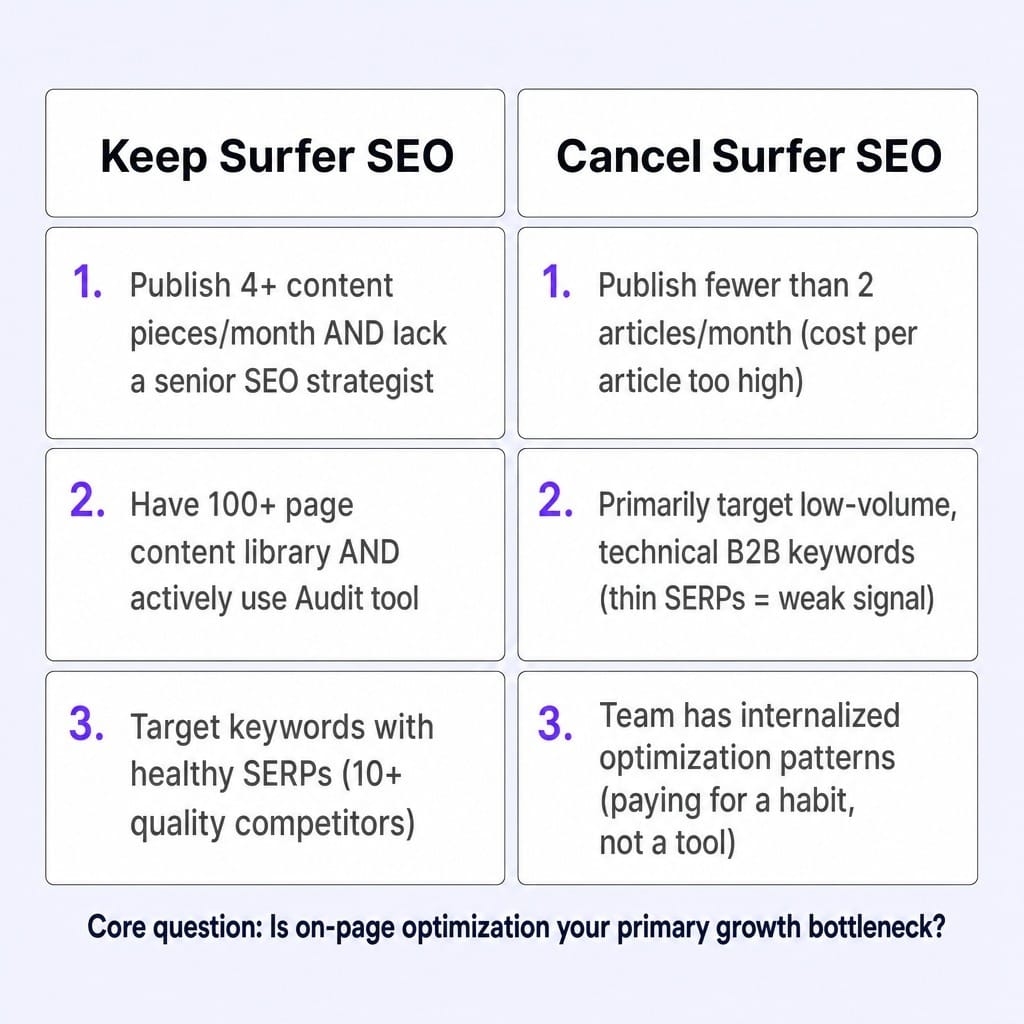
The real question isn't whether Surfer is a good tool. It is. The question is whether on-page content optimization is the primary bottleneck constraining your growth.
Read more: Surfer SEO vs MarketMuse: Which Tool Matches Your Actual Content Bottleneck (2026)
When the Bottleneck Isn't Content Optimization—It's Execution Throughput
For most B2B teams, the system stalls not because articles score 75 instead of 85. It stalls because the latency between identifying what needs to change and actually shipping that change eats weeks of runway.
A team can have perfect Surfer scores on every blog post and still see a flat pipeline because they aren't running enough experiments across their website, conversion paths, and ad campaigns. The real constraint is execution throughput. Optimizing one content piece at a time is an incremental activity. Compounding growth comes from a system that can identify the highest-impact move across the entire marketing surface—whether it's a CRO test on the pricing page, a technical SEO fix, or an AEO adjustment to capture an AI overview—and deploy it.
This is the execution gap Spike AI is built to close. Instead of helping you optimize one asset, Spike AI's marketing execution engine identifies the single highest-impact move across your website, SEO/AEO content, and ads, then executes it. Every week. The cadence of weekly releases that compound over time is structurally different from the slow gains of perfecting individual content pieces. It shifts the marketing team's focus from operating SaaS marketing tools to approving revenue-driving outcomes.
See how Spike AI identifies and ships your highest-impact marketing move every week
Conclusion: What Is Actually Constraining Your Growth?
So, is Surfer SEO worth it? The answer depends entirely on whether on-page content optimization is the real constraint limiting your growth.
Surfer is a genuinely good tool. It earns its monthly fee when you publish frequently, target keywords with healthy SERPs, and use its Content Editor as a diagnostic guide, not a rigid scorecard. It provides a system for a task that is otherwise messy and manual.
But the moment your growth stalls despite a sea of green content scores, the problem is no longer at the level of the tool. The bottleneck has moved downstream to execution velocity, cross-channel integration, and shipping cadence.
Stop asking, "Is this tool worth the money?" Start asking, "What is the single biggest thing constraining our growth right now?" The answer to that question determines where your budget, attention, and effort should go next.
Frequently Asked Questions
Does Surfer SEO help with AI overview optimization and zero-click searches?
Surfer recently added an "AI Search" feature to check if your content covers facts AI overviews might surface. It's a useful directional signal, but true AI overview optimization depends more on entity authority, structured formatting (lists, tables), and passage-level extractability. Surfer's NLP term density focus doesn't directly address these, so treat its guidance as one input, not a complete AEO strategy.
Is the Surfer AI writer good enough to publish without heavy editing?
No. Surfer AI produces structurally sound first drafts with decent topical coverage, but the voice is generic and the reasoning is shallow. Practitioners consistently report needing to rewrite or heavily edit 30-50% of the text for it to meet the standards of client-facing B2B content. It's a tool for overcoming a blank page, not for replacing a skilled writer.
How long does it typically take to see ROI from a Surfer SEO subscription?
For refreshed content targeting keywords where you have some existing authority, you can see measurable ranking movement within 6-8 weeks. For new content, the timeline is longer—typically 3-6 months. Surfer only accelerates the on-page optimization component; it has no impact on the other critical ranking factors like backlink acquisition, crawl indexing, or overall domain authority.
Is Surfer SEO better than Clearscope for content optimization in 2026?
They solve the same core problem with different trade-offs. Surfer offers more features for a lower price (Content Editor, Audit, SERP Analyzer, Keyword Research). Clearscope is more focused, and its content grading is arguably cleaner and less prone to encouraging keyword stuffing, but it costs significantly more. For most lean teams, Surfer provides better value; for enterprise teams wanting maximum simplicity, Clearscope may justify its premium.
Does Surfer SEO integrate with WordPress and common CMS platforms?
Yes. Surfer has direct integrations with WordPress, Google Docs, and Jasper AI, which cover the most common content workflows. The WordPress integration allows you to publish optimized content directly, while the Google Docs add-on is popular for collaborative editing. For other platforms like Webflow, you can export the content as HTML or Markdown.