
Is Yext Worth It? A Candid Review from Marketers Who've Used It for a Year
TL;DR
- For businesses with 50+ locations and frequent data changes (e.g., retail, healthcare), practitioners agree Yext's time-savings and duplicate suppression justify the cost.
- For most B2B companies with 1-5 locations, Yext is an over-investment. The budget delivers a higher ROI when spent on website conversion optimization or content.
- Canceling Yext can actively degrade your listings. The "churn-on-cancel" problem means you may have to pay for manual cleanup after your subscription ends, making the total cost of ownership much higher.
- In the era of AI search, which prioritizes Google Business Profile and your website, the value of syndicating data to hundreds of minor directories is rapidly diminishing for B2B.
- Before committing, evaluate alternatives like BrightLocal, Semrush Listing Management, or a one-time manual cleanup, which can cost a fraction of Yext's recurring fee.
We collected feedback from multiple practitioners—agency owners, in-house marketers, and multi-location operators—who have used Yext for at least 12 months. The goal was to answer one question: is Yext worth it?
The feedback surfaced an immediate tension. Yext solves a real, frustrating problem: ensuring your business name, address, and phone number (NAP consistency) are accurate across hundreds of online directories. But it charges a recurring annual fee for what many feel is fundamentally a one-time setup task.
The verdict from those who've paid the invoices is clear. The answer to "is Yext worth the money" depends entirely on three variables: how many locations you manage, how frequently your business data changes, and whether you understand what happens to your listings if you stop paying.
This is not another surface-level Yext review. This is a consolidated briefing on what practitioners actually reported—the good, the bad, and the specific scenarios where Yext is a smart investment versus where it's an expensive distraction.
What Yext Actually Does (and What It Doesn't)
The single biggest misconception about Yext is that it permanently claims and fixes your business listings. It doesn't. Yext's platform syncs your data to its publisher network via direct API integrations and other data amplifier endpoints. As long as you pay, your data stays current. The moment you cancel, that sync layer is removed.
One practitioner who used Yext for two years put it best: "It's like renting furniture for your apartment. The apartment looks great while you're paying, but you never owned any of it."
When the Yext subscription ends, your listings revert to whatever data the publisher finds from other sources. This could be the state they were in before, or worse, stale data that accumulated during your subscription.
Yext's PowerListings network boasts over 200 endpoints, but the quality of these connections varies. There are direct, real-time API integrations with major players like Google Business Profile, Apple Business Connect, and Bing Places. However, many others are data submission endpoints where Yext simply pushes data without direct control over the listing. Understanding this distinction—that Yext is a temporary sync service, not a permanent fix—is critical to calculating its true value.
What Practitioners Say After Using Yext for a Full Year
We framed our conversations around value delivered versus cost. The feedback from marketers across multi-location enterprises, single-location B2B companies, and agencies split cleanly along one axis: the scale and volatility of their location data. For some, it was an operational lifesaver. For others, it was a solution in search of a problem.
The pattern was unmistakable. Practitioners managing 50 or more locations were consistently positive. Those managing one to five locations almost universally felt they had overpaid.
Where Practitioners Found Yext Worth Every Dollar
The marketers who championed Yext all managed complex, multi-location businesses. We spoke with a marketing director for a healthcare network with over 200 clinics where provider names, office hours, and accepted insurance plans changed quarterly. She reported that before Yext, a single address change took her team 15-20 hours to propagate manually, with errors persisting for months. With Yext, the same change was updated across the core publisher network within 48 hours from a single dashboard. For them, the time savings alone justified the annual contract commitment.
Another practitioner, managing 50+ franchise locations, highlighted the duplicate suppression feature as a game-changer. Yext's suppression queue automatically identified and proposed merges for over 40 duplicate listings that were diluting their local search presence and confusing customers.
The consensus was clear: Yext's value scales directly with location count and data volatility. For businesses in industries like healthcare, hospitality, or retail with dozens of locations and frequent data changes, the platform's entity management and knowledge manager features provide a clear ROI by replacing thousands of hours of manual work.
Where Practitioners Felt They Overpaid
On the other side of the spectrum were B2B companies and single-location businesses. We heard from a marketing lead at a B2B SaaS company with one office who signed up for Yext after a compelling sales call. Twelve months later, he audited his analytics. Fewer than 3% of all website sessions originated from any directory Yext managed, and zero qualified leads could be traced back to a directory listing. His conclusion: "We spent a thousand dollars to solve a problem that wasn't costing us a single dollar in lost revenue."
An agency owner shared a story of Yext's sync layer overwriting a carefully crafted, high-performing Yelp business description with a generic one, requiring hours of manual work to fix. It's a small detail, but it highlights the risk of a one-size-fits-all sync.
The core insight from this group was simple: for a B2B company whose buyers don't search for "accounting software near me," the entire premise of local listing management is misaligned with how their pipeline is actually built. For these businesses, Yext is often an expensive and unnecessary piece of infrastructure.
Read more: B2B SaaS Marketing in 2026: The Execution Gap Most Teams Never Close
The Churn-on-Cancel Problem Nobody Warns You About
Canceling your Yext subscription doesn't just return your listings to their previous state—it can actively degrade them. This is the churn-on-cancel problem, and it was the most common frustration we heard.
Here's the mechanism: While you're subscribed, Yext's data sync layer overrides any data that existed on publisher sites. If you had manually claimed listings before, Yext's sync may have taken precedence. When you cancel, that sync layer vanishes. However, your original manual claims may no longer be active, leaving listings to pull from outdated third-party data aggregators.
One marketer described discovering that after canceling a two-year Yext subscription, their Google Business Profile reverted to an old phone number and three other directory listings resurfaced a previous office address. The cleanup took weeks.
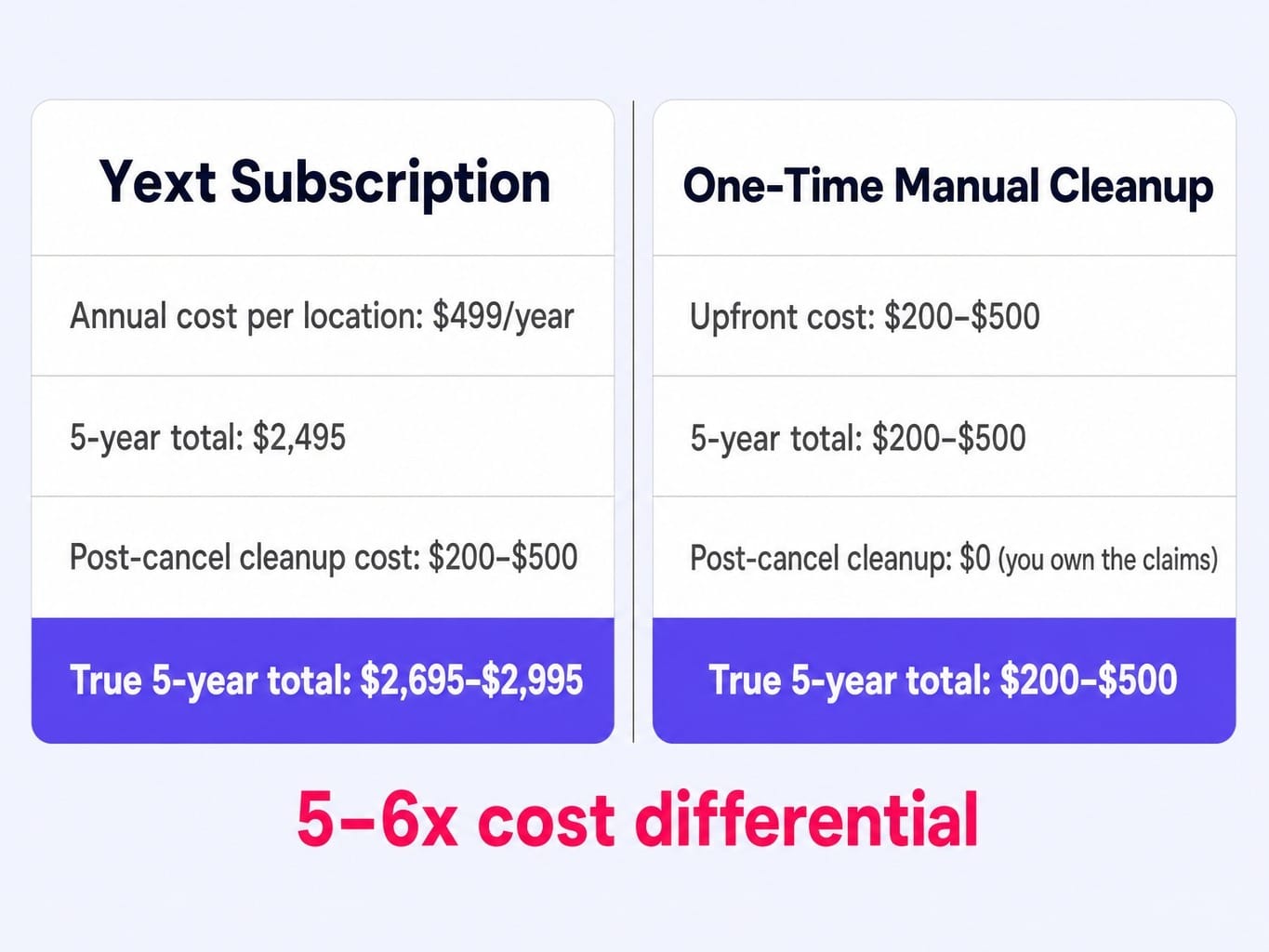
Let's frame this financially. A Yext subscription might run $499/year per location. Over five years, that's $2,495. A one-time manual citation cleanup from a service like Whitespark or BrightLocal costs between $200 and $500. Because of the churn-on-cancel problem, the Yext subscriber may need to pay for that manual cleanup anyway after they cancel. The true total cost of ownership isn't just the subscription; it's the subscription plus the eventual cleanup cost, a 5-6x differential from a one-time fix.
Does Yext Matter in the Age of AI Search?
In 2020, listing syndication mattered because searchers clicked through directory results. In 2026, the landscape is fundamentally different. AI search engines like ChatGPT Search, Perplexity, and Google's AI Overviews increasingly synthesize answers directly, bypassing the traditional list of blue links.
The question practitioners are now asking is this: does pushing your NAP data to 200 publisher endpoints matter when the AI answer engine primarily references your Google Business Profile, your own website's structured data, and other authoritative first-party sources?
One B2B marketer audited their referral traffic from all Yext-managed directories. The result? Fewer than 1% of sessions came from endpoints outside of Google, Bing, and Apple—all of which can be managed directly, for free. With over 60% of Google searches now ending without a click to a website, the value of being listed on a second-tier directory is more marginal than ever.
This represents a strategic reframe. For most B2B companies, the marketing investment that actually moves the needle isn't listing syndication. It's ensuring your own website converts the traffic you already have and that your content is structured to appear in AI-generated answers. The leverage is in optimizing assets you own, not renting visibility on platforms you don't.
Read more: B2B SaaS Website Design in 2026: The Conversion-First Framework Most Teams Miss
A Decision Framework: When Yext Makes Sense and When It Doesn't
The answer to "is Yext worth it for B2B" isn't a simple yes or no. Based on the feedback we gathered, the decision is conditional on a specific set of business characteristics. Here's a clear decision framework.
Yext Likely Makes Sense If…
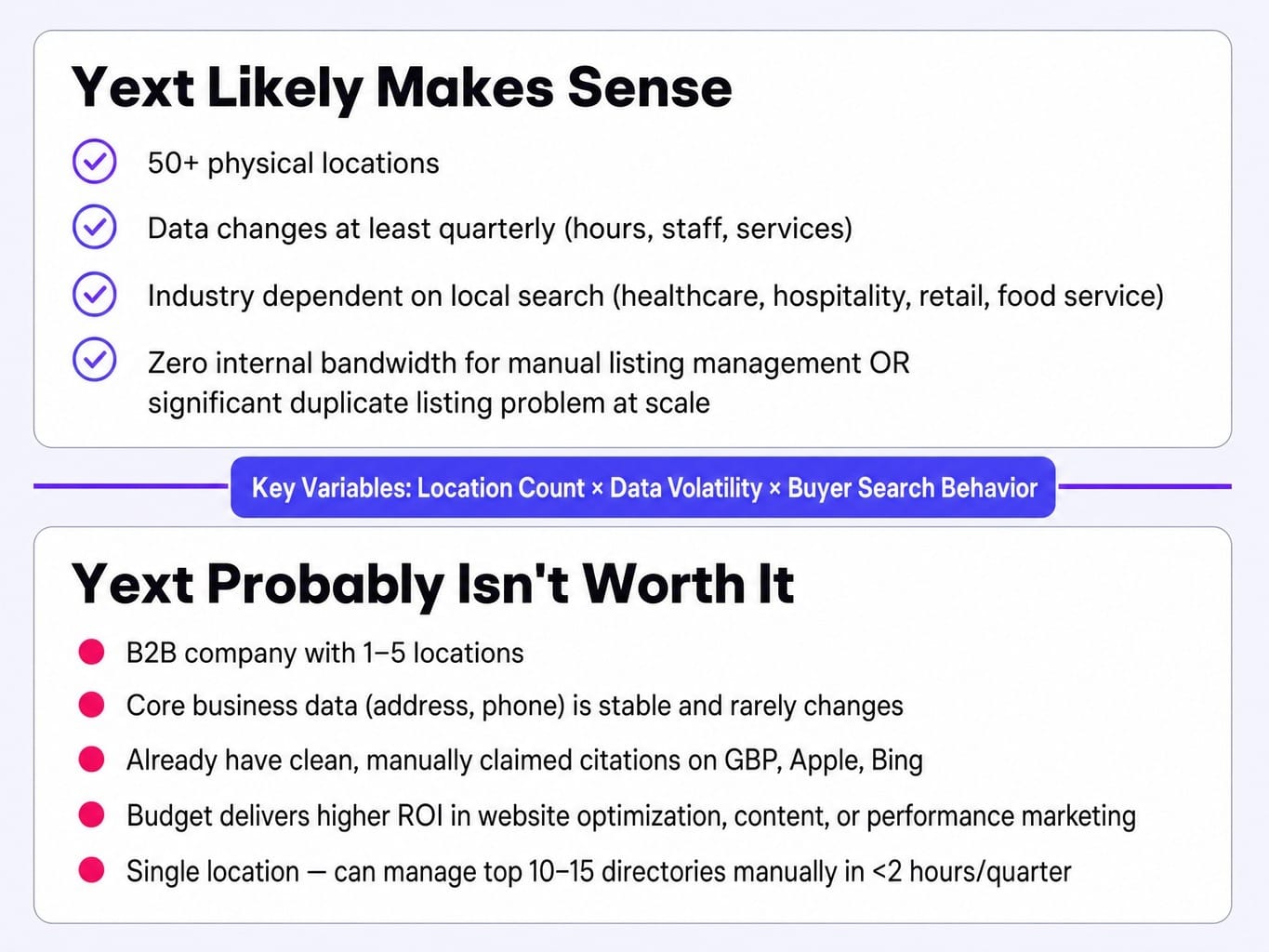
- You manage 50 or more physical locations, and your business data (hours, staff, services) changes at least quarterly.
- You operate in an industry where local search accuracy directly impacts foot traffic and revenue, such as healthcare, hospitality, retail, or food service.
- You have zero internal bandwidth for manual listing management, and the cost of hiring a person or agency for this task exceeds the Yext subscription fee.
- You are dealing with a significant duplicate listing problem at scale across your entire location portfolio and need an automated suppression queue.
Yext Probably Isn't Worth It If…
- You are a B2B company with 1-5 locations whose buyers discover you through content, referrals, or paid search—not local queries.
- Your core business data (address, phone number) is stable and rarely changes.
- You already have clean, manually claimed citations across the most important directories (Google Business Profile, Apple Business Connect, Bing Places).
- Your marketing budget would deliver a higher ROI invested in website conversion optimization, content creation, or performance marketing.
- You are a single-location business and can manage your top 10-15 directory listings manually in under two hours per quarter.
Alternatives Worth Evaluating Before You Commit
If the framework above placed you in the "probably not worth it" category, here are the four alternatives that practitioners recommended most frequently.
- BrightLocal: Often cited as the best option for agencies and businesses managing multiple locations that need more than manual work but less than Yext's enterprise price tag. It offers strong citation audit tools, review monitoring, and a campaign-based cleanup service.
- Semrush Listing Management: A solid choice for teams already invested in the Semrush ecosystem. Ironically, its listing distribution is powered by Yext's network, but it's offered at a lower price point and bundled with other valuable SEO tools.
- Moz Local: Known for a simpler interface, Moz Local automates distribution to major data aggregators and key directories. It's a good, straightforward option for small businesses looking for basic automation.
- Manual Management: This was the most recommended path for lean B2B teams. The process: claim and optimize your Google Business Profile, Apple Business Connect, and Bing Places profiles directly. Then, use a tool like Whitespark's Citation Finder to identify the 10-15 niche directories that actually matter for your industry and claim them manually. One practitioner noted this took about 8 hours upfront and 30 minutes per quarter to maintain—a tiny fraction of Yext's annual cost.
When the Real Problem Isn't Listings — It's What Happens After the Click
The practitioners we interviewed consistently pointed to the same pattern: teams evaluating Yext are often focused on an upstream visibility problem while ignoring the bigger constraint on their growth. They invest in listings, directories, and citations while their website conversion rates sit at 2% and their optimization backlog grows untouched.
This is where the conversation needs to shift from data syndication to execution velocity. If listing management isn't the highest-impact use of your budget, what is?
The answer is closing the execution gap—the painful latency between knowing what needs to change on your website and actually shipping that change. Where Yext syncs static business data to directories, Spike AI acts as a marketing execution engine that continuously identifies the highest-impact growth opportunities across your website, SEO, and ads, and then helps you execute them.
You came here asking whether to spend $500/year on directory listings. The better question is whether that budget would compound faster if it fueled a system that ships high-impact website improvements every single week.
See how Spike AI identifies and ships your highest-impact website improvements weekly
The Final Verdict on Yext
Yext is not a scam, but for most B2B companies with fewer than 50 locations, it's a recurring payment for a one-time problem. The churn-on-cancel dynamic creates a vendor dependency that can make the true cost of ownership significantly higher than the sticker price.
Our review of practitioner feedback is conclusive: Yext provides a clear, defensible ROI for high-location-count, high-data-volatility businesses in local-search-dependent industries. For nearly everyone else—especially B2B companies whose buyers don't search locally—that budget delivers far more value when invested in compounding assets like content creation and website conversion optimization.
As AI search engines increasingly bypass directories to pull answers directly from authoritative sources, the companies that win will be those optimizing the assets they own, not renting visibility on platforms they don't control.
Frequently Asked Questions
Does Yext suppress duplicate listings permanently or only while you're subscribed?
Only while you are subscribed. Yext's suppression queue actively monitors and merges duplicates during your subscription. Once you cancel, that mechanism is turned off, and previously suppressed duplicates can resurface as they are discovered by data aggregators again.
Are Yext's publisher integrations actually direct API connections?
Some are, but many are not. Yext has direct, two-way API integrations with major platforms like Google, Facebook, and Apple. However, a significant portion of its 200+ endpoint network consists of data submission connections where update speed and reliability can vary.
How long does it typically take to see local search ranking improvements from Yext?
Practitioners report that NAP consistency improvements from Yext can take 8-12 weeks to influence local search rankings. However, the impact is modest for businesses that already had reasonably clean citations. Yext improves data consistency, which is just one of many local ranking factors.
Can I use Yext for just one year to clean up listings and then cancel?
You can, but this is where the churn-on-cancel problem is most acute. When you cancel, listings may revert to old, inaccurate data. If this is your plan, it's critical to manually claim your most important profiles (GBP, Bing, Apple) independently before canceling.
Does Yext's review management compete with dedicated reputation platforms like Birdeye or Podium?
Not at the same depth. Yext offers solid review monitoring and response tools. However, dedicated platforms like Birdeye or Podium provide more advanced review generation workflows, SMS-based solicitation, and deeper sentiment analytics. If reviews are your primary focus, a dedicated platform is superior.