Jasper AI Review (2026): An Honest B2B Assessment of Cost, Quality & Alternatives
TL;DR
- Best Use Case: Jasper excels at accelerating structured, short-to-medium format marketing content (ad copy, email sequences, social posts) where iteration speed is critical. It is not a replacement for long-form content writers.
- Quality Depends on Configuration: The "Brand Voice" feature only works if you invest 2-4 hours upfront loading it with style guides and approved content. Without this knowledge base grounding, output is generic.
- Beware Output Drift: Content quality degrades as you scale past 30-40 assets per month. Outputs become repetitive, increasing the human editing time per asset and negating some of the speed advantage.
- Calculate Total Cost: A 4-person B2B team on the Pro plan will spend ~$1,400/month when you factor in subscription fees (seat cost bleed) and the 15-22 hours of required monthly editing labor.
- The Right Tool for the Job: Jasper is a strong content velocity tool. For compliance and governance, Writer is better. For budget-friendly flexibility, ChatGPT Enterprise is cheaper.
Your marketing team is likely a 2- or 3-person operation expected to produce 15-20 content assets a month—blog posts, landing pages, email sequences, ad copy—with the actual bandwidth for maybe six. This is the exact execution gap that drives teams to run a jasper ai review. The promise is seductive: an AI content generation platform to finally close that gap.
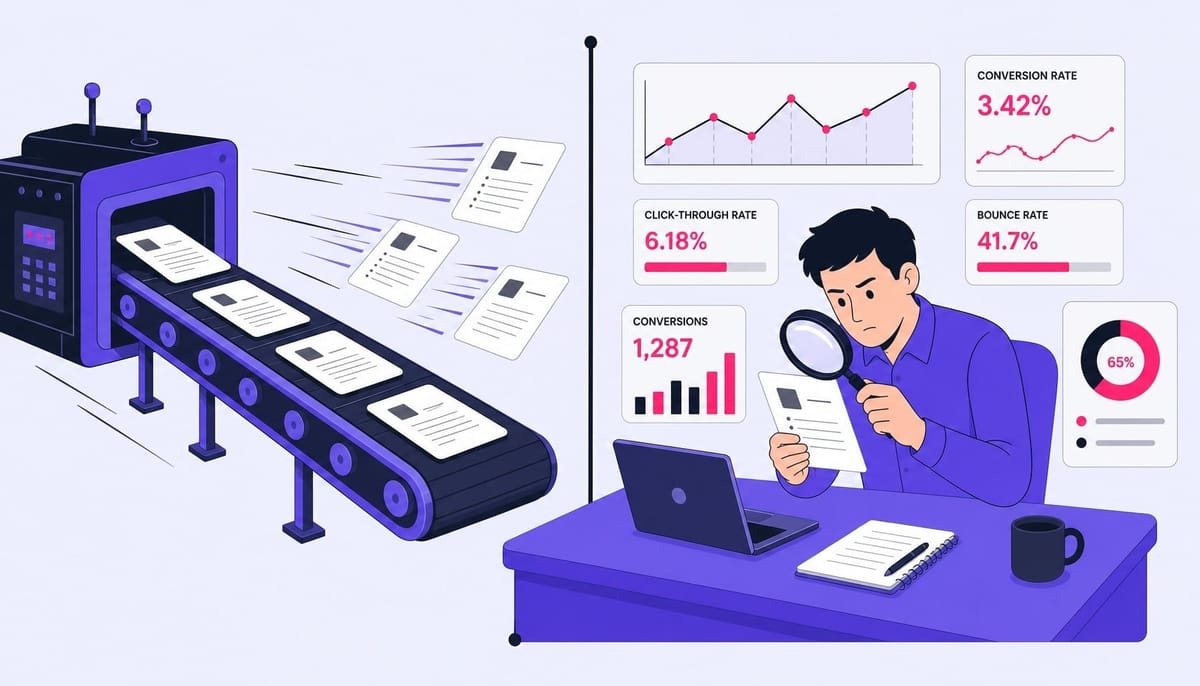
Let's be clear: Jasper is genuinely fast at generating structured marketing content. It can turn a brief into a first draft in minutes. But this is where most reviews stop. They conflate the speed of content production with the quality of content performance, and for a B2B team accountable for pipeline, they are not the same problem.
This is not another feature list. This is an honest assessment of Jasper AI for B2B marketing teams that need content to convert, not just exist. We evaluated its brand voice fidelity, long-form output quality, and true cost for teams. We'll show you how it compares to Writer, Copy.ai, and ChatGPT Enterprise, and what teams are actually still using six months after signing up.
What Jasper AI Actually Is in 2026—and How Its Positioning Has Shifted
Forget explaining what a large language model is. You already know. What's important is that Jasper has fundamentally repositioned. Backed by over $125M in funding and serving over 100,000 customers, it has shifted from a simple "AI writer" to a campaign content platform.
This isn't just marketing speak; it's evident in the product's evolution. The introduction of Jasper Campaigns, Jasper Knowledge Assets, and a more robust Jasper API signals a strategic move to become a content operations layer. The goal is no longer to just help you write a blog post. The goal is to help you orchestrate the dozens of assets—emails, ads, social posts, landing page variants—that support a single marketing campaign.
This shift changes how you should evaluate it. In 2026, Jasper competes less with a generic tool like ChatGPT and more directly with enterprise-grade platforms like Writer and Copy.ai Workflows. Evaluating Jasper as just "an AI writer" misses the point. The real question this jasper honest review will answer is whether it succeeds as a B2B content marketing system.
What Jasper Does Well for B2B Marketing Teams
Every tool has a performance envelope, and Jasper's is most effective in two specific areas for B2B teams. It's not about listing features; it's about identifying the use cases where its output provides measurable time savings without demanding heavy human rework.
Structured Marketing Content at Speed
Jasper's strongest use case is not long-form blog content, where outputs can often feel stiff. Its real power lies in accelerating structured, template-driven marketing assets. Think email subject lines, ad copy variations, product descriptions, and social post batches.
Consider a demand gen manager who needs 12 email subject line variants and four landing page hero copy options for an A/B test. Manually, that's an hour of brainstorming and wordsmithing. With Jasper, you can feed it a brief and get usable first drafts in minutes. The content velocity metric here is undeniable.
This is where the ROI is highest: high-volume, short-to-medium format content where the cost of a mediocre first draft is low and the value of iteration speed is high. For a lean team, this campaign accelerator function can genuinely reduce asset production time from days to hours.
Brand Voice Grounding Reduces Editing Time—When Configured Properly
The single feature that differentiates Jasper from generic ChatGPT usage is Jasper Brand Voice. But let's be honest: in the rush to hit content velocity targets, this configuration is the first corner most teams cut.
When properly configured, the results are noticeable. By uploading your brand style guide, approved messaging docs, and a few high-performing blog posts into Jasper Knowledge Assets, you provide the model with a retrieval-augmented generation layer. The output measurably shifts from generic AI prose toward your actual voice. The platform even provides a brand voice score to quantify alignment.
However, teams that skip this 2-4 hour upfront investment get output that is functionally indistinguishable from a generic LLM. The fidelity of Jasper's style transfer is a direct function of your configuration investment, not a default feature. When you do the work, it reduces editing time. When you don't, you're just paying a premium for a nicely wrapped interface.
Where Jasper Breaks Down for B2B Content Operations
Acknowledging a tool's strengths is easy. The real test is understanding its limitations. Jasper's performance envelope is narrower than its marketing suggests, and most B2B teams discover these two failure modes 60-90 days after adoption.
Output Drift at Scale: Why Quality Degrades Past 30-40 Assets Per Month
Jasper's output quality has an inverse correlation with volume that most reviews fail to surface. You've probably seen this with any generative tool. The first few outputs are crisp. By the tenth, you start recognizing its favorite sentence structures.
Here's the scenario: a team producing 10-15 assets a month finds Jasper's output usable with light editing. When that same team tries to scale to 40-50 assets a month, they discover output drift. The generated content becomes increasingly repetitive—the same transitional phrases, the same argument patterns, the same rhetorical flourishes. This happens because the underlying model, whether it's GPT-4 or Claude, is drawing from the same probability distributions, leading to a regression to the mean over time.
The practical consequence is that your editing time per asset increases as your volume increases, creating a workflow templatization fatigue that partially negates the initial speed advantage. The style transfer fidelity degrades under pressure. Jasper's value proposition has a volume ceiling, and knowing where it is for your content types matters.
The Hidden Cost Curve: Seat-Based Pricing Compounds Faster Than Teams Expect
Jasper's pricing model creates a cost curve that accelerates as your team's adoption succeeds—the opposite of what most teams budget for. This is the seat cost bleed.
Let's do the math. The Jasper Pro plan starts at around $69/month per seat. For a 3-person marketing team, that's $207/month. Now, add a freelance writer and a product marketer who needs occasional access. You're at $345/month. If you need the Business plan for API access or more advanced Knowledge Assets, the cost can jump to over $125 per seat, pushing your team toward $500+/month.
This is before you measure whether the content actually performs. This pricing structure puts Jasper at a premium compared to ChatGPT Enterprise or Claude for Business, where per-seat costs are significantly lower for equivalent core generation capabilities, albeit with a less specialized marketing workflow. The result is an approval bottleneck ratio where managers hesitate to add new users due to the escalating cost, limiting the tool's reach within the organization.
Jasper AI vs. Writer, Copy.ai, and ChatGPT Enterprise for B2B Teams
The critical comparison for a jasper review for b2b is not "which tool writes best?" but "which tool fits our content operations model?"
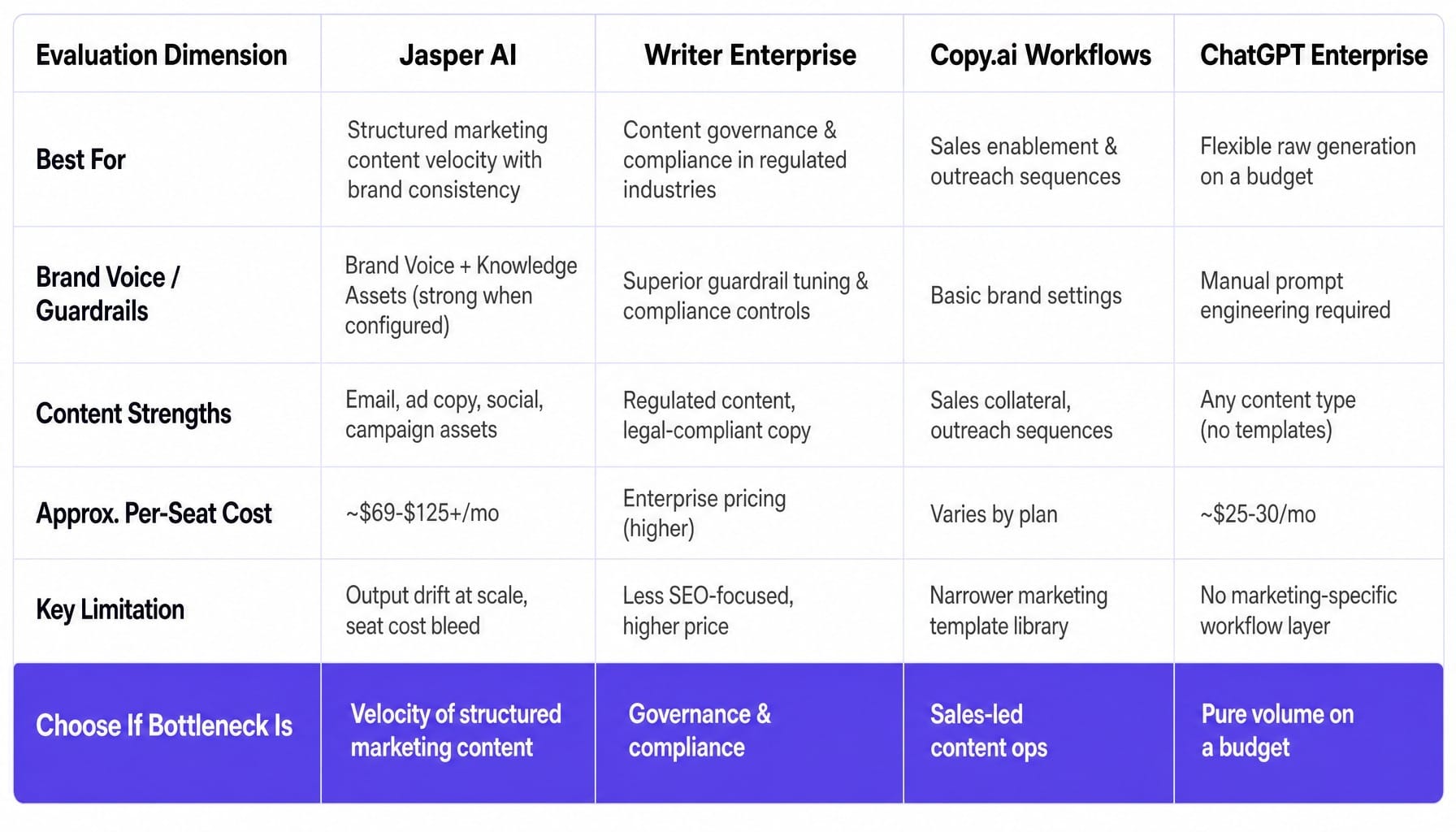
- Jasper vs. Writer: Writer Enterprise is the stronger choice for B2B teams in regulated industries like fintech or healthtech. Its content governance and compliance guardrails are more granular than Jasper's Brand Voice. If your primary bottleneck is ensuring every piece of content adheres to strict legal and brand standards, Writer's superior guardrail tuning wins. Jasper, with its Surfer SEO integration, is stronger for teams focused on SEO content velocity.
- Jasper vs. Copy.ai: Copy.ai has expanded its Workflows feature into sales enablement, making it a compelling option for sales-led organizations. However, its workflow automation is better suited to generating outreach sequences and sales collateral than the diverse content types a marketing team produces. For pure marketing asset fragmentation and campaign support, Jasper's template library is more robust.
- Jasper vs. ChatGPT Enterprise: This is the trade-off between workflow convenience and cost. At roughly $25-30 per seat, ChatGPT Enterprise is the most flexible and affordable option for raw generation. However, it lacks the marketing-specific layer—the templates, campaign structures, and integrated brand voice training—that makes Jasper faster for structured tasks. With ChatGPT, you save money but spend more time on prompt engineering for marketing.
The decision heuristic is simple. If your bottleneck is governance, choose Writer. If it's pure volume on a budget, choose ChatGPT Enterprise. If your bottleneck is the velocity of structured marketing content with brand consistency, Jasper remains a very strong option.
Read more: 8 Jasper Alternatives Worth Evaluating in 2026 (And What Most Comparisons Miss)
The Real Cost of Jasper AI for a B2B Marketing Team
The price on Jasper's website is the beginning of your cost calculation, not the end. To understand the total cost of ownership, you need to factor in subscription tiers and, most importantly, the cost of human editing.
Let's model a realistic scenario: a 4-person B2B SaaS marketing team (lead, writer, demand gen specialist, freelance contributor).
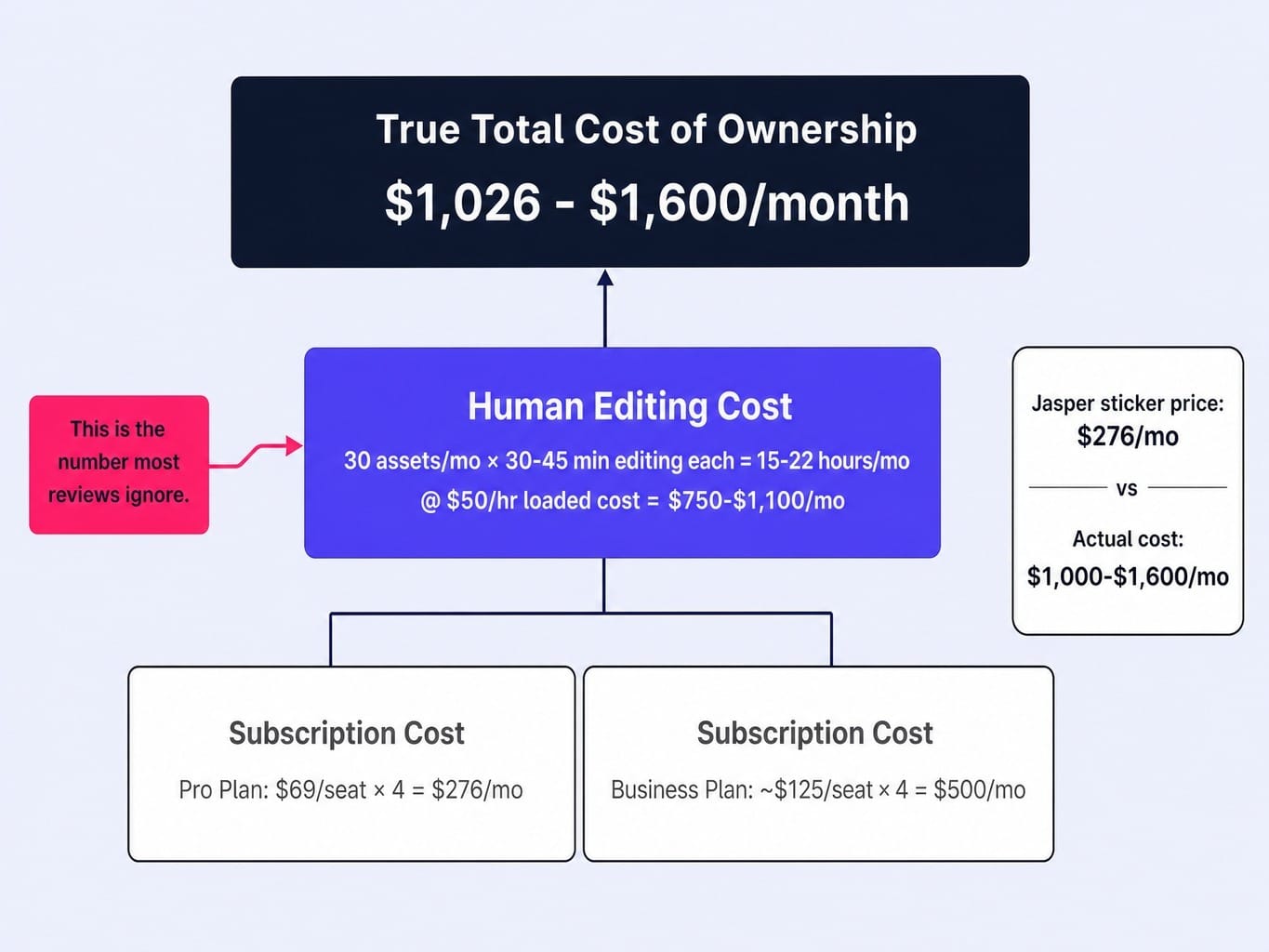
- Subscription Cost: On the Pro tier, that's ~$69/seat × 4 seats = $276/month. If they need API access and upgrade to the Business plan, that figure can easily approach $500/month.
- Human Editing Cost: This is the number most reviews ignore. If each Jasper-generated asset requires 30-45 minutes of editing to reach publishable quality (a realistic figure, as some studies show an average of 52 minutes of editing on a 561-word draft), and your team produces 30 assets per month, that's 15-22 hours of editing labor. At a loaded cost of $50/hour, that's an additional $750 - $1,100 per month.
The real cost for this 4-person team isn't the $276 sticker price. It's closer to $1,000 - $1,600 per month.
The 7-day free trial and annual billing discount can mitigate this, but the trial is too short to properly evaluate the brand voice score after full configuration. You must budget for the full cost of adoption: software seats and the human labor required to make the output usable.
What B2B Teams Actually Use After 6 Months vs. What They Signed Up For
Most Jasper reviews evaluate the tool at the point of maximum enthusiasm—the first few weeks when everything feels novel. The more useful evaluation is what your team is still actively using at the six-month mark.
Here's the pattern we've observed: teams sign up expecting to use Jasper for everything—blog posts, landing pages, email campaigns, ad copy, social content. By month six, active usage has narrowed to two or three core use cases. These are almost always email subject lines, ad copy variations, and first-draft outlines for short articles.
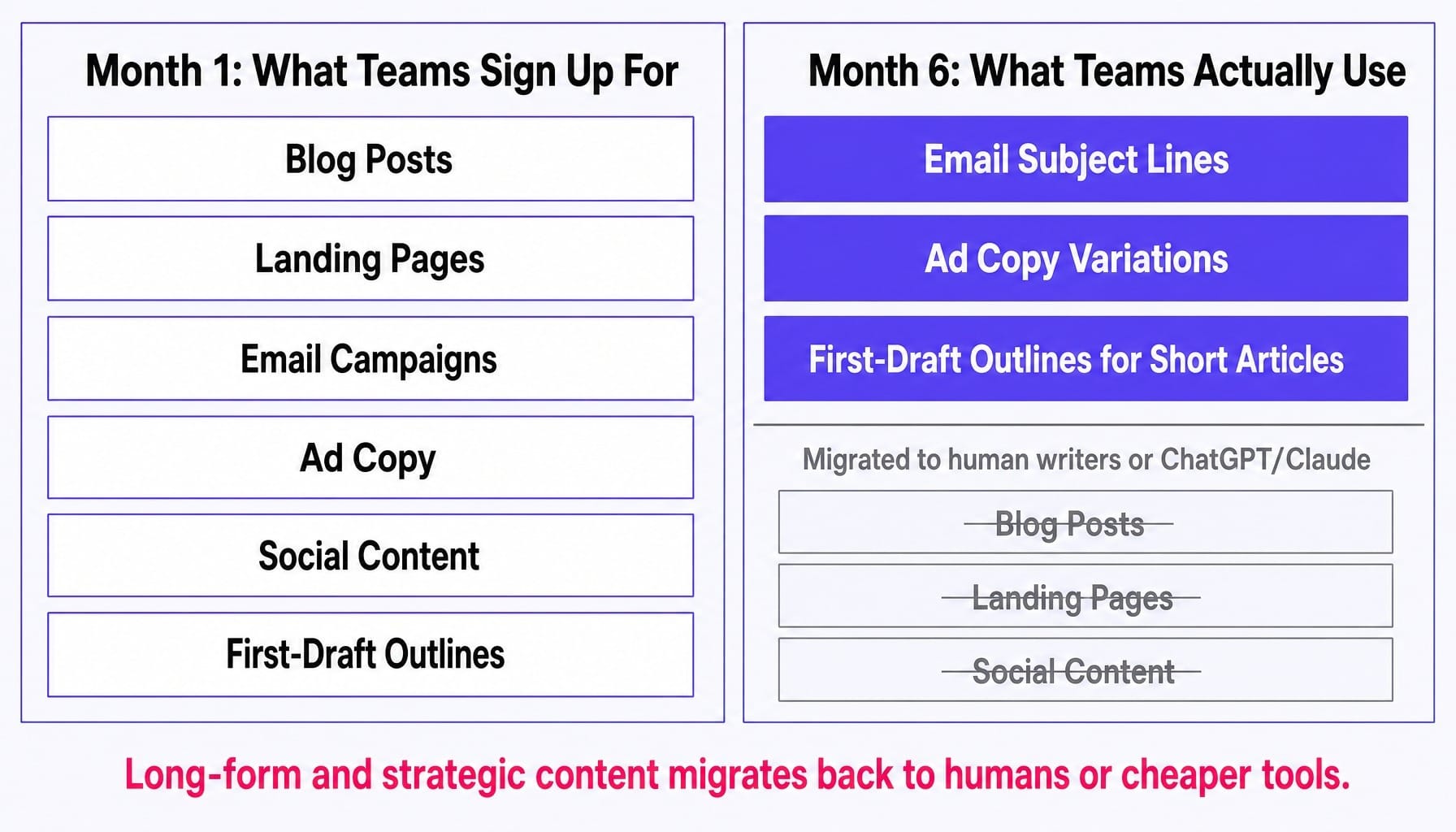
Why? Long-form blog content and strategic landing page copy tend to migrate back to human writers or cheaper, more flexible tools like ChatGPT or Claude. The reason is workflow templatization fatigue. Jasper's template-driven approach feels efficient for repetitive tasks but becomes constraining for more nuanced, strategic content.
This isn't a dealbreaker, but it should inform your buying decision. Jasper's long-term value is often narrower than its initial promise. You are buying a powerful content acceleration workflow for specific marketing tasks, not a full-stack content team in a box.
Read more: 6 Copy AI Alternatives That Actually Fit B2B Content Workflows (2026)
When Content Velocity Isn't the Bottleneck—Conversion Is
Jasper is a powerful tool for solving the content velocity problem. You can produce more assets, faster. But B2B teams that solve for velocity often discover their real constraint was never "we can't produce enough content." It was "the content we produce doesn't convert visitors into pipeline."
This is the execution gap that most marketing tools, including content generators, don't address. They help you create the assets, but they stop there. They don't tell you which page element is killing your conversion rate, what technical SEO issue is holding back your best content, or which ad landing page needs an immediate fix to stop wasting budget.
Spike AI is built to close that gap. It's not a content generator; it's a marketing execution engine. It functions as a closed-loop optimization system that continuously analyzes what's constraining growth across your website, SEO, and ads. Every week, it identifies the single highest-impact move, models the outcome, and deploys the fix.
Where Jasper helps you create more content, Spike AI ensures that content—and your entire marketing funnel—actually performs. The cadence itself becomes the growth engine: detect, prioritize, ship, measure, and re-prioritize for the next weekly release.
See how Spike AI turns your content into conversions — book a discovery call
Is Jasper AI Worth It for B2B in 2026?
Jasper AI is a strong content acceleration tool for specific B2B marketing tasks. Its value is real but narrower than its marketing suggests. It excels at high-volume, short-format content, but it is not a complete content operations solution, nor is it a replacement for a strategic writer.
The distinction matters for how you budget, staff, and measure ROI. The B2B teams that win aren't the ones who produce the most content; they're the ones whose execution compounds into pipeline. Choose your tools accordingly.
Frequently Asked Questions
How long does it take to properly configure Jasper's Brand Voice for a B2B company?
Expect 2-4 hours for initial setup: uploading style guides, product docs, and 3-5 approved content samples. Teams that skip this get generic output. Plan for another 1-2 hours of refinement after reviewing the first batch of outputs against your actual brand standards and brand voice score.
Does Jasper AI produce content that passes AI detection tools?
Jasper output is frequently flagged by AI detectors, especially for long-form content. Short-form copy is harder to detect. If passing detection matters for your use case (e.g., guest posting, academic content), plan for substantial human rewriting, which reduces Jasper's time-saving advantage.
Can Jasper AI handle technical B2B content like product documentation or API guides?
Poorly. Jasper is optimized for marketing copy, not technical accuracy. It often generates plausible-sounding technical content with factual errors or hallucinated details. For this, a tool like ChatGPT or Claude with retrieval from your actual documentation is a more reliable approach.
Does Jasper integrate with HubSpot and other B2B marketing automation platforms?
Jasper offers direct integrations with Google Docs and Surfer SEO, plus Zapier for broader automation. There is no native HubSpot integration; content must be copied manually or routed via Zapier. API access is only available on the pricier Business plan.
What ROI metrics should a B2B team track after adopting Jasper AI?
Track three things: content production velocity (assets/week), editing ratio (human editing minutes per asset), and content performance (conversion rate or pipeline influenced by Jasper-assisted content vs. human-written). If velocity increases but performance stays flat, the ROI case weakens significantly.