Best Jasper AI Alternatives in 2026: Tested by Workflow, Not Just Features
TL;DR
- Stop evaluating Jasper alternatives on draft quality. The real bottleneck is the post-draft workflow: SEO, optimization, and publishing.
- Choose a tool based on your primary bottleneck: Copy.ai for sales copy workflows, Writesonic for integrated SEO/GEO, and Writer for enterprise content governance.
- For SEO-focused teams, Surfer SEO and Frase are optimization and research tools first. They solve the optimization problem, not the writing problem.
- Switching has real costs. If you have deep brand voice training and high-volume output on Jasper, the 4-6 week productivity dip during migration may not be worth it.
- If your core problem is the entire marketing pipeline—not just the writing tool—you may need a system that ships changes, not just a tool that drafts them.
Most marketers searching for Jasper alternatives think they have a writing tool problem. They don't. They have a shipping problem.
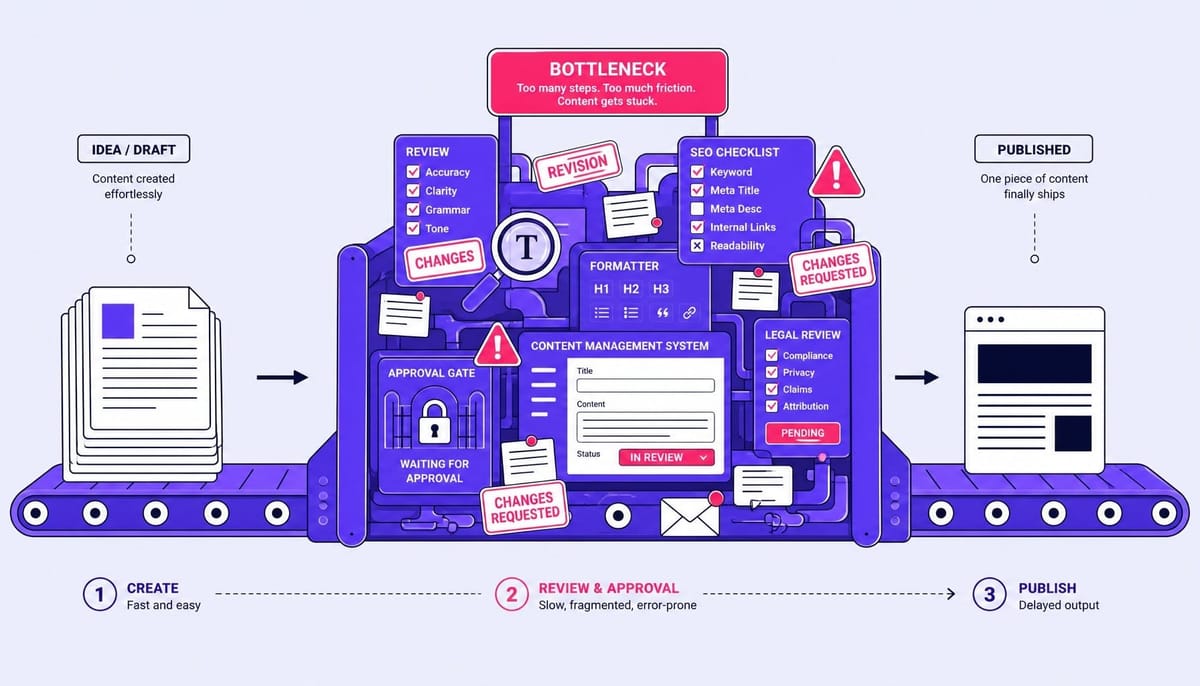
Jasper generates drafts quickly—that was never the complaint. The real friction is everything that happens after the draft is generated. SEO optimization requires Surfer SEO or Clearscope, a separate subscription. Brand voice consistency degrades at scale, requiring manual editing. Publishing still involves a clumsy handoff to your CMS. You're still managing a fragmented, human-dependent workflow.
This guide is different. Instead of ranking 13 tools by feature checkboxes, we evaluate 7 leading Jasper alternatives by a single, practitioner-grade criterion: how much of the post-draft workflow each tool actually eliminates. We'll also be direct about the specific scenarios where staying on Jasper is the right call, because switching tools costs more than just money.
Why Marketing Teams Actually Leave Jasper (It's Not the Writing Quality)
The decision to look for Jasper AI alternatives is rarely sudden. It's a slow burn, rooted in a simple cost calculation that goes beyond the subscription fee. Jasper Pro at $69/seat/month is only the visible cost. When you add Surfer SEO at $99/month for the optimization Jasper lacks, your real per-seat cost is already $168. For a three-person team, that's over $500 a month for a system that still requires hours of manual reformatting and publishing work for every single asset.
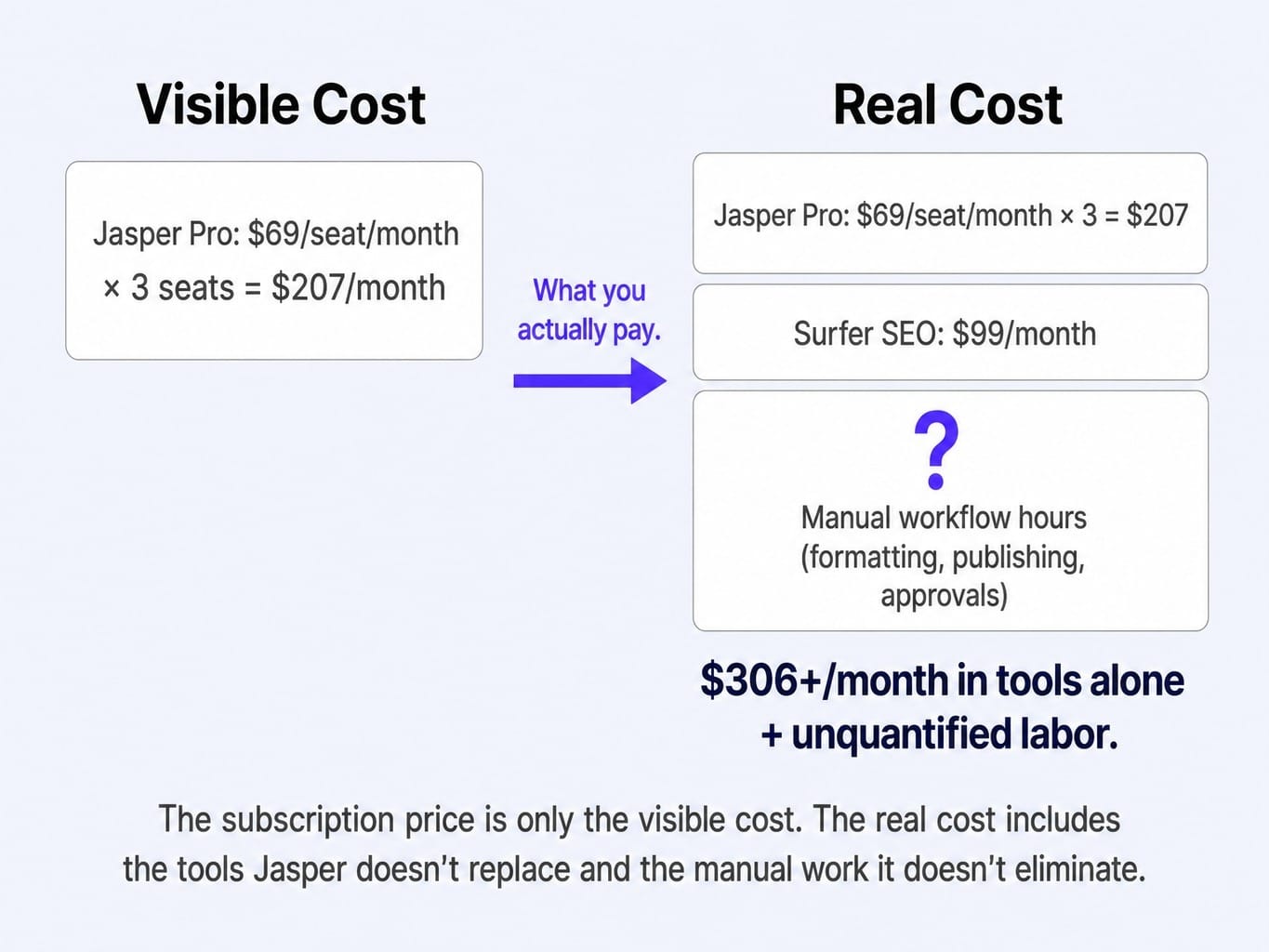
This is why the most common complaints on G2—"expensive," "generic output," "weak SEO"—are just symptoms of a deeper issue. Jasper was built in an era when "AI writes a first draft" was revolutionary. In 2026, that's table stakes. The bottleneck has moved downstream.
Teams don't struggle to generate text anymore. They struggle to get that text optimized, approved, and published without a three-week turnaround. The price isn't high for what Jasper does; it's high for what it doesn't do. It stops at the draft and leaves the most time-consuming parts of the content workflow—optimization, governance, and publishing—entirely on your plate. The alternatives worth evaluating are the ones that recognized this shift and built solutions for the entire pipeline, not just the first step.
Read more: Jasper AI Review (2026): An Honest B2B Assessment of Cost, Quality & Alternatives | Spike AI
What Most Jasper Alternatives Lists Get Wrong
Almost every list of Jasper competitors you'll find compares tools on the same dimensions: number of templates, tone options, language support, pricing tiers. These are input metrics. They tell you what the tool can generate, not what it can ship.
Consider this scenario:
- Tool A has 80 templates and produces a clean 1,500-word blog draft in four minutes.
- Tool B has only 30 templates but includes built-in SEO scoring, internal linking suggestions, and one-click CMS publishing.
If your bottleneck is draft quality, Tool A wins. But if your bottleneck is the three hours of manual work between "draft done" and "article live," Tool B is the clear winner. For most marketing teams today, the bottleneck is the latter.
This article evaluates tools on the metrics that determine switching ROI:
- Post-Draft Workflow: What happens after the draft? SEO, CMS integration, approvals.
- Real Per-Asset Cost: What's the true cost, including mandatory add-ons?
- Team Profile Fit: What specific team structure and content needs does the tool serve?
You've been comparing tools on the wrong axis. Let's fix that.
7 Jasper Alternatives Compared by What They Ship, Not Just What They Draft
The table below compares 7 top-tier alternatives across the dimensions that actually determine their value to a marketing team. We're focusing on post-draft workflow coverage, the real entry cost (including required add-ons), and the specific team profile each tool serves best.
Note: We deliberately excluded general-purpose LLMs like ChatGPT, Claude, and Gemini. They are powerful drafting engines but are not true Jasper AI competitors in a workflow sense. They lack the templates, brand voice persistence, and team features required for a marketing content operation, placing them in a different category entirely.
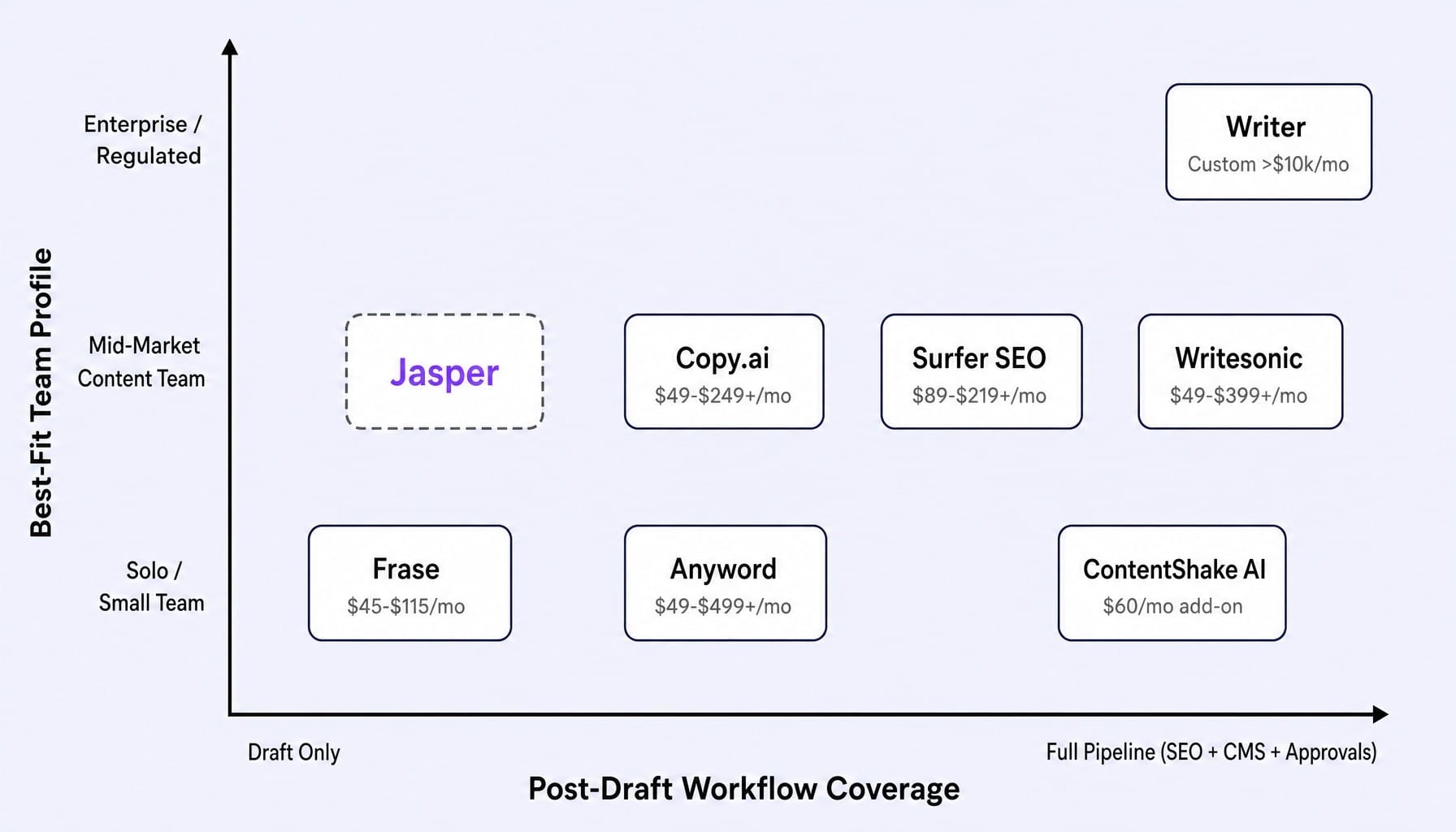
Jasper competitors mapped by what they ship, not just what they draft.
Copy.ai — Best for Sales-Led Teams That Need Outbound Copy
Choose Copy.ai if your primary content need is short-form sales copy—outbound emails, ad variations, LinkedIn sequences—and your team is embedded in a CRM workflow. Copy.ai has pivoted hard toward Go-To-Market automation, with deep CRM integrations (HubSpot, Salesforce) and workflow builders that chain prompts into multi-step sequences. This makes it genuinely powerful for sales-led organizations.
Workflow Scenario: A three-person demand gen team needing 50 personalized outbound email variants per week will find Copy.ai's workflow automation far faster than Jasper's template-based approach. It can pull from CRM data to inform copy, closing a major gap in the GTM process.
What You Lose: Long-form content quality. Copy.ai's blog writer produces serviceable drafts, but they lack the depth and structural coherence of Jasper's output for 1,500+ word pieces. Its brand voice training is also less granular.
Avoid When: Do NOT choose Copy.ai if your primary need is SEO blog content or long-form thought leadership. You'll end up supplementing with another tool, recreating the same fragmented SaaS marketing tools stack you're trying to escape. Also, be aware of the pricing cliff: the jump from the $49/month plan to the $249/month plan for advanced workflows is steep.
Writesonic — Best for Teams That Need SEO Content and AI Search Visibility
Choose Writesonic if your primary bottleneck is producing SEO-optimized blog content and you want to track AI search visibility (GEO) without bolting on another tool. Writesonic's Article Writer generates drafts with built-in SERP analysis, and its AI Visibility Tracker monitors how your content appears across multiple AI platforms—a forward-looking capability Jasper doesn't offer at all.
Workflow Scenario: A content manager publishing 8-12 SEO articles per month who currently uses Jasper for drafts, Surfer for optimization, and a separate tool for GEO monitoring can consolidate this entire stack into Writesonic.
What You Lose: Brand voice consistency at scale. Writesonic's style transfer fidelity can be spotty; multiple user reviews note that drafts still require "heavy editing"—the same complaint leveled at Jasper, just at a lower price point. The GEO tracking on lower-tier plans is also limited.
Avoid When: Do NOT choose Writesonic if brand voice fidelity across thousands of outputs is your top priority. The voice tends to drift noticeably after about 50 pieces without manual recalibration. While cheaper upfront, the real value is in the higher-tier plans, which narrows the cost gap with a Jasper+Surfer stack.
Writer — Best for Enterprise Teams in Regulated Industries
Choose Writer if your switching trigger is content governance. If you need approval chains, compliance guardrails, terminology enforcement, and audit trails that Jasper's marketing-first architecture simply doesn't provide, Writer is your platform. It was built for enterprise content operations, ingesting your brand guidelines, style guides, and legal rules into a grounding corpus that constrains output at generation time.
Workflow Scenario: A fintech or healthcare SaaS marketing team where every published asset must pass legal review. Writer's output guardrails can reduce the legal-review cycle from days to hours because the first draft already conforms to regulated terminology.
What You Lose: Creative flexibility. Writer is not a creative writing tool. Its governance-first approach can feel restrictive for teams producing punchy ad copy or campaign-driven landing pages. Template variety is also limited compared to Jasper.
Avoid When: Do NOT choose Writer if you're a small team that values speed and creative flexibility over compliance. The setup cost is significant (knowledge graph configuration takes weeks), and the ROI only materializes at enterprise content volume. With its custom/enterprise-only pricing, it's not a fit for teams with content budgets under $10k/month.
Surfer SEO — Best for Teams Whose Bottleneck Is Optimization
Choose Surfer if your real problem isn't generating content—it's optimizing it for search performance. Surfer is not a Jasper replacement; it's a Jasper complement that many teams realize they need more than Jasper itself. Its Content Editor scores drafts against SERP competitors in real time, suggesting everything from keyword density to heading structure. With Surfer AI now able to produce full drafts, it makes Jasper redundant for many SEO-focused teams.
Workflow Scenario: A content team with strong writers (human or AI) that consistently underperforms on organic rankings because their drafts aren't optimized against real-time SERP data. Surfer closes this gap completely.
What You Lose: Brand personality. Surfer's generative AI produces competent but formulaic content. It optimizes for search signals, not for reader engagement or a distinctive voice. If your strategy depends on unique thought leadership, Surfer's output will feel generic.
Avoid When: Do NOT choose Surfer as your primary content tool if you need high-volume, multi-format output like emails, ads, or social posts. It is purpose-built for long-form SEO content and does not extend well beyond that use case.
Read more: Surfer SEO Pricing 2026: What Each Plan Actually Costs Per Article
Frase — Best for Content Strategists Who Start from Research
Choose Frase if your workflow starts with SERP research and content briefs rather than a blank prompt. Frase's core strength is its research-to-brief pipeline. It analyzes top-ranking pages, extracts topic clusters, identifies content gaps, and generates structured briefs before a single word of content is written. This is the philosophical opposite of Jasper's "generate and edit" model.
Workflow Scenario: A content lead managing freelance writers who need detailed briefs with target headings, questions to answer, and competitor analysis. Frase produces these briefs in minutes, ensuring writers execute against a clear spec.
What You Lose: Writing quality. Frase's AI-generated drafts are noticeably weaker than Jasper's. They read more like structured outlines filled with text than polished articles. Most users treat Frase's AI writing as a starting scaffold, not a finished output.
Avoid When: Do NOT choose Frase if you need a tool that produces publish-ready drafts with minimal editing. You will be disappointed by the output quality and find yourself doing more manual work than you did with Jasper, defeating the purpose of switching.
Anyword — Best for Performance Marketers Optimizing by Predicted Conversion
Choose Anyword if your primary content is conversion-focused—ad copy, landing page headlines, email subject lines—and you want predictive performance scoring. Anyword's key differentiator is its Predictive Performance Score—which estimates how a piece of copy will perform with a specific audience before it goes live. This is a fundamentally different value proposition: Jasper helps you write; Anyword helps you predict which version will convert.
Workflow Scenario: A growth marketer running 20+ ad variants per week who currently uses Jasper to generate variants and then tests them manually. Anyword's predictive scoring lets you pre-filter variants before spending ad budget, reducing waste.
What You Lose: Long-form content capability. Blog posts, whitepapers, and thought leadership pieces are not Anyword's strength. Its predictive model is trained on short-form conversion copy, not long-form informational content.
Avoid When: Do NOT choose Anyword if your content calendar is primarily SEO articles. You'll find the tool underpowered for anything over 500 words, and the predictive scoring model doesn't apply to organic content, making it an expensive, niche tool for your needs.
ContentShake AI by Semrush — Best for Teams in the Semrush Ecosystem
Choose ContentShake AI if your team already lives in Semrush for keyword research and competitive analysis. ContentShake eliminates the handoff between research and writing by pulling directly from Semrush's keyword data to generate SEO-optimized drafts that are pre-aligned with your targets. It collapses the workflow.
Workflow Scenario: A solo marketer who currently exports keyword data from Semrush, creates a brief in Google Docs, writes in Jasper, optimizes in Surfer, and publishes in WordPress. ContentShake AI can collapse this five-tool workflow into one integrated system, from keyword to published post.
What You Lose: Exceptional writing quality and flexibility. The output is adequate but not creative; it's optimized for SEO coverage, not brand voice. And the tool is tightly coupled to the Semrush ecosystem. If you don't use Semrush, it loses most of its value.
Avoid When: Do NOT choose ContentShake AI if you need multi-format content (it's built for blogs) or if you're not a committed Semrush subscriber. It is purpose-built for a specific SEO workflow and does not generalize well. If you're weighing the broader Semrush pricing commitment, factor in ContentShake as an add-on cost.
When to Stay on Jasper Instead of Switching
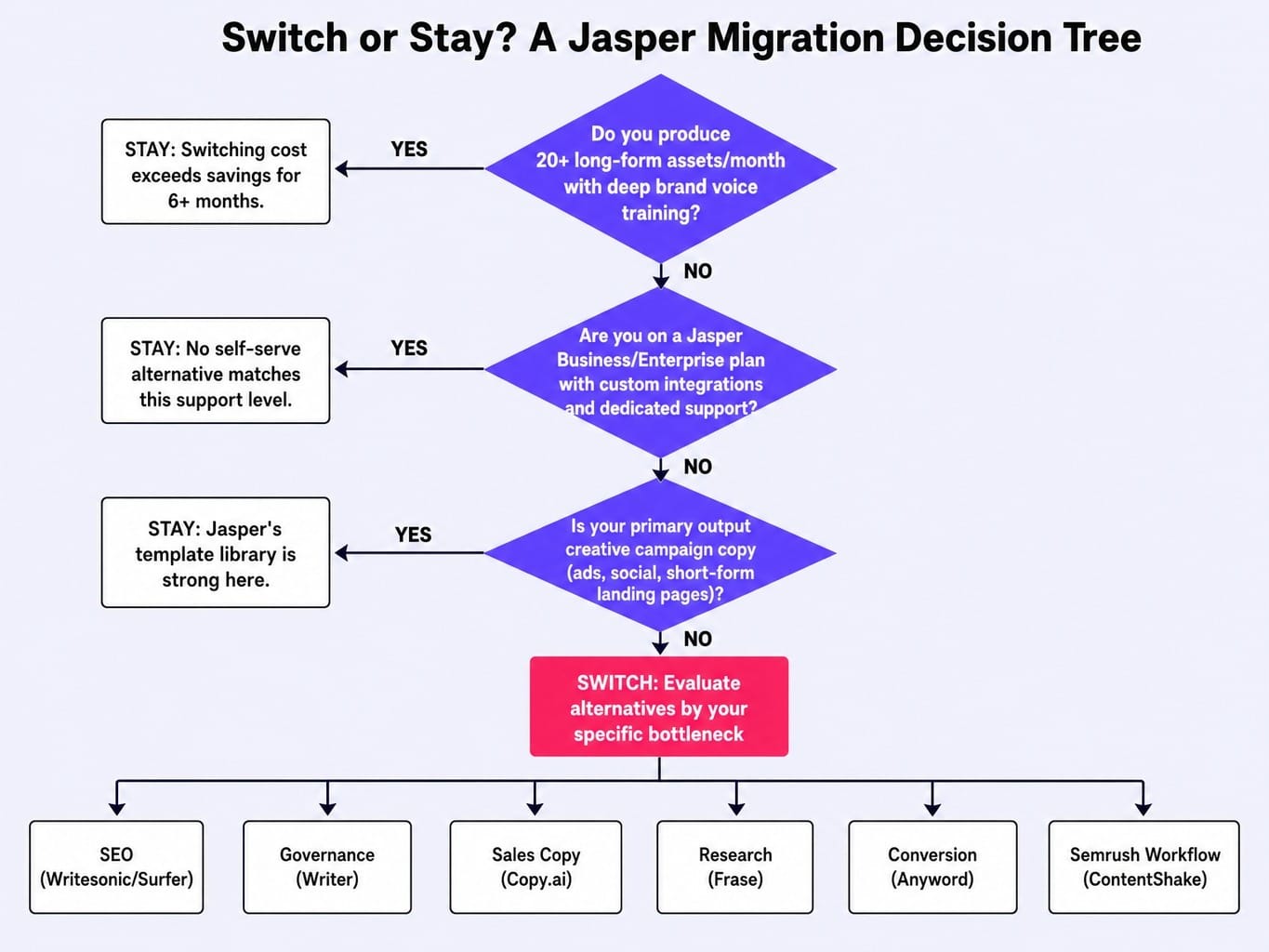
Switching tools has real costs: migration time, team retraining, workflow disruption, and lost brand voice training data. Before you jump, consider the scenarios where Jasper remains the better choice.
- You have high volume and deep brand voice investment. If your team produces 20+ long-form assets per month and has spent months training Jasper's brand voice, the switching cost likely exceeds any potential savings for at least six months.
- You have an enterprise contract with dedicated support. If you're on a Jasper Business plan with custom integrations and a dedicated success manager, no self-serve alternative will match that level of support at the same price point.
- Your primary need is creative campaign copy. Jasper's template library is genuinely good for generating high-volume, campaign-driven marketing copy (ads, social posts, short-form landing pages) where brand voice is less about governance and more about creative variety.
Jasper's weakness isn't its writing quality. It's that the tool stops at the draft. If your team has the bandwidth and tooling to handle the entire post-draft workflow, Jasper is still a strong, capable choice.
What if the Real Alternative Isn't Another Writing Tool?
This entire discussion has been about finding a better AI writing tool. But what if that's the wrong problem to solve? Each Jasper alternative we've reviewed solves one piece of the post-draft puzzle—SEO, governance, predictive scoring—but none of them solve the full pipeline from insight to shipped asset. You're still just moving the bottleneck.
For teams whose real problem isn't "I need better drafts" but "I need marketing changes to actually go live," the solution may not be another tool in the stack. It might be a different approach entirely. Spike AI operates across your full marketing surface—SEO, CRO, website, and content—to identify the highest-impact change each week and then executes it.
Where other tools diagnose problems and hand you homework, Spike AI deploys solutions. If the bottleneck is the post-draft workflow, the answer isn't a better draft tool. It's a system that handles the entire pipeline.
See how Spike AI ships marketing changes weekly — without the tool stack
The Real Switching Decision
The market for Jasper alternatives in 2026 is mature, with genuinely good options for every team profile. But the decision that actually improves your output isn't about finding a tool that writes 10% better drafts. It's about finding one that eliminates the hours of manual work between "draft done" and "asset live."
Evaluate these tools by their workflow coverage, not their feature count. The teams that will produce the most effective content in the coming year won't be the ones with the best AI writing tool. They'll be the ones with the shortest distance between a good idea and a published change.
Frequently Asked Questions
Can ChatGPT or Claude fully replace Jasper for marketing content workflows?
They can replace Jasper's draft generation—often with better output—but they lack the workflow infrastructure marketing teams need: brand voice persistence, template libraries, team collaboration, and SEO/CMS integrations. Using them as a Jasper replacement means building the surrounding workflow manually, which breaks down for teams producing 10+ assets per month.
Which Jasper alternatives let you train a custom brand voice that holds across thousands of outputs?
Writer and Jasper itself are the strongest for brand voice fidelity at scale—Writer enforces it via a knowledge graph, while Jasper uses training profiles. Copy.ai and Writesonic offer brand voice settings, but users report noticeable drift after about 50 outputs without recalibration. No tool maintains perfect voice consistency at high volume without periodic human review.
Are there free Jasper alternatives that produce high-quality long-form content?
Copy.ai and Writesonic offer free tiers, but both cap word count and restrict access to advanced features. For genuinely high-quality long-form content on a free plan, ChatGPT's free tier produces better raw prose than most dedicated tools—but you'll need to handle SEO, formatting, and publishing entirely on your own.
How do Jasper competitors handle hallucination and factual accuracy differently?
Most alternatives use the same underlying LLMs and inherit the same risks. The differentiator is post-generation checks: Frase cross-references claims against SERP data, and Writer applies fact-checking rules from your knowledge base. None eliminate hallucination; they use retrieval-augmented generation and output guardrails to reduce it, but human review remains essential.
What does switching from Jasper actually cost beyond the subscription price?
The hidden costs include re-training brand voice profiles (2-4 weeks), rebuilding template workflows, team retraining (1-2 weeks of reduced productivity), and losing historical data. For teams with 12+ months of brand voice training and custom workflows, expect a 4-6 week productivity dip during migration.
Which Jasper alternative is best for agencies managing multiple client brands simultaneously?
Writer is the strongest for multi-tenant brand management; each client gets a separate knowledge graph with distinct voice and compliance rules. Copy.ai's workspace feature supports multiple brands but with less granular separation. Most alternatives were built for single-brand teams, so agencies should test brand isolation specifically before committing.