
Majestic vs Moz: A Practitioner's Guide to Link Intelligence in 2026

TL;DR
- Majestic and Moz are not interchangeable; they measure different things. Majestic's Trust Flow measures a domain's position in the web's trust architecture, while Moz's Domain Authority is a machine-learning score that predicts ranking probability.
- The most effective link vetting workflow uses both. Use Majestic's TF/CF ratio (flag anything below 0.3) to assess link neighborhood quality and Moz's Spam Score to detect on-page degradation signals.
- For niche B2B, Majestic's Topical Trust Flow is a critical advantage, allowing you to filter prospects by industry relevance—a capability Moz's topic-agnostic DA lacks.
- Beware of "DA inflation." Tracking Domain Authority as a KPI can be misleading, as the score naturally drifts upward across the web over time. Focus on relative position against competitors, not the absolute number.
- The right tool depends on your workflow. Solo consultants get more value from Majestic's depth, in-house teams benefit from Moz's breadth, and agencies need both for comprehensive vetting.
You've been there. You export a list of 50 link prospects from Moz, all glowing with a Domain Authority of 40 or higher. This feels like a solid list for your next outreach campaign. But you run a quick cross-reference in Majestic, and the picture changes. A third of those "high-authority" domains have a Trust Flow to Citation Flow ratio below 0.3, revealing a link neighborhood you wouldn't touch.
This dissonance isn't a glitch. It's the central theme of the Majestic vs Moz debate. They are not interchangeable tools doing the same thing with different branding. They measure fundamentally different properties of the web—trust propagation versus ranking probability—and conflating them leads to bad prospecting decisions, inflated reporting, and wasted outreach.
This article won't rehash feature lists. Instead, we'll dissect why these tools produce different numbers for the same domain, walk through how to use their unique strengths in a real-world B2B workflow, and help you decide which one actually belongs in your stack.
Why Majestic and Moz Show Different Numbers for the Same Domain
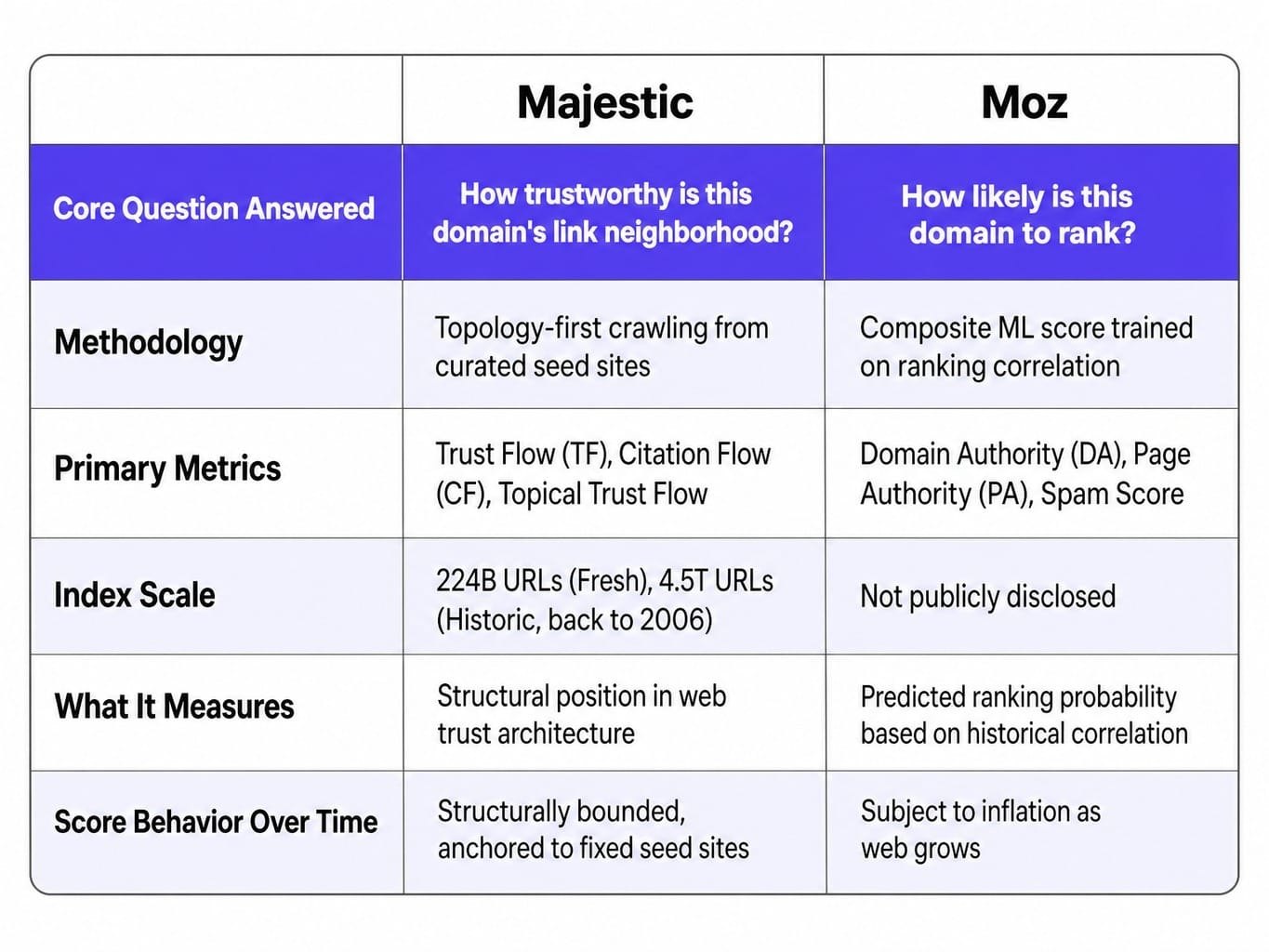
Most comparisons jump straight to Trust Flow vs. Domain Authority as if the metrics are the whole story. They aren't. The metrics are outputs of fundamentally different data collection systems. Understanding the input—how each tool crawls, indexes, and categorizes the web—is the single most important factor in choosing between them.
Majestic's Fresh Index, for instance, covers around 224 billion unique URLs and is updated multiple times per hour, while its Historic Index holds data on 4.5 trillion URLs dating back to 2006. Moz doesn't prominently publish its index size, which is itself informative. This difference in scale and philosophy is where the disagreement between their metrics begins. A B2B SaaS team might find a competitor's 2019 partnership that generated 40+ editorial links in Majestic's Historic Index—links that Moz's smaller index never even captured.
Majestic's Link Graph: Topology-First Crawling and Seed Site Trust
Majestic builds its data set by crawling the web's link graph outward from a curated list of trusted seed sites. Every link it discovers is evaluated based on its topological distance from these manually vetted root domains. This is why Trust Flow (TF) and Citation Flow (CF) aren't just popularity scores; they are structural measurements of how a domain is positioned within the web's trust architecture.
Trust Flow measures the perceived quality and trustworthiness of links pointing to a site, while Citation Flow measures the raw volume or "power" of those links, regardless of quality. The Historic Index's deep data retention makes it uniquely valuable for detecting link velocity changes, historical partnerships, and backlink decay patterns that no other tool preserves with such granularity. Majestic's data reflects the shape of the link graph, not a prediction about rankings.
Moz's Composite Model: Machine Learning Trained on Ranking Correlation
Moz's Domain Authority (DA) is not a measurement of links alone. It's a composite machine-learning score trained to correlate with Google's actual ranking outcomes. DA incorporates link counts, linking root domains, and other proprietary signals into a single 1-100 logarithmic score designed to predict how likely a domain is to rank.
This means DA is inherently backward-looking: it reflects what has correlated with rankings historically, not necessarily what the link graph's trust structure looks like right now. Page Authority (PA) applies the same model at the URL level, and the Spam Score adds another layer, evaluating 27 on-page and link signals for penalty risk.
Ultimately, Moz answers, "How likely is this domain to rank?" while Majestic answers, "How trustworthy is this domain's link neighborhood?" These are not the same question.
Link Quality Vetting in Practice: TF/CF Ratio vs Moz Spam Score
So when you have a list of 50 link prospects, how do you separate the genuinely valuable domains from the inflated, manipulated, or risky ones? This is where the philosophical difference becomes an operational one. Using only one tool creates dangerous blind spots.
Let's use a common scenario: an in-house B2B marketer has a prospect list from a competitive backlink gap analysis. They need to vet these domains before spending a single minute on outreach. Here's how the two tools provide complementary layers of security.
The strongest vetting workflow uses both: Majestic's TF/CF ratio for trust structure assessment and Moz's Spam Score for on-page risk. They catch different failure modes.
Using TF/CF Ratio to Filter Link Neighborhoods
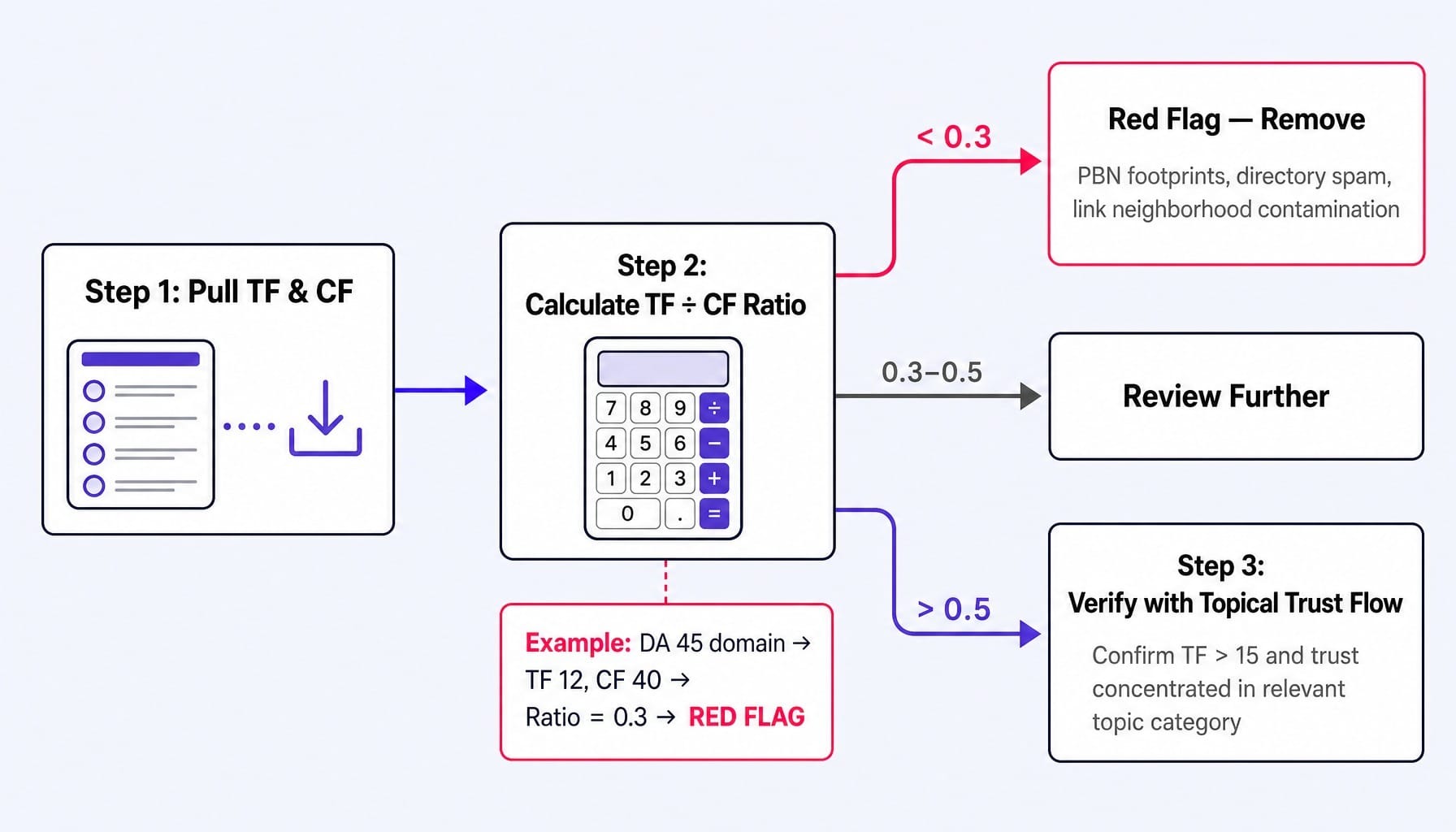
A healthy link profile receives both quality and quantity. The TF/CF ratio is a simple heuristic for measuring this balance. Here's a three-step vetting workflow:
- Pull TF and CF for each prospect domain in your list.
- Calculate the ratio (TF ÷ CF). Any domain with a ratio below 0.3 is a red flag. This indicates it's receiving far more raw link volume than transferred trust—a classic pattern for PBN footprints, directory spam, or general link neighborhood contamination.
- Prioritize. For domains with a ratio above 0.5 and a Trust Flow over 15, layer in Topical Trust Flow to confirm the trust is concentrated in a relevant industry.
Consider our earlier example: a domain shows DA 45 in Moz, which looks strong. But in Majestic, it has a TF of 12 and a CF of 40. The ratio is 0.3. This domain isn't an authority; it's a potential liability. An outreach email sent here is wasted effort.
Where Moz Spam Score Catches What Trust Flow Misses
The TF/CF ratio is powerful, but it has a blind spot: it evaluates the link graph, not the page itself. A domain can have a healthy ratio (say, 0.82) because it earned great links years ago, but the site itself has since degraded. It might now be riddled with thin content, aggressive ads, or suspicious anchor text distribution—signs of a domain that was acquired and repurposed.
This is where Moz's Spam Score shines. It evaluates 27 distinct on-page and link signals to detect these patterns.
Imagine another prospect: it has a clean TF of 28 and CF of 34 (a healthy 0.82 ratio) in Majestic. But Moz gives it a Spam Score of 8/17, flagging it for thin content and high ad density. Without checking Spam Score, you'd have put this domain on your outreach shortlist. The best workflow cross-references both metrics to get a complete picture of trust and risk.
Topical Trust Flow: The Capability Moz Has No Equivalent For
In niche B2B verticals—cybersecurity, fintech, healthtech—a domain's overall trust score matters less than whether that trust is concentrated in a relevant topic. A DA 50 general business blog and a DA 30 cybersecurity publication are not equivalent prospects for a cybersecurity SaaS company, but DA alone can't distinguish their value.
This is where Majestic's Topical Trust Flow provides an advantage Moz has no direct equivalent for.
Majestic categorizes trust across more than 800 topic categories, allowing you to filter prospects by whether their link graph authority is actually concentrated in your industry. For example, a B2B fintech company prospecting for partners can use Topical Trust Flow to identify domains where "Finance/Banking" is the dominant trust category. This instantly filters out generalist sites that have high overall TF but zero topical relevance. A DA 30 finance-focused publication might have higher topical trust for this campaign than a DA 55 general business blog, completely reversing the priority order that DA alone would suggest.
For niche B2B link building, this isn't a nice-to-have. It's often the primary reason to keep Majestic in your toolkit, even if you already have Ahrefs or Semrush.
DA Inflation: Why Experienced SEOs Stopped Trusting Domain Authority at Face Value
There's a persistent problem with using Domain Authority as a primary KPI: the metric inflates over time. A DA 40 in 2026 does not represent the same ranking probability as a DA 40 in 2020. Teams that track DA growth are often measuring this metric inflation, not actual authority gains.
This isn't a flaw in Moz's methodology. It's an inherent consequence of using a composite ML score trained on a constantly growing data set. As more links are created and indexed across the web, the entire scale drifts upward.
Here's a real-world scenario: a marketing team proudly reports to their CMO that their DA increased from 35 to 42 over 12 months. They frame it as a massive win. But a quick analysis shows their competitive set's average DA also rose by 5-7 points in the same period. The relative position is unchanged. The metric moved; the competitive reality didn't. This is the vanity metric trap.
DA is most useful as a relative comparison at a single point in time, not as a longitudinal KPI. Trust Flow, anchored to a fixed set of seed sites, is structurally bounded and doesn't inflate in the same way. Understanding this distinction is crucial for setting realistic goals and reporting accurately to leadership.
Read more: SaaS Marketing Metrics That Actually Inform Decisions (Not Just Dashboards)
Which Tool Belongs in Your Stack: Three Practitioner Scenarios
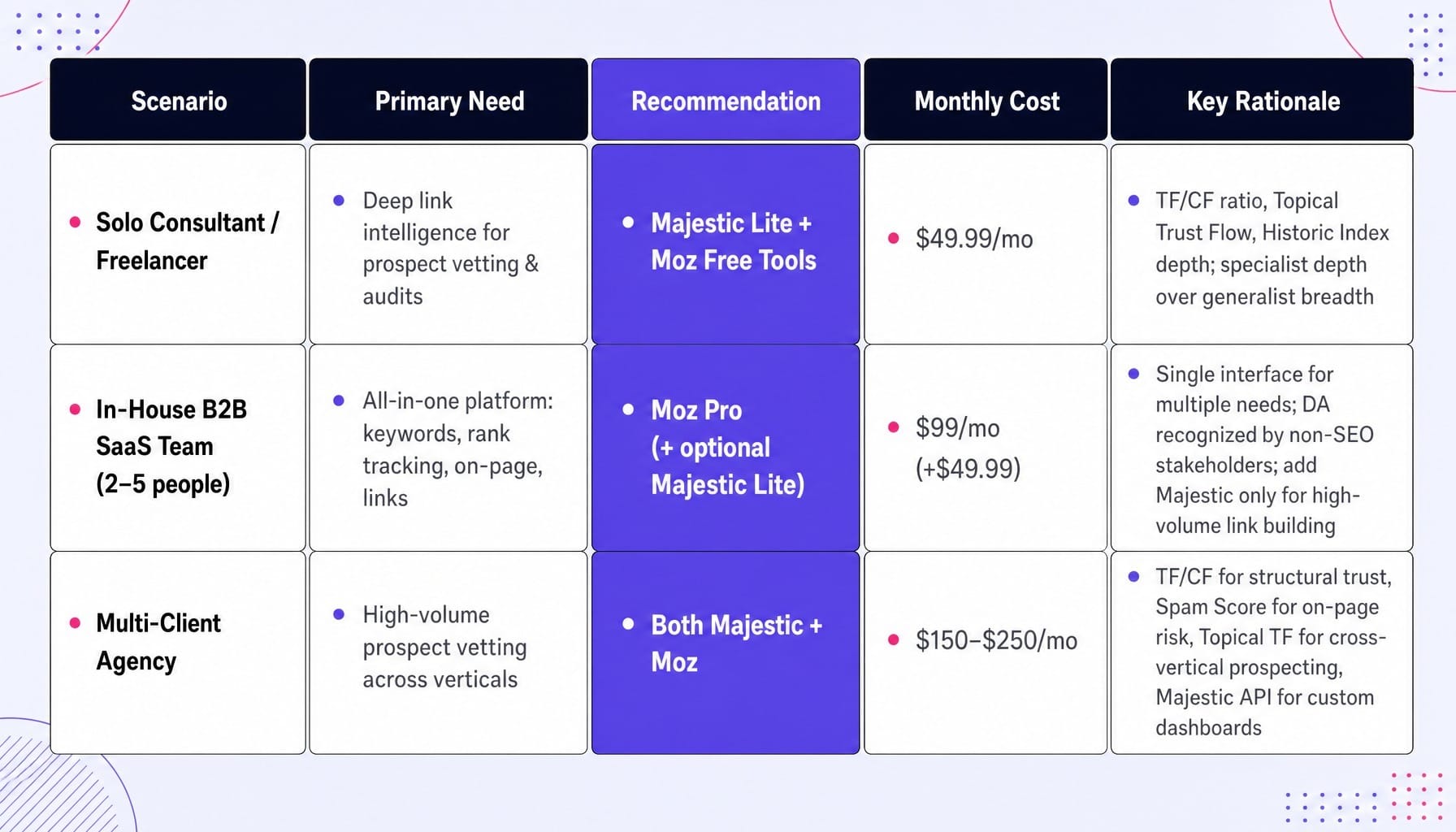
The right answer depends on what you're actually using link data for—prospecting, auditing, reporting, or competitive intelligence—and what other tools are already in your stack. Here are three common B2B practitioner scenarios.
Solo SEO Consultant or Freelancer
Recommendation: Majestic Lite ($49.99/mo), supplemented by Moz's free tools.
A solo consultant's primary need is deep link intelligence for prospect vetting and client audits. Majestic's TF/CF ratio, Topical Trust Flow, and deep Historic Index provide more actionable data for these tasks than DA alone. At this budget, Majestic's link-specific depth beats Moz's all-in-one breadth, as other features like rank tracking can be found in cheaper alternatives. It's a specialist tool for a specialist's core tasks.
In-House B2B SaaS Marketing Team (2-5 People)
Recommendation: Moz Pro ($99/mo), with Majestic as an optional add-on.
A lean in-house team needs a single platform that covers keyword research, rank tracking, on-page optimization, and link analysis in one interface. Moz Pro delivers this. Plus, DA is the metric that non-SEO stakeholders (like your CMO) recognize, which smooths the reporting process. If your team runs active, high-volume link-building campaigns, add Majestic Lite for its superior vetting capabilities. If not, Moz alone is a sufficient and pragmatic choice.
Read more: SaaS Marketing Tools in 2026: How to Build a Stack That Ships, Not Just Reports
Multi-Client Agency Running Link Building at Scale
Recommendation: Pay for both.
Agencies vetting hundreds of prospects per month across different client verticals need both the TF/CF ratio for structural trust assessment and the Spam Score for on-page risk detection. Topical Trust Flow becomes essential when prospecting for a healthcare client one day and a fintech client the next. Furthermore, Majestic's API is generally more cost-effective for building custom reporting dashboards. The combined cost (~$150-$250/mo) is a fraction of the price of one bad link placement.
When the Bottleneck Isn't Which Tool You Pick — It's Shipping What the Tools Tell You
You now have a framework for choosing the right link intelligence tool and a workflow for vetting prospects. But for most lean B2B marketing teams, the real constraint isn't data quality—it's the latency between identifying what needs to change and actually shipping those changes.
Prospect lists sit in spreadsheets. Disavow files stay pending review. Content gaps identified through competitive link analysis never get addressed because the team is buried in other priorities. The backlog grows, and the insights from Majestic or Moz gather dust.
This is the execution gap.
Spike AI is built to close that gap. It's not a replacement for your link analysis tools; it's the execution layer that turns their outputs into compounding weekly improvements. Every week, Spike AI identifies the highest-impact move across your website, SEO, and ads—then executes it. It transforms your backlog from a source of anxiety into a prioritized queue of shipped fixes. You move from operator to orchestrator, approving the work instead of getting buried by it.
See how Spike AI turns your SEO intelligence into weekly shipped improvements →
Conclusion
The debate over Majestic vs. Moz isn't a "which is better" question. It's a "which problem are you solving" question. Majestic measures where a domain sits in the web's trust architecture; Moz predicts how likely a domain is to rank. They are complementary lenses, not competing answers.
The tools produce different numbers because their underlying crawl architectures and measurement philosophies are fundamentally different. The right choice for your stack depends on your workflow: deep prospecting and auditing favor Majestic's link graph depth, while all-in-one reporting and generalist SEO favor Moz's breadth. For many, the answer is both.
But the harder question isn't which tool to subscribe to. It's whether your team has the system in place to act on what either tool surfaces, week after week.
Frequently Asked Questions
What is the Trust Flow to Citation Flow ratio and why does it matter?
The TF/CF ratio divides a domain's Trust Flow by its Citation Flow. A ratio below 0.3 indicates the domain receives far more raw link volume than trust—a common pattern in PBNs and manipulated link profiles. Practitioners use this as a first-pass filter to vet prospects and avoid low-quality link neighborhoods.
Can I use both Majestic and Moz together in my SEO workflow?
Yes, and many agencies do. The strongest vetting workflow uses Majestic's TF/CF ratio to assess link graph trust and Moz's Spam Score to detect on-page degradation signals like thin content or aggressive ads. Each tool catches failure modes the other misses, making them complementary.
How well do Moz and Majestic metrics correlate with actual Google rankings?
Moz's Domain Authority is explicitly designed to correlate with rankings, as it's a predictive ML score. Majestic's Trust Flow is not; it measures link graph topology. While DA shows moderate correlation at an aggregate scale, neither metric is a direct Google ranking factor, and both are often outperformed by content quality and intent alignment in competitive SERPs.
Does Majestic or Moz provide better API access for custom reporting?
Majestic's API is generally more cost-effective per call and offers deeper link-level data, making it preferred for agencies building automated prospecting or auditing pipelines. Moz's API provides DA and Spam Score lookups but has stricter rate limits on lower-tier plans. For bulk backlink checking, Majestic's pricing is typically more favorable.
How do Majestic and Moz handle nofollow and sponsored link attributes?
Both tools crawl and index nofollow and sponsored links but treat them differently. Majestic's Trust Flow does not pass through these links, reflecting Google's historical treatment. Moz includes them in its index but weights them differently in DA calculations. For auditing, both tools allow you to filter by link type.