SaaS Email Marketing in 2026: The Execution System That Replaces Drip Campaigns
TLDR
- Replace static, time-based drip sequences with event-gated micro-flows. A user's action (or inaction) inside your product is a better trigger than a calendar.
- The five email flows that move revenue are: Trial Activation, Feature Adoption, Usage Decay Intervention, Expansion Prompts, and Dunning/Renewal. Focus here first.
- Segment users by product usage behavior (e.g., feature_X_used = false), not just demographics. This requires piping product analytics data into your email platform.
- Stop benchmarking against industry-average open rates. They are vanity metrics, especially post-Apple MPP. Instead, build internal baselines and measure email performance by cohort against a control group.
- Separate your transactional and marketing email infrastructure (e.g., Postmark for transactional, Customer.io for marketing) as you scale. This is a non-negotiable deliverability multiplier.
Your marketing team just launched the new 7-email onboarding sequence. It's timed perfectly: Day 1, 3, 5, 7, 10, 14, and 21. The copy is sharp, the subject lines are A/B tested, and open rates look healthy. But trial-to-paid conversion stays stubbornly flat at 3%.
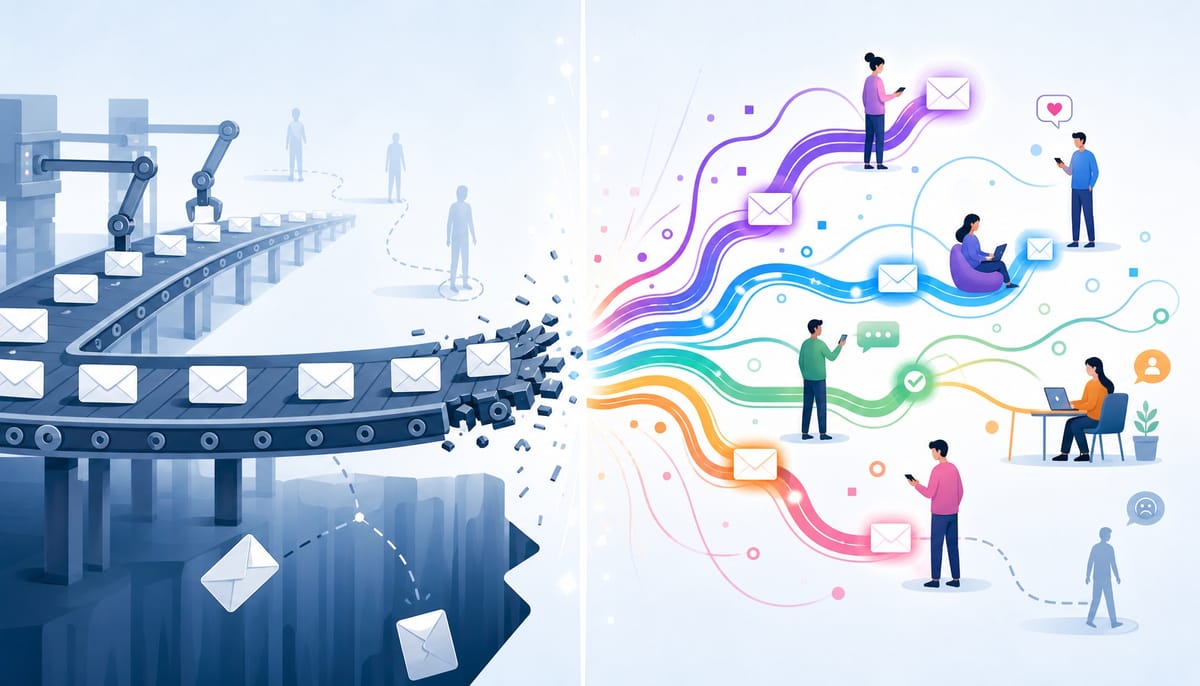
The problem isn't the copy. It's the architecture. The sequence fires on a calendar, indifferent to what users actually do. The power user who hit their activation milestone on Day 2 gets the same Day 3 "getting started" email as the user who never logged in after signup.
This is the central failure mode of most SaaS email marketing programs: they treat email as a broadcast channel when it should function as a behavioral response system.
The truth is, effective SaaS email marketing only works when it's architected around product-usage events, not arbitrary time delays. Most teams know this. The bottleneck isn't strategy; it's execution. The gap between identifying the need for a behaviorally-triggered email and actually shipping it is measured in weeks of engineering tickets and cross-team alignment meetings. This article provides the strategic framework to close that gap, moving from diagnosing the problem to designing an execution system that scales.
Why SaaS Email Is a Fundamentally Different Execution Problem
Most SaaS email marketing advice is borrowed from eCommerce playbooks, and the transplant fails because the underlying business mechanics are different. In eCommerce, email's primary job is to drive a discrete transaction: an abandoned cart recovery, a flash sale announcement, a restock alert. The goal is singular and immediate.
In SaaS, email must orchestrate a sequence of behavioral milestones across a multi-month, often multi-year, lifecycle: signup → activation → habit formation → expansion → renewal. The critical revenue event isn't a single purchase; it's the continuation of paid usage, which is a direct proxy for perceived value. This gives SaaS email a fundamentally different job: it must respond to what users do inside the product, not just what they do in their inbox.
This operational difference is why the persistent ~2-3% average free trial to paid conversion rate remains a painful benchmark for so many companies, despite teams sending more emails than ever.
Consider the data required for segmentation. An eCommerce brand can segment effectively by purchase history and demographic data. A SaaS company needs to segment by feature adoption depth, time-to-value velocity, and usage decay patterns. An eCommerce abandoned cart email is triggered by a single, simple event. A SaaS activation email, to be effective, must respond to a complex pattern of product usage events (or their absence) across multiple sessions.
This data—the lifeblood of effective SaaS email—lives in product analytics tools like Amplitude or Mixpanel, is unified in CDPs like Segment, and must be piped into a lifecycle messaging platform. The operational implication is stark: effective SaaS email marketing requires a tight, real-time integration between product telemetry and messaging infrastructure. Most teams haven't built this, which is why they default to time-based drips. Your email program isn't underperforming because of bad copy; it's underperforming because of an architectural mismatch.
Event-Gated Micro-Flows Replace Static Drip Sequences
The single highest-leverage change a SaaS email program can make is shifting from time-based drip campaigns to event-gated micro-flows. This isn't a theoretical improvement. It's the operational model used by product-led SaaS companies that consistently achieve trial-to-paid conversion rates in the 8-12% range. This model treats email as a response to user behavior, not a monologue dictated by a calendar.
Let's use a project management SaaS as an example, where the core activation milestone is: created a project, invited a teammate, and completed a task within the first 5 days.
The Structural Problem with Time-Based Drip Sequences
Traditional drip sequences—emails fired at fixed intervals post-signup—operate on the flawed assumption that all users progress at the same rate. In reality, this is never true.
In our project management tool example, User A signs up, creates a project, and invites two teammates within the first hour. User B signs up, gets distracted, and never logs in again. Both receive the exact same Day 3 email with the subject line, "Getting Started with Your First Project."
For User A, this email is irrelevant, redundant, and subtly communicates that the product isn't paying attention to their progress. For User B, it arrives without context, failing to address the specific friction point that caused them to disengage in the first place.
The drip sequence treats time as a proxy for user state, but time is a terrible proxy. The result is an email program that feels generic at best and counterproductive at worst, generating its own disengagement. This is precisely why concepts like a sunset policy for cold contacts exist—the system itself creates the unengaged users it later needs to purge. Your drip sequence isn't just suboptimal; it's actively harming the user experience for your most and least engaged trial users.
How Event-Gated Micro-Flows Work in Practice
The alternative is to dismantle the monolithic drip sequence. Instead of a linear 7-email campaign, you build 3-4 distinct micro-flows of 1-2 emails each. Each flow is gated by a specific product event—or the notable absence of one.
Continuing the project management SaaS example:
- Micro-flow 1 (Friction to First Action): Triggers if the user has not created a project within 48 hours. The one or two emails in this flow are laser-focused on overcoming the initial hurdle to creating that first project, perhaps by offering templates or a case study.
- Micro-flow 2 (Collaboration Nudge): Triggers if the user has created a project but has not invited a teammate within 72 hours. The email here ignores project creation and focuses exclusively on the value of collaboration, the next logical step.
- Micro-flow 3 (Post-Activation/Expansion): Triggers only when a user completes all activation milestones. This email confirms their success and begins to introduce advanced features or upgrade paths, shifting the conversation from adoption to expansion.
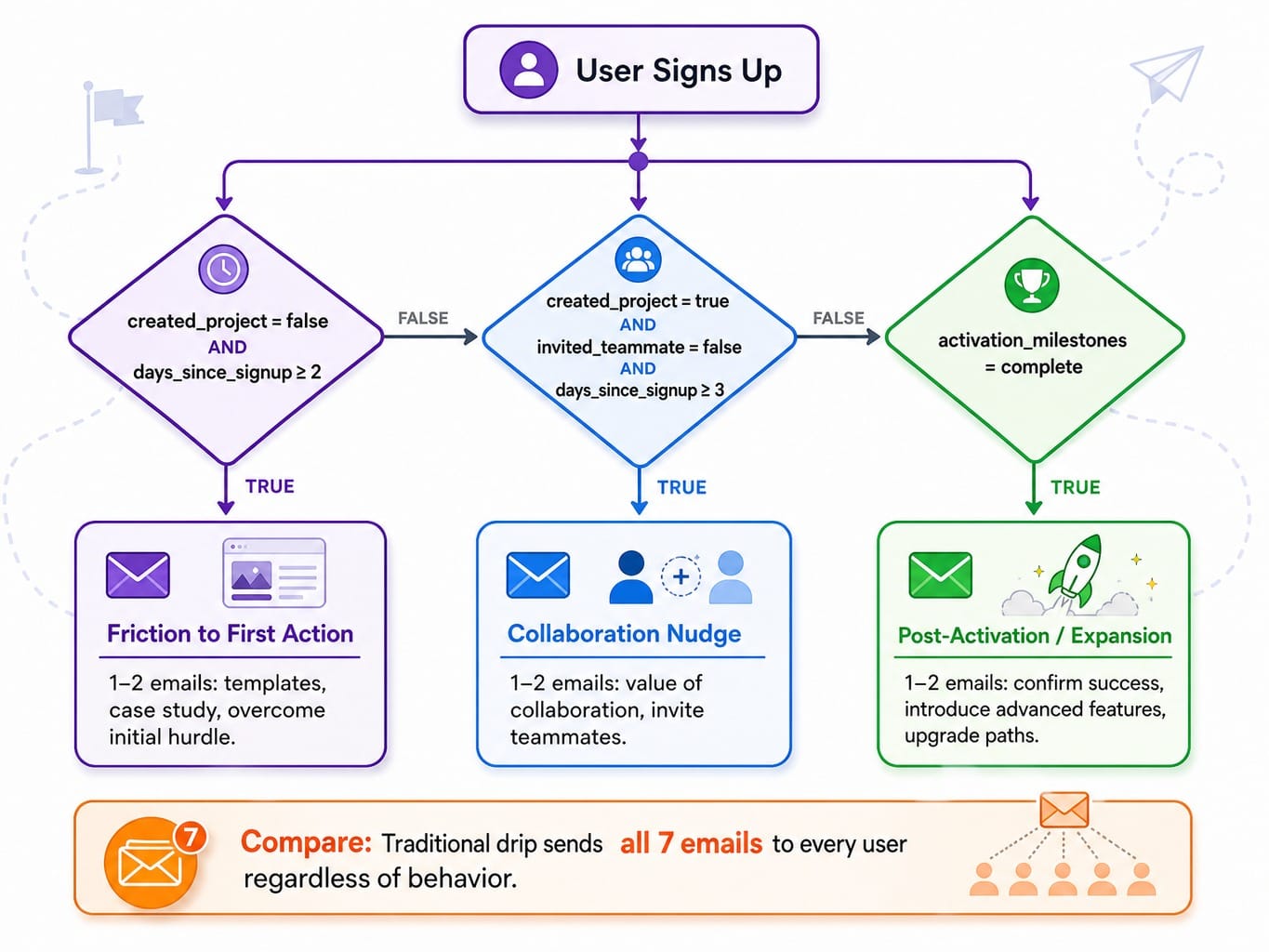
Each micro-flow is short, contextually aware, and fires only when a behavioral signal warrants it. This is enabled by lifecycle messaging platforms like Customer.io, Userlist, or Encharge, which support webhook-triggered sends based on in-app events piped from your product via a CDP like Segment. The logic is no longer just signed_up. It's signed_up = true AND created_project = false AND days_since_signup >= 2. This is event-property segmentation, and it's the engine of modern SaaS email marketing.
Five Lifecycle Email Flows That Actually Move SaaS Revenue
Not all SaaS email flows are created equal. Many teams waste cycles on newsletters and generic "tips" emails that have no measurable impact on revenue. These five flows are different. They are selected because they directly influence the metrics that compound into net revenue retention: trial conversion, activation rate, expansion revenue, and churn prevention.
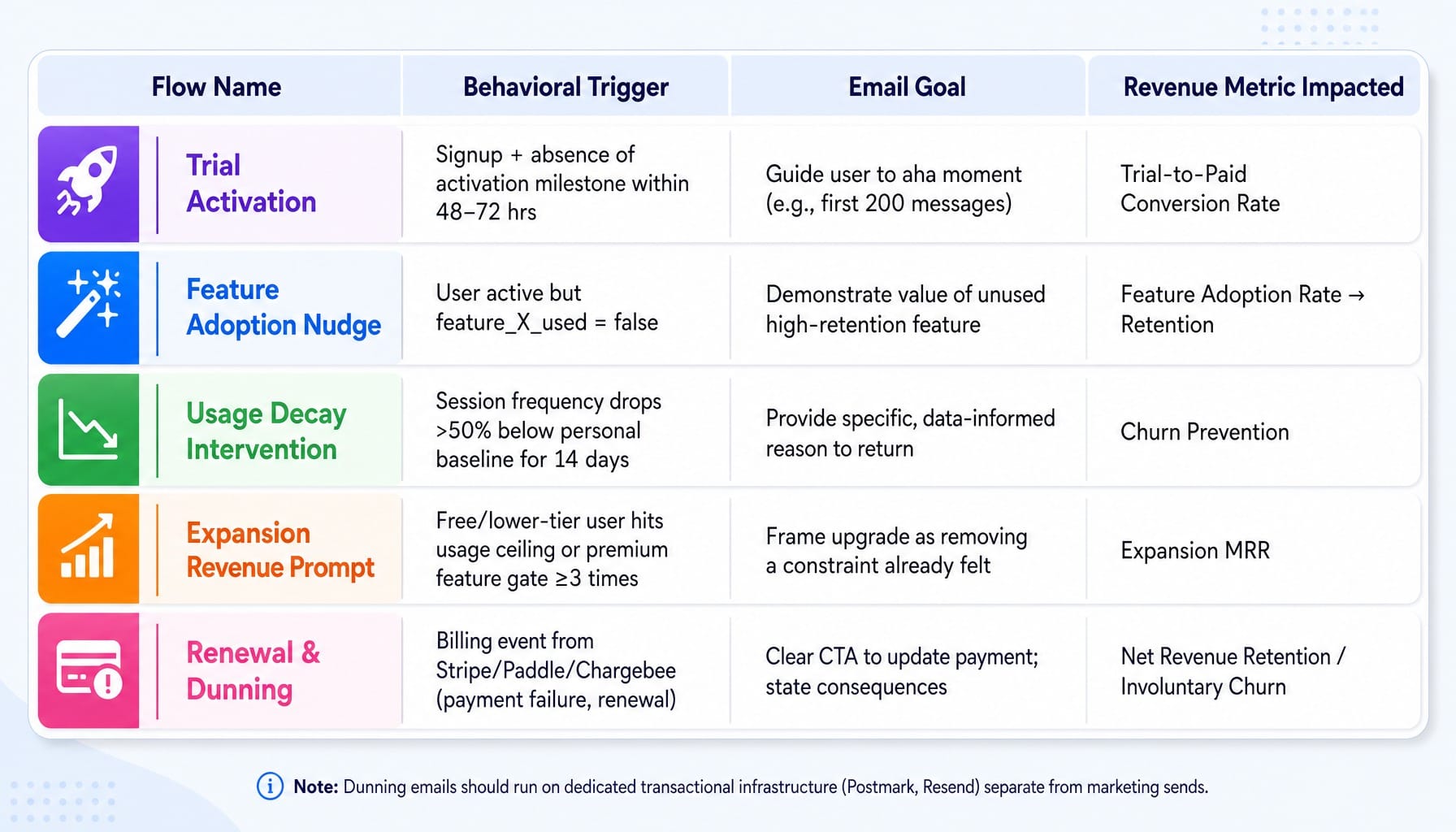
- The Trial Activation Sequence. This isn't a welcome series; it's a friction-reduction engine. It's triggered by signup combined with the absence of a core activation milestone within 48-72 hours. The email's sole job is to guide the user to their "aha moment." Slack's classic onboarding emails didn't list features; they relentlessly focused on getting you to send your first 200 messages, because their data showed that was the tipping point for retention. Your activation email must be similarly obsessed with one specific outcome.
- The Feature Adoption Nudge. This flow is triggered when a user is active but has not engaged with a specific, high-value feature that correlates with long-term retention. For example, a design tool like Canva might notice a user has created several designs but never used the "Brand Kit" feature. The email shouldn't just announce the feature's existence; it should demonstrate its value with a hyper-relevant use case ("Tired of finding your brand's hex codes every time?").
- The Usage Decay Intervention. This is the pre-churn signal most teams ignore. It triggers when a previously active user's session frequency or key action count drops below their personal baseline for a sustained period (e.g., 14 days). Don't send a generic "We miss you!" email. Use product data to make a specific, valuable suggestion: "You haven't created a new report in two weeks. Here's a template for the Q3 summary report many teams are building now." This shows you're paying attention and provides a concrete reason to return.
- The Expansion Revenue Prompt. This is the art of the well-timed upsell. It's triggered when a user on a free or lower-tier plan repeatedly hits a usage ceiling or tries to access a gated feature. Loom and Otter.ai are masters of this, timing upgrade emails to the exact moment a user hits their recording or transcription limit. The email frames the upgrade as removing a constraint the user has already felt, making the purchase a relief, not a sales pitch.
- The Renewal & Dunning Flow. This is the most directly revenue-critical email you send. Triggered by billing events from Stripe, Paddle, or Chargebee, these emails must be brutally clear and simple. For payment failures, the email must be transactional in tone, state the consequence (e.g., "Your account will be suspended in 7 days"), and provide a one-click path to update payment details. Critically, these dunning emails should run on dedicated transactional email infrastructure (like Postmark, Resend, or Mailgun) to protect their deliverability from any reputation damage caused by your marketing sends.
These five flows, properly instrumented, form the revenue-critical backbone of a SaaS email program. Everything else is secondary.
Segmenting by Product Usage Instead of Demographics
Demographic segmentation—industry, company size, job title—is table stakes for top-of-funnel communication, but it's nearly useless for driving product adoption and retention. The segments that actually move the needle in SaaS email marketing are behavioral, defined by what users do (or don't do) inside your product.
High-performing teams build dynamic segments based on a continuous stream of product-usage data. This requires an architecture where in-app events from a product analytics layer (like Amplitude or Mixpanel) are piped through a customer data platform (like Segment) and made available for segmentation inside a lifecycle messaging tool (like Customer.io, Iterable, or Braze).
This sounds complex, but the logic is straightforward. Here are three examples of behavioral segments that are far more powerful than any demographic data:
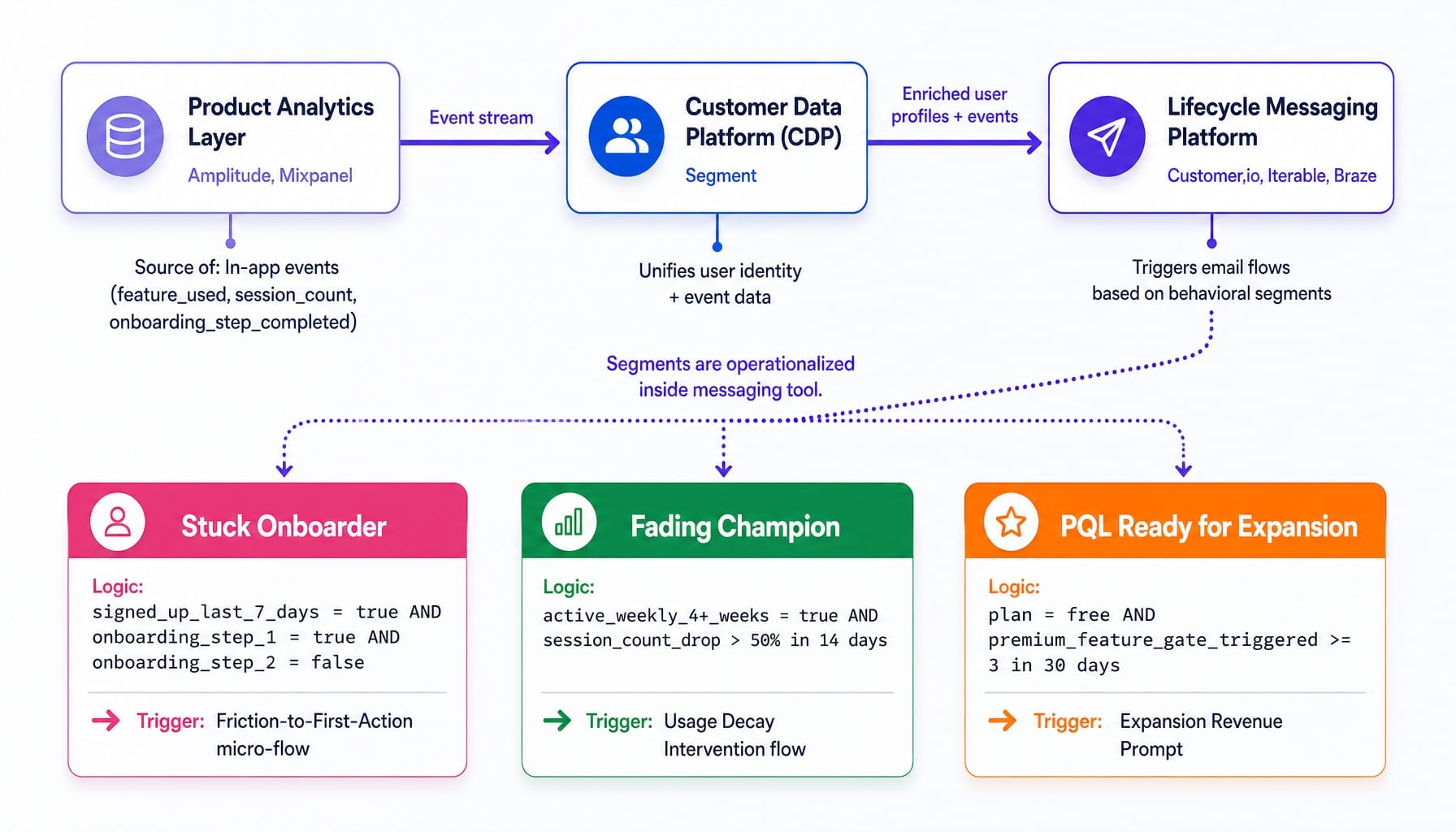
Segment A: The "Stuck Onboarder"
Logic: Signed up in the last 7 days AND completed_onboarding_step_1 = true AND completed_onboarding_step_2 = false.
Action: Trigger a micro-flow with a targeted email that addresses the specific friction point between step 1 and step 2.
Segment B: The "Fading Champion"
Logic: Was active weekly for 4+ weeks AND session_count dropped by >50% in the last 14 days.
Action: Trigger the Usage Decay Intervention flow, re-engaging them with a personalized, high-value reason to return.
Segment C: The "PQL Ready for Expansion"
Logic: On free plan AND triggered_premium_feature_gate >= 3 times in the last 30 days.
Action: Trigger the Expansion Revenue Prompt, presenting the upgrade as the logical solution to a problem they've already experienced.
This is event-property segmentation, and it's what enables the personalization that actually feels helpful, not creepy. Yes, this architecture can take a few weeks to instrument properly. But once built, it's an autonomous system that compounds in value as more behavioral data accumulates, allowing you to move from guessing what users need to responding to what they actually do.
Why Industry Email Benchmarks Mislead SaaS Teams
If your monthly marketing report opens with "Our open rate is above the industry average of 21%," you are celebrating a meaningless victory. Industry benchmarks aggregate performance across wildly different SaaS models (PLG vs. sales-led), lifecycle stages (onboarding vs. renewal), and audience types (SMB vs. enterprise). They are a recipe for feeling good about the wrong metrics.
A 35% open rate on a transactional password reset email, a 35% open rate on a Day 3 trial activation email, and a 35% open rate on a monthly newsletter are not comparable achievements. They reflect entirely different user states, intents, and levels of urgency. Lumping them together into a single "average open rate" and comparing it to an external benchmark obscures all meaningful signals.
Furthermore, the open rate itself has become a structurally broken metric for performance measurement since Apple's Mail Privacy Protection (MPP) began pre-fetching images, artificially inflating open counts. The metric that matters more for deliverability today is the inbox placement rate.
The only benchmarks that matter are your own, measured by cohort. Instead of aggregate monthly numbers, track your activation email performance by weekly signup cohort. If the emailed group in Cohort 12 had a trial-to-paid conversion rate of 4.5% and Cohort 15 drops to 3.2%, that delta is a real signal. It tells you something changed—in your product, your acquisition channel mix, or your email content. That is an actionable insight, and it is completely invisible in an industry benchmark report.
Stop chasing averages. Build internal baselines for each of your core lifecycle flows and measure performance against a control holdout group. The goal for your onboarding emails isn't a high open rate; it's a measurable lift in activation rate for the emailed cohort versus the group that received nothing. That's a metric you can take to the bank.
Choosing Email Infrastructure That Matches Your Stage
The right email tool for your SaaS depends on your stage, not a G2 comparison chart. A five-person team sending 10,000 emails a month has fundamentally different needs than a 50-person team sending 500,000. Over-investing in tooling too early burns cash and adds complexity; under-investing too late creates a massive migration headache and technical debt.
Here's a simple, stage-based framework for your email infrastructure:
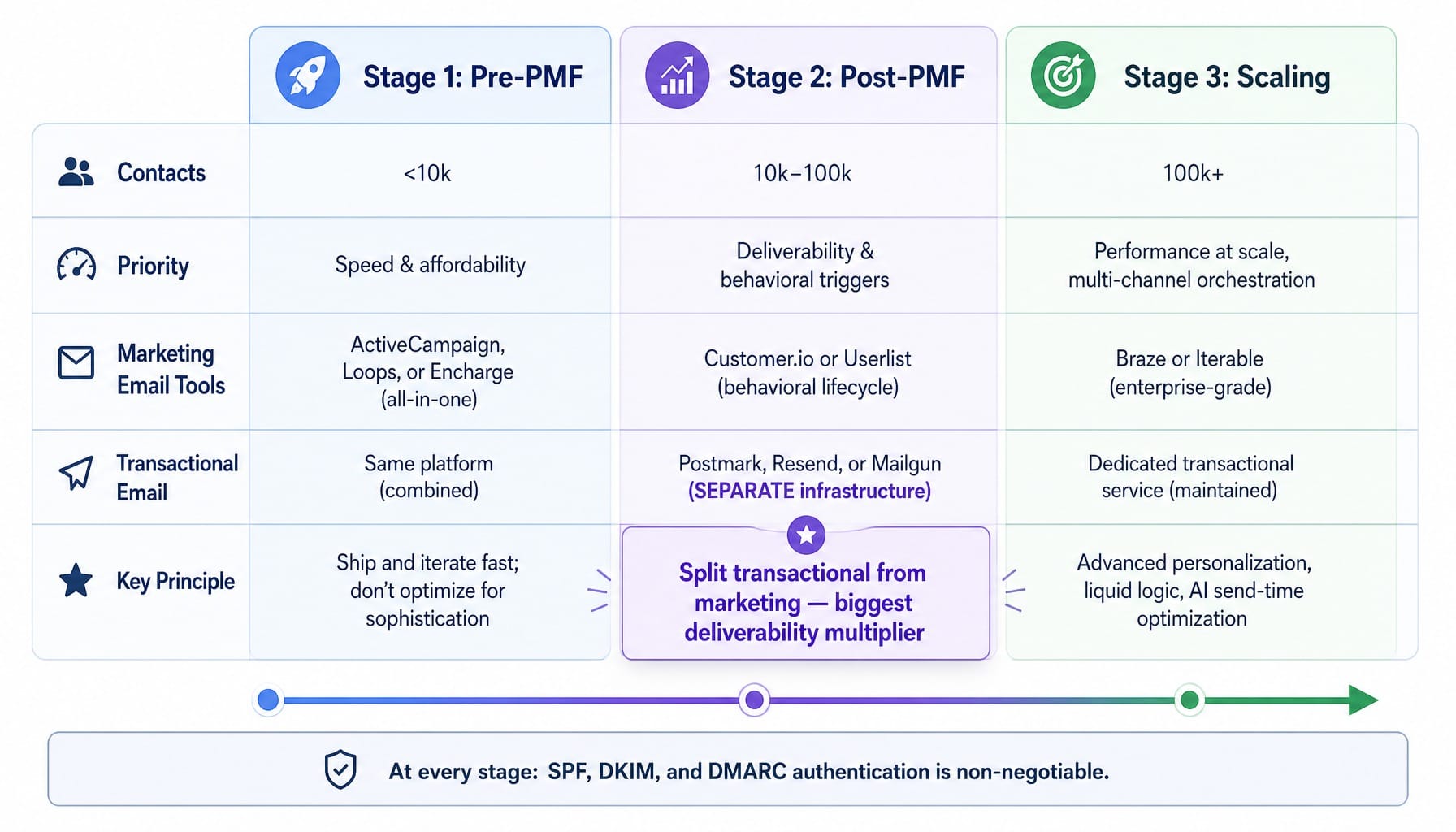
- Stage 1: Pre-PMF (<10k Contacts): Your priority is speed and affordability. Use a simple, all-in-one platform that handles both marketing and basic transactional sends. Tools like ActiveCampaign, Loops, or Encharge are built for this stage. You need to be able to set up, test, and tear down flows quickly. Don't optimize for sophistication yet.
- Stage 2: Post-PMF (10k-100k Contacts): This is the critical juncture where you must separate your transactional and marketing email infrastructure. Use a dedicated transactional email service like Postmark, Resend, or Mailgun for all app-generated, business-critical emails (password resets, welcome emails, billing confirmations, dunning). This protects their deliverability. For your lifecycle marketing, use a platform built for behavioral triggers like Customer.io or Userlist. This separation is the single biggest deliverability multiplier most growing SaaS teams ignore. When a marketing campaign gets spam complaints, it won't tank the sender reputation of your revenue-critical billing emails.
- Stage 3: Scaling (100k+ Contacts): Your needs now revolve around performance at scale, complex personalization, and multi-channel orchestration. This is when you graduate to enterprise-grade customer engagement platforms like Braze or Iterable. These tools support advanced features like liquid templating logic, AI-driven send-time optimization algorithms, and sophisticated event-property segmentation across email, push, and in-app messages.
At every stage, ensuring your sending domains are properly authenticated with SPF, DKIM, and DMARC is non-negotiable. But the most common point of failure is running everything through one pipe. Don't wait for a deliverability crisis to learn that lesson.
When the Bottleneck Is Not Your Email Program — It Is Everything Around It
This entire article has built a case for a more intelligent, responsive SaaS email marketing system. But even the most perfectly instrumented, event-gated email program will underperform if the rest of the marketing system is broken.
Your email program doesn't exist in a vacuum. It depends on high-intent traffic from SEO and ads, landing pages that convert that traffic, and a website experience that reduces friction at every step. Most lean SaaS marketing teams feel this tension daily: they know what to build but can't ship it fast enough. The backlog for CRO improvements, content updates, and technical SEO fixes grows, while the latency between insight and implementation stretches into weeks or months.
Read more: Landing Page Conversion Rate Optimization: A Revenue-Weighted Playbook
This is the real execution gap. The email flows described here will only compound in value when the rest of the marketing surface is also improving on a weekly cadence.
Spike AI is the marketing execution engine that closes this gap. We don't just give you insights; we turn your strategy into a weekly shipping cadence. Every week, Spike AI identifies the highest-impact move to make across your website, SEO/AEO, and ads—then executes it. It's the system that ensures your finely tuned email program has a high-converting funnel feeding into it and a frictionless product experience waiting on the other side. You've just designed a better email system. Spike AI is how you build a better growth system around it.
See what Spike AI would ship for your website this week
From Strategy to Execution System
The fundamental shift required for high-performing SaaS email marketing is not about content or tools. It's about re-architecting your execution process. Most teams have a viable strategy; they lack a system to ship behavioral flows, instrument product-event segmentation, and iterate on cohort-level data at the speed their product evolves.
We've moved from diagnosing why SaaS email is a unique execution problem to designing the event-gated micro-flows that replace static drips. We've mapped the five revenue-critical lifecycle flows, operationalized behavioral segmentation, and established a saner approach to measurement.
But the final step is recognizing that your email program is a component in a larger system. The SaaS companies that will win in 2026 are not the ones with the cleverest copywriters. They are the ones that treat their entire marketing function as a real-time response system—and have the execution cadence to ship improvements every week, not every quarter.
Frequently Asked Questions
How many emails should be in a SaaS trial conversion sequence?
There is no universal number. Event-gated micro-flows typically use 1-2 emails per behavioral trigger rather than a fixed-length sequence. A trial program might have 3-4 micro-flows of 1-2 emails each, but only a subset fires for any given user based on their actual product behavior. The goal is contextual relevance per email, not total volume.
How do you A/B test SaaS email sequences without skewing activation metrics?
Use a control holdout group. Randomly exclude 10-15% of eligible users from receiving the email flow entirely, then compare activation and conversion rates between the holdout and the emailed group over a full cohort lifecycle (typically 30-60 days). This isolates the email's causal impact from organic user behavior. Avoid testing subject lines in isolation; test the entire flow's presence against its absence first.
What is the difference between send reputation warming and ongoing deliverability maintenance?
Reputation warming is the initial, finite process of gradually increasing send volume on a new IP or domain over 2-4 weeks to build trust with inbox providers. Ongoing maintenance is the perpetual process of hygiene: cleaning suppression lists of hard bounces, monitoring inbox placement, maintaining DMARC/BIMI compliance, and enforcing a sunset policy for contacts who haven't engaged in 90+ days.
Should SaaS companies use plain-text emails or designed HTML templates?
It depends on the email's function. Lifecycle emails triggered by product behavior (like activation nudges or usage alerts) often perform better as plain-text or minimal-design emails because they feel personal and contextual. They feel like a message from a person, not a campaign. Designed HTML templates work better for product announcements, newsletters, and expansion campaigns where visual hierarchy and branding reinforce credibility.
How do you capture zero-party data in SaaS email flows without hurting conversion?
Embed a single-question micro-survey in your onboarding flow after the user has experienced an "aha moment" or received value. For example, ask their primary use case immediately after they complete their first key action. Use the response to tag them and personalize subsequent emails. Asking for data before you've provided value creates friction; asking after creates a helpful feedback loop.