SaaS Marketing: Why Strategy Stalls and How Execution Systems Compound Growth
TLDR
- SaaS marketing fails on execution, not strategy. The primary bottleneck is the latency between identifying a needed change and shipping it.
- Stop optimizing for Marketing Qualified Leads (MQLs). Instead, measure leading indicators that predict revenue, like Product Qualified Lead (PQL) velocity, activation rate, and CAC payback period.
- The highest-impact SaaS marketing teams run as a unified system, not fragmented channels. The highest-ROI move is often a cross-functional fix, not a channel-specific optimization.
- In 2026, the winning go-to-market motion is hybrid. Marketing must build an architecture that supports both product-led growth (PLG) for self-serve users and a sales-led motion for enterprise expansion.
- The most significant competitive advantage is execution cadence. A team that ships one improvement per week compounds 52 changes a year, far outpacing teams stuck in quarterly planning cycles.
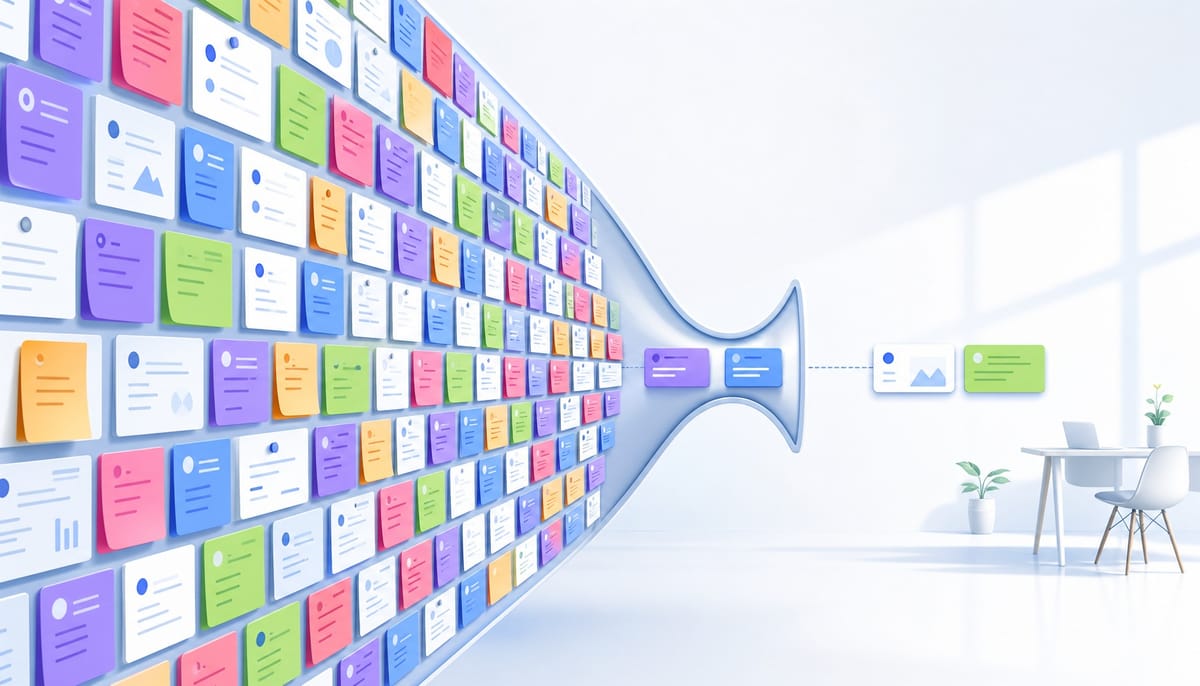
Your SaaS marketing team has a 40-item backlog. It's filled with high-impact moves: a pricing page A/B test, a new set of competitor comparison pages, a dozen SEO content updates, and a rewrite of the onboarding email sequence. The team knows exactly what needs to happen to move the needle on pipeline and net revenue retention. Yet, at the end of the month, maybe two of those items have shipped.
The bottleneck isn't insight. It isn't strategy. It's the latency—the gap between identifying what should change and actually deploying it.
This is the core failure mode of modern saas marketing. It doesn't fail because teams lack channel knowledge or strategic frameworks. It fails because execution cannot keep pace with the inherent complexity of the SaaS model: recurring revenue, multi-touch buyer journeys that are mostly invisible, simultaneous acquisition and retention demands, and fragmented tooling.
Most guides offer another list of tactics. This is not that guide. This is a systems-level breakdown of how SaaS marketing actually works when it compounds, diagnosing why most teams plateau and how the right execution system can break the stalemate.
What Is SaaS Marketing and Why Does the Model Change Everything?
SaaS marketing is the set of strategies and systems used to acquire, activate, retain, and expand customers for subscription-based software products. While it shares tools with traditional marketing, its structure is fundamentally different because revenue is not a one-time event; it is earned continuously over the lifetime of a customer.
This single distinction changes everything. In traditional software, marketing's job ends at the point of sale. In SaaS, the sale is just the beginning. A team that acquires 1,000 customers but churns 7% of them monthly isn't growing; it's on a treadmill, and the entire customer base will have evaporated in just over a year without constant, costly replacement.
This is why the AARRR (Acquisition, Activation, Retention, Revenue, Referral) framework remains the mental model for SaaS. Marketing is accountable for the entire lifecycle. Your job isn't to generate a lead and hand it off; it's to attract the right user, ensure they activate and find value, help them stay, and create opportunities for them to expand their usage. It's a retention-and-expansion system, not just an acquisition engine. This is why practitioners obsess over metrics like Net Dollar Retention (NDR) and CAC payback period, not just MQLs.
Why Most SaaS Marketing Strategies Stall Before They Compound
Most SaaS marketing teams have a strategy document, a channel mix, and a backlog of good ideas. What they lack is the execution velocity to make those strategies compound. SaaS marketing is a throughput system. Its output is constrained not by the quality of its inputs (ideas, strategy) but by the speed at which those inputs become deployed changes that impact a metric.
A growth marketer identifies that the pricing page has a 70% bounce rate among qualified visitors. They know exactly which three CRO changes to test. But shipping that experiment takes six weeks, tangled in a web of design requests, engineering tickets, and stakeholder approvals. By the time the test is live, the insight is stale, and the opportunity cost is massive. This isn't a strategy problem; it's an execution system failure. Two specific failure modes are responsible for this stall.
Optimizing for MQLs Instead of Activation Metrics
Most SaaS marketing teams measure success by Marketing Qualified Lead (MQL) volume because it's the metric their CRM tracks and their leadership reviews. But MQLs measure interest, not activation. They are a proxy for a proxy.
A team generating 500 MQLs/month with a 2% trial-to-paid conversion rate has a fundamentally different—and much worse—problem than a team generating 200 MQLs with an 8% conversion rate. Yet both might report "marketing is working" based on top-of-funnel volume. The real story is in the activation data. When one B2B SaaS company shifted its primary KPI from MQL count to Product Qualified Lead (PQL) velocity—the rate at which users hit activation milestones—it discovered that 60% of its MQLs never logged in a second time.
Marketing was successfully generating activity that created zero business value. When you optimize for the wrong metric, you build a system that is perfectly designed to produce outcomes that don't matter.
Channel Fragmentation as a System Failure
In most lean SaaS marketing teams, SEO, paid search, CRO, and lifecycle marketing are run as separate workstreams. They have different owners, different tools, and different dashboards. This fragmentation means no one has a unified view of where the highest-impact move is at any given moment.
Imagine a three-person team: one owns SEO content, another runs paid campaigns, and a third manages email nurture. Each is diligently optimizing their own channel metrics. But what if the single highest-ROI action for the entire business is a landing page CRO fix that would improve conversion rates across all three channels simultaneously? In a fragmented system, this opportunity remains invisible. Each operator continues to pursue local optima, producing diminishing returns, while the global maximum goes unaddressed.
Tools like Amplitude or Mixpanel can surface the data, but they don't prioritize or execute the next action. The gap between insight and implementation remains a manual, human-bottlenecked process.
Read more: How to Prioritize Marketing Channels With a Limited Budget And Resources (Framework for Lean Teams)
Five Execution Layers That Make SaaS Marketing Compound
Instead of a list of disconnected channels, effective SaaS marketing operates as a stack of five interconnected execution layers. Each layer builds on and amplifies the one before it. They are not interchangeable tactics to cherry-pick; they are a system that creates leverage when operated in sequence.
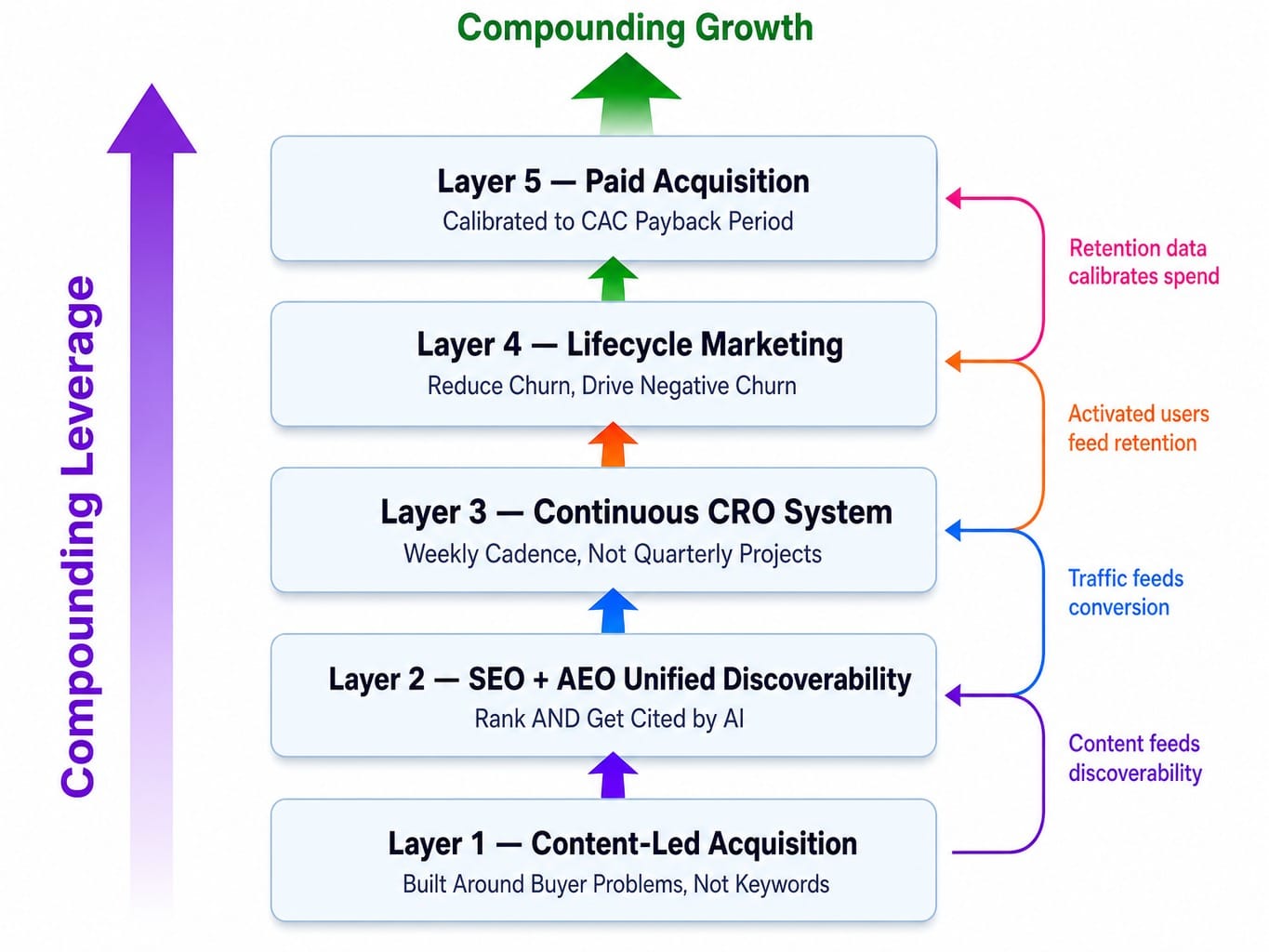
1. Content-Led Acquisition Built Around Buyer Problems, Not Keywords
SaaS content marketing fails when it targets keyword volume instead of buyer problems. A blog post ranking #3 for a 5,000-search-volume informational keyword that attracts zero ICPs is a net loss. It consumes resources and generates costly, irrelevant traffic. A comparison page ranking #8 for a 200-search-volume commercial keyword that converts at 4% is a pipeline-generating asset.
This is the difference between content marketing and content-led acquisition. One is a volume play; the other is a precision strike. One SaaS company saw pipeline contribution from content increase 3x not by publishing more, but by publishing less. They shifted from eight blog posts a month targeting high-volume queries to three pieces targeting bottom-of-funnel comparison and alternative queries. Tools like Clearbit or 6sense can help identify the topics and intent signals that indicate a buyer is in-market, ensuring your content budget is spent solving problems for people who can actually buy your product.
2. SEO and AEO as a Unified Discoverability System
In 2026, optimizing for Google rankings and optimizing for AI citation are no longer separate activities. SEO and AEO (Answer Engine Optimization) have converged. A SaaS company that ranks well but is never cited in AI Overviews or a ChatGPT response is losing a growing share of discovery. As Google itself states, the best practices for visibility in generative AI features are rooted in foundational SEO.
This means creating non-commodity, expert-led content that an AI system can reliably extract and cite. Consider a SaaS company whose "What is [category]?" page ranks #2 but is never featured in an AI overview. The content is likely a generic definition without a unique perspective. The fix isn't a new keyword strategy; it's enriching the page with first-party data, a practitioner's framing, and clear, passage-level extractability. Your content must succeed twice: first as a page that ranks, and second as a set of answers that can be trusted.
Read more: How to Prioritize Search Marketing Channels for Growth (2026 Framework)
3. Conversion Rate Optimization as a Continuous System, Not a Project
Most SaaS companies treat CRO as a quarterly project: run a few A/B tests, implement the winners, and move on. But conversion optimization only compounds when it operates as a continuous system. The cadence is the strategy.
A team that runs four major CRO experiments per quarter is out-shipped by a team that deploys one smaller, high-impact optimization every single week. The weekly team compounds 52 improvements per year versus 16. This weekly cadence is the core of systems like Spike AI, which are built to close the latency between insight and deployment. The CRO metric that matters most for SaaS isn't just conversion rate; it's reducing time to value—how quickly a new user reaches the "aha!" moment where the product delivers on its promise. Every second of friction you remove from that path increases activation, retention, and expansion revenue.
4. Lifecycle Marketing That Reduces Churn Before It Happens
Churn reduction is a marketing function, not just a customer success responsibility. Marketing teams that stop engaging customers after the initial conversion are leaving the majority of a customer's potential lifetime value on the table. In fact, analysis of SaaS marketing funnels shows that up to 30% of expansion revenue can originate from marketing-driven emails about integrations, new features, and underused capabilities.
The goal is to achieve negative churn, where expansion revenue from existing customers (upgrades, add-ons) exceeds the revenue lost from churned customers. This should be a core marketing KPI. Proactive lifecycle marketing—like HubSpot's automated onboarding sequences that guide users to activation milestones—is the engine for negative churn. It demonstrates that marketing's job doesn't end at acquisition; it extends through the entire subscription lifecycle.
5. Paid Acquisition Calibrated to CAC Payback Period
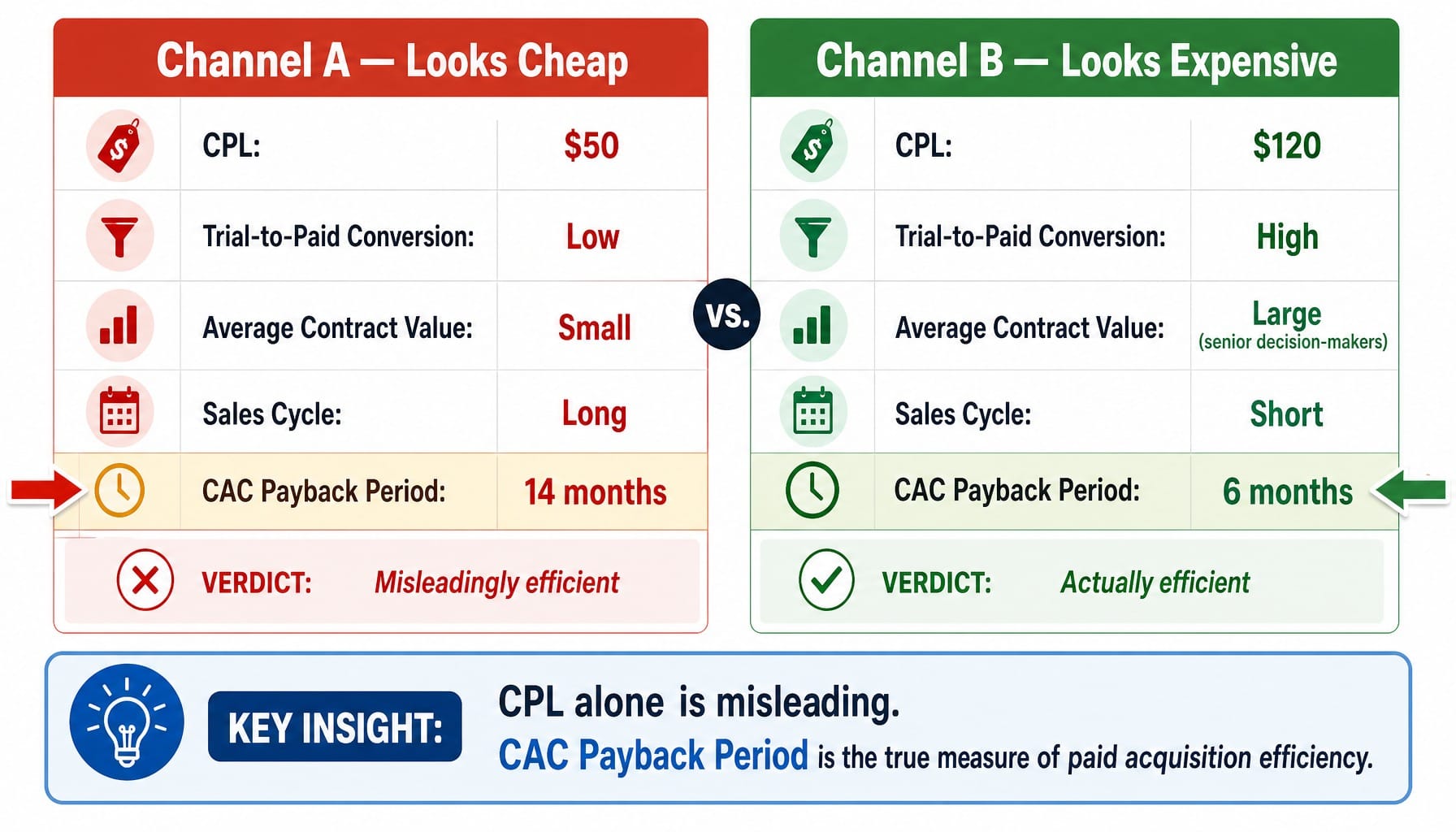
SaaS paid acquisition fails when teams optimize for Cost Per Lead (CPL) instead of CAC Payback Period. A $50 CPL that converts to a customer with a 14-month payback period is a far worse investment than a $120 CPL that converts to a customer with a 6-month payback period. Yet most ad dashboards only show the first number.
One SaaS company found that its LinkedIn Ads campaigns looked prohibitively expensive on a CPL basis. But when they analyzed the CAC payback period, they discovered it was their most efficient channel. The leads were senior decision-makers who moved through a shorter sales cycle and signed larger contracts. With average B2B sales cycles stretching to 211 days according to Dreamdata, understanding the difference between your blended vs. paid CAC and optimizing for a fast payback period is the only way to scale paid acquisition without bankrupting the company.
How PLG and Sales-Led Motions Are Converging in 2026
The discourse in SaaS marketing has long been dominated by a binary choice: you are either product-led (PLG) or sales-led. In 2026, this is a false dichotomy. The most effective SaaS companies run a hybrid motion. They use product-led acquisition to land new users and smaller accounts through a self-serve or freemium model, then deploy a sales-assisted motion to expand high-potential accounts into enterprise deals.
This convergence fundamentally changes marketing's role. Your team is no longer just generating MQLs for sales or PQLs for the product team; you must generate both, and the funnel architecture must support both paths seamlessly.
Companies like HubSpot and Notion exemplify this hybrid model. They offer world-class freemium products that attract millions of users (PLG), while simultaneously running sophisticated ABM campaigns and enterprise sales teams to close six- and seven-figure deals. Their marketing systems are built to serve both motions. A user can sign up and get value without ever speaking to a human. But when that user's team reaches a certain usage threshold, marketing can trigger a sales-assisted conversation about an enterprise plan. This "land-and-expand" strategy is the bridge between PLG and sales-led, and marketing is the architect of that bridge.
SaaS Marketing Metrics That Actually Signal Growth
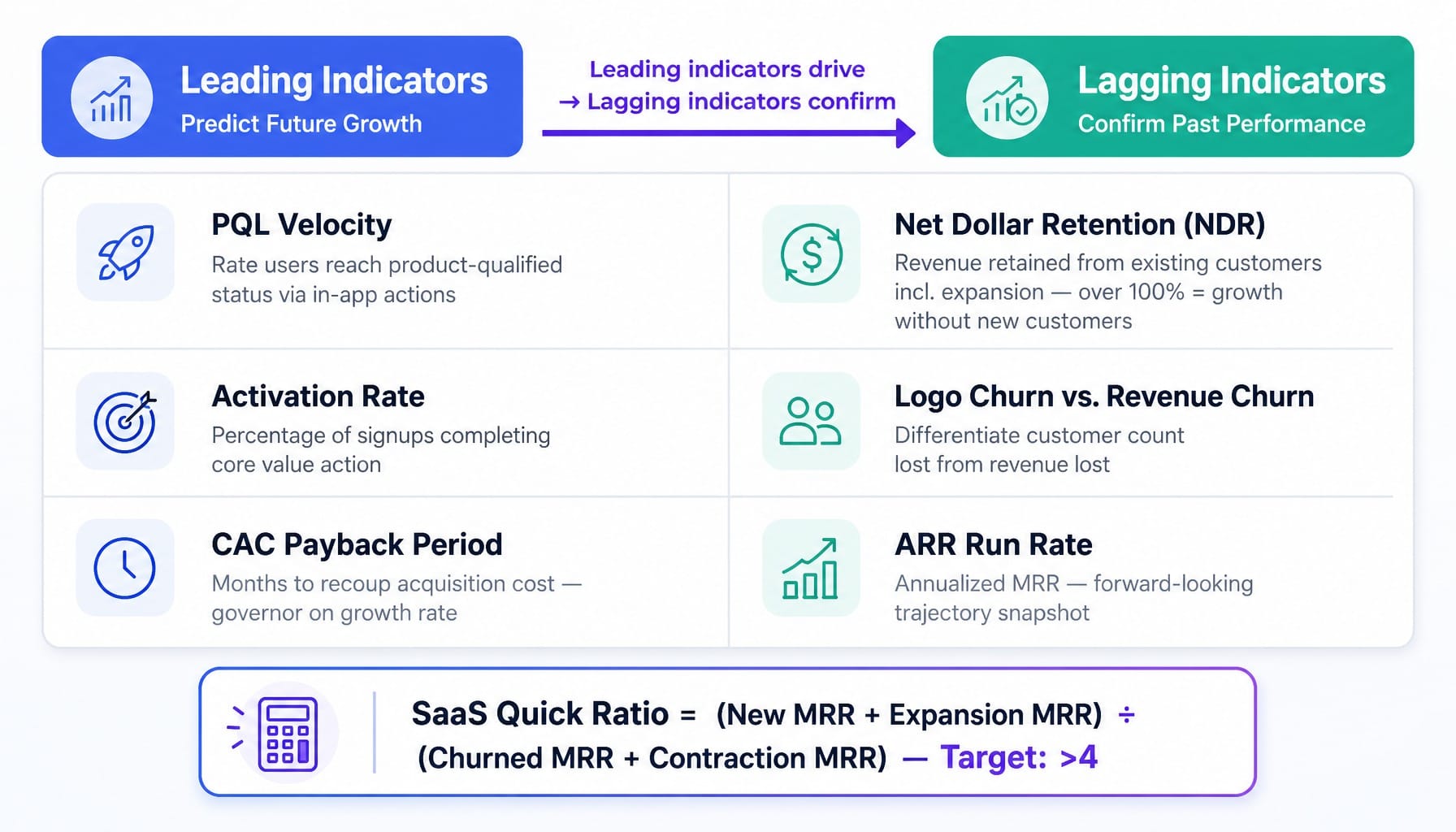
Most SaaS marketing dashboards are a graveyard of vanity metrics. Teams track too many numbers and understand too few. The only distinction that matters is between leading indicators (metrics that predict future growth) and lagging indicators (metrics that confirm past performance).
Teams that only track lagging indicators like MRR and total customers are always looking in the rearview mirror. They are reacting to history. Teams that track leading indicators can intervene before a problem compounds. A powerful health check is the SaaS quick ratio: (New MRR + Expansion MRR) / (Churned MRR + Contraction MRR). A ratio above 4 indicates strong, healthy growth.
Leading Indicators: PQL Velocity, Activation Rate, and CAC Payback
These three metrics tell you if your growth engine is working before the revenue shows up.
- PQL Velocity: The rate at which new users reach product-qualified status, defined by completing specific in-app actions that correlate with retention (not just filling out a form). It measures the speed at which you are creating potential customers.
- Activation Rate: The percentage of new signups who complete the core action that delivers the product's primary value. A low activation rate means your marketing is making promises your product can't keep, or that your onboarding is broken.
- CAC Payback Period: The number of months it takes to recoup the cost of acquiring a customer. This is the ultimate measure of marketing efficiency and the governor on your growth rate. Platforms like ChartMogul or Paddle are essential for tracking this accurately.
Lagging Indicators: NDR, Logo Churn, and ARR Run Rate
These metrics confirm that your leading indicators are translating into real business outcomes.
- Net Dollar Retention (NDR): The single most important metric in SaaS. It measures revenue retained from existing customers, including expansion and contraction. An NDR over 100% means you are growing even without acquiring new customers. World-class SaaS companies have NDRs exceeding 120%.
- Logo Churn vs. Revenue Churn: Losing ten small accounts might be less damaging than losing one enterprise account. Differentiating between the number of customers lost (logo churn) and the amount of revenue lost (revenue churn) is critical for understanding the health of your customer base.
- ARR Run Rate: This is the ultimate confirmation that the system is working. It annualizes your current monthly recurring revenue, providing a forward-looking snapshot of the company's trajectory if current conditions hold.
The Dark Funnel: Marketing the 70% of the Buyer Journey You Cannot Track
The dark funnel is the portion of the buyer journey that happens in channels your analytics cannot track: Slack communities, private LinkedIn DMs, podcast conversations, word-of-mouth recommendations, and internal team discussions. For B2B SaaS, this untrackable activity often represents the majority of the buying decision.
A prospect who books a demo today may have been influenced over the last six months by seeing your founder's LinkedIn posts, hearing your product mentioned on a podcast, and reading a peer's recommendation in a private community. None of this shows up in your multi-touch attribution model.
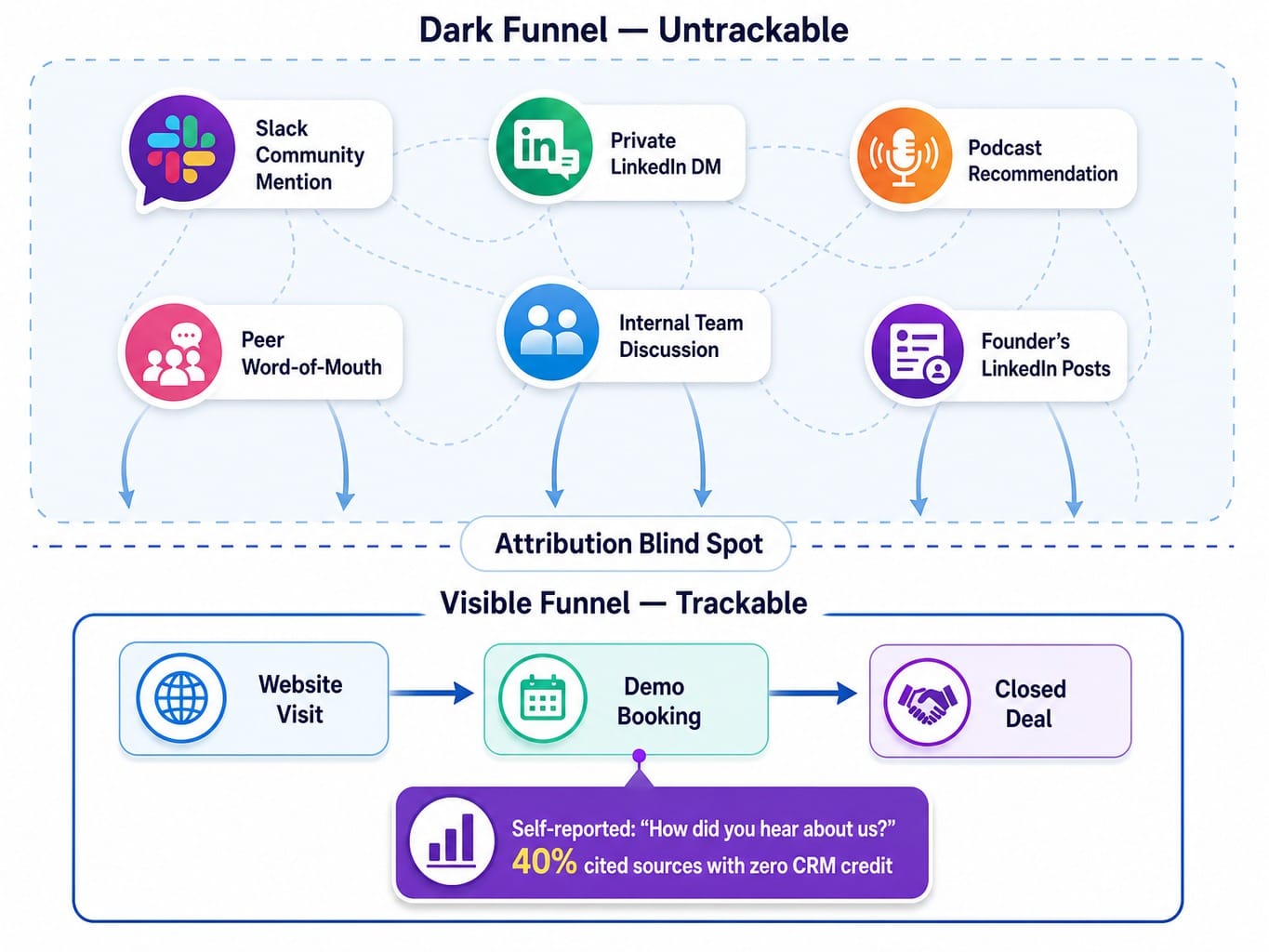
The practical implication for your saas marketing strategy is profound. You must invest in brand-building activities that you cannot directly attribute to pipeline—community engagement, thought leadership, social presence, events—while maintaining the discipline to measure what you can. The dark funnel is not a problem to be solved; it is a reality to be designed around. The simplest way to illuminate it? Add a "How did you hear about us?" field to your demo form. One SaaS company found that 40% of its booked demos cited sources that received zero credit in its CRM. Teams that only invest in trackable channels are systematically underinvesting in the activities that build the most trust.
When the Bottleneck Is Shipping, Not Strategy
The tension is clear. You know what to do—the backlog is full of validated ideas. But you can't ship fast enough. The execution gap between identifying the highest-impact change and deploying it stretches into weeks, killing momentum. Your channels are fragmented, so there's no unified view of where to focus. CRO runs as a project, not a system. Your dashboards are full of metrics that don't translate into a prioritized action plan.
Spike AI is built to resolve this specific tension. It operates as the execution layer that closes the gap between insight and deployment. By analyzing your full funnel—from SEO and ads to website behavior—Spike AI identifies the single highest-impact move that will drive qualified leads, then executes it.
This isn't about more dashboards; it's about a weekly shipping cadence. The weekly improvements that compound to 52 optimizations a year are exactly what Spike AI operationalizes. If the bottleneck is the latency between knowing what to fix and actually fixing it, the solution is a system that prioritizes, deploys, and compounds—every week, without engineering tickets or agency briefs.
See how Spike AI turns your marketing backlog into weekly shipped improvements
Conclusion
The defining belief shift for SaaS marketers must be this: your primary challenge is not channel selection or strategic planning. It is an execution throughput problem. The SaaS model demands continuous marketing across a customer lifecycle that never ends, from acquisition and activation to retention and expansion.
Most teams possess the strategic knowledge to do this. What they lack is the execution velocity to make it compound—the system to identify the highest-impact move, deploy it, measure the result, and move to the next one before the insight goes stale.
The SaaS marketing teams that win in 2026 will not be the ones with the most elaborate strategy decks. They will be the ones with the fastest, most intelligent execution cadence. They will be the teams that ship more meaningful changes, learn faster, and compound improvements week over week, turning their marketing function into a true growth engine.
Frequently Asked Questions
What is the ideal CAC to LTV ratio for a SaaS company?
The commonly cited benchmark is 1:3, meaning lifetime value should be at least three times the acquisition cost. However, the more actionable metric is CAC payback period. For most B2B SaaS, a payback period under 12 months is considered strong. A period over 18 months often signals that your pricing, targeting, or retention strategy needs urgent attention from the marketing team.
How do you market a usage-based SaaS product differently from a seat-based model?
Usage-based pricing shifts marketing's focus from selling seats to driving adoption. Revenue scales with product usage, so your primary goal is to reduce friction to the "aha!" moment. This means emphasizing time-to-value, building frictionless self-serve onboarding flows, and optimizing the funnel for activation depth—how much of the product a user engages with—rather than just lead volume. Expansion revenue becomes a core marketing KPI.
When should a SaaS company invest in paid acquisition versus organic growth?
Paid acquisition buys speed when you have a validated conversion funnel. Organic growth (content, SEO, community) builds a compounding asset but often takes 6-12 months to generate meaningful pipeline. Most successful SaaS companies run both simultaneously: paid channels generate near-term pipeline and learnings, while organic channels build long-term defensibility. The right mix depends on your CAC payback tolerance and available runway.
What role do AI agents play as SaaS buyers, and should marketing account for them?
AI agents are increasingly used to evaluate SaaS products on behalf of human decision-makers, comparing features, parsing pricing pages, and summarizing reviews. This means your website must be structured for machine comprehension, not just human readability. Ensure critical information like pricing tiers, feature comparisons, and integration details are presented in clean, extractable formats like tables and supported by structured data, not buried in narrative prose or gated behind forms.
How do you measure the ROI of SaaS content marketing when attribution is unreliable?
Combine multi-touch attribution data from your CRM with self-reported attribution ("How did you hear about us?") on your demo and signup forms. Instead of demanding first- or last-touch credit, track content-influenced pipeline—deals where the contact engaged with content at any point before converting. Also, measure leading indicators like organic traffic to bottom-of-funnel pages (comparisons, alternatives) separately from top-of-funnel blog traffic, as their conversion profiles are fundamentally different.