
How to Build SaaS Marketing Attribution That Actually Drives Pipeline (Not Just Dashboards)
TLDR
- SaaS marketing attribution fails not because of the model you choose, but because of the execution gap between what the data reveals and what your team has the bandwidth to ship.
- For SaaS in 2026, the five approaches that matter are time-decay, position-based, linear, data-driven, and self-reported attribution—each with specific use cases and failure modes.
- Building a reliable attribution system is a five-step process: define questions, standardize data (UTM hygiene is critical), select a model based on maturity, implement full-funnel tracking, and build reports that answer your initial questions.
- Advanced SaaS teams are moving beyond single models to triangulation: combining multi-touch attribution (MTA), marketing mix modeling (MMM), and incrementality testing to get a more accurate picture of performance.
- A significant portion of your pipeline is influenced by the "dark funnel" (podcasts, communities). Capture it with free-text self-reported attribution fields and direct traffic analysis.

SaaS marketing attribution is the practice of identifying which marketing touchpoints contribute to pipeline and revenue across a multi-month B2B buying cycle. For most teams, it starts with a noble goal: connect marketing spend to revenue. It often ends in frustration.
Imagine this: your team spends six weeks implementing a sophisticated multi-touch attribution model. The dashboard finally goes live, revealing a critical insight—your monthly webinar series influences 40% of all closed-won deals. The data is correct, the insight is actionable. There's just one problem: your two-person team is already buried running paid campaigns and maintaining the blog. They have zero bandwidth to produce more webinars, optimize the underperforming registration pages, or build the nurture sequences the data demands.
The attribution data is right. The team still can't act on it.
This is the central failure of modern attribution. We treat it as a measurement problem, debating the merits of U-shaped versus time-decay models. But the real breakdown is the execution gap: the chasm between what attribution reveals and what a resource-constrained team can actually ship in response.
This guide reframes the conversation. We'll cover the five attribution approaches that matter for SaaS in 2026 and a five-step implementation process. But more importantly, we'll show you how to move from building dashboards to building a system that turns insights into shipped improvements that generate pipeline.
Why Your Attribution Model Isn't the Real Problem
Most SaaS teams that struggle with attribution don't have a model problem—they have an execution problem. The obsession with finding the "perfect" model distracts from the more pressing issue of shipping capacity.
Consider a typical B2B SaaS company at $8M ARR with a two-person marketing team. They implement a position-based attribution model and discover that organic content on their blog influences 35% of their total pipeline. The model is working perfectly. It has identified a massive lever for growth.
But the team is already maxed out. They're managing Google Ads, running social campaigns, and trying to keep a regular cadence of product updates. The attribution data tells them to double down on content optimization and production, but their backlog is already overflowing. The insight, while accurate, is inactionable due to a lack of human bandwidth. This is attribution debt—the accumulation of known-but-unfixed problems that your data surfaces.
HockeyStack reports that B2B deals now average 266 touchpoints before closing. Most articles cite this to argue that buyer journeys are complex. That's true, but it misses the point. 266 touchpoints means 266 potential optimization opportunities. No lean team can act on even 10% of those without a system for ruthless prioritization and execution.
Focusing on whether a first-touch blog post gets 30% credit or 22% credit is a rounding error compared to the pipeline lost because you can't ship the landing page improvements your data has been screaming about for three months. The bottleneck isn't the model; it's the throughput of your marketing execution system.
5 Attribution Models That Actually Work for SaaS (and When Each One Fails)
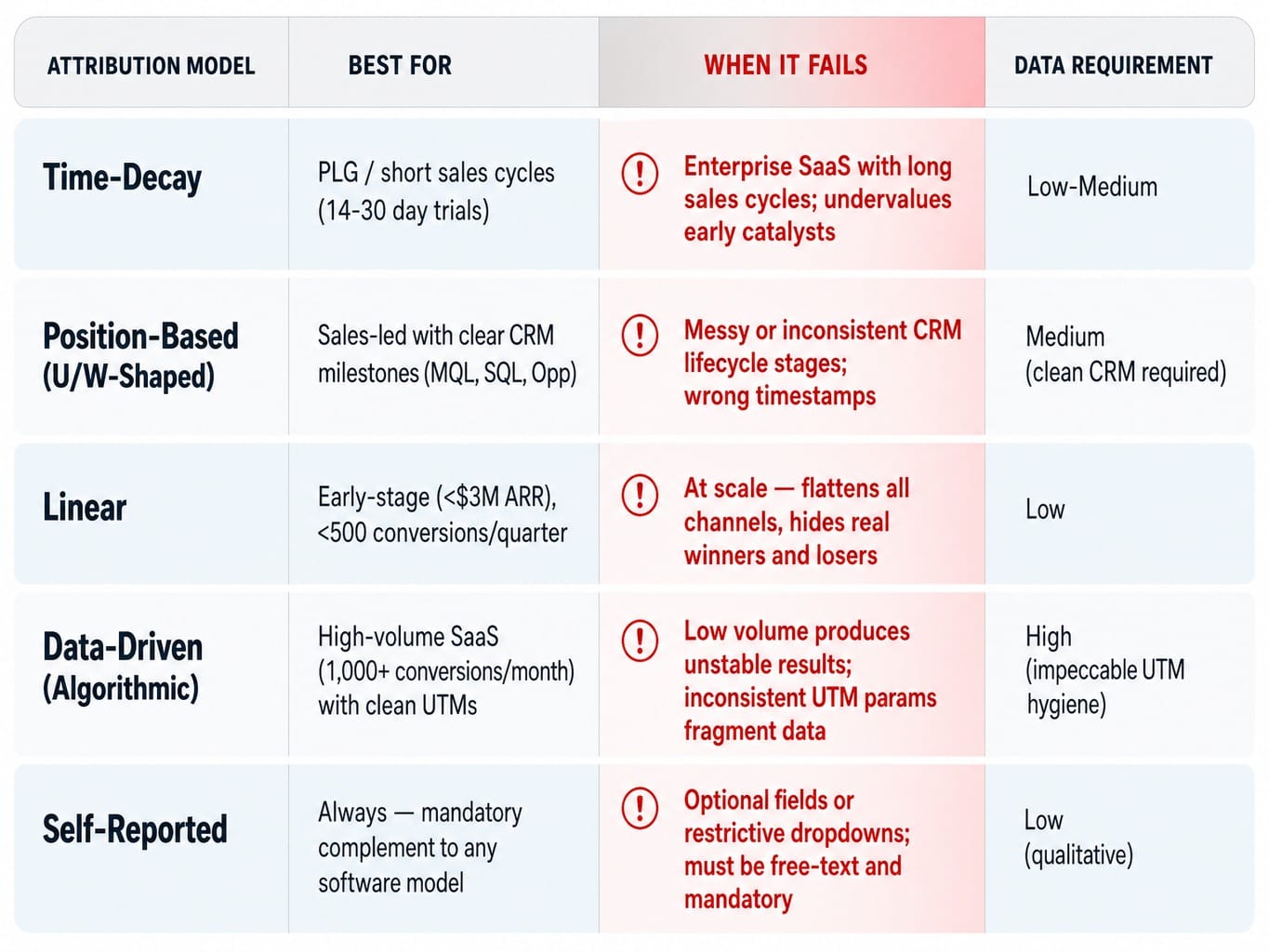
The best attribution model for a SaaS company depends on sales cycle length, deal complexity, and data maturity—not on which model sounds most sophisticated. First-touch and last-touch attribution are legacy concepts; no serious SaaS team should use them as a primary model in 2026. Instead, focus on these five approaches.
Time-Decay Attribution: Best for PLG and Short Sales Cycles
Time-decay attribution assigns increasing credit to touchpoints as they get closer to the conversion event. It's built on the premise that the most recent interactions are the most influential.
- When to use it: This model works well for product-led growth (PLG) SaaS companies with short, transactional sales cycles (e.g., 14- to 30-day trials). When the path from signup to paying customer is quick, recency often does correlate with influence.
- When it fails: It breaks down for enterprise SaaS with long sales cycles. A webinar attended four months ago might have been the true catalyst for a deal, but time-decay will give it almost zero credit. If your sales team consistently says, "The prospect mentioned a case study they read months ago," but that content gets minimal attribution, your model is misattributing value.
Position-Based (U-Shaped/W-Shaped): Best for Sales-Led with Clear Milestones
Position-based models give weighted credit to key moments in the funnel. U-shaped gives 40% to the first touch, 40% to the lead creation touch, and 20% to the touches in between. W-shaped adds a third milestone, typically opportunity creation, splitting credit between first touch, lead creation, and opp creation.
- When to use it: This is ideal for sales-led SaaS companies with well-defined lifecycle stages in a CRM like HubSpot or Salesforce. If you can cleanly and consistently identify the MQL and SQL moments, this model provides a clear view of what creates and accelerates pipeline.
- When it fails: This model is garbage-in, garbage-out. It fails when your CRM lifecycle stages are messy or inconsistently applied by your sales team. If a rep manually updates a lead stage weeks after the fact, the timestamp is wrong, and the model assigns 40% of the credit to the wrong touchpoint. Clean CRM data hygiene is a non-negotiable prerequisite.
Linear Attribution: Best for Early-Stage Teams with Limited Data
A linear attribution model distributes credit equally across every single touchpoint in the customer journey.
- When to use it: It's a reasonable starting point for early-stage SaaS companies (sub-$3M ARR) with low conversion volume (fewer than 500 conversions per quarter). When you don't have enough data for a statistical model, linear provides a simple, understandable baseline without making strong assumptions.
- When it fails: At scale, linear attribution is the equivalent of saying "everything matters," which means nothing gets prioritized. It flattens the contribution of every channel, masking the real winners and losers. If your attribution report shows all your major channels contributing within 5% of each other, your linear model is likely hiding the truth.
Data-Driven (Algorithmic) Attribution: Best for High-Volume SaaS with Clean Data
Data-driven attribution uses machine learning to analyze all converting and non-converting paths to assign fractional credit based on statistical impact. Google Analytics 4's native model is the most accessible version of this approach.
- When to use it: This is the gold standard for SaaS companies with high conversion volume (1,000+ conversions per month) and impeccable UTM hygiene. With enough clean data, it can uncover non-obvious patterns and provide the most accurate fractional credit allocation.
- When it fails: It produces unstable, fluctuating results with insufficient data. Teams with low volume end up chasing noise as the algorithm struggles for signal. It also fails spectacularly with inconsistent UTM parameters; utm_source=google, utm_source=Google, and utm_source=adwords are treated as three different sources, fatally fragmenting your data.
Self-Reported Attribution: Best for Capturing What Software Misses
Self-reported attribution involves adding a "How did you hear about us?" field to your demo, signup, or contact forms and analyzing the responses as a first-class data source.
- When to use it: Always. It should be used as a mandatory complement to any software-based model. It's the only way to capture dark funnel touchpoints like podcast mentions, word-of-mouth referrals, community recommendations, and private Slack group conversations that no tracking pixel will ever see.
- When it fails: It provides weak signal when the field is optional (resulting in low fill rates) or when it uses a restrictive dropdown menu. A dropdown with "Social Media" is useless. A free-text field that captures "Saw your CEO's post on LinkedIn about attribution" is invaluable.
How to Build a SaaS Marketing Attribution System in 5 Steps
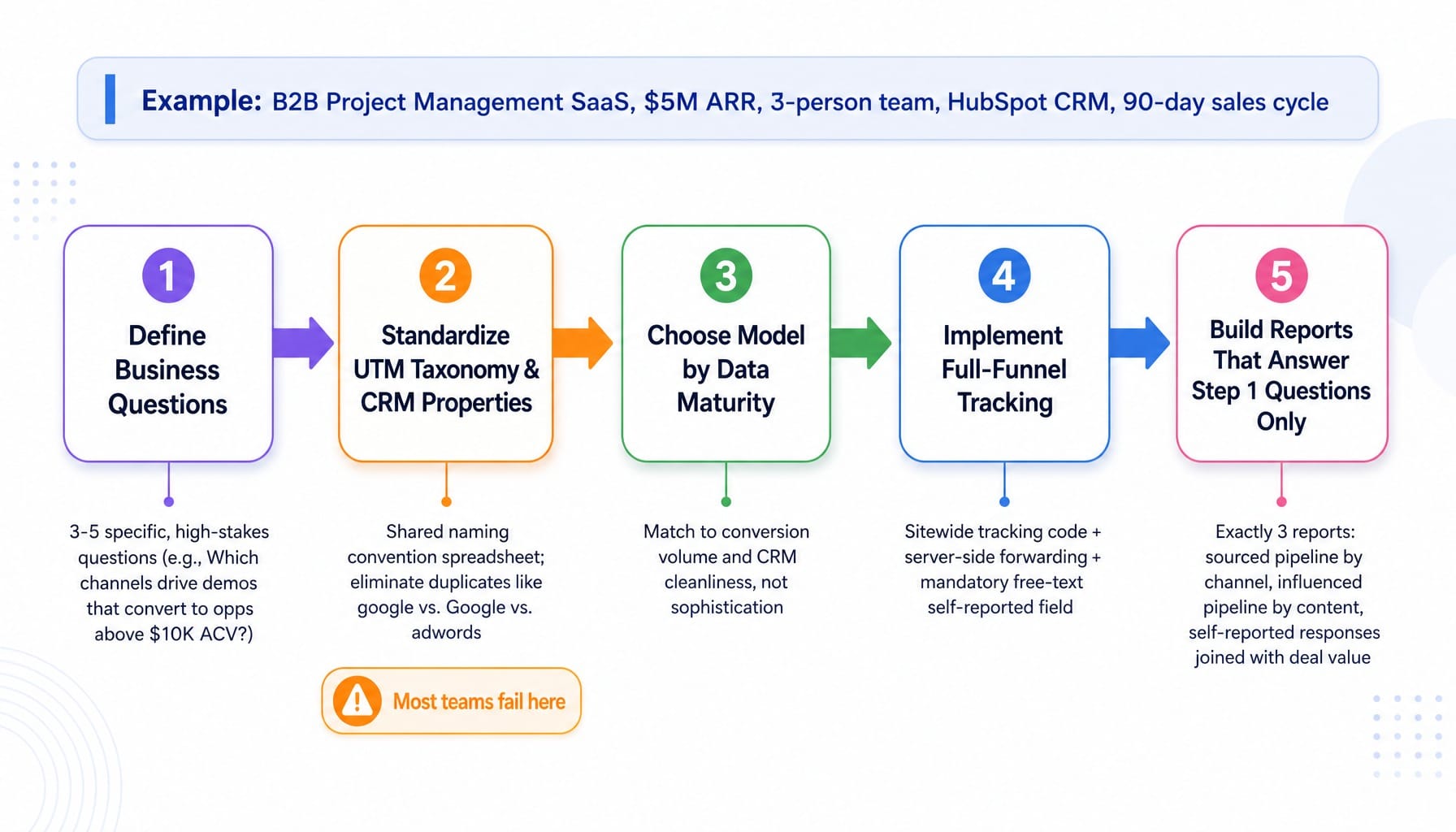
SaaS marketing attribution requires five sequential steps, and most teams fail at Step 2—not because it's hard, but because it's tedious.
Let's walk through the process with a worked example: a B2B project management SaaS at $5M ARR with a 3-person marketing team, using HubSpot CRM and facing a 90-day average sales cycle.
Step 1: Define the Business Questions Attribution Must Answer
Before you touch any tool, write down 3-5 specific, high-stakes questions your attribution system must answer. Avoid vague queries like "Which channels work?" Instead, get specific.
- Action: The team leadership agrees on three core questions:
1. Which marketing channels drive demos that convert to opportunities above a $10K ACV within 90 days?
2. Which specific blog posts and guides are most frequently viewed by prospects who ultimately close?
3. What is the sourced pipeline vs. influenced pipeline split for organic search compared to paid search?
- Outcome: This creates a filter. Now, the team will only build reports that directly answer these questions, avoiding a sprawling dashboard of interesting-but-useless vanity metrics.
Step 2: Standardize Your UTM Taxonomy and CRM Properties
This is where most attribution systems silently break. Inconsistent data tagging makes accurate reporting impossible.
- Action: The team creates a shared spreadsheet that defines their UTM naming convention for utm_source, utm_medium, utm_campaign, utm_content, and utm_term. All links for ads, emails, and social posts are generated from this sheet. They also confirm that HubSpot's tracking code is installed correctly and that form submissions are creating contacts with the right Original Source properties.
- Outcome: Every touchpoint is tagged consistently. When they run a report, "Google Ads" appears as one channel, not fifteen different variations. This disciplined UTM hygiene is the foundation of trustworthy attribution.
Step 3: Choose Your Attribution Model Based on Data Maturity
Now, use the decision framework from the previous section to select a model that fits your current reality, not an aspirational one. This is a common failure point.
- Action: The project management SaaS gets about 150 demo requests per month. This volume is too low for a data-driven model to be stable. However, their sales process has very clean lifecycle stages in HubSpot (MQL > SQL > Opportunity > Closed-Won). They choose a position-based (W-shaped) model, as it aligns perfectly with their CRM structure.
- Outcome: They have a model that reflects their actual business process. They avoid the common mistake of choosing a data-driven model that sounds sophisticated but would produce meaningless results with their data volume. If your attribution credits shift by more than 20% month-over-month with no change in your marketing mix, your model likely lacks sufficient data.
Step 4: Implement Tracking Across the Full Funnel
To connect marketing activity to revenue, you must track the entire journey, from anonymous visitor to paying customer.
- Action: The team ensures their HubSpot tracking code is implemented sitewide. They configure server-side event forwarding to improve data accuracy in a cookieless world. Critically, they add a mandatory, free-text "How did you hear about us?" field to their demo request form. This process of "stitching anonymous to known" is what separates real attribution from simple pageview counting.
- Outcome: They now have a unified view. They can see the anonymous first visit, the form submission that creates a known contact, the subsequent pages visited, and the final closed-won deal—all connected within HubSpot.
Step 5: Build Reports That Answer Your Step 1 Questions (Nothing More)
Resist the temptation to build a comprehensive, all-in-one attribution dashboard. Those dashboards are where data goes to die. They get ignored.
- Action: The team builds exactly three reports in HubSpot that map directly to their questions from Step 1:
1. A revenue attribution report showing sourced pipeline by channel.
2. A content attribution report showing influenced pipeline by blog post URL.
3. A custom report that pulls all responses from the "How did you hear about us?" field, joined with the associated deal value.
- Outcome: They have a small set of high-signal reports that they review weekly. This focused view allows them to make actual budget and marketing channel prioritization decisions, distinguishing between sourced pipeline (the channel that gets credit for creating the opportunity) and influenced pipeline (any channel that touched the deal).
Why Triangulation Beats Picking a Single Attribution Model
Triangulation is the practice of combining multi-touch attribution (MTA), marketing mix modeling (MMM), and incrementality testing to cross-validate marketing performance. It is replacing single-model attribution at the most sophisticated SaaS companies.
No single model is trustworthy on its own.
- Multi-touch attribution (MTA) tells you which touchpoints get credit but is biased by what it can track and blind to what it can't (the dark funnel).
- Marketing mix modeling (MMM) shows aggregate channel impact over time but can't reveal individual customer journeys.
- Incrementality testing (or a holdout test) reveals true causal impact but is slow, expensive, and hard to run for every channel.
Together, they compensate for each other's blind spots. For example, a SaaS company's MTA dashboard might show that LinkedIn ads drive 30% of their pipeline. But after running an incrementality test—pausing ads for a specific geo and comparing it to a control group—they discover that 60% of those "attributed" prospects would have converted anyway through organic channels. The true incremental lift from LinkedIn is only 12%, not 30%. Without triangulation, they would have doubled down on a channel with inflated performance.
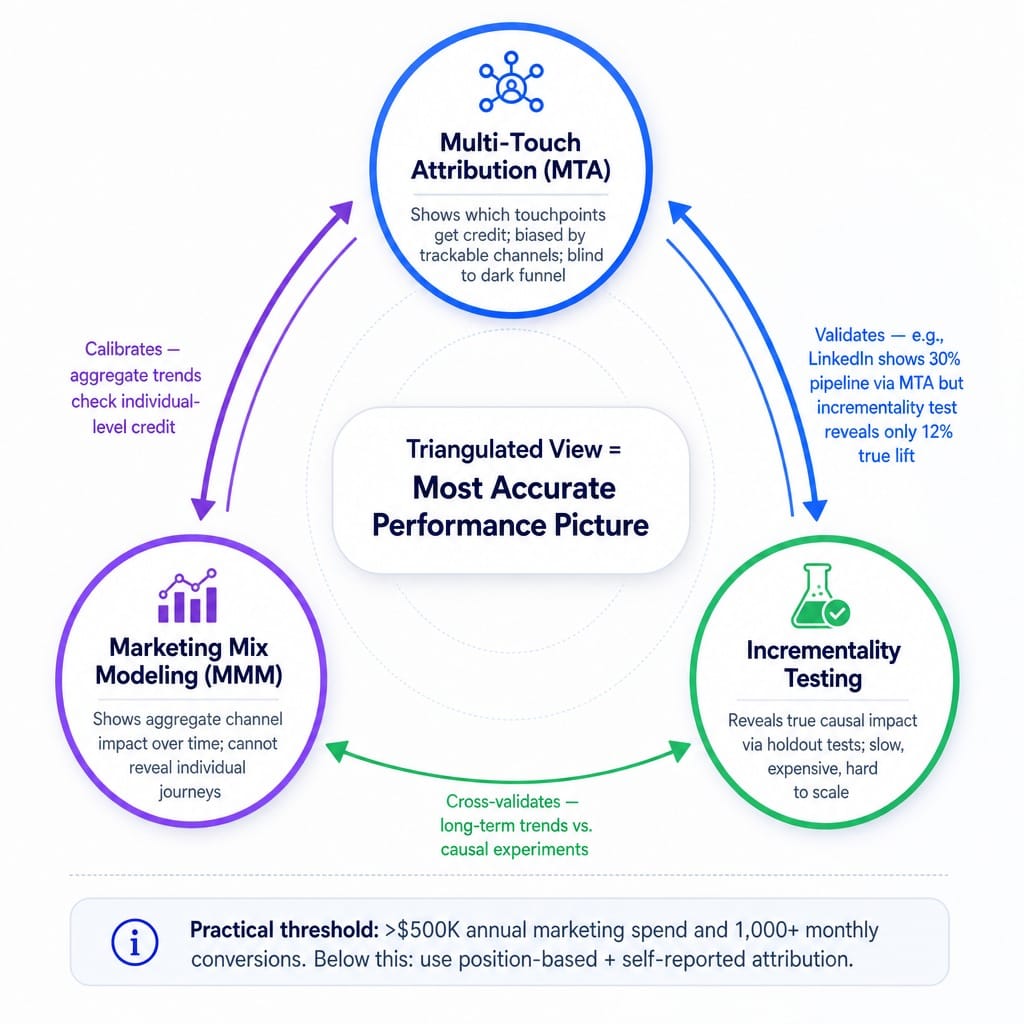
Let's be clear: this level of sophistication requires significant scale. Triangulation is only practical for teams with over $500K in annual marketing spend and 1,000+ monthly conversions. Below that, a combination of a solid position-based model and self-reported attribution is the right, pragmatic choice.
How to Handle Dark Funnel and Unmeasurable Touchpoints
The dark funnel refers to marketing touchpoints that influence buying decisions but cannot be tracked by attribution software—including podcast mentions, Slack community recommendations, word-of-mouth referrals, and LinkedIn DM conversations.
For B2B SaaS, this is not a peripheral issue; it's central. Buyers increasingly conduct their research in private channels before ever visiting a website. By the time a prospect fills out your demo form, they may have already made 70-80% of their decision based on information your attribution software never saw.
You can't measure it perfectly, but you can illuminate it with two practical methods:
- Self-Reported Attribution with Free-Text Fields: As mentioned before, a mandatory "How did you hear about us?" field is your best tool. But it must be a free-text field, not a dropdown. A dropdown forces users into your predefined boxes. A free-text field captures reality. You'll get responses like, "Heard your CEO on the Acquired podcast," or "A colleague shared your integration guide in our marketing Slack." This is pure gold.
- Direct Traffic Cohort Analysis: Not all direct traffic is the same. Segment visitors who arrive directly to your site. A user who lands on your homepage and leaves is different from one who types your URL directly and navigates to your pricing page, then a specific case study. Analyzing the behavior of these direct traffic cohorts can reveal patterns that suggest high prior brand exposure versus genuinely new discovery.
When Attribution Reveals the Problem but Your Team Can't Ship the Fix
The entire process we've outlined leads to one place: a list of things to improve. Your attribution system will show you which landing pages are underperforming, which content assets are influencing the pipeline but have low engagement, and which ad campaigns are driving traffic that doesn't convert.
This is where the real work begins, and where most lean teams get stuck. The insight is clear, but the execution capacity isn't there.
Read more: Landing Page Conversion Rate Optimization: A Revenue-Weighted Playbook
This is precisely the execution gap Spike AI is built to close. Spike AI isn't another attribution tool that gives you more dashboards. It's the execution layer that makes your existing attribution data actionable.
When your data shows a key landing page influences 20% of your pipeline but converts at a dismal 1.8%, that's not just another task for your backlog. Spike AI identifies that as the single highest-impact move you can make, prioritizes it against every other opportunity across your website, SEO, and ads, and then executes the fix. Not next quarter, but next week. It turns your attribution insights into a continuous rhythm of shipped improvements that compound over time.
Conclusion
SaaS marketing attribution isn't a model-selection exercise. It's a system that starts with asking the right business questions, implements tracking with discipline, and triangulates across methods to build a more complete picture of performance.
But even a perfect system only creates value when the team can act on what it reveals. The execution gap—not the model gap—is where most SaaS companies lose pipeline. The data points to the problem, but a lack of bandwidth prevents the fix from ever shipping.
The SaaS teams that win in 2026 won't be the ones with the most sophisticated attribution dashboards. They will be the ones who build the tightest loop between insight and action—the teams who ship the fastest in response to what their data tells them.
Frequently Asked Questions
Why does my attribution data not match between my CRM and my analytics platform?
CRM attribution (e.g., HubSpot) tracks at the contact/account level using form submissions and lifecycle changes, while analytics platforms (e.g., GA4) track at the session/user level. They use different identity models, attribution windows, and definitions of a "conversion." They will never match exactly; use CRM data for pipeline decisions and analytics data for traffic optimization.
How does account-based attribution differ from lead-based attribution in SaaS?
Lead-based attribution credits the individual who converted. Account-based attribution aggregates touchpoints from every contact at the same company into a single journey, which is critical for enterprise SaaS where 6-10 stakeholders influence a deal. Tools like Dreamdata and HockeyStack are built for this; native CRM tools often require workarounds for a true account view.
How do you attribute revenue to content marketing in a SaaS company?
Use influenced pipeline reporting. Tag every blog post or guide a prospect visited before converting, then calculate the total pipeline value of deals where that content appeared in the journey. Don't rely on sourced pipeline for content—it rarely creates the first touch but is a powerful force in the middle of the funnel.
How do you track marketing attribution without third-party cookies in 2026?
Shift to server-side tracking, first-party data collection (stitching identity via email), and self-reported attribution. GA4's Consent Mode and enhanced conversions also help maintain measurement. For B2B SaaS, CRM-based attribution is inherently more resilient as it tracks form submissions and lifecycle changes, not just browser sessions.
What metrics should a SaaS CMO report using attribution data?
Focus on three metrics: (1) Sourced Pipeline by Channel (opportunity creation), (2) Influenced Pipeline by Channel (any touchpoint), and (3) Blended CAC by Channel (total spend divided by attributed customers). Avoid reporting MQL volume by source without connecting it to pipeline value, as it incentivizes lead quantity over quality.
How do you attribute pipeline to brand marketing and awareness campaigns?
Brand marketing is the hardest to attribute. Use three methods together: (1) self-reported attribution to capture responses like "I heard you on a podcast," (2) monitor branded search volume as a proxy for awareness lift, and (3) run geo-based holdout tests where you pause brand spend in one region and measure the pipeline impact versus a control region.