SaaS SEO Checklist: 25 Items Sequenced by Revenue Impact (2026)

TLDR
- Stop using flat checklists. Sequence SEO tasks by growth stage (Pre-traction, Growth, Scale) and map every action to a specific conversion event like a trial or demo request.
- Prioritize building bottom-of-funnel (BOFU) pages like comparison ([Competitor] vs. [You]) and alternative ([Competitor] alternatives) pages before writing a single blog post. They convert at 5-15x the rate of top-of-funnel content.
- Shift keyword research away from search volume. Prioritize keywords based on ICP-alignment and conversion proximity, even if the volume is lower. A query like "project management software for remote teams" is more valuable than "project management tips."
- Focus on SaaS-specific technical SEO: JavaScript rendering issues, index bloat from faceted navigation, crawl budget waste on authenticated app pages, and implementing SoftwareApplication schema.
- Optimize for AI Overviews by structuring content in extractable, answer-first passages. If your CTR drops while impressions are stable for a key query, an AI Overview is likely absorbing the clicks.
We've all seen it. A three-person SaaS marketing team diligently completes a 40-item SEO checklist over eight weeks. They fix canonical tags, publish 12 blog posts, submit sitemaps, and add FAQ schema. The result? A few more vanity keywords on page three and zero change in trial signups.
The problem wasn't a lack of effort. It was a failure of sequence.
They spent six of those eight weeks on tasks that wouldn't produce pipeline impact for another six months, while ignoring three high-leverage moves—building comparison pages, optimizing the pricing page, and strengthening internal links to the demo CTA—that could have generated results within the quarter.
A SaaS SEO checklist is only useful if it tells you what to do first, what to do later, and what to skip entirely at your current stage. Most are just flat lists organized by category, creating a false sense of progress while your team burns bandwidth on low-impact work.
This checklist is different. It's sequenced by compounding revenue impact. Every item is mapped to a specific SaaS conversion event—a trial, a demo, a qualified lead—so you ship the work that moves the pipeline, not just the work that feels productive.
Before You Touch the Checklist: Know Your Stage and Your Conversion Math
A SaaS company at $500K ARR and one at $10M ARR should not be working from the same checklist priority order. The items might overlap, but the sequence and the definition of a "win" are completely different.
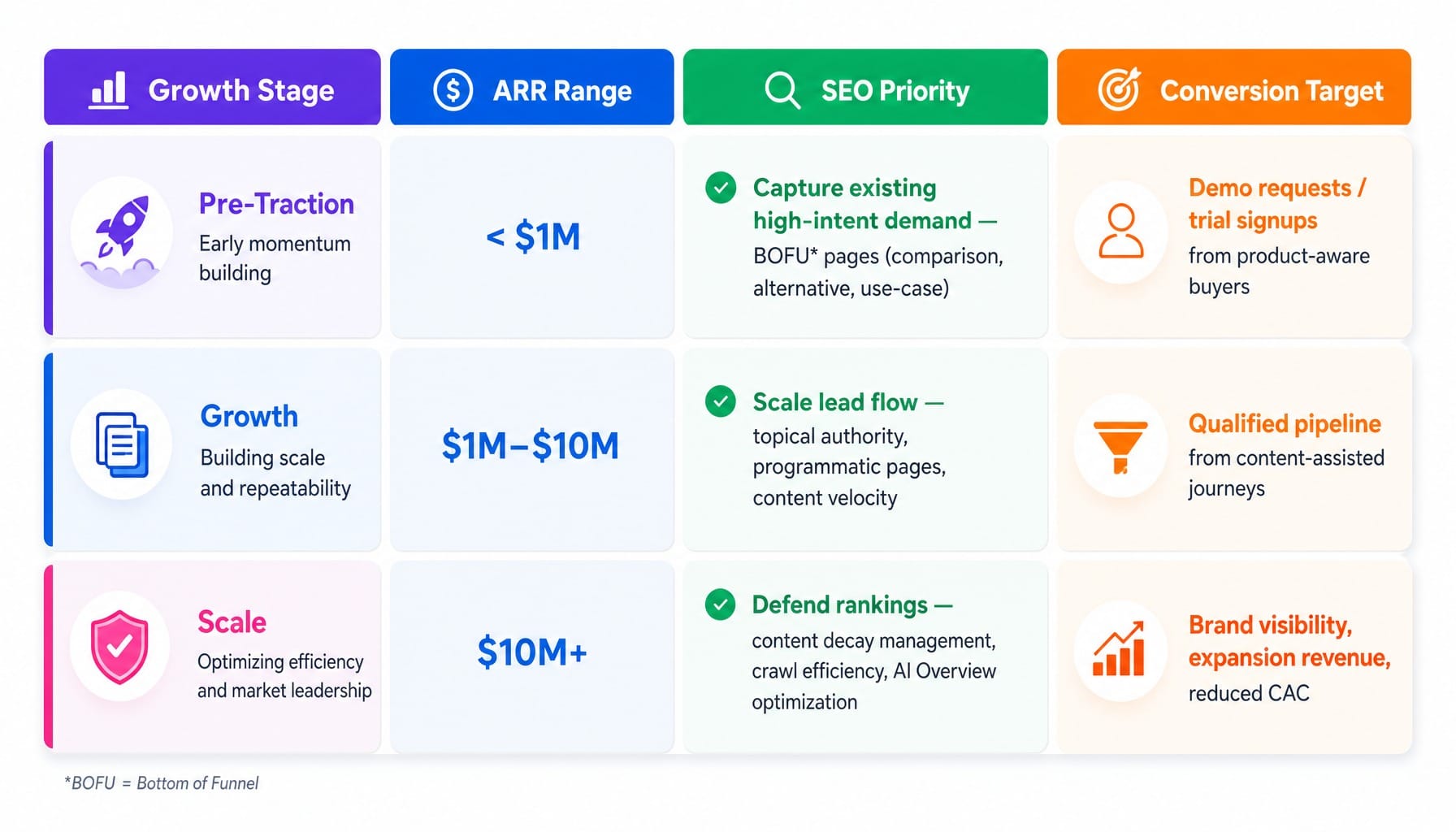
The first step is to identify your stage and its corresponding conversion target.
- Pre-Traction (< $1M ARR): Your primary goal is capturing existing, high-intent demand. The conversion target is demo requests or trial signups from people who are already product-aware. Your SEO priority is building BOFU content that intercepts buyers at the moment of decision: comparison pages, alternative pages, and specific use-case landing pages. Spending four weeks building five [Competitor] vs. [Your Product] pages will generate more pipeline this quarter than spending that same time fixing your Core Web Vitals scores.
- Growth ($1M–$10M ARR): You have traction and need to scale lead flow. The priority shifts from intercepting demand to creating it by building topical authority. Your conversion target is a qualified pipeline from content-assisted journeys. This is where programmatic pages, middle-of-funnel content clusters, and building a real content velocity become critical.
- Scale ($10M+ ARR): You are a known entity in your category. The priority is defending your rankings, managing content decay on a large site, and optimizing for zero-click cannibalization from AI Overviews. Your conversion target expands to include brand visibility, influencing expansion revenue, and reducing customer acquisition cost by dominating informational queries. At this stage, fixing a sitewide technical issue that improves crawl efficiency might be the highest-impact move.
Before starting any item on this checklist, ask yourself two questions: Does this map directly to my current conversion target? And will the effort compound over time, or is it a one-time fix?
Read more: How to Prioritize Marketing Channels With a Limited Budget And Resources (Framework for Lean Teams)
The Pages Every SaaS Website Needs Before Blogging
Most SaaS SEO checklists start with "conduct keyword research" and then jump to "create blog content." This skips the five highest-converting page types entirely. Before you write a single blog post, your site needs a foundation of pages that capture bottom-of-funnel intent.
These pages convert at 5-15x the rate of top-of-funnel (TOFU) blog posts because the searcher's intent is already commercial. They aren't looking to learn; they're looking to buy.
- Comparison Pages ([Your Product] vs [Competitor]): Targets buyers actively weighing you against a known alternative. This is the highest-intent traffic you can get.
- Alternative Pages ([Competitor] alternatives): Captures dissatisfied users of a market leader who are actively searching for a replacement.
- Use-Case Pages ([use case] software): One dedicated page for each core job-to-be-done your product solves for a specific ICP.
- Integration Pages ([tool] + [your category] integration): One page for each major tool you integrate with, capturing users looking to connect their existing stack.
- Feature Pages ([feature] software): A dedicated, SEO-optimized page for each of your core features.
Consider a project management SaaS that built eight comparison pages targeting queries like "[Asana] alternative" and "[Monday.com] vs. [Our Product]" before publishing any blog content. Within 90 days, those eight pages generated 40% of all organic trial signups.
Now contrast that with a similar SaaS that published 50 blog posts first. They drove 15,000 monthly organic sessions but only 12 trial signups. Why? The blog targeted TOFU informational queries with no clear conversion path. They had traffic, but no pipeline.
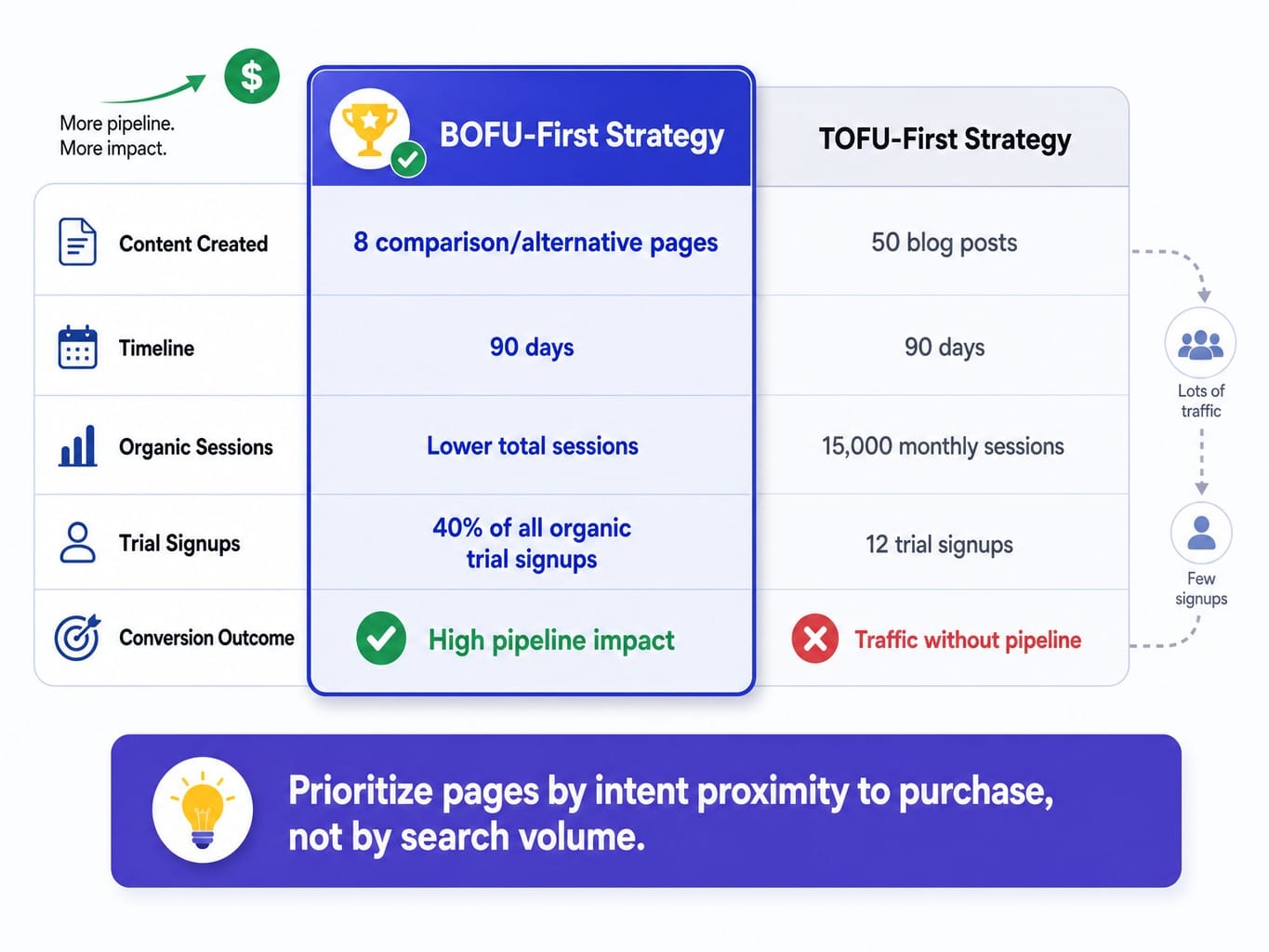
The transferable principle is simple: Prioritize pages by their intent proximity to a purchase decision, not by search volume.
How to Prevent Keyword Cannibalization Across Feature and Comparison Pages
The most common failure mode when building these pages is creating a mess of keyword cannibalization. You have a /features/reporting page, a blog post on "Best Reporting Tools," and a comparison page that heavily features reporting—all competing for the same queries, and all ranking on page two as a result.
The fix is to be ruthlessly intentional. Use a keyword clustering tool to assign one primary query per URL, then use internal linking to establish a clear hierarchy.
A quick diagnostic is to check Google Search Console. If you see two different URLs getting significant impressions for the same high-value query, you have a cannibalization problem.
Use this rule of thumb to assign ownership:
- Feature Pages own queries like [feature] software.
- Comparison Pages own [competitor] vs and [competitor] alternative queries.
- Blog Posts own informational how to [achieve outcome] queries.
ICP-Aligned Keyword Research: Volume Is the Wrong Starting Metric
Every generic SEO checklist tells you to start keyword research with search volume and keyword difficulty. This is how you end up with a content plan optimized for traffic, not pipeline.
For a B2B SaaS company, the correct starting filter is ICP alignment. Does the person searching this query match your buyer profile, and is their intent close enough to a conversion event to justify the content investment?
Consider this comparison:
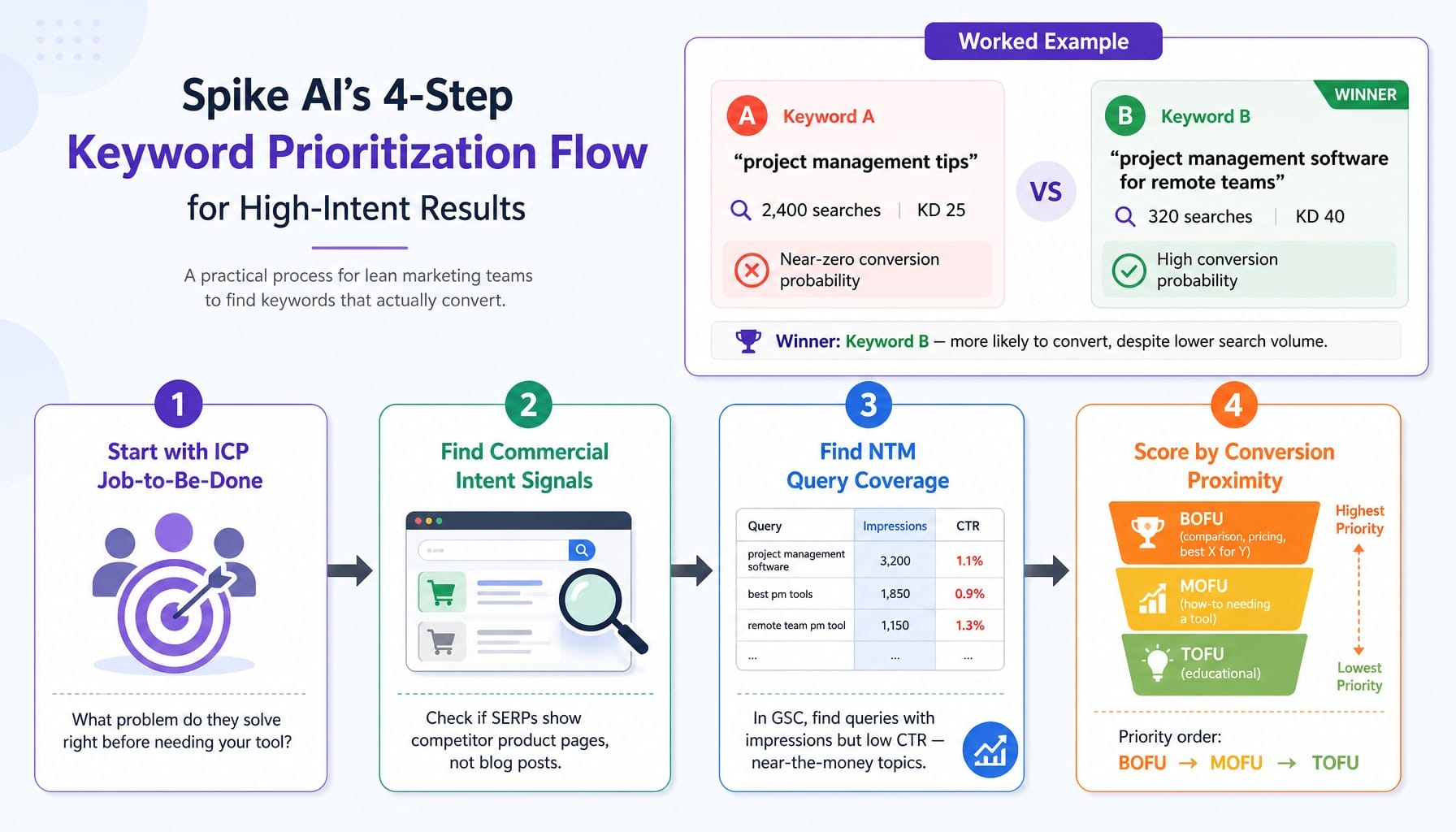
- Keyword A: "project management tips" (2,400 monthly searches, KD 25)
- Keyword B: "project management software for remote teams" (320 monthly searches, KD 40)
Keyword A has 7x the volume, but near-zero conversion probability. The searcher wants advice, not software. Keyword B has a fraction of the volume, but the searcher is actively evaluating tools. A SaaS team with limited bandwidth must build the page for Keyword B first.
Your keyword research process should look like this:
- Start with your ICP's job-to-be-done, not a seed keyword from a tool. What problem are they trying to solve right before they need a tool like yours?
- Find commercial intent signals. Use a tool like Ahrefs to find queries where the SERP is already dominated by competitor product pages, not blog posts. This is Google telling you the intent is commercial.
- Find your NTM query coverage. Look in GSC for queries where you already have impressions but a low CTR. This often points to "near-the-money" topics you're adjacent to but haven't created a dedicated page for.
- Score by conversion proximity. Prioritize keywords in this order: BOFU (comparison, pricing, "best X for Y") → MOFU (how-to guides that require a tool) → TOFU (purely educational). A topical map gap analysis can help visualize which clusters you've neglected.
Read more: SEO Content Prioritization: A Data-Driven Framework for What to Write, Update, or Kill
Technical SEO for SaaS: Only the Items That Actually Differ from Standard Sites
This section intentionally excludes generic technical SEO advice. You already know to use HTTPS, submit a sitemap, and make your site mobile-friendly. Instead, here are the five technical issues specifically common on SaaS websites that most checklists miss.
- JavaScript Rendering Issues: Many SaaS sites are built on modern frameworks like React, Angular, or Vue. This often leads to content that users see but Googlebot can't render. We once found a Next.js site where 40% of the blog content was invisible to Googlebot due to client-side rendering issues. Diagnosis: Use Screaming Frog's JavaScript rendering mode or Google's URL Inspection tool to compare the rendered HTML to the raw page source.
- Index Bloat from Faceted Navigation: SaaS platforms with filterable knowledge bases, directories, or large blogs can generate thousands of useless parameter-based URLs that get indexed. This dilutes your authority and wastes the crawl budget. Diagnosis: Check the Index Coverage report in GSC for unexpected spikes in indexed pages or suspicious URL patterns containing ?filter= or &sort=.
- Crawl Budget Waste on Authenticated Pages: Googlebot shouldn't be wasting time trying to crawl your login page, user dashboards, or internal app URLs. This is surprisingly common. Diagnosis: Conduct a log file analysis to see exactly where Googlebot is spending its time. If you see frequent requests to /app/, /dashboard/, or /login/, you have a leak.
- Schema Markup Gaps: At a minimum, every SaaS site needs SoftwareApplication schema (with pricing, features, and OS data) on product pages and FAQPage schema on support pages. Most have neither. This is a missed opportunity to feed structured information directly to search engines.
- Core Web Vitals Degradation from Third-Party Scripts: Your marketing site is likely loading 15-25 third-party scripts for analytics, chat, A/B testing, and heatmaps. These scripts are notorious for destroying LCP and INP scores. Diagnosis: Use Sitebulb or PageSpeed Insights to audit script impact.
Content That Compounds vs. Content That Decays: How to Sequence Your Publishing Calendar
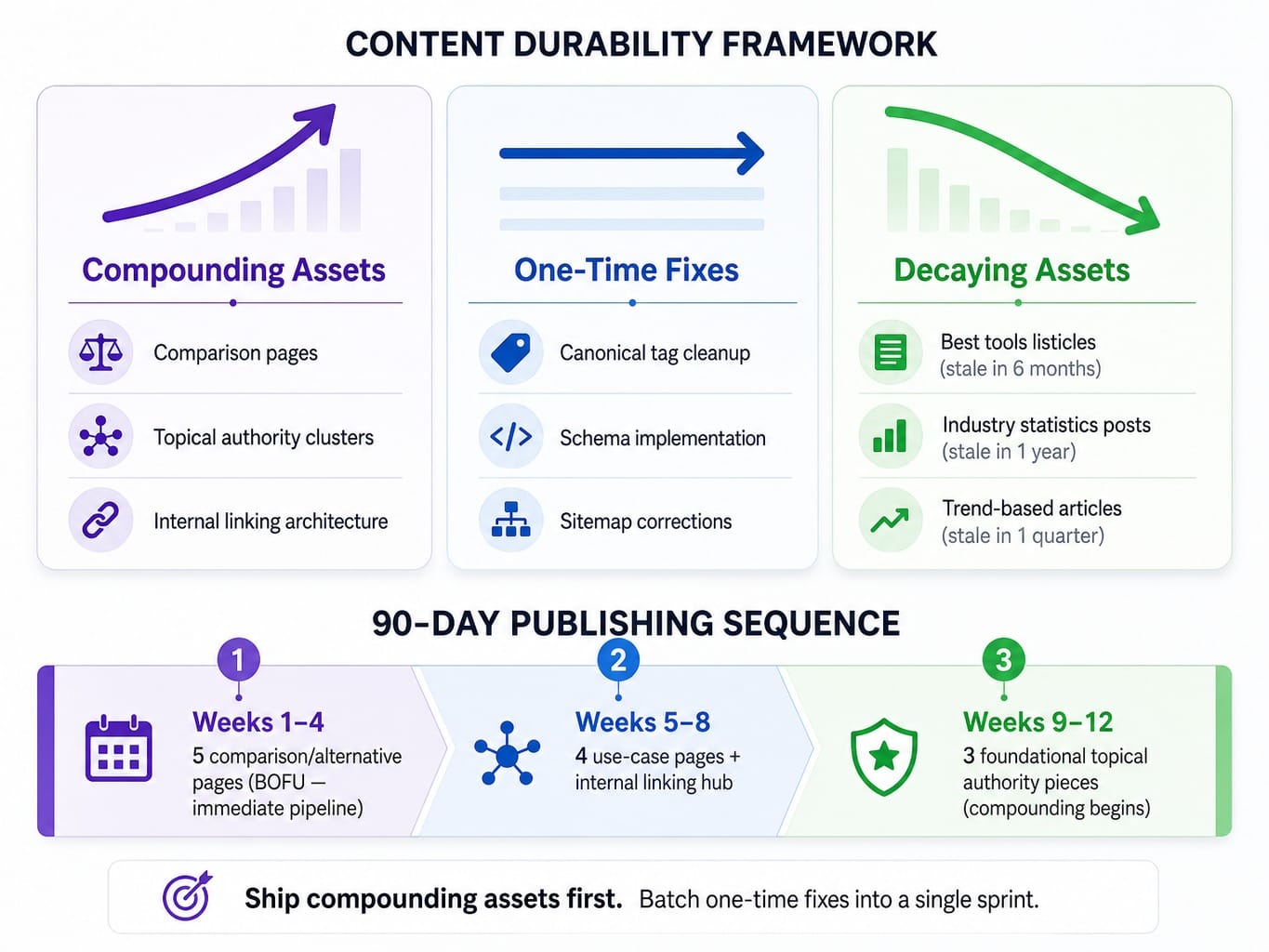
Not all SEO actions are equal in durability. Some compound, generating increasing returns over time. Others are one-time fixes. And some content actively decays, losing relevance and rankings unless maintained. A smart SaaS team sequences their work accordingly.
- COMPOUNDING Assets: These gain value over time.
Comparison Pages: Accumulate branded search equity and links.
Topical Authority Clusters: Each new page strengthens the entire cluster.
Internal Linking Architecture: Each new link intelligently redistributes authority.
- ONE-TIME FIXES: These produce a step-change but no ongoing growth.
Canonical tag cleanup, schema implementation, sitemap corrections.
- DECAYING Assets: These lose value without active maintenance.
"Best tools" listicles (outdated in 6 months).
Industry statistics posts (stale in a year).
Trend-based articles (irrelevant in a quarter).
The sequencing rule is clear: Ship compounding assets first, batch one-time fixes into a single sprint, and only create decaying content if you commit to a quarterly content pruning cadence.
A 90-day publishing sequence for a growth-stage SaaS should look like this:
- Weeks 1-4: Build 5 high-intent comparison/alternative pages.
- Weeks 5-8: Publish 4 use-case pages and build a strong internal linking hub between them.
- Weeks 9-12: Create 3 foundational topical authority pieces in your core category.
This sequence works because the BOFU pages generate pipeline immediately while the topical authority pieces begin their compounding journey in the background. For maintenance, set a quarterly calendar reminder to review GSC for any page with a >20% impression decline over 90 days. Update, consolidate, or prune it.
Optimizing for AI Overviews and ChatGPT Search: The 2026 Addition to Every SaaS SEO Checklist
In 2026, a significant portion of SaaS-related queries trigger Google AI Overviews or are answered directly within ChatGPT Search and Perplexity. The risk isn't just losing clicks; it's being invisible in the answer entirely while a competitor gets cited.
Your checklist needs an AEO (Answer Engine Optimization) layer. While Google's guidance notes that AEO is still SEO, the emphasis on extractability is new.
- Write in Atomic Passages: Structure every H2 section so the first 1-2 sentences directly answer the heading as a standalone statement. AI systems extract at the passage level, not the page level.
- Add Definition-Style Openings: Start key concept explanations with a direct definition, like "A SaaS SEO checklist is a prioritized sequence...". This is prime real estate for AI extraction.
- Use Lists and Tables: For any comparative or sequential information, use structured HTML lists (<ul>, <ol>) and tables (<table>). Extraction engines vastly prefer this over prose.
- Implement FAQPage Schema: For any page targeting question-based intent, use this schema to explicitly signal the Q&A format.
- Build Entity Authority: Use consistent Organization schema with sameAs links pointing to your company's LinkedIn, Crunchbase, and G2 profiles. This helps AI systems confidently identify who you are.
- Monitor for SGE Displacement: In GSC, track queries where your impressions remain stable but CTR plummets. This is a classic sign that an AI Overview is now sitting above you and absorbing clicks.
We saw a SaaS knowledge base page that buried its answer in the third paragraph of a 500-word section. By restructuring it to put a direct answer in the first sentence, adding a supporting table, and implementing FAQ schema, it was cited in Google's AI Overview within six weeks.
Link Building for SaaS in 2026: What Actually Moves Domain Authority vs. What Wastes Outreach Hours
Link building matters. But most checklists list tactics like guest posting or HARO without telling you which ones are worth your time at your current domain authority (DR).
A better approach is DR gating. If your DR is below 30, a single guest post on a DR 60+ site is the highest-leverage activity. If your DR is already 50, that same guest post has diminishing returns, and your time is better spent creating a linkable asset.
Here is a prioritized SaaS link building checklist:
- SaaS Review Platforms: G2, Capterra, and TrustRadius are free, high-authority links that also drive high-intent referral traffic. Do these first, regardless of stage.
- Integration Partner Pages: If you integrate with HubSpot, Slack, or Salesforce, get listed in their app directories. These are some of the most contextually relevant, high-DR links you can get.
- Guest Posting with DR Gating: Use Ahrefs to filter prospects by DR 40+, 5K+ monthly traffic, and strict topical relevance. Don't waste time on generic "write for us" blogs.
- Original Research & Data: Anonymize and publish proprietary benchmarks from your product data. This is how you attract passive, high-quality editorial links.
- Podcast Appearances: Getting your founder on relevant SaaS podcasts is a low-effort way to get high-authority links to your homepage from episode show notes.
We saw a team spend three months on mass outreach, placing 15 guest posts on irrelevant DR 15-25 sites. The result? Zero ranking movement. Three links from high-DR integration directories would have had a greater impact. Use a tool like Clay to personalize outreach at scale and focus only on high-value prospects.
Measuring SEO ROI for SaaS: Pipeline Attribution, Not Just Traffic Dashboards
Most SaaS teams measure SEO success with organic traffic and keyword rankings. These are activity metrics, not outcome metrics. A checklist that doesn't map to a pipeline is incomplete.
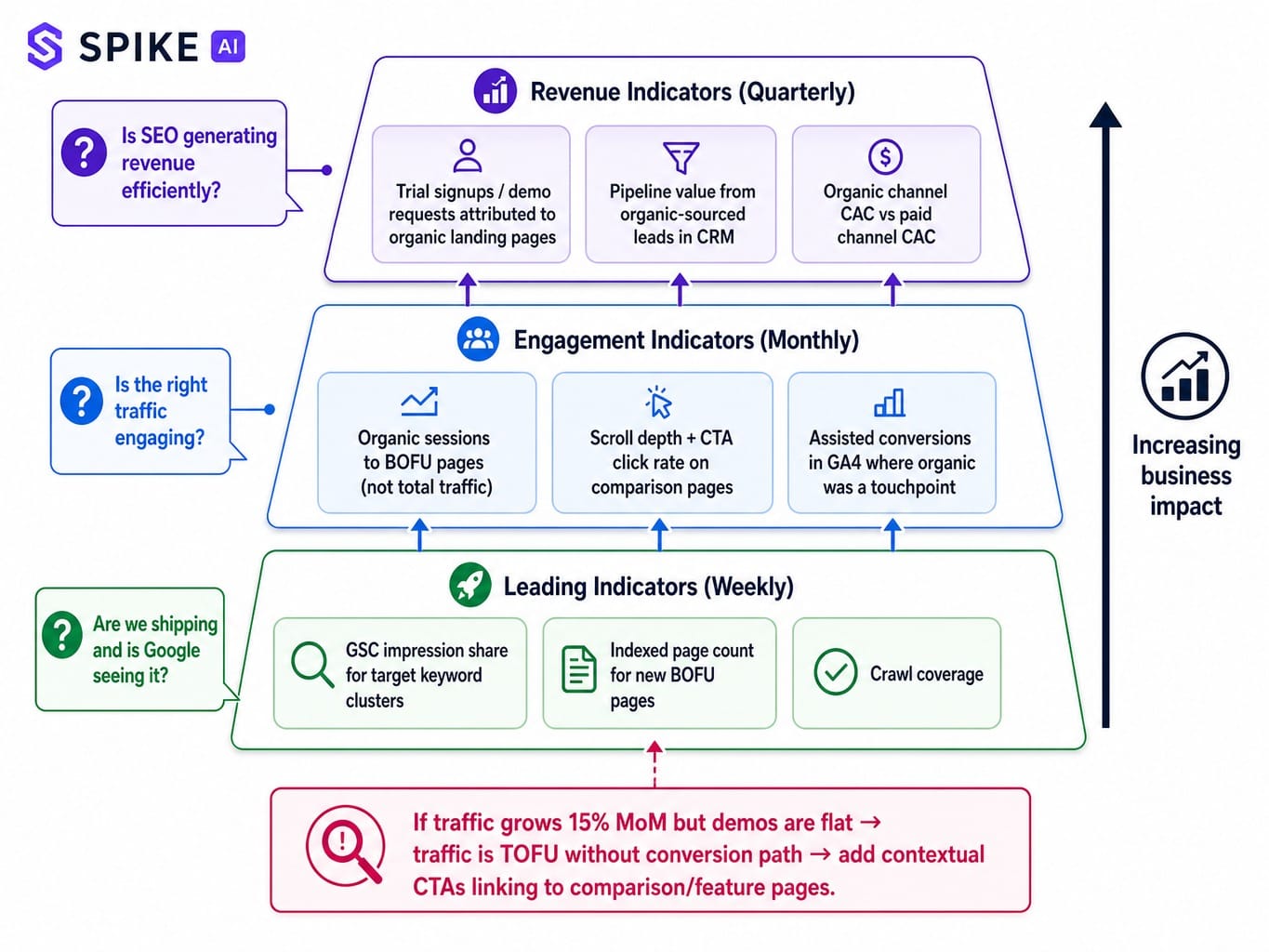
Use this three-layer measurement framework:
- Leading Indicators (Weekly): GSC impression share for target keyword clusters, indexed page count for new BOFU pages, crawl coverage. Are we shipping and is Google seeing it?
- Engagement Indicators (Monthly): Organic sessions to BOFU pages, not total traffic. Scroll depth and CTA click rate on comparison pages. Assisted conversions in GA4 where organic was a touchpoint. Is the right traffic engaging?
- Revenue Indicators (Quarterly): Trial signups or demo requests attributed to organic landing pages. Pipeline value from organic-sourced leads in your CRM (like HubSpot). CAC for the organic channel versus paid channels. Is SEO generating revenue efficiently?
Imagine your organic traffic is growing 15% month-over-month, but demo requests are flat. This is a classic disconnect. The diagnosis is likely that traffic growth is coming from TOFU blog posts without a conversion path. The fix is to add contextual CTAs on those posts that link to relevant comparison or feature pages, then track the assisted conversion. Applying data-driven CRO strategies to your organic landing pages can help close this gap between traffic and revenue.
Your checklist must include a monthly review where you ask: is our work moving pipeline metrics, or just traffic metrics? If it's the latter, your priorities are wrong.
When the Checklist Is Right but the Bandwidth Isn't: How Spike AI Closes the Execution Gap
You now have a sequenced, revenue-focused checklist. But a gap remains. The core problem for most lean SaaS marketing teams isn't knowing what to do; it's the latency between identifying the highest-impact move and actually shipping it.
Your backlog of SEO improvements—comparison pages to build, internal links to restructure, content to prune, schema to implement—grows every week. The coordination cost of prioritizing, briefing, approving, and deploying each change through engineering tickets or across fragmented tools eats weeks.
Spike AI is built to resolve this specific tension. It's a marketing execution engine that closes the gap between insight and implementation.
Every week, Spike AI identifies the single highest-impact SEO or CRO move across your website, then executes it. Not a report. Not a recommendation. A deployed change. This weekly cadence means checklist items don't sit in a backlog; they compound. Each release feeds the next prioritization cycle: measure, re-prioritize, ship again. It's the difference between having a checklist and having a shipping rhythm.
See how Spike AI turns your SEO backlog into weekly shipped improvements
Conclusion
A SaaS SEO checklist organized by category is a reference document. A checklist sequenced by compounding revenue impact is a growth system. The difference is whether your team ships the highest-leverage item first or simply checks boxes in whatever order feels comfortable.
The teams that win organic search in 2026 won't be the ones with the longest checklists. They'll be the ones with the tightest shipping cadence, executing fewer items but in the right order, every single week. They understand that sequence is strategy.
Frequently Asked Questions
What is the difference between SaaS SEO and traditional B2B SEO?
SaaS SEO prioritizes product-led page types like comparison, feature, and integration pages that traditional B2B SEO rarely uses. SaaS also has unique conversion events—trial signups and demo requests—that require different keyword intent mapping than lead-gen forms. The technical profile also differs, with SaaS sites more likely to be JavaScript-heavy SPAs that can leak crawl budget.
When should a SaaS startup hire an SEO specialist vs. use an agency?
Hire an in-house specialist when you have enough organic traffic (10K+ monthly sessions) to justify a full-time role and SEO is a primary acquisition channel. Use an agency or an AI-driven platform when you're pre-traction and need execution without the overhead of a full hire. The priority at that stage is shipping BOFU pages fast, not building a team.
What schema types should SaaS websites implement first?
Start with SoftwareApplication schema on your product and pricing pages, including pricing and feature properties. Add FAQPage schema to any page with a Q&A section. Implement Organization schema with sameAs links to your LinkedIn, G2, and Crunchbase profiles to strengthen entity recognition. These are higher priority than standard Article schema.
Should SaaS companies invest in programmatic SEO pages?
Only if each programmatic page delivers unique, contextually relevant value. Good examples for SaaS include use-case pages ([Your Product] for [Industry]) or integration pages. Bad examples are hundreds of near-identical pages with only a city name swapped. Google's helpful content system actively penalizes the latter as scaled content abuse.
How often should a SaaS company audit its SEO?
Run a full technical audit quarterly with a tool like Screaming Frog. Review content performance monthly in GSC, flagging any page with a >20% impression decline for an update or consolidation. Check for keyword cannibalization whenever you publish a new page. A lightweight monthly review catches decay before it compounds.