
SEO Content Prioritization: A Data-Driven Framework for What to Write, Update, or Kill

TLDR
- Stop starting with search volume and keyword difficulty. These metrics distort priority by ignoring business value and realistic ranking potential.
- Use a five-dimension scoring model: impression-to-click gap, content decay velocity, competitive feasibility, conversion proximity, and effort-to-impact ratio.
- Prioritize updating content over creating new posts when a page already ranks in positions 4-15, has existing authority signals, and the core search intent hasn't shifted.
- Calculate the opportunity cost of every content decision. Choosing a low-impact new article over a high-impact refresh can cost tens of thousands in pipeline value.
- Re-prioritize your content roadmap every 4-6 weeks, not quarterly. This creates a feedback loop where each release makes the next cycle's decisions more accurate.
It's a familiar scene. The B2B SaaS marketing team sits down for quarterly content planning. On the screen is a spreadsheet with 87 ideas: some from keyword research, some from sales requests, some from an audit that flagged 30 decaying posts. Two hours of debate later, the team leaves with a plan born from gut feel, recency bias, and whoever argued loudest.
Ninety days later, the results are in. Three of the eight pieces they shipped moved the needle. The five that didn't consumed 60% of the budget.
The problem isn't a lack of ideas or even a lack of frameworks. It's that most SEO content prioritization models are built on incomplete signals. Search volume and keyword difficulty are table stakes, not decision criteria.
Real impact comes from a scoring model built on the signals most teams overlook: impression-to-click gaps, content decay velocity, revenue proximity, and opportunity cost. This is the system that turns prioritization from a debate into a calculation.
Why Search Volume and Keyword Difficulty Are the Wrong Starting Point
SEO content prioritization is the process of scoring and ranking content opportunities—both new topics and existing pages—by their projected impact on organic traffic, conversions, and revenue, then allocating limited resources to the highest-scoring items first.
Most teams start this process by sorting a keyword list by search volume and filtering by keyword difficulty. This feels data-driven, but it produces a distorted priority queue that systematically favors vanity traffic over revenue.
Consider a SaaS company targeting two keywords:
- 'project management software': 22,000 monthly searches, 89 Keyword Difficulty (KD).
- 'project management for remote engineering teams': 480 monthly searches, 23 KD.
The first keyword looks like the prize. But it attracts generic, tire-kicking traffic with near-zero conversion intent. The second keyword, while having 97% less volume, matches the company's ideal customer profile precisely and converts at four times the rate. Volume and difficulty alone cannot distinguish between these two opportunities. Tools like Ahrefs and Semrush surface these metrics prominently, but the signals that actually predict content ROI are buried deeper.
A robust prioritization model creates a traffic-weighted priority queue that incorporates business value scoring, conversion proximity, and realistic ranking potential. It doesn't just ask "How many people search for this?" It asks "How many of the right people search for this, and how likely are we to win them?"
A Scoring Model That Uses the Signals Most Teams Ignore
A strong SEO content prioritization framework scores each opportunity across five dimensions: impression-to-click gap, content decay velocity, competitive positioning feasibility, conversion proximity, and effort-to-impact ratio.
Here's how to structure the model:
- Impression-to-Click Gap: This identifies pages Google already sees as relevant but users aren't clicking. It's the highest-ROI signal for content refreshes. (More on this below.)
- Content Decay Velocity: This predicts which pages are about to lose significant traffic, allowing you to intervene before the damage is done. (More on this below.)
- Competitive Positioning Feasibility: This grounds your ambition in reality. If your site's Domain Rating (DR) is 45 and the target keyword's difficulty is 72, the math doesn't work, regardless of how good the content is. The DR-to-KD gap must be manageable.
- Conversion Proximity: This scores how close a topic is to a purchase decision. A page on 'how to calculate customer acquisition cost' is much closer to a SaaS purchase than one on 'what is marketing.' Score this on a 1-5 scale tied to your funnel stages. With average B2B website conversion rates hovering around 2-3%, this weighting is essential.
- Effort-to-Impact Ratio: This adapts the classic ICE scoring model. Impact = Projected Traffic × Conversion Proximity Score. Confidence = Data quality behind the projection. Ease = Estimated production hours. Many teams using Google Sheets ICE scoring templates skip the "Confidence" variable, which is precisely what prevents wasted effort on long-shot projects.
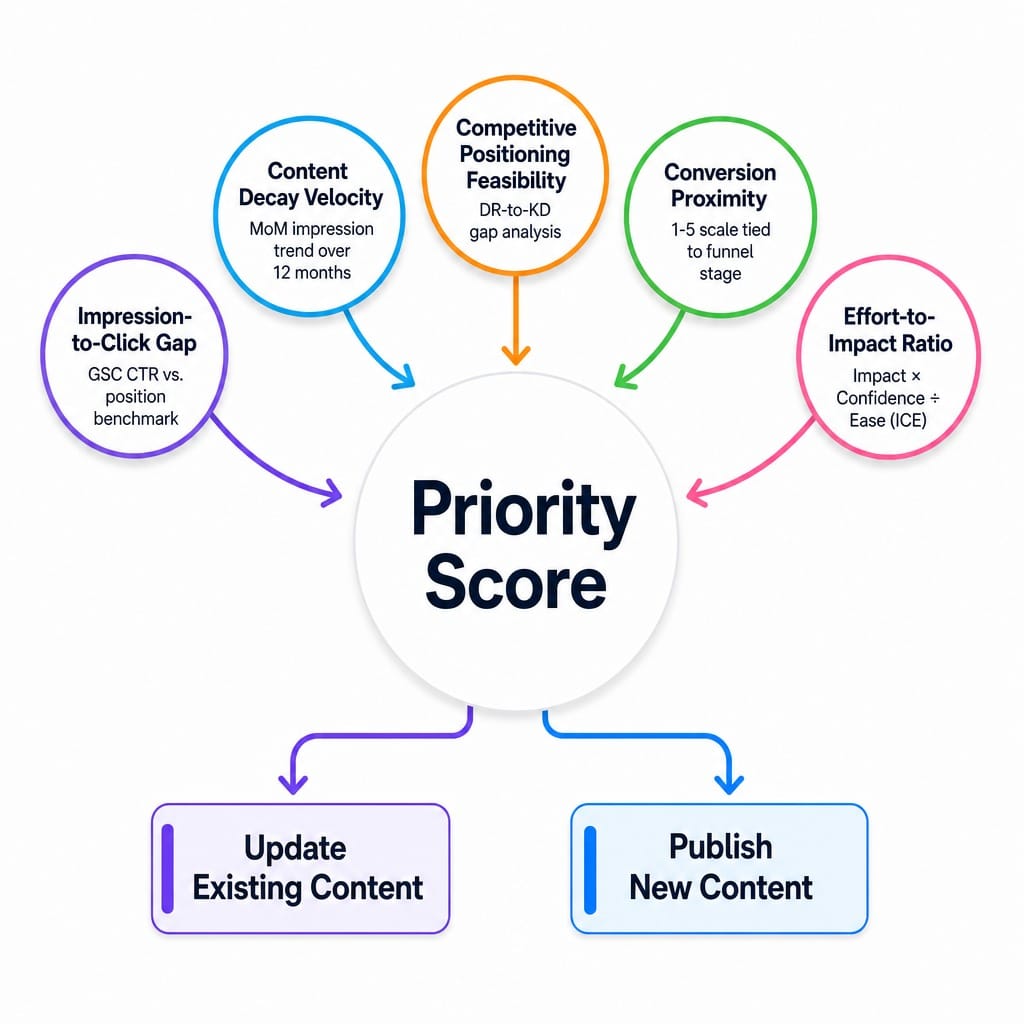
Imagine scoring two opportunities: a new post on a high-volume keyword and a refresh of a decaying page. The new post might have higher projected traffic, but when you factor in a lower conversion proximity score and a wider DR-to-KD gap, the "less exciting" refresh often emerges as the clear winner for immediate business impact.
Read more: Data-Driven CRO Strategies: Identifying Marketing Opportunities for True Conversion Optimization
Using Impression-to-Click Gaps as Your Primary Prioritization Signal
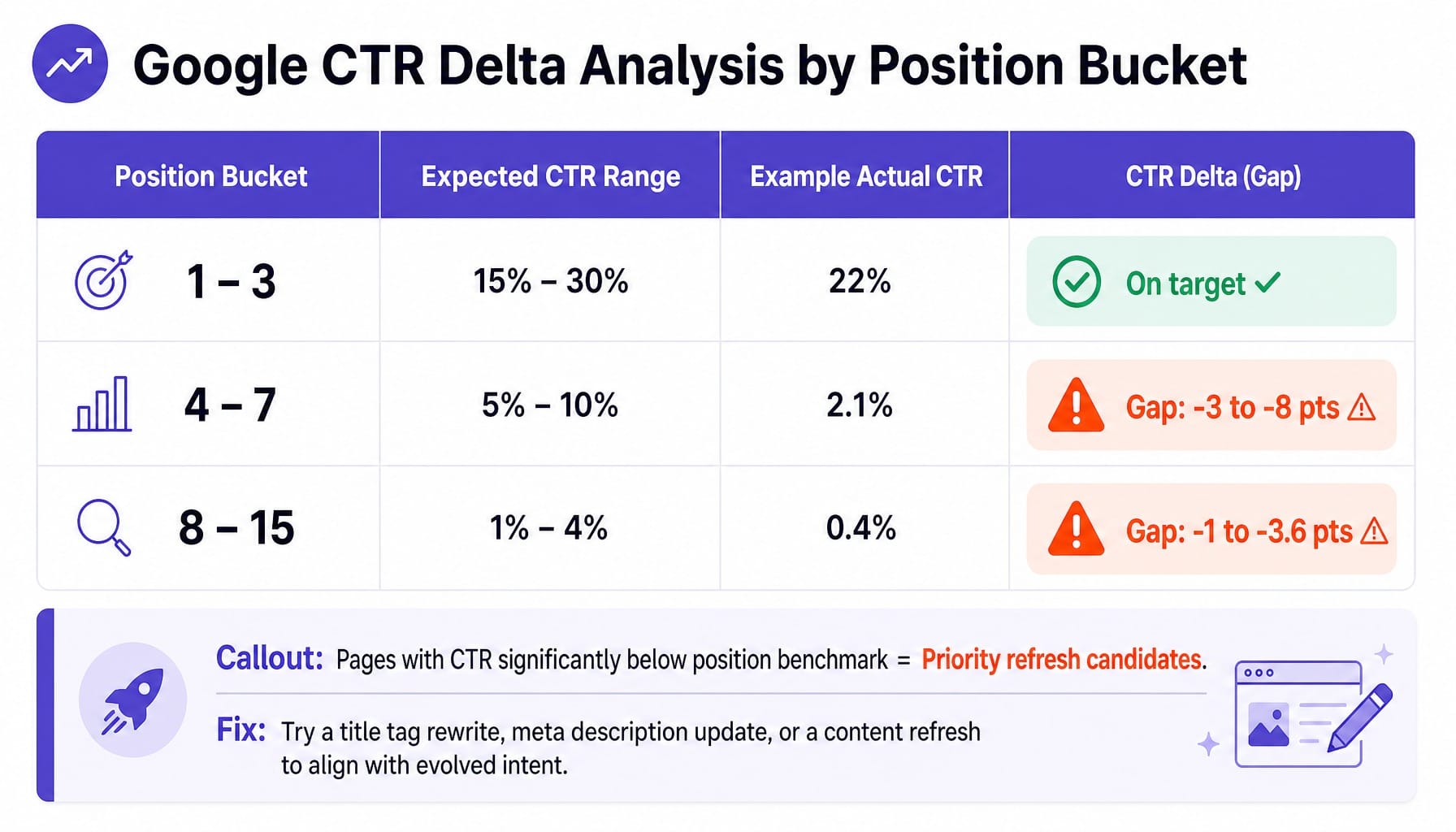
An impression-to-click gap occurs when a page receives significant impressions in Google Search Console but a disproportionately low click-through rate (CTR) for its average position. This is the single highest-ROI signal because it identifies content Google already deems relevant—you just need to close the gap between visibility and clicks.
To find this, go to your GSC Performance report, filter by pages, and sort by impressions. Then, compare your actual CTR to the expected CTR for that position bucket:
- Positions 1-3: ~15-30% CTR
- Positions 4-7: ~5-10% CTR
- Positions 8-15: ~1-4% CTR
Any page with a CTR significantly below its position's benchmark is a priority candidate. This practitioner shorthand is often called CTR delta analysis. The fix might be a simple title tag rewrite, a better meta description, or a content refresh to match evolved search intent—not necessarily a full rewrite.
Building a Decay-Velocity Model to Predict Which Pages Drop Next
Content decay detection is the process of identifying pages losing organic traffic before the decline becomes severe. Most teams only notice a GSC impression bleed after a page has lost 40-60% of its peak traffic. By then, recovery often requires a full rewrite rather than a targeted refresh.
A decay-velocity model is proactive. Export 12 months of GSC data by page and calculate the month-over-month impression trend. Flag any page with three consecutive months of declining impressions as entering the decay curve. Pages with accelerating decline—where each month's drop is larger than the last—should be scored highest for immediate intervention.
Content shelf life varies; "best tools" posts can decay in 6-9 months, while conceptual frameworks might hold for years. Using tools like Semrush Position Tracking or a custom Google Looker Studio dashboard can help automate this monitoring, turning decay from a reactive crisis into a predictable input for your prioritization queue.
When to Update Existing Content vs. Publish Something New
Here's a common dilemma: should you update an old post or write a new one? The answer isn't always obvious.
Prioritize updating existing content over publishing new articles when the page already ranks in positions 4-15 for its target query, has accumulated backlinks or internal links, and the content's core argument is still valid but supporting details are outdated.
Use this three-question framework to make the call:
- Does the page have existing authority signals? Check its backlink count in Ahrefs and the number of internal links pointing to it. If it has equity, updating preserves it. Publishing a new page starts from zero and risks creating cannibalizing URLs.
- Has the search intent shifted? Search for the target keyword and analyze the format and angle of the top 3 results. If the SERP now favors comparison tables and your page is a narrative guide, a simple refresh won't fix the structural mismatch. You may need a new page with a different format. A slight query-level intent drift can make a perfectly good article obsolete.
- Is the page cannibalizing another URL? Run a cannibalization audit by checking if multiple URLs on your site receive impressions for the same query cluster in GSC. If two pages are splitting impressions, consolidating them into one stronger page is almost always better than updating either one individually.
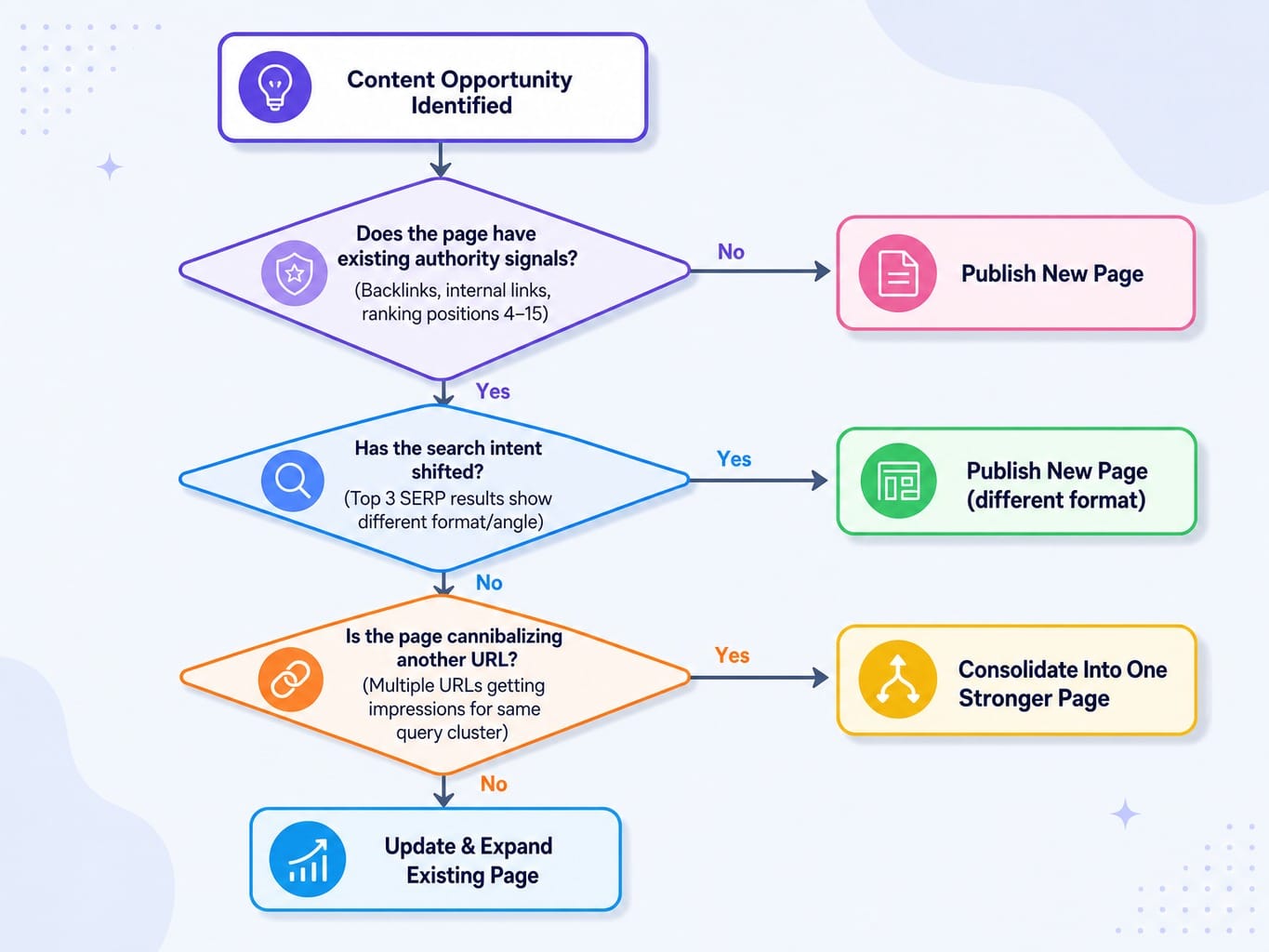
Consider a SaaS company with a 2022 blog post on 'email marketing automation tools' ranking at position 11 with 14 backlinks. The SERP still favors listicles. The clear decision is to update and expand the existing page. The backlink equity and existing impressions give it a head start that a new URL would take six months or more to replicate.
The Opportunity Cost Most Content Calendars Never Calculate
Every content prioritization decision has an opportunity cost—the value of the next-best option you did not pursue. Most content calendars track what they plan to publish but never quantify what they lose by not working on something else.
Let's make this concrete. A two-person content team has capacity for eight articles per quarter. They choose to write three new top-of-funnel awareness posts instead of refreshing three decaying pages in the position 4-15 bucket.
- The New Posts: Projected 2,400 visits/quarter at a 0.3% conversion rate = ~7 leads.
- The Refreshes: Projected to recover 4,800 lost visits/quarter at a 1.8% conversion rate = ~86 leads.
The opportunity cost of choosing the new posts is 79 leads per quarter. At an average lead value of $600, that's $47,400 in lost pipeline value.
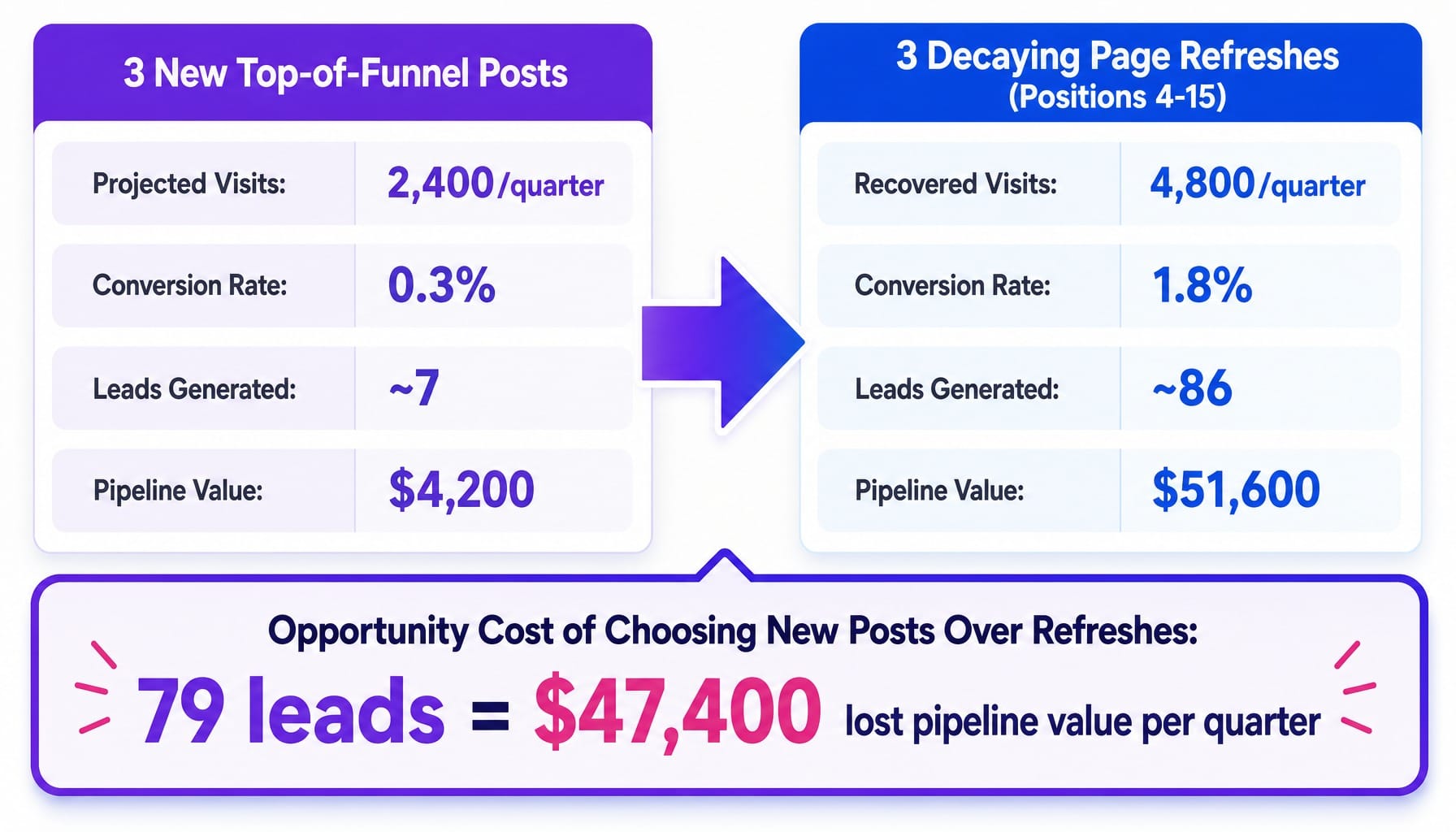
This isn't hypothetical math; it's the calculation most teams skip because their editorial calendar is organized by publish date, not by projected impact. A traffic-weighted priority queue, managed in a tool like a Notion database or Google Sheets, forces this calculation to the surface. It ensures the team is always working top-down on the highest-value items. This discipline is what separates teams that ship content from teams that ship results.
How to Build a Re-Prioritization Cadence That Compounds
Re-prioritize your SEO content roadmap every 4-6 weeks, not quarterly. A quarterly cycle is too slow. Ranking positions, SERP features, and competitor content shift constantly. A page that was at position 12 six weeks ago may have climbed to position 6 due to a competitor's content decay, making it a much higher-priority refresh candidate than it was at the start of the quarter.
This shorter cycle creates a powerful feedback loop. After each content release—a new post or a refresh—measure its impact on impression and click trends in GSC within 2-3 weeks. Feed that data back into your scoring model.
- Pages that responded well get deprioritized for now; they're performing.
- Pages that didn't respond get re-evaluated for a different intervention.
This creates a compounding effect. Each cycle's data improves the accuracy of the next cycle's prioritization. Your team's hit rate improves over time. Contrast this with the typical approach: plan 12 articles in January, execute through March, review in April, and repeat. That model treats content as a production schedule, not an optimization system. This is where content velocity planning comes in—not just publishing faster, but shipping the right things faster because the prioritization model gets smarter. Prioritization isn't a one-time exercise; it's a continuous system.
Read more: Done For You SEO vs. In-House: A Decision Framework for Lean B2B Teams
What Happens When Prioritization, Execution, and Re-Scoring Run Continuously
The framework is clear: pull data from GSC and Ahrefs every 4-6 weeks, re-score every opportunity across five dimensions, make update-vs-new decisions, execute the top-priority changes, measure impact, and feed the results back into the model.
For a lean marketing team, this system is correct, but it's also 15-20 hours of analytical and operational work per cycle—on top of actually writing and shipping. This is the exact gap between strategy and execution that most teams fall into.
The scoring model described above is what Spike AI runs every week, across your entire site, without requiring your team to build the spreadsheet or pull the data. It closes the gap by running the prioritization-execution-measurement loop continuously. It identifies the highest-impact move each week, ships it, measures the result, and re-prioritizes for the next cycle, turning your backlog into weekly releases that compound.
See how Spike AI prioritizes and ships your highest-impact SEO changes weekly
Your Calendar Is Not Your Priority List
The single most important shift is this: SEO content prioritization is not a planning exercise. It is an ongoing scoring system that gets smarter with each cycle.
Most teams default to sorting by search volume because it's the most visible metric. But the signals that actually predict content ROI—impression-to-click gaps, decay velocity, conversion proximity, and opportunity cost—are hiding in data you already have.
The framework isn't complex. The discipline of running it continuously is what separates teams that publish content from teams that compound results.
The next time your team sits down to plan the content calendar, open Google Search Console before your keyword tool. The priorities will look different. And they will be right.
Frequently Asked Questions
What is a striking distance keyword and how do I find them in Google Search Console?
A striking distance keyword is any query where your page ranks in positions 4-15—close enough to page one that a targeted improvement could move it into a high-click position. Find them in the GSC Performance report by filtering for an average position between 4 and 15, then sorting by impressions. These are your highest-ROI refresh candidates.
How do I avoid keyword cannibalization when adding new topics to my content plan?
Before starting a new topic, search your own site in GSC for the target query cluster. If an existing page already gets impressions for those queries, publishing a new page will split Google's signals. Instead, expand or restructure the existing page. Only create a new page when the intent is genuinely distinct.
What metrics indicate an article should be consolidated or deleted rather than refreshed?
Consolidate when two or more pages target overlapping queries and neither ranks well. Delete (with a 301 redirect) when a page has negligible impressions, zero backlinks, and covers a topic handled better elsewhere on your site. Thin content that cannot be meaningfully expanded can drag down topical authority signals for the entire cluster.
How has AI-generated search changed SEO content prioritization in 2025-2026?
AI Overviews mean some queries now deliver answers directly in the SERP, reducing clicks. This shifts prioritization toward queries where AI answers are absent or incomplete—typically commercial investigation, comparison, and complex how-to topics. Deprioritize simple definitional queries that AI can fully answer without a click.
How do I factor topical authority into which content clusters to build next?
Audit your rankings by topic cluster, not individual keywords. If you already rank for 8 of 12 subtopics in a cluster, completing the remaining 4 is a higher priority than starting a new cluster from scratch. Use Ahrefs Content Gap or Semrush Topic Research to find uncovered subtopics within your strongest existing clusters.