
SEMRush Pricing in 2026: The True Cost for B2B Teams

TL;DR
- The advertised Semrush price is the floor, not the ceiling. The true total cost of ownership for a B2B team is often 40-80% higher after accounting for extra user seats, toolkit add-ons, and App Center purchases.
- The best plan for most B2B SaaS teams (2-5 marketers) is Guru or Semrush One Pro+. The Pro plan is a false economy, as its 5-project limit forces an upgrade within months.
- Semrush is overkill if you only need basic keyword research and rank tracking. A stack of cheaper point solutions like SE Ranking and Screaming Frog can deliver 80% of the value for 30% of the cost.
- The real bottleneck to Semrush ROI isn't the quality of its data; it's your team's execution bandwidth to act on the hundreds of recommendations it generates.
- Choosing a plan requires mapping its constraints (projects, historical data, API access) to your team's operational reality, not just your company's size.
The Semrush pricing page presents three clean numbers: $139.95, $249.95, and $499.95 per month. But for a B2B marketing team, the amount that hits the credit card is almost always higher. The advertised price is a starting point, not a final figure.
The real Semrush cost emerges when you account for the necessary additions: extra user seats for your team, the AI Visibility Toolkit for modern search, the Semrush .Trends add-on for competitive intelligence, and separate App Center purchases. These costs stack, often pushing the total spend well beyond the initial budget.
This is not another feature list copied from Semrush. It's a total-cost-of-ownership analysis for B2B marketers who need to justify the spend and decide if the investment compounds into a pipeline—or just into more dashboards. We'll break down the true cost, provide a framework for choosing the right plan, and cover when Semrush is more of a tool than a lean team needs.
Semrush Plans and Pricing: What Each Tier Actually Costs in 2026
Semrush offers three core plans—Pro, Guru, and Business—alongside its newer Semrush One bundles that package the base tool with its AI Visibility Toolkit. On monthly billing, the legacy plans are priced at $139.95/mo (Pro), $249.95/mo (Guru), and $499.95/mo (Business). Opting for annual billing reduces the effective monthly cost by about 17%.
Here is how the core plans and their limits compare.
*Pricing may be subject to change in 2026.
Pro Plan ($139.95/mo): A False Economy for Most B2B Teams
The Pro plan's 5-project and 500-keyword ceiling is its critical failure point for any serious B2B operation. A SaaS company managing just one product, a blog, and two geographic markets will exhaust its five project slots immediately. The keyword tracking burn rate is similarly high. This plan is functional for a solo consultant or a single-product business in one market, but for anyone else, it's a trial that forces an upgrade within 60 days.
Guru Plan ($249.95/mo): The B2B Default Starting Point
The jump to Guru is less about the increased keyword and project quotas and more about two critical unlocks: historical data access and the full Content Marketing Toolkit. If you need to show performance trends to leadership or run a content program that requires SEO briefs and audits, Guru is the minimum viable tier. The Looker Studio connector is also gated at this level, making it essential for teams building custom marketing dashboards.
Business Plan ($499.95/mo): For API-Driven Teams and Agencies
The Business plan is only justified by its technical capabilities. If you are not using the API to feed data into a business intelligence tool, leveraging Share of Voice for advanced competitive rollups, or managing a portfolio of 30+ client projects, you are overpaying. The increased limits are a secondary benefit; the primary value is programmatic access to Semrush's data.
The newer Semrush One bundles (starting at $199/mo) combine a classic SEO plan with the AI Visibility Toolkit, saving about $40/mo versus buying them separately. For most mid-market B2B teams, the Semrush One Pro+ tier ($299/mo) hits the sweet spot, bundling a Guru-level plan with AI tracking.
The True Total Cost of a Semrush Subscription: Add-Ons, Seats, and App Center Creep
The price on Semrush's website is the floor. For most B2B teams, the real monthly spend is 40–80% higher than the base plan price once you account for three cost layers that are easy to overlook during procurement.
1. Extra User Seats: Every Semrush plan includes only one user seat. Seat stacking adds up quickly.
- Pro: $45/mo per additional user
- Guru: $80/mo per additional user
- Business: $100/mo per additional user
A three-person marketing team on the Guru plan needs two extra seats, adding $160/mo to their bill. This alone pushes the real cost from $249.95 to $409.95 per month.
2. Toolkit Add-Ons: Core capabilities for modern marketing are often sold separately.
- AI Visibility Toolkit: $99/mo per domain
- Semrush .Trends (Competitive Intelligence): $289/mo
- Local SEO: $30–$60/mo per location
- Semrush Social: $20–$60/mo
A B2B company tracking AI visibility on its main site and a secondary product domain, while also using .Trends for market analysis, adds another $487 per month.
3. Semrush App Center: This marketplace of third-party and Semrush-built tools operates with independent billing, creating a significant hidden cost layer.
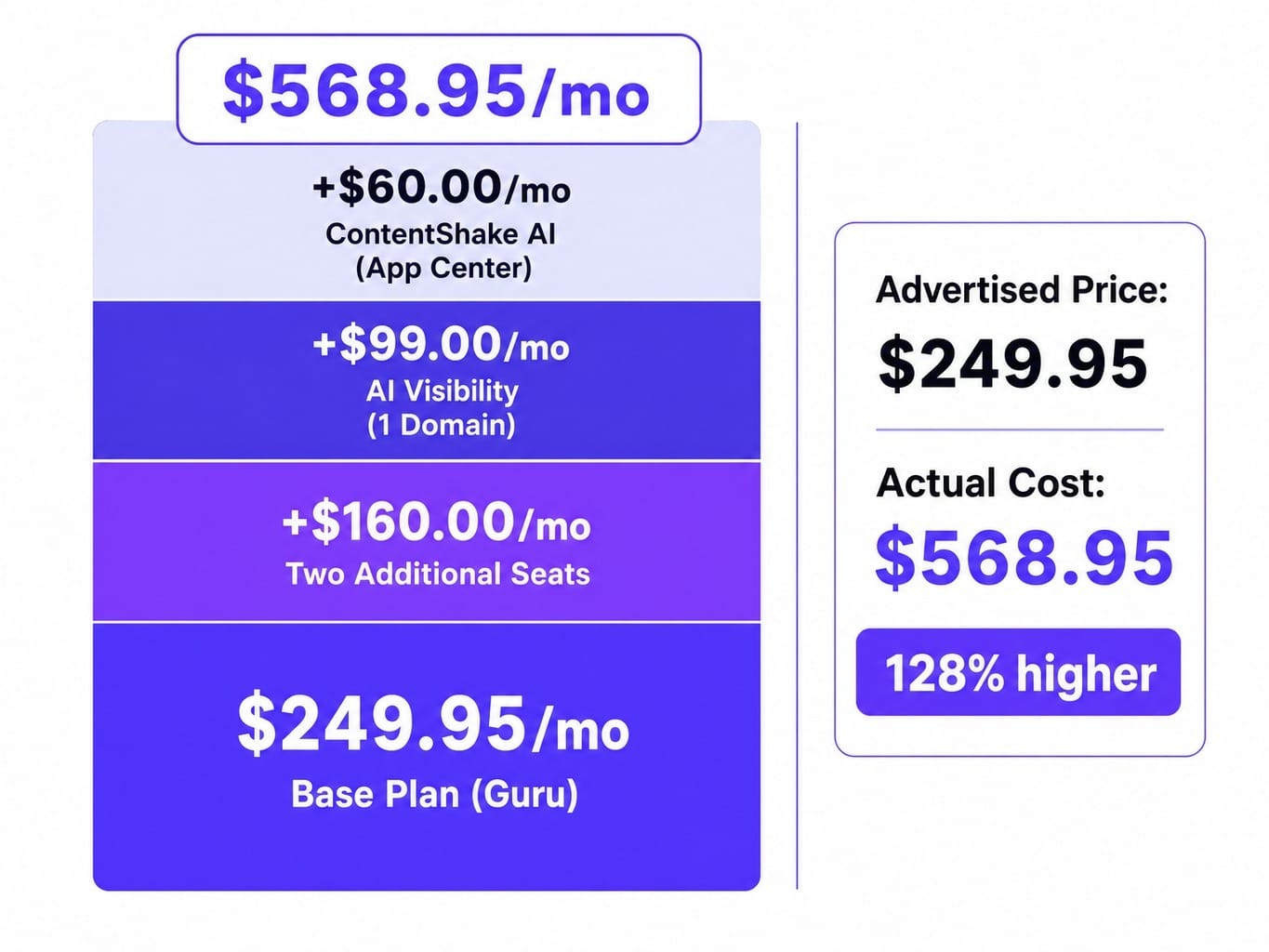
Let's calculate the total cost of ownership for a realistic B2B scenario: a 3-person SaaS marketing team on the Guru plan.
- Base Plan (Guru): $249.95/mo
- Two Additional Seats: +$160.00/mo
- AI Visibility (1 Domain): +$99.00/mo
- ContentShake AI (from App Center): +$60.00/mo
Total Monthly Cost: $568.95
This is 128% higher than the advertised Guru price. This is the number that needs to go into the budget, not the one on the pricing page.
How Semrush App Center Costs Stack on Top of Your Base Plan
The Semrush App Center is the least transparent cost layer. It functions as a marketplace where capabilities that feel like they should be part of a premium subscription are sold à la carte. For B2B teams, common purchases include ContentShake AI ($60/mo) for content creation and ImpactHero ($200/mo) for content analytics.
These apps are not included in any base plan or Semrush One bundle. This creates a "feature gating by marketplace" dynamic, where the true cost of assembling a complete workflow is fragmented across multiple subscriptions. When evaluating Semrush pricing, you must audit your team's potential dependencies on App Center tools, as they can easily add hundreds of dollars to your monthly bill.
Which Semrush Plan Fits a B2B Marketing Team? A Decision Framework
The generic advice—"Pro for beginners, Guru for agencies"—is useless for a B2B marketing team. It maps to company size, not operational need. A better approach is to evaluate plans against three B2B-specific criteria.
Criterion 1: Number of Concurrent Projects
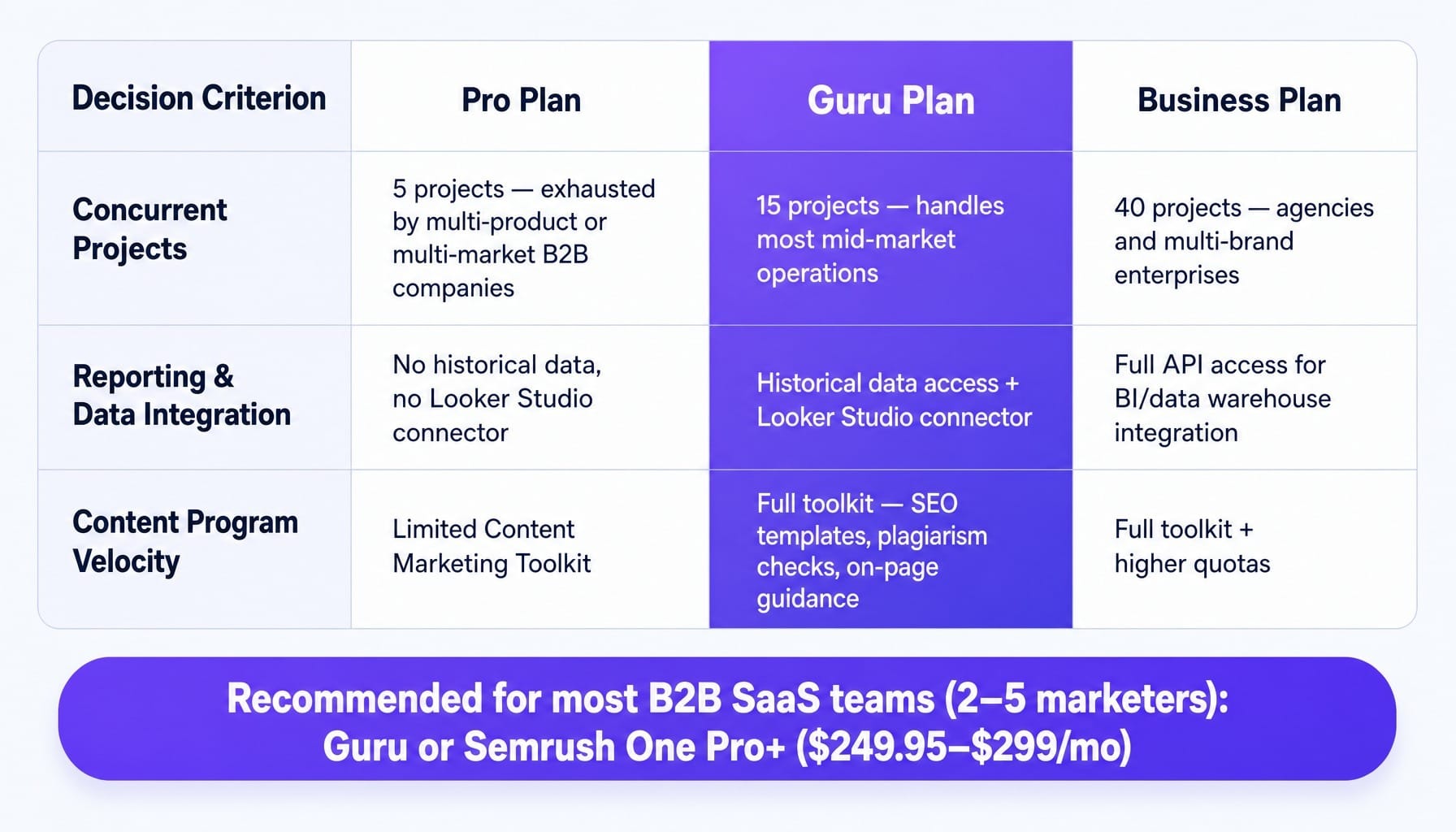
If you manage multiple product lines, geographic markets, or distinct content properties (like a main site and a separate blog), each one requires a project slot. Pro's 5-project limit is exhausted almost instantly by any B2B company with more than one core offering. Guru's 15 projects can handle most mid-market operations, while Business's 40-project capacity is built for agencies or large, multi-brand enterprises. Don't underestimate your project slot allocation needs.
Criterion 2: Reporting Cadence and Data Integration
If your team reports to a VP or board and needs to show performance trends over time, you need Guru's historical data access. Pro provides none. If you build custom dashboards in Looker Studio (formerly Google Data Studio), you also need Guru at a minimum, as the connector is tier-gated. If your RevOps team needs to pull data into a centralized BI platform or data warehouse, only the Business plan's API access will suffice.
Read more: B2B RevOps in 2026: What to Measure, What to Build, and Where Most Teams Stall
Criterion 3: Content Program Velocity
If your team publishes more than 8-10 articles per month, the full Content Marketing Toolkit included with Guru is the real unlock. It provides SEO content templates, plagiarism checks, and on-page optimization guidance that are essential for scaling a content engine. The keyword quota is secondary; the content workflow support is what justifies the price jump from Pro.
The Recommendation: Most B2B SaaS marketing teams with 2-5 marketers and an active content program should start on the Guru plan or Semrush One Pro+. The Pro plan is a false economy that almost guarantees a forced upgrade within a single quarter. The Business plan is only justified when API access or advanced Share of Voice rollups are non-negotiable operational requirements.
When Semrush Is More Tool Than You Need
Semrush is a comprehensive platform, but comprehensiveness comes at a cost—both in dollars and operational complexity. For B2B teams with a narrow, well-defined use case, Semrush can be overkill, and you end up paying for a suite of features that sit idle.
The inflection point is this: if your team's primary workflow revolves around keyword research and rank tracking—and you do not regularly use site audits, backlink analysis, content marketing tools, or competitive intelligence modules—you are overpaying.
In this scenario, a more focused, unbundled stack delivers most of the value at a fraction of the cost.
- Alternative Stack: Pair SE Ranking ($55/mo for comparable rank tracking) or Mangools ($29/mo for keyword research) with the free version of Screaming Frog (for technical audits up to 500 URLs). This combination provides 80% of the core SEO value for roughly 30% of the Semrush Guru cost.
A second scenario is when your team's workflow is highly channel-specific. Pairing a lower Semrush tier (Pro) with a best-in-class point solution like Surfer SEO for content optimization or SpyFu for PPC intelligence can outperform an all-in-one Guru subscription.
The tradeoff, of course, is coordination overhead. Semrush's core value proposition is consolidation. The question your team must answer is whether your workflow actually benefits from that consolidation, or if you're just paying for an integration you don't use.
Read more: SaaS Marketing Tools in 2026: How to Build a Stack That Ships, Not Just Reports
Semrush ROI Is Not About Features—It Is About Execution Bandwidth
Most ROI calculations for tools like Semrush are flawed. They assume that identifying a keyword opportunity automatically translates into revenue. It doesn't. The system fails at the human layer.
The gap between Semrush surfacing an insight—"this keyword has 2,400 monthly searches and a KD of 34"—and that insight becoming a published, optimized page that ranks is measured in weeks for most lean B2B teams. A team running Semrush Guru will generate dozens of actionable recommendations every week from Site Audit, On Page SEO Checker, and Position Tracking. But a two-person team can realistically act on only 3-5 of those.
The rest accumulate in a backlog that grows faster than the team can ship.
This is the central execution constraint. The ROI of Semrush is not determined by the quality of its data, which is excellent. It is determined by your team's execution bandwidth to act on that data. If your primary bottleneck is not "what should we do next?" but "how do we ship what we already know we should do?", the question shifts. It's no longer "is Semrush worth $250/mo?" but rather "what is the cost of the execution gap between Semrush's recommendations and our ability to implement them?"
What If the Execution Gap Closed Itself?
The real cost of an intelligence platform like Semrush isn't the subscription fee; it's the operational drag of a backlog that never shrinks. Your team knows what to do. The problem is the latency between identifying a fix and shipping it.
This is an execution system failure. Spike AI is designed to solve it.
Where tools like Semrush provide the prioritized recommendations—fix a title tag, optimize a landing page, resolve a technical SEO issue—Spike AI acts as the execution layer that ships the fix. Every week. Without engineering tickets, agency briefs, or backlog anxiety.
For the two-person team staring at 30 recommendations, the system changes. Instead of manually shipping 3-5 fixes, Spike AI identifies the single highest-impact move across your entire marketing surface (SEO, CRO, content) and deploys it. The backlog becomes an approval queue. The marketer moves from operator to orchestrator. This weekly shipping cadence is what creates compounding growth, turning insights into tangible results.
See how Spike AI turns your SEO backlog into weekly shipped improvements
The Real Cost Is the Execution Gap
Choosing a Semrush plan is not a simple subscription decision. It is a total cost of ownership decision that must account for add-ons, seat stacking, and, most critically, the human bandwidth required to act on the data it surfaces.
The advertised price is the floor. The right plan depends on your team's operational constraints, not your company size. But even with the perfect plan, the ultimate ROI question is not whether Semrush's data is good—it is. The question is whether your execution system can move fast enough to turn that data into revenue. The teams that win with Semrush, or any intelligence tool, are those that solve the execution problem first.
Frequently Asked Questions
Does Semrush offer nonprofit, startup, or educational discounts?
Semrush does not publicly advertise discount programs for nonprofits or startups. However, some organizations report success negotiating discounts on annual plans by contacting sales directly, especially for multi-year commitments. Educational institutions may qualify for limited access through Semrush Academy partnerships.
What happens to my historical data and projects if I downgrade my Semrush plan?
Downgrading from Guru or Business to Pro immediately removes access to historical data and the full Content Marketing Toolkit. Projects exceeding the new tier's limit become inaccessible—you must deactivate them to fit the new ceiling before downgrading. Keyword tracking data beyond the new quota is paused, not erased.
Can B2B teams negotiate custom enterprise pricing with Semrush?
Yes. Semrush offers custom enterprise plans for teams needing more than 40 projects, higher API call volumes, or dedicated account management. Your leverage increases with annual commitments and multi-seat purchases. The published Business plan price is a starting point for negotiation, not a final offer.
How often does Semrush refresh position tracking data, and does it vary by plan?
Position tracking data refreshes daily on all paid plans; the refresh interval does not vary between Pro, Guru, and Business. However, the number of keywords you can track (500/1,500/5,000) is the real constraint, limiting how much of your keyword landscape gets a daily update.
Is the Semrush free trial available for all plans, and what are the limitations?
Semrush offers a 7-day free trial for its Pro and Guru plans, though some partners provide extended 14-day trials. A Business plan trial is not publicly available and requires contacting sales. The trial provides full plan access but requires a credit card and will auto-renew if not cancelled.