Semrush Review 2026: An Honest Evaluation for B2B Teams

TL;DR
- Best for Competitive Intelligence: Semrush excels at reverse-engineering competitor content and PPC strategies, making it invaluable for B2B teams needing to find keyword gaps that map directly to sales pipeline.
- Validate Low-Volume Data: For B2B keywords under 200 monthly searches, use Semrush for discovery and intent classification, but always validate volume and traffic data against your own Google Search Console.
- Real Cost is Higher: The effective starting price for a B2B team is the Guru plan (~$249/mo), not Pro. Factor in an extra $45-$90/mo for additional user seats.
- Diagnoses, Doesn't Execute: Semrush's primary limitation is structural: it's an intelligence platform that generates a backlog of tasks. The bottleneck for most lean teams isn't insight; it's the bandwidth to ship the fixes Semrush identifies.
- Ahrefs vs. Semrush: Choose Semrush for content-led strategies and competitive intelligence. Choose Ahrefs if your primary workflow is link building and digital PR, as its backlink index is stronger.
Your team subscribes to Semrush. You run a site audit, pull a keyword gap analysis, and identify 40+ high-intent content opportunities. The insights are powerful, the data is comprehensive. A week later, that list of opportunities is sitting in a backlog. Nothing has shipped.
This isn't a hypothetical. For lean B2B marketing teams, it's a recurring reality. The gap isn't in strategy; it's in execution.
Semrush is widely considered the most comprehensive marketing intelligence platform available. But for a team that needs to turn insights into pipeline, is more intelligence the answer, or is it just more homework?
This Semrush review is different. We're not evaluating it on feature count. We're evaluating it through the lens of a B2B marketing team under pressure to drive revenue, analyzing its accuracy, B2B relevance, true cost, and—most importantly—what it structurally cannot do for a resource-constrained team.
What Semrush Actually Is in 2026
In 2026, Semrush is a full-stack marketing intelligence system. It has expanded far beyond its origins as a keyword research tool into a suite that covers SEO, PPC, content marketing, competitive intelligence, and AI visibility tracking. This breadth is both its greatest strength and a common source of confusion.
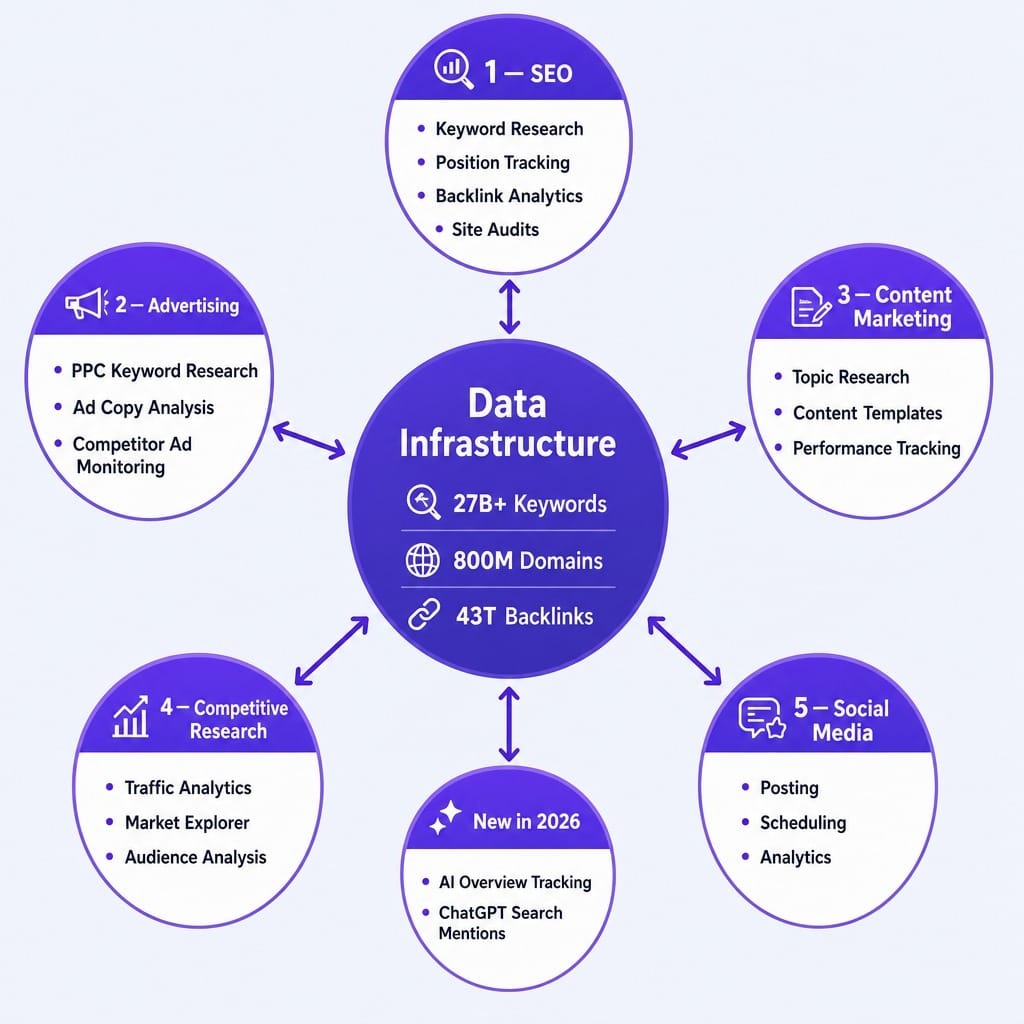
The platform is best understood as five interconnected toolkits:
- SEO: Keyword research, position tracking, backlink analytics, and site audits.
- Advertising: PPC keyword research, ad copy analysis, and competitor ad monitoring.
- Content Marketing: Topic research, content template generation, and performance tracking.
- Competitive Research: Full-funnel traffic analytics, market exploration, and audience analysis.
- Social Media: Posting, scheduling, and analytics.
Underpinning these workflows is a massive data infrastructure: over 27 billion keywords, 800 million domains, and a 43 trillion-strong backlink index. Recent additions, like tracking for Google's AI Overviews and ChatGPT search mentions, signal the platform's commitment to navigating the shift in search.
But a long feature list doesn't guarantee results. The rest of this review will assess Semrush on its practical utility for a B2B team: its accuracy, its pricing transparency, and its ability to bridge the gap between analysis and execution.
Where Semrush Excels for B2B Marketing Teams
For B2B companies, Semrush's value isn't in its raw keyword volume data, which naturally favors high-traffic consumer queries. Its power lies in its competitive intelligence workflows—the tools that help you reverse-engineer what's already driving the pipeline for competitors in your specific vertical.
B2B keyword research operates under different constraints: lower search volumes, hyper-specific intent, and the need to map terms to long buying cycles. A B2B marketer selling project management software, for example, cares less about the 50,000 searches for "project management" and more about the 50 searches for "alternatives to Asana for construction firms." Semrush is one of the few platforms that provides the tools to find and act on that nuance.
Competitive Intelligence That Maps to Pipeline
Semrush's Domain Overview, Organic Research, and Keyword Gap tools are most valuable to B2B teams as inputs for content strategy, not as vanity dashboards. They allow you to move from monitoring traffic to deconstructing a competitor's entire demand capture model.
Consider this scenario: a B2B SaaS marketing lead uses the Organic Research tool to analyze a top competitor. By filtering their ranking pages for keywords with "commercial" and "transactional" intent, they discover the competitor ranks for 12 different comparison-intent keywords ([Competitor A] vs [Competitor B], alternatives to [Legacy Tool]) that their own team has no content for.
This isn't just a keyword gap; it's a pipeline gap. These are queries from buyers actively comparing solutions. Semrush's ability to classify keywords by intent—informational, navigational, commercial, transactional—provides a level of strategic clarity that many alternatives lack, allowing you to prioritize the keywords that signal buying behavior.
Keyword Research in Low-Volume B2B Niches
Is Semrush accurate for B2B keywords with only 50 or 100 monthly searches? The answer is mixed, and understanding the nuance is critical.
The Keyword Magic Tool is excellent for discovery. It surfaces long-tail variations and question-based queries that are often the lifeblood of B2B content strategy. Its intent classification helps you focus on commercial-intent terms, even with low volume.
However, at volumes under 200 monthly searches, the numbers become directional at best. The tool often reports 0 or 10 for terms that Google Search Console shows are driving hundreds of impressions and a handful of valuable clicks. For example, a term like "enterprise data governance platform" might show 40 monthly searches in Semrush, while your GSC data reveals it's a consistent source of qualified demo requests.
The takeaway for B2B practitioners is clear: use Semrush for keyword discovery and intent prioritization. But for any target keyword under 200 monthly searches, validate the volume and traffic potential against your own first-party GSC data. The Keyword Gap tool remains particularly useful here, as it uncovers terms your competitors rank for that you don't—a valuable signal regardless of precise volume.
Read more: Semrush vs Ubersuggest (2026): Data Accuracy, Real Costs, and When Each Tool Stops Being Enough
How Accurate Is Semrush Data—and Where Does It Break Down?
Most Semrush reviews avoid the uncomfortable truth: its traffic estimates are directionally useful but frequently inaccurate at the individual domain level. If you're presenting Semrush traffic data to your VP as absolute truth, you're setting yourself up for a difficult conversation.
Anyone can validate this. Compare Semrush's "Organic Traffic" estimate for a domain you own against your actual Google Analytics sessions for the same period. For most B2B sites, Semrush will underestimate traffic by 30-60%. This isn't a flaw so much as a structural limitation; the tool extrapolates from a known set of tracked keywords and cannot see the vast long-tail, branded searches, or zero-volume terms that collectively drive significant traffic.
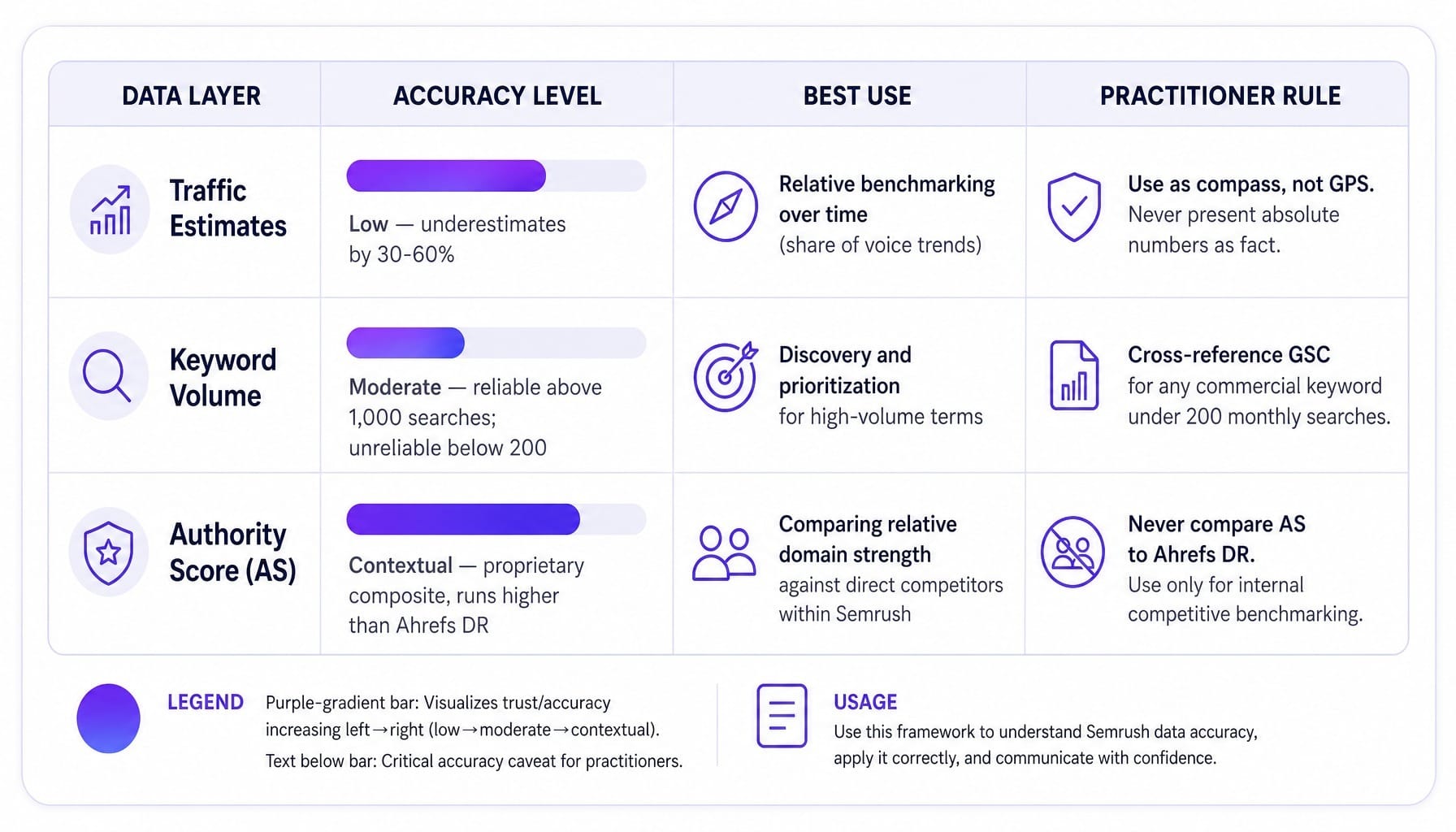
To use the platform effectively, you need to understand the accuracy of three key data layers:
- Traffic Estimates: Treat these as a relative compass, not a GPS. They are useful for benchmarking your share of voice against a competitor's over time. If your estimated traffic is growing faster than theirs, you're gaining ground. But the absolute numbers—"they get 15,000 visits a month"—are unreliable.
- Keyword Volume: Reasonably accurate for terms with over 1,000 monthly searches. Below 200, it becomes increasingly unreliable. As noted, always cross-reference with GSC for your most important commercial keywords.
- Authority Score (AS): This is a proprietary composite metric. Use it to compare your domain's relative strength against direct competitors within Semrush's ecosystem. Do not treat it as an absolute measure or compare it to Ahrefs' Domain Rating (DR). Authority score inflation is a known phenomenon; Semrush's AS often runs higher than Ahrefs' DR for the same domain, which can be misleading.
The point isn't that Semrush is inaccurate. It's that understanding its data boundaries is what separates a novice user from an effective practitioner.
Semrush Pricing: What You Actually Pay
Semrush's published pricing is a starting point, not a final cost. This is a critical detail most reviews gloss over, but for a B2B team where multiple people need access and several domains need tracking, the gap between the sticker price and the monthly invoice can be significant.
As of 2026, the core plans (with annual billing) are approximately:
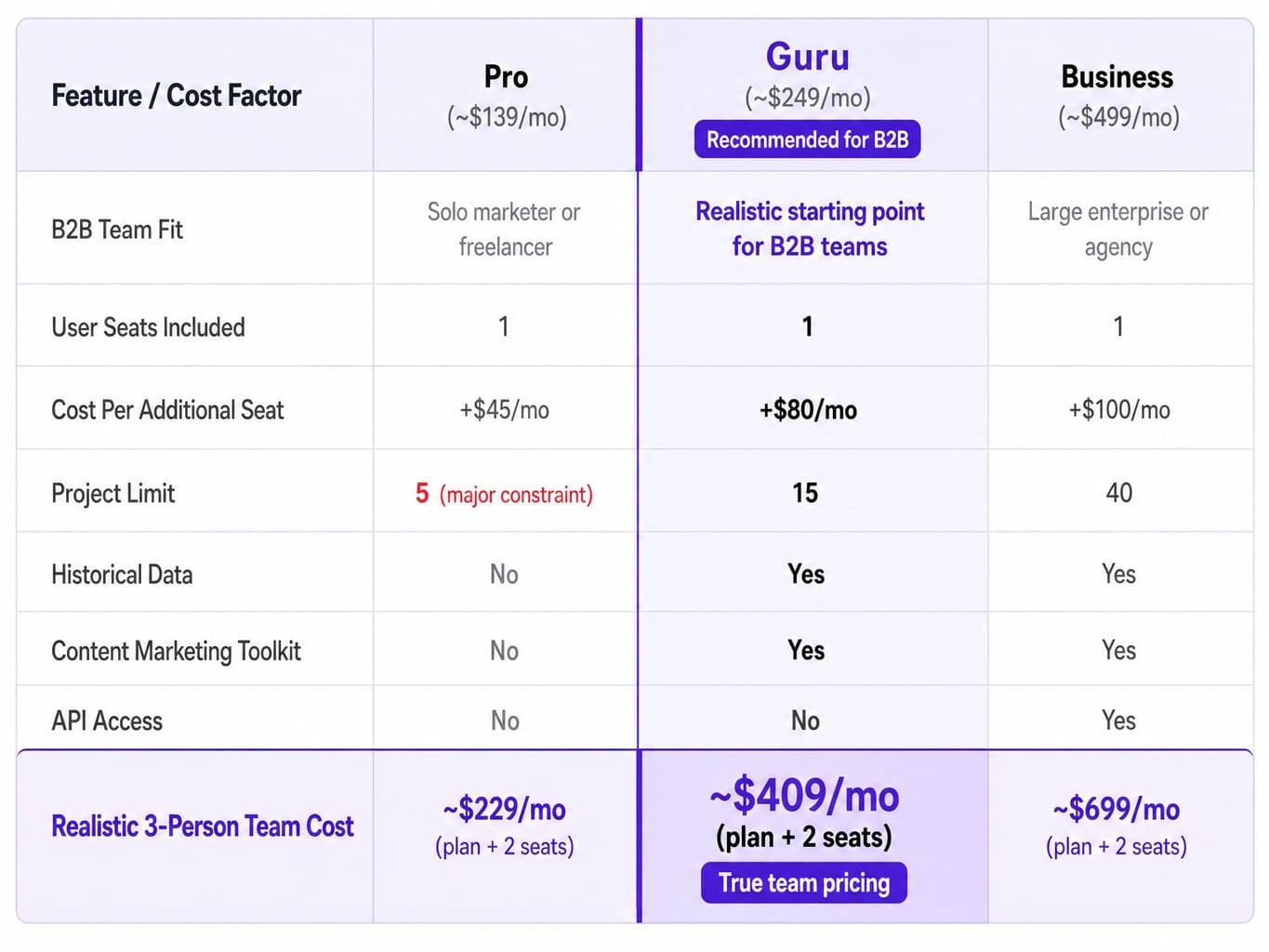
- Pro: ~$139/month
- Guru: ~$249/month
- Business: ~$499/month
Monthly billing is about 15-20% higher. The real cost, however, is determined by which plan you actually need and the add-ons that become necessary as your team scales.
Pro vs. Guru vs. Business: Which Plan Fits a B2B Team
Here's a decision-oriented breakdown for B2B teams:
- Pro: Sufficient for a solo marketer or freelancer managing one or two domains. However, its 5-project limit and single user seat make it impractical for almost any team. You'll hit the project ceiling just tracking your main site, a blog subdomain, and 2-3 competitors.
- Guru: The realistic starting point for most B2B marketing teams. It unlocks historical data, the full Content Marketing Toolkit, and multi-location tracking. If you have 2+ marketers and a content program, this is your minimum viable plan.
- Business: Geared for larger enterprises or agencies needing API access, Share of Voice metrics, and significantly higher data limits.
The key takeaway is that the effective entry price for a B2B team is the Guru plan at ~$249/month, not the advertised Pro plan. Understanding SaaS pricing strategy patterns can help you anticipate how these costs compound as your team grows.
The Costs Most Reviews Do Not Mention
Three cost drivers consistently inflate Semrush's real price:
- Additional User Seats: This is the biggest one. A single seat on the Guru plan costs an additional $80/month. A three-person team will pay their base plan fee plus $160, bringing their monthly total to over $400, not $249.
- Project Caps: The 5-project limit on the Pro plan is a major constraint. Any team managing a main site, landing page subdomains, international versions, and competitor tracking will be forced to upgrade or purchase project packs.
- Add-on Tools: Many powerful tools are not included in any standard plan. The Semrush App Center offers specialized tools for local SEO, agency reporting, and more, each carrying a separate monthly fee. Even something as basic as additional crawl pages for a large site audit can trigger an extra charge.
Before committing, calculate your realistic cost: start with the Guru plan, add $80 for every team member beyond the first, and assume you'll need at least one add-on if your needs are specialized.
What Semrush Structurally Cannot Do
Semrush's biggest limitation isn't a missing feature; it's a category constraint. It is an intelligence platform. It tells you what's wrong, what competitors are doing, and where opportunities lie.
It does not fix anything.
A growth marketer runs a Site Audit and gets a list of 127 technical issues. They run a Keyword Gap analysis and find 35 high-intent terms competitors rank for. They pull a backlink report and identify 20 toxic links that need to be disavowed. Each of these is a valid, actionable insight. And for a lean team, none of them get implemented. Three months later, the same audit surfaces the same issues.
The tool worked perfectly. The execution system failed.
For a B2B company with dedicated SEO specialists, content writers, and developers, this is fine. Semrush provides the intelligence layer, and a team of humans provides the execution layer. But for the far more common scenario—a lean team of 1-3 marketers carrying specialist expectations—Semrush's output is a perpetually growing backlog. The bottleneck isn't a lack of insight; it's the latency between identifying what needs to change and actually shipping that change.
This isn't a Semrush problem. It's an intelligence tool problem. They create homework. The critical question for any team considering the investment is whether they have the bandwidth to do that homework.
Read more: Stop Syncing Strategy and Execution: Platforms That Unify Marketing Goals With Task Management
When the Bottleneck Is Not Insight but Shipping
The scenario is all too familiar. The 127-issue audit, the 35-keyword gap, the growing backlog—these are symptoms of an execution bottleneck, not an intelligence failure. Semrush excels at surfacing what needs to change, but the gap between knowing and shipping is where marketing teams stall.
This is the structural problem Spike AI is built to solve. It is the execution layer that sits downstream of intelligence.
Where Semrush identifies technical SEO issues, content gaps, and conversion friction, Spike AI prioritizes which fix will move qualified leads most and then deploys it. The cadence itself becomes the growth engine. Every week, Spike AI identifies the single highest-impact move across your website, content, or ads, and executes it. No engineering tickets. No agency briefs.
This isn't about replacing Semrush; it's about making its intelligence productive. Instead of a backlog of homework, you get a queue of shipped improvements. It closes the loop, turning diagnosis into weekly releases that compound over time—a rhythm that quarterly agency cycles can never match.
See how Spike AI turns your SEO backlog into weekly shipped improvements
Semrush Copilot AI: What It Automates vs. What It Does Not
Semrush Copilot is the platform's direct attempt to address the execution gap. It's an AI-powered interface that surfaces prioritized recommendations, flags anomalies in your data, and suggests next steps based on your project goals.
Here's the honest assessment: Copilot is a useful prioritization layer, but it is not autonomous execution.
On a Monday morning, Copilot might alert you: "Your organic traffic dropped 12% this week—here are 3 possible causes." It might suggest, "These 5 keywords show high ranking potential." This is a significant workflow improvement over manual dashboard review. It surfaces critical information faster.
But it does not change the fundamental dynamic. It doesn't fix the technical issue causing the traffic drop. It doesn't write the content for the high-potential keywords. The marketer is still the execution layer. Copilot gives you a prioritized to-do list; it doesn't do the tasks on it. Compared to Semrush's ContentShake AI, which drafts generic content that requires heavy editing for B2B, Copilot is a step in the right direction. It makes Semrush's intelligence more accessible, but it doesn't solve the core bandwidth problem.
Semrush vs. Ahrefs for B2B: Which One Deserves the Budget
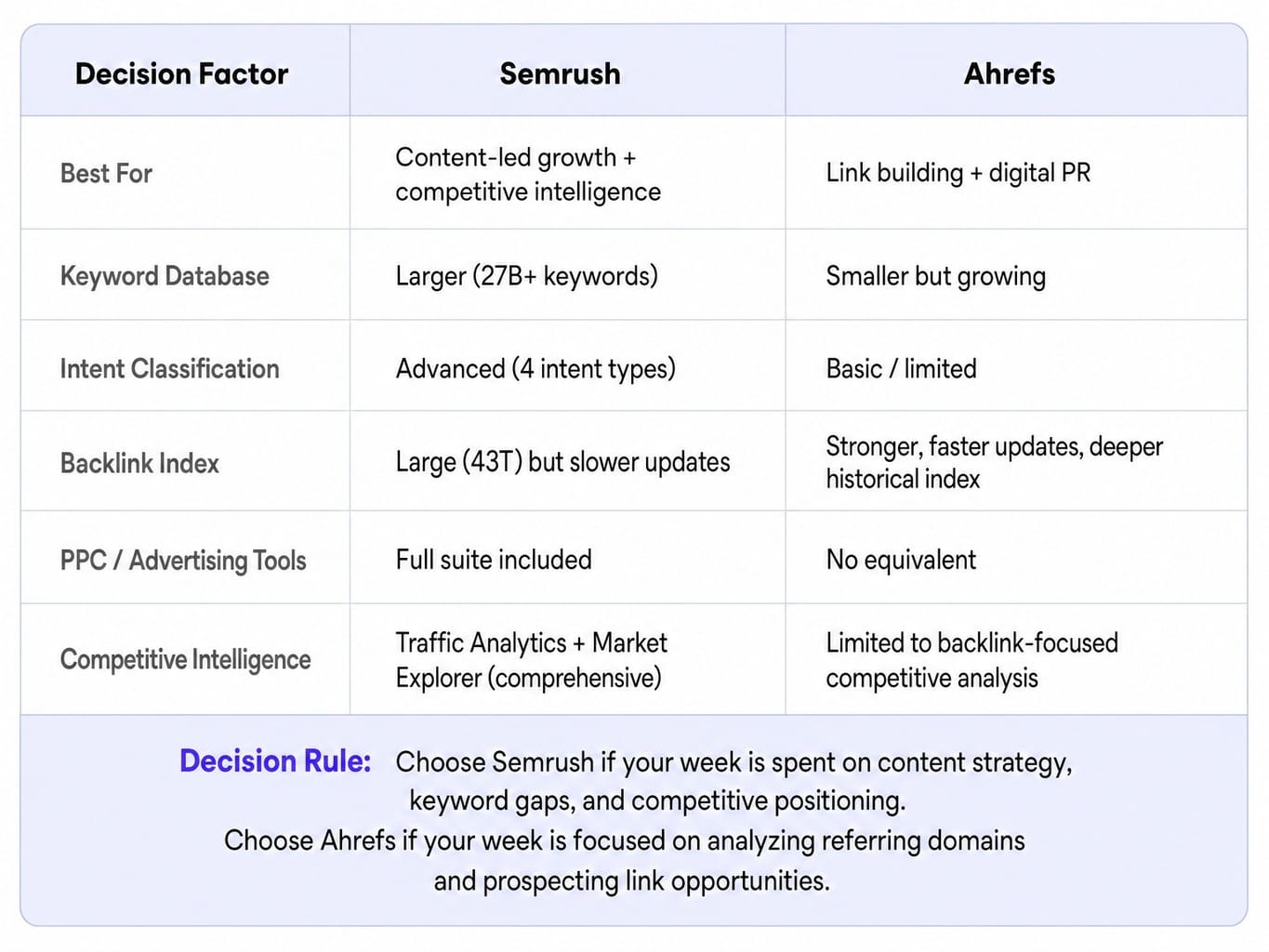
For B2B teams, the choice between Semrush and Ahrefs depends entirely on which workflow dominates your week. It's not about which tool is "better," but which is better for the job you need to do right now.
Choose Ahrefs if your primary growth lever is link building and digital PR. Ahrefs has a stronger, faster, and more intuitive interface for backlink analysis. Its backlink index is updated more frequently, its link intersection tool is more granular, and its historical index is deeper. If your week is spent analyzing referring domain velocity and prospecting for link opportunities, Ahrefs is the superior tool for that specific job.
Choose Semrush if your growth strategy is content-led and requires competitive intelligence across SEO and PPC. Semrush's keyword database is larger, its intent classification is more developed, and its advertising toolkit has no Ahrefs equivalent. Its Traffic Analytics and Market Explorer tools provide a level of competitive positioning insight that Ahrefs doesn't attempt to match. If you need to deconstruct a competitor's entire content and paid acquisition strategy, Semrush is the more comprehensive platform.
Most lean B2B teams cannot justify the $500+/month cost of subscribing to both. The practical choice comes down to your core strategy: link-led growth favors Ahrefs; content-led growth favors Semrush.
Is Semrush Worth It in 2026?
Semrush is the best intelligence platform in its category. But for a lean B2B team, intelligence is only half the equation—and it's often the easier half.
The platform excels at competitive intelligence, keyword discovery, and tracking the evolving SERP, including AI-driven features. But its data has known accuracy boundaries that require practitioner judgment. Its true cost is significantly higher than its entry-level price suggests. And its core structural limitation—that it diagnoses but does not execute—is a category reality that ultimately determines whether the investment pays off.
The teams who extract the most value from Semrush in 2026 are not the ones who admire its dashboards. They are the ones who have solved their execution problem, whether through dedicated headcount, agency support, or an autonomous system that can actually ship what Semrush surfaces.
Frequently Asked Questions
Is Semrush's keyword difficulty score reliable for competitive B2B verticals?
It's directionally useful but shouldn't be treated as absolute. The score is heavily weighted by the backlink profiles of ranking pages, which under-values content quality and topical authority—factors that are often decisive in specialized B2B niches. Use it as a rough filter, but always manually review the top-ranking pages for any high-value keyword.
Can you use Semrush effectively with only one user seat?
Yes, but with significant workflow friction. The single-seat limitation on the Pro plan creates bottlenecks if multiple team members need to pull data. The practical workaround is to designate one person as the "Semrush operator" who exports data for the team, but this adds latency to every task that requires SEO data.
Does Semrush support AI Overview and zero-click tracking in 2026?
Yes. Semrush now tracks whether your pages appear in Google AI Overviews and other generative AI answers. The Position Tracking tool includes specific filters for AI features. However, the data is still maturing. AI citation tracking is less granular than traditional rank tracking, and historical data is limited since the feature is relatively new.
How well does Semrush integrate with HubSpot and other B2B marketing platforms?
Integration is limited. While Semrush connects natively with Google products, there is no direct, bidirectional HubSpot integration. You can pipe Semrush data into HubSpot reports using third-party connectors or Looker Studio, but it requires manual setup. For most B2B teams, SEO performance data and CRM pipeline data remain in separate systems.
Is Semrush worth the price for a B2B team with under a $10K monthly marketing budget?
It depends on whether organic search is a primary growth channel. If a meaningful share of your pipeline comes from SEO and content, the Guru plan at ~$249/mo is a defensible investment. If your growth is primarily outbound or paid, the cost is harder to justify. Start with a trial and run a Keyword Gap analysis against three competitors; if it surfaces 10+ actionable opportunities, the tool will likely pay for itself.