Ahrefs Review for B2B (2026): The Gap Between Intelligence and Execution

TL;DR
- Best-in-Class Intelligence, Not Execution: Ahrefs provides the market's best backlink and keyword intelligence but stops there, creating a backlog of insights your team must manually execute.
- Validate All Data: Ahrefs' organic traffic estimates can be off by 40-60% for niche B2B sites. Use its data for directional competitive analysis, but always validate against Google Search Console for reporting.
- Ignore Domain Rating (DR) for B2B: DR is a volume-based metric that's misleading for niche authority. Focus on referring domain relevance and position distribution curves to assess real competitive strength.
- Calculate Your Real Cost: The monthly sticker price is not the true cost. Model your team's workflow to estimate your monthly credit burn rate, as you can easily exhaust your plan's credits by week three.
- Stack vs. Single Platform: For solo marketers, Ahrefs as a single platform is defensible to reduce cognitive load. For teams of 3+, a best-of-breed stack (Ahrefs + Screaming Frog + a content tool) delivers superior capability.
Ahrefs is arguably the best backlink and keyword intelligence platform on the market. That isn't the interesting question. For B2B marketing teams, the real question is whether intelligence alone moves the needle—or if Ahrefs just becomes another dashboard that surfaces problems your team lacks the bandwidth to fix.
Most Ahrefs reviews are just feature checklists. This is an operational assessment from a team that has used Ahrefs for years across B2B SaaS campaigns. We're not asking what it can do. We're asking where it creates leverage, where it creates work, and what it actually costs when you factor in credits, add-ons, and the human hours required to act on its output.
This is an honest Ahrefs review for B2B teams. We'll cover a quick verdict, its core strengths and weaknesses through real-world workflow scenarios, the hidden economics of its credit system, and how it fits into a modern marketing execution system.
Quick Verdict: Ahrefs in 2026
Ahrefs earns a 4.2/5 for B2B marketing teams. The rating is high for its data intelligence layer but is marked down for its lack of execution support, which is the primary bottleneck for most lean teams.
- Best For: Competitor backlink profiling, B2B keyword gap analysis, and establishing a baseline for technical SEO monitoring. Its backlink index, crawling at 5M+ pages per minute, is the freshest and deepest available from any third-party tool.
- Not Ideal For: Teams under three people who need end-to-end execution, not just insights. It's also less reliable for low-volume B2B verticals where its clickstream data model breaks down, and it's a poor choice for teams that need a true content optimization layer.
- Pricing: Standard plans range from $129–$449/mo, but this is a baseline. The real cost is higher once you factor in the credit system, per-seat fees for additional users, and necessary add-on tools for content optimization.
Ahrefs provides the best research and diagnostics layer in SEO. But for a lean B2B team, research without a clear path to execution compounds your backlog, not your revenue.
Where Ahrefs Delivers Real Value for B2B Teams
In three specific areas, Ahrefs provides genuine operational leverage that changes what a B2B marketing team can accomplish. These aren't just features; they are workflows that unlock competitive and strategic advantages.
Competitor Backlink Profiling That Actually Informs Strategy
Imagine a B2B SaaS marketer needs to understand why a competitor's new product page is already outranking theirs for a high-value, commercial-intent term. Ahrefs' Site Explorer doesn't just show you a list of links; it reveals the strategy behind them.
By using the Referring Domains view, analyzing the anchor text profile distribution, and running the Link Intersect tool, you can deconstruct their entire link acquisition model. Are they earning editorial links from high-authority publications, or are they scaling with guest posts and resource page placements? The distinction between raw backlinks and unique referring domains (especially from diverse referring class C subnets) clarifies whether their authority is broad or shallow.
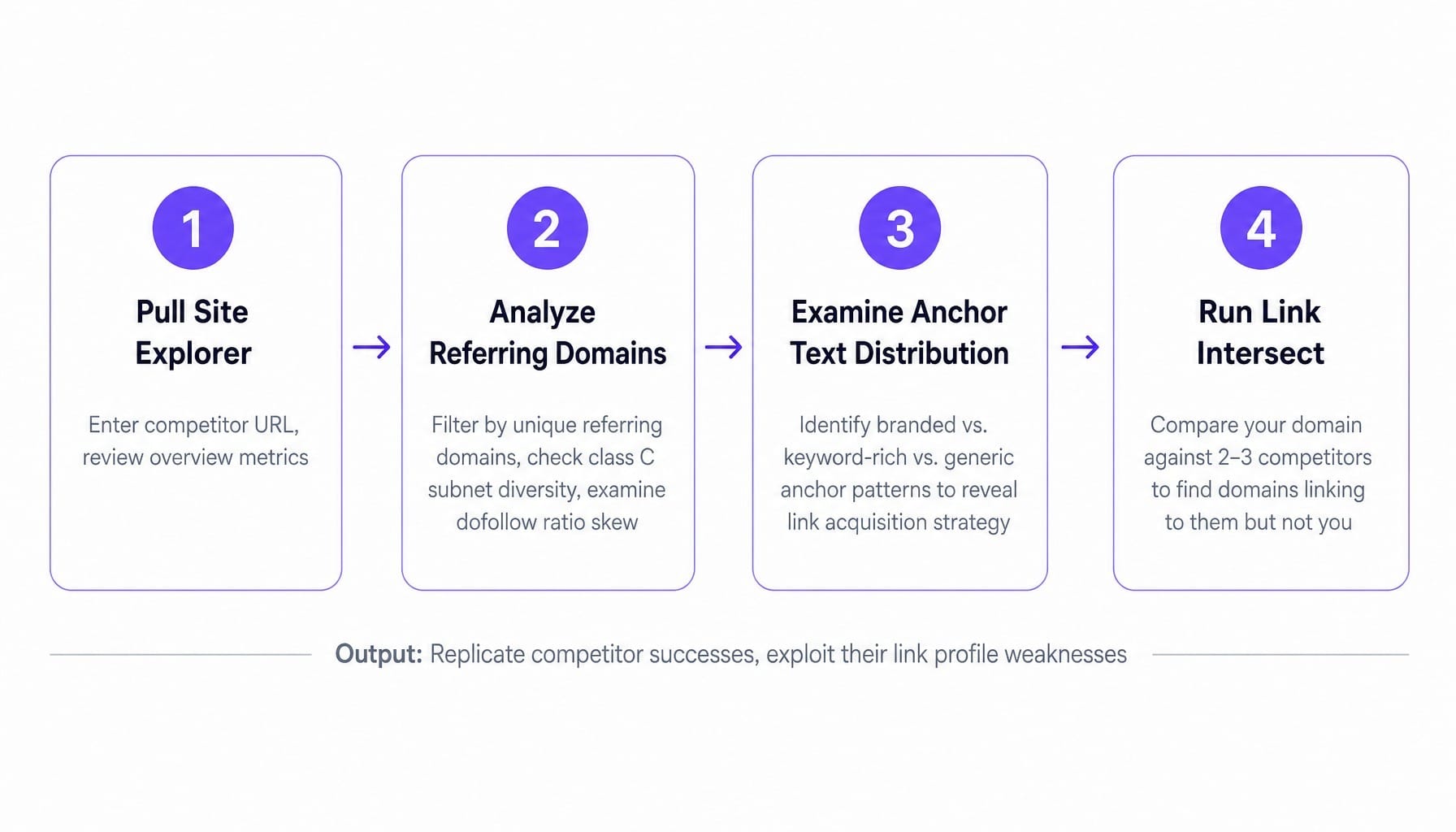
You can even spot the quality of their program by checking the dofollow ratio skew. Ahrefs doesn't just count backlinks—it exposes the system a competitor is running to acquire them, allowing you to replicate their successes and exploit their weaknesses.
Read more: Ahrefs vs Majestic: Which Backlink Tool Fits Your Actual Workflow (2026 Comparison)
Keyword Research for Low-Volume B2B Verticals
The world of B2B marketing runs on keywords with 50-200 monthly searches—terms that most tools either ignore or report as having zero volume. This is where Ahrefs' data model provides a distinct advantage. Its use of clickstream-adjusted volume and, more importantly, the Traffic Potential metric changes the entire calculus for B2B keyword research.
Consider a cybersecurity SaaS company evaluating the term "SIEM implementation guide." Ahrefs might show a search volume of only 90, but a Traffic Potential of 1,400. Why? Because it understands the top-ranking pages for that term also rank for dozens of related long-tail queries. This metric shifts the focus from a single keyword's volume to a topic's total traffic opportunity.
Combined with search intent classification filters that help isolate commercial and transactional keywords, this allows B2B teams to prioritize zero-volume keyword mining and find terms that generate pipeline, not just vanity traffic. For the low-volume, high-intent reality of B2B, Ahrefs' keyword model is uniquely suited to the task.
Site Audit as a Technical Baseline (Not a Replacement)
Let's be clear: Ahrefs' Site Audit is not a replacement for a deep technical crawler like Screaming Frog. However, it is an excellent tool for establishing a technical health baseline and, more importantly, for ongoing monitoring of regressions.
For a lean B2B team without a dedicated technical SEO specialist, Site Audit excels at surfacing critical issues without requiring complex configuration. It's particularly effective for monitoring Core Web Vitals, visualizing internal linking structures to find orphan pages, and identifying signs of index bloat detection. One of its most useful functions is flagging crawl parity issues—discrepancies between what Ahrefs can crawl and what Google has actually indexed.
Where it falls short is in crawl depth configuration, custom data extraction, and advanced JavaScript rendering control—workflows where Screaming Frog remains indispensable. The ideal mental model: use Ahrefs for your weekly or monthly health checks and automated alerts, but pull out Screaming Frog for deep investigations and migrations.
Where Ahrefs Falls Short for B2B Marketing Teams
Ahrefs' weaknesses are not about data quality. They are about what happens after the data is surfaced—and the operational friction it creates for lean teams.
Organic Traffic Estimates Break Down in B2B Niches
Here's a scenario many B2B marketers have experienced: you use Ahrefs' traffic estimates for your monthly leadership report, only to find out later that the actual numbers in Google Search Console are off by 40-60%. This isn't a bug; it's a feature of their methodology. Ahrefs' organic traffic estimation relies on third-party clickstream data panels, which are heavily skewed toward consumer behavior and large websites.
For B2B sites with 5,000 to 50,000 monthly visits targeting niche professional audiences, the traffic value delta between Ahrefs' estimate and reality can be massive. This creates a significant credibility problem.
The workaround is to change your mental model. Never use Ahrefs' traffic numbers for absolute reporting. Use them for directional, relative comparisons against competitors ("Competitor A gets roughly 2x our estimated traffic"). For your own site's performance, Google Search Console is the only source of truth.
Domain Rating Is Misleading for Niche B2B Sites
DR inflation is a real problem, and relying on Domain Rating (DR) as a primary competitive metric is one of the biggest strategic mistakes a B2B team can make. Ahrefs calculates DR based on the quantity and authority of referring domains, but the algorithm doesn't weigh topical relevance sufficiently.
A niche fintech SaaS with a DR of 45, built on 200 highly relevant links from financial news sites and banking blogs, possesses far more ranking power for its target terms than a general-purpose marketing site with a DR of 70 built on 2,000 irrelevant links. Chasing DR parity with a competitor is a waste of resources. The real gap is almost always in topical authority, not raw link volume.
Instead of DR, use Ahrefs' referring domain reports to analyze relevance and study the position distribution curve to see how broadly a competitor ranks across the top 10 positions. These are far better indicators of true authority in a B2B niche.
No Content Optimization Layer Worth Using
Ahrefs knows it has a content gap. It has tried to plug it with features like Content Grader and the AI-powered Content Helper. But for a B2B team that needs to produce expert-level content, these tools are an afterthought, not a workflow. They are shallow compared to dedicated content optimization platforms like Surfer SEO or Clearscope.
This creates a tool fragmentation problem. A B2B content team will use Ahrefs for keyword research and competitive analysis, then immediately have to switch to another tool to build a content brief, analyze semantic coverage, and optimize the draft. This means another subscription, another workflow, and another context switch.
Given that Ahrefs' "Content Kit" is a $99/month add-on, you're paying a premium for functionality that doesn't replace the need for a best-in-class tool. Ahrefs is a research platform, not a content production or execution system. Plan your stack accordingly.
The Credit System: What Ahrefs Actually Costs Per Workflow
Most Ahrefs reviews mention the monthly price but ignore the single biggest factor in its real-world cost: the credit system. Your plan's sticker price is a floor, not a fixed cost. The ceiling is determined by your credit burn rate.
Every action in Ahrefs consumes credits. A Site Explorer overview costs 1 credit. Each additional tab (backlinks, anchors, referring domains) costs another. A keyword lookup costs a credit. A SERP analysis costs a credit. For an active B2B team, these add up fast.
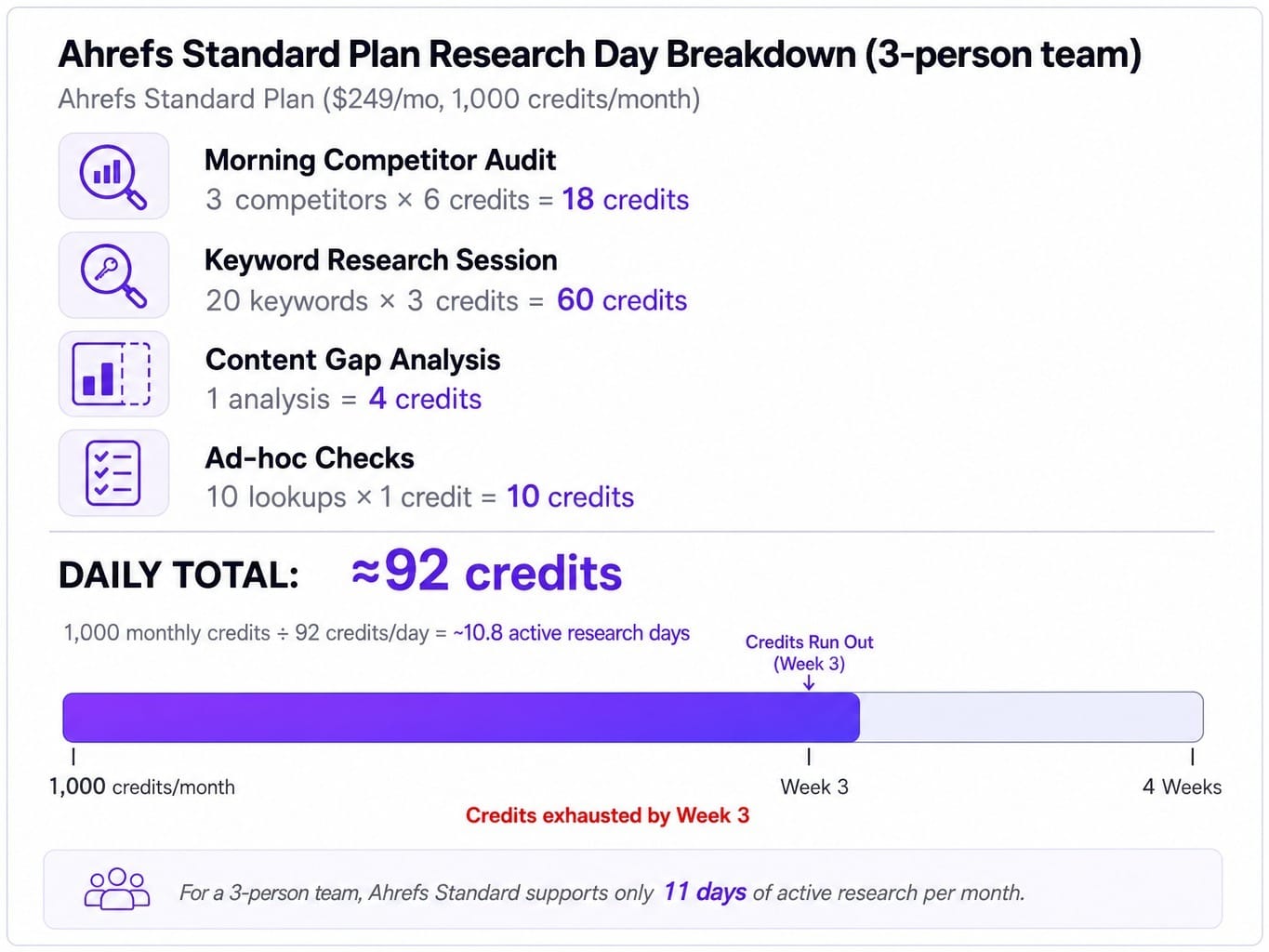
Let's model a typical research day for a 3-person team on the $249/mo Standard plan (1,000 credits/mo):
- Morning Competitor Audit: Pulling Site Explorer and 5 report tabs for 3 competitors. (3 competitors 6 credits = 18 credits)
- Keyword Research Session: 20 core keywords, each expanded to view matching terms and SERPs. (20 3 credits = 60 credits)
- Content Gap Analysis: Comparing your domain against 3 competitors. (4 credits)
- Ad-hoc checks: 10 more quick lookups throughout the day. (10 credits)
That's over 90 credits in one day. A few focused sessions like this, plus a monthly Site Audit crawl, and a team can easily exhaust its 1,000 credits by the third week of the month. At that point, your intelligence system shuts down, or you're forced into a costly upgrade. Before buying, map your essential weekly workflows and calculate your expected credit consumption.
Ahrefs as a Single Stack vs. Best-of-Breed Assembly
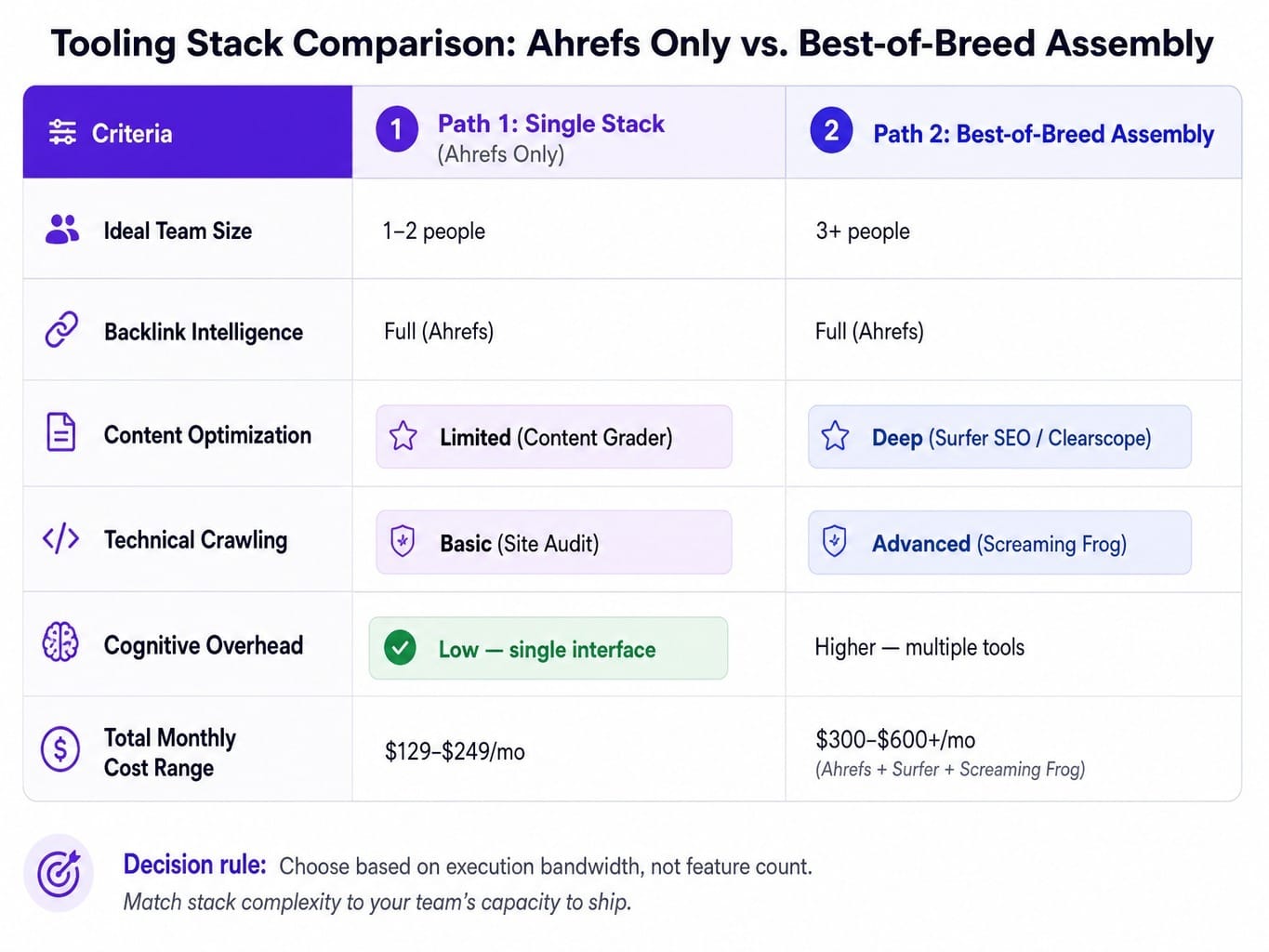
The real question for B2B teams isn't just "Is Ahrefs good?" but "How should Ahrefs fit into our execution system?" This boils down to a choice between a consolidated single stack and a specialized, best-of-breed assembly. The right answer depends entirely on your team's execution bandwidth.
Path 1: The Solo Marketer / Lean Team (1-2 people)
For a solo marketer or a tiny team, the cognitive overhead of managing four separate tools (e.g., Ahrefs for links, Screaming Frog for technical, Surfer for content, GSC for tracking) can be a significant bottleneck. In this scenario, consolidating on Ahrefs as a single platform is a defensible choice. You accept its limitations in content optimization and deep technical crawling in exchange for fewer context switches and a unified interface. The goal is to reduce friction, even if it means sacrificing some capability.
Path 2: The Specialized Growth Team (3+ people)
For a team of three or more, where roles start to specialize (e.g., a content lead, an SEO lead), the best-of-breed approach wins. At this scale, the capability gaps in Ahrefs become material constraints. The content lead is better served by Surfer SEO's deep analysis. The technical lead needs the granular control of Screaming Frog. The accuracy of Google Search Console for rank tracking becomes non-negotiable. Here, Ahrefs serves as the core intelligence layer for backlinks and keyword discovery, but it's not the entire system. While Semrush offers a broader all-in-one feature set, Ahrefs' backlink index and keyword difficulty data remain superior.
Read more: Serpstat vs Ahrefs in 2026: Real Cost, Data Accuracy, and Who Should Switch
The decision isn't about features. It's about matching your tool stack's complexity to your team's capacity to execute.
When the Bottleneck Isn't Intelligence — It's Shipping the Fix
This entire review builds to one conclusion: Ahrefs is exceptional at surfacing what needs to change. It will fill your backlog with keyword gaps, backlink opportunities, content decay alerts, and technical debt. But for most lean B2B teams, the backlog grows faster than they can ship. This is the execution gap.
Every insight Ahrefs provides becomes a ticket. Every ticket requires discussion, prioritization, planning, and manual execution across multiple systems. The latency between identifying a problem and deploying a fix eats weeks, and the highest-impact work often gets stuck behind lower-priority tasks that are easier to ship.
If your primary constraint is execution bandwidth, not a lack of intelligence, then adding another intelligence tool doesn't solve the core problem. You need an execution system. Where Ahrefs identifies the highest-impact opportunities, Spike AI prioritizes them by projected revenue impact and deploys the fix—every single week. We turn the backlog into an approval queue, fusing SEO, CRO, and paid media insights into a single, closed-loop system that ships.
See how Spike AI turns your SEO backlog into weekly shipped improvements
Conclusion: Choose Your Tools Based on Shipping Velocity
Ahrefs remains the best research layer in SEO. Its backlink intelligence is unmatched, its keyword data model is uniquely suited for B2B niches, and its site audit provides a solid technical baseline. But it is just one layer in a system, not the system itself.
Its misleading traffic estimates and DR metrics require practitioner oversight, its credit economics can make it prohibitively expensive, and its lack of a meaningful content optimization layer creates workflow fragmentation. The single most important takeaway from this Ahrefs review is that intelligence quality is no longer the primary bottleneck for B2B growth. Execution velocity is.
The teams that win in 2026 won't be the ones with the most comprehensive dashboards; they'll be the ones that ship the most high-impact changes per month. Choose your SaaS marketing tools accordingly.
Frequently Asked Questions
Is Ahrefs accurate for estimating organic traffic on B2B websites in 2026?
It's directionally useful for competitive benchmarking but often inaccurate for absolute measurement. Expect a 30-60% variance from Google Search Console on B2B sites under 50,000 monthly visits because its clickstream data panels underrepresent niche professional audiences. Always use GSC as the source of truth for reporting.
Does Ahrefs offer API access on all pricing tiers?
No. API access begins with the Standard plan ($249/mo), but the credit allocation is separate from UI credits and is quite limited. Enterprise plans offer more generous API limits. If you plan to build automated reporting in Looker Studio or other BI tools, you must factor the cost of API credits into your total budget.
How often does Ahrefs update its backlink index in 2026?
Ahrefs has the fastest index in the industry. It crawls over 5 million pages per minute and its systems are designed to discover and index newly built backlinks within 15-30 minutes. This near-real-time freshness is a significant advantage for monitoring link velocity and analyzing competitor campaigns as they happen.
Can Ahrefs identify topical authority gaps for B2B websites?
Partially, but not directly. You can use the Content Gap and Link Intersect tools to find specific keywords and linking domains that competitors have and you don't. However, Ahrefs lacks a dedicated topical authority mapping feature that visualizes your semantic coverage of a topic cluster. For true topical analysis, you'll need to combine Ahrefs data with manual analysis or a dedicated tool.
What Ahrefs plan do I need for enterprise-level B2B SEO?
Most enterprise B2B teams will require the Advanced plan ($449/mo) as a minimum. This tier provides enough credits for a small team, access to 6+ months of historical data, and features like keyword clustering. Per-seat costs ($50-$100/mo per extra user) and add-ons like Brand Radar ($99/mo) must also be factored into your budget.
What integrations does Ahrefs support for automated SEO reporting?
Ahrefs provides a native Looker Studio (formerly Google Data Studio) connector and API access for custom integrations. It does not offer native integrations with HubSpot, Salesforce, or other common marketing automation platforms. To pipe Ahrefs data into your CRM for revenue attribution, you will need to use a third-party connector or build a custom solution via the API.