
Serpstat vs Ahrefs: Where the Data Actually Diverges (2026 Comparison)

TL;DR
- Backlink Data: Ahrefs has a significantly larger and fresher backlink index, making it the clear choice for active link acquisition and competitive intelligence. Serpstat is adequate for high-level monitoring.
- Keyword Difficulty (KD): The tools measure different things. Ahrefs' KD is backlink-centric, estimating the link investment needed to rank. Serpstat's KD is a composite score. Never compare them directly; use Ahrefs for link planning and validate Serpstat's scores with manual SERP analysis.
- True Cost: The sticker price is misleading. Ahrefs' credit system can be quickly exhausted by daily workflows, pushing you to higher tiers. Serpstat is more cost-effective at entry levels but gates features and export rows. Model your actual usage to find the real cost.
- The Verdict: Ahrefs is the superior tool for data depth and freshness, especially in English-speaking markets. Serpstat is a viable, cost-efficient alternative for teams on a tight budget, those focused on non-English markets, or those whose workflows don't require deep, daily backlink analysis.
- The Real Constraint: Both tools generate backlogs. The winning strategy isn't just choosing the right tool, but building a system to execute on the insights it provides, consistently.
Most Serpstat vs Ahrefs comparisons are a feature-checklist exercise. They miss the fundamental point: choosing an SEO tool isn't about who has more buttons. It's about which tool's data model and architectural biases you'll trust enough to build your daily execution workflow around.
The core tension is this: for the same domain, the same keyword, the same backlink profile, these two tools often produce meaningfully different numbers. That divergence isn't a bug. It reflects different crawling architectures, scoring methodologies, and data freshness cadences. A team that picks a tool without understanding why the numbers differ will constantly second-guess their own decisions.
This comparison is for practitioners. We'll start with a quick verdict for those who need an answer now. Then, we'll dissect the operational differences that actually matter: backlink index integrity, keyword difficulty methodology, the hidden cost-per-query, and regional data coverage.
Serpstat vs Ahrefs at a Glance: The Decision Matrix
This table summarizes where each tool leads based on 2026 data. The rest of the article unpacks the rows where the tools diverge most, because those are the areas that determine whether you'll trust the tool or fight with it.
The real decision isn't in this table. It's in understanding the implications of these differences. A larger backlink index is useless if it's stale, and a lower price is irrelevant if you hit usage limits in the first week.
Backlink Index: Why the Two Tools Show Different Link Profiles for the Same Domain
Ahrefs and Serpstat will show you different backlink counts for the same domain—sometimes dramatically so. A B2B marketing lead runs a competitor's domain through both. Ahrefs shows 12,000 referring domains; Serpstat shows 4,800. Understanding why is more important than knowing which number is bigger.
The question isn't "which is right?" but "which tool's crawl architecture discovered the links that matter for my strategy?" A backlink index is a function of three things: crawl budget (how many pages a tool can crawl), crawl frequency (how often it recrawls them), and link graph depth (how many links-of-links it follows).
Ahrefs claims to crawl over 8 billion pages daily, with a backlink update cycle measured in days. Serpstat's refresh cadence is closer to 2-4 weeks. This architectural difference is the primary source of data discrepancy. Ahrefs' system is built for near-real-time discovery, while Serpstat's provides a periodic snapshot.
Index Size vs. Index Freshness: Which Matters More for Link Prospecting
For most B2B link-building workflows, index freshness matters more than raw index size. A massive but stale index is full of dead links and 404s, wasting outreach cycles on opportunities that no longer exist. It inflates referring domain counts and gives you a false sense of a competitor's strength.
This is where the concept of "referring domain velocity"—the rate at which a competitor gains or loses links—becomes critical. Only a fresh index can reliably surface this. If a competitor just landed a major placement on a high-DR site, Ahrefs will likely spot it within a week. With Serpstat, you might not see that link for a month, losing a critical window to react or replicate the success.
Ahrefs' aggressive crawl cadence gives it a structural advantage for any time-sensitive link prospecting, digital PR monitoring, or competitive intelligence that relies on seeing the link landscape as it is today, not as it was three weeks ago. The larger index is a byproduct of this aggressive crawling; the freshness is the real operational benefit.
Read more: Ahrefs vs Majestic: Which Backlink Tool Fits Your Actual Workflow (2026 Comparison)
What Serpstat's Backlink Data Is Still Useful For
This doesn't render Serpstat's backlink module useless. For teams that aren't running aggressive, daily outreach campaigns, its data is often operationally adequate.
Serpstat is sufficient for high-level competitive landscape mapping: understanding the general shape of a competitor's link profile, identifying broad categories of link sources, and monitoring your own backlink health at a portfolio level. If your primary need for backlink data is for quarterly reporting, defensive monitoring (checking for spammy links), or identifying the most obvious, long-standing links of your top three competitors, Serpstat gets the job done.
The choice depends entirely on your execution cadence. If you're doing active, weekly link acquisition, you need the freshest data possible, and the investment in Ahrefs is justified. If your workflow is more passive monitoring and periodic analysis, Serpstat provides a perfectly viable and more cost-effective data source.
Keyword Difficulty Scores: Why the Same Keyword Gets Different Numbers
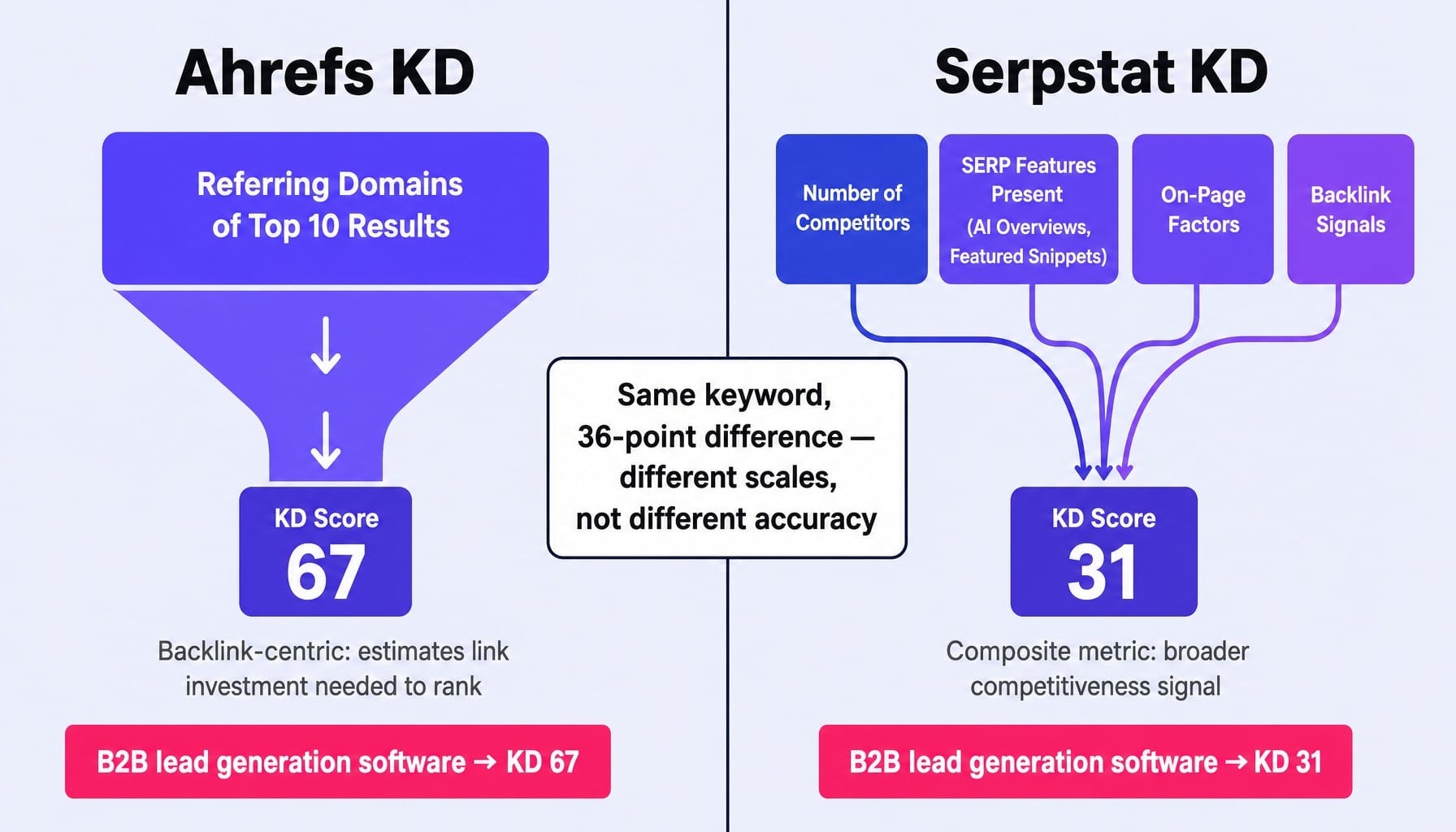
Here's a scenario that exposes the problem: a growth marketer evaluates "B2B lead generation software." Ahrefs shows a Keyword Difficulty (KD) of 67. Serpstat shows a KD of 31. It's the same keyword, but the tools are sending opposite signals. If you trust Serpstat, you prioritize it. If you trust Ahrefs, you target something else. The tool you use dictates your content strategy.
This happens because Ahrefs and Serpstat are measuring different things. Neither is "wrong," but they aren't interchangeable. The KD delta between tools is significant; it's not uncommon to see a 30+ point difference. This isn't a sign of inaccuracy; it's a sign of different methodologies. Understanding this is the key to using either tool effectively.
How Each Tool Calculates Keyword Difficulty
Ahrefs' KD methodology is famously backlink-centric. It primarily estimates the number of referring domains you would need to rank in the top 10 for a given keyword, based on the link profiles of the pages currently ranking. Ahrefs has been public about this: their KD score is intentionally narrow. It measures link difficulty, not overall ranking difficulty.
Serpstat's KD score is a composite metric. It incorporates a broader set of signals, including the number of competitors, the presence of SERP features (like AI Overviews and featured snippets), and other on-page factors. This results in a score that is harder to reverse-engineer but often lower for the same keyword because it's not solely dependent on the backlink strength of the top results.
Comparing these two scores directly is like comparing temperatures in Celsius and Fahrenheit without converting. They are different scales measuring related but distinct phenomena.
A Practitioner's Rule of Thumb for Cross-Tool KD Interpretation
Here is an actionable framework for interpreting these divergent scores:
- When using Ahrefs KD: Treat it as a direct estimate of the link-building investment required. A high KD (60+) means you will not rank without a serious, sustained effort to build high-quality backlinks. It's a budget planning metric for your link acquisition team.
- When using Serpstat KD: Treat it as a general "competitiveness" signal. A lower KD might indicate fewer pages are perfectly optimized for that term, or that the SERP is less commercially saturated. It's a signal to investigate further.
And let's be honest, the best practitioners never trust a single KD number from any tool. The only source of truth is the SERP itself. Regardless of which tool you use, the final step is always manual analysis. Look at the top 10 results. What is their Domain Rating (DR)? How deep is their content? Do they have strong topical authority? The KD score is the starting pistol, not the finish line.
The Hidden Cost Anatomy: What You Actually Pay Per Query
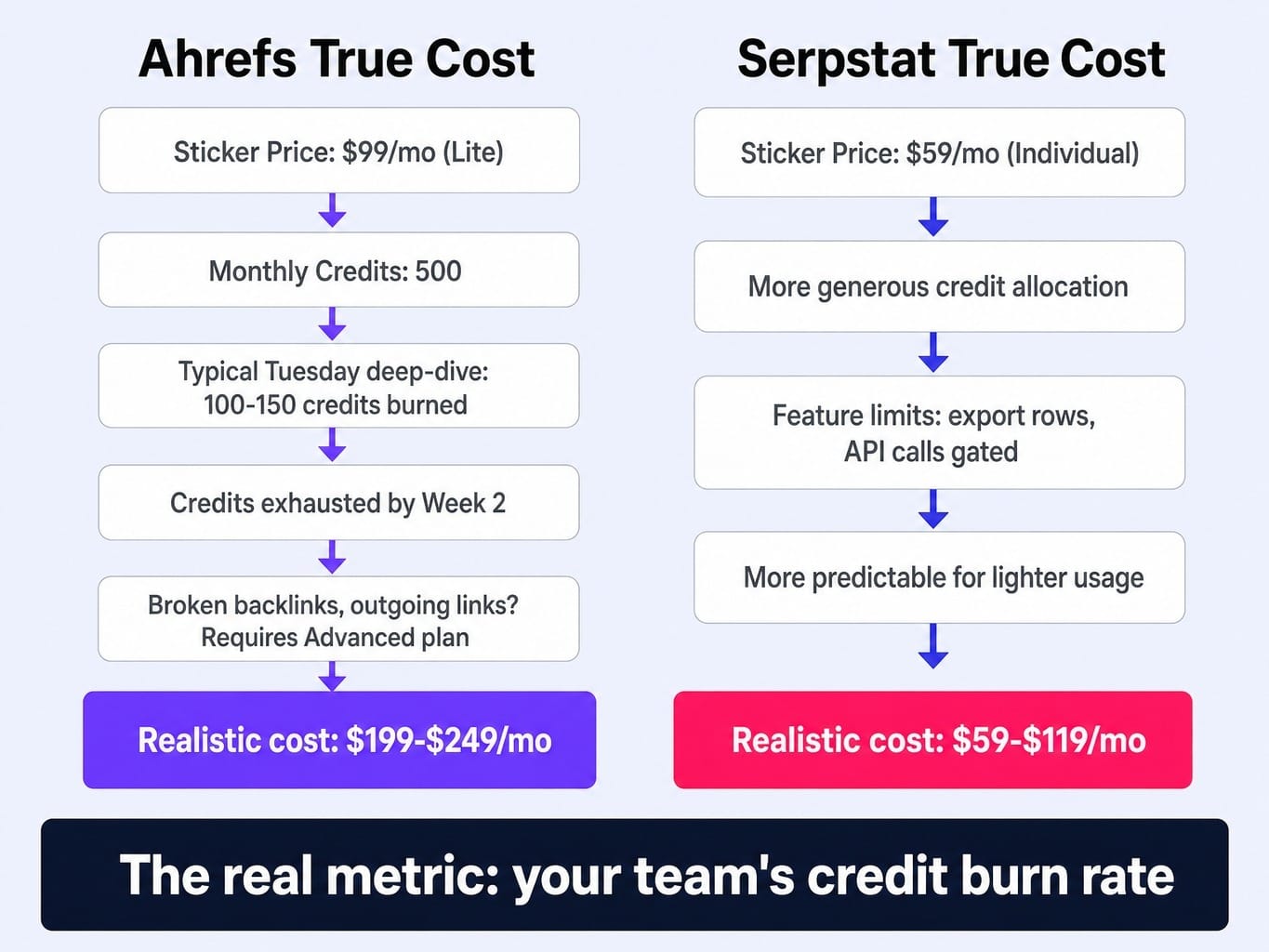
The sticker price comparison between Serpstat ($59/mo+) and Ahrefs ($99/mo+) is misleading. Both tools gate their functionality behind usage limits that most reviews gloss over, and the real cost is a function of your team's execution velocity.
Consider a lean, 3-person B2B marketing team. Their weekly workflow includes competitor audits, monthly content gap analyses, and daily rank checks. On Ahrefs' Lite plan ($99/mo), they get 500 credits per month. Each Site Explorer query, each Keywords Explorer lookup, each new domain added to Rank Tracker burns credits. A single deep-dive competitor analysis session on a Tuesday morning can burn through 100-150 credits. At that rate, they'll hit their monthly limit in two weeks, stalling all research. The work doesn't stop, but the tool does.
Serpstat's credit system is more generous on lower tiers, but it creates friction elsewhere with limits on export rows and API calls. The real metric is your team's "credit burn rate."
Ahrefs, in particular, aggressively tier-gates features. Want to see a competitor's broken backlinks or outgoing links? That's on the Advanced plan, at $249/mo. This isn't just an upsell; it's a workflow constraint. You identify a need, go to the tool, and hit a paywall. The true cost of Ahrefs for a serious B2B team is rarely the advertised $99/mo; it's the $199/mo or $249/mo plan you're forced to upgrade to just to do your job. Serpstat is more inclusive with features on its lower plans, making it a more predictable expense for teams with lighter usage patterns.
Read more: Ahrefs Pricing in 2026: What You'll Actually Pay (Plans, Hidden Costs, and Per-Deliverable Math)
Site Audit and Rank Tracking: The Daily-Use Features Competitors Ignore
Comparisons obsess over backlinks and keywords, but the features most B2B teams use daily are site audit and rank tracking. The experience here differs meaningfully.
Site Audit: Ahrefs' Site Audit is more technically granular. It excels at surfacing complex issues like internal link opportunities, JavaScript rendering problems, and page-level indexability conflicts. It's built for a technical SEO specialist. Serpstat's audit is simpler but arguably more immediately actionable for a generalist marketer. It organizes issues into clear priority buckets (critical, warnings, notices), which helps a lean team decide what to fix first without getting lost in a sea of low-impact suggestions.
Rank Tracking: The key difference is update cadence. Serpstat offers daily rank tracking on most of its plans, providing a high-frequency signal of SERP volatility. Ahrefs' update frequency is tied to your plan tier, with lower plans updating less often. Both tools track SERP features, showing you when you appear in AI Overviews, People Also Ask boxes, and featured snippets. For a team that needs to react quickly to ranking drops or capitalize on new SERP feature wins, Serpstat's daily data on lower tiers is a distinct advantage.
Regional and Multilingual Database Depth: The Comparison Nobody Makes
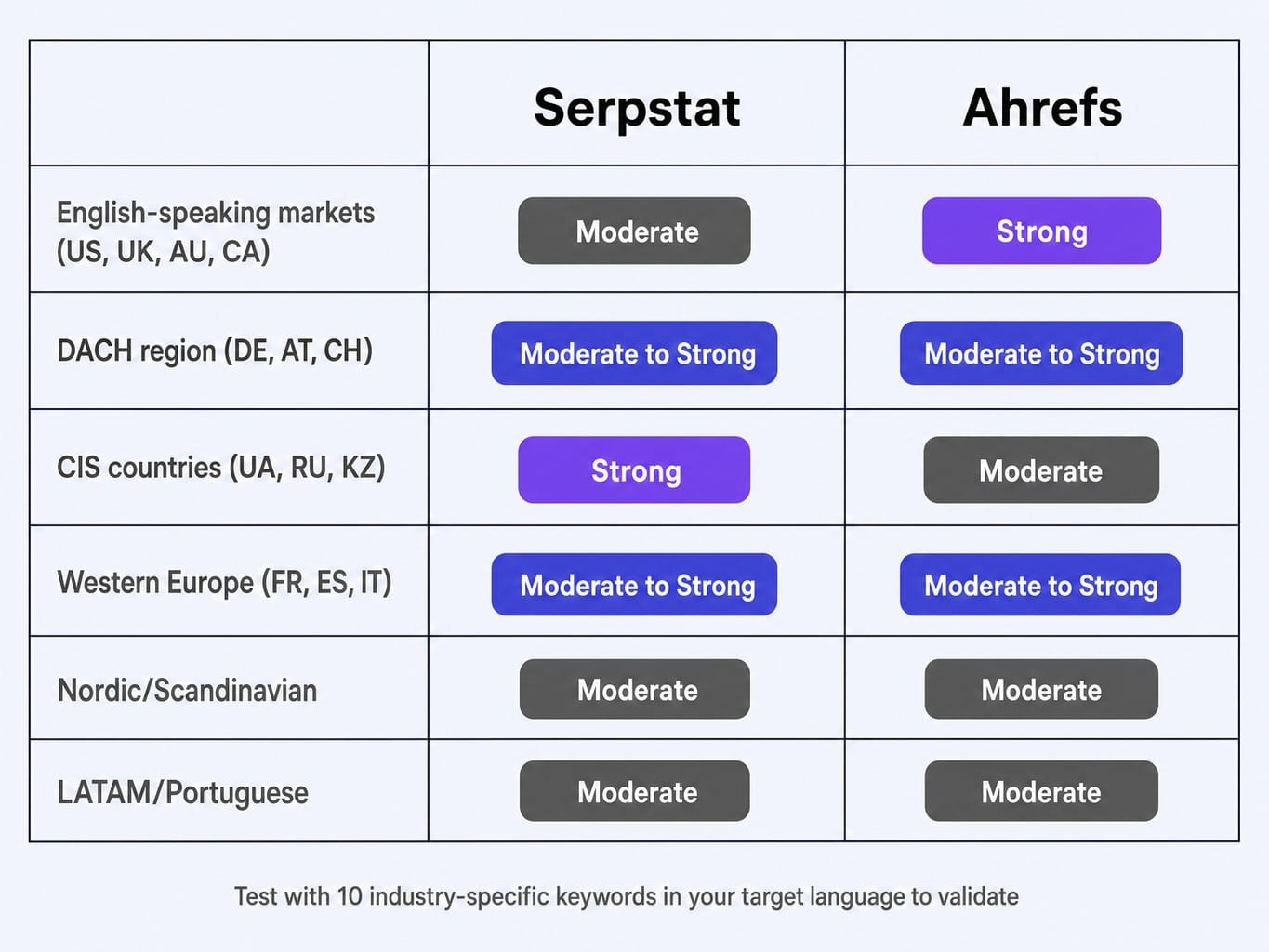
If your B2B company operates exclusively in English-language markets, Ahrefs' database dominance is unambiguous. The comparison gets interesting when it doesn't.
Serpstat was founded in Ukraine and has historically maintained stronger and deeper keyword databases for CIS countries, parts of Eastern Europe, and certain non-English markets where Ahrefs' crawl coverage can be thinner. If you're a B2B SaaS company expanding into the DACH region (Germany, Austria, Switzerland), France, or Spain, this matters. Your keyword research is only as good as the database behind it. A tool with weak coverage in your target market will miss long-tail opportunities and provide unreliable search volume estimates, leading to poor content strategy decisions.
The best way to test this is simple and takes 10 minutes. Identify 10 core, industry-specific keywords in your target language. Run them through both tools' keyword explorers. Compare the search volume data, the number of related keyword ideas, and the depth of the suggestions. If one tool consistently returns more data and more relevant long-tail variants, that's your answer for that specific market.
When the Real Bottleneck Isn't Which Tool You Pick
Choosing between Serpstat and Ahrefs is a meaningful decision. But both tools, for all their power, share the same fundamental limitation: they surface data and leave execution entirely on your plate.
Every backlink report, every keyword opportunity, every site audit alert generates work. For lean B2B teams, the bottleneck was never which SEO tool to subscribe to. It's the latency—the weeks of discussion, planning, and approvals—between what the tool tells you and what actually gets deployed on your website. You have the insights; you lack the shipping cadence.
This is the execution gap that Spike AI is built to close. Instead of just diagnosing problems, Spike AI functions as a marketing execution engine. It identifies the highest-impact move across your SEO, content, and CRO, and then helps you ship it. The goal isn't just to build a better dashboard; it's to turn your backlog into a weekly release cycle. The tool comparison matters, but the execution gap matters more.
See how Spike AI turns SEO insights into weekly shipped improvements
Conclusion: It's a Workflow Decision, Not a Feature Decision
The right choice between Serpstat and Ahrefs is not about which tool has "more features." It's about which tool's data model, cost structure, and update cadence best fit your team's actual workflow.
Ahrefs is the clear winner on backlink depth, crawl freshness, and English-language keyword coverage. It's the professional standard for a reason. Serpstat wins on cost efficiency, feature accessibility on lower tiers, and data depth in specific non-English markets. It's a powerful and viable choice for teams whose workflows don't demand the absolute-latest backlink data.
But the tool you pick matters far less than your ability to act on what it surfaces. The teams that compound SEO gains aren't the ones with the most expensive subscription. They are the ones that have a system to ship changes, measure the impact, and ship again—every single week.
Frequently Asked Questions
Can I use Serpstat and Ahrefs together in a complementary stack?
Yes, and some teams do. They use Serpstat for broad keyword discovery and content gap analysis, where its lower cost-per-query is an advantage, then validate high-priority targets in Ahrefs for deep backlink analysis. The combined cost (~$160/mo) can be justified if your workflow genuinely leverages each tool's unique strengths instead of duplicating lookups.
Is Serpstat accurate enough to replace Ahrefs for backlink analysis?
For active link-building where you need to track referring domain velocity and find fresh prospects, Ahrefs' index is meaningfully more comprehensive. For high-level monitoring, quarterly competitive audits, and identifying long-standing links, Serpstat's backlink data is adequate. Teams doing weekly outreach, however, will find gaps in Serpstat's coverage that affect targeting.
How often do Serpstat and Ahrefs refresh their keyword and backlink databases?
Ahrefs crawls billions of pages daily and updates its backlink index within days. Serpstat's backlink index typically refreshes on a 2-4 week cycle. For fast-moving competitive landscapes, this freshness gap means Ahrefs will surface new competitor links and keyword trends weeks before Serpstat does, which can be a significant competitive disadvantage.
Does Serpstat offer AI-powered keyword clustering comparable to Ahrefs?
Serpstat has offered keyword clustering longer than Ahrefs, and it remains one of its stronger features, grouping keywords by SERP similarity to show which terms can be targeted on one page. Ahrefs has since added similar capabilities. Be aware that Serpstat often locks its most advanced clustering features behind higher-tier plans, so verify access before subscribing.
Which tool is better for agencies managing 15+ client projects?
Ahrefs' agency-level plans support more projects with deeper data, but the cost scales steeply ($249-$999+/mo). Serpstat's Agency plan is more cost-effective for a high volume of projects and includes white-label reporting out of the box. The choice usually comes down to whether your agency's core deliverable is backlink analysis (favors Ahrefs) or keyword research and reporting volume (favors Serpstat).