Similarweb Pricing in 2026: Plans, Hidden Costs, and What You'll Actually Pay
TL;DR
- Similarweb's published pricing is the floor, not the ceiling. The real entry point for serious B2B teams is the Team plan at $14,000/year, not the $199/month Starter plan.
- The total cost of ownership often doubles the sticker price due to hidden costs like mandatory add-on modules ($15K+), API overages, mid-contract seat expansion premiums (10-20%), and renewal price hikes.
- Similarweb's data accuracy degrades significantly for sites under 100K monthly visits. If your competitive set is in this range, you're paying enterprise prices for directional estimates with a 40-60% error margin.
- Negotiate everything. Enterprise quotes are starting points. Leverage Q4 timing, multi-year commitments, and bundled modules to secure discounts of 20-30% and insist on a renewal price cap.
- For many B2B teams, a composite stack of Semrush or Ahrefs ($1,200-$1,700/yr) plus Similarweb's free tier provides deeper SEO intelligence and better ROI than a single Similarweb license.
You've landed on the Similarweb pricing page. You see a clean grid of plan names, a few feature checklists, and a starting price that seems manageable. But the enterprise cost is hidden behind a "Contact Us" button, there's no mention of add-on modules, and you have no idea what the renewal conversation will look like in 12 months.
This opacity is by design. Similarweb's published price is the floor, not the ceiling. The real cost of the platform is a function of how many seats you add mid-contract, which intelligence modules are non-negotiable for your use case, whether you require API access, and how effectively you navigate the procurement redline cycle.
This is not another pricing page summary. This is a breakdown of what you will actually pay, written by people who have been through the procurement process. We'll walk through every 2026 tier with real numbers, surface the costs that don't appear on the pricing page, and provide a negotiation playbook for enterprise contracts.
Similarweb Pricing Plans in 2026: Every Tier With Actual Numbers
Similarweb's pricing architecture is engineered to create upgrade pressure. Each tier gates a specific capability—like historical data depth, keyword limits, or subdomain analysis—that most teams only discover they need after committing to a lower plan. The jump between tiers isn't a gentle ramp; it's a series of steep cliffs designed to move you into higher contract values.
The structure is built around five core plans, with the most significant price increase occurring between the Starter and Team tiers.
The critical insight here is the 9x price jump from the Starter plan ($1,500/yr) to the Team plan ($14,000/yr). This isn't an incremental upgrade. It's a jump that unlocks country-level filtering and subdomain-level breakouts—two features that are table stakes for any B2B SaaS team operating in multiple markets or analyzing specific product sections of a competitor's site.
Consider a B2B marketing team that signs up for the Starter plan to test the waters. Within days, they realize they can't filter competitor traffic to just the US and UK, nor can they isolate the traffic going to a competitor's blog.competitor.com subdomain. The platform is functionally useless for their core task. This makes the "real" entry price for any serious marketing team $14,000 per year, not the advertised $199 per month.
What the Free Plan Actually Gives You (and Where It Stops Being Useful)
Similarweb's free tier is useful for one specific task: getting a rough, directional read on a competitor's traffic volume before deciding whether to invest in a deeper investigation. It provides top-level traffic estimates, basic channel splits (Direct, Search, Social), and geography distribution, but with severe limitations that make it unsuitable for ongoing analysis.
The constraints are immediate and absolute:
- 5 results per metric: You see the top 5 keywords, top 5 referring sites, and top 5 social sources. Everything else is blurred out.
- 1 month of historical data: Trend analysis is impossible. You can see last month's traffic, but you can't see if it was an anomaly or part of a pattern.
- No data exports: You can look, but you can't touch. All data is confined to the UI.
The free plan is sufficient for a founder doing initial market validation. They can quickly check if their top five competitors are getting 50,000 or 500,000 monthly visits, which is enough to gauge market size. But for a growth marketer tasked with running monthly competitive reports, the free plan creates more questions than it answers. The truncated data prevents any meaningful analysis of traffic sources, keyword strategy, or performance trends over time.
The Costs That Don't Appear on the Pricing Page
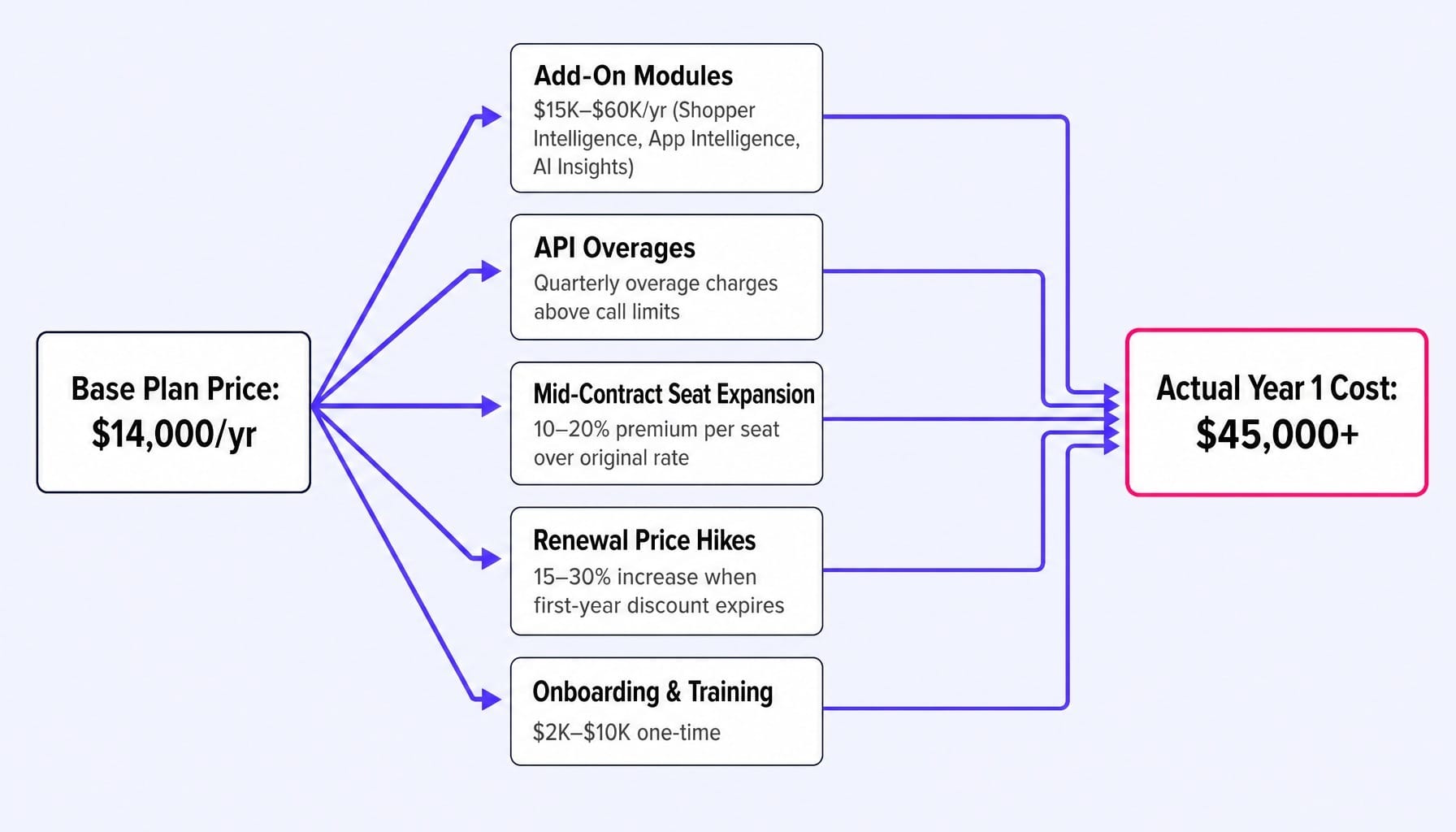
The price on the website is your entry fee. The total cost of ownership is a different number, inflated by at least five additional cost vectors that surface during the sales process or, worse, after you've signed the contract. A plan that starts at $14,000 can easily balloon to over $45,000 in the first year.
Add-On Intelligence Modules
Similarweb unbundles its platform into separate "intelligence" modules, and the most valuable ones are always priced separately. These aren't optional nice-to-haves; for many teams, they are the entire reason for evaluating the tool. Key add-ons include:
- App Intelligence: For mobile app analysis.
- Shopper Intelligence: For e-commerce and SKU-level data.
- Market Research & Conversion Analysis: For deeper funnel and industry views.
- AI Traffic & Insights: The newest AI-driven analysis module.
For an e-commerce company, Shopper Intelligence is essential, yet it can add $15,000 to $60,000 per year to your bill. The "Web Intelligence" plan you see on the pricing page is just the foundation.
API Access, Seat Creep, and Renewal Surprises
This is where costs escalate systemically.
First, API access is not included in Starter or Team plans. It becomes available at the Business tier ($35,000/yr) and comes with strict API call rate limits. If your RevOps team plans to pull data into internal BI tools like Tableau or Power BI, you'll likely need a custom Enterprise plan with a separately negotiated API tier. Exceeding your call limits results in quarterly overage charges.
Second, the seat expansion trap is a classic SaaS revenue strategy. Adding users mid-contract is deliberately punitive, often costing 10-20% more per seat than the rate in your original agreement. This incentivizes you to over-buy seats upfront, locking in a higher initial contract value.
Finally, renewal pricing often comes with a surprise. Initial contracts frequently include a first-year discount that vanishes at renewal, leading to common price increases of 15-30%. A proactive negotiation is your only defense against this built-in escalation.
Onboarding and Monthly Billing Premiums
Two final costs to factor in. First, onboarding and training packages, while presented as optional, are strongly recommended by the sales team. These can range from $2,000 to $10,000 depending on your team's size and needs.
Second, the monthly billing option, available only on the Starter plan, carries a significant premium. The $199/month price amounts to $2,388 over a year. The same plan, paid annually, is $1,500. That's a 59% premium for the flexibility of monthly payments—an $888 difference that's easy to miss.
When Similarweb's Data Isn't Accurate Enough to Justify the Price
Most pricing discussions focus on features and limits, ignoring a more fundamental question: is the underlying data accurate enough for your use case to justify any price?
Similarweb's platform is built on a panel-based estimation methodology. It collects clickstream data from a sample of millions of users who have opted into data collection through browser extensions, ISP partnerships, and app SDKs. It then extrapolates traffic patterns from this sample to estimate behavior across the entire internet.
This model works reasonably well for high-traffic consumer websites (100K+ monthly visits), where the panel provides a large enough sample to generate statistically meaningful estimates.
However, for the niche B2B SaaS world, where a competitor might only have 10,000 to 50,000 monthly visits, the panel coverage is often thin. The estimates can be off by 40-60% in either direction. A competitor getting 30,000 monthly visits might be reported by Similarweb as having 18,000 or 45,000. Without cross-referencing against more reliable sources like Google Ads auction data, you have no way of knowing which direction the error runs.
Here is the practical rule of thumb: If the majority of your competitors and target accounts receive fewer than 100,000 monthly visits, Similarweb's data becomes directional, not actionable. Paying $14,000+ per year for directional data that could be off by 50% is an extremely difficult ROI case to make to any CFO. In this scenario, tools like Semrush or Ahrefs, which rely on different data sources (search index crawling and backlink data), often provide more reliable intelligence for SEO-specific competitive analysis.
Similarweb vs. Semrush vs. Ahrefs: Pricing Compared for 2026
No evaluation of Similarweb happens in a vacuum. Most teams are weighing it against Semrush and Ahrefs. The comparison isn't apples-to-apples; the tools are designed for overlapping but fundamentally different jobs.
Here is the interpretive layer: If your primary job is understanding a competitor's full channel mix—search, social, referral, direct, display—Similarweb is the only tool that provides that breadth. You are paying a significant premium for that market-level view.
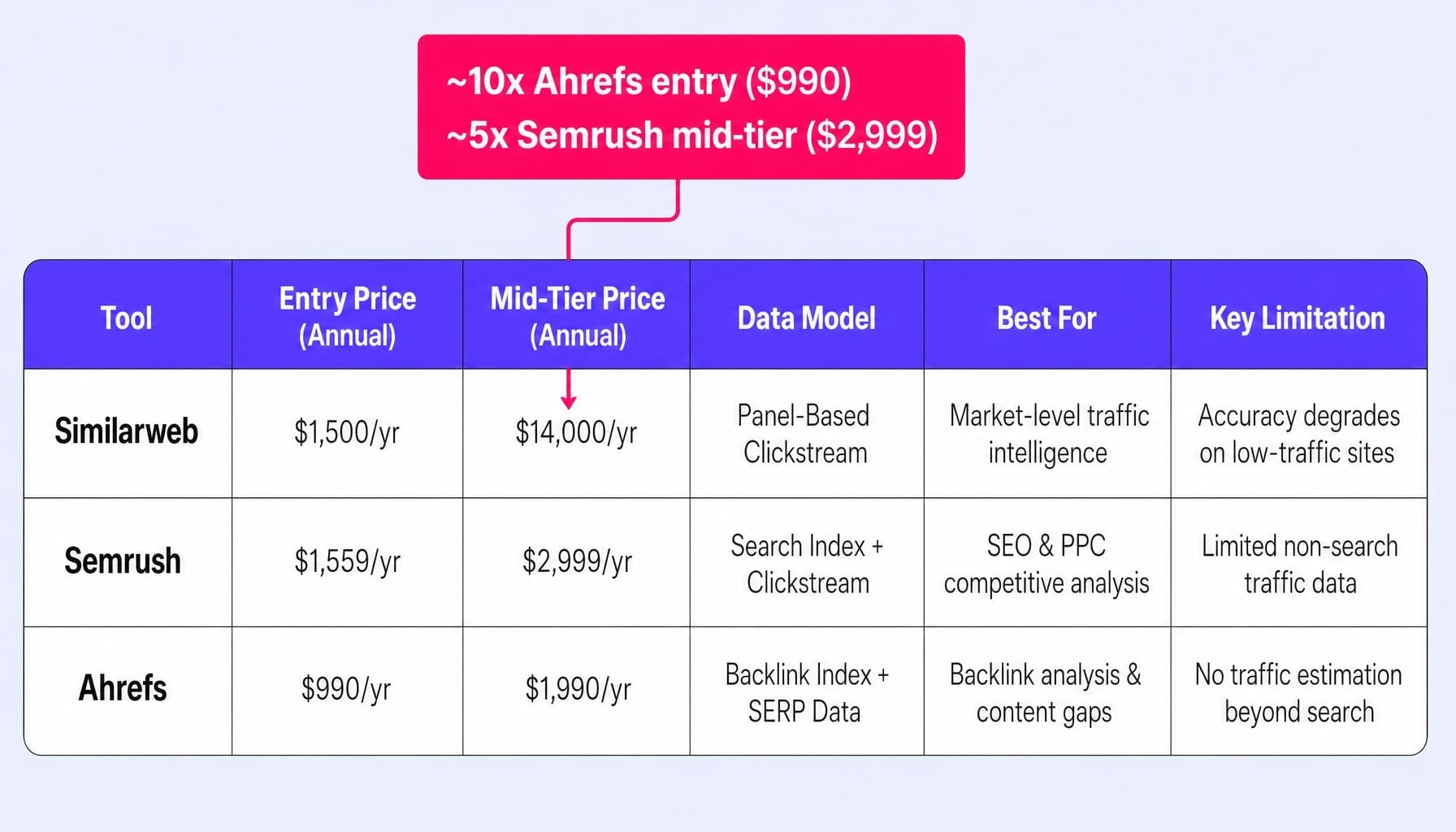
However, if your primary job is SEO and content execution—finding keyword gaps, analyzing backlink profiles, tracking SERP movements—Semrush and Ahrefs deliver deeper, more actionable data at a fraction of the cost. The cost difference is stark: Similarweb's Team plan is over 10x the price of Ahrefs' entry-level plan. For a detailed breakdown of what you'll actually pay for Ahrefs, see our guide on Ahrefs pricing.
For many lean B2B SaaS teams, the optimal system isn't one tool, but a composite stack: Semrush or Ahrefs for daily SEO execution, supplemented by Similarweb's free tier for occasional, directional traffic benchmarking. This stack delivers superior SEO intelligence for a total cost under $2,000/year, versus the $14,000+ commitment for a single Similarweb license.
Read more: SEMRush Pricing in 2026: What You Actually Pay After Add-Ons, Seats, and Hidden Costs
How to Negotiate Similarweb Enterprise Contracts
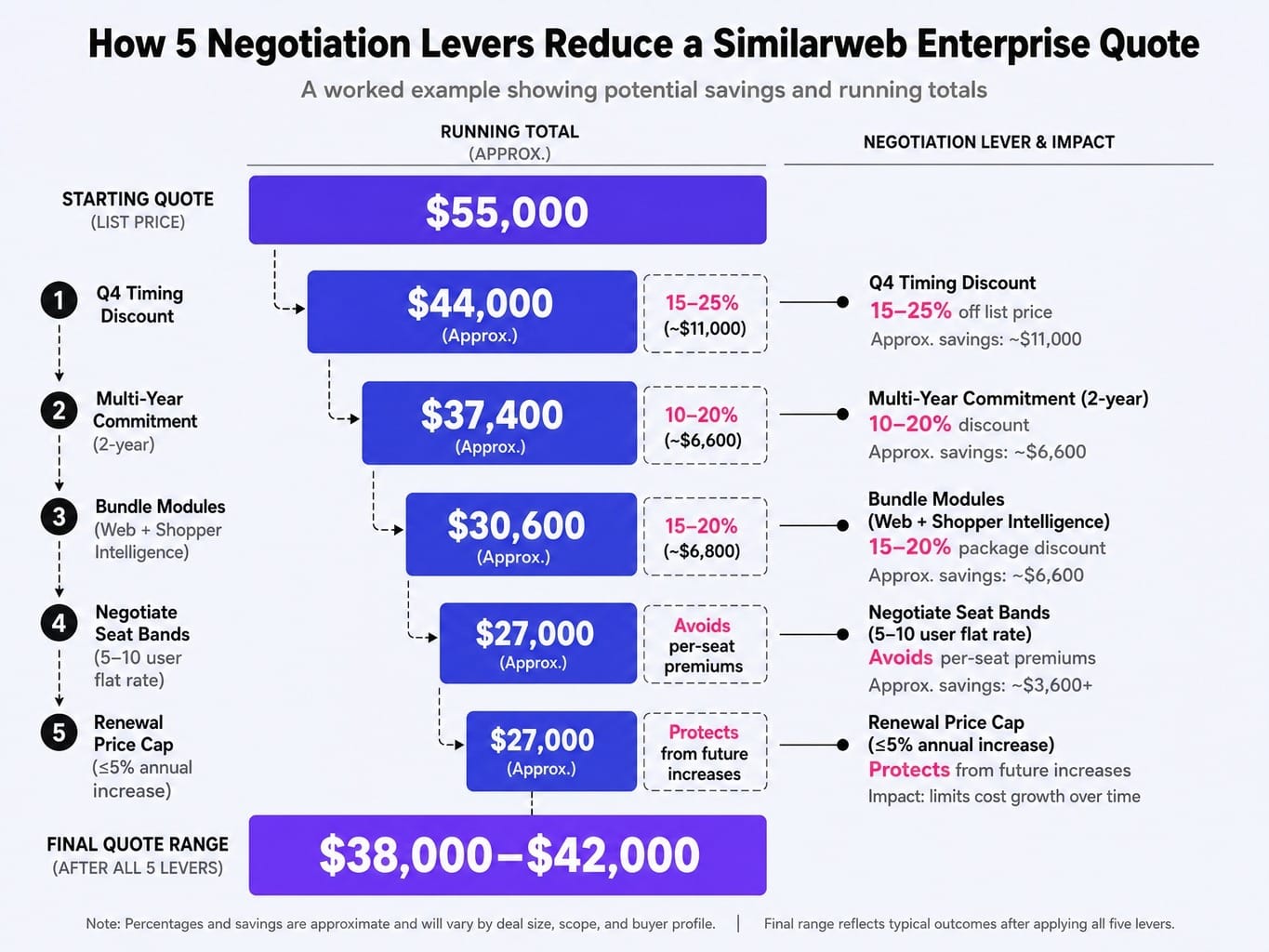
Similarweb's enterprise pricing is not fixed. The initial quote is a starting position, and the sales team has meaningful discount authority, especially at the end of a quarter or fiscal year. Here are five levers to use in your next champion-challenger pricing negotiation.
- Timing is Everything: Similarweb's fiscal year ends in December. Sales reps are most flexible in Q4 (October-December) as they push to hit their annual quota. Deals signed during this period can often secure 15-25% deeper discounts than those signed in Q1 or Q2.
- Commit to Multi-Year Deals: Offering a two-year contract instead of a one-year can unlock an additional 10-20% discount. However, you must pair this with renewal protection.
- Insist on a Renewal Price Cap: The biggest risk of a multi-year deal is a massive price hike in year three. Negotiate a price cap clause (e.g., "annual price increases shall not exceed 5%") into your initial contract. This is nearly impossible to add later.
- Negotiate Seat Bands, Not Per-Seat Pricing: Instead of buying five individual seats, negotiate a "5-10 user" seat band for a flat rate. This protects you from the punitive mid-contract seat expansion premium and gives your team room to grow.
- Bundle Modules for a Package Discount: If you know you need Web Intelligence and Shopper Intelligence, negotiate them as a single package. Bundled pricing is typically 15-20% lower than buying modules à la carte.
A procurement lead who combines Q4 timing with a two-year commitment and bundled modules can realistically negotiate an initial $55,000 quote down to the $38,000-$42,000 range.
When the Real Problem Isn't the Price of Intelligence — It's the Gap Between Insight and Action
After all this analysis—evaluating tiers, uncovering hidden costs, and planning negotiations—a fundamental problem remains. Even after you've paid $14,000, $35,000, or more for Similarweb, you are left with a dashboard. You have intelligence, not an outcome.
The insight-to-action gap is the most expensive part of any marketing system. A growth marketer who discovers a competitor's top referral source still faces a manual, multi-week workflow to act on that insight: plan a partnership outreach campaign, create landing pages, get approvals, and track results. The latency between knowing what to do and getting it done eats budget and kills momentum.
This is the execution system failure that most intelligence tools ignore. Instead of paying for a separate data layer and then manually executing on its findings, Spike AI operates as a closed-loop marketing execution engine. It doesn't just identify the highest-impact move across your website, SEO, or ads; it ships the fix. Every week.
The true cost comparison isn't Spike AI vs. Similarweb. It's the total cost of your current insight-to-action pipeline—the tools, the headcount, and the lost velocity. For most lean teams, that pipeline is far more expensive than any single tool subscription.
See how Spike AI turns your marketing backlog into weekly shipped improvements
The Right Decision Framework
Choosing whether to invest in Similarweb is not about affording the sticker price. It's about understanding the system you're buying into. The platform's value is undeniable for teams doing market-level intelligence on high-traffic competitive sets. For many B2B SaaS teams, however, the combination of high cost, data accuracy limitations, and the persistent gap between insight and action makes it a questionable investment.
A composite stack of a dedicated SEO tool plus Similarweb's free tier often delivers far better ROI for execution-focused teams. Before evaluating any intelligence tool's pricing, ask yourself a more fundamental question: is your bottleneck really a lack of insight? Or is it the latency between that insight and a shipped improvement? The answer determines where your budget will create the most leverage. For teams looking to build a complete SaaS marketing tools stack that prioritizes execution over reporting, the calculus shifts even further away from a single expensive intelligence platform.
Frequently Asked Questions
Does Similarweb offer monthly billing or only annual contracts?
Monthly billing is only available on the entry-level Starter plan for $199/month. This represents a 59% premium over the annual rate ($1,500/yr, or $125/mo equivalent). The Team, Business, and Enterprise plans all require annual contracts with upfront or quarterly payment terms, with no month-to-month option available.
What happens to your data and reports if you downgrade or cancel Similarweb?
Any data you have exported remains yours, but your access to the platform's historical dashboards, custom reports, and saved views is revoked immediately upon cancellation. If you downgrade from a higher tier, you lose access to data beyond the history limit of your new plan (e.g., from 25 months to 5 months) and any API integrations will cease to function.
Does Similarweb offer discounts for startups or nonprofits?
Similarweb does not publicly advertise specific discount programs for startups or nonprofits. However, their sales team has the discretion to offer reduced pricing for early-stage companies, especially if you are willing to participate in a case study or act as a reference customer. You must ask for this directly during the sales process.
Is Similarweb API access included in standard plans or priced separately?
API access is not included in the Starter or Team plans. It becomes available at the Business tier (starting at $35,000/yr) but comes with defined call rate limits. Higher API volumes or custom data feeds require an Enterprise plan with a separately negotiated, and more expensive, API tier. Exceeding your allocated calls triggers overage charges.
How do enterprise customers typically justify Similarweb's cost internally?
The most successful business cases tie Similarweb data directly to revenue-impacting decisions. This includes sizing new market entry opportunities based on competitor traffic, validating M&A or partnership targets by analyzing referral sources, or benchmarking campaign performance against the industry. Justifying the spend on features alone rarely works; frame it as the cost of making a key strategic decision with data versus without it.