Similarweb vs Ahrefs in 2026: What Each Tool Actually Tells You (and What It Misses)

TL;DR
- Similarweb and Ahrefs are not interchangeable. Similarweb uses clickstream panel data to estimate total traffic and market share, while Ahrefs uses a web crawler to analyze organic search performance and backlinks.
- Use Similarweb for top-funnel market intelligence: analyzing competitor channel mix, sizing your total addressable market (TAM), and understanding audience demographics.
- Use Ahrefs for bottom-funnel SEO execution: conducting deep backlink analysis, granular keyword research, and identifying specific content gaps to drive organic growth.
- Trust neither tool's traffic estimates blindly. Calibrate their accuracy by cross-referencing their data for your own domain against your Google Search Console and GA4 data.
- For teams with budgets over $500/month, stacking both tools provides a complete intelligence picture: use Similarweb to find what competitors are growing, and Ahrefs to decode how they're doing it in organic search.
You pull traffic estimates for a competitor from Similarweb and Ahrefs. The numbers differ by 40%. One says they get 100k monthly visits; the other says 60k. Which do you trust? Or are both wrong?
This isn't a data error; it's a system design feature. The fundamental difference between Similarweb and Ahrefs isn't features or pricing—it's their data collection architecture. Similarweb uses clickstream panel estimation to model the entire market. Ahrefs uses a web crawler to map the organic search landscape. They are not two versions of the same tool; they answer fundamentally different strategic questions.
Comparing them without understanding this distinction leads to flawed analysis and wasted budget. This breakdown goes beyond feature lists to explain the methodologies, the use cases where each tool excels, and how to get a true picture of your competitive landscape.
Why Similarweb and Ahrefs Produce Different Numbers for the Same Domain
The core of the Similarweb vs Ahrefs debate comes down to this: they are not measuring the same thing. Similarweb is like a census bureau, using panel surveys to estimate a population's behavior. Ahrefs is a cartographer, driving every road to map the terrain. Both create useful models of reality, but they map different dimensions. Trying to make their numbers match is a category error. One recent study by Promodo found that third-party traffic tools can have an error rate of around 50% compared to Google Search Console. This isn't a bug; it's a structural consequence of their estimation methodologies.
For example, a mid-market SaaS domain with 50,000 actual monthly visits in GA4 might see Similarweb report 35,000 total visits (across all channels) and Ahrefs report 22,000 organic visits. Both numbers can be directionally correct within their own framework, yet neither matches the first-party data precisely. Understanding why is the first step to using these tools effectively.
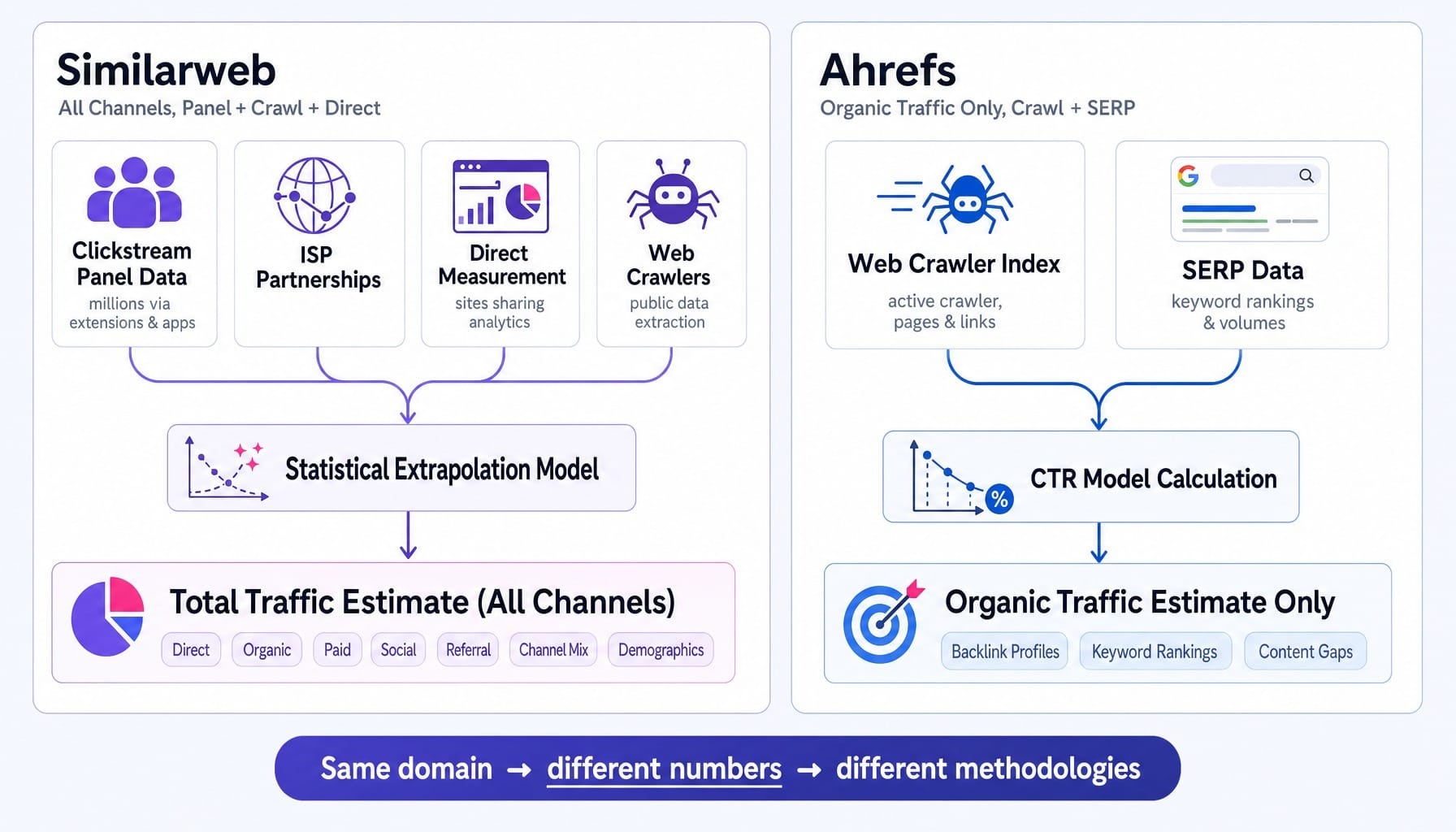
The difference between Similarweb and Ahrefs starts at the data source level.
Read more: Similarweb vs Ahrefs in 2026: Different Data, Different Jobs: Here's Which One You Actually Need
How Similarweb Estimates Traffic Using Clickstream Panels
Similarweb builds its digital market intelligence from four primary data sources: a panel of millions of users who agree to share anonymized clickstream data (via browser extensions and apps), partnerships with internet service providers (ISPs), direct measurement from sites that share their analytics, and public data extracted from its own web crawlers.
The key takeaway is that this data is sampled. Similarweb extrapolates from its panel to estimate total traffic across all channels—direct, organic, paid, social, referral. This gives it incredible breadth. Its strength is seeing the whole picture: channel mix, audience demographics, and referral sources. The weakness is precision, especially on smaller domains. Accuracy degrades sharply on sites with fewer than 5,000 monthly visits, though a July 2024 methodology update has improved this.
How Ahrefs Estimates Traffic Using Web Crawlers and SERP Data
Ahrefs' methodology is entirely different. It operates one of the world's most active web crawlers, constantly indexing pages and the links between them. It estimates organic traffic by combining a domain's keyword ranking positions with the search volume for those keywords and a proprietary click-through rate (CTR) model.
Ahrefs does not measure actual visits. It calculates the traffic a page should receive based on its organic search visibility. This makes it exceptionally powerful for SEO-specific intelligence: backlink profiles, keyword gaps, and content opportunities. But it's blind to everything else. Ahrefs can't tell you about direct traffic, paid search spend, or audience demographics. It answers the question, "How is this site performing in organic search?" while Similarweb answers, "How much total traffic does this site get, and where does it come from?"
Where Each Tool Wins: Use Cases That Actually Matter
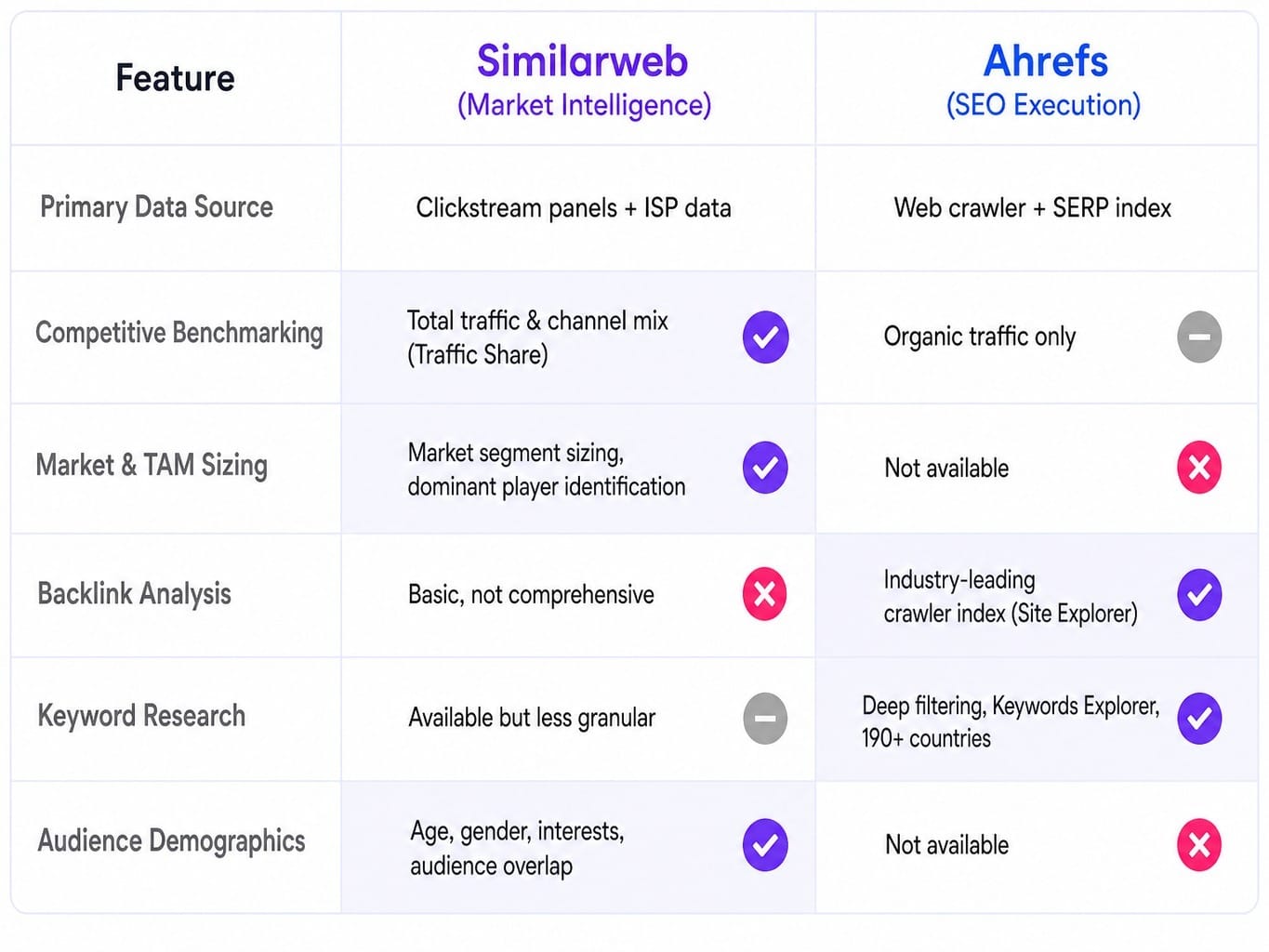
The right tool depends entirely on the question you're trying to answer. Most comparisons list features side-by-side as if both tools compete for the same job. They don't. Similarweb is a market intelligence platform. Ahrefs is an SEO execution platform. The overlap is surprisingly narrow.
If a VP of Marketing is preparing a board deck on competitive market share and channel mix, they need Similarweb. If an SEO Lead is building a link acquisition strategy and identifying content gaps, they need Ahrefs. The "which is better" question is flawed; the real question is "which problem am I solving today?"
When Similarweb Is the Right Tool: Market Intelligence, TAM Sizing, and Channel Mix Analysis
Similarweb's core value is answering strategic questions that sit above the channel level. Its clickstream data provides a wide-angle view of the entire digital landscape, making it the right choice for:
- Competitive Benchmarking: What is a competitor's total traffic, and what's their channel mix (paid vs. organic vs. direct)? Similarweb's Traffic Share analysis is essential for this.
- Market & TAM Sizing: How big is a market segment, and who are the dominant players? This is critical for investor decks and strategic planning.
- Paid Search Intelligence: What is a competitor's estimated ad spend, and which keywords are they bidding on? While not perfectly accurate, it provides directional insight Ahrefs lacks.
- Audience Analysis: What are the demographics and interests of a competitor's audience? The Audience Overlap feature helps identify partnership opportunities and audience expansion targets.
The primary limitation is that its keyword-level data and backlink analysis are not as granular or comprehensive as Ahrefs'. You use Similarweb to understand the market, not to execute a technical SEO campaign.
When Ahrefs Is the Right Tool: Backlink Analysis, Keyword Research, and Content Execution
Ahrefs is built for the practitioner responsible for executing on organic growth. Its massive web crawler index and deep feature set make it indispensable for the tactical work of SEO. You use Ahrefs for:
- Backlink Analysis: Auditing a competitor's backlink profile to find high-value referring domains is Ahrefs' killer feature. Its Site Explorer provides the most comprehensive link data on the market, far surpassing Similarweb.
- Granular Keyword Research: Finding high-intent, low-competition keywords using its Keywords Explorer and keyword difficulty score is a core SEO workflow. Ahrefs' database is vast and its filtering capabilities are robust.
- Content Gap Analysis: Identifying topics your competitors rank for that you don't is a direct path to a content strategy.
- Rank Tracking & Technical Audits: Monitoring daily keyword movements across 190+ countries and running site audits to find technical issues are foundational tasks for any SEO team.
The limitation is its total blindness to non-organic channels. Ahrefs can tell you how a competitor wins in search, but not if they're actually winning the market.
How to Cross-Check Accuracy: A Practical Workflow Using Google Search Console
Neither tool's traffic estimates for your own domain should be trusted at face value. However, you can calibrate your confidence in their competitor data by cross-referencing them against your own first-party data. This simple process turns blind trust into informed analysis.
Here is a practical workflow you can execute in under 30 minutes:
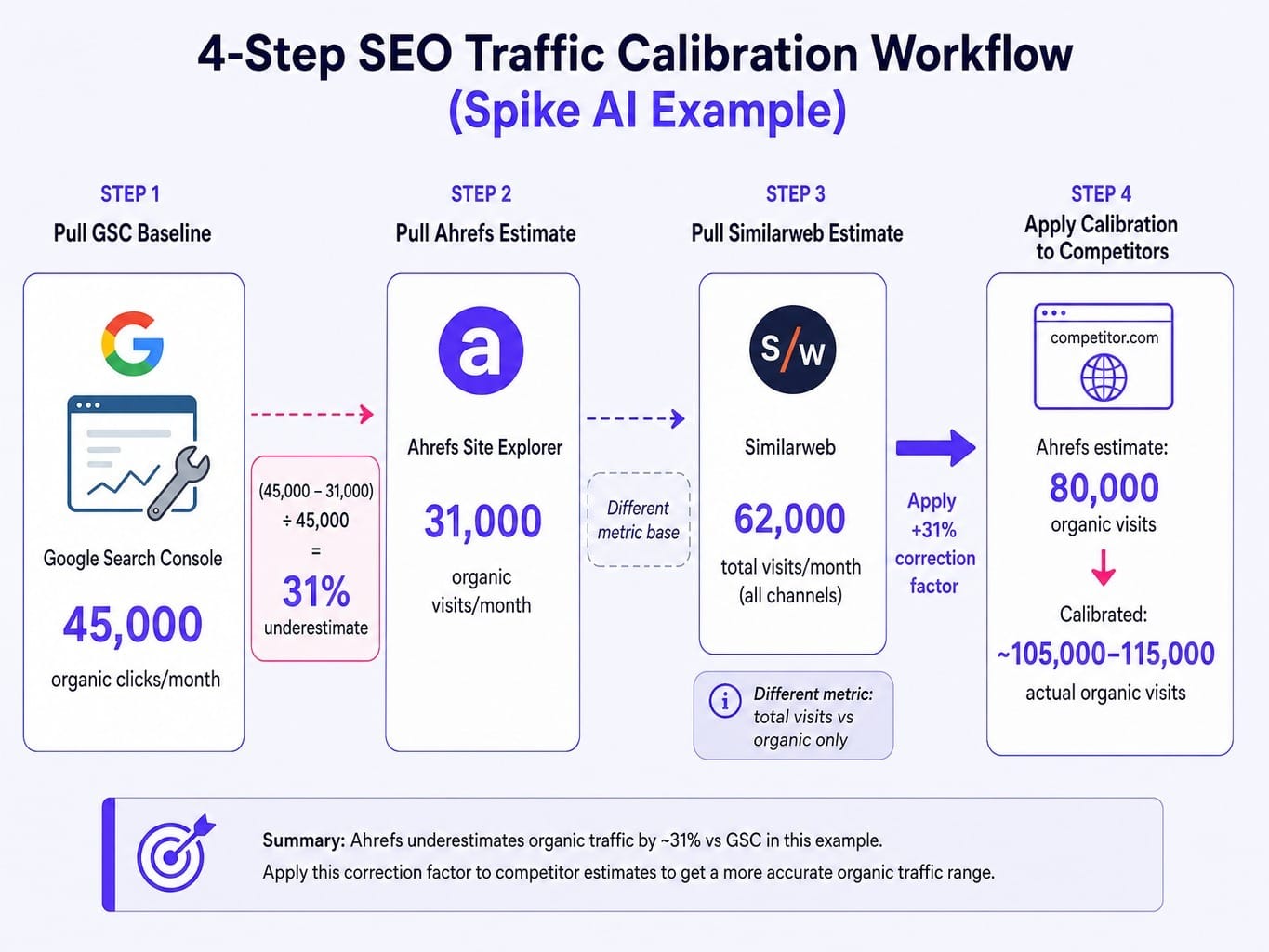
- Pull Your Baseline: Log into Google Search Console and export your total organic clicks for the last 6 months. For an even broader baseline, pull your total user data from GA4 for the same period.
- Pull Ahrefs' Estimate: In Ahrefs' Site Explorer, enter your domain and look at the organic traffic estimate for the same 6-month period.
- Pull Similarweb's Estimate: In Similarweb, look up your domain and find the total visits estimate for the same period.
- Calculate the Variance: Compare each tool's estimate to your GSC/GA4 baseline. For example:
Your GSC shows 45,000 organic clicks last month.
Ahrefs estimates 31,000 organic visits.
Similarweb estimates 62,000 total visits.
This tells you that Ahrefs is underestimating your organic traffic by roughly 31%. Now, when you see Ahrefs estimate a competitor has 80,000 organic visits, you can apply your calibrated understanding and reasonably infer their actual traffic is likely closer to 105,000–115,000. You've established a traffic estimation confidence interval. This process transforms these tools from black boxes into calibrated instruments.
When You Need Both: Stacking Similarweb and Ahrefs for Full Competitive Intelligence
For lean teams, choosing one tool is a necessity. But for organizations doing serious competitive intelligence, using both platforms together unlocks insights neither can generate alone.
The stacking methodology is simple: use Similarweb to identify what is happening in the market, then use Ahrefs to reverse-engineer how it's being achieved through organic search.
Imagine this scenario: Similarweb shows a key competitor's organic traffic share jumped 15% last quarter, and they are now outperforming you in a specific market segment. That's the signal. You then pivot to Ahrefs' Site Explorer and discover the cause: they launched a cluster of 40 new pages targeting long-tail keywords and acquired 200 high-authority referring domains through a targeted guest posting campaign.
Now you have the complete picture: the market-level signal from Similarweb and the tactical playbook from Ahrefs. This is an actionable insight. This approach typically makes sense for teams with a marketing tool budget exceeding $500/month. For those operating below that, stick to the one tool that solves your most immediate problem.
Pricing Structures Compared: Flat-Rate Access vs. Credit-Based Metering
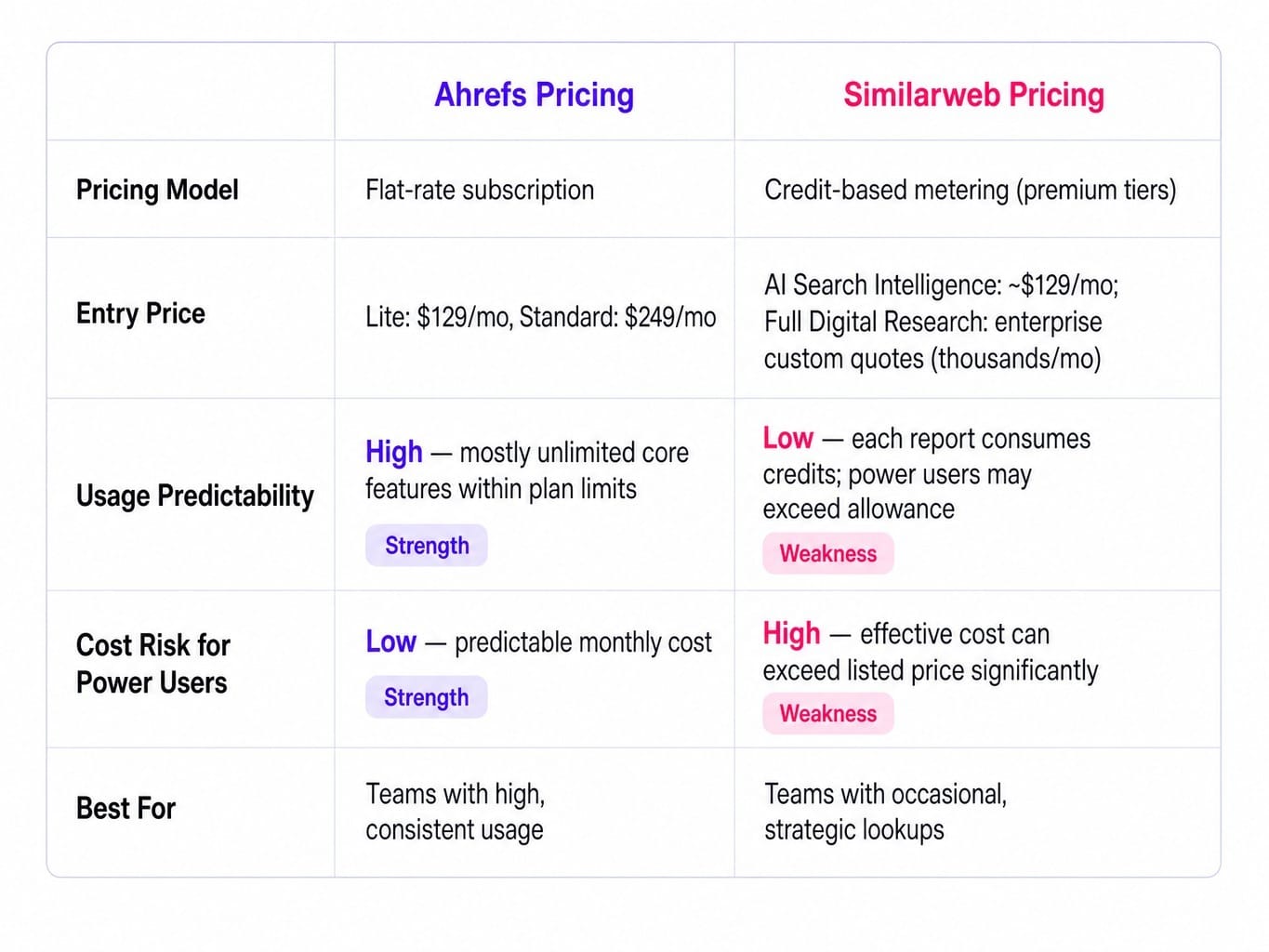
The sticker price comparison between Similarweb and Ahrefs is misleading because the pricing structures are fundamentally different, which dramatically impacts the total cost of ownership.
Ahrefs uses a predictable, flat-rate subscription model. Tiers like Lite ($129/month) and Standard ($249/month) give you mostly unlimited use of core features within the plan's limits on tracked keywords or projects. For teams with high usage patterns, this is predictable and cost-effective.
Similarweb, for its premium tiers, uses a credit-based metering system. Each report you run or competitive analysis you pull consumes credits. A power user running deep analyses across dozens of domains can burn through their monthly credit allowance quickly, forcing an upgrade or the purchase of additional credits. This can make the effective monthly cost much higher and less predictable than the listed price. Their AI Search Intelligence plans start around $129/month, but the full Digital Research Intelligence suite is enterprise-priced with custom quotes often running into thousands per month on annual contracts.
Which is cheaper depends entirely on your usage patterns, not the list price.
What Happens After You Have the Data: Closing the Gap Between Insight and Execution
This entire analysis highlights a systemic constraint in marketing: even with the right tools, the output is still just data. Similarweb shows you where competitors are winning market share. Ahrefs reveals the exact keywords and backlinks driving their growth. But neither platform ships a single change to your website.
The gap between "now I know what to do" and "it's actually done" is where most marketing systems break down. Insights from these tools pile up in backlogs, waiting on engineering tickets or getting deprioritized because the execution bandwidth simply doesn't exist. This latency between identification and implementation is the single biggest drag on growth.
This is the execution gap Spike AI is built to close. We don't replace Ahrefs or Similarweb; we function as the execution layer that sits downstream. Spike AI takes the intelligence these tools surface—keyword gaps, content opportunities, conversion bottlenecks—and turns it into prioritized, shipped changes on a weekly cadence. For lean teams who can't afford to let valuable insights age in a backlog, the question isn't just which tool to buy, but how to build a system that acts on the data.
See how Spike AI turns competitive intelligence into weekly shipped improvements
The Right Tool for the Right Job
The Similarweb vs Ahrefs debate is the wrong frame. These are not interchangeable tools competing for the same budget slot. They are complementary instruments built on different data architectures to solve different problems.
Similarweb maps the market, showing you total traffic, channel mix, and audience dynamics. Ahrefs maps the organic search terrain, revealing the backlinks, keywords, and content strategies that drive visibility. Choosing between them requires knowing which question you need to answer. As AI-generated search continues to reshape traffic distribution, the teams that win will be those who combine market-level intelligence with SEO-level execution—and who close the gap between insight and action faster than their competitors.
Frequently Asked Questions
Does Ahrefs provide audience demographic data the way Similarweb does?
No. Ahrefs does not collect or report on audience demographics like age or gender because its data comes from web crawling, not user panels. Similarweb's clickstream methodology enables this reporting. If audience analysis is a core need, Similarweb is the only option between the two.
Can Similarweb track keyword rankings like Ahrefs does?
Similarweb offers keyword rank tracking, but its keyword database and historical data are less granular than Ahrefs'. Ahrefs' Keywords Explorer provides deeper data and filtering for Google, YouTube, Amazon, and Bing. For dedicated rank tracking at scale, Ahrefs offers more depth; Similarweb's capabilities are better suited for high-level competitive monitoring.
How do Similarweb and Ahrefs handle AI-generated search and zero-click queries differently?
Similarweb has released dedicated features like AI Brand Visibility and AI Traffic tracking to measure visibility within AI chatbot responses. Ahrefs tracks SERP features including AI Overviews and has tools for monitoring brand mentions, but its core model is still centered on traditional rankings. Neither tool has fully solved zero-click attribution, but Similarweb currently offers more direct AI search visibility features.
Which tool gives more reliable backlink data — Ahrefs or Similarweb?
Ahrefs, by a significant margin. Ahrefs operates one of the largest and freshest web crawler indexes in the industry, making its backlink data substantially more comprehensive. For any workflow involving link building, backlink auditing, or referring domain analysis, Ahrefs is the industry-standard tool and the clear winner.
How do the free versions of Similarweb and Ahrefs compare?
Similarweb's free tier offers a basic traffic overview for any domain, making it useful for quick competitive lookups. Ahrefs' free offering, Ahrefs Webmaster Tools, only works for sites you own and verify, providing a site audit and backlink data for your own properties. For free competitive research, Similarweb is more useful; for auditing your own site, Ahrefs is more actionable.