
SpyFu Pricing 2026: What Each Plan Actually Costs (With Hidden Limits)
TL;DR
- SpyFu offers two paid plans: Basic at $39/mo (for in-browser research) and Professional at $79/mo (for data extraction and API access). A free plan exists for occasional lookups.
- The Basic plan's real ceiling is its 10,000-row data export limit, which can be exhausted in a single large competitor analysis project. The plan is a research-viewing tool, not a data-extraction engine.
- The "true cost" of SpyFu includes hidden factors: export throttling on the Professional plan can slow down workflows, and API overages can add unexpected costs for automated monitoring.
- Annual billing saves about 25%, but the 30-day money-back guarantee only applies to the first month. Start with a monthly plan for 2-3 months to validate usage before committing annually.
- SpyFu is a PPC-first competitive intelligence tool, not a standalone SEO platform. It excels at ad history and keyword gap analysis but lacks the robust backlink data and technical site auditing of Semrush or Ahrefs.
SpyFu's pricing page makes the decision look simple: two paid plans, two clear monthly prices. But the real cost of any competitive intelligence tool isn't the subscription line item. It's what you can actually extract at each tier before hitting search caps, export limits, or feature walls that force an upgrade. The sticker price is just the entry fee; the effective cost is determined by your workflow's intensity.
This is not a mirror of SpyFu's pricing page. It's a breakdown of what each plan actually delivers in practice. We'll cover the hidden limits most reviews gloss over, calculate the annual billing math, and compare SpyFu's cost against Semrush, Ahrefs, and Moz Pro—not on features, but on cost-per-insight for specific workflows.
SpyFu Pricing at a Glance: 2026 Plans and Costs
For teams that need a quick reference, here is the current SpyFu pricing structure. The key differentiators are not just features, but the hard limits on search results and data exports.
A few essential context points:
- The "Team" Plan is Gone: If you've seen references to a $299/mo "Team" plan, it no longer exists as a standard public offering. The lineup has been consolidated to Basic and Professional.
- A Free Account Exists: SpyFu offers a permanent free account with a handful of limited daily searches. It's genuinely useful for occasional, one-off lookups but not for sustained competitive research.
- No Free Trial, But a Guarantee: There is no traditional free trial for the paid plans. However, SpyFu offers a 30-day money-back guarantee on all new subscriptions, allowing you to test a plan and get a full refund if it doesn't fit.
What You Actually Get at Each SpyFu Tier
The difference between SpyFu's plans isn't just a list of features—it's about how quickly your team's workflow hits a hard wall. The right choice depends entirely on whether you view competitive data in-browser or need to extract it for analysis and reporting elsewhere.
SpyFu Basic ($39/month): Where the Ceiling Hits
The Basic plan is viable for solo operators and small teams who primarily use SpyFu for in-browser research rather than heavy data extraction. For $39/month, you get access to the core toolset but with significant limitations: 10,000 search results, 10,000 rows of data exports, and 5,000 tracked keywords for one user. There is no API access.
Scenario: A freelance PPC consultant managing a few small client accounts. They run 3-5 competitor domain lookups daily to check ad copy from the ad history tool and identify top keywords using the Kombat report. This in-browser usage might stay under the 10,000 search result cap for a few weeks.
But here's the catch. The moment that consultant needs to run a full keyword gap analysis and export the 8,000 keywords a competitor ranks for that their client doesn't, they've used 80% of their monthly export limit in a single task. The Basic plan is a research-viewing plan, not a data-extraction plan.
SpyFu Professional ($79/month): When It Justifies the Premium
The real value of the Professional plan isn't just the unlimited searches. It's the unlimited data exports and API access that transform SpyFu from a simple lookup tool into a data pipeline for your marketing system. For $79/month, you get unlimited results and exports, 15,000 tracked keywords, custom branded reports, and API access with included credits.
Scenario: A B2B SaaS growth team needs to pull competitor keyword gaps weekly, mine PPC negative match opportunities, and feed that data into Google Ads. They also generate monthly competitive landscape reports for leadership, requiring bulk exports of SERP history and ad spend estimation data. This workflow is impossible on the Basic plan; its export cap would be exhausted in days.
For this team, the Professional plan pays for itself if it replaces even one manual competitor analysis project that would otherwise take a contractor 4-6 hours. Let's be honest, Professional is the real product; Basic is effectively a trial with a price tag.
SpyFu's Free Account: When Paying Is Unnecessary
This is an angle most pricing articles ignore. For occasional competitive lookups, SpyFu's free account is often sufficient. You get a limited number of searches per day, and the results are truncated, but it's enough for quick sanity checks.
Scenario: A founder needs to check a competitor's top five organic keywords and see their latest ad copy before a board meeting. Or a content marketer wants to quickly verify if a competitor is bidding on a specific branded term. For these use cases, paying $39/month is a waste. The free account provides the directional insight needed without the cost.
The threshold where free stops being viable is clear: the moment you need to see the full list of 5,000 keywords, export any data to a spreadsheet, or run more than a few searches in one day, you have to upgrade.
The Costs SpyFu's Pricing Page Doesn't Emphasize
SpyFu's sticker price is straightforward, but the effective cost per insight depends on three factors that aren't immediately obvious on the pricing page: search caps, export throttling, and API overages.
First, consider the effective per-query cost on the Basic plan. At $39 for 10,000 search results, each result effectively costs you $0.0039. That seems negligible, but if your workflow burns through that cap in the second week of the month, you're either dead in the water or forced into an early upgrade, pushing your real monthly cost higher. The documentation is also unclear on what happens when you hit the cap—whether results are simply blocked or if overage charges apply. This ambiguity is a risk.
Second, there's export throttling. Even on the Professional plan with "unlimited" exports, users running very large bulk exports (tens of thousands of rows at once) can experience rate limiting. This doesn't add a direct dollar cost, but it introduces a time cost, slowing down workflows that depend on pulling a competitor ad copy swipe file or a complete keyword gap matrix into external tools.
Third, and most concrete, are API overage charges. The Professional plan includes API credits, but once those are exhausted, you're billed for additional data. According to SpyFu's developer documentation, overage rates are typically $0.50 per 1,000 rows, though specific endpoints can range from $0.20 to $5.00 CPM. A growth team running automated weekly competitor keyword pulls—say, 50,000 rows per week—can easily accumulate a significant overage bill they didn't budget for.
Annual vs. Monthly Billing: The Exact Savings Math
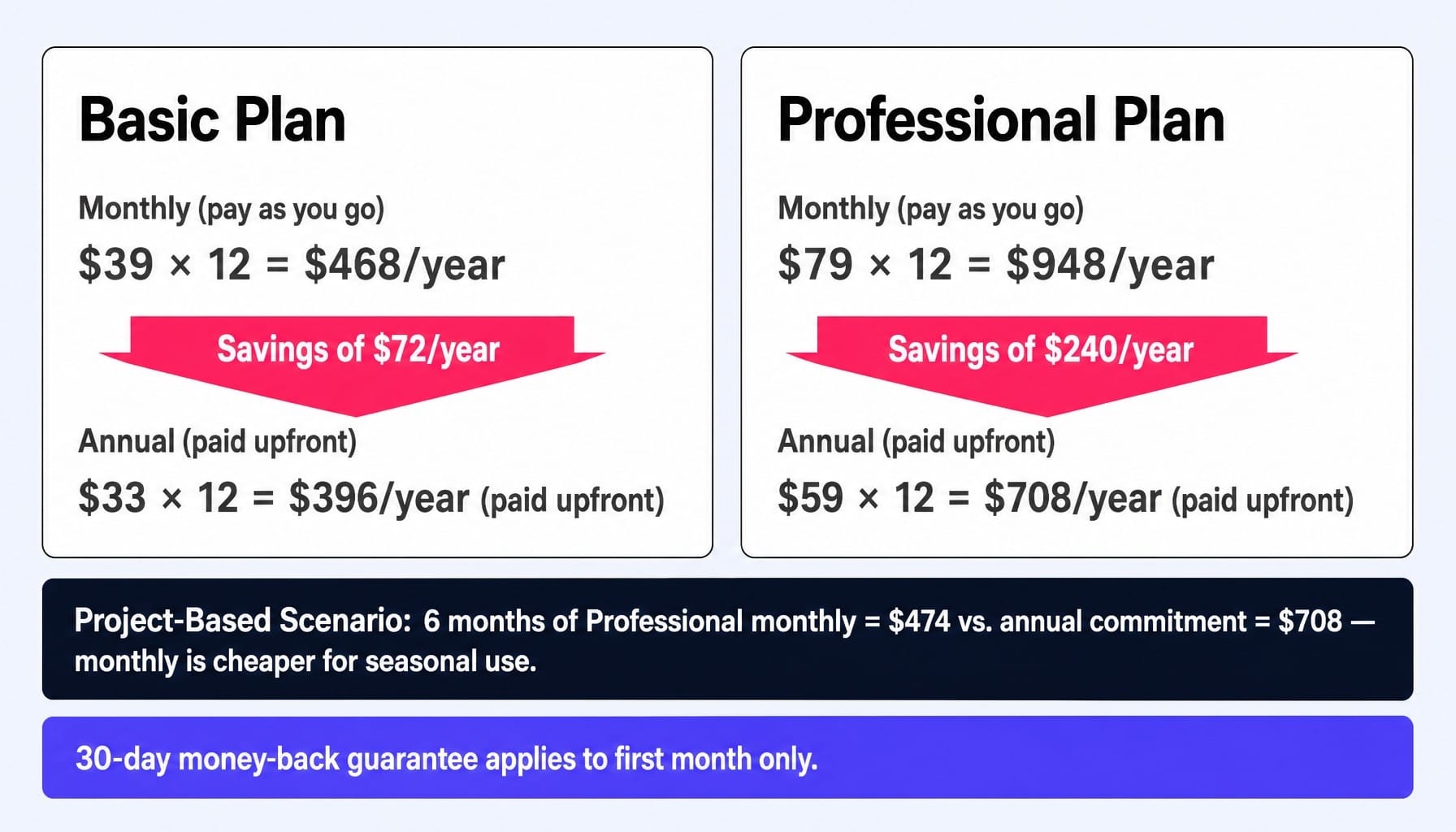
Opting for an annual plan saves you roughly 25%, a significant discount if you're committed to the tool. But the decision isn't just about the percentage.
Here's the exact math:
- Basic Plan: Drops from $39/mo to $33/mo when billed annually. You pay $396 upfront instead of $468 over the year, saving $72.
- Professional Plan: Drops from $79/mo to $59/mo when billed annually. You pay $708 upfront instead of $948 over the year, saving $240.
The trade-off is commitment. SpyFu's 30-day money-back guarantee only applies to your first month. If you pay annually and decide to cancel in month four, you've prepaid for eight months of service you won't use.
Here's a practical recommendation: if you're evaluating SpyFu, start with a monthly plan for 60-90 days. This gives you enough time to validate that your usage patterns justify the subscription. Once you've confirmed the tool fits your workflow, switch to annual billing to lock in the savings. For project-based work, like a consultant who only needs competitive data for Q1 and Q3 client pitches, sticking with monthly billing for six months ($474 on Professional) is cheaper than the full annual commitment ($708).
SpyFu vs. Semrush, Ahrefs, and Moz Pro: Cost-Per-Insight Comparison
Comparing SpyFu's price to Semrush or Ahrefs on a feature-for-feature basis is misleading. These tools are built for different primary use cases, and the relevant comparison is the cost to get the specific insight you need for your workflow.
Here are three arguments to frame your decision:
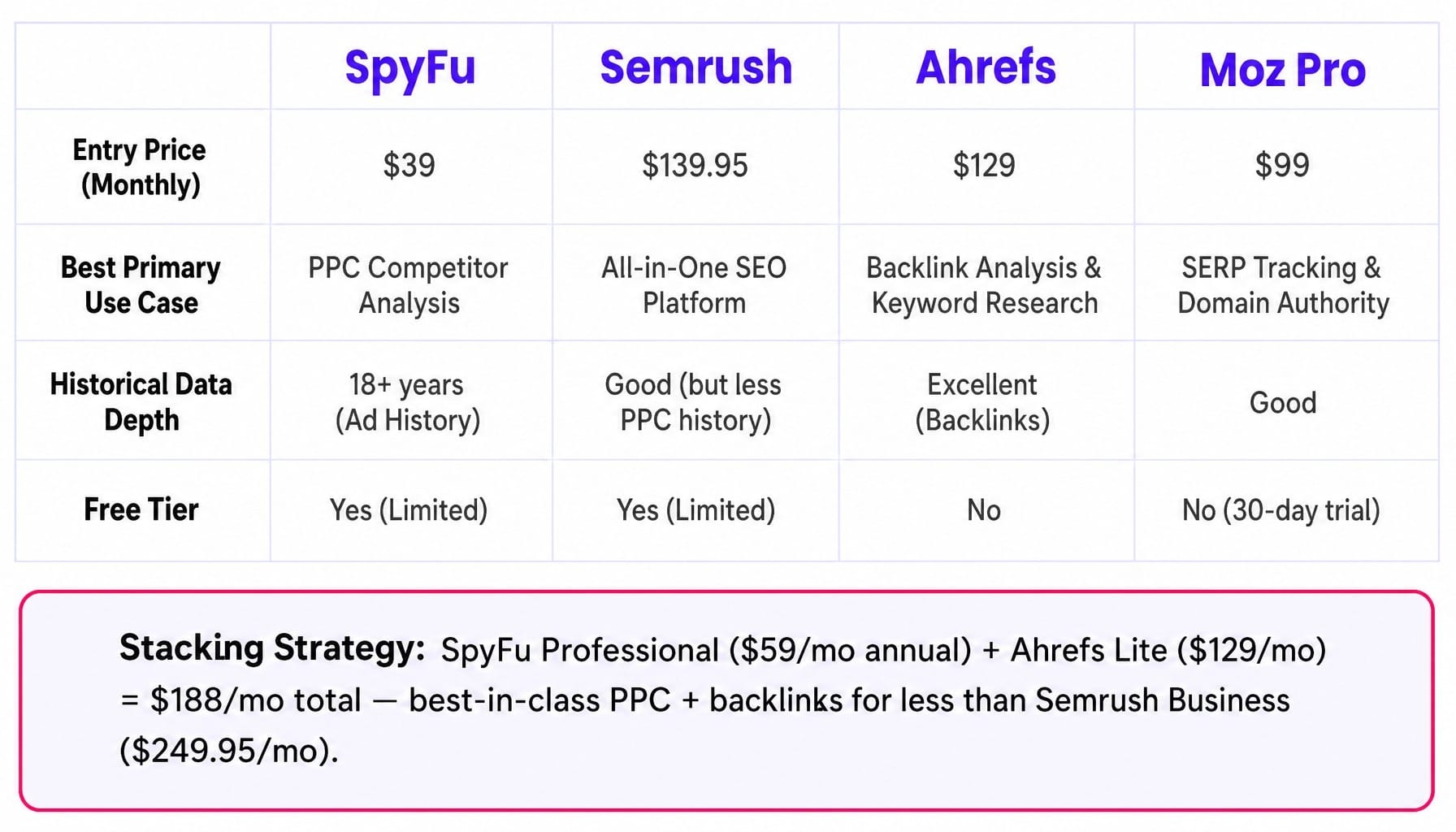
- SpyFu vs. Semrush: SpyFu is a PPC-first competitive intelligence tool; Semrush is a broader, all-in-one SEO platform. If your primary need is deep PPC competitor research—accessing 18+ years of ad history, building ad copy swipe files, and getting CPC bid intelligence—SpyFu Professional ($79/mo) delivers more PPC-specific depth than Semrush Pro ($139.95/mo). If you need robust backlink analysis, technical site auditing, and integrated content tools, Semrush justifies its premium. For a deeper look at what Semrush actually costs after add-ons, see our SEMRush pricing breakdown.
- SpyFu vs. Ahrefs: Ahrefs has a far superior backlink index, with updates that are significantly more frequent than SpyFu's. However, Ahrefs provides almost no PPC competitor data. For teams that need both, a stacking strategy is often most effective. You can combine SpyFu Professional ($59/mo annual) with Ahrefs Lite ($129/mo) for a total of $188/mo. This gives you best-in-class PPC intelligence and best-in-class backlink data for less than the cost of a Semrush Business plan ($249.95/mo).
- SpyFu vs. Moz Pro: These tools are more complementary than competitive. Moz excels at rank tracking, link building campaigns, and its proprietary Domain Authority metric. SpyFu is focused on unearthing competitor strategies in search. You would use Moz to track your own performance and SpyFu to understand why your competitors are performing the way they are.
Read more: Semrush vs Moz (2026): Which SEO Tool Fits Your Team's Actual Workflow | Spike
Is SpyFu Enough as a Standalone SEO Tool?
No, for most teams, SpyFu is not sufficient as a standalone SEO platform. And that's not a criticism—it was never designed to be one.
SpyFu's core strength is competitive intelligence. It's exceptional for seeing what keywords your competitors rank for, what ads they're running, how their ad spend estimation has changed, and where your keyword gaps exist. It answers the "what" and "who" of your competitive landscape with deep historical context.
What it lacks are the execution and monitoring tools required for a complete SEO workflow:
- Robust Backlink Analysis: Its backlink data is not as comprehensive or fresh as what you'll find in Ahrefs or Semrush.
- Technical Site Auditing: It has no site crawl engine comparable to Screaming Frog, Sitebulb, or the built-in auditors in Semrush and Ahrefs. You can't use it to find and fix technical SEO issues at scale.
- Content Optimization: There are no features equivalent to Surfer SEO or Clearscope for scoring content against SERP competitors.
- Rank Tracking Depth: While it offers rank tracking, the keyword limits (5k-15k) and feature set are less comprehensive than dedicated tracking tools.
Think of SpyFu as the intelligence layer in your SaaS marketing tools stack, not the entire stack. It tells you which hill to take. You still need other tools to help you take it. A marketer who cancels a broader platform to save money with SpyFu alone often creates a false economy, quickly realizing they have no system for monitoring backlinks or running technical audits.
When the Bigger Cost Isn't the Tool — It's the Work After It
You pay $39 or $79 a month for SpyFu to get a prioritized list of keyword gaps, competitor ad copy to analyze, and new PPC campaigns to test. But the tool's job stops there. The real cost begins with the manual work that follows: exporting those lists, deciding which opportunities to pursue, briefing content, updating landing pages, adjusting bids, and then checking results weeks later. The subscription cost is a rounding error compared to the cost of that execution latency.
This is the execution gap most marketing systems ignore. Tools surface insights, but teams are bottlenecked by the bandwidth required to ship them.
Spike AI is built for the teams who already know what needs to change but can't move fast enough. It takes the competitive intelligence you've gathered and turns it into prioritized, weekly execution across your website, SEO, and ads—without engineering tickets or agency briefs. It closes the gap between what a tool like SpyFu tells you and what actually gets shipped.
See how Spike AI turns competitive insights into shipped improvements — every week.
Your Final Decision Framework
SpyFu's pricing is straightforward, but choosing the right plan is a function of your workflow intensity, not the feature list. Basic is for looking, Professional is for exporting, and the free account handles more casual lookups than most people realize. If your team lives in spreadsheets and external analysis tools, the unlimited exports of the Professional plan are non-negotiable.
But the harder question isn't which SpyFu plan to buy. It's whether your team has the system and bandwidth to act on the opportunities SpyFu surfaces every single week. If the answer is no, the subscription price is the least of your problems. The real constraint is execution.
Frequently Asked Questions
Can I share a SpyFu account across my team, or do I need extra seats?
SpyFu plans include one user seat by default, with additional seats costing $30/month each. SpyFu tracks concurrent sessions, so sharing a single login across multiple active team members risks session conflicts and potential account flags. If 3+ people need regular access, the per-seat cost might make a competitor more economical.
Does SpyFu offer discounts for agencies, nonprofits, or startups?
SpyFu does not publicly advertise standardized discounts for agencies, nonprofits, or startups. The only documented discount is the ~25% savings from annual billing. Some large agencies report success negotiating custom pricing by contacting sales directly, but this is handled on a case-by-case basis and is not guaranteed.
What happens to my data if I cancel my SpyFu subscription?
SpyFu's documentation doesn't clearly state its data retention policy after cancellation. It's critical to export any saved keyword lists, Kombat reports, and custom projects before your billing period ends. Once your subscription lapses, your account reverts to the free tier, and access to saved data is not guaranteed.
Has SpyFu raised its prices recently?
SpyFu's pricing has remained relatively stable through 2025 and 2026, especially compared to competitors like Semrush and Ahrefs which have seen multiple increases. The most significant recent change was the removal of the high-tier "Team" plan, simplifying the offerings to Basic and Professional. Always check the official pricing page for the most current rates.
Is SpyFu's 30-day money-back guarantee a true refund or account credit?
It is a full refund to your original payment method, not an account credit. To claim it, you must contact SpyFu support via email or live chat within the first 30 days of your initial subscription. The guarantee applies only to first-time purchases and does not reset if you cancel and re-subscribe.