SpyFu Review 2026: The Honest Verdict for Practitioners

TL;DR
- SpyFu excels as a specialist competitive intelligence tool, particularly for PPC ad history and competitor keyword mapping via its Kombat report.
- It is not an all-in-one SEO platform; its backlink analysis and technical SEO capabilities are significantly weaker than Ahrefs or Semrush.
- Data accuracy is a real concern for low-volume, long-tail keywords (under 200 monthly searches) and markets outside the US/UK, where estimates can be unreliable.
- At a starting price of $39/month with unlimited searches, SpyFu's best ROI is as a low-cost "second-opinion tool" alongside a primary platform like Semrush, not as a replacement.
- Buy SpyFu for PPC research and fast competitive reconnaissance on a budget. Skip it if you need a single, all-in-one tool for SEO, link building, and site audits.
Most SpyFu reviews fall into two unhelpful camps. They are either sprawling comparison articles that inevitably conclude the most expensive tool has the most features, or they're thinly veiled marketing content from SpyFu itself. Neither answers the real question you have: is SpyFu worth my money, for my specific use case?
This is a different kind of SpyFu review. It's a standalone, honest assessment based on real-world usage in B2B SaaS marketing workflows. We're not going to just list features. We're going to show you what this tool genuinely excels at, where it honestly falls short, and who should—and absolutely shouldn't—buy it in 2026.
Here's the core of it: SpyFu is best understood not as a competitor to all-in-one platforms like Semrush and Ahrefs, but as a specialist competitive intelligence tool. It does a few things exceptionally well, often better than tools costing four times as much. And that distinction changes the entire value equation.
What SpyFu Actually Does Well (And Why It Matters)
SpyFu's value is concentrated in two areas where it delivers outsized returns: deep competitor keyword intelligence and PPC campaign archaeology. It's built on a massive data set, claiming over 7 billion historical results and 18+ years of Google Ads data. While you can't verify that, the depth is apparent in practice, especially for paid search history where no other tool at this price point comes close.
This isn't about having more data; it's about having the right data to make strategic decisions without an agency-sized budget.
Competitor Keyword Intelligence: The Kombat Report and Shared Keywords
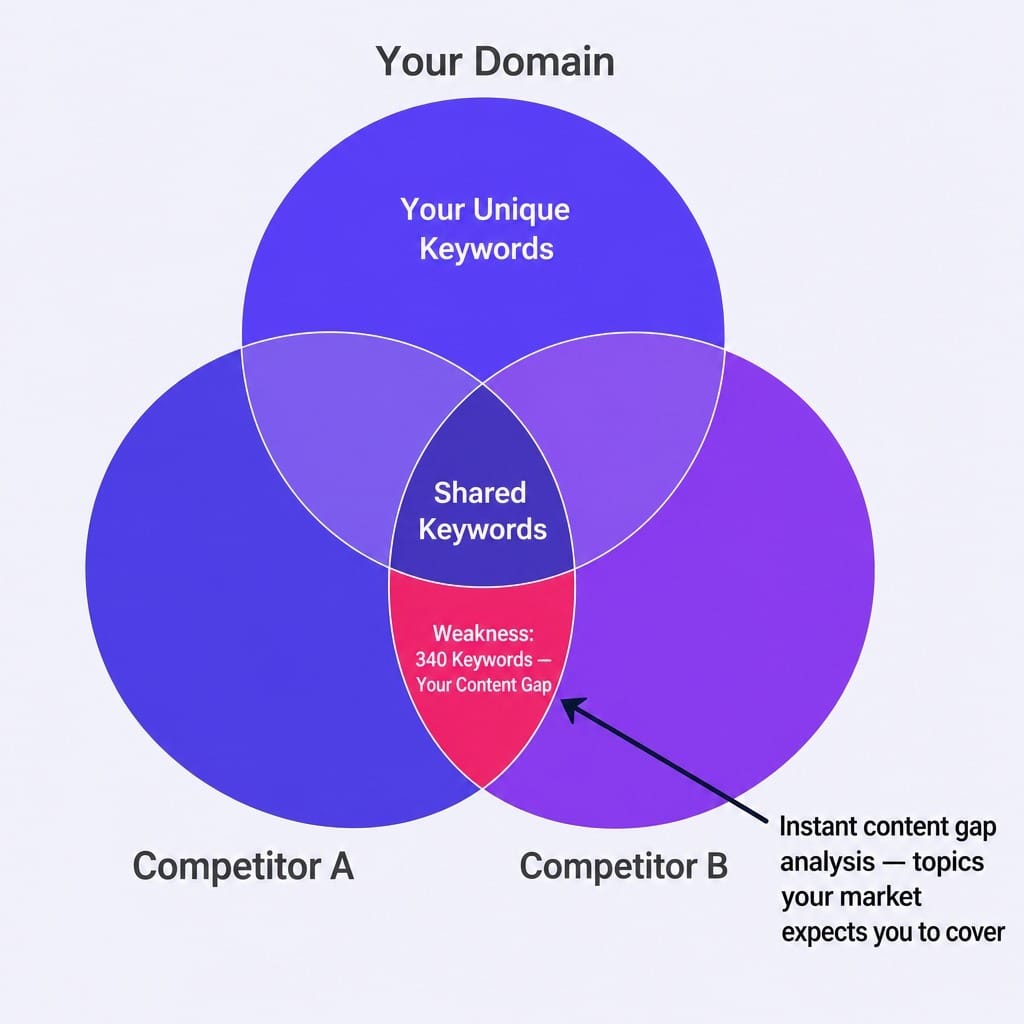
SpyFu's Kombat report is its single most powerful and differentiated feature. It allows you to overlay your domain with up to three competitors and instantly see a Venn diagram of your keyword universe: which keywords you share, which are unique to each competitor, and where the gaps are.
Imagine you're a growth marketer at a Series B SaaS company launching a new product. You enter your domain and two established competitors into Kombat. Within seconds, you see a "Weakness" segment showing 340 keywords where both competitors rank on page one, but you don't. That's not just a list; it's an instant content gap analysis that tells you exactly which topics your market expects to see covered. The domain-level overlap coefficient gives you a quick read on competitive positioning. This is the kind of recon that informs entire quarterly content strategies, and you get it without needing Ahrefs' Content Gap tool or a complex spreadsheet. For fast, high-level competitive mapping, Kombat is arguably the best in the business.
PPC Research Depth: Ad History and Competitor Spend Estimation
If you run paid search campaigns, SpyFu's PPC intelligence is where it most clearly justifies its cost. The ad history timeline is the one feature I'd miss if I canceled tomorrow. It lets you see virtually every Google Ads variation a competitor has run for a given keyword, going back over a decade. You can see which ad copy they tested and killed after two weeks (a signal of poor performance) and which ad copy they've run consistently for over a year (a signal of a high-performing control).
For a PPC manager entering a competitive B2B niche, this is gold. Instead of starting from a blank slate, you can study the messaging evolution of your top competitor, learning from their expensive tests. One thing to keep in mind: the CPC delta vs actual auction price is real. SpyFu's cost-per-click and ad spend estimates are directional, not precise. They are modeled from clickstream data, not pulled from Google's live auction. Treat them as relative signals for budget allocation, not absolute figures for financial planning.
Where SpyFu Honestly Falls Short
This is the credibility anchor of this review. SpyFu's limitations are predictable consequences of its specialist positioning. It doesn't try to be a Swiss Army knife, and the gaps reflect that focus. For a freelance SEO trying to use SpyFu as their only tool, these gaps are dealbreakers.
Data Accuracy at the Long Tail and Outside the US
SpyFu's data fidelity degrades meaningfully in two specific scenarios: low-volume keywords and non-US markets. If your keyword universe lives in the long tail, this will frustrate you. For terms with search volume below roughly 200 monthly searches, its clickstream-derived volume estimates become unreliable. I've seen it report "0" for keywords that Google Search Console confirms are driving dozens of clicks per month. For a B2B marketer targeting a niche term like "SOC 2 compliance software pricing," this data fidelity at low-volume tails is a significant issue.
The same applies to international data. While SpyFu covers around 30 countries, its data is significantly thinner and less reliable outside the US and UK. If your primary markets are in continental Europe or APAC, you'll find Semrush's database of 120+ countries to be far more robust. For US-centric campaigns, it's less of an issue, but don't rely on SpyFu for a global SEO strategy.
Backlink Analysis and Technical SEO: Not SpyFu's Job
Let's be direct: SpyFu's backlink database and technical SEO capabilities are not just weaker than Ahrefs—they're fundamentally not what the tool is built for. Criticizing SpyFu for its backlink data is like criticizing a scalpel for not being a screwdriver. It misses the point.
The backlink data exists to support competitive analysis (e.g., "see who links to this competitor's top page"), not to power a full-fledged link-building workflow. The crawl depth is shallower and the index freshness lag is noticeable compared to Ahrefs or Semrush. More importantly, there is no site audit tool. While one has been promised for some time, as of 2026, it's not there. If you need to diagnose and fix technical SEO issues, you need a different tool. Period. This isn't a product failure; it's a positioning reality.
SpyFu Pricing: The ROI Math Most Reviews Skip
Here's the reality that changes the entire evaluation. SpyFu's Basic plan starts at $39/month (paid annually). Ahrefs starts at $129/month. Semrush starts at $139.95/month. But the key differentiator isn't just the price—it's that SpyFu offers unlimited search results and data exports on all plans.
This pricing model creates a different ROI calculus. The question isn't whether SpyFu can replace your primary SEO platform. For most, it can't. The real question is whether its specialized competitive intelligence is worth an extra $39/month on top of what you already pay.
Consider a growth team on Semrush's Pro plan ($139.95/mo). Adding SpyFu Basic brings their total spend to about $179/mo. For that, they gain historical PPC ad copy analysis and the Kombat report—capabilities that Semrush doesn't match at that tier. The cost per insight becomes incredibly low.
The three main tiers are:
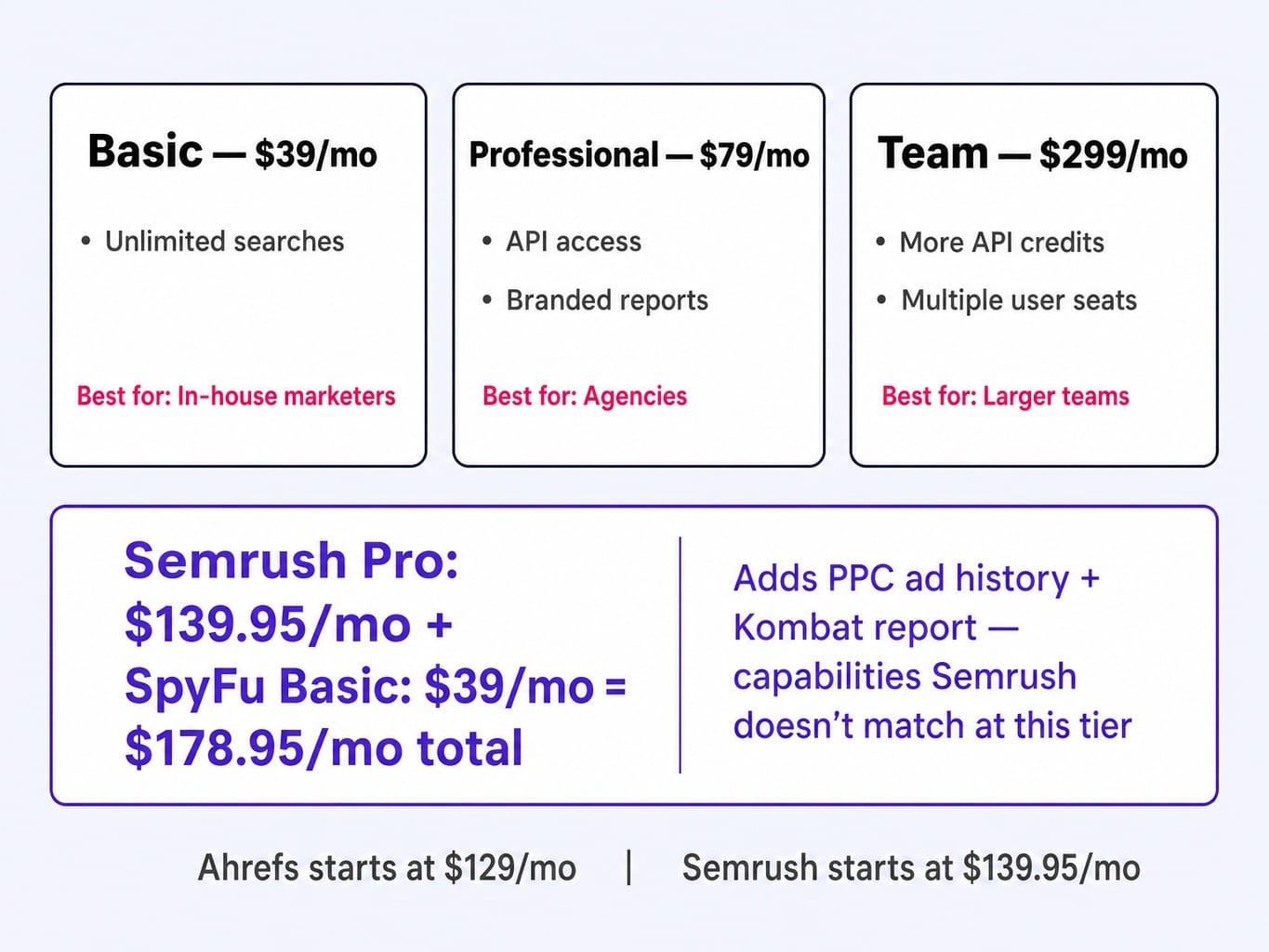
- Basic ($39/mo): Unlimited searches, perfect for in-house marketers.
- Professional ($79/mo): Adds API access and branded reports, aimed at agencies.
- Team ($299/mo): More API credits and user seats.
With a 30-day money-back guarantee, the financial risk is minimal. At this price, it's less about tool consolidation and more about augmenting your recon stack.
SpyFu vs Semrush vs Ahrefs: A Decision Framework, Not a Feature War
Most comparisons pit these tools against each other feature-by-feature. That's not useful. It produces a predictable result where the most expensive tool wins. A better approach is to understand which tool is best for which job.
This brings us to the verdicts:
- SpyFu is best for dedicated competitive intelligence and PPC research on a budget. It's the ultimate recon tool.
- Ahrefs is best for backlink analysis and technical SEO. Its crawler and link index are the industry standard.
- Semrush is best as an all-in-one marketing suite for teams who want everything from SEO to social media scheduling in one dashboard.
So, is SpyFu good enough to replace Semrush or Ahrefs? For a serious SEO practitioner, the answer is no. But that's the wrong question. A 3-person B2B marketing team might use Semrush daily but log into SpyFu for two hours each quarter to run a deep competitive landscape review. For them, SpyFu isn't a replacement; it's a force multiplier.
Read more: SpyFu vs. SEMrush (2026): Which Tool Fits Your Team's Actual Workflow?
Who Should Buy SpyFu — And Who Shouldn't
Let's resolve the "is it worth it" question with a clear, prescriptive framework.
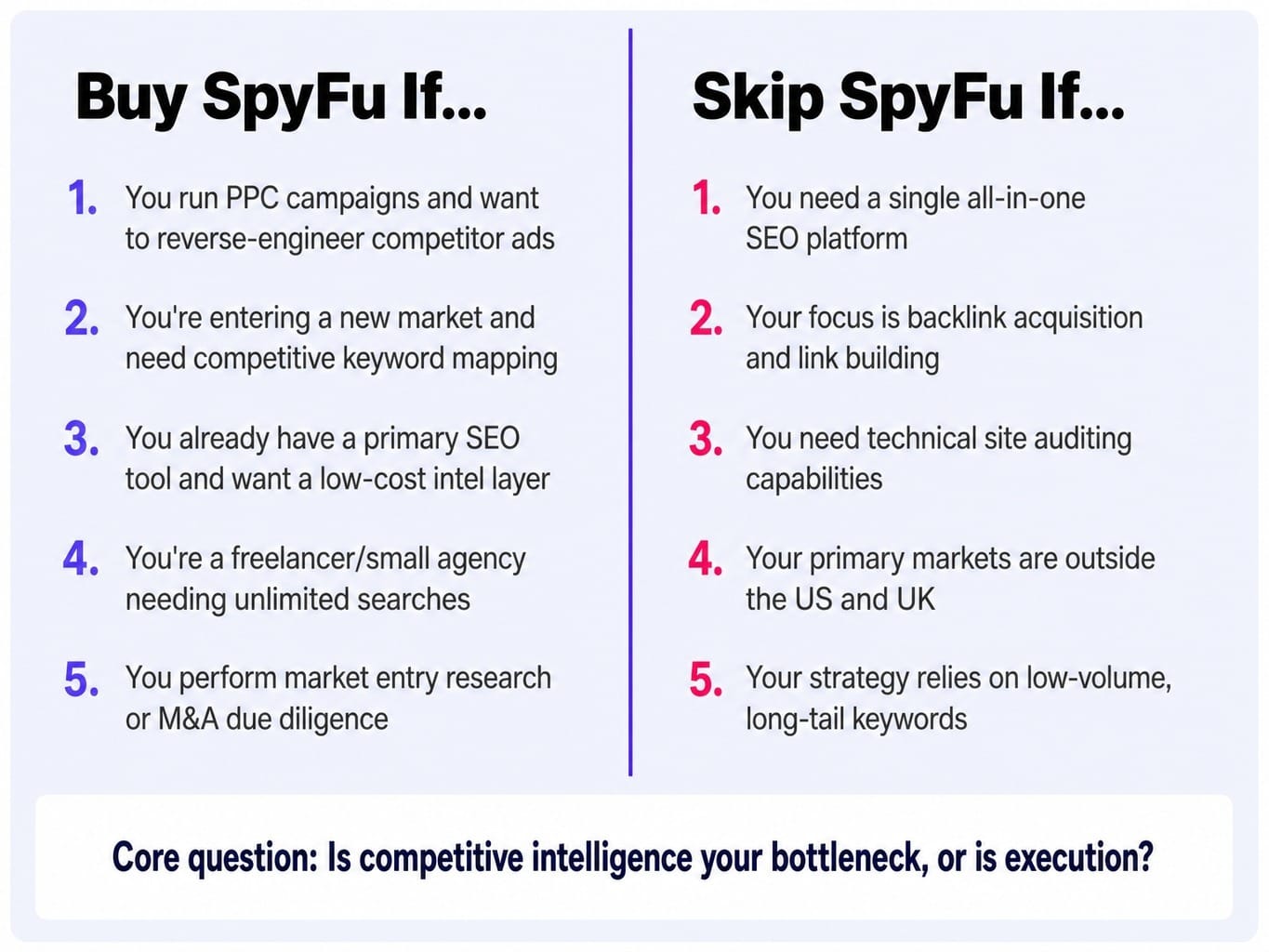
Buy SpyFu if...
- You run PPC campaigns and want to reverse-engineer competitor ad strategies and copy.
- You're entering a new market and need to map the competitive keyword landscape quickly.
- You already have a primary SEO tool (like Semrush or Ahrefs) and want a low-cost competitive intelligence layer.
- You're a freelancer or small agency who needs unlimited searches without worrying about report limits.
- You perform market entry research or M&A due diligence and need access to deep historical SERP and ad data.
Skip SpyFu if...
- You need a single, all-in-one SEO platform and can only afford one subscription.
- Your primary marketing focus is on backlink acquisition and you need a robust link-building tool.
- You need a powerful technical site auditing tool to diagnose and fix on-page issues.
- Your primary markets are outside the US and UK, where SpyFu's data is less reliable.
- Your strategy relies heavily on low-volume, long-tail keywords where data accuracy is paramount.
When Competitive Intelligence Isn't the Bottleneck — Execution Is
SpyFu delivers intelligence. It shows you the keyword gaps, the winning ad copy, the competitor strategies. But for most lean marketing teams, intelligence isn't the problem—it's the execution gap. You now have a backlog of content ideas, landing page improvements, and SEO fixes, but the time between identifying what needs to change and actually shipping it can stretch for weeks, caught in a cycle of planning, approvals, and engineering tickets.
That's a system failure. Insights from tools like SpyFu are only valuable if they get deployed. This is where Spike AI closes the loop. It's a marketing execution platform that takes those prioritized insights and turns them into shipped changes—weekly CRO improvements, SEO fixes, and content updates—without the manual overhead. Where SpyFu tells you what to do, Spike AI is the system that does it.
See how Spike AI turns competitive insights into shipped improvements — every week.
Conclusion: A Specialist in a Generalist's World
Ultimately, this SpyFu review leads to a clear verdict. SpyFu isn't trying to be the best all-in-one SEO tool, and evaluating it as one misses the entire point. It is a focused, powerful competitive intelligence platform that delivers exceptional value in two specific areas: competitor keyword research and PPC campaign archaeology.
Its aggressive pricing and unlimited search model make it a uniquely valuable addition to almost any marketing stack, not as a primary platform, but as a specialist second-opinion tool. As the market continues to consolidate around expensive, feature-heavy suites, SpyFu's focused positioning feels less like a limitation and more like a strategic advantage. For the right user, it's one of the highest-ROI tools on the market.
Read more: Semrush Review 2026: What B2B Teams Actually Need to Know
Frequently Asked Questions
How often does SpyFu update its keyword and ranking data?
SpyFu's core keyword database is updated monthly, while tracked keywords are refreshed daily. However, its index freshness for newly discovered keywords or pages can lag behind Semrush and Ahrefs by 2-4 weeks, meaning very recent SERP changes might not appear immediately in their general database.
Can SpyFu track keywords outside the United States?
Yes, SpyFu covers approximately 30 countries, but its data depth and accuracy are significantly thinner outside of the US and UK. If your primary markets are in continental Europe, Asia, or Latin America, you will likely encounter gaps in competitor coverage and search volume estimates.
Does SpyFu offer an API, and is it practical for agency workflows?
An API is available on the Professional plan ($79/mo) and higher. It's functional for running bulk competitive audits and pulling keyword data for periodic reports. However, compared to Semrush's API, it has fewer endpoints and lower rate limits, making it less suitable for real-time dashboard integrations but perfectly adequate for scalable reporting workflows.
What does SpyFu do that free tools like Google Keyword Planner cannot?
Google Keyword Planner shows keyword opportunities from your perspective but reveals nothing about your competitors. SpyFu's entire value proposition is the competitive layer: it shows which keywords your competitors rank for, what their Google Ads history looks like, and where keyword overlap exists between multiple domains—intelligence no free Google tool provides.
Is SpyFu still actively developing new features in 2026?
SpyFu has added AI-adjacent features like SpyGPT for monitoring brand mentions in AI answers and RivalFlow AI for content briefs. However, its core platform UI has evolved more slowly than its main competitors. Expect incremental improvements to its core toolset rather than major, transformative platform overhauls.
How does SpyFu's Kombat tool compare to Ahrefs' Content Gap analysis?
Both tools identify keywords your competitors rank for that you don't. SpyFu's Kombat is faster for high-level reconnaissance, using a Venn diagram to visualize domain-level overlap intuitively. Ahrefs' Content Gap is more granular, allowing filtering by rank position and comparing more domains at once, making it better for detailed content planning. For a quick competitive snapshot, Kombat wins; for in-depth analysis, Ahrefs is deeper.