
Surfer SEO Pricing 2026: A Practitioner's Cost-Per-Article Breakdown
TL;DR
- Surfer SEO's monthly price is not your true cost. The real metric is your cost-per-article, which is often 2-3x higher than you think once you factor in credit usage, re-optimization, and audits.
- The three main plans (Discovery, Standard, Pro) are differentiated by credit limits, not core features. Your content velocity—how many articles you publish and optimize monthly—is the only factor that matters when choosing a plan.
- Hidden costs like the $95/mo AI Tracker add-on, extra team seats, and expiring monthly credits can significantly inflate your bill. A team on the Standard plan could easily see their costs double.
- Upgrading plans only saves money at specific thresholds. If you publish over 10 articles/month on the Discovery plan, upgrading to Standard is cheaper than buying extra credits. The same logic applies from Standard to Pro at around 25 articles/month.
- Compared to alternatives, Surfer's pricing model creates credit anxiety. Tools like Clearscope offer unlimited reports at a higher price point, while Frase bundles more AI features, reducing the need for other subscriptions.
Surfer SEO's pricing page shows you three plans and their monthly costs. But it doesn't answer the question that actually determines whether you're overpaying: what does each optimized article really cost you? When you factor in credit limits, add-on fees, and the supplementary tools you'll still need, the sticker price is just the starting point.
Most pricing breakdowns list the same feature tables Surfer already publishes. This analysis is different. We'll calculate the true per-article cost at each tier, identify the hidden cost multipliers that inflate your monthly spend, and show you the exact content volume where upgrading plans starts saving you money.
This is for content teams and growth marketers evaluating whether Surfer's pricing model fits their publishing cadence, not just their budget. It's about understanding the cost of the entire optimization workflow, not just the price of the tool.
Surfer SEO Pricing Plans in 2026: What Each Tier Includes
Surfer SEO currently offers three core plans—Discovery, Standard, and Pro—plus a custom Enterprise tier. The plan names and feature sets have shifted over the last year, so any pricing information from before 2026 is likely outdated. The most important differences between these plans aren't the features, as the core Content Editor is available on all of them. The real differentiator is the credit limits: how many Content Editor articles, AI-generated articles, and audits you get per month. This is what determines your effective cost per piece of content.
(Note: All prices are based on figures available in early 2026 and should be verified on Surfer's official pricing page.)
Discovery Plan: For Solo Creators on a Tight Budget
- Monthly Price: $89/month
- Annual Price: $890/year (saves $178)
- Key Limits: 15 Content Editor (CE) credits, 5 AI articles, 25 audits/month.
The Discovery plan is designed for individual bloggers, freelancers, or very small businesses publishing a low volume of content. It provides access to the core optimization engine for a handful of articles per month.
The primary limitation is the credit ceiling. If your workflow involves optimizing, publishing, and then re-optimizing a post a few weeks later, you're burning two CE credits on a single article. At this tier, you'll exhaust your credits quickly if you publish more than 7-8 articles per month, forcing you to purchase expensive one-off credits and driving your per-article cost sky-high.
Standard Plan: The Most Common Starting Point for Small Teams
- Monthly Price: $179/month
- Annual Price: $1,790/year (saves $358)
- Key Limits: 45 Content Editor (CE) credits, 15 AI articles, 100 audits/month.
- Includes: 3 team seats.
This is the plan most small marketing teams and solo operators at B2B companies will evaluate first. It offers a significant jump in credit allocation and introduces multi-user support, making it viable for collaborative workflows. The Standard plan also unlocks Grow Flow, Surfer's feature for identifying low-hanging optimization opportunities on existing content.
However, the same credit burn rate logic applies. For a team producing 12-15 articles per month and running audits on their existing content library, the 45 CE credits can feel tight. It's the first tier where Surfer becomes a functional team tool, but the per-article cost is still higher than most assume once you account for a realistic optimization cadence.
Pro and Enterprise: When Volume Justifies the Premium
- Pro Plan Monthly Price: $359/month
- Pro Plan Annual Price: $3,590/year (saves $718)
- Pro Plan Key Limits: 100 Content Editor (CE) credits, 35 AI articles, 250 audits/month.
- Includes: 5 team seats, white-label reporting.
The Pro plan is built for agencies and larger in-house content teams with significant content velocity. The expanded credit limits, additional seats, and white-label reporting are tailored for managing multiple client projects or a high-volume internal content program.
Enterprise pricing, which starts around $999/month, is a different system entirely. It requires a sales conversation for custom credit limits and user seats. The trigger for Enterprise is typically an agency managing 10+ client domains or an in-house team publishing over 50 articles per month. Critically, Enterprise is the only tier that includes API access, SSO, and dedicated support—features necessary for integrating Surfer into an existing marketing execution system. Both Pro and Enterprise only make financial sense at a specific output level.
The Real Cost Per Article Across Each Surfer SEO Plan
The monthly subscription fee is not your cost per article. Your true cost is a function of your plan price, your credit burn rate, and the cost of supplementary tools you still need.
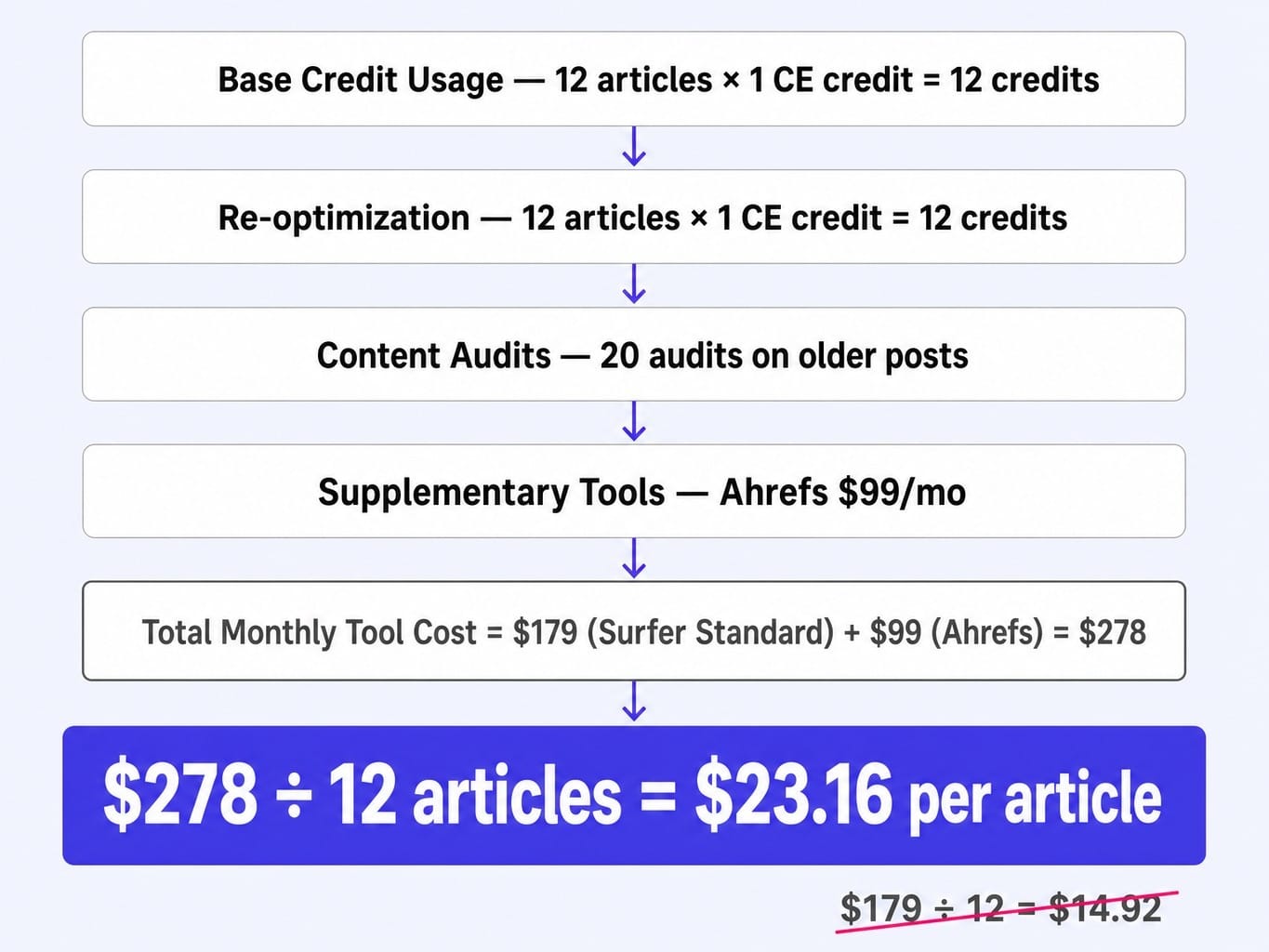
Let's walk through a concrete scenario. A B2B SaaS marketing team is on the Standard plan at $179/month, aiming to publish 12 new articles.
- Base Credit Usage: 12 articles use 12 of their 45 Content Editor credits.
- Re-optimization: Their workflow involves re-optimizing each article 30 days after publishing. This is a common practice Surfer itself encourages. That's another 12 credits. Total CE credits used: 24.
- Content Audits: They also run audits on 20 older, underperforming posts. This uses 20 of their 100 audit credits.
- Supplementary Tool Cost: Let's be honest, Surfer's keyword research module is not a replacement for a dedicated SEO platform. Most serious teams run Ahrefs or Semrush alongside it for competitive analysis and keyword discovery. A basic Ahrefs plan adds another $99/month to the total stack cost.
Now, let's calculate the real cost:
- Total Monthly Tool Cost: $179 (Surfer) + $99 (Ahrefs) = $278
- Cost Per New Article: $278 / 12 articles = $23.16 per article
This $23 figure is a far more realistic benchmark than simply dividing the plan price by article count. For the Discovery plan, this per-article cost can easily exceed $30-$40, while on the Pro plan it might drop to under $15, assuming you use the full credit allocation. The sticker price is an illusion; the true cost is embedded in your workflow.
Hidden Cost Multipliers Most Surfer SEO Reviews Ignore
Your base subscription price is the floor, not the ceiling. Several cost multipliers can dramatically increase your actual monthly spend, turning a seemingly affordable plan into a significant line item.
- Add-On Stacking: Many of Surfer's most powerful features are not included in the base plans. The AI Content Detection tool costs an additional $29/month. The SERP Analyzer is another $29/month on the Discovery plan. Want to track rankings? The Rank Tracker starts at $8.50 for 100 keywords. For a team on the $89/mo Discovery plan, adding these three essentials more than doubles their monthly bill before they've even written a word.
- Per-Seat Economics: The Discovery plan includes one seat and the Standard plan includes three. If your content team has four people, you're forced to upgrade to the Pro plan ($359/mo) or manage multiple separate subscriptions. This per-seat pricing model makes Surfer less scalable for growing teams compared to tools that offer more generous user limits on lower tiers. A 3-person team on Standard is fine, but the fourth hire triggers a $180/month price jump.
- Credit Expiration: This is the most frustrating hidden cost. On monthly billing, your unused credits expire at the end of the billing cycle—they do not roll over. B2B content production is rarely consistent; it fluctuates around product launches, campaigns, and quarterly goals. A month where you only publish 5 articles instead of 15 means you've paid for credits that vanish. This forces teams into a "use it or lose it" mindset, which can lead to rushed, low-quality work just to avoid wasting the investment. Annual plans front-load all credits, but then you're dealing with a high upfront cost and year-long lock-in.
When Does Upgrading from Discovery to Standard (or Standard to Pro) Actually Save Money?
Every growing team on Surfer eventually asks this question: "I'm on Discovery and keep buying extra credits. Should I just upgrade?" This isn't a question of features; it's a break-even calculation.
Let's assume a one-time purchase of an extra Content Editor credit costs $15.
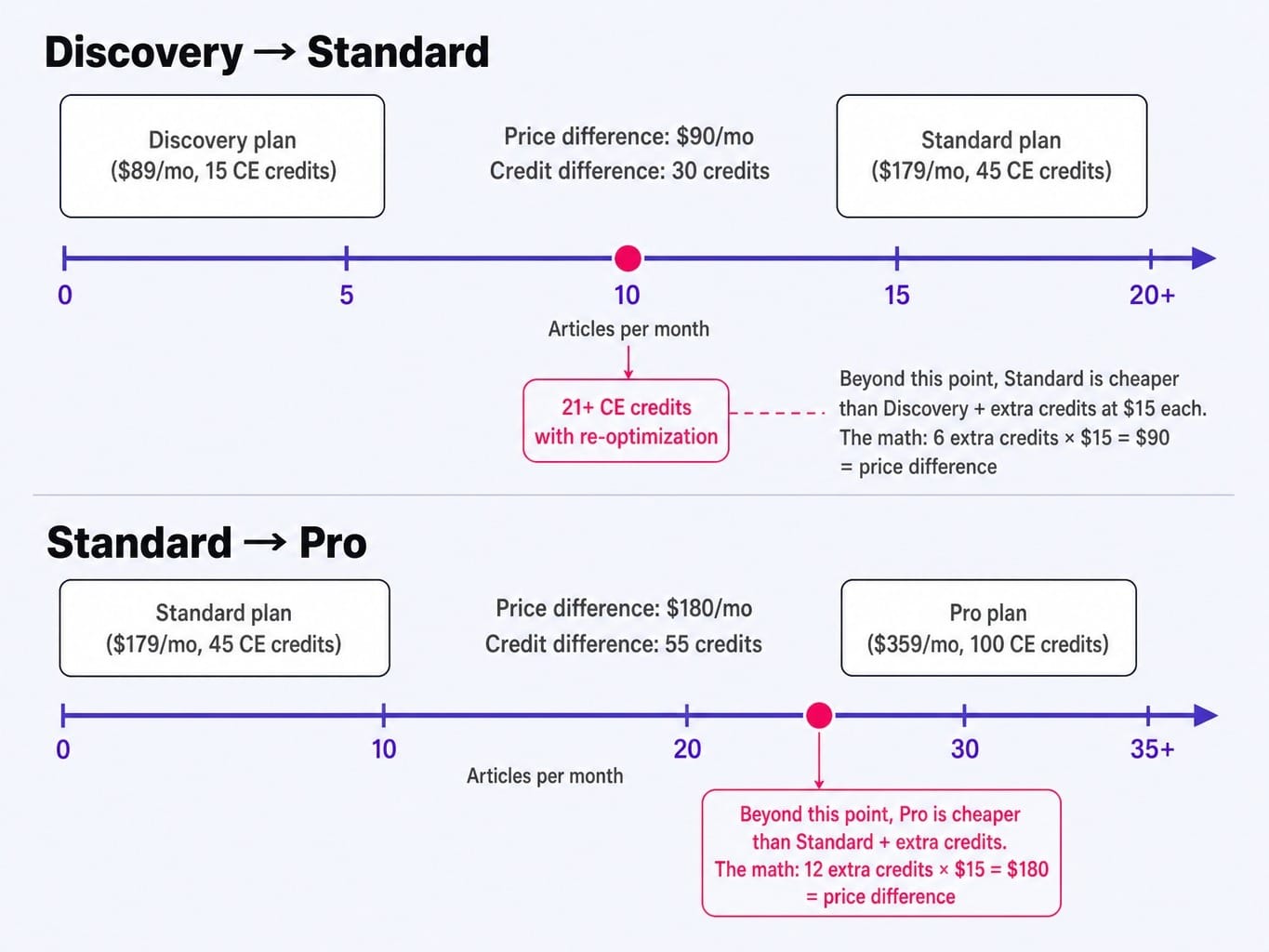
Discovery to Standard Break-Even:
- Discovery Plan: $89/month for 15 CE credits.
- Standard Plan: $179/month for 45 CE credits.
- Price Difference: $90/month.
- Credit Difference: 30 CE credits.
If you need more than your 15 allotted credits on the Discovery plan, you start buying them for $15 each. Once you buy your 6th extra credit in a month (6 x $15 = $90), you've spent the exact amount it would have cost to upgrade to the Standard plan, which would have given you 30 extra credits.
The threshold is clear: if you consistently publish more than 10 articles per month (using more than 21 CE credits including re-optimization), the Standard plan is cheaper than staying on Discovery and buying add-on credits.
Standard to Pro Break-Even:
- Standard Plan: $179/month for 45 CE credits.
- Pro Plan: $359/month for 100 CE credits.
- Price Difference: $180/month.
- Credit Difference: 55 CE credits.
Using the same logic, if you buy 12 extra credits on the Standard plan (12 x $15 = $180), you've paid for the Pro upgrade.
The threshold: if your content velocity pushes you past ~25-30 articles per month on the Standard plan, the Pro plan becomes the more cost-effective option. This math only works if you actually use the additional credits. Upgrading for headroom you never touch is a cost, not a saving.
Surfer SEO Pricing vs. Clearscope, Frase, MarketMuse, and NeuronWriter
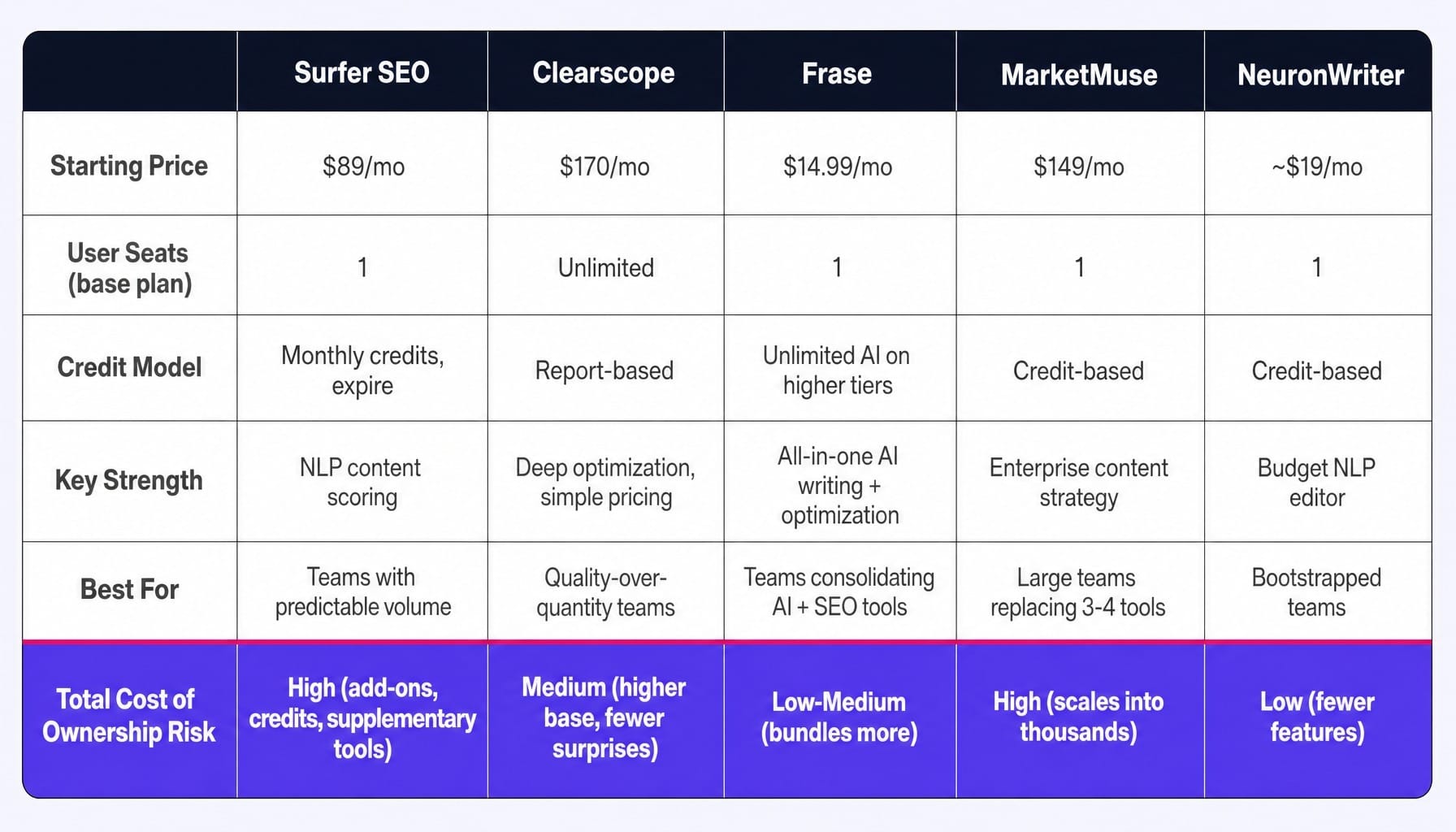
Surfer doesn't exist in a vacuum. The most useful comparison isn't between Surfer's own plans, but against the other tools you're likely evaluating. The metric that matters is the total cost of ownership—the subscription that eliminates the most supplementary tools and manual work for your specific content velocity.
- Clearscope (starts at $170/mo): Clearscope's model is simpler. Their base plan includes 10 Content Reports and unlimited user seats. This eliminates the per-seat cost anxiety of Surfer. For teams that value deep, high-quality optimization on a smaller number of high-value articles, Clearscope's straightforward pricing can be more predictable, despite the higher entry point. For a deeper feature-level comparison, see our Surfer SEO vs Clearscope breakdown.
- Frase (starts at $14.99/mo): Frase positions itself as an all-in-one research, writing, and optimization tool. Its higher-tier plans (around $115/mo) bundle unlimited AI-generated content with the optimization editor. For teams looking to consolidate their AI writer (like Jasper) and their content optimizer into one subscription, Frase can offer a lower total cost of ownership, though some practitioners argue its NLP analysis is less nuanced than Surfer's.
- MarketMuse (starts at $149/mo): MarketMuse is an enterprise-grade platform focused on content strategy, not just on-page optimization. Its pricing reflects this, scaling quickly into thousands per month. It includes sophisticated topical modeling, content planning, and competitive analysis features that you'd need to buy as add-ons or get from other tools in the Surfer ecosystem. It's not a direct competitor for a solo blogger, but for a large team, it can replace 3-4 other tools.
- NeuronWriter (starts at ~$19/mo): NeuronWriter is the budget alternative. It offers a similar NLP-driven content editor and scoring system for a fraction of Surfer's price. The trade-off is a less polished UI, less sophisticated SERP analysis, and fewer integrations. For bootstrapped teams or those just starting with content optimization, it provides 80% of the core functionality for 20% of the cost.
Read more: Surfer SEO vs MarketMuse: Which Tool Matches Your Actual Content Bottleneck (2026)
The cheapest tool isn't the one with the lowest subscription price. It's the one that best matches your content velocity and eliminates the most manual work and supplementary tool costs from your marketing execution system.
When the Real Cost Isn't the Tool—It's the Manual Optimization Loop
This entire analysis of Surfer SEO pricing highlights a fundamental constraint in modern marketing. The true cost isn't just the subscription—it's the credits, the add-ons, the supplementary tools, and critically, the human bandwidth required to interpret recommendations and manually implement changes.
Every tool in this comparison—Surfer, Clearscope, Frase, MarketMuse—shares the same limitation: they diagnose and recommend, but the execution still falls on your team. They generate a backlog of optimization tasks. For a lean marketing team, the hours spent running audits, debating content scores, re-optimizing pages, and coordinating implementation are the largest hidden cost of all.
This is the execution gap where Spike AI operates. Instead of adding another tool to your stack that generates a to-do list, Spike AI functions as an autonomous execution layer. It doesn't just identify the highest-impact optimization across your website, SEO, and content—it ships the fix, every week. The model shifts from "subscription fee + human hours per optimization" to "continuous improvement at a fixed execution cadence." This resolves the core bottleneck that makes every tool's ROI dependent on bandwidth you simply don't have.
See how Spike AI replaces manual optimization cycles with autonomous weekly execution
Conclusion: Price is Relative to Your Execution System
Surfer SEO's pricing isn't inherently expensive or cheap. Its value is entirely relative to your content volume, team size, and the efficiency of your execution workflow. The sticker price is merely a starting point.
A true evaluation requires calculating your real cost-per-article, accounting for hidden fees and supplementary tools, and comparing that total cost of ownership against alternatives that might bundle more capability into a single subscription. As AI-driven content tools continue to consolidate, the teams that win won't be the ones who picked the tool with the lowest price. They'll be the ones who built a system that eliminates the most manual steps between an insight and a shipped optimization.
Frequently Asked Questions
Does Surfer SEO offer a free trial, and what plan does it include?
Yes, Surfer offers a 7-day free trial that typically mirrors the Pro plan, giving you full access to the Content Editor, AI writing, and SERP Analyzer with Pro-tier credit limits. No credit card is required to start, but the trial will auto-convert to a paid plan if not cancelled.
What happens when you run out of Content Editor credits mid-month on Surfer SEO?
You can purchase additional credits as one-time add-ons, but the per-credit cost is significantly higher than the effective rate within your plan. On monthly billing, unused credits expire and do not roll over, making variable publishing schedules costly. Annual plans provide all credits upfront, mitigating this issue.
Can I use Surfer SEO for a single project without a monthly subscription?
No, Surfer does not offer a per-project or one-time purchase option. The minimum commitment is one month. For a single project, the most cost-effective approach is to subscribe to the Discovery plan for one month and cancel before it renews.
Does Surfer SEO charge separately for API access?
Yes. API access is only available on the custom Enterprise plan, which starts at $999/month. There is no way to add API access to the Discovery, Standard, or Pro plans. This locks teams needing programmatic access into the highest pricing tier, regardless of content volume.
Is the Surfer SEO annual plan refundable if the tool doesn't fit my workflow?
Surfer offers a 7-day money-back guarantee on all new subscriptions, including annual plans. After this 7-day window, annual plans are non-refundable. It's crucial to test your actual workflow intensively during this first week to ensure the credit limits and features align with your needs before committing for the year.