
Surfer SEO Review 2026: An Honest Assessment for B2B Marketing Teams

TL;DR
- Surfer SEO is a powerful on-page content optimization tool, but it is not a complete SEO platform. It will not fix technical issues, build backlinks, or optimize for conversions.
- The Content Editor is its best feature, but chasing scores above 80-85 often degrades B2B content quality by encouraging NLP term stuffing risk.
- Surfer's correlation-based model can be misleading for niche, low-volume B2B keywords where the SERP is thin or contains non-standard content like PDFs and forums.
- The Audit tool is its most underrated feature, providing an excellent framework for content refresh triage by connecting to Google Search Console and identifying decaying assets.
- B2B success requires a full execution system, not just page-level content optimization. Surfer is a useful component, but it won't solve the larger problems of prioritization and shipping velocity.
Surfer SEO is one of the most recognized content optimization tools on the market, and for good reason—its Content Editor provides genuinely useful, data-driven guardrails for writers. But most B2B marketing teams adopt Surfer expecting an SEO solution and instead get a content grading tool. The gap between achieving a green content score and shipping a page that actually ranks, converts, and compounds revenue is where frustration begins.
This is not another feature list. This is an honest Surfer SEO review for B2B marketers, growth leads, and lean teams who need to know if the tool is sufficient for their actual workflow. We'll evaluate Surfer against the real demands of B2B content: low-volume technical keywords, long-form pillar pages, and complex, multi-persona buying journeys.
Is Surfer SEO worth it in 2026? It depends entirely on whether you have a content optimization problem or an execution system problem. Let's distinguish between the two.
What Surfer SEO Actually Is (And What It Isn't)
Surfer SEO is a correlation-based on-page optimization platform. It analyzes the top-ranking pages for a given keyword and reverse-engineers a set of content guidelines from their shared characteristics—things like word count, heading structure, and the prevalence of certain NLP terms.
Let's be clear about the boundaries. Surfer is designed to answer one question: "Is this piece of content structured and written similarly to the pages that already rank?"
It does not handle:
- Technical SEO: It won't tell you if your page is slow, has broken schema, or is blocked from crawling.
- Backlink Analysis: It offers no insight into the off-page authority signals that are critical for ranking.
- Site Architecture: It has no awareness of your internal linking strategy, topical map coverage gaps, or content cannibalization issues.
- Conversion Rate Optimization (CRO): It cannot diagnose why a page gets traffic but no leads.
Imagine a B2B SaaS marketing manager who buys Surfer to fix their low conversion rates. They quickly discover the tool can only tell them their blog post is missing a few keywords; it can't tell them their CTA is invisible or their value proposition is unclear. Surfer is a specialized instrument, not a complete diagnostic system. It complements tools like Ahrefs or Semrush for backlink analysis and keyword research, but it absolutely does not replace them.
Content Editor: Where Surfer Genuinely Earns Its Price
The Content Editor is the heart of Surfer and the primary reason for its loyal user base. It provides real-time NLP term suggestions, word count targets, heading recommendations, and a simple 0-100 content score that gives writers a tangible optimization goal. For B2B content teams where writers aren't necessarily SEO specialists, it provides invaluable guardrails. It prevents the most common on-page mistakes, like writing thin content or completely missing critical subtopics.
For a competitive B2B keyword like 'project management software comparison,' where the SERP is mature and full of strong blog content, the Content Editor's correlation-based model is genuinely helpful. It ensures your article has the topical breadth and structural depth required to compete. However, for many B2B use cases, relying solely on this feature can be misleading.
The Content Score Chasing Problem
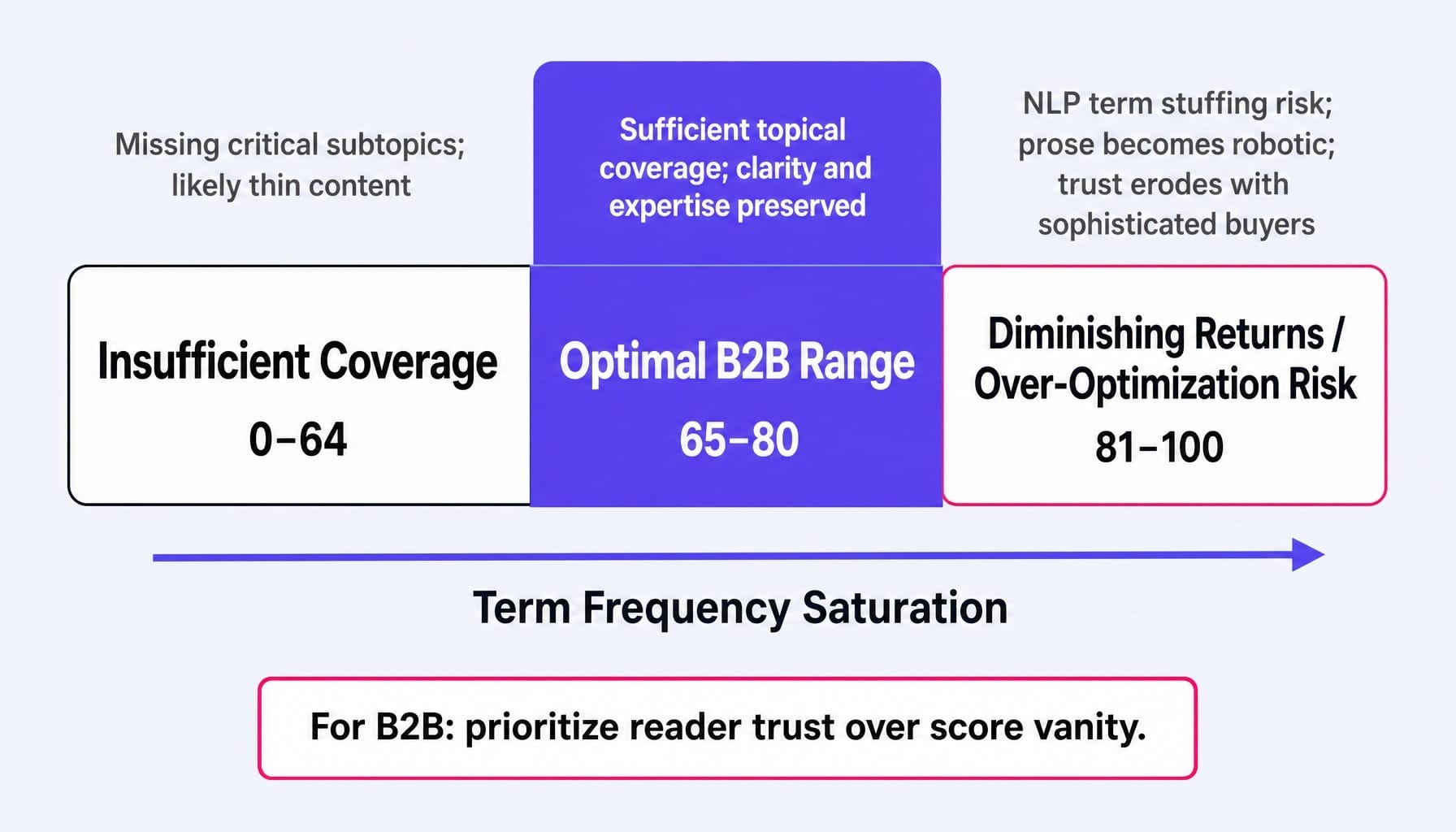
The first issue arises when writers start chasing a high score. The tool gamifies optimization, and it's tempting to push for 85, 90, or higher. But for a sophisticated B2B audience, this often degrades content quality. The score primarily rewards term frequency saturation. To move a score from 72 to 85, a writer might find themselves stuffing terms like 'ETL pipeline,' 'data warehouse,' and 'API connector' into every other paragraph of an article on data integration.
The prose becomes robotic and repetitive, written for an algorithm, not a procurement director. We've seen this repeatedly: content score chasing leads to content that feels untrustworthy. A score in the 65–80 range usually indicates sufficient topical coverage. Pushing higher often introduces more noise than signal, sacrificing clarity for a vanity metric.
Why Surfer's Scores Can Mislead on Low-Volume B2B Keywords
The second, more fundamental problem is that Surfer's model breaks down when the SERP is thin. For highly specialized B2B keywords like 'SOC 2 compliance automation for SaaS' or 'revenue attribution modeling for PLG,' the top-ranking pages are often a mix of vendor documentation, Reddit threads, analyst reports, and forum discussions—not 10 well-structured blog posts.
This is where you see surfer score inflation on thin SERPs. The tool is forced to derive its recommendations from a weak, heterogeneous, and often irrelevant set of pages. The resulting content score is built on a foundation of noise. For these niche B2B keywords, your subject matter expert's brain is infinitely more valuable than a content score derived from a SERP with a low SERP overlap coefficient. Original insight and first-hand experience will always outperform a score based on three blog posts and a Quora thread.
SERP Analyzer, Audit Tool, and Keyword Research: Honest Assessment
Beyond the Content Editor, Surfer offers a suite of supporting tools. Some are genuinely useful for B2B teams; others are more of a distraction. Knowing which to use and which to ignore is key to getting value from the platform.
SERP Analyzer: Useful for Competitive Intelligence, Overwhelming for Daily Use
The SERP Analyzer is where Surfer shows its 500+ correlation data points. It's most valuable when you're entering a new topic cluster and need to understand the competitive landscape. What's the average word count? How many H2s do top pages have?
But let's be honest—for daily content production, this is analysis paralysis. Most experienced practitioners look at it once per pillar topic, not once per article. The actionable insights are already distilled into the Content Editor. You don't need to pore over charts of "words in bold" to write a good article. Use it for initial research, then live in the Content Editor.
Audit Tool: The Best Feature for Content Refresh Triage
The Audit tool is Surfer's most underrated feature, especially for B2B teams with existing content libraries. By connecting to your Google Search Console, it identifies pages with decaying rankings and surfaces specific, actionable gaps: missing NLP terms, word count deficiencies, or internal linking opportunities.
Imagine a marketing team with 200+ blog posts published over the last two years. Where do you start? The Audit tool provides a structured triage framework. It gives you a content refresh scoring system to prioritize the assets with the highest potential for recovery. Instead of guessing, you get a data-driven backlog of your most valuable refresh targets, helping you reverse the audit decay curve on key pages. For teams with established content, this feature alone can justify Surfer's cost.
Keyword Research: Functional but Not a Replacement for Ahrefs or Semrush
Surfer's keyword research tool is functional. It provides related keyword clusters based on SERP similarity, which is helpful for building out a cluster-first architecture.
However, it lacks the robust keyword difficulty metrics, backlink data, and deep competitive analysis of platforms like Ahrefs or Semrush. If you're already using one of those industry-standard tools for your keyword strategy, Surfer's offering is redundant. Think of it as a convenient add-on, not a replacement for your primary research platform.
Surfer AI Writer: Useful Shortcut, Not a B2B Content Replacement
The Surfer AI writer produces drafts that are structurally sound and score well within Surfer's own ecosystem. Of course they do—the AI is built to satisfy the Content Editor's rules. But scoring well is not the same as being useful to a B2B buyer.
Let's take a real-world scenario. You ask Surfer AI to write an article on 'enterprise identity access management best practices.' The draft comes back with a content score of 78. It covers all the expected NLP terms and has a logical heading structure. But the content itself is a shallow summary. It lacks practitioner insight, offers no vendor-neutral evaluation criteria, and shows no awareness of how IAM decisions are actually made in enterprises with legacy Active Directory deployments.
The draft would need a 40-60% rewrite by a subject matter expert to be publishable.
Here's the practical guidance: use Surfer AI to generate a first-draft outline or to quickly scaffold the main sections of an article. It's a useful tool for beating the blank page and ensuring you've identified the right topical coverage. But for B2B, it's a structural starting point, not a content production shortcut. The trust signals and domain expertise that buyers require cannot be generated by an AI that only knows how to pass its own test.
Read more: B2B SaaS Content Writing: How to Write Content That Moves Pipeline, Not Just Traffic
Surfer SEO Pricing in 2026: What You're Actually Paying For
Surfer's pricing is transparent and based on usage credits. As of early 2026, the core plans for teams are:
- Essential: $99/month ($79/mo annually) for 15 Content Editor credits and 20 Audits.
- Scale: $219/month ($175/mo annually) for 90 Content Editor credits and 140 Audits.
Both plans come with a 7-day money-back guarantee.
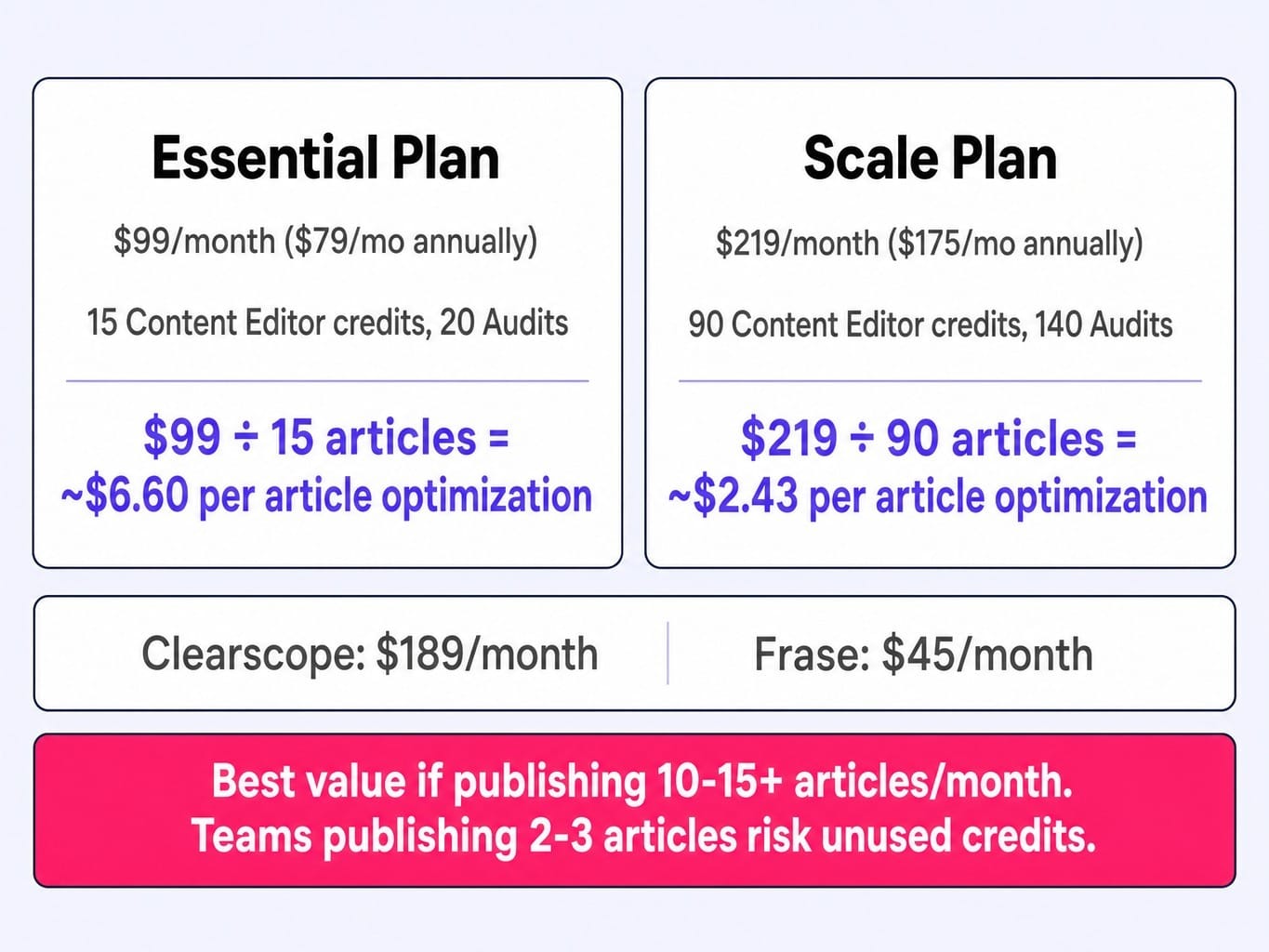
The best way for B2B teams to evaluate this is to calculate the cost per optimized article. On the Essential plan, you're paying roughly $5–$7 per article optimization. Compared to the cost of an SEO consultant's time, this is excellent value. The Scale plan drops the per-article cost even further.
The value proposition is strong if your content velocity matches the plan. A team publishing 10-15 articles per month will easily get their money's worth. A team publishing only 2-3 articles may find themselves with unused credits. Compared to alternatives like Clearscope ($189/month) or Frase ($45/month), Surfer sits in the mid-to-upper range, justified by the quality of its Content Editor and Audit tool.
Where Surfer SEO Falls Short for B2B Marketing Teams
Surfer is a capable tool. But its architecture was not designed to address the systemic challenges that B2B marketing teams face. Understanding these limitations is critical to making the right investment. This isn't about feature gaps; it's about fundamental mismatches in approach.
When SERP Competitors Are PDFs, Forums, and Gated Content
Surfer's model is entirely dependent on analyzing the content of top-ranking pages. But for many technical B2B keywords, the top results aren't blog posts. They are gated analyst reports, vendor documentation PDFs, LinkedIn discussions, or GitHub repositories.
Consider a cybersecurity SaaS trying to rank for 'zero trust architecture implementation guide.' The SERP might contain four gated Gartner reports and two documentation PDFs. Surfer cannot crawl this content. Its recommendations are therefore based on the few accessible pages, creating a skewed and incomplete picture. In these common B2B scenarios, Surfer's guidance becomes noise, and your team must rely on genuine subject matter expertise, not a flawed content score.
Surfer Optimizes Pages, Not Funnels
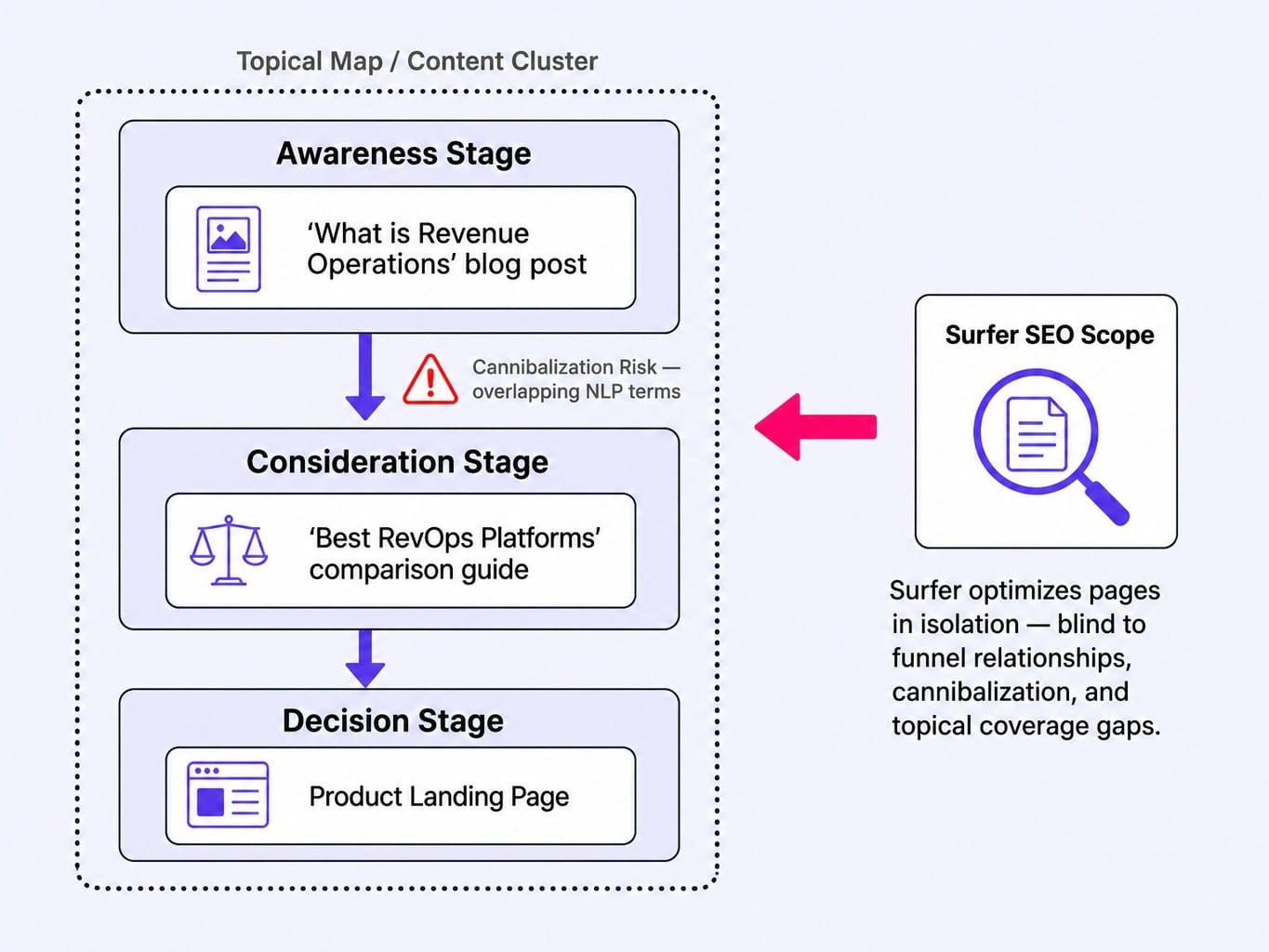
The most significant limitation is strategic. B2B buying journeys are not linear; they involve multiple stakeholders consuming different content at different stages. Surfer has no concept of this. It optimizes one page for one keyword in isolation.
It cannot tell you:
- If your awareness-stage blog post is causing cannibalization flagging with your consideration-stage comparison guide.
- If your content cluster has topical map coverage gaps that are hurting your authority.
- If the page you're optimizing is even the right asset for that keyword within your funnel architecture.
A B2B team might have one page for 'what is revenue operations' and another for 'best RevOps platforms.' Surfer will happily optimize both with overlapping terms, creating semantic confusion for Google. This is a system-level problem that a page-level tool simply cannot see, let alone solve.
Read more: Data-Driven CRO: Evolve Your Marketing Strategy for Revenue
When Content Optimization Is Only One Piece of the Growth Problem
This review highlights a core tension: Surfer SEO is a strong content optimization tool, but most B2B teams don't have an isolated content problem. They have an execution system problem.
The real challenge isn't just getting a better content score. It's continuously deciding which page to create, which to refresh, and which to re-architect—across SEO, CRO, and paid channels. It's about prioritizing the one move that will have the highest impact on qualified leads this week, not just improving on-page signals on a single blog post. And most importantly, it's about shipping that change, not letting it die in a backlog.
Where Surfer diagnoses a page-level issue and hands you homework, a true marketing execution engine identifies the highest-impact opportunity across your entire funnel and deploys the solution. The goal for lean teams isn't more data from more SaaS marketing tools; it's a closed-loop system that turns strategy into weekly releases that compound.
Spike AI is built on this principle. It functions as a unified intelligence and execution layer that moves you from operator to orchestrator. Instead of chasing content scores, you approve prioritized, high-impact changes that are shipped for you.
See how Spike AI identifies and ships your highest-impact marketing move every week
Conclusion: A Good Tool, An Incomplete System
So, is Surfer SEO worth it for B2B teams in 2026? Yes, if you understand exactly what you're buying: a best-in-class on-page content optimization tool. Its Content Editor provides valuable guardrails for writers, and its Audit tool is a powerful asset for content refresh prioritization.
But it is a component, not a complete solution. Its correlation-based model falters on the niche, low-volume SERPs common in B2B. Its AI writer lacks the domain depth required to build trust. And most critically, it operates at the page level, blind to the funnel-level and system-level execution problems that actually constrain growth.
The B2B teams that win are not the ones with the highest content scores. They are the ones with the fastest, most intelligent execution systems. Surfer can be a valuable part of that system, but treating it as the entire system is a recipe for stagnation.
Frequently Asked Questions
Can Surfer SEO handle long-form B2B content like pillar pages and whitepapers?
Surfer's Content Editor can manage pillar pages up to around 5,000 words, but its NLP term recommendations can become noisy at higher word counts as it doesn't distinguish between different sub-intents within the page. For whitepapers, Surfer is not designed to optimize gated PDFs; it's built for web pages competing in standard SERPs.
Does Surfer SEO support multi-language content optimization for global B2B companies?
Surfer supports over 20 languages, but the quality of its recommendations varies. English, Spanish, and German SERPs are typically deep enough to produce reliable suggestions. For smaller-market languages or niche B2B terminology in non-English markets, the underlying SERP data can be sparse, leading to thin or inaccurate recommendations.
Can you connect Surfer SEO to a headless CMS through its API?
Yes, Surfer provides an API that supports programmatic content workflows, allowing you to pull guidelines and push optimized content to a headless CMS. This is functional for a brief-to-publish pipeline, but teams should be aware that API rate limits on lower-tier plans can be a bottleneck for high-volume programmatic SEO.
Is Surfer SEO worth it if you already use Semrush or Ahrefs?
Yes, but specifically for its Content Editor and Audit tool. Semrush and Ahrefs are far superior for keyword research, backlink analysis, and rank tracking. The unique value Surfer adds to that stack is the real-time, on-page optimization guidance it provides during the writing and refresh process, which those platforms don't offer at the same depth.
How long does it take to onboard a content team onto Surfer SEO?
For writers who are not SEO specialists, plan for 2-3 weeks of guided usage. The main learning curve isn't the interface itself; it's developing the judgment to know when to follow the content score and when to prioritize clarity and reader experience over term density. We recommend establishing internal guidelines for target scores to prevent over-optimization.