
The Trade Desk Competitors in 2026: 8 DSPs Worth Evaluating (With Decision Framework)

TL;DR
- The DSP landscape has shifted. The Trade Desk's market dominance is being actively challenged by rising costs, transparency demands from agencies like Publicis, and innovative AI from nimbler competitors.
- Evaluate DSPs on Total Cost of Ownership (TCO) and data portability—not just feature lists. Hidden data fees, managed service markups, and minimums can inflate your real media cost by 30% or more.
- The real competitive moats in 2026 are forming around exclusive inventory access. Walled gardens in Connected TV (Roku, Samsung) and the rise of retail media networks mean no single DSP can offer comprehensive reach.
- Sophisticated programmatic buyers are abandoning the single-vendor model. They are building multi-DSP portfolios to gain best-in-class access to open internet, CTV, and retail media inventory simultaneously.
- The choice is no longer about replacing The Trade Desk; it's about designing a programmatic buying system that fits your strategy, budget, and tolerance for vendor lock-in.
For years, The Trade Desk (TTD) was the default demand-side platform for the open internet. But the ground is shifting. In March 2026, Publicis Groupe told clients it would no longer recommend the platform after an audit dispute. The company's stock has seen a significant decline over the past year, and several senior executives have departed. The search for The Trade Desk competitors is no longer a hypothetical exercise for agencies and advertisers; it's an active re-evaluation of the entire programmatic buying system.
This isn't just about finding a cheaper alternative. Most competitor roundups provide feature lists, but the real decision in 2026 hinges on three structural questions:
- What is the total cost of ownership, beyond the stated platform fee?
- Who truly owns the inventory, especially in the fragmented Connected TV (CTV) and retail media landscapes?
- What happens to your data and optimization history if you decide to leave?
This article provides a decision framework to answer those questions first. Then, we apply that framework to eight of The Trade Desk alternatives worth your serious consideration.
Why Teams Are Re-Evaluating The Trade Desk in 2026
The Trade Desk's long-standing dominance on the open internet created a powerful flywheel: more advertiser demand attracted more publisher supply, which in turn attracted more demand. But in 2026, three forces are converging to weaken that flywheel and force a market-wide reassessment.
First is pricing leverage. As TTD's market share grew, so did its ability to dictate terms. Agencies and direct advertisers report increasing take rates and rigid minimum spend requirements, often starting at $100,000 quarterly, with some managed service seats requiring $300,000 or more annually. For a mid-market agency running $500,000 a year in programmatic spend, allocating 80% of that to a single, high-cost platform is no longer sustainable. The cost pressure is forcing a diversification of spend across multiple DSPs simply to manage budget efficiency.
Second is the shift in transparency expectations. The Publicis audit dispute, where the agency requested documentation that TTD declined to provide, wasn't an isolated incident. It was a public signal of a growing industry demand for greater clarity on auction dynamics, data usage, and supply path optimization (SPO). Advertisers are no longer willing to accept opaque platform mechanics, and this friction is creating openings for competitors who lead with transparency.
Finally, the performance gap is narrowing. For years, TTD's premium was justified by its superior bidding algorithms and optimization engine. But AI-driven platforms like StackAdapt and Moloco are now delivering comparable, and in some cases superior, performance on key metrics like ROAS and CPA. The technological moat that once protected TTD is shrinking, making it harder to justify the high cost of entry for many buyers.
How to Evaluate Any DSP Against The Trade Desk
Most DSP comparison articles devolve into feature checklists. But features converge quickly across platforms. The real differentiators in 2026 are economic structure and strategic flexibility. Choosing a DSP is a structural decision about your marketing execution system, not a simple feature-matching exercise. Here's how to frame your evaluation.
Total Cost of Ownership: Beyond Platform Fees
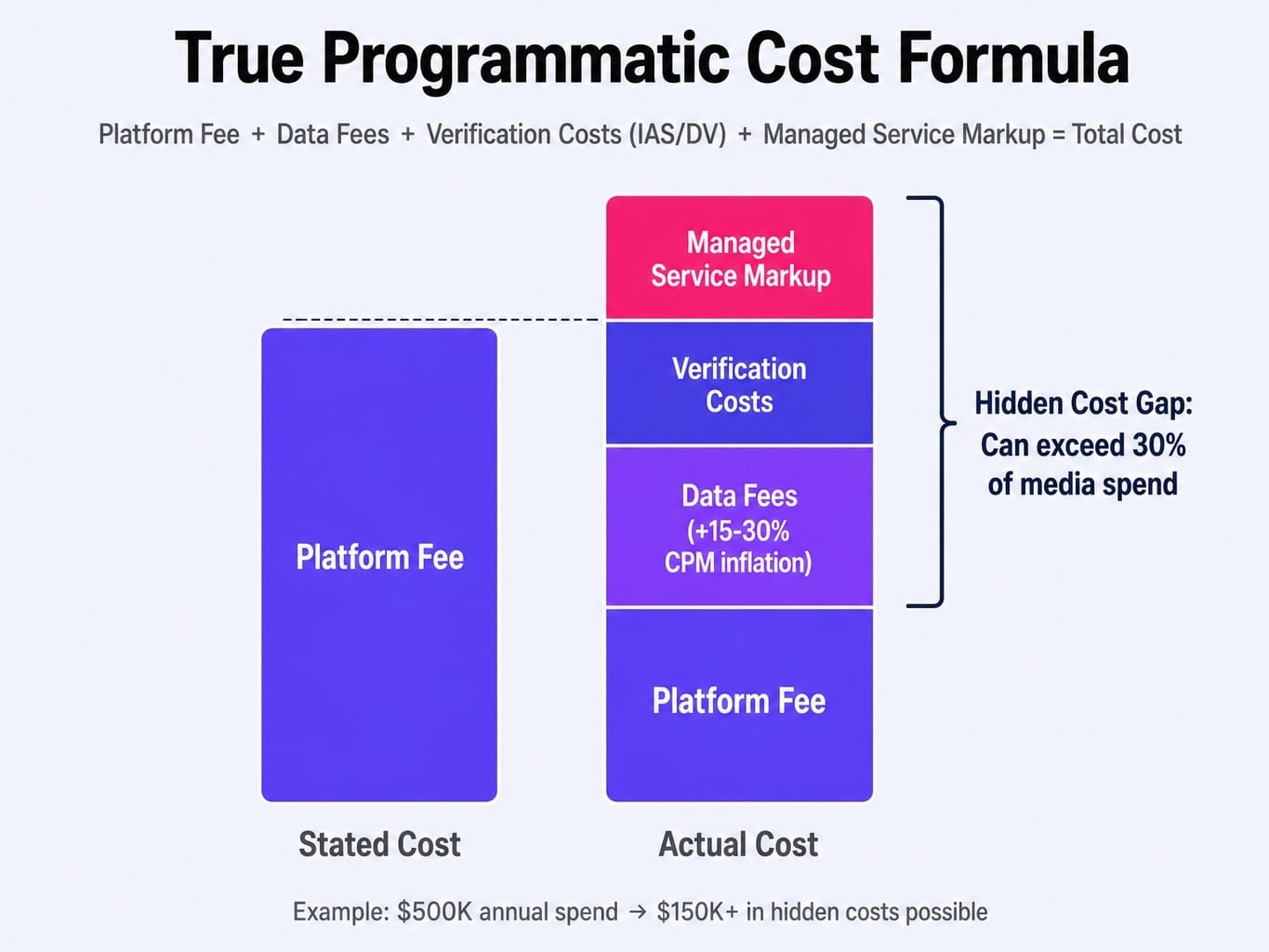
A DSP's stated platform fee—often a percentage of media spend—is only one layer of your total cost. Practitioners know the real expense is often buried in three other areas. This is where the math gets fuzzy, and where your finance team starts asking uncomfortable questions.
- Data Costs: TTD's data marketplace makes activating third-party audiences easy, but it comes at a cost. These are pass-through fees that can inflate your effective CPMs by 15-30% before a single impression is served. An alternative DSP with stronger first-party data activation tools or lower-cost contextual targeting might deliver a significantly lower all-in media cost.
- Managed Service Markups: Many agencies layer their own margin on top of the DSP's take rate, creating what's known as "margin stacking." The advertiser rarely sees the aggregate percentage being skimmed from their budget. A self-serve DSP with a transparent, flat platform fee can eliminate this layer of cost.
- Minimum Spend Commitments: A high minimum spend forces budget allocation. If your TTD contract requires a $100K quarterly spend, you may be forced to push dollars into programmatic campaigns even when another channel would deliver better ROAS that quarter, simply to meet your commitment.
Rule of Thumb: Calculate your true programmatic cost as: Platform Fee + Data Fees + Verification Costs (IAS/DoubleVerify) + Managed Service Markup. Compare that aggregate number, not just the base platform fee.
Read more: How to Prioritize Marketing Channels With a Limited Budget And Resources (Framework for Lean Teams)
Data Portability and Vendor Lock-In Risk
The most underrated evaluation criterion is what happens when you want to leave. A DSP isn't just a tool; it's a system that accumulates intelligence. The stickiness of that system determines your future flexibility.
Switching away from TTD means rebuilding your optimization history from scratch. The custom algorithms, proprietary audience segments, and campaign performance data you've built are not portable. An alternative DSP might start with a 4-8 week "learning period" of higher CPMs and lower performance as its pacing algorithms calibrate to your campaigns.
Even Unified ID 2.0 (UID2), the open-source identity framework developed by TTD, creates ecosystem stickiness. While the framework is open, advertisers who build their entire identity strategy around TTD's specific implementation of UID2 face significant friction migrating that strategy to another platform. In contrast, some competitors offer full, un-redacted log-level data exports, giving you ownership of your auction data for independent analysis and making a future migration less painful.
The Key Question for Any Vendor: "If we decide to leave your platform in 12 months, what data, audience segments, and optimization history can we take with us?" Their answer will tell you everything you need to know about their approach to partnership versus lock-in.
8 Trade Desk Competitors Worth Evaluating in 2026
These eight platforms represent the most credible The Trade Desk alternatives, spanning different use cases from enterprise-scale open internet buying to mid-market self-serve and CTV-specific solutions. This isn't a feature checklist. Each entry focuses on the structural differentiation from TTD, applying the framework above.
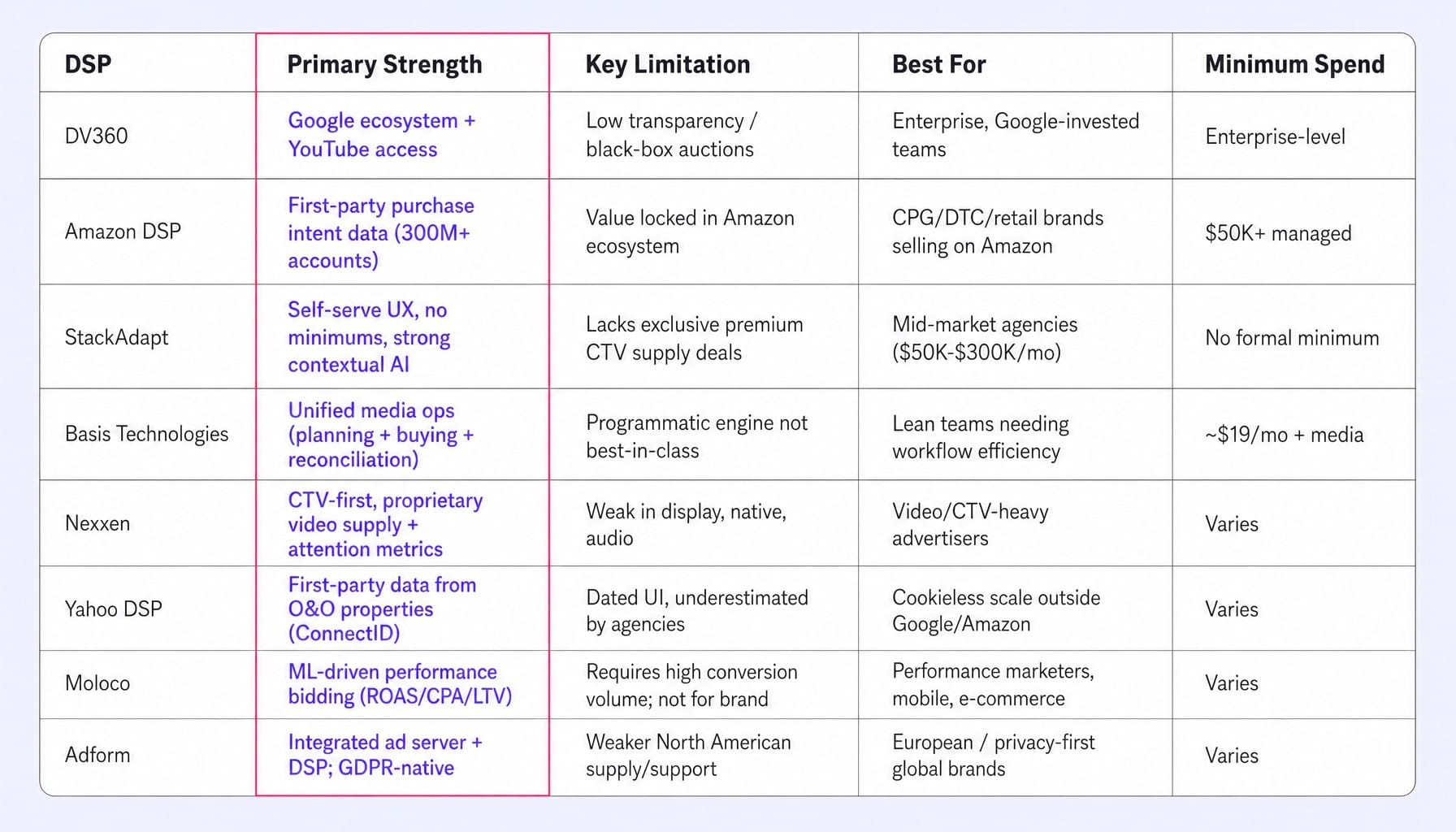
1. DV360 (Google Display & Video 360)
DV360 is the only platform that matches TTD's scale on the open internet while also providing native access to Google's walled garden.
- Key Differentiator: DV360's primary advantage is its deep integration with the Google ecosystem. It allows for unified buying and measurement across YouTube, Google Search (through SA360), and the open web. As third-party cookies deprecate, its native access to Google's first-party data via Privacy Sandbox and the Topics API gives it a structural advantage for cookieless targeting that independent DSPs must work harder to replicate. DV360's CTV advantage isn't just its bidding engine—it's YouTube. No other DSP can offer that inventory natively.
- Key Limitation: Transparency. Practitioners consistently report that DV360 provides less granular log-level data and auction-level clarity compared to independent DSPs. You are operating within Google's ecosystem, subject to its rules and its black-box auction dynamics.
- Best For: Enterprise advertisers already invested in the Google Marketing Platform who need a single point of control for buying across YouTube and the open programmatic landscape.
2. Amazon DSP
Amazon DSP is not a general TTD replacement. It's a fundamentally different buying paradigm built on first-party retail data.
- Key Differentiator: The platform's unmatched access to Amazon's 300 million+ active customer accounts. It enables targeting based on actual purchase behavior, searches, and browsing history on Amazon.com—not just inferred interest signals. For CPG, DTC, and retail brands, this purchase-intent data is the most powerful targeting asset available, making Amazon DSP a must-have for campaigns aimed at driving product sales. Its control over inventory on Fire TV, IMDb TV (now Freevee), and Twitch also gives it a growing, exclusive CTV footprint.
- Key Limitation: Its strength is also its weakness. While its open internet buying capabilities are improving, the platform's core value remains locked within Amazon's ecosystem. For advertisers not selling on Amazon or whose goals are purely brand awareness, it's often a complementary tool rather than a primary DSP.
- Best For: Any brand selling products on Amazon, or CPG/DTC brands who want to target audiences based on real-world purchase intent.
3. StackAdapt
StackAdapt has emerged as the consensus mid-market alternative, the platform most frequently chosen by agencies migrating clients off TTD.
- Key Differentiator: Its self-serve platform experience. For teams managing spend between $50,000 and $300,000 per month, StackAdapt is consistently rated as more intuitive, with faster campaign setup and more actionable reporting than TTD's more complex interface. It has no major minimum spend requirements, making it accessible to smaller clients. Its AI-driven contextual targeting and bid factoring capabilities are particularly strong in cookieless environments, often outperforming TTD on direct-response campaigns.
- Key Limitation: While its programmatic CTV access is broad, StackAdapt lacks the direct, exclusive supply deals with premium streaming publishers that TTD and platform-specific DSPs (like Roku or Samsung) possess. For buyers focused heavily on premium, non-biddable CTV inventory, it has gaps.
- Best For: Mid-market agencies and in-house teams who need TTD-like omnichannel capabilities and a strong self-serve experience without the enterprise-level minimum spend commitments.
4. Basis Technologies (formerly Centro)
Basis differentiates not on bidding algorithms but on operational efficiency, positioning itself as a unified media operations platform.
- Key Differentiator: Workflow automation. Basis combines a competent DSP with tools for media planning, buying, vendor management, and financial reconciliation into a single interface. For lean teams where one person manages programmatic alongside direct buys, paid social, and search, this consolidation is the core value proposition. It reduces the manual work of managing disparate systems, spreadsheets, and insertion orders, addressing a critical execution bottleneck for under-resourced teams.
- Key Limitation: The programmatic engine itself is not best-in-class. While solid, its supply path optimization, bidding sophistication, and QPS capacity don't match the raw power of a pure-play DSP like TTD. It's a trade-off: you gain operational simplicity at the expense of top-tier programmatic performance.
- Best For: Agencies and marketing teams that prioritize workflow efficiency and cross-channel integration over having the most powerful, standalone programmatic buying tool.
Read more: Stop Syncing Strategy and Execution: Platforms That Unify Marketing Goals With Task Management
5. Nexxen (formerly Tremor Video / Amobee)
Following a series of acquisitions, Nexxen has consolidated its assets to become a formidable CTV-first competitor.
- Key Differentiator: A deep, native focus on video and CTV. Nexxen's heritage in video advertising gives it proprietary supply relationships and unique measurement capabilities, including attention metrics that go beyond simple viewability. The platform integrates Tremor Video's demand-side tech with Amobee's cross-channel planning tools, creating a buying experience that is purpose-built for video-centric advertisers. Their exclusive supply deals provide access to inventory that isn't always available in the open auction.
- Key Limitation: Its capabilities in other channels, like display, native, and audio, are secondary. A team that needs to run a truly balanced, omnichannel campaign may find Nexxen insufficient as a single TTD replacement. It's a specialist platform, not a generalist.
- Best For: Advertisers and agencies whose programmatic spend is predominantly allocated to CTV and online video and who value video-specific planning and measurement tools.
6. Yahoo DSP
Often underestimated, the Yahoo DSP holds a unique position with its vast trove of first-party data from its owned-and-operated properties.
- Key Differentiator: Access to cookieless identity at scale. The platform leverages first-party data from Yahoo Mail, Finance, News, and Sports, reaching hundreds of millions of users in authenticated environments. This provides a durable targeting and measurement foundation that doesn't rely on third-party cookies or mobile ad IDs. Its identity solution, ConnectID, offers cross-device resolution, making it a powerful alternative for advertisers looking to escape the Google/Amazon duopoly.
- Key Limitation: Market perception and user experience. Many agencies haven't re-evaluated the platform since its pre-Apollo Global Management days, and its self-serve UI is widely considered less polished and intuitive than modern competitors like StackAdapt. It's a powerful engine with a dated dashboard.
- Best For: Advertisers seeking large-scale, first-party data targeting outside of the major walled gardens, particularly for reaching finance, news, and general consumer audiences.
7. Moloco
Moloco represents the future of programmatic buying: a platform built entirely around proprietary machine learning models that optimize for business outcomes.
- Key Differentiator: Performance-first bidding. Originally built for the hyper-competitive mobile app user acquisition space, Moloco's entire architecture is designed to optimize toward advertiser-defined goals like ROAS, CPA, or LTV, not proxy media metrics like CTR. Its ML models process log-level data in real-time to make bid decisions. This makes it exceptionally powerful for performance-focused commerce and mobile advertisers who can provide a clean conversion signal for the models to learn from.
- Key Limitation: It's not a brand-awareness tool. The platform requires a significant volume of conversion data to train its models effectively, making it less suitable for low-volume advertisers or pure upper-funnel campaigns. Its strength in performance marketing is also a constraint on its versatility.
- Best For: Performance marketers, mobile app developers, and e-commerce brands who can feed the platform a steady stream of conversion data and want to optimize directly against business KPIs.
8. Adform
Adform is the leading European-first, privacy-centric alternative, built with GDPR compliance as a core design principle.
- Key Differentiator: An integrated ad server and DSP architecture (IAP). This eliminates the need for a separate ad serving contract, which reduces both direct cost and the data leakage that occurs when passing information between separate ad tech vendors. Headquartered in Denmark, its entire platform was engineered for a strict regulatory environment, making it a structurally sound choice for brands with significant EU media spend. It also offers strong log-level data transparency.
- Key Limitation: Weaker North American presence. While a global company, Adform's US inventory access and sales support are less comprehensive than TTD or other US-based competitors. Agencies buying primarily in the North American market may find its supply path less competitive.
- Best For: European advertisers or global brands that prioritize GDPR compliance, data privacy, and the cost efficiency of an integrated ad serving and buying stack.
CTV and Retail Media: Where the Real Competitive Moats Are Forming
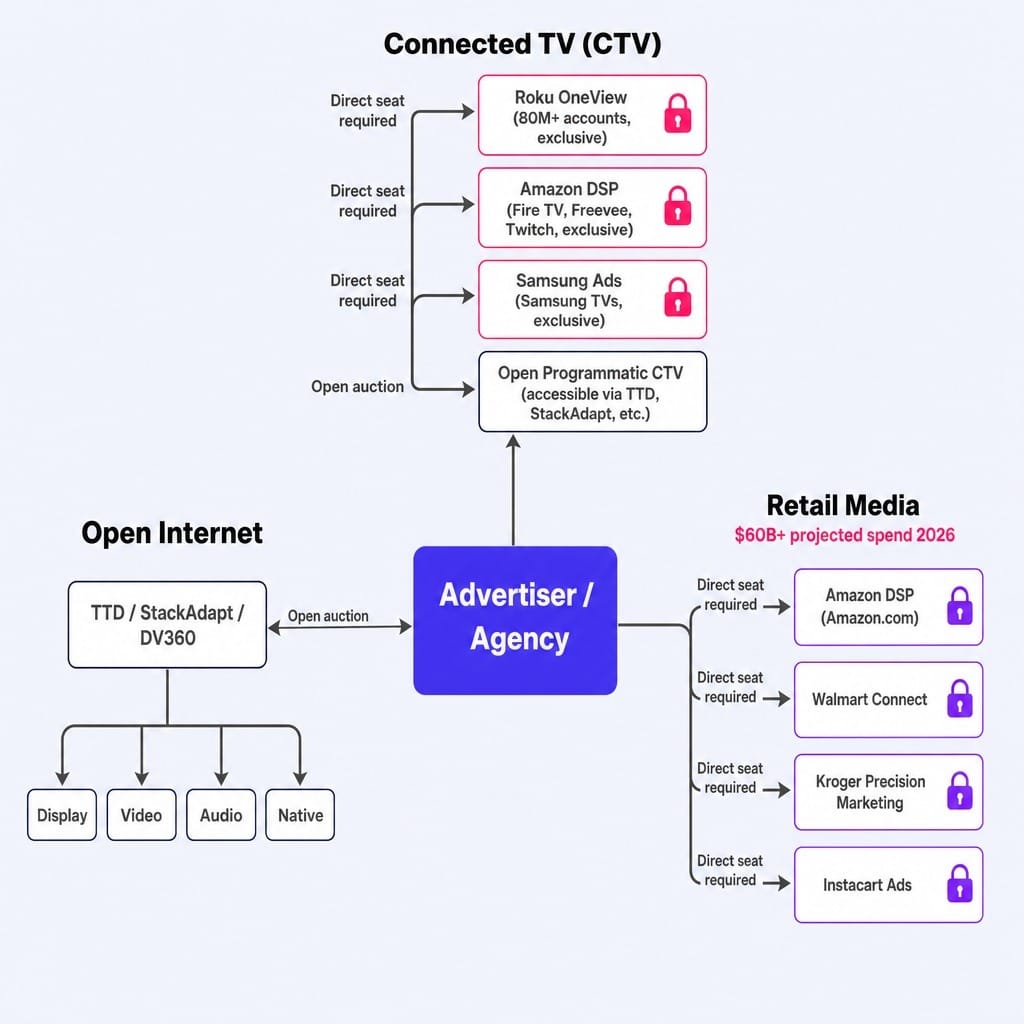
For years, DSP competition was about features: better bidding algorithms, more targeting options, slicker UIs. In 2026, that's secondary. The real competitive moats are being built at the inventory access layer, creating a fragmented landscape where no single DSP can be comprehensive.
First, Connected TV (CTV) is de-platforming. While TTD maintains broad access to open programmatic CTV, the most valuable inventory is increasingly locked behind device-specific walled gardens. Roku OneView holds exclusive data and ad inventory from its 80 million+ active accounts. Amazon DSP controls inventory on Fire TV and its Freevee streaming service. Samsung Ads has its own DSP for inventory on Samsung smart TVs. These are not just alternative DSPs; they are closed ecosystems. A CPG brand that once bought all its CTV through TTD might now need to split its budget across three or four platforms just to achieve comprehensive reach, using TTD for the open internet portion, Roku OneView for Roku-exclusive inventory, and Amazon DSP for Fire TV.
Second, retail media is pulling the budget away from generalist DSPs. Platforms like Walmart Connect, Kroger Precision Marketing, and Instacart Ads are building their own powerful demand-side interfaces. While TTD has built integrations with some retail media networks, the trend is clear: retailers want to own the relationship with advertisers and control their first-party data. With retail media ad spend projected to exceed $60 billion in 2026, this represents a significant fragmentation of the addressable market that TTD once dominated.
The Multi-DSP Strategy: Why Choosing One Alternative May Be the Wrong Frame
The very search for "The Trade Desk competitors" contains a flawed assumption: that you need to find a single replacement. The most sophisticated programmatic buyers in 2026 are not picking one winner; they are building a portfolio.
This multi-DSP strategy acknowledges that no single platform offers best-in-class capabilities across every channel and objective. A modern programmatic buying system might look like this:
- The Trade Desk: For maximum scale and reach on the open internet display and video.
- Amazon DSP: For all campaigns targeting purchase intent and running on Amazon's properties.
- Roku OneView or Nexxen: For dedicated, premium CTV campaigns requiring specific inventory access.
- StackAdapt: For mid-market clients or direct-response campaigns that don't meet TTD's minimums.
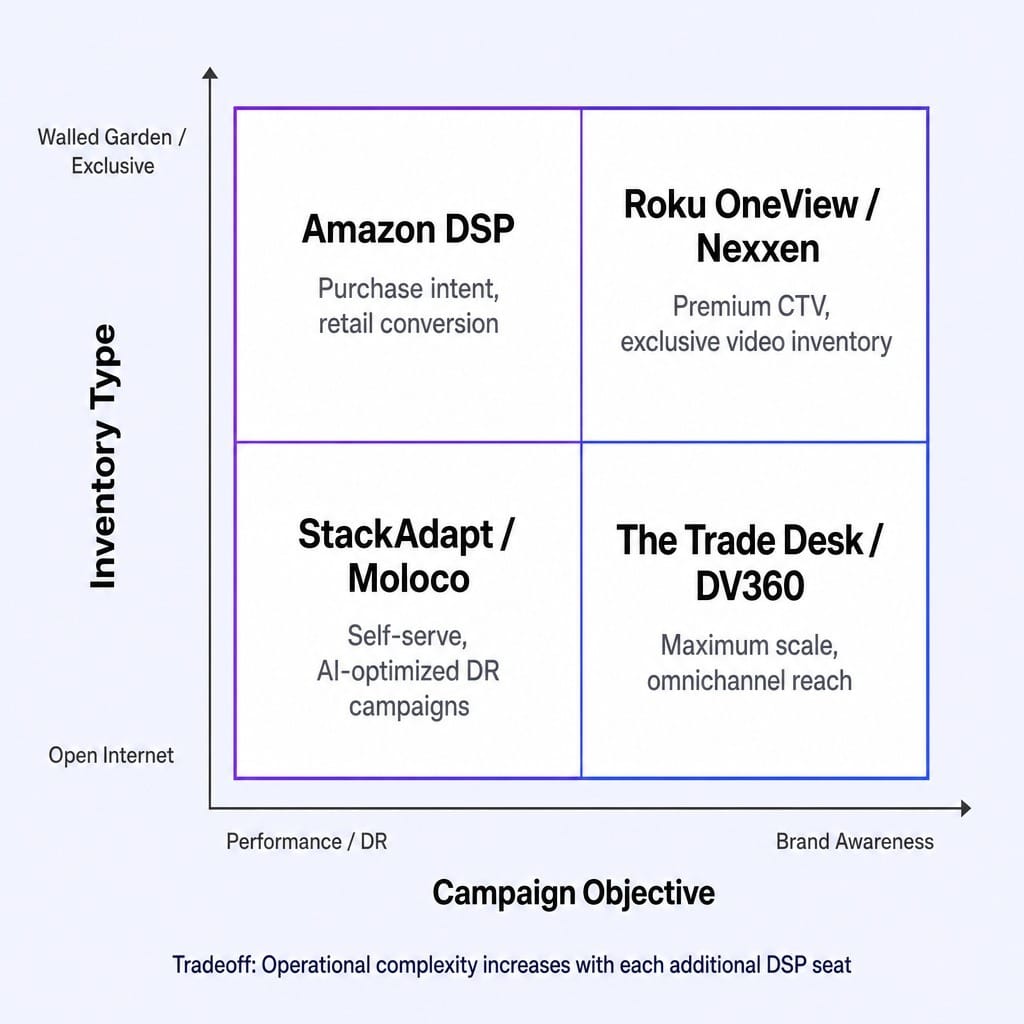
The tradeoff, of course, is operational complexity. Managing multiple seat-level contracts, reconciling attribution across platforms, and trying to maintain consistent frequency capping is a significant execution burden. And let's be honest, untangling frequency capping leakage across three different DSPs is a nightmare no one wants. This approach requires a team with the bandwidth and technical skill to manage a complex system, not just operate a single tool. It shifts the problem from vendor selection to system design.
When the Bottleneck Isn't Your DSP — It's Your Execution Bandwidth
Evaluating DSPs, negotiating contracts, and building a multi-platform media buying system requires immense analytical and operational bandwidth. For the lean marketing teams this article is written for—those running programmatic alongside SEO, CRO, and paid search—the DSP decision is just one of dozens of optimization levers competing for attention every week. The real constraint isn't which tool to choose; it's having the execution capacity to act on insights across all channels simultaneously.
This is the execution gap that Spike AI is built to close. The smartest programmatic buyers are building systems (like a multi-DSP portfolio) rather than just picking vendors. The smartest marketing teams are building execution systems that ship improvements continuously, not sporadically. Spike AI acts as that execution layer for your owned and paid channels. It continuously identifies, prioritizes, and executes the highest-impact optimizations across your website, SEO, and ads, freeing your team's bandwidth for high-level strategic decisions like media mix modeling and DSP portfolio management. While you design the media buying system, Spike AI ensures the rest of your marketing engine is running at peak performance.
See how Spike AI turns your marketing backlog into weekly shipped improvements
Conclusion
Choosing a demand-side platform in 2026 is no longer a simple vendor replacement decision. The market has shifted from The Trade Desk's near-monopoly on the open internet to a fragmented, multi-platform reality. The evaluation criteria that matter now are structural: total cost of ownership, data portability, and access to the walled gardens of CTV and retail media.
The search for a single TTD replacement is the wrong frame. The most effective programmatic buyers are thinking like systems architects, constructing a portfolio of DSPs tailored to specific inventory and data needs. The teams that will outperform in the years ahead are not those who find the "best" DSP, but those who design and manage the most effective system of buying platforms—treating their tech stack not as a contract to be renewed, but as a dynamic portfolio to be continuously optimized.
Frequently Asked Questions
What is the minimum spend required to use The Trade Desk vs. its main competitors?
The Trade Desk typically requires a commitment of $100K+ per quarter, or $300K-$400K annually, especially for managed service. In contrast, StackAdapt has no formal minimums, with self-serve access viable from $5K-$10K/month. Basis Technologies offers its platform from around $19/month plus media spend. Amazon DSP's self-serve option has lower minimums than TTD, though its managed service also requires $50K+. These figures vary by region and agency seat agreements.
What are the hidden costs when switching from The Trade Desk to an alternative DSP?
Teams often underestimate three costs: (1) Optimization history loss, which forces a new DSP into a 4-8 week "learning period" with potentially higher CPMs. (2) Audience segment rebuilding, as custom audiences built in TTD's marketplace are not transferable. (3) Integration re-work, requiring you to rebuild any API connections or reporting dashboards tied to TTD's data. Running parallel campaigns during a transition is safer than a hard switch.
Which Trade Desk competitors offer the best log-level data transparency?
Log-level data is crucial for auditing DSP margins and supply path quality. TTD provides this data but often charges for it. StackAdapt and Basis Technologies include log-level reporting in their standard platform access. Adform is notably strong, positioning full data transparency as a core feature. DV360 has faced persistent criticism for providing less granular auction data than its independent counterparts, a key tradeoff for access to Google's ecosystem.
How do Trade Desk alternatives handle cookieless targeting and identity resolution in 2026?
The landscape is fragmented. TTD's UID2 is open-source and supported by many competitors. DV360 relies on Google's Privacy Sandbox and Topics API. Amazon DSP uses its own first-party purchase data, making it inherently cookieless. Yahoo DSP has its own ConnectID. StackAdapt has invested heavily in advanced contextual targeting. The takeaway is that no single solution has won; evaluate which approach best aligns with your audience and data strategy.
Are there Trade Desk competitors that specialize in retail media network access?
Yes, but retail media is increasingly moving to retailer-owned platforms. Amazon DSP is the dominant player for buying on Amazon. Criteo has strong direct integrations with a broad network of non-Amazon retailers like Target, Best Buy, and Macy's. While TTD has built partnerships with networks like Walmart Connect, specialized platforms like Criteo or Amazon DSP offer deeper, more focused access for brands needing to buy across multiple retailers.