
Ubersuggest Pricing in 2026: The Real Cost Per Insight
TL;DR
- Ubersuggest pricing ranges from $29/mo (Individual) to $99/mo (Enterprise), with annual and lifetime deals offering significant discounts. The key differences are capacity limits (daily searches, tracked keywords), not features.
- The free plan is functionally a demo, limited to 3 daily searches, making any sustained SEO workflow impractical. It's useful for a quick volume check and nothing more.
- The lifetime deal ($290-$990) breaks even in about 10-18 months, but carries a "feature decay" risk where plan features and limits may be restructured over time, devaluing the initial investment.
- Compared to Ahrefs or Semrush, Ubersuggest has a lower data quality ceiling, especially for long-tail keyword volume and rank tracking freshness. It's cost-effective for basic needs but becomes a false economy for complex SEO programs.
- The real bottleneck for most lean teams isn't tool cost, but the execution bandwidth to act on the data. The highest-performing teams are defined by their shipping cadence, not their tool stack.
Ubersuggest is almost always framed as the affordable SEO tool. With its Individual plan starting at $29 per month, the sticker price certainly supports that narrative. But for any marketing team accountable for revenue, sticker price is the wrong lens.
The real question isn't what Ubersuggest costs, but what each dollar buys you in usable keyword data, accurate rank tracking, and actionable site audit insights. At what point do the limits on daily searches, crawl pages, and tracked keywords create a bottleneck that forces you into a more expensive system?
This is not a feature list copied from the pricing page. It is an operational analysis of what each Ubersuggest subscription tier actually delivers, where the limits bite, how the cost-per-insight compares to premium tools like Ahrefs and Semrush, and a decision framework for which plan—if any—fits your execution system.
Ubersuggest Pricing Plans in 2026: What Each Tier Costs and Includes
Ubersuggest offers three paid tiers—Individual, Business, and Enterprise—plus a highly restricted free plan. The pricing is structured across monthly, annual, and lifetime payment options, with significant discounts for longer commitments.
- Individual Plan: $29/month, $16/month billed annually ($192/year), or a $290 lifetime deal.
- Business Plan: $49/month, $27.17/month billed annually ($326/year), or a $490 lifetime deal.
- Enterprise Plan: $99/month, $54.75/month billed annually ($657/year), or a $990 lifetime deal.
Here is how the core limits break down across each plan:
The meaningful differences between tiers are not features. Every paid plan includes the core modules: site audit, keyword research, backlink data, and the Chrome extension. The real differentiators are capacity limits. This creates a query burn rate problem. A solo marketer performing competitive research for a single content pillar can easily exhaust the Individual plan's 150 daily searches by mid-morning. A team managing multiple client sites requires the Business tier at a minimum simply for the domain analysis limits. The pricing structure is designed to move you up the ladder as your operational tempo increases.
What You Actually Lose on the Free Plan
Ubersuggest's free tier is useful for exactly one thing: a quick keyword volume check when you don't have another tool open. Beyond that, its constraints make it functionally unusable for any sustained SEO workflow.
The limitations are severe:
- 3 keyword searches per day: This is the most significant bottleneck.
- No historical keyword data: You can't analyze trends or seasonality.
- Limited backlink results: The index is shallow, showing only a fraction of a domain's profile.
- No rank tracking: You cannot monitor keyword performance over time.
- Surface-level site audit: The 150-page crawl limit is insufficient for all but the smallest sites.
- No AI writer access: The AI features are entirely token-gated for paid users.
Consider a real-world scenario: a content marketer building a keyword universe for a new product launch. The process involves researching 50-100 seed keywords, analyzing the SERP for each, and identifying competitor content gaps. At three searches per day, this initial research phase would take between 17 and 34 working days—before a single word of content is written.
The free plan isn't a viable tool; it's a trial funnel designed to demonstrate the platform's UI while making the limits feel acute. While the free Chrome extension retains some utility for SERP overlays, any team serious about SEO will need to budget for a paid plan.
Read more: Semrush vs Ubersuggest (2026): Data Accuracy, Real Costs, and When Each Tool Stops Being Enough
Is the Ubersuggest Lifetime Deal Still Worth It in 2026?
On paper, the break-even math for the Ubersuggest lifetime deal is compelling.
- The Individual lifetime deal ($290) pays for itself in 10 months versus monthly billing or 18 months versus annual billing.
- The Business ($490) and Enterprise ($990) tiers follow the same 10/18-month payback ratio.
If you plan to use the tool for more than 18 months, the lifetime deal seems like a clear financial win. However, this calculation ignores the risk most analyses miss: feature decay and LTV deal amortization. And let's be honest, SaaS companies have to fund future development somehow; lifetime deals are a calculated risk on both sides.
Ubersuggest has a history of restructuring its plans. Features that were once generous or unlimited—like AI writer credits—have been throttled or moved into tiered allocations. The lifetime deal locks in your price, but it does not guarantee your feature set remains static. A buyer from 2022 might find their plan's daily search limits or data access no longer match what is advertised for the same tier today. This is the structural risk of any SaaS lifetime deal: you are buying a snapshot in time, and as the product evolves, your "lifetime" access may apply to a less valuable version of the tool.
Given that the lifetime deal is explicitly non-refundable, it's a calculated bet on both the tool's future utility and the stability of its feature packaging.
Ubersuggest vs. Ahrefs vs. Semrush: The Real Cost-Per-Insight Comparison
Comparing Ubersuggest's $29/month entry price to Semrush's ~$139/month or Ahrefs' ~$129/month is misleading without normalizing for data quality and capacity. This is where many teams get stuck. The numbers on the pricing page look great, but the reality of your daily workflow tells a different story.
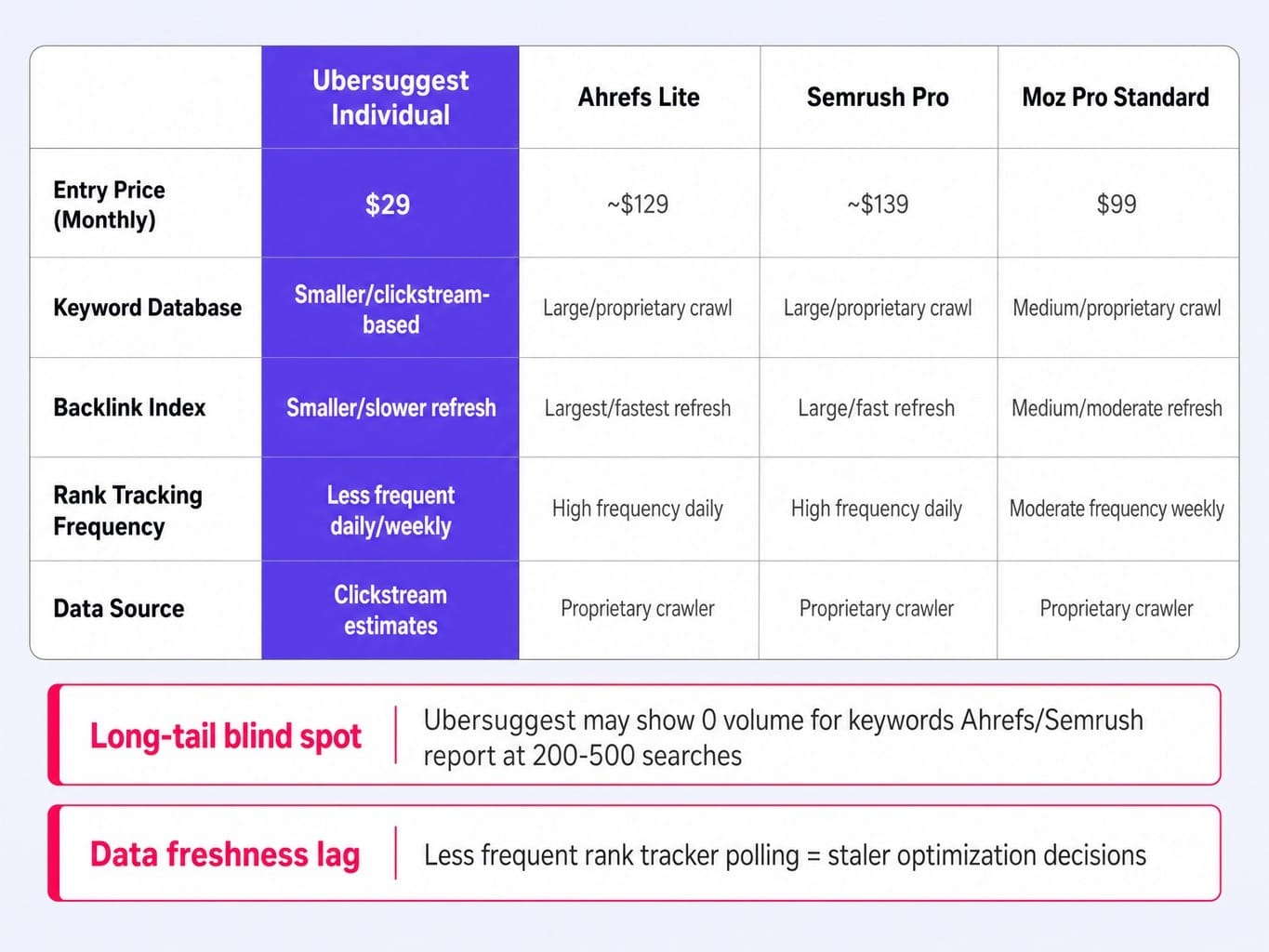
Two points are critical:
- Data Provider Parity: Ubersuggest relies on clickstream-derived volume estimates. For high-volume head terms, these numbers are often comparable to premium tools. The divergence happens in the long tail. For keywords with under 1,000 monthly searches—where most B2B content strategies operate—Ubersuggest can show zero volume for queries that Ahrefs or Semrush report at 200-500. This discrepancy directly impacts content prioritization and can render the tool a false economy.
- Rank Tracker Polling Interval: Ubersuggest's rank tracker polling interval is less frequent than Ahrefs or Semrush. This means you are making optimization decisions based on staler data, introducing lag into your feedback loop.
Ubersuggest is genuinely cost-effective for solopreneurs or small sites doing foundational keyword research. But for teams running continuous SEO programs, where long-tail accuracy and data freshness directly affect revenue, the cost-per-usable-insight gap narrows significantly.
Read more: Moz or Ubersuggest? A Data-Grounded Comparison for Lean Marketing Teams in 2026
Which Ubersuggest Plan Fits Your Business—A Decision Framework
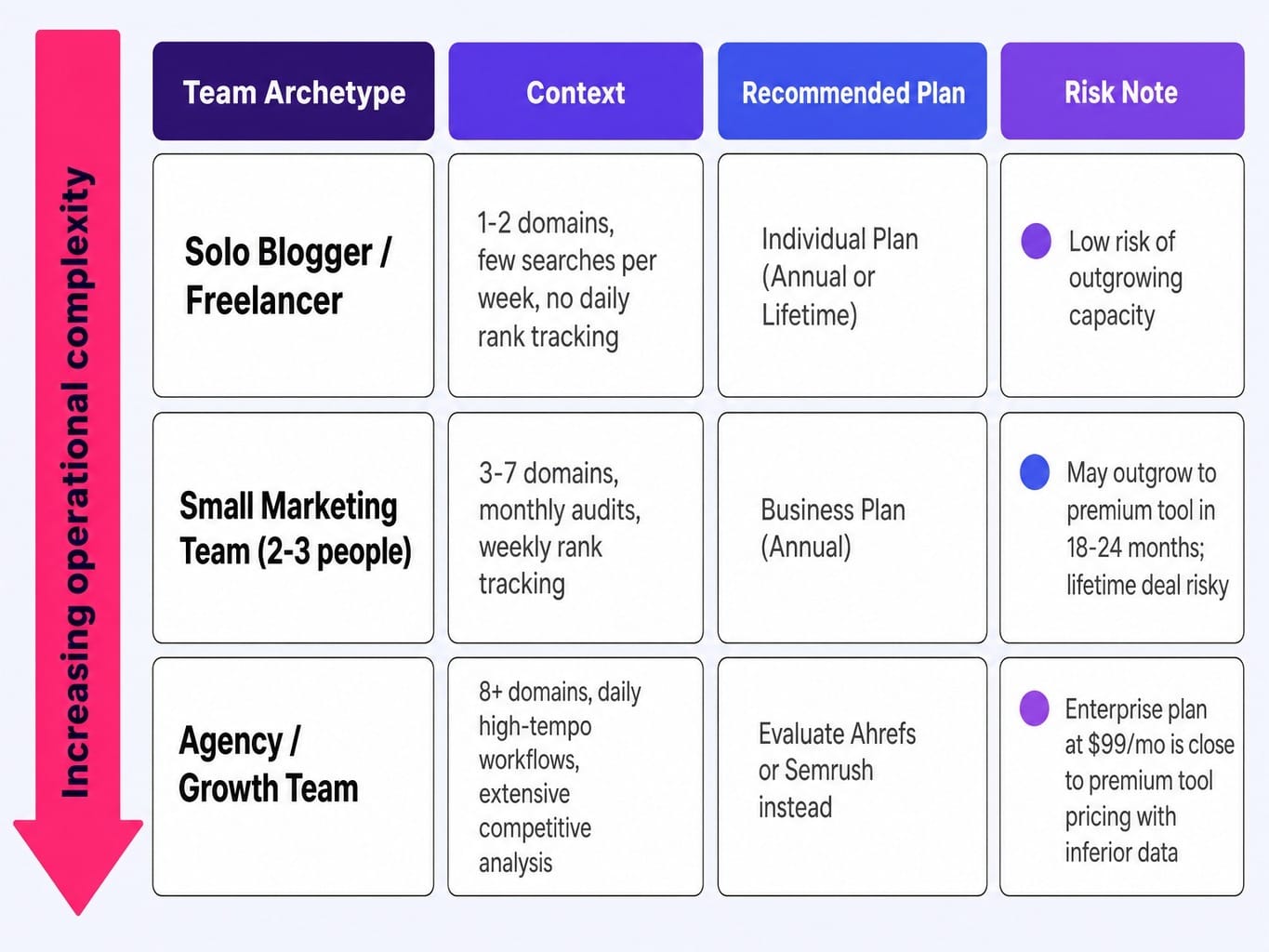
No pricing page tells you which plan to buy based on your operational reality. Here is a decision framework based on common marketing team structures.
Archetype 1: The Solo Blogger or Freelancer
- Context: Managing 1-2 domains, doing keyword research a few times per week, not running continuous, daily rank tracking.
- Recommendation: Individual Plan (Annual or Lifetime). The 150 daily searches and 125 tracked keywords are sufficient for this workflow. The lifetime deal is attractive here because the risk of outgrowing the tool's core capacity is relatively low.
Archetype 2: The Small Marketing Team
- Context: A 2-3 person team managing 3-7 client or product domains, running monthly site audits, and tracking keyword rankings weekly.
- Recommendation: Business Plan (Annual). The 7-domain limit and 300 daily searches align with this workflow. Consider annual billing over the lifetime deal. Teams at this scale often mature into needing a premium tool like Ahrefs or Semrush within 18-24 months, making the lifetime deal a riskier bet.
Archetype 3: The Agency or Growth Team
- Context: Managing 8+ domains with daily, high-tempo SEO workflows involving extensive competitive analysis and rank tracking.
- Recommendation: Evaluate Alternatives. Before committing to the Enterprise plan at $99/month, assess if its 900 daily searches and 300 tracked keywords are truly sufficient. At this price point, the gap to Semrush or Ahrefs narrows enough that the superior data quality and higher API call ceilings of a premium tool often provide a better return.
Choosing the right tool is the easy part. The harder question is whether your team has the system to act on the insights it provides.
When the Tool Cost Is Not the Bottleneck—The Execution Gap
The analysis above helps you match a tool's data capacity to your workflow. But the deeper constraint for most lean marketing teams isn't the SEO tool. It's the execution gap.
You can have the most accurate keyword data from Ahrefs or the most affordable plan from Ubersuggest, but it doesn't matter if the insights sit in a backlog. The latency between identifying a content opportunity or a technical fix and actually shipping it can stretch into weeks or months. Teams don't fail because they chose the wrong keyword tool; they fail because their execution system can't keep pace with the opportunities.
This is the problem Spike AI is built to solve. It's not another tool for your stack; it's the execution layer that closes the gap between insight and implementation. Spike AI ingests data from your entire marketing system, identifies the single highest-impact move to make across SEO, CRO, or ads, and then executes it. Every week.
The marketer's job shifts from operator to orchestrator. The backlog becomes an approval queue. The growth engine isn't the tool—it's the relentless weekly shipping cadence.
See what Spike AI would ship for your site this week
Conclusion
Ubersuggest's pricing is undeniably competitive, particularly for solopreneurs and small teams whose SEO needs are foundational. The lifetime and annual plans offer a low-cost entry point into the world of SEO tooling.
But the right question is not "how much does the tool cost?" It's "does this tool's data quality and capacity match the complexity of my SEO program?" And more importantly, "do I have the execution bandwidth to act on what it surfaces?" The teams that win aren't defined by the expense of their tool stack, but by the velocity of their execution. They ship improvements every week, turning data—from any source—into compound growth.
Frequently Asked Questions
Does Ubersuggest charge per user or per account?
Ubersuggest uses seat-based licensing bundled into each plan. The Individual plan includes 1 user, Business includes 2, and Enterprise includes 5. This structure contrasts with a pure per-seat model, but you can add extra users to any plan for a $5/month add-on fee, offering some flexibility as your team grows.
What is Ubersuggest's refund policy if I cancel early?
For monthly subscriptions, Ubersuggest offers a 7-day free trial; you can cancel before it ends without being charged. Once a paid period begins, it is non-refundable. For lifetime deals, the policy is stricter: they are explicitly non-refundable. Once purchased, you cannot get a partial or full refund, regardless of usage.
Are Ubersuggest AI writer credits included in all plans or do they cost extra?
AI writer credits are included in all paid plans, but the allocation is a token-gated feature that varies by tier. These credits reset monthly and do not roll over. If you exhaust your monthly allowance, you can purchase additional AI prompts as a $5/month add-on, so it functions as a hybrid of included value and potential upsell.
How often does Ubersuggest update its keyword volume and backlink data?
Ubersuggest's keyword volume data, derived from clickstream estimates, is refreshed on a monthly basis. Its backlink data updates are less frequent and the backlink index depth is smaller than premium competitors like Ahrefs, meaning data can lag by days or weeks. This data freshness lag is a key tradeoff for its lower price point.
Does Ubersuggest offer discounts for students, nonprofits, or startups?
Ubersuggest does not advertise a formal discount program for students, nonprofits, or startups. The company positions its highly restricted free tier and the low entry price of the Individual plan ($29/month or $290 lifetime) as its primary accessibility options for users with limited budgets.