
Ubersuggest Review 2026: An Honest B2B Assessment (Where It Works, Where It Breaks)

TL;DR
- For Early-Stage B2B: Ubersuggest is a rational choice for initial keyword discovery and content ideation, especially when paired with Google Search Console for validation. The lifetime deal offers a low-risk entry point.
- Misleading B2B Data: Its keyword difficulty score is unreliable for low-volume, high-intent B2B terms, as it doesn't properly weigh the authority of ranking domains. Search volume estimates for these queries also show significant variance.
- Operational Bottlenecks: The low project caps, daily search limits, and 1,000-page site audit cap on the base plan become critical bottlenecks for any B2B team managing more than a single small website.
- The Hidden Cost: The real cost isn't the subscription fee; it's the 4+ hours per week of manual work your team will spend validating its data and patching its gaps with other tools, an "execution tax" that can exceed $1,200/month.
- Inflection Point: Most B2B SaaS teams outgrow Ubersuggest between $1M and $3M ARR, when SEO shifts from an experiment to a pipeline-critical execution system that demands reliable data and operational scale.
The tension is real. Ubersuggest is $29/month. Ahrefs and Semrush are over $129/month. The feature lists look superficially similar, and for a lean B2B marketing team, the instinct to save over $1,200 a year is strong. But the question isn't whether Ubersuggest has a keyword research tool. It's whether its data is accurate enough for the environment B2B teams operate in.
You aren't targeting keywords with 50,000 monthly searches. You're fighting for 50-500 search volume queries with immense commercial intent. In that context, data variance isn't a minor detail; it's the difference between a sound content strategy and months of wasted effort.
This Ubersuggest review evaluates the platform specifically through that B2B lens. We'll analyze its data accuracy, keyword depth, backlink coverage, and operational limits to provide a clear verdict on who should use it—and when it's time to graduate.
What Ubersuggest offers in 2026 — and what it doesn't
Ubersuggest is a budget SEO platform offering the standard suite of keyword research, domain analysis, backlink data, site audits, and rank tracking. It's structured across three main pricing tiers—Individual ($29/mo), Business ($49/mo), and Enterprise ($99/mo)—with a popular lifetime deal option. Its core data comes from two places: Moz's index for some backlink and authority metrics, and its own crawling infrastructure. That infrastructure is where the first trade-off appears. Ubersuggest's keyword database sits at around 1.25 billion keywords, a fraction of Ahrefs' (~28.7B) or Semrush's (~26.3B).
The platform's feature set covers the basics well, and its Chrome extension is a genuinely useful free tool for surfacing SERP data on the fly. However, a professional-grade toolset is not. Notably absent are critical features for serious B2B teams: no SERP feature coverage, no query-level intent classification, limited historical data (12 months max), and no advanced reporting like position distribution curves or share of voice tracking. The project and usage limits are also tight. The Individual plan caps you at 3 projects and 150 daily searches, a ceiling you'll hit faster than you think.
Read more: Semrush vs Ubersuggest (2026): Data Accuracy, Real Costs, and When Each Tool Stops Being Enough
Where Ubersuggest genuinely performs for B2B teams
Despite its limitations, praising Ubersuggest for being "cheap and easy" misses the point. Its value lies in specific operational contexts where those attributes solve a real problem. For B2B teams, there are three scenarios where it's a defensible choice.
First, for early-stage keyword discovery. If you're a two-person marketing team at a new SaaS, you don't have enough search volume to justify a $129/month tool. Ubersuggest's keyword ideas module provides a reasonable seed keyword expansion ratio for building an initial content calendar. The workflow is simple: generate broad topics in Ubersuggest, then cross-reference the suggestions with your actual impression data in Google Search Console for validation. It's directional, not precise, but at this stage, directional is often enough.
Second, the Chrome extension provides a valuable passive intelligence layer. It surfaces volume, CPC, and domain authority data directly in your search results. For quick competitive scans or ad-hoc content ideation during research, this is genuinely useful and reduces the friction of logging into a separate dashboard.
Third, the lifetime deal is a rational financial decision for bootstrapped or pre-revenue companies. Paying $290 one-time versus $1,548 per year for Semrush is a meaningful budget difference when every dollar is scrutinized. Over three years, that's a savings of over $4,300 on subscription fees alone. This math works perfectly, right up until the point where the tool's data limitations start costing you more in wasted time than you're saving on the subscription. Teams in this position should think carefully about how to prioritize marketing channels with limited budget before locking in any tool.
Where Ubersuggest breaks down for B2B marketing
The limitations of a budget SEO tool are rarely obvious when evaluating it against high-volume consumer keywords, where data variances are marginal. But B2B teams operate in a different reality. We target low-volume, high-intent keywords where a 30-40% variance in search volume or a flawed difficulty score leads to fundamentally wrong prioritization.
Our testing shows Ubersuggest traffic estimates can deviate by 30-40% from Google Analytics actuals for mid-traffic B2B sites. Its backlink detection rate often hovers around 60-70% of what Ahrefs finds for the same domain. These aren't just numbers; they are systemic flaws that break down in two critical areas for any scaling B2B marketing program.
Data accuracy gaps in low-volume, high-intent keyword environments
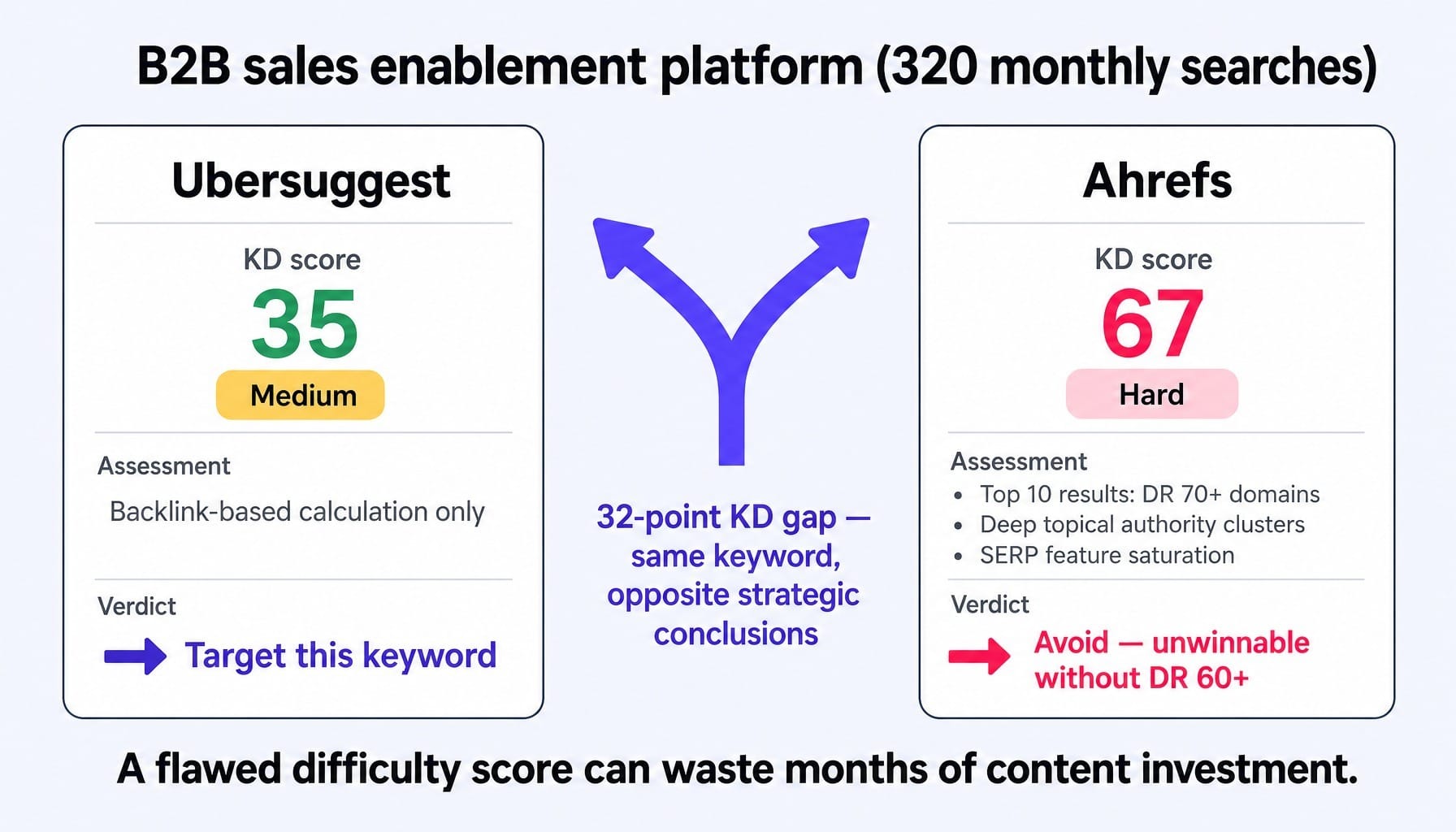
Ubersuggest's Keyword Difficulty (KD) score is particularly misleading for B2B queries. The metric relies on a simplified, backlink-centric calculation that doesn't adequately factor in the domain rating distribution of ranking pages, SERP feature saturation, or topical authority signals.
Consider a keyword like "B2B sales enablement platform" with 320 monthly searches. Ubersuggest might show a KD of 35 (Medium), encouraging you to target it. Ahrefs, however, might show a KD of 67 (Hard). Why the massive difference? Ahrefs' algorithm sees that all top-10 results are from DR 70+ enterprise sites with deep topical authority on sales software. Ubersuggest's simpler model misses this nuance entirely, sending you into an unwinnable battle.
This problem is compounded by search volume accuracy. Ubersuggest's reliance on clickstream data sourcing produces less reliable estimates for keywords under 1,000 monthly searches—precisely the range where most valuable B2B commercial queries live. Its data isn't wrong in a vacuum, but it's often inaccurate in the specific ways that matter most for B2B keyword prioritization.
Operational ceilings that constrain growing B2B teams
Beyond data quality, the tool's operational limits create a hard ceiling for growth. The Individual plan's 150 daily searches and 3-project cap become a bottleneck almost immediately. A growth marketer managing a main product site, a blog subdomain, and a set of campaign landing pages has already exhausted their project slots.
The 1,000-page crawl limit on the base plan's site audit means any B2B site with more than a few hundred pages of content and documentation will get an incomplete report. It will miss critical issues like index bloat, thin content, and cannibalization hiding in your blog archives or help center.
Rank tracking is similarly constrained at 125 keywords per project, insufficient for tracking branded terms, core product categories, and key competitor terms simultaneously. And the backlink index gap is a dealbreaker for serious link building. When your tool only detects 60-70% of a competitor's referring domains, you can't perform an accurate link gap analysis or reliably track referring domain velocity. These aren't theoretical problems; they are the concrete walls a growing B2B team will hit within three to six months of serious use.
Who should use Ubersuggest — and who has outgrown it
The question isn't whether Ubersuggest is a "good" tool. It's whether it's the right tool for your company's current stage of marketing maturity.
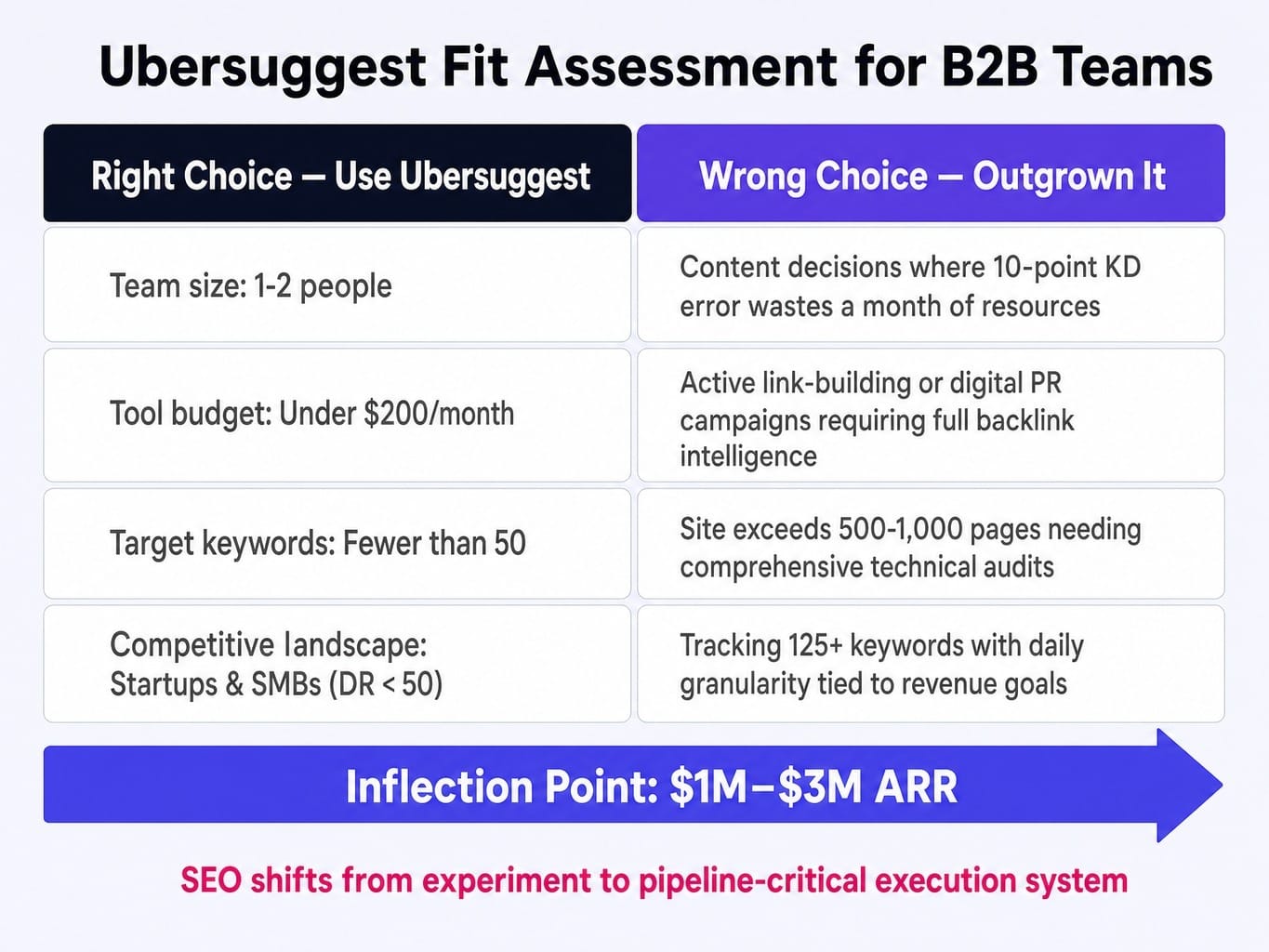
Ubersuggest is the right choice when:
- Your marketing team is 1-2 people.
- Your total marketing tool budget is under $200/month.
- You're targeting fewer than 50 core keywords.
- Your competitive landscape consists of other startups and SMBs, not enterprise incumbents with DR 70+ domains.
In this scenario, for a pre-seed dev tools startup, Ubersuggest is perfectly adequate for initial exploration.
Ubersuggest is the wrong choice when:
- You make content prioritization decisions where a 10-point error in a keyword difficulty score could waste a month of engineering or writing resources.
- You run link-building or digital PR campaigns that require comprehensive backlink intelligence.
- Your site has grown beyond 500-1,000 pages and needs thorough technical audits to manage index bloat and technical debt.
- You need to track more than 125 keywords with daily granularity to monitor performance against revenue goals.
Most B2B SaaS teams hit this inflection point somewhere between $1M and $3M in ARR. This is the stage where SEO shifts from "let's get some organic traffic" to "organic is a primary pipeline channel that demands a rigorous, scalable execution system." For a Series B HR tech company in this position, the data gaps in Ubersuggest are no longer an inconvenience; they are a direct cost to the pipeline.
Read more: SaaS Marketing Tools in 2026: How to Build a Stack That Ships, Not Just Reports
The hidden execution tax of a budget SEO tool
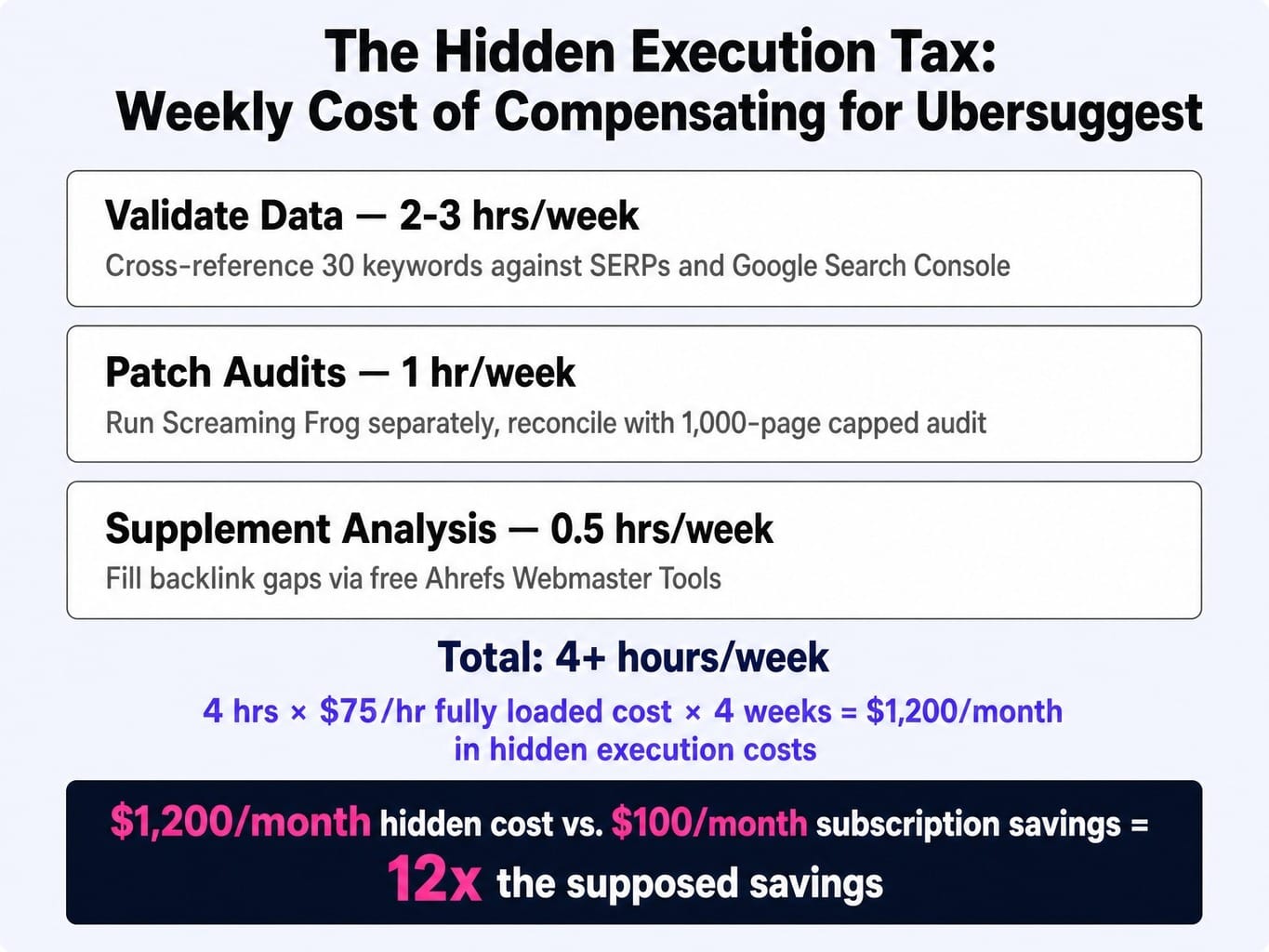
The subscription fee is the smallest part of an SEO tool's total cost. The real cost—the one that never appears on an invoice—is the human time spent compensating for the tool's limitations. This is the hidden execution tax.
Picture this weekly workflow for a B2B growth marketer:
- Validate Data (2-3 hours/week): They use Ubersuggest to identify 30 keyword opportunities. Not trusting the difficulty scores, they manually cross-reference each one in the SERPs and check impression data in Google Search Console.
- Patch Audits (1 hour/week): They run a site audit, but the 1,000-page crawl cap misses their entire documentation section. They run Screaming Frog separately and spend an hour manually reconciling the two reports.
- Supplement Analysis (30 mins/week): They want to analyze a competitor's link profile, but Ubersuggest only shows a fraction of the referring domains. They log into a free Ahrefs Webmaster Tools account to try and fill the gaps, context-switching between platforms.
That's over four hours a week of manual workaround labor. At a fully loaded cost of $75/hour for a mid-level marketer, that's $1,200 per month in hidden execution costs. That "tax" is more than ten times the $100 monthly savings you gained by choosing a budget tool. The affordability is an illusion; you're just paying for it in payroll instead of software. Teams tracking SaaS marketing metrics closely will notice this drag on efficiency long before it shows up in a budget review.
What if the tool did the execution, not just the analysis?
The analysis reveals a deeper truth: all SEO tools, from Ubersuggest to Semrush, operate on the same broken model. They generate analysis that still requires manual human execution. They surface keyword opportunities, but a marketer still has to perform the high-latency work of prioritizing them, creating the content, optimizing the pages, and tracking the results. The data gets better with more expensive tools, but the execution gap remains identical.
The real bottleneck isn't data quality. It's the latency between identifying what needs to change and actually shipping that change.
This is the system failure Spike AI was built to fix. We are not another SEO tool competing on data accuracy. We are the execution layer that eliminates the gap. Where other tools stop at "here's a dashboard of problems," Spike AI identifies the single highest-impact move across your website, SEO, and ads—then deploys it. Weekly. The "execution tax" isn't just reduced; it's eliminated, because the system handles both prioritization and implementation. The marketer moves from operator to orchestrator.
See how Spike AI turns your SEO backlog into weekly shipped improvements
Conclusion
Ubersuggest is not a bad tool; it's a stage-appropriate tool. And most B2B teams stay on it for too long. They see the responsible $29/month subscription fee, but the hidden execution costs—the hours spent validating data and patching gaps—remain invisible.
For pre-revenue and early-stage B2B teams, Ubersuggest paired with Google Search Console is a perfectly rational starting stack. But the moment SEO becomes a pipeline-critical channel, the moment prioritization accuracy and execution velocity directly impact revenue, the savings evaporate. The tool that felt like a smart, frugal choice becomes a bottleneck that slows down your entire growth engine.
The question for your team isn't whether you can afford a better tool. It's whether you can afford the hours you're spending compensating for a limited one.
Frequently Asked Questions
Is the Ubersuggest lifetime deal still available, and does it make financial sense in 2026?
Yes, the lifetime deal is still available for around $290. It breaks even against the monthly plan in 10 months, making it seem attractive. However, if your needs grow beyond the Individual plan's 3 projects or 150 daily searches within a year—a common scenario for B2B teams—you'll have to upgrade anyway, turning the lifetime deal into a sunk cost.
Does Ubersuggest support API access for automated reporting workflows?
No, Ubersuggest does not offer a public API. Teams needing to pull keyword, backlink, or rank tracking data into automated dashboards like Looker Studio or HubSpot must rely on manual CSV exports. This is a significant limitation for any RevOps or marketing team building a scalable reporting pipeline, a function that both Ahrefs and Semrush support via their APIs.
How often does Ubersuggest refresh its keyword and backlink data?
Ubersuggest's keyword data is updated approximately monthly, while its backlink index is refreshed less frequently than Ahrefs or Semrush, which crawl more continuously. For B2B teams in fast-moving markets or those running active link-building campaigns, this lag can mean you're making strategic decisions based on data that is already two to four weeks out of date.
Can Ubersuggest handle site audits for B2B websites with large documentation sections?
The lower-tier plans cap site audits at 1,000 pages. For any B2B SaaS company with extensive documentation, a help center, or a large blog archive, this audit will be incomplete. It will fail to detect critical issues like index bloat, thin content, or internal linking problems in the uncrawled sections, requiring you to supplement with another tool like Screaming Frog.
How does Ubersuggest handle search intent classification for B2B commercial queries?
Ubersuggest does not provide query-level intent classification (e.g., informational, commercial, transactional). For B2B marketers, distinguishing between a user searching "what is CRM" versus "best CRM for enterprise" is fundamental to content strategy. With Ubersuggest, this analysis must be done manually by reviewing SERPs for every keyword, adding significant time to your research workflow.