Yext Pricing in 2026: A Complete Breakdown of Real Costs
TL;DR
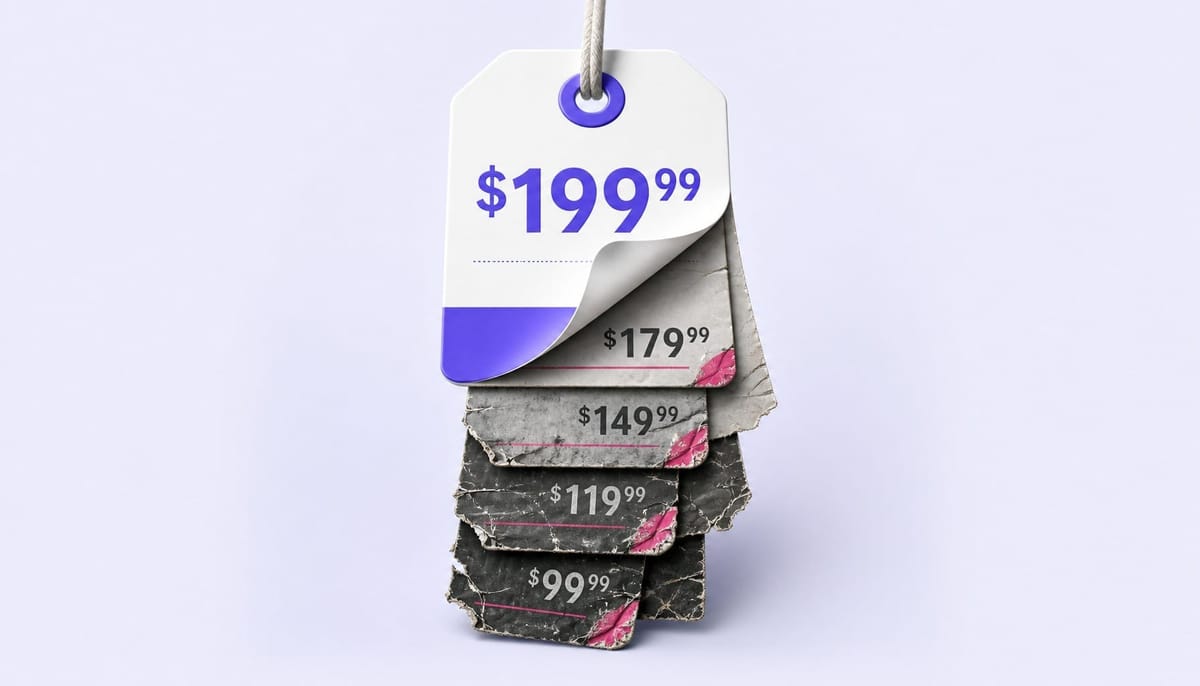
- Yext plans cost between $199 and $999 per location, per year, with no monthly billing options. The "Complete" plan at $499/year is the practical minimum for businesses wanting analytics.
- Your total cost of ownership will be 30-50% higher than the sticker price due to mandatory per-location billing, annual renewal price hikes (5-10%), and paid add-on modules.
- If you cancel your Yext subscription, your listings can revert to outdated information. You are renting accuracy, not buying permanent citations, which creates a perpetual cost.
- For businesses with fewer than 20 stable locations, tools like BrightLocal offer a more cost-effective model (permanent citations) and a lower total cost. Yext's value scales for enterprises with 50+ locations and high data volatility.
- The real bottleneck for most marketing teams isn't just listing management; it's the lack of a unified execution system to act on insights across all channels, from local SEO to website CRO.
Last Updated: May 2026. Pricing verified against Yext's published plans and industry data.
You're here because Yext's pricing page shows features across four tiers but lists zero dollar figures. Every plan directs you to "Contact Us," a deliberate friction point designed to get you on a call with sales before you can evaluate the cost. This isn't an oversight; it's a strategy.
This article bypasses the sales gate. We'll provide the exact plan prices, the per-location math, the hidden fees that inflate the sticker price, and the single most important cost factor: what happens to your business listings if you decide to cancel.
Yext's list price is only the starting point. The total cost of ownership is materially different, and understanding that difference is what separates an informed purchase from an expensive, long-term lock-in.
Yext Pricing Plans: What Each Tier Costs and Includes
Yext offers four primary self-serve plans, all priced per location and billed annually. There is no monthly billing option; every plan requires a full year's commitment upfront. This is a critical factor in calculating your initial investment and comparing it to competitors that offer monthly flexibility.
The pricing structure is designed to push you up the tiers, with key features gated behind specific plans.
The critical insight here is the jump from the Essential plan ($449) to the Complete plan ($499). For just $50 more per location, you unlock analytics dashboards and access to the full PowerListings network. This makes the Complete plan the practical floor for any business that wants to measure whether Yext is actually working.
Conversely, the jump from Complete to Premium nearly doubles the cost to $999 per location. This increase primarily funds review monitoring and a basic Yext Pages subscription—capabilities many businesses already handle through more robust, specialized tools.
The per-location model means costs scale linearly. A business with 10 locations on the Essential plan pays $4,490 per year. That same business on the Premium plan pays $9,990 per year.
Enterprise and Reseller Partner Pricing
For businesses with over 50 locations, Yext's pricing shifts to a custom-quoted enterprise model. These deals are negotiated based on location volume, contract length (often 24-36 months), and which products are bundled (Listings, Reviews, Pages, Search). Typical enterprise annual contract values (ACVs) start in the $15,000–$25,000 range and scale up from there.
Agency and reseller partners access a different set of tiers—Base, Starter, Professional, and Ultimate—with custom pricing that includes built-in margins. Reseller pricing is often 20–40% lower per location than direct pricing, as Yext incentivizes channel distribution. However, the agency controls the account. If you're evaluating Yext through a partner, insist on seeing the Yext platform cost as a separate line item from their management fee to understand your true spend.
The Hidden Costs That Inflate Yext's Sticker Price
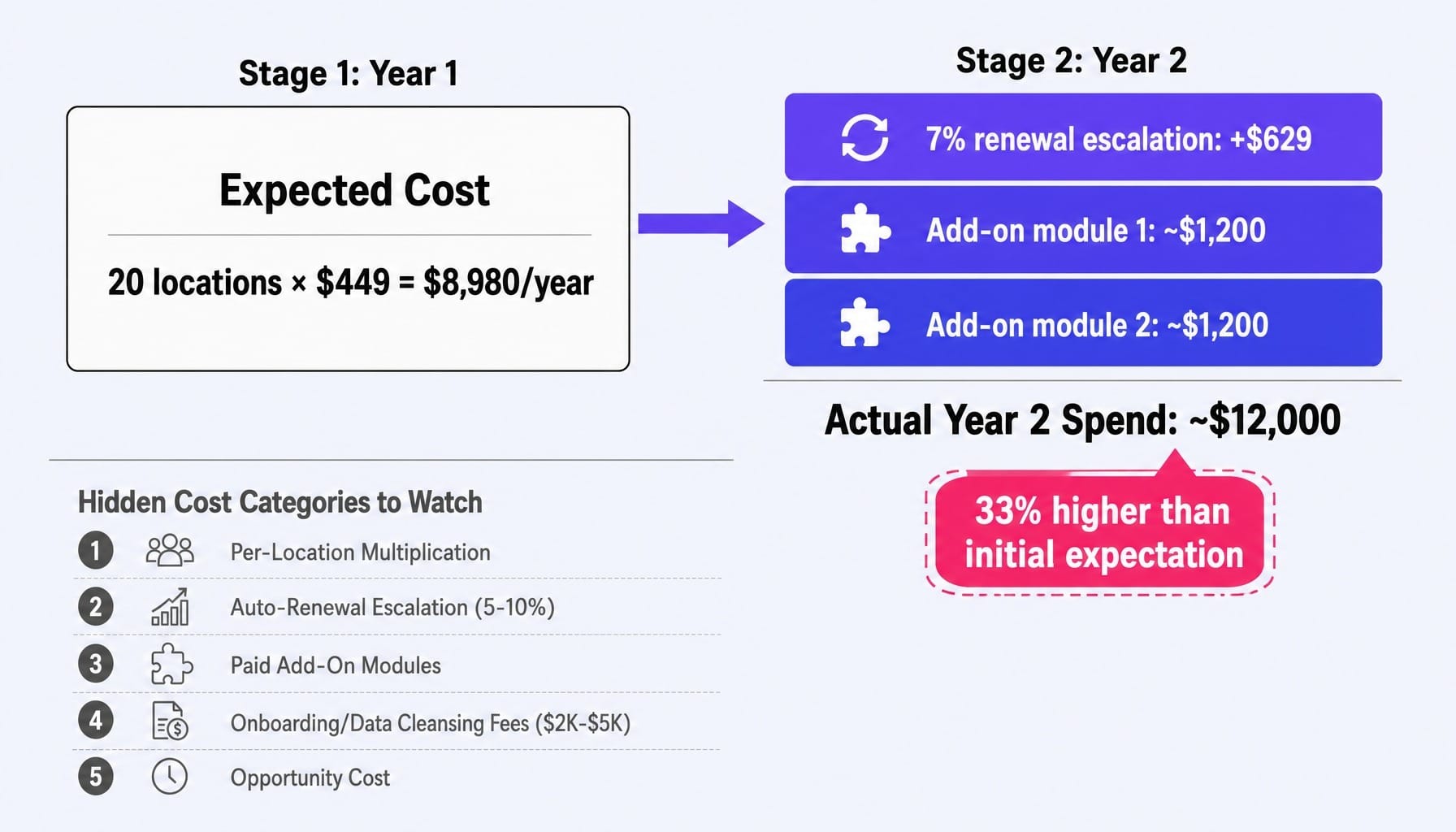
Yext's published per-location price is the floor, not the ceiling. Your actual annual spend is typically 30-50% higher once you account for costs that aren't visible on the main pricing page. Calculating your total cost of ownership requires factoring in these five inflators.
- Per-Location Multiplication: This is the most obvious but often miscalculated cost. The price is per location. A 15-location retail chain on the $999/year Premium plan is not paying $999; they are paying $14,985 per year. This linear scaling makes Yext prohibitively expensive for many SMBs with multiple storefronts.
- Auto-Renewal with Escalation Clauses: Yext contracts are structured to auto-renew annually. Buried in the terms of service is often an ACV escalator clause that allows for a price increase upon renewal, typically between 5% and 10%. Your $999/year plan can quietly become a $1,100+ plan by year three without any change in features.
- Paid Add-On Modules: Critical capabilities are often sold as separately priced add-ons. Want Competitive Intelligence to see how you stack up against others? That's an add-on. Need to manage listings on Yelp's Knowledge network? Another add-on. Live API access for custom integrations or additional user seats for your team also carry extra fees.
- Onboarding and Data Cleansing Fees: Enterprise accounts frequently face a one-time setup fee for the initial data cleansing pass and entity mapping into Yext's Knowledge Graph. This fee can range from $2,000 to $5,000 and is not part of the subscription cost.
- Opportunity Cost: The budget allocated to Yext—often $5,000 to $20,000 for a mid-sized business—is a budget that cannot be spent on direct local SEO activities. This includes local link building, creating service-area content, or advanced Google Business Profile optimization, which often deliver a more direct and measurable impact on local pack rankings and revenue.
A 20-location business signing an Essential plan contract might budget for $8,980/year. By year two, with a 7% renewal escalation and two paid add-ons, their actual spend is closer to $12,000—a 33% increase over their initial expectation.
What Happens to Your Listings If You Cancel Yext
This is the single most important factor in the Yext pricing equation. When you cancel your Yext subscription, your listings don't just stop updating—they can actively degrade.
Yext uses an API-based sync, which it calls its PowerListings Network, to continuously push your business data to directories. This connection is live only as long as you pay. When the subscription ends, the API connection is severed. The data Yext was pushing is no longer maintained.
In practice, this means your listings may revert to whatever information the directory had before you started using Yext. This could be outdated addresses, incorrect phone numbers, or duplicate entries that Yext had been suppressing. While some directories might retain the corrected data, many will not. The resulting inconsistency across the web is the real problem. NAP (Name, Address, Phone Number) inconsistency is a negative ranking signal that directly harms local search performance.
Consider a restaurant group that used Yext for three years to manage 80+ directories. They cancel the service to cut costs. Within 60 days, 30% of their listings revert to old data. Their local pack rankings drop measurably for key terms. This isn't a bug; it's the model's design.
This structural lock-in makes Yext's pricing fundamentally different from tools like BrightLocal or Whitespark, where citation submissions are permanent. With those services, you pay once for the submission, and the listing persists whether you remain a subscriber or not.
Yext's annual fee isn't buying you a service; it's renting you listing accuracy. The moment you stop paying rent, that accuracy is at risk. This transforms the ROI calculation from a one-year decision to a perpetual cost evaluation.
How Yext Pricing Compares to BrightLocal, Moz Local, and Semrush
Yext operates in a competitive market, but its pricing model is an outlier. The right choice depends on your business size, budget, and whether you need continuous API sync or are better served by one-time, permanent citation building.
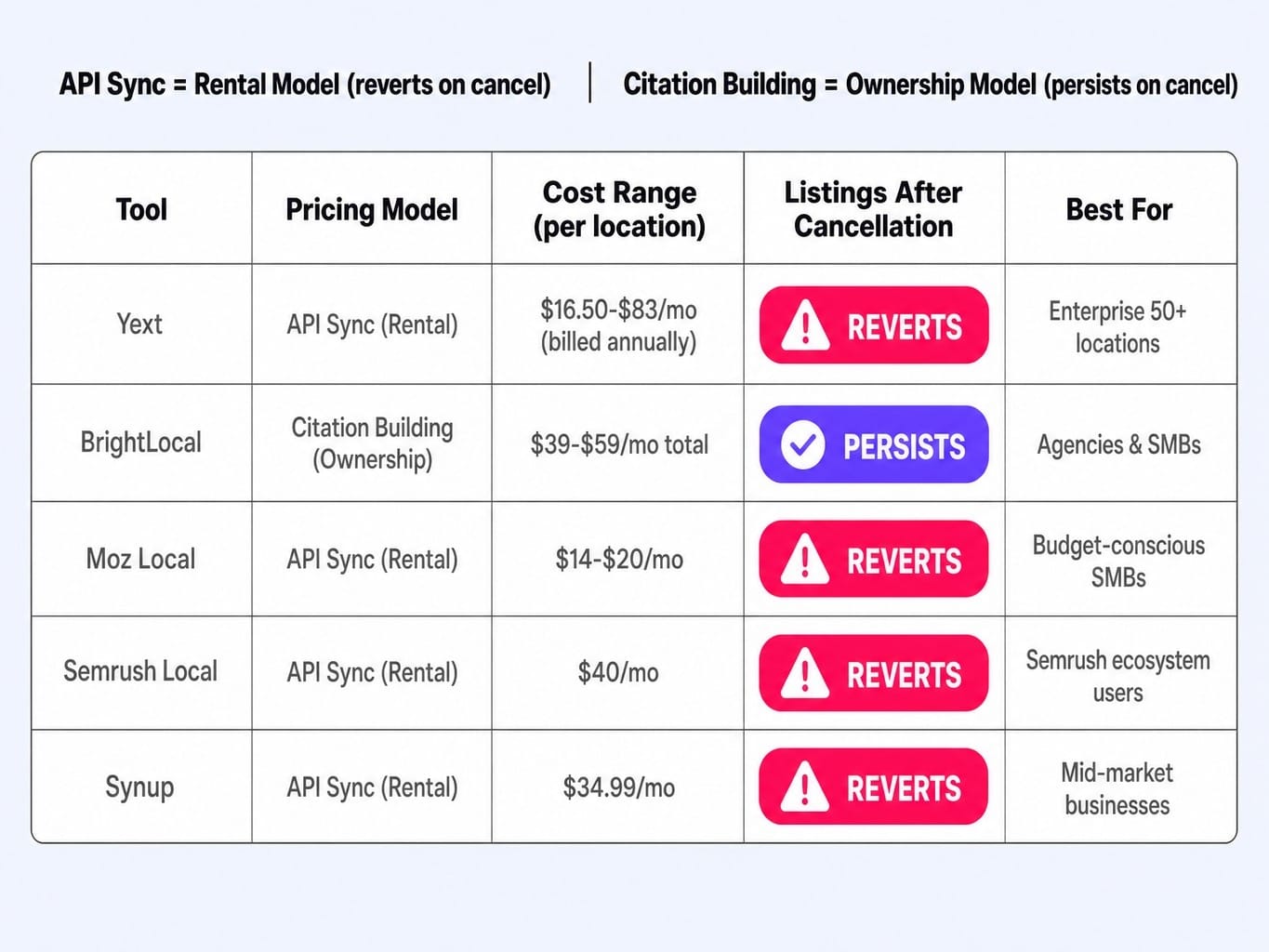
The market is split between two fundamentally different models:
- API Sync (The "Rental" Model): Used by Yext, Moz Local, Semrush, and Synup. Listings are actively managed and updated via API as long as you pay. Accuracy is high, but the cost is perpetual. If you cancel, listings can revert.
- Citation Building (The "Ownership" Model): Used by BrightLocal and Whitespark. You pay for a one-time campaign to submit or clean up your listings. The submissions are permanent. This is more cost-effective long-term but slower to update if your data changes frequently.
For businesses with stable locations that rarely change, the citation building model is almost always more cost-effective. The API sync model only justifies its recurring cost for businesses with high data volatility—frequent location changes, seasonal hours, or dynamic menus.
There's also a cost curve to consider. Below ~20 locations, Yext is almost always the most expensive option. However, at enterprise scale (100+ locations), Yext's volume discounts can compress the per-unit cost, making it more competitive with platforms that maintain flat per-location pricing.
Read more: Moz Pricing in 2026: Plans, Hidden Costs, and What B2B Teams Actually Need
When Yext Is Worth the Cost — and When It Isn't
"Is Yext worth it?" is the wrong question. The right question is, "Is the Yext execution model the most efficient system for my specific situation?" The answer depends on three variables: location count, data volatility, and internal bandwidth.
Yext is likely worth the cost if:
- You manage 50+ physical locations where manual updates are operationally impossible.
- Your business data has high volatility (e.g., seasonal hours, frequent menu changes, pop-up stores).
- You have no internal marketing team or agency to manage listings manually or through cheaper tools.
- You need a centralized dashboard for review monitoring across a large enterprise and value the convenience of a bundled solution.
Yext is likely NOT worth the cost if:
- You have fewer than 10 locations with stable addresses and hours.
- You already work with an SEO agency that handles citation management as part of their service.
- Your budget would deliver a higher ROI if invested in direct local SEO activities like Google Business Profile optimization, local content creation, and review generation campaigns.
- You are a single-location business. The cost is simply not justifiable.
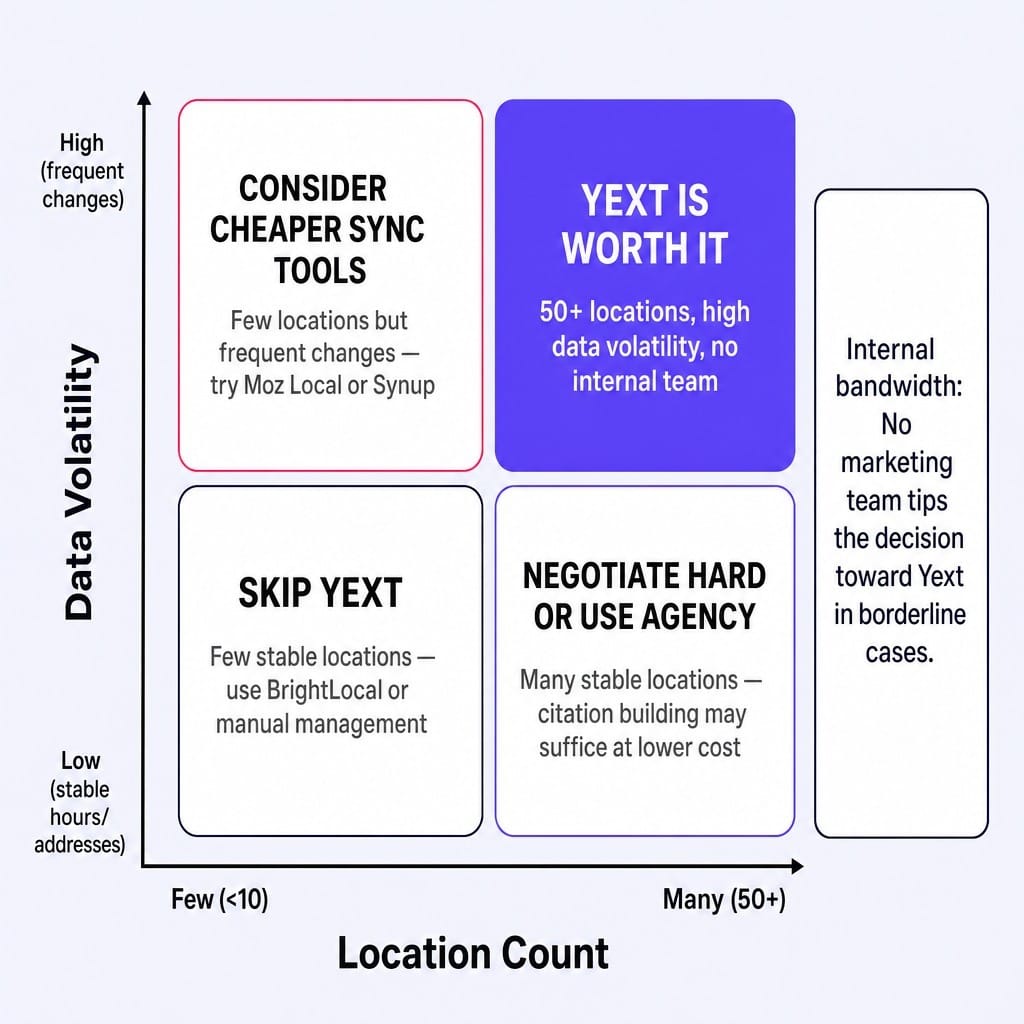
For most small-to-mid-size businesses, the $5,000–$10,000 annual spend on Yext would generate far more measurable growth if allocated to the marketing execution that directly drives rankings and revenue. Yext solves a real problem, but it's a problem many businesses can solve more efficiently with a different system.
When the Real Problem Isn't Listings — It's Execution Velocity
Businesses scrutinize Yext's per-location pricing because they are trying to solve a visibility problem within a fixed budget. But listings management is just one node in a fragmented marketing execution system. Teams pay for Yext, a separate SEO tool, a different CRO platform, and another for analytics. The true bottleneck isn't the cost of any single tool; it's the latency between identifying what needs to change and actually shipping that change.
Instead of paying for a stack of point solutions that diagnose problems and create more manual work, a unified execution layer can identify the single highest-impact move across your entire digital presence and ship it. This is the core principle behind Spike AI. We run your marketing like software, turning backlogs into weekly releases. Each week, our system identifies and executes the top priority—whether it's a website conversion fix, an SEO content gap, or a technical change—compounding gains over time.
If you're calculating the ROI of a single tool, you're optimizing a single workflow. A better question is whether your entire marketing execution model is optimized for cost-per-outcome.
See how Spike AI replaces fragmented tool spend with unified marketing execution.
Conclusion: Calculate Your Total Cost of Ownership
Yext's sticker price is not its real cost. The total cost of ownership—factoring in per-location scaling, renewal escalations, paid add-ons, and the perpetual nature of its rental model—makes it a significantly more expensive system than it first appears.
For large enterprises with high location counts and constant data changes, the platform can solve a genuine operational headache. But for the vast majority of small and mid-sized businesses, the same or better outcomes can be achieved at a fraction of the cost through permanent citation-building tools and direct investment in local SEO.
Before committing to any annual contract, calculate your total cost of ownership over three years, not just the year-one price. Compare that number to what the same budget would achieve if invested in the marketing execution that directly drives local rankings and revenue. The answer is usually revealing.
Frequently Asked Questions
Does Yext offer monthly billing or only annual contracts?
Yext requires annual billing for all its self-serve plans; there is no monthly payment option. Enterprise contracts are also structured annually, typically with 12- or 24-month minimum commitments. This means you are committing to at least $199 upfront for the lowest tier, with no ability to test the platform month-to-month before committing to a full year.
Does Yext increase pricing at renewal, and by how much?
Yes, it's common. Yext enterprise contracts often include an annual price escalation clause, typically raising the cost by 5–10% per year upon renewal. Self-serve plans can also increase in price at the end of a term. Always review the auto-renewal and pricing adjustment clauses in your contract before signing, as the year-three price may be materially different from year one.
Can I get a lower Yext price through a reseller or agency partner?
Yes, this is often possible. Yext reseller partners access lower per-location rates than direct buyers because Yext heavily incentivizes its channel program. However, the reseller will add their own management fee. To evaluate the true cost, ask any agency partner to provide a proposal that itemizes the Yext platform cost separately from their service and management fees.
What ROI should I expect from Yext relative to its annual cost?
Yext's primary ROI is indirect, stemming from improved local search visibility due to listing accuracy. Most directory listings generate minimal direct referral traffic or leads. The measurable benefit is that consistent NAP data across 100+ directories strengthens local ranking signals, which can improve visibility in the Google Map Pack, where a significant portion of local search clicks occur.
How much does Yext charge for its Pages and Search products?
Yext Pages (for building location landing pages) and Yext Search (for adding AI-powered search to your website) are separate products from their core Listings offering. Their pricing is not public and is almost always bundled into custom enterprise contracts. If you only need listings management, be sure to confirm you are not being quoted a bundle that includes products you do not need or will not use.