
AdRoll in 2026: What Reviews Won't Tell You About Pricing, ROAS, and Incrementality

TL;DR
- AdRoll's pricing is two-layered: a small monthly plan fee plus your media spend, which includes a non-transparent margin AdRoll takes on every ad impression.
- The platform's value is convenience and speed, especially for lean ecommerce teams who need to consolidate display, social, and email retargeting into one dashboard.
- AdRoll disappoints when your site traffic is too low (under 5,000 unique visitors/month), you trust its inflated ROAS numbers (caused by view-through attribution), or you're a B2B company with a long sales cycle.
- Before committing, run an incrementality holdout test. The core question isn't if AdRoll drives conversions, but if those conversions would have happened anyway.
- For B2B lead generation, budget is almost always better spent on LinkedIn retargeting or fixing on-site conversion issues before paying to chase visitors who already left.
Most AdRoll reviews fall into two unhelpful categories. The first is a wall of aggregated star ratings from G2 or the Shopify app store, telling you that users are generally satisfied but not why, or whether their business looks anything like yours. The second is AdRoll's own promotional content, which reads less like a review and more like a sales page with H2 tags.
Neither answers the questions a marketing lead with a real budget needs answered: Will this platform generate conversions I wouldn't have gotten anyway? At what real cost? And is it the right tool for my specific business model?
This is not another surface-level AdRoll review. We're going to dissect the platform from a practitioner's perspective.
We'll break down its actual pricing mechanics (not just the plan fee), the specific scenarios where it genuinely earns its keep, and the three predictable failure modes that produce the 1-star reviews. Most importantly, we'll tackle the incrementality question that determines your true return on ad spend—the one no other review addresses. We'll examine the B2B vs. ecommerce fit, DSP markup transparency, and the audience size thresholds that make or break a campaign.
What AdRoll Actually Does (And What It Doesn't)
AdRoll is a retargeting-first platform that bundles display advertising, social ad management, and basic email marketing into a single, unified console. It is not a prospecting tool for finding new audiences, not a full-featured demand-side platform (DSP), and not a complete replacement for your native Google or Meta ad accounts. Its primary function is to bring back visitors who left your site without converting.
The core loop is straightforward. A mid-market ecommerce brand running on Shopify installs the AdRoll pixel. The pixel builds an audience of site visitors who viewed a product or added to a cart but didn't complete a purchase. AdRoll then serves those users dynamic ads—showing the exact products they viewed—across its network of publisher websites, as well as on social platforms like Facebook and Instagram.
What's missing from most descriptions is how AdRoll accesses that ad inventory. The platform operates as a managed layer on top of the programmatic ad ecosystem. It's buying impressions on your behalf through its own DSP relationships, which means there's a markup between what the publisher receives and what you ultimately pay. This distinction is critical for understanding the platform's true cost, which we'll cover next.
Given that you can run retargeting campaigns directly through Google Ads or Meta Ads Manager, the central question this review answers is simple: what is AdRoll's managed layer actually worth?
AdRoll Pricing in 2026: The Two-Layer Cost Most Reviews Gloss Over
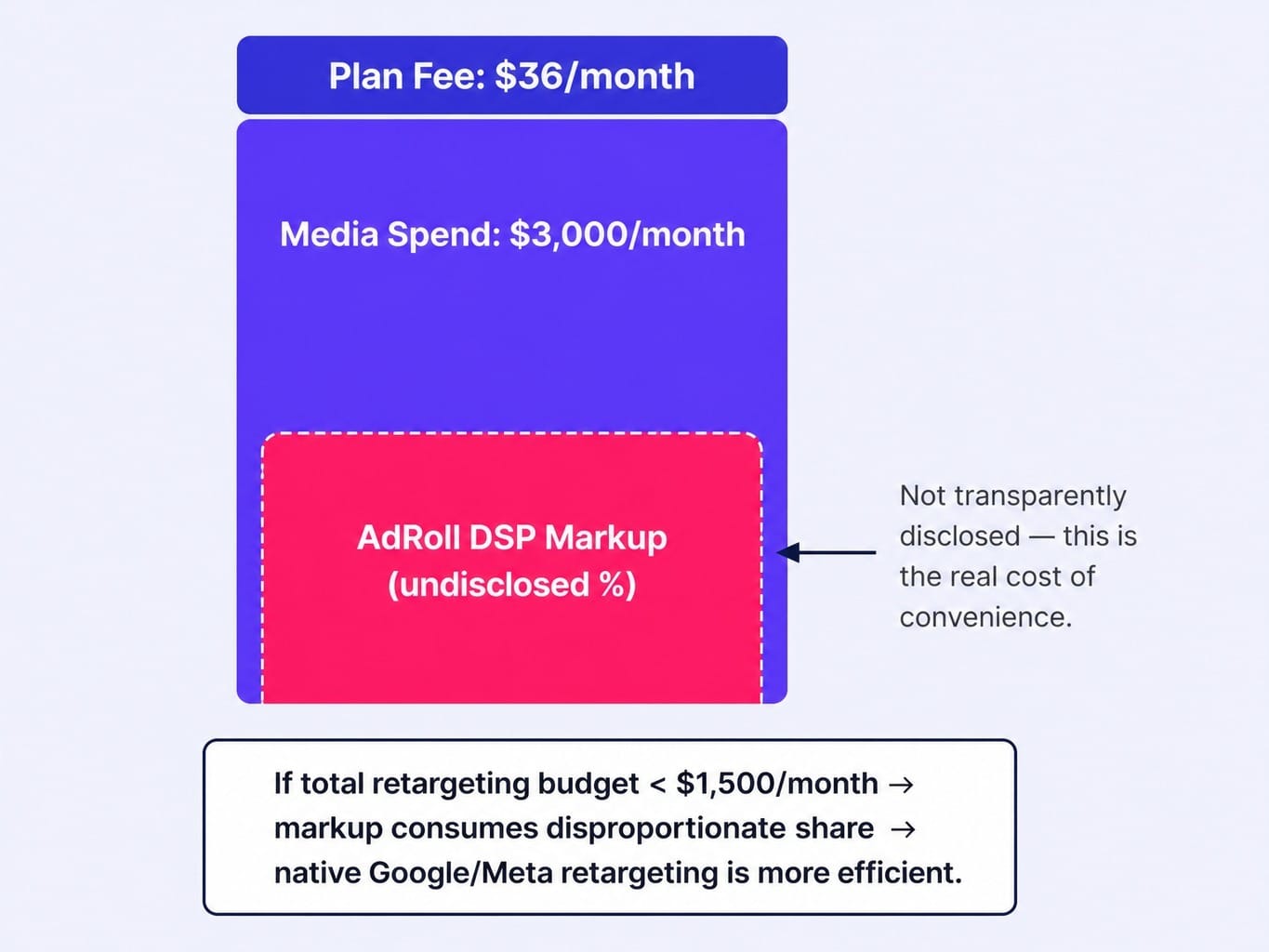
AdRoll's pricing page creates a false impression of affordability by highlighting its software access fee. The plan fees—$0/month for the basic Ads tier or around $36/month for the Marketing & Ads Plus package—seem trivial. But this fee is a fraction of your total cost. The real expense is your media budget, which runs on top of the plan fee and has AdRoll's margin baked into every impression.
Let's walk through a concrete example. Imagine a Shopify store allocates $3,000 per month to its AdRoll retargeting campaigns. The invoice will show the $36 plan fee plus the $3,000 media spend. However, embedded within that $3,000 is AdRoll's DSP markup, which functions like a managed-service fee layered on top of the underlying exchange CPM and is not transparently disclosed. This is the cost of convenience—paying for AdRoll's bidding algorithms, publisher relationships, and consolidated reporting.
For growth teams already running Google and Meta campaigns, adding AdRoll's managed DSP markup on top of existing media costs only makes financial sense if the retargeted traffic converts at a meaningfully higher rate once it arrives. Without a system for continuous on-site optimization, like the one Spike AI provides, most teams never isolate whether their retargeting underperformance is a traffic quality problem or a landing page problem.
This two-layer cost structure is the source of the most common complaint on G2 and Capterra: billing surprises. Users see the low monthly fee, sign up, and are shocked by an invoice for hundreds or thousands of dollars. The model isn't deceptive, but it is poorly communicated.
As a practical rule of thumb: if your total monthly retargeting budget is under $1,500, the platform's markup consumes a disproportionate share of your spend, making native retargeting on Google or Meta a more efficient choice.
Where AdRoll Genuinely Earns Its ROAS
The platform's average star ratings across review sites, which hover between 4.0 and 4.4, aren't manufactured. In three specific scenarios, AdRoll delivers genuine value that justifies its cost.
First, consolidation for lean teams. Consider a two-person marketing team at an ecommerce brand. They're running retargeting campaigns on the Google Display Network, Facebook, and Instagram. This means three separate platforms, three sets of creative, and three different reports that need to be manually stitched together. AdRoll consolidates this into a single dashboard with cross-channel attribution. Even if the attribution is imperfect, the operational time saved is real. The value here is bandwidth.
Second, dynamic creative for large product catalogs. For a Shopify store with over 50 SKUs, manually creating ads for every product is a non-starter. AdRoll's dynamic product ads automatically generate and serve creative featuring the specific items a visitor viewed. While this is possible to set up natively on Google Display, it requires configuring custom data feeds and involves significantly more technical overhead. AdRoll makes it nearly plug-and-play.
Third, onboarding speed and simplicity. A consistent theme in Shopify reviews is the speed to launch. Many users report going from installing the pixel to running live campaigns in under a day. For a founder or a small marketing team without a dedicated paid media specialist, this low barrier to entry is a major advantage over the steeper learning curves of native ad platforms.
The common thread is clear: AdRoll's value proposition is rooted in convenience and consolidation, not necessarily superior ad performance.
Where AdRoll Disappoints: The Three Failure Modes
The 1-star reviews on G2 and Capterra aren't random noise. They cluster around three predictable failure modes that stem from a mismatch between the user's business and the platform's mechanics.
The Audience Size Threshold Problem
AdRoll's retargeting engine requires a critical mass of site traffic to function. A B2B SaaS site with 1,500 unique monthly visitors might generate a retargeting audience of a few hundred people. This pool is so small that frequency cap bleed becomes inevitable. The same handful of users see the same ads over and over, creative fatigue sets in within days, and the campaign burns budget serving impressions to people who are either not interested or have already converted.
The platform's bidding algorithm has no room to optimize. As a practical threshold, if your site receives fewer than 5,000 unique visitors per month, your retargeting audience will likely decay faster than it replenishes. This is the root cause behind many "AdRoll doesn't work" reviews. It's not that the platform is broken; it's that the audience is too small for the system to work as designed.
The Attribution Inflation Problem
AdRoll's dashboard ROAS is often significantly higher than what you'll see in Google Analytics 4 for the same campaigns. The discrepancy is almost entirely due to view-through conversions (VTCs). AdRoll's default attribution model gives credit for a conversion if a user simply saw a display ad, even if they never clicked it.
Here's a common scenario: a user visits your site and leaves. They see an AdRoll display ad on a news site but don't click. Days later, they remember your brand, perform a branded Google search, click the organic link, and purchase. AdRoll's pixel fires, and it claims credit for that conversion. So does Google Search Console. The same sale is attributed to two different channels. This is how VTC inflation creates a misleading picture of performance. The distinction between a post-click and a post-view attribution window is everything. Any ROAS number from AdRoll's dashboard must be mentally discounted before you use it to make budget decisions.
The Contract and Billing Friction
The third failure mode is operational. A clear pattern emerges in Shopify and G2 reviews: users sign up for a plan, set a loose budget, and are surprised by a large invoice when media spend auto-scales. When they try to pause or cancel, they encounter friction. One widely cited Shopify review from Kaspar Sovrano reported a $4,000+ overcharge and a refusal to refund, which is representative of this pattern of misaligned expectations.
This happens because AdRoll's model is designed to spend your budget to hit performance goals. If you set a monthly budget without a conservative daily cap, the algorithm can ramp up spend quickly. The practical takeaway is simple: on day one, set strict daily spend caps. Monitor your first invoice closely, and be sure you understand the cancellation terms in your contract before committing.
The Incrementality Question No Other Review Asks
The most important question about any retargeting platform isn't "What's the ROAS?" It's "Would these people have converted anyway?"
This is the question of incrementality. By definition, retargeting targets your warmest audience—people who have already visited your site and signaled intent. A significant percentage of them would have come back and converted on their own, without seeing a single ad. When a retargeting platform reports a conversion from this group, it's often taking credit for a sale it didn't truly cause.
I once ran a holdout test for a client where we took 10% of their retargeting audience and placed them in a suppression list, showing them no ads for 30 days. The platform's dashboard was reporting a 5x ROAS. But when we compared the conversion rates, we found the holdout group converted at nearly 75% of the rate of the group that saw ads. The true incremental lift from the campaign was only about 25%. The platform was overstating its real impact by 4x.
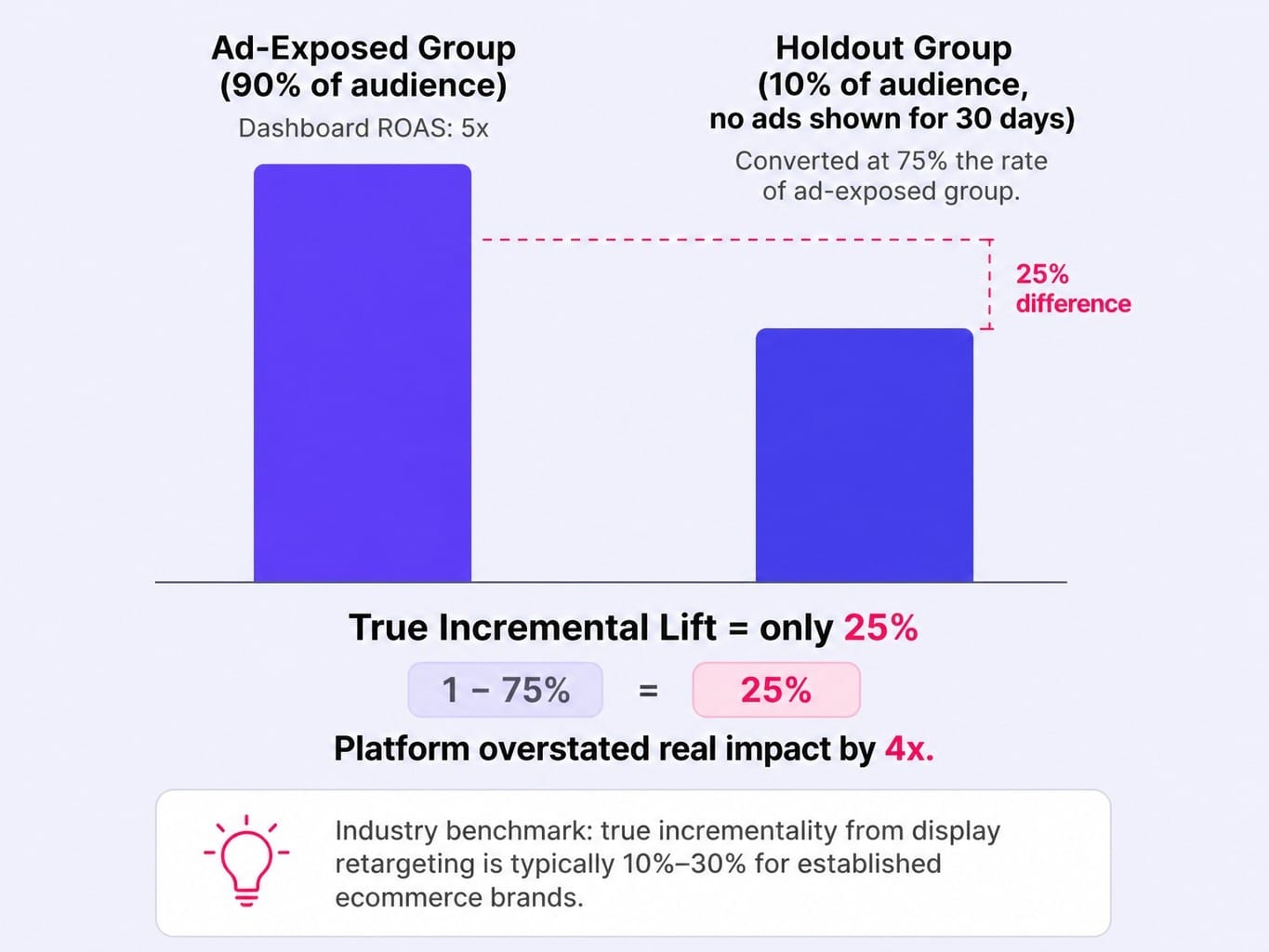
You can run this test yourself. The difference in conversion rates between the ad-exposed group and the holdout group is your true incremental lift. Conventional wisdom among performance marketers suggests that for established ecommerce brands, the true incrementality from display retargeting often ranges from 10% to 30%. The answer to "is AdRoll worth it?" depends entirely on whether you're measuring the dashboard ROAS or the incremental ROAS. Most teams measure the wrong one.
Read more: AdRoll vs Criteo in 2026: Attribution, Margins, and the Decision Most Teams Get Wrong
AdRoll for B2B vs. Ecommerce: Two Different Verdicts
The question "is AdRoll worth it" has two different answers, and most reviews conflate them.
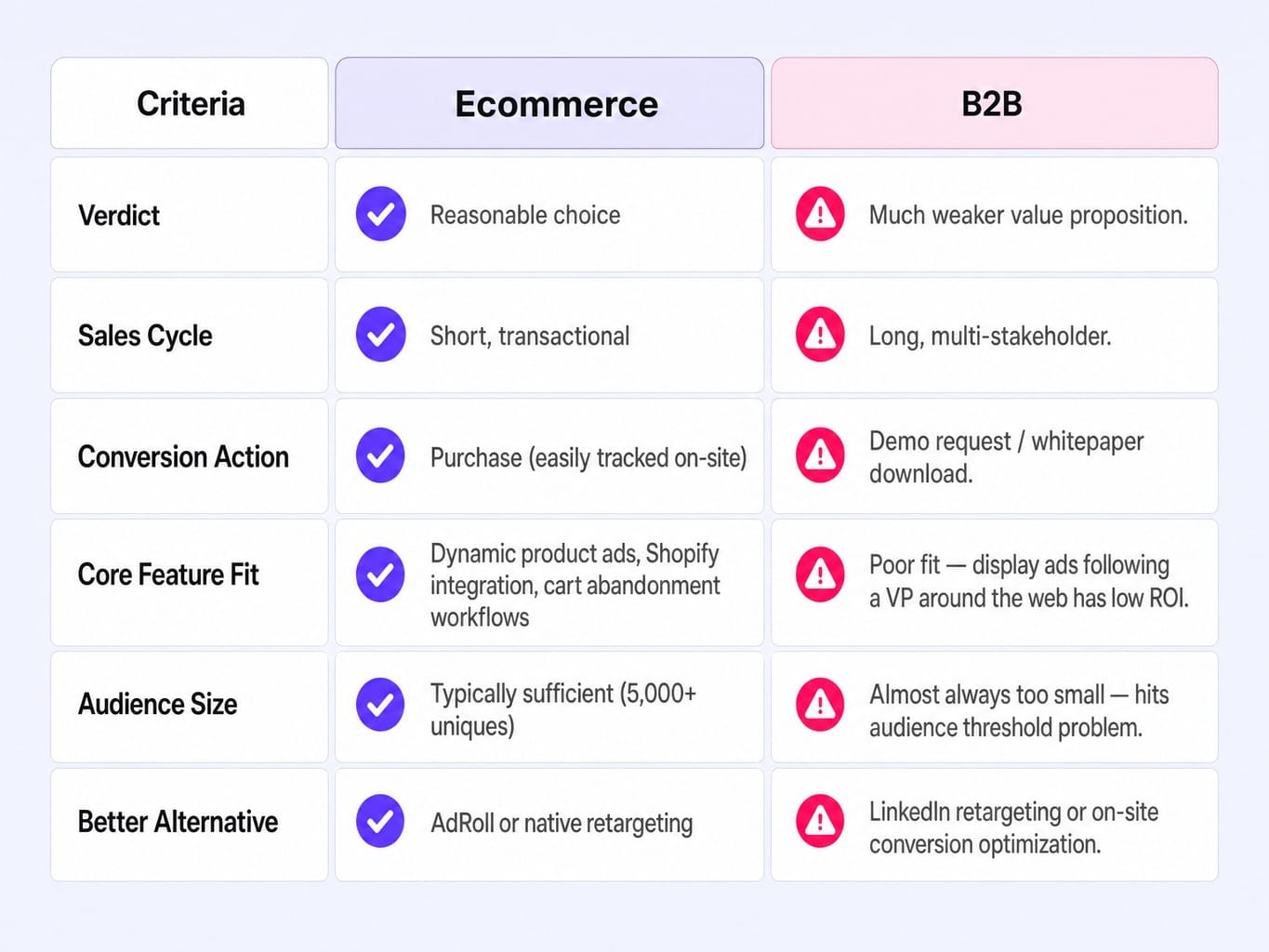
For ecommerce, AdRoll is a reasonable choice. The platform's core features—dynamic product ads, Shopify and BigCommerce integrations, and cart abandonment workflows—align perfectly with the short, transactional purchase cycle. A visitor saw a specific pair of shoes, left, and needs a visual reminder. Display retargeting is a natural fit, and the conversion action (a purchase) is easily tracked on-site. If you have the requisite traffic (5,000+ uniques/month) and a multi-SKU catalog, AdRoll's convenience can justify its cost.
For B2B, the value proposition is much weaker. B2B sales cycles are long and involve multiple stakeholders. The conversion isn't a purchase; it's a demo request or a whitepaper download. Following a VP of Marketing around the web with display ads for 30 days after they glanced at your pricing page has a very different ROI profile than reminding a shopper about an abandoned cart. Furthermore, B2B audience pools are almost always smaller, running headfirst into the audience size threshold problem.
The verdict is clear: for most B2B lead generation, that budget is better spent on LinkedIn retargeting, where you can target by job title and company, or invested in website conversion optimization to capture more high-intent traffic on the first visit.
AdRoll vs. Running Retargeting Through Google and Meta Directly
Experienced marketers inevitably ask: if I'm already running Google and Meta ads, why would I pay AdRoll's markup to do the same thing through a middleman?
AdRoll's value proposition over native platforms rests on two pillars: cross-channel consolidation and access to display inventory beyond Google's network. But the cost of that convenience is the DSP markup. For teams with a dedicated paid media manager comfortable in the native ad platforms, AdRoll's consolidation benefit is minimal, and the markup is a pure net cost.
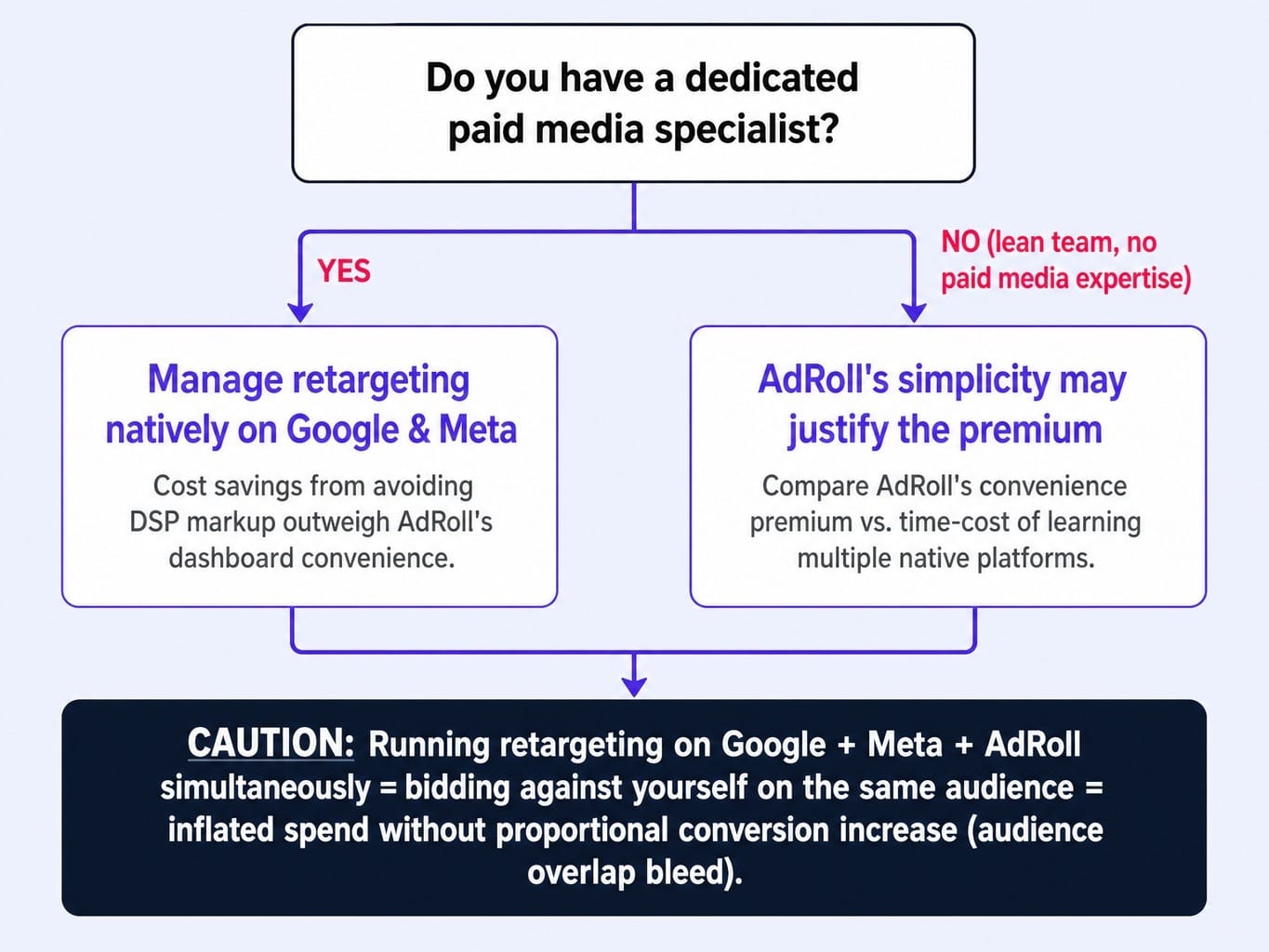
Then there's the problem of audience overlap bleed. If you run retargeting campaigns on Google, Meta, and AdRoll simultaneously to the same audience of "all site visitors," you are actively bidding against yourself. The same user exists in all three pools, and each platform rushes to claim credit for the eventual conversion. This inflates your total ad spend without proportionally increasing conversions.
The decision framework is straightforward:
- If you have a dedicated paid media specialist: Manage retargeting natively. The cost savings from avoiding the DSP markup will outweigh the convenience of AdRoll's dashboard.
- If you are a lean team without paid media expertise: AdRoll's simplicity and single interface may justify the premium. The real comparison isn't AdRoll vs. Google; it's the cost of AdRoll's convenience premium versus the time-cost of learning and managing multiple native platforms.
The Problem Retargeting Can't Fix: What Happens When Visitors Land on Your Site
This entire discussion of retargeting ROI, incrementality, and platform markups operates on a hidden assumption: that it's normal for the vast majority of your visitors to leave without converting. If your website's conversion rate is around the industry average of 2%, then 98 out of every 100 visitors leave. Retargeting is an expensive system built to chase that 98%.
Every dollar spent on DSP markups to follow those visitors across the web is a dollar not spent fixing the on-site experience that caused them to leave in the first place. The more fundamental question isn't which platform is best for chasing visitors, but why they are leaving unconverted. Is the value proposition unclear? Is the call-to-action buried? Does the landing page create friction?
This is the execution gap that retargeting can't solve. Instead of paying a premium to follow visitors who already left, Spike AI continuously identifies and ships the highest-impact conversion improvements directly on your website. It focuses on the messaging, layout, and CTA changes that increase the percentage of visitors who convert on their first visit, reducing your reliance on expensive follow-up campaigns. The most effective way to improve retargeting ROI is to fix the upstream conversion problem first.
See how Spike AI identifies and ships your highest-impact website improvements weekly
The Final Verdict
AdRoll is not a universally good or bad platform. It is a convenience layer for retargeting that only earns its keep when three conditions are met: you have sufficient audience size (5,000+ monthly uniques), you are measuring true incrementality instead of dashboard ROAS, and you have a transactional, ecommerce-style sales model.
Most reviews get stuck on "what does it do?" The real questions are "would these conversions have happened anyway?" and "is the hidden markup worth the convenience?"
Before you commit your budget, run a simple two-week incrementality holdout test on your existing retargeting campaigns. The results will tell you more about whether AdRoll is worth it than any online review ever could.
Frequently Asked Questions
Does AdRoll still work effectively after third-party cookie deprecation?
AdRoll has shifted toward first-party data activation and contextual targeting as cookie-based tracking declines. If you have the AdRoll pixel and sufficient first-party data (email lists, site visitor pools), retargeting still functions, but reach on some display inventory has narrowed. The impact is most noticeable for smaller sites with limited first-party data.
How does AdRoll's reported ROAS compare to what GA4 shows for the same campaigns?
They will almost always diverge, often significantly. AdRoll's default attribution includes view-through conversions, while GA4 defaults to a data-driven or last-click model. The gap represents attribution inflation. Use GA4 as your source of truth and treat AdRoll's dashboard ROAS as directional, not definitive.
What is the minimum monthly ad spend needed to see meaningful results with AdRoll?
While there's no official minimum, spending below $1,000–$1,500/month on media produces audience pools too small for AdRoll's AI to optimize effectively. At that level, the platform's DSP markup also becomes a disproportionate percentage of your total cost. Most positive reviews come from advertisers spending $3,000+/month.
Can AdRoll handle cross-device tracking accurately in 2026?
AdRoll uses probabilistic matching and first-party data, but its accuracy is limited compared to walled gardens like Google and Meta, which have logged-in user graphs. For ecommerce with email-based customer IDs, it's reasonable. For anonymous B2B visitors, reliable cross-device attribution remains a challenge on any platform, AdRoll included.
How does AdRoll compare to Criteo for mid-market retailers?
Criteo generally offers stronger dynamic creative optimization and is better suited for retailers with very large catalogs (500+ SKUs). AdRoll is simpler to set up and manage, making it a better fit for smaller teams. Both have opaque pricing, but for retailers spending over $5K/month, Criteo's performance edge can justify its complexity.