B2B Martech Stack Architecture: 4 Decisions That Determine Whether Your Stack Scales or Breaks

TL;DR
- Your B2B martech stack isn't failing because of bad tools; it's failing because of architectural gaps between them that create a compounding "Stack Tax" of manual work.
- B2B requires a fundamentally different architecture than B2C to handle long sales cycles, account-level targeting, buying committees, and complex attribution.
- Focus on four critical architecture decisions: ABM integration, the MQL-to-SQL handoff, buying committee tracking, and long-cycle attribution.
- The best stacks in 2026 won't have the most tools; they'll have the fewest architectural gaps, moving from manual workarounds to system-driven orchestration.
- Before adding another tool, audit whether it solves one of these four core B2B architecture problems or just adds another layer of integration overhead.
A B2B marketing leader sits in a quarterly review. The slide shows 14 tools in their martech stack, with a six-figure annual cost. Yet the team still can't answer a simple question: did the whitepaper a prospect downloaded in February influence the deal that closed in August? The tools are individually excellent. The b2b martech stack is collectively broken.
This isn't a hypothetical. It's the default state for most growing B2B companies.
The core problem is that B2B marketing has fundamentally different architectural requirements than B2C. We operate with longer sales cycles, smaller audiences with higher deal values, account-level targeting, and buying committees of 6-10 stakeholders. Yet most martech stack advice, most tool defaults, and most integration patterns are designed for B2C volume plays.
The result is what we'll call 'Stack Tax'—the compounding friction cost of forcing B2C architecture onto B2B execution. It's the manual data pulls, the spreadsheet stitching, and the broken automations that consume your team's bandwidth.
This article isn't another list of tools. It's a guide to the four architectural decisions that determine whether your stack compounds growth or compounds friction.
Why B2B Stacks Are an Architectural Problem, Not a Tool Problem
The reason most b2b martech stack advice fails is that it frames the challenge as a tool-selection problem when it's an architecture problem. A B2C e-commerce brand optimizing for individual user conversions on a three-day purchase cycle has radically different data flow requirements than a B2B SaaS company tracking six stakeholders across a nine-month sales cycle.
It's no surprise that marketing teams only use 33% of their martech stack's capabilities. This isn't a training issue; it's an architecture issue. Teams buy tools for features their B2B GTM motion will never need, while the core architectural gaps remain unsolved.
Four constraints make B2B architecturally distinct:
- Long Sales Cycles: Cycles of 6-12 months mean attribution models must persist data across quarters, not just sessions. Standard cookie-based tracking and 90-day lookback windows are insufficient.
- Small Audience Sizes: With target audiences of 500 to 5,000 accounts, statistical models designed for millions of users break down. You can't A/B test your way to significance on a 50-person audience.
- Account-Level Targeting: Your CRM thinks in contacts. Your ABM platform thinks in accounts. Your marketing automation platform (MAP) thinks in contacts. Without a clean bridge between these object models, "account engagement" becomes a manual calculation.
- Buying Committees: A single "lead" is actually a cluster of contacts whose engagement must be aggregated at the account level. Most stacks track individual scores, leaving you blind to the collective momentum of a buying committee.
Consider a 30-person B2B SaaS company with HubSpot, Salesforce, Google Analytics, and LinkedIn Ads—four best-in-class tools. They still track their MQL-to-SQL handoff in a shared Google Sheet. The Stack Tax is the manual work required to bridge the architectural gap that no single vendor solves.
ABM Integration: Does Your Stack Actually Support Account-Level Targeting, or Are You Stitching It Together?
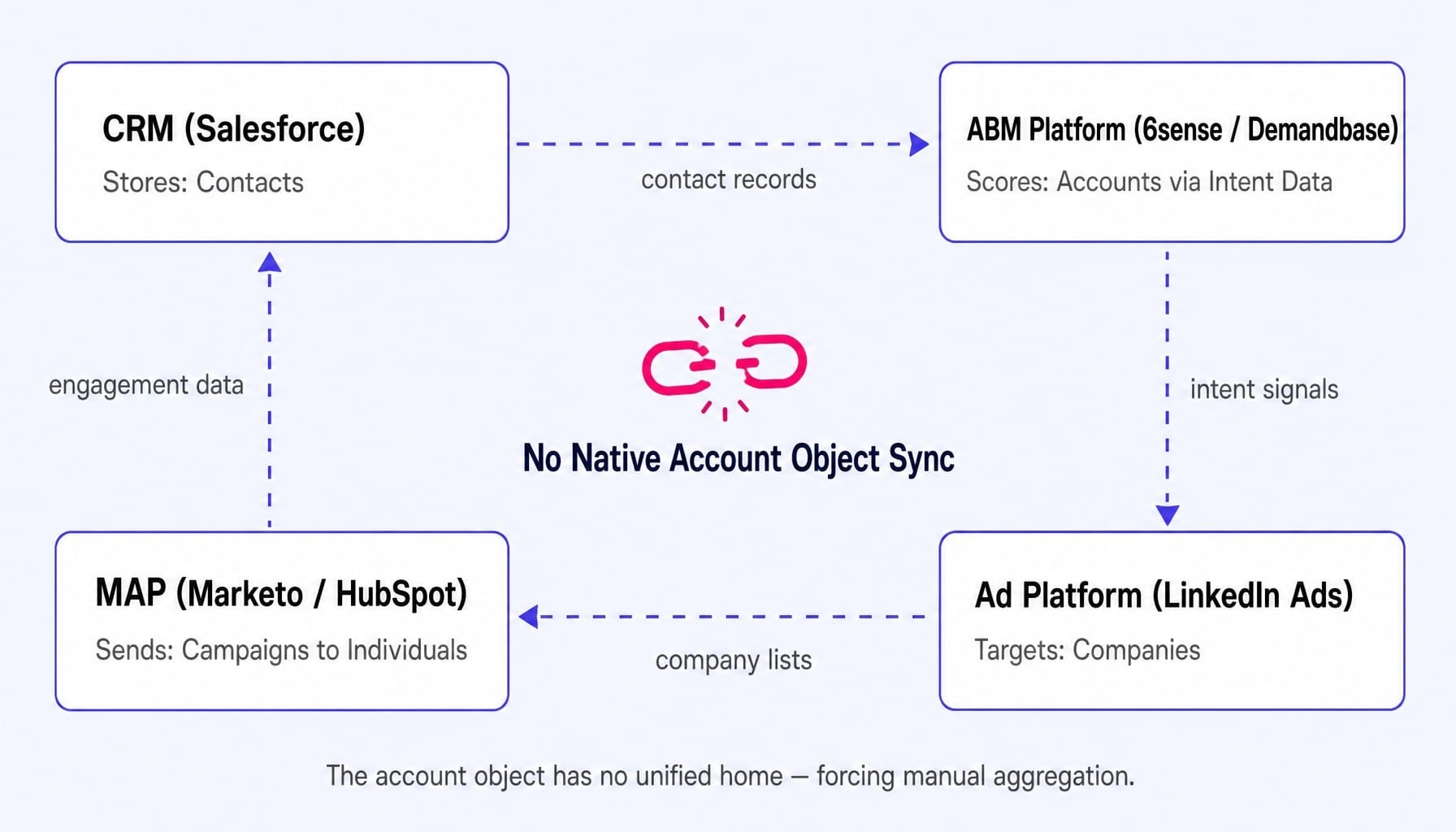
Most B2B teams say they "do ABM," but their stack doesn't actually support account-level orchestration. They run LinkedIn Ads targeting a company list, send emails to individual contacts, and track engagement in a CRM that thinks in contacts. Then, someone manually aggregates signals in a spreadsheet to decide which accounts are "engaged."
The typical tool combination includes a CRM (like Salesforce), an ABM platform (like 6sense or Demandbase), an ad platform (LinkedIn Ads), and a MAP (like Marketo or HubSpot). The friction is structural:
- The CRM stores contacts.
- The ABM platform scores accounts based on intent data.
- The ad platform targets companies.
- The MAP sends campaigns to individuals.
There is no native, bidirectional sync for the account object across these layers.
As one B2B marketing leader at a Series B security startup put it, "We bought 6sense thinking it would solve ABM. It surfaces intent signals beautifully. But getting those signals into our actual campaign workflows still requires three Zapier automations and a prayer."
The result is a weekly, manual process. Someone pulls contact activity from the MAP, aggregates it by account in a spreadsheet, cross-references it with the ABM platform's intent signals, and builds a new target list. The data is stale by the time it's complete, and the workflow breaks every time a field mapping changes. ABM isn't a tool you buy; it's an architecture decision about how account-level data flows between systems.
The MQL-to-SQL Handoff: Where Most B2B Stacks Quietly Break
The MQL-to-SQL handoff is where the B2B martech stack most visibly fails—and where that failure is most expensive. In a B2C stack, there is no handoff; marketing drives a user to a conversion. In B2B, marketing generates a qualified lead and passes it to sales. That pass is where data, context, and momentum die.
The typical tool chain is a lead scoring model in a MAP (HubSpot or Marketo) that pushes a contact to the CRM (Salesforce) once it hits a threshold. The sales rep receives a name and a score. They don't see which content the prospect consumed, which pages they visited, or that two other stakeholders from the same account also engaged last week.
The friction is that lead scoring and lead grading are different systems solving different problems. Scoring measures behavioral engagement (clicks, downloads), while grading measures firmographic fit (title, company size). Most MQL models conflate them into a single number, which sales teams rightly learn to distrust.
I once ran a post-mortem on a failed handoff where the sales team had quietly built a shadow qualification layer in a Google Sheet because they didn't trust the MQL score from the CRM. Marketing reported a four-hour response time based on the CRM timestamp; sales reported eighteen hours because they measured from their own sheet. The stack created two parallel routing systems, one automated and one manual, producing conflicting metrics and killing MQL-to-SQL velocity.
The fix isn't better SLAs; it's ensuring account-level context travels with the lead.
Tracking the Buying Committee: Can Your Stack See an Account, or Just a Contact?
B2B purchases involve 6 to 10 stakeholders, yet most martech stacks track engagement at the individual contact level. Your stack can see that one person from Acme Corp visited the pricing page. It can't see that three other people from Acme Corp downloaded the ROI calculator, watched the demo video, and read two case studies in the same week.
The stack sees four unrelated contacts. The reality is one account in active evaluation.
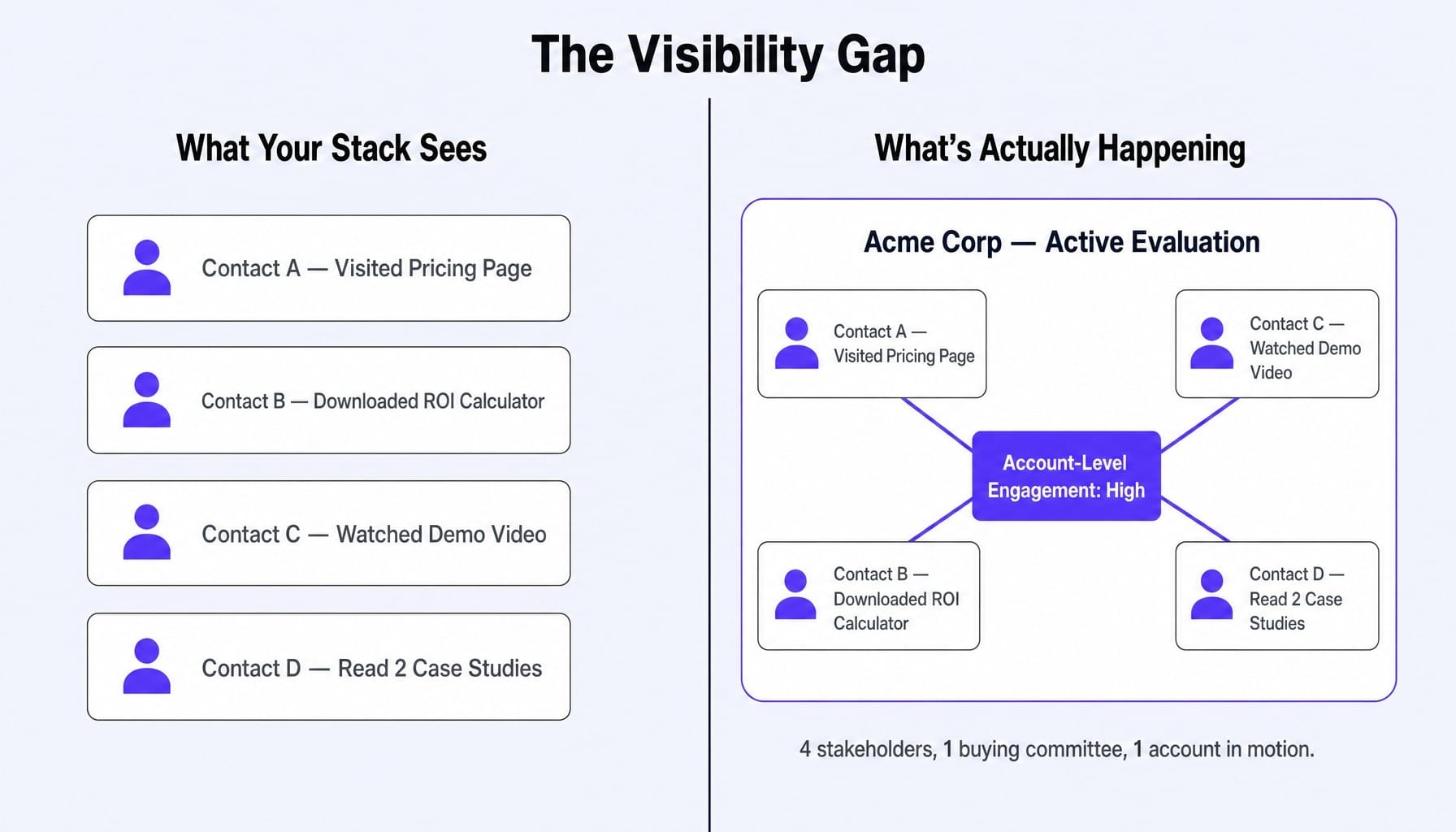
This limitation is baked into the architecture of most MAPs like HubSpot and Marketo, which are fundamentally contact-centric. They score individuals, not accounts. Even when teams add an ABM platform for account-level intent, the content engagement data from the MAP doesn't automatically roll up to the account level in a way that informs campaign logic.
The result is marketing "flying blind," as a VP of Marketing for a fintech platform described it. The team sends the same nurture sequence to a VP of Engineering and a CFO at the same target account because the MAP can't differentiate stakeholder roles or track account-level content coverage gaps. You have no system to answer: "Has the economic buyer seen our ROI case study?" or "Has the technical buyer seen our security whitepaper?"
Content distribution across a buying committee isn't a content strategy problem. It's a data aggregation problem that your stack either solves architecturally or forces you to solve manually.
Read more: LinkedIn Ads for SaaS: A Full-Funnel Strategy That Targets Buying Committees, Not Just Job Titles
Attribution Across a 9-Month Sales Cycle: The Hardest Problem in B2B Martech
Can your b2b martech stack connect a blog visit in January to a closed deal in September? For most B2B teams, the honest answer is no. Standard attribution models—first-touch, last-touch, even multi-touch—were designed for B2C purchase cycles measured in days. They break when the cycle stretches to 6-12 months.
Here's why:
- Data Persistence: Cookies expire, sessions reset, and identity resolution across devices becomes unreliable over months. The initial touchpoint is often lost to the "dark funnel."
- Conversion Definition: The "conversion" in B2B isn't a single purchase. It's a series of micro-conversions (content download, demo request, proposal review) spread across multiple stakeholders.
- Offline Signals: The most influential touchpoints—sales calls, conferences, executive dinners—are often the hardest to capture in the stack.
The typical approach involves Google Analytics for web attribution, a CRM for pipeline tracking, and a BI tool (like Tableau) or a marketing data warehouse to stitch them together. The friction is immediate: GA's attribution window maxes out at 90 days. The CRM tracks pipeline stages but not the marketing touchpoints that preceded them. As one RevOps leader for a 200-person SaaS company lamented, "Attribution is the metric everyone wants and nobody trusts. Our model credits the SDR's cold email as first touch, which makes our entire content program look like it contributes nothing to the pipeline."
Perfect B2B attribution is a myth. But "good enough" attribution requires an architecture that can handle identity resolution and long data persistence—decisions most teams never make deliberately.
Read more: Pipeline Marketing in 2026: The Framework, Metrics, and Mistakes That Shape Revenue
The B2B Stack Maturity Model: How Stack Tax Compounds at Every Growth Stage
The architectural gaps in ABM, handoffs, committee tracking, and attribution don't get solved as a company grows. They get papered over with more tools, more integrations, and more manual workarounds. This is how the Stack Tax compounds. When a B2B stack can't track engagement at the account level, marketing optimizes for contact volume while sales chases buying committees, and the resulting misalignment silently inflates cost-per-opportunity.
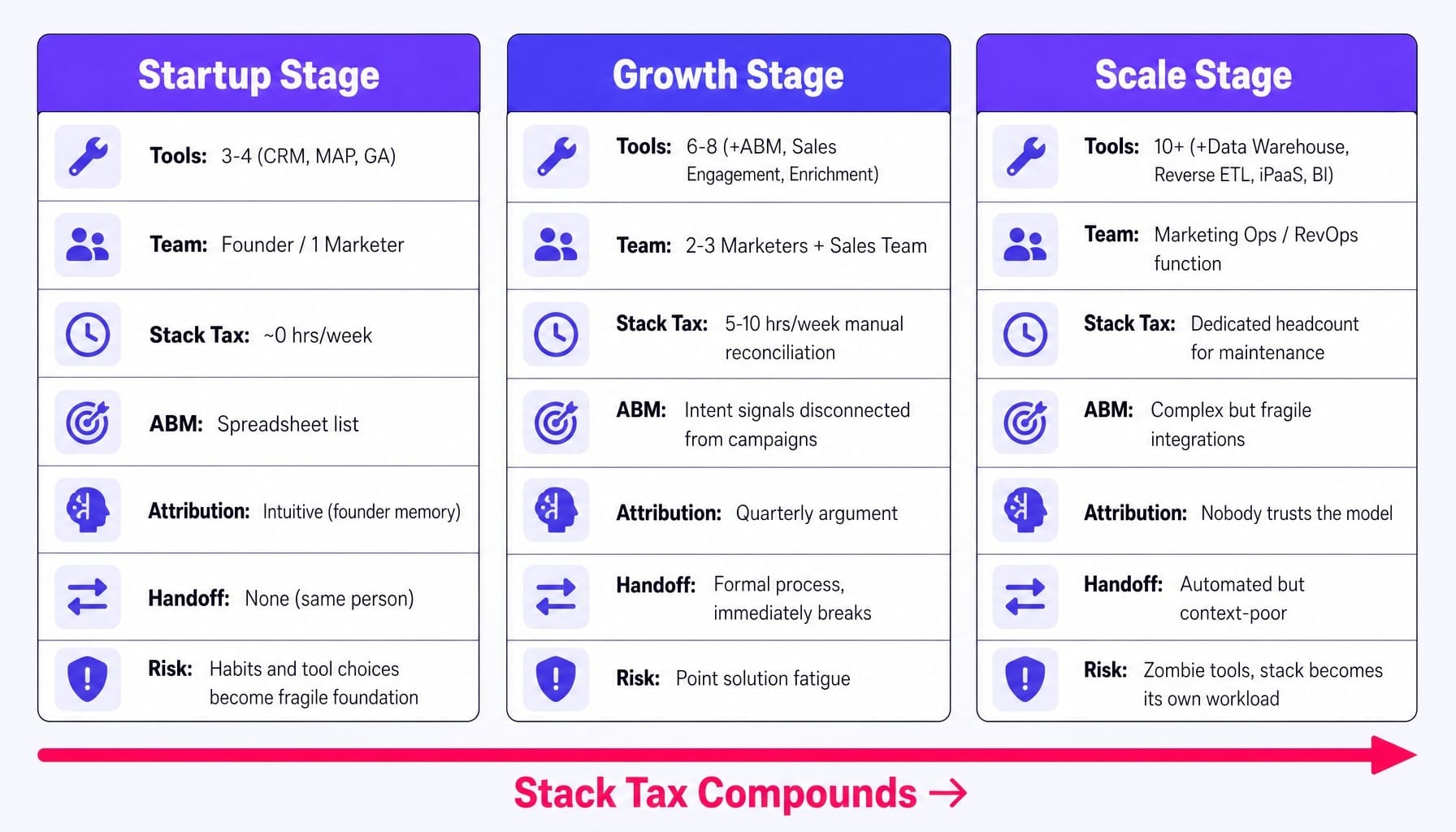
Here's what the stack and its associated tax look like at each stage of maturity.
Startup Stage: 3-4 Tools, Founder-Led Sales
The typical startup b2b marketing tech stack includes a CRM (HubSpot Free or Salesforce Essentials), a MAP (Mailchimp), and Google Analytics. The founder or a single marketer runs everything.
The Stack Tax is nearly zero. The human is the integration layer. ABM is a target account list in a spreadsheet. Attribution is intuitive because the founder knows which conversations led to which deals. The handoff doesn't exist because marketing and sales are the same person.
The danger here is that the habits and tool choices made at this stage—often optimized for cost and simplicity—become the fragile foundation that everything else gets bolted onto. The architectural decisions you skip now become the Stack Tax you pay later.
Growth Stage: 6-8 Tools, Dedicated Marketing Team
This is where the Stack Tax becomes visible. The team adds an ABM platform (Demandbase), a sales engagement platform (Outreach), and an enrichment tool (Clay). Now there are 2-3 marketers and a sales team. The founder no longer holds all the context.
The MQL-to-SQL handoff becomes a formal process and immediately breaks. ABM intent signals live in one system while campaign execution lives in another. Attribution becomes a quarterly argument.
Stack Tax at this stage is tangible: 5-10 hours per week of manual data reconciliation, spreadsheet-based reporting, and integration maintenance. This is where most B2B teams feel stuck, suffering from point solution fatigue as they try to plug architectural holes with more software.
Scale Stage: 10+ Tools, Marketing Ops Function
At scale, the stack includes a data warehouse (Snowflake), reverse ETL (Hightouch), iPaaS middleware (Zapier), and a BI layer (Looker). A marketing ops or RevOps person now exists primarily to keep this complex system running.
The Stack Tax becomes paradoxical. The company hired someone to reduce friction, but that person spends most of their time maintaining integrations, fixing broken automations, and fighting data hygiene decay. The stack has become its own workload. Zombie tools emerge—platforms the team pays for but no longer uses because the person who configured them left or the workaround became too cumbersome. The operational cost of the stack begins to rival the license fees. Scaling the tool count without solving the underlying architecture problems doesn't reduce Stack Tax—it institutionalizes it.
What If the Website Optimization Layer Didn't Add to Your Stack Tax?
The maturity model reveals a painful truth: by the time a B2B team has the budget and awareness to focus on conversion rate optimization, they are already drowning in stack maintenance. The website—the single surface where all demand generation efforts must convert—is often the most neglected layer precisely because adding another tool, another dashboard, and another manual workflow feels unbearable.
This is where the system design of your stack matters most. Most teams treat CRO as a project: a quarterly audit, an occasional A/B test. This is because their stack doesn't support continuous optimization without adding to the integration burden.
Spike AI operates differently. It's a continuous optimization layer that identifies the highest-impact website and conversion changes, prioritizes them by projected revenue impact, and ships them weekly. It functions as a self-maintaining system, not another point solution that requires configuration, integration, and a dedicated operator. It's the anti-Stack-Tax approach to CRO, solving the bandwidth problem without adding to the complexity.
See how Spike AI continuously optimizes your website without adding to your stack complexity
Conclusion
Your b2b martech stack's performance is not determined by the tools you select. It's determined by four architectural decisions: how you handle ABM integration, the sales-marketing handoff, buying committee tracking, and long-cycle attribution.
Most B2B teams inherit a stack built on B2C assumptions, then spend years papering over the architectural gaps with more tools, more integrations, and more manual workarounds. The Stack Tax—the hidden cost of this friction—compounds at every growth stage, consuming bandwidth and obscuring performance.
Before adding the next tool, audit your architecture. Does the new tool solve one of these four fundamental B2B problems, or does it just add another layer of integration overhead? The best B2B stacks in 2026 won't be the ones with the most tools. They'll be the ones with the fewest architectural gaps.
Frequently Asked Questions
How much should a mid-market B2B company spend on its martech stack?
While benchmarks suggest 20-40% of the marketing budget, a better metric is the pipe-to-spend ratio: how much pipeline does each dollar of martech generate? A lean $50K stack that generates $2M in qualified pipeline outperforms a bloated $200K stack that generates $3M. Spend is less important than the architectural efficiency of that spend.
Should B2B companies consolidate their martech stack onto fewer platforms?
Consolidation can reduce Stack Tax but introduces vendor lock-in. The better question is whether your current stack has clean data flow across the four core B2B architectures. If it does, tool count matters less. If it doesn't, consolidating onto a suite like HubSpot can be worth it, but only if its native account-level capabilities match your GTM motion.
What is the difference between a composable and monolithic martech stack for B2B?
A monolithic stack (e.g., all-in on Salesforce Marketing Cloud) reduces integration overhead but limits best-of-breed capability. A composable stack (best-of-breed tools connected via APIs) offers flexibility but dramatically increases Stack Tax. For lean B2B teams, monolithic often wins on operational efficiency. Composable only becomes viable with a dedicated marketing ops function to maintain the integrations.
How do intent data platforms like 6sense and Bombora fit into a B2B martech stack?
Intent data platforms are a signal layer, identifying which accounts are actively researching your category. The architectural challenge is getting those signals into your execution layer (MAP, ad platforms) in near-real-time. Without a bidirectional sync between the intent platform and your CRM/MAP, intent data becomes a weekly report, not an activation trigger.
When should you replace a tool in your martech stack versus integrate around it?
Replace a tool when its core data model conflicts with your B2B architecture—for example, a MAP that cannot aggregate engagement at the account level. Integrate around a tool when it excels at its core function but lacks connectivity; this is a solvable problem with iPaaS middleware like Zapier. The framework is simple: if the friction is in the tool's data model, replace. If it's in the connection between tools, integrate.