7 B2B SaaS Growth Hacks That Actually Compound (Not Just Spike Traffic)

TLDR
- Stop optimizing acquisition before you fix activation. The highest-leverage growth hack is compressing time-to-value so more users reach their "aha moment."
- Replace gated PDF reports with interactive product demos. You'll generate product-qualified leads (PQLs) who have experienced your product, not just MQLs who downloaded a file.
- The most overlooked hack is engineering negative churn. Focus on seat expansion triggers within existing accounts to generate revenue that compounds monthly without new customers.
- Prioritize experiments using an ICE (Impact, Confidence, Effort) framework. A team that ships one well-prioritized fix per week will always outperform a team that ships one brilliant idea per quarter.
- The real growth hack isn't a clever trick; it's building a system where each shipped change feeds the next. The shipping cadence itself becomes the growth engine.
Your growth team ran 12 experiments last quarter. You launched an interactive demo on the homepage, a new referral program, a big Product Hunt push, a LinkedIn outbound sequence, a gated ebook, and a full pricing page redesign. You ended the quarter at the exact same conversion rate you started with.
This isn't a hypothetical. It's the default state for most B2B SaaS marketing teams. The failure isn't the tactics; it's the execution model. Each experiment was an isolated island. No learnings from the pricing page test informed the outbound sequence. The referral program was abandoned before it reached statistical significance. The team was busy, but the needle didn't move.
The most effective B2B SaaS growth hacks are not the cleverest ideas. They are the ones designed as compounding loops, where each iteration informs the next. The real growth engine isn't the tactic; it's the shipping cadence.
This list isn't another 87-item brain dump. These are 7 interconnected growth hacks that build on each other. Each one:
- Creates a feedback loop, not a one-time spike.
- Is implementable by a lean team of 1-3 marketers.
- Is grounded in a real B2B SaaS scenario, including the metrics and tools that matter.
1. Compress Time-to-Value to Under 5 Minutes — The Activation Hack That Multiplies Everything Else
Time-to-value compression is the single highest-leverage B2B SaaS growth hack because every downstream metric—activation rate, trial-to-paid conversion, expansion revenue—improves when users reach their aha moment faster. While average B2B SaaS free trial activation rates hover around 15–25%, top-quartile products consistently exceed 40% by relentlessly optimizing this one variable.
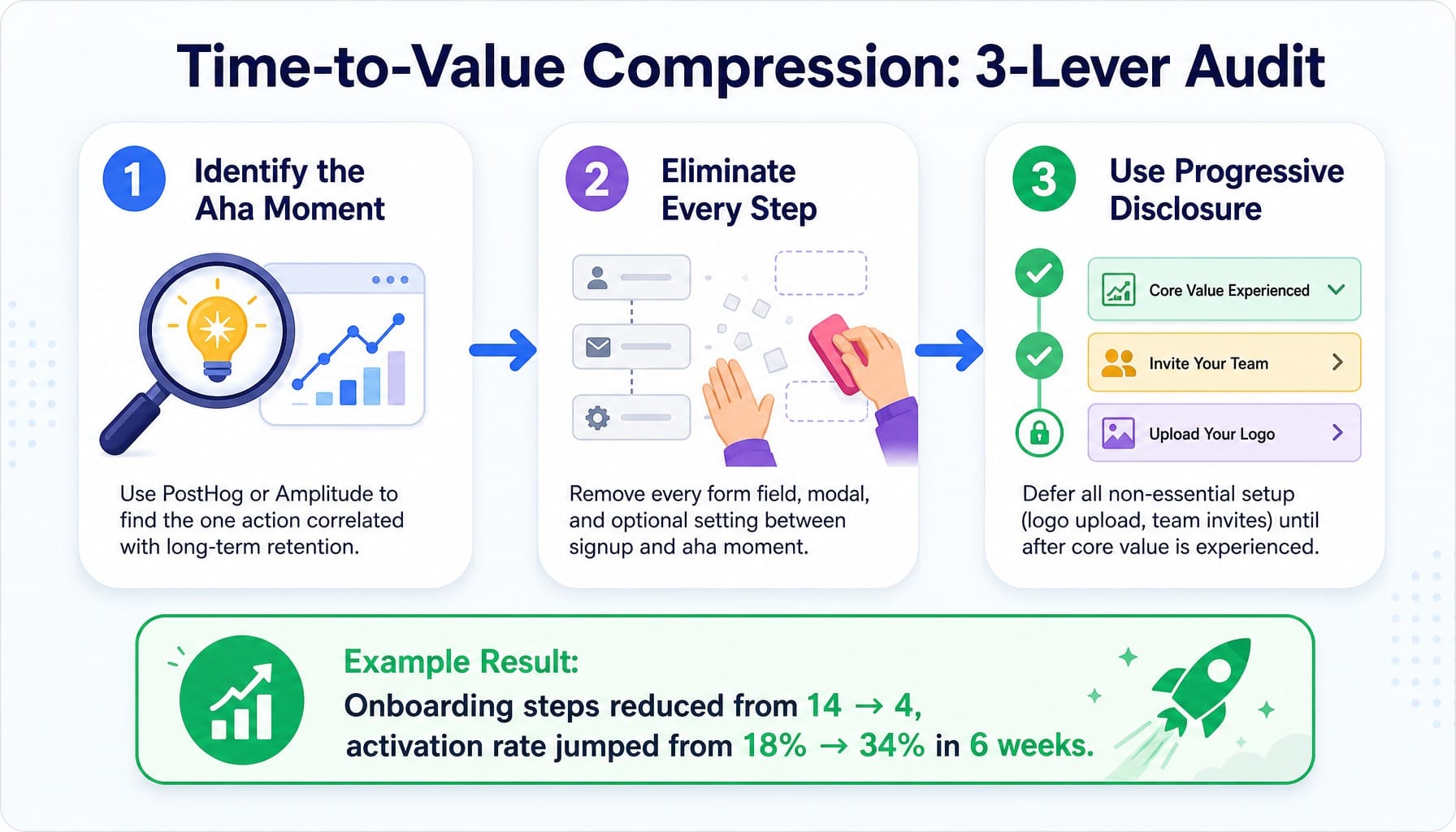
Consider a project management SaaS. They mapped their activation cohort decay using PostHog and found a massive drop-off during their 14-step onboarding flow. Users who never created their first project churned within 48 hours. The fix was radical: they redesigned the signup flow to pull the user's company and team data via an API, then used that data to pre-populate a sample workspace with three relevant-looking projects. The onboarding flow shrank from 14 steps to 4. Activation rate—defined as "user creates one real project"—jumped from 18% to 34% in six weeks.
You can run this same play by auditing three levers:
- Identify the "Aha Moment": Use a tool like PostHog or Amplitude to find the one action that correlates with long-term retention. Where do your best customers go in their first session? Where do churned users never reach? That's your north star metric for onboarding.
- Eliminate Every Step: Your goal is to get the user from signup to that aha moment with zero friction. Every form field, every modal, every optional setting you ask them to configure is a potential exit point. Be ruthless.
- Use Progressive Disclosure: Defer all non-essential setup. Does the user really need to upload their company logo and invite their entire team in the first three minutes? Or can that wait until after they've experienced the core value?
This hack compounds because higher activation means more users reach the expansion triggers and referral prompts you'll build in later. It's the foundation for every other growth loop. The anti-pattern? Gating your core feature behind a "schedule a call" step, killing self-serve activation entirely and forcing every user through a high-friction, sales-led funnel.
2. Replace Gated Content With Interactive Product Demos — The Top-of-Funnel Hack That Generates PQLs, Not Dead MQLs
Interactive product demos—built with tools like Navattic or Storylane—outperform gated ebooks as a B2B SaaS growth hack because they generate product-qualified leads (PQLs) who have already experienced the product, not marketing-qualified leads (MQLs) who downloaded a PDF and forgot about it.
Here's a common failure scenario: a B2B analytics SaaS was spending $8,000/month on paid traffic to a gated "State of Analytics" report. They generated 2,400 MQLs per quarter. Of those, 3% converted to a demo request, and only 0.5% ultimately became customers. The CAC was unsustainable.
They replaced the gated report with an interactive demo of their core dashboard, letting users click through a pre-populated environment. Demo completions became the new lead signal. The result? The PQL-to-SQL conversion rate was 4x higher than the old MQL path. Why? Because the lead had already self-qualified by engaging with the product interface. They understood the value before ever talking to sales.
The transferable principle is simple: the "penny gap" between consuming free content and committing to a product experience is where most B2B funnels leak. Interactive demos eliminate it. Where MQL-to-opportunity rates in B2B SaaS often struggle to break 10%, PQL-to-opportunity rates frequently land between 25-40%.
This loop compounds. Every demo completion generates behavioral data—which features a prospect clicked, how far they got, where they dropped off. You can use this data to personalize follow-up sequences, making each sales cycle smarter than the last. The anti-pattern is just as common: companies that build a beautiful interactive demo but then hide it behind a lead form, recreating the exact friction they were supposed to eliminate.
Read more: 7 B2B SaaS Lead Generation Strategies That Build Pipeline (Not Just MQLs) in 2026 | Spike
3. Use Intent Signals to Replace Cold Outbound With Warm Sequences — Signal-Based Selling in 2026
Signal-based outbound replaces batch-and-blast cold email with sequences triggered by real buying signals—website visits, job changes, tech stack changes, funding rounds—making it the most efficient B2B SaaS growth hack for pipeline velocity in 2026.
A 3-person growth team at a $12M ARR SaaS was sending 2,000 cold emails a week using Apollo.io. Their reply rate was a dismal 0.4%. They were burning out their domain and their team. They switched to a signal-based workflow.
First, they used a tool like Koala to identify and de-anonymize accounts visiting their high-intent website pages. Then, they used Clay to enrich those accounts with firmographic data (employee count, industry) and technographic data (what marketing automation or CRM they use). An SDR only contacted an account if it showed two or more intent signals in a 7-day window (e.g., visited the pricing page and just hired a new VP of Marketing).
The team's volume dropped from 2,000 emails per week to just 200. But their reply rate jumped to 6.2%. They were having fewer, but much better, conversations. This is the difference between shouting into a void and whispering to someone who is already listening.
This system compounds because each closed deal provides data that refines the ICP scoring matrix. You learn which combination of signals predicts the highest likelihood of closing, making the next cycle's targeting even more accurate. It's the definitive end of MQL recycling through nurture sequences that nobody reads.
4. Engineer Negative Churn Through Seat Expansion Triggers — The Expansion Revenue Hack Hiding in Your Existing Accounts
Negative churn—where expansion revenue from existing customers exceeds lost revenue from churned customers—is the most overlooked B2B SaaS growth hack because it compounds monthly without requiring a single new customer. While most teams obsess over acquisition, top-quartile SaaS companies achieve over 120% net revenue retention (NRR), meaning they grow even if they don't sign a single new logo.
A B2B collaboration SaaS noticed a powerful pattern: accounts that reached 8+ active users in the first 60 days had a 92% 12-month retention rate and expanded their seat count by an average of 3.2x. So they stopped waiting for renewals to upsell and started engineering expansion.
They built automated triggers to capitalize on this momentum:
- Usage-Based Thresholds: When an account hit 6 active users, the CSM received an automated alert to initiate a multi-threading conversation with the account's department head about a team-wide plan.
- In-App Prompts: When a user tried to use a collaboration feature (e.g., "@mention" a colleague not in the tool), the product surfaced a prompt suggesting they invite them.
- Champion Tracking: The system identified internal advocates—users with the highest session times and feature adoption—and armed them with a pre-built business case PDF to share with their manager.
This creates second-order revenue effects. Each expanded account becomes a powerful case study, reducing the customer acquisition cost for new accounts in the same vertical. The common mistake is treating upselling as an annual event tied to renewal. The opportunity for seat expansion happens every day.
5. Design a Referral Program That Rewards the Outcome, Not the Invite — Why Most B2B SaaS Referral Programs Fail
Most B2B SaaS referral programs fail because they reward the invite (send a link, get a credit) instead of the outcome (your referral activates and becomes a paying customer). This simple misalignment floods the funnel with low-quality leads and kills the program's ROI.
A B2B email marketing SaaS learned this the hard way. They launched a "give $50, get $50" referral program. The volume of invites was huge—over 1,200 in the first month. But only 14 converted to a paid plan. The reason was obvious in hindsight: referrers were gaming the system, spamming their link to anyone and everyone to harvest credits, not because they were making a thoughtful recommendation to a qualified peer.
The fix was to restructure the reward. The referrer's $50 credit only triggered when the referred account completed onboarding and sent their first email campaign.
Referral volume plummeted to 180 per month, but the number of paid conversions jumped to 41. The quality of each referral skyrocketed.
The transferable principle is this: in B2B, a referral is an act of social capital. The referrer is putting their reputation on the line. They will only make a recommendation when they genuinely believe the product will solve a peer's problem. Your program must align with that psychology. By rewarding the successful outcome, you ensure referrers only send people who are likely to succeed. This is how you build a true viral loop mechanic, where each new happy customer creates another.
6. Stack Your GTM Motions Instead of Picking One — Why PLG vs. Sales-Led Is a False Choice
GTM motion stacking—running product-led growth, sales-led outbound, and community-led growth as interconnected systems rather than choosing one—is the B2B SaaS growth hack that separates companies growing at 2x from those growing at 5x. The endless debate over "PLG vs. sales-led" is a false choice that paralyzes teams and surrenders growth.
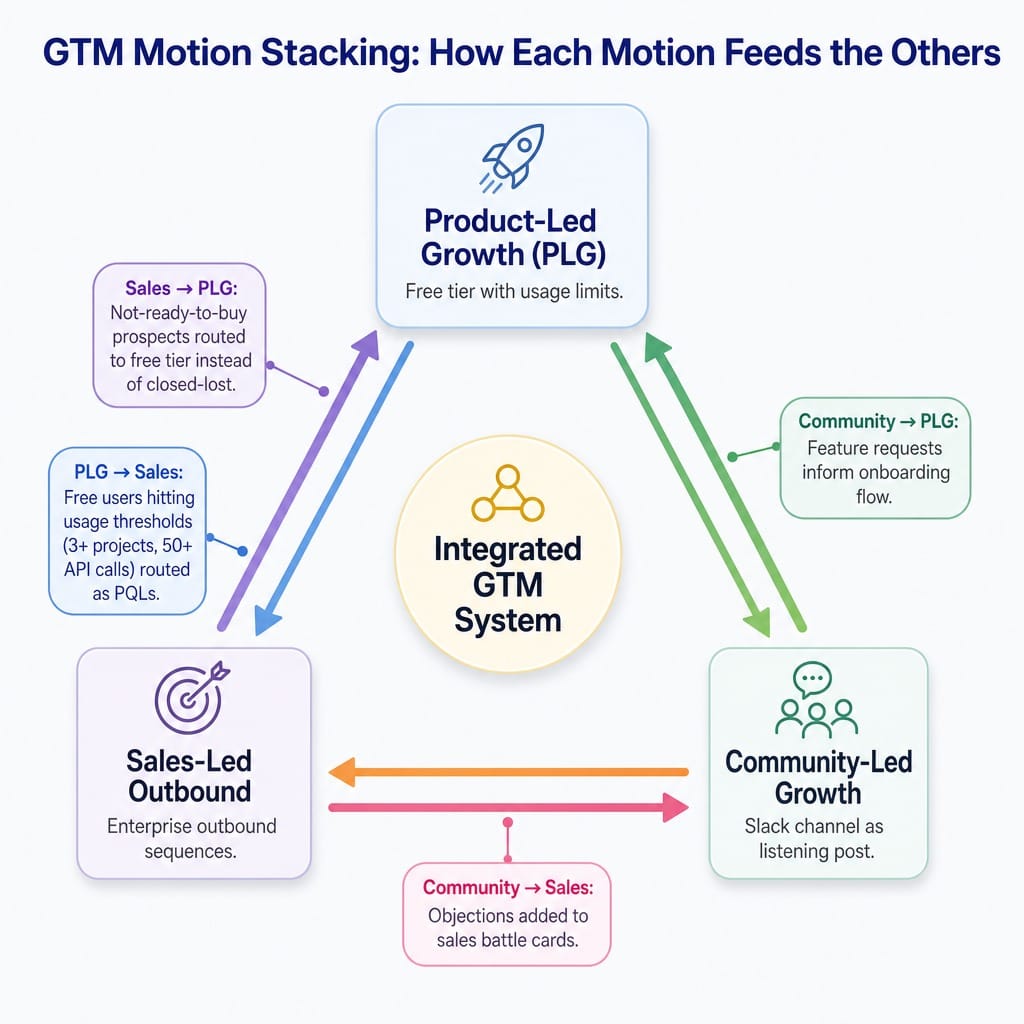
A $7M ARR developer tools company was stuck. They ran a PLG motion (a free tier with usage limits) and a sales-led motion (enterprise outbound) as two separate teams with two separate P&Ls. The sales team had no idea which accounts were hitting usage limits in the free product, and the product team had no visibility into why enterprise deals were being lost.
They stopped treating them as channels and started managing them as a single, integrated system.
- PLG feeds Sales: Free tier signups that hit specific usage thresholds (e.g., 3+ projects, 50+ API calls) were automatically routed to a sales rep as a product-qualified lead for a warm outbound sequence.
- Sales feeds PLG: Enterprise prospects who weren't ready to buy were routed to the free tier to build familiarity, instead of being marked "closed-lost" and forgotten.
- Community feeds both: The company's community Slack channel became a listening post, surfacing feature requests that informed the PLG onboarding flow and objections that were added to the sales team's battle cards.
This is the essence of building compounding growth loops, as described in Reforge's growth frameworks. Each motion generates data and users that make the other motions more effective. The anti-pattern is a leadership team that spends six months debating which motion is "right" and ends up shipping neither.
Read more: How to Build a SaaS Marketing Playbook That Compounds, Not Collects Dust | Spike AI
7. Prioritize Growth Experiments Using Impact-Confidence-Effort, Not Gut Feel — The Anti-Hack That Makes Every Other Hack Work
The most effective B2B SaaS growth hack is not a tactic—it is a prioritization system that ensures your team always ships the highest-impact experiment next. This means using a framework like ICE (Impact, Confidence, Effort) instead of defaulting to the loudest voice in the room.
Imagine a growth team with a backlog of 23 experiment ideas. They could redesign the pricing page, launch a LinkedIn content series, or build a Zapier integration. Without a system, they default to the founder's pet project: starting a company podcast. It consumes six weeks of effort and generates 12 trial signups.
After that failure, they implement ICE scoring. Each idea is rated on a 1-10 scale:
- Impact: How much will this move our north star metric?
- Confidence: How sure are we that this will work? (Based on data, user research, or past experiments).
- Effort: How much time/resources will this take? (Lower score = more effort).
The team quickly identifies a simple CTA copy change on their highest-traffic landing page. Its score: Impact 9, Confidence 7, Effort 2. It could be shipped in a day and would affect 40% of all trial signups. They ship it on Monday, measure the results by Friday, and move to the next highest-scored item.
The compounding mechanic here is in the system itself. ICE scoring isn't a one-time exercise. After each experiment ships, the results feed back into the "Confidence" scores of remaining backlog items, making the next prioritization decision more informed. A team that ships one well-prioritized experiment per week will always outperform a team that ships one brilliant experiment per quarter. Effort-adjusted impact beats ambition every time.
What Happens When the Shipping Cadence Runs Itself
The compounding loops this article describes—faster activation, higher-quality leads, systematic expansion—all depend on one thing: a shipping cadence most lean teams cannot sustain manually.
You can build the perfect ICE-scored backlog, but the bottleneck remains. The gap between identifying the highest-impact move and actually getting it live is measured in weeks of engineering tickets, cross-functional approvals, and context-switching. The growth team knows what to do, but they lack the capacity to do it. The backlog grows, momentum stalls, and the compounding system breaks.
This is the execution gap Spike AI was built to close. It operates as the system that makes weekly releases the default, not the aspiration. By connecting to your core marketing and product analytics, Spike AI continuously identifies the highest-impact move across your website's CRO, SEO, and ad funnels. Then it deploys the change.
The result is a closed-loop growth system. The marketer moves from operator to approver. The backlog shrinks into an approval queue. And the shipping cadence—the real growth hack—finally runs itself.
See how Spike AI turns your growth backlog into weekly shipped improvements
The Real Hack Is the System, Not the Trick
The seven tactics on this list are not independent tricks. They are interconnected loops. Faster activation feeds expansion revenue. Signal-based outbound populates your PLG funnel with high-intent users. A rigorous prioritization framework ensures the highest-impact loop gets attention first.
Growth hacking in B2B SaaS isn't about finding the one clever idea that changes everything. It's about building a system where each small, well-prioritized change compounds on the last. Your competitors have read the same articles and know the same tactics. Your only durable competitive advantage is your ability to ship them more consistently, measure the results immediately, and re-prioritize for the next weekly release.
The teams that win in 2026 will not be the ones with the most creative growth ideas. They will be the ones with the tightest shipping loop.
Frequently Asked Questions
What growth hacking experiments should a B2B SaaS company run first?
Start with the experiment closest to revenue: optimize your activation rate before you scale acquisition volume. A 10% improvement in trial-to-paid conversion on your existing traffic compounds every month without additional spend. Only after your activation funnel is healthy should you invest in top-of-funnel experiments like referral programs or new content channels.
Can AI agents replace traditional B2B SaaS growth hacking tactics?
AI agents don't replace growth tactics; they accelerate the shipping cadence around them. An AI can deploy a landing page variant, monitor results, and flag when statistical significance is reached, but the strategic decision of which experiment to run still requires human judgment informed by your ICP and business context.
What metrics should you track when growth hacking a B2B SaaS product?
Focus on activation rate (percentage of signups reaching the aha moment), time-to-value (minutes from signup to first meaningful action), net revenue retention (expansion minus churn), and CAC payback period (months to recover acquisition cost). Vanity metrics like total signups or page views are noise unless tied directly to one of these four.
How do you build a viral loop into a B2B SaaS product when the buyer is not the user?
Design the loop around the user's workflow, not the buyer's budget. If your product requires collaboration—shared dashboards, team comments, external client access—each touchpoint exposes a new potential user. The viral loop triggers when a non-customer must create an account to participate, then experiences enough value to advocate internally for a paid seat.
What are the biggest mistakes companies make when growth hacking B2B SaaS?
Three patterns dominate: (1) optimizing acquisition before fixing activation, which pours budget into a leaky funnel; (2) calling A/B tests "winners" before reaching statistical significance because the team is impatient; and (3) treating growth as a one-time sprint instead of a continuous weekly cadence where each experiment informs the next.