
The B2B SaaS Growth Strategy That Actually Ships: From Planning Paralysis to Compounding Execution

TLDR
- Your growth strategy isn't failing because it's wrong; it's failing because the latency between identifying a fix and shipping it—your 'execution debt'—is too high.
- The dominant growth motion for 2026 is Product-Led Sales, a hybrid where self-serve acquisition (PLG) feeds a sales team focused on expansion, optimizing for both CAC and LTV.
- Prioritize Net Revenue Retention (NRR) over new logo acquisition. An NRR of 120%+ means your business grows even with zero new customers, creating a compounding revenue base.
- Replace static ICPs with a signal-based GTM. Focus on the 30 accounts showing buying intent this week, not a list of 500 accounts that might buy this year.
- Shift from linear funnels to compounding growth loops. A funnel stops when you stop spending; a loop builds momentum where one user cohort generates the next.
Your three-person marketing team spent all of Q1 building a comprehensive B2B SaaS growth strategy. You have pristine ICP definitions, multi-channel content calendars, and a prioritized ABM target list. By April, you've shipped exactly two meaningful changes to your website.
The strategy was sound. The execution stalled.
This is the central failure mode of modern growth marketing. The problem is not a lack of knowledge. Teams know what product-led growth is. They understand why Net Revenue Retention matters. They've read about signal-based selling. The real constraint is the latency between identifying what needs to change and actually deploying that change. It's an execution bandwidth problem.
Most articles will sell you another strategic framework to add to your backlog. This isn't one of them.
Instead, this guide reframes B2B SaaS growth strategy as an execution system. We'll diagnose why most strategies fail at the operational level and outline a model built for shipping velocity and compounding returns—covering the GTM motions to prioritize, the metrics that actually signal efficiency, and the structure required to build a cadence that wins.
Why Most B2B SaaS Growth Strategies Fail at Execution, Not Planning
The failure point of a modern B2B SaaS growth strategy is not choosing the wrong framework; it's the operational latency between a strategic decision and a shipped change. This gap creates a drag on growth that no amount of planning can overcome.
Consider this scenario: a growth marketer identifies that their trial-to-paid conversion rate is 40% below the benchmark. They know the fix requires restructuring the onboarding flow, running a CTA experiment on the pricing page, and aligning three key landing pages with new ICP messaging.
The insights are there. The backlog is clear. But shipping those changes requires a sequence of handoffs: design tickets, engineering sprints, stakeholder reviews, and cross-functional approvals. Six weeks later, one of the three changes is live. And let's be honest, that's if you're lucky.
This is execution debt: the compounding cost of known improvements that never get deployed. Every week a fix sits in the backlog, you lose the potential revenue from that improvement. More importantly, you lose the learnings from that change, which should be informing the next highest-impact move. Your growth engine isn't just slow; it's not learning.
In a post-ZIRP environment, investors scrutinize efficiency metrics like the burn multiple and GTM efficiency. The Rule of 40 doesn't just reward raw growth; it rewards efficient, sustainable growth. Data shows companies that can adjust pricing quarterly see a 103% higher ARPU, but this only works if you have a system that can actually ship those changes at that cadence. A strategy that can't be deployed is just a document.
Three Growth Motions That Are Converging Into One
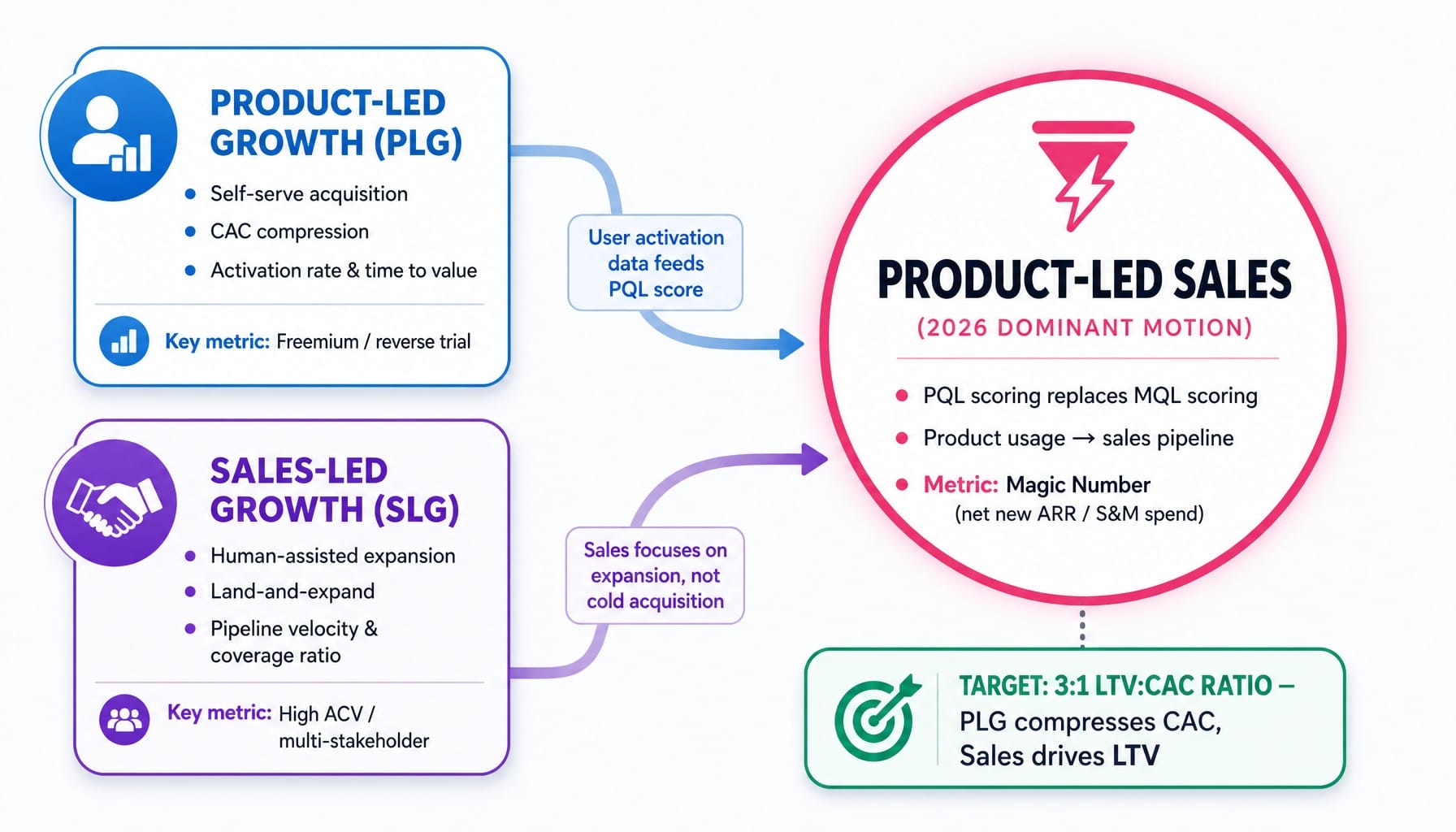
The debate between Product-Led Growth (PLG) and Sales-Led Growth (SLG) is becoming irrelevant. The dominant B2B SaaS growth strategy for 2026 is a hybrid: Product-Led Sales. This isn't a compromise; it's a structurally superior GTM motion where self-serve acquisition funnels high-intent users to a sales team focused on expansion.
Choosing "PLG or sales-led" is a false binary. The real strategic question is how to design the handoff between automated user activation and human-assisted revenue expansion. Companies like HubSpot and Amplitude have already demonstrated this convergence, evolving from pure-play models to a system that leverages the best of both. This hybrid approach is how you achieve the ideal 3:1 LTV:CAC ratio—PLG compresses customer acquisition cost, while an efficient sales motion drives lifetime value through expansion and negative churn.
Product-Led Growth: Where Self-Serve Acquisition Compresses CAC
The primary value of PLG is not just "try before you buy." It's a mechanism to aggressively compress customer acquisition cost (CAC) by removing sales friction from initial adoption. A reverse trial or freemium model allows users to reach their "aha moment" without a single sales touch. The cost to acquire that user is driven by content and product infrastructure, not SDR salaries and demo coordination.
This only works if you obsess over two metrics: activation rate and time to value. If a user doesn't activate key features within their first session, your PLG motion becomes a leaky bucket, not a growth engine. This is where tools like Navattic for interactive demos come in, shortening the path to value, while platforms like Amplitude and Mixpanel track the user journey to pinpoint where activation stalls. PLG isn't a "no sales" strategy; it's a CAC compression strategy that feeds the rest of the revenue engine.
Sales-Led Growth: Where Human Judgment Drives Expansion Revenue
A sales-led motion remains essential for any B2B SaaS company with a high ACV, a complex implementation, or a multi-stakeholder buying committee. However, its role is fundamentally shifting from front-line acquisition to high-value expansion and multi-threading within key accounts.
The model is land-and-expand. The initial deal might be smaller, but the real revenue is generated by expanding usage across departments and upselling to higher tiers. In this context, MQL volume is a vanity metric. What matters is pipeline velocity and maintaining a healthy pipeline coverage ratio. Your sales team's time is your most expensive resource; it should be spent on accounts with proven potential for expansion, not chasing low-quality leads. Tools like Gong provide the conversation intelligence to understand customer needs for expansion, while Salesforce remains the system of record for managing that pipeline. Sales-led isn't dying; it's being repositioned as the expansion engine.
Product-Led Sales: The Convergence That Defines 2026
Product-Led Sales is the synthesis. Self-serve acquisition acts as a qualification layer, feeding a PQL (Product-Qualified Lead) scoring system that routes the highest-potential accounts to sales for proactive expansion. This model is structurally superior because it replaces the guesswork of MQL scoring (e.g., "downloaded a whitepaper") with concrete behavioral data.
Imagine a user signs up for a free plan, activates three core features, invites two teammates, and hits a usage limit. That sequence of actions is a far more predictive buying signal than any form fill. This is where the modern growth stack operates. Tools like Common Room aggregate community and product signals, which are then used to build a PQL score. Sales reps engage not with a cold lead, but with an active, engaged user who has already demonstrated need and intent. This GTM efficiency is measured by the magic number (net new ARR / sales and marketing spend), reflecting a system where product usage directly fuels sales pipeline. The strategic question is no longer "which motion," but "how do we design the handoff?"
Build Your Growth Strategy Around Net Revenue Retention, Not New Logos
The highest-leverage B2B SaaS growth strategy is not acquiring more customers; it's extracting more revenue from the ones you already have. This isn't a retention platitude. It's a mathematical argument for building a compounding growth engine.
Consider two companies:
- Company A grows new logo ARR by 40% but has 15% gross churn and minimal expansion. Its net growth is around 25%, achieved through a high-burn acquisition model.
- Company B grows new logos by a more modest 20% but has only 5% gross churn and achieves 30% expansion revenue from its existing customers. Its net growth is 45% with a much lower CAC.
Company B wins, not because it's better at acquisition, but because it has engineered negative churn. When revenue from upgrades and cross-sells exceeds revenue lost from downgrades and cancellations, your installed customer base becomes its own growth engine. This is the difference between running on an acquisition treadmill and building a compounding asset.
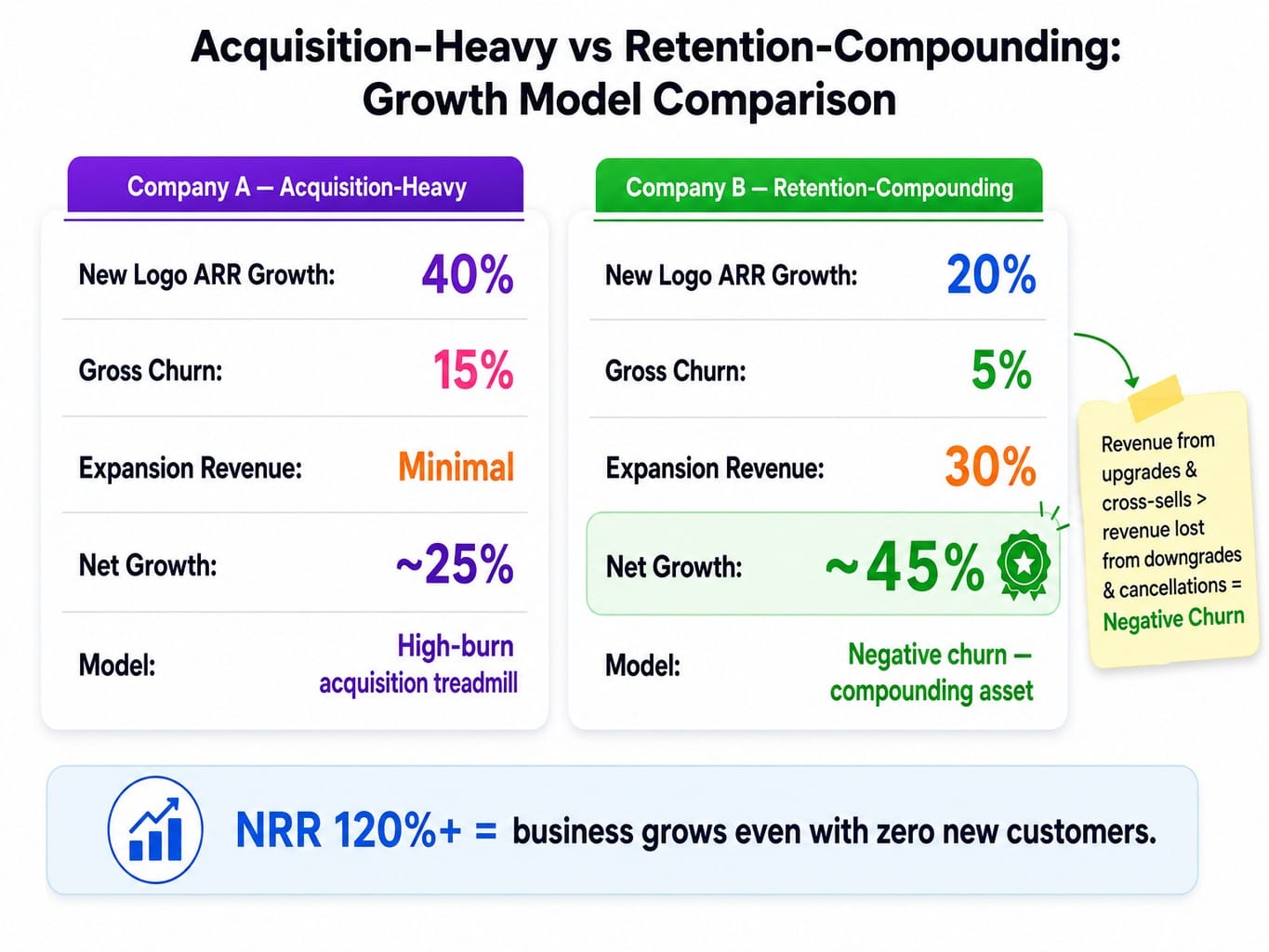
Best-in-class B2B SaaS companies target a Net Revenue Retention (NRR) of 120% or higher. An NRR over 100% means your business continues to grow even if you acquire zero new customers. The diagnostic tool for this is NDR cohort analysis, which allows you to segment retention by customer cohort, acquisition channel, or plan tier. This reveals which segments are compounding and which are leaking, telling you exactly where to focus your product and sales efforts. Your growth strategy should be organized around NRR as the primary KPI, with new logo acquisition serving as an input to that compounding engine.
Read more: Data-Driven CRO Strategies: Identifying Marketing Opportunities for True Conversion Optimization
Signal-Based GTM: Replacing Static ICPs With Real-Time Intent
The static Ideal Customer Profile—"Series B SaaS companies with 50-200 employees"—is an obsolete targeting model. It describes who might buy, not who is buying right now. A modern SaaS growth strategy replaces demographic lists with a dynamic, signal-based Go-to-Market motion.
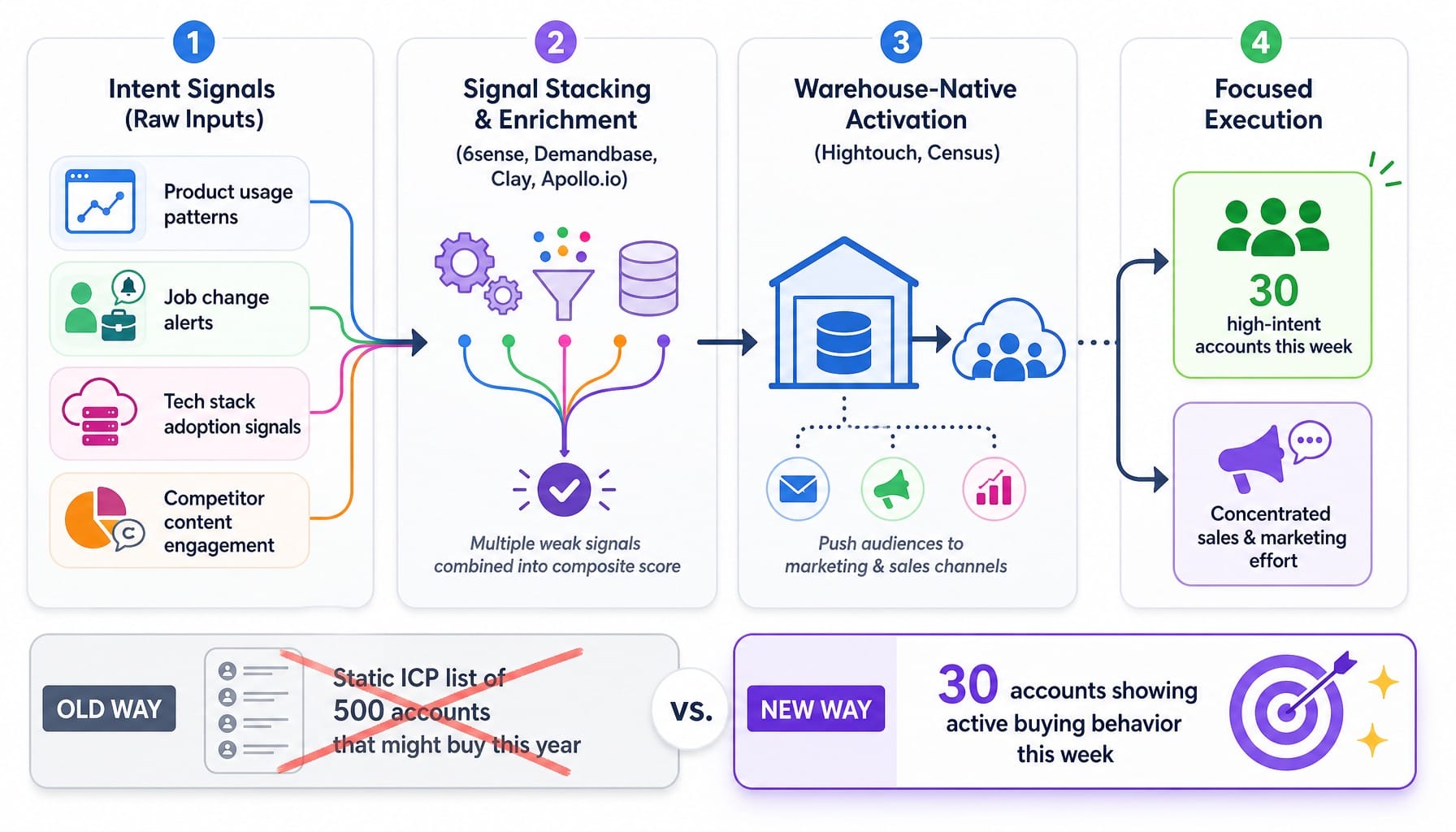
This approach prioritizes accounts based on real-time behavioral and intent data: product usage patterns, job change alerts, technology adoption signals from their tech stack, or engagement with competitor comparison content.
Instead of running an ABM campaign against a static list of 500 accounts, a signal-based approach identifies the 30 accounts showing active buying behavior this week. This could be a team visiting your pricing page three times, a key contact from a target account viewing a webinar on a competitor, or a surge in brand mentions from that company on social media. This concentrates your most expensive resources—sales and marketing effort—on accounts with the highest probability of conversion now, dramatically improving pipeline velocity.
This is powered by a new layer of the martech stack. Intent platforms like 6sense and Demandbase identify accounts in-market. Enrichment tools like Clay and Apollo.io build out contact data. And warehouse-native activation platforms like Hightouch and Census push these audiences directly into your marketing and sales channels. The art is in intent signal stacking—combining multiple weak signals (e.g., a website visit + a job posting for a relevant role) into a composite score that is highly predictive. This is how you find signals in the dark funnel, influencing the 70% of the buyer journey that happens before a form is ever filled.
Growth Loops Replace the Linear Funnel
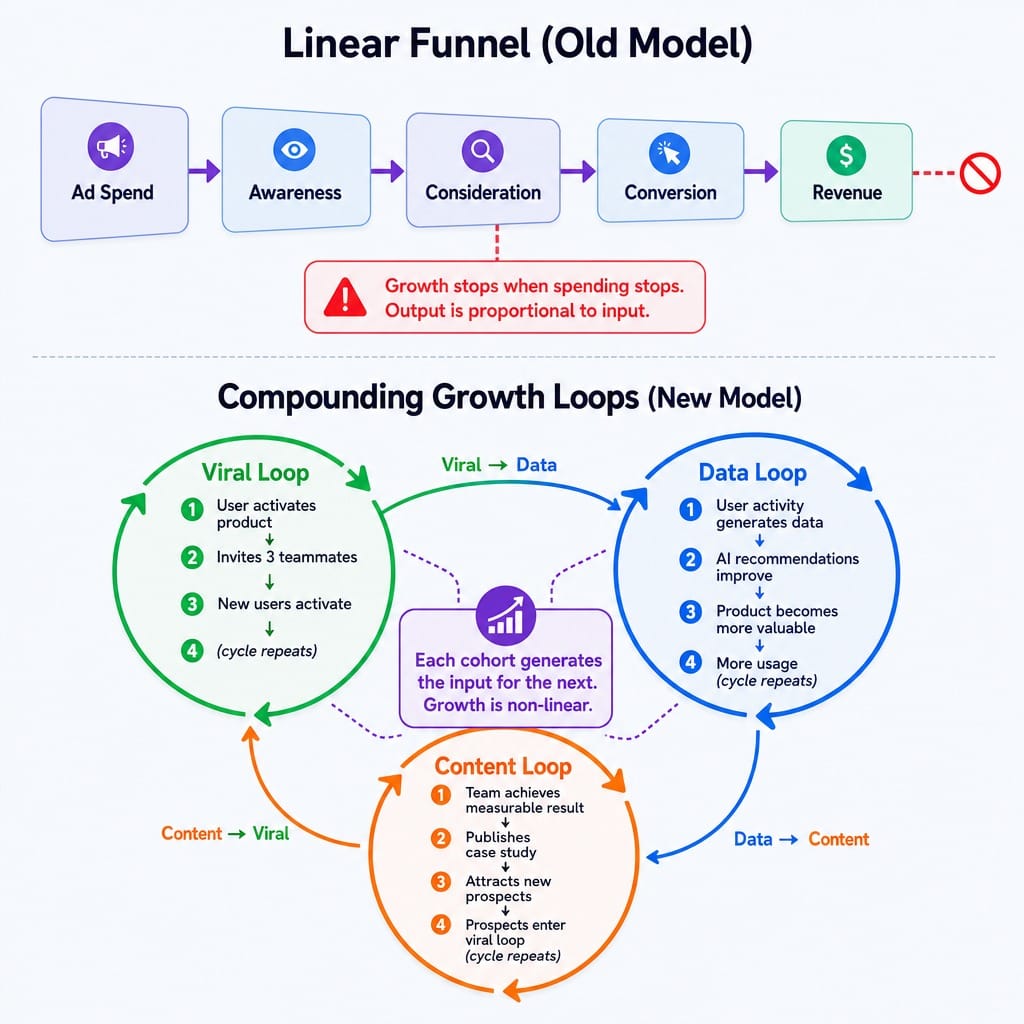
The traditional marketing funnel is a linear model that requires constant, expensive top-of-funnel investment to sustain output. Growth stops when you stop spending. Growth loops, in contrast, are closed systems where each cohort of users generates the input for the next cohort, creating compounding momentum.
This isn't a semantic distinction; it fundamentally changes how you allocate resources. In a funnel model, growth is proportional to ad spend. In a loop model, growth is non-linear.
Consider a simple B2B SaaS loop system:
- Viral Loop: A user activates the product and invites three teammates to collaborate. The output (new users) becomes the input for the next cycle.
- Data Loop: The usage from those new teammates generates data that improves the product's AI-driven recommendations, making the product more valuable for everyone.
- Content Loop: The team achieves a measurable result and publishes a case study. This content attracts a new cohort of prospects, who then enter the viral loop.
Each loop feeds the next without requiring incremental marketing spend. While this is harder to build than a simple paid acquisition funnel—it requires deep coordination between product, marketing, and customer success—the payoff is a durable, compounding growth advantage. The teams that win are not just optimizing channels; they are engineering systems.
Read more: Marketing Channel Prioritization for 2026: Where Your Budget Actually Compounds
When the Bottleneck Is Shipping, Not Strategy
You now have a blueprint for a modern B2B SaaS growth strategy: a converged GTM motion, an obsession with NRR, signal-based targeting, and a focus on compounding loops. But each of these requires continuous execution—A/B testing on your onboarding, deploying new pricing tiers, optimizing landing pages for intent signals, and instrumenting your product for viral hooks.
The bottleneck is not knowing what to do. It's the latency between identifying the highest-impact change and actually shipping it. This is the execution debt that stalls growth.
Spiking your marketing prioritization framework is the first step, but you also need the capacity to act on it. Spike AI is the execution engine designed to close that gap. It functions as an autonomous layer that identifies the single highest-impact move across your website, SEO, and ads each week—and then deploys it. We don't deliver another dashboard or a list of recommendations to add to your backlog. We deliver a weekly release cadence.
This is how you eliminate execution debt. Your backlog becomes a prioritized shipping queue, and your team moves from operators to orchestrators. Spike AI provides the output of an elite CRO agency or a large internal growth team, but runs as a continuous, autonomous system—fusing diagnostics, prioritization, and implementation into a single closed loop.
See how Spike AI ships your highest-impact marketing changes weekly
Your Growth Strategy Is an Execution System
A B2B SaaS growth strategy is not a planning exercise; it's an execution system. The winning model for 2026 is clear: GTM motions are converging into product-led sales, the primary metric is shifting from new logos to Net Revenue Retention, targeting is evolving from static ICPs to real-time intent signals, and the underlying structure is moving from linear funnels to compounding loops.
But none of these strategic shifts matter if your team cannot ship changes at the cadence the market demands. The companies that win are not the ones with the most elaborate strategy decks. They are the ones that deploy the most informed changes per week. Growth is a shipping problem.
Frequently Asked Questions
How do you build a B2B SaaS growth strategy with a marketing team of 1-3 people?
Acknowledge that lean teams cannot execute everything at once. Choose one primary growth motion—typically product-led sales for B2B SaaS—and focus on a single acquisition channel. The goal is to establish a high shipping velocity on a narrow front before expanding your scope. Your constraint is not strategic breadth; it's execution cadence on what matters most.
What is the ideal LTV to CAC ratio for a B2B SaaS company in 2026?
The benchmark is 3:1 or higher, with a customer payback period under 18 months. However, this ratio varies significantly by segment. Enterprise deals may justify a 5:1+ ratio with a longer payback period, while self-serve PLG motions should aim for 3:1 with payback under 6 months. Segment-level analysis is more important than a single aggregate number.
How do you balance demand generation and demand capture in a SaaS growth strategy?
Fund demand capture first. This means targeting prospects who are already actively searching for a solution like yours (e.g., via search ads or content for high-intent keywords). The revenue from these quick wins provides the cash flow to fund longer-term demand generation activities, which create awareness among audiences who don't yet know they have a problem. Most teams get this backward.
When should a B2B SaaS company invest in ABM versus broad demand generation?
ABM is justified when your average contract value (ACV) exceeds ~$25,000, the typical buying committee has three or more stakeholders, and your total addressable market is a finite list of under 1,000 accounts. Below these thresholds, broad demand generation paired with signal-based prioritization is almost always more efficient. Don't run an enterprise playbook for a PLG-appropriate product.
How should a B2B SaaS startup structure its growth team for the first time?
Avoid hiring by channel (e.g., an SEO specialist, a paid ads manager). Instead, structure the team around the growth loop. Hire one person to own activation and conversion (a product-marketing hybrid), one to own acquisition (a channel-agnostic demand expert), and one to own retention and expansion. This aligns your headcount with revenue mechanics, not marketing tactics.