The B2B SaaS Marketing Funnel: A Signal-Based Framework for 2026
TL;DR
- The traditional linear funnel (TOFU/MOFU/BOFU) is broken for modern SaaS. Replace it with a model based on observable buyer signals, not marketing assumptions.
- Define funnel stages by what the buyer does, not what marketing delivers. An MQL isn't someone who downloaded a PDF; it's an account showing active evaluation signals.
- Stop using static lead scores. If your MQL-to-SQL rejection rate is over 30%, your scoring model is broken. Rebuild it around real-time behavioral composites that predict pipeline.
- Measure stage-to-stage conversion using time-based cohorts, not monthly aggregates. Snapshot metrics hide your biggest funnel leaks.
- The funnel doesn't end at conversion. Marketing must own the post-sale expansion motion, creating content that drives feature adoption and justifies upgrades to drive Net Revenue Retention (NRR).
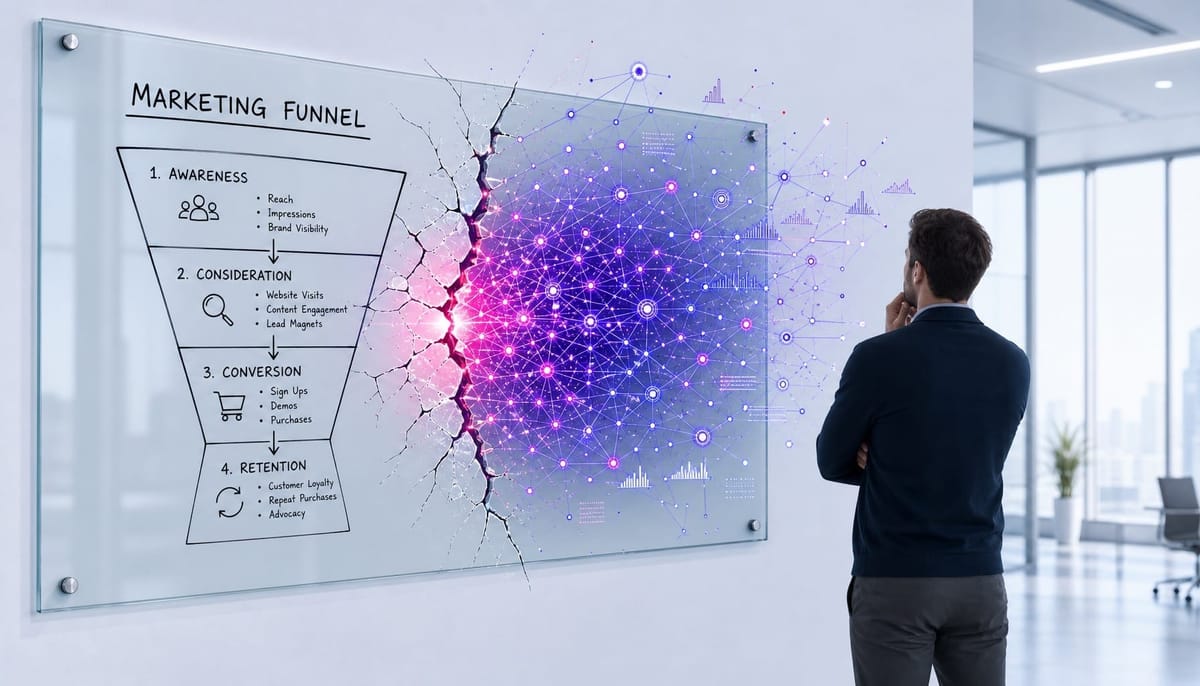
Ask any B2B SaaS marketing team to draw their funnel on a whiteboard, and you'll get a familiar diagram: Awareness, Consideration, Decision, Retention. They know the stages. The problem surfaces when you ask the next question: "What's your conversion rate from an activated free trial to a paid seat?" or "Where did you lose the most pipeline value last quarter?"
Suddenly, the confident drawing gets hazy. The real numbers are buried in a HubSpot dashboard nobody trusts, or they simply don't exist.
The issue in B2B SaaS isn't a lack of strategic knowledge. Every marketing leader understands the concept of a funnel. The failure point is operational. Teams can't accurately measure conversion between stages, can't account for the 70% of buyer activity happening in untrackable "dark funnel" channels, and most critically, can't ship optimizations fast enough to fix the leaks they do find.
This guide won't rehash what "Awareness" means. It provides a signal-based framework for building a b2b saas marketing funnel that reflects how buyers actually behave. We'll cover how to measure what matters at each stage and, more importantly, how to close the gap between knowing what's broken and actually getting it fixed.
Why the Linear Funnel Model Breaks for PLG-Hybrid SaaS
The traditional TOFU → MOFU → BOFU funnel model is built on a fatal assumption: that the buyer journey is a clean, sequential progression. In modern B2B SaaS, it's anything but.
Consider two scenarios for the same product:
- The PLG Motion: A developer discovers your API documentation through a search. She signs up for a free trial, hits three key activation milestones within 48 hours, and invites two teammates. She completely skipped what you call "Awareness" and "Consideration," jumping straight to an in-product decision.
- The Sales-Led Motion: An enterprise VP of Engineering attends your webinar (Awareness). He goes dark for four months, then reappears by having his director request a demo (Decision). The buying committee then spends two months re-evaluating your category from scratch, looping back to Consideration.
The linear model creates three immediate problems for any SaaS company running these dual motions:
- High Stage-Skip Rates: Buyers constantly jump stages, making sequential conversion metrics misleading. Your "Consideration to Decision" rate means nothing if half your best customers skip Consideration entirely.
- Divergent Funnel Shapes: Self-serve and sales-assisted motions have fundamentally different journeys. Forcing both into a single linear model obscures the unique friction points and acceleration levers in each.
- Simultaneous Stage Occupancy: A single account can have one user in a free trial (Decision) while another stakeholder is reading your blog for the first time (Awareness). The account isn't in one stage; it's emitting signals from multiple stages at once.
The replacement isn't a more complicated diagram. It's a shift in thinking: build a signal-based funnel where stages are defined by observable buyer behaviors, not by marketing's campaign structure. This is the foundation of modern buyer journey mapping and multi-touch attribution—you don't dictate the path; you interpret the signals.
The Five Stages of a B2B SaaS Funnel, Mapped to Buyer Signals
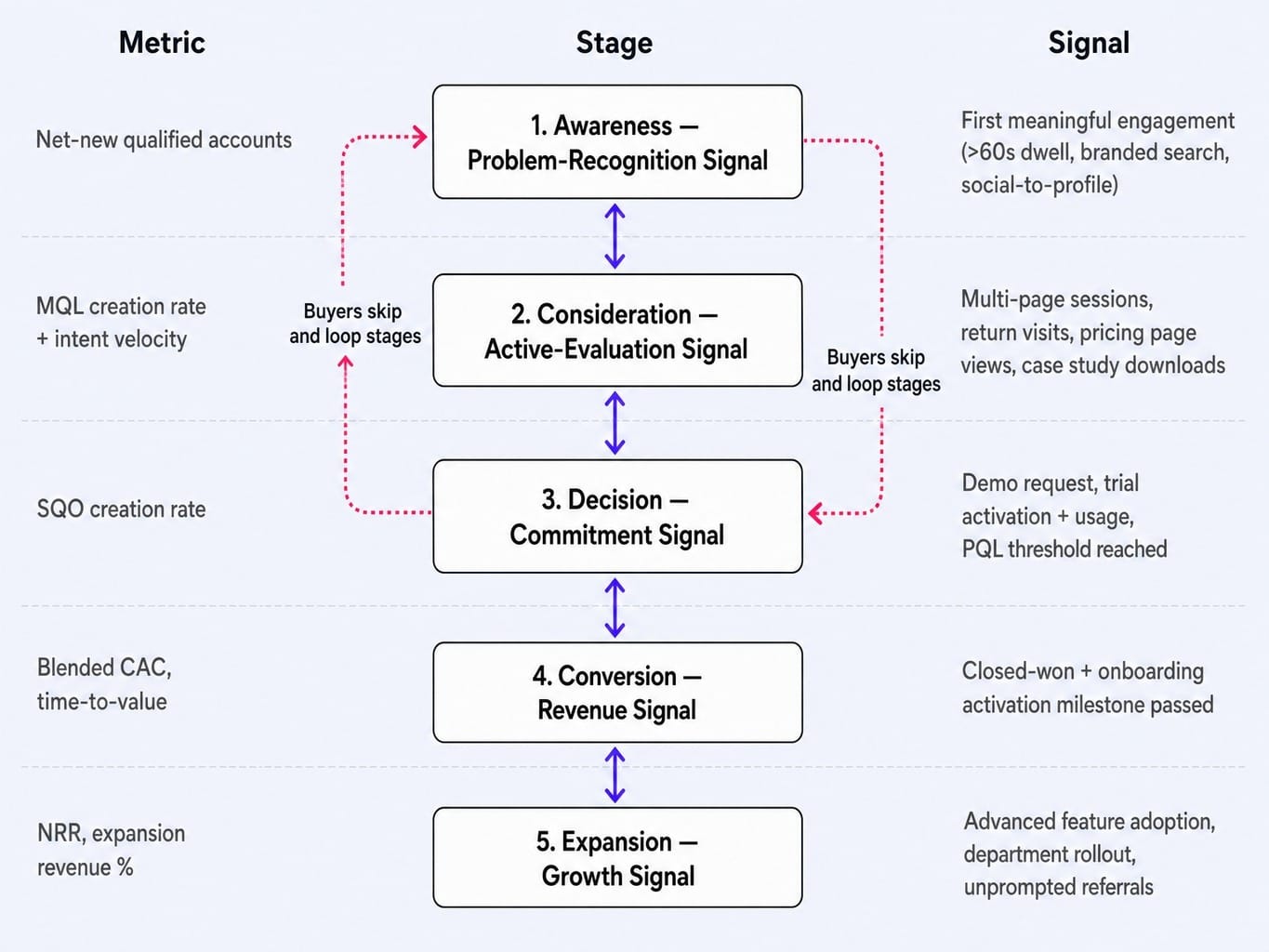
Instead of defining stages by what marketing does (e.g., "we ran ads, so that's Awareness"), we must define them by what the buyer does. Each stage is identified by a specific, observable behavioral signal. This reframe transforms the saas marketing funnel from a conceptual framework into a measurable architecture.
Awareness: The Problem-Recognition Signal
Awareness isn't when a prospect sees your ad; it's the moment they recognize they have a problem your category can solve. It's the shift from passive browsing to active information gathering.
- Behavioral Signal: The first meaningful engagement. This isn't a bounce. It's a blog visit with over 60 seconds of dwell time, a branded search after hearing a podcast mention, or a social post engagement that leads to a profile view.
- Metric That Matters: Net-new qualified accounts entering your ecosystem. Raw traffic and impressions are vanity metrics. The goal of content-led acquisition and SEO at this stage is to attract the right company profiles and initiate a pattern of engagement, not just to rack up pageviews.
Consideration: The Active-Evaluation Signal
Consideration begins when a prospect is actively comparing solutions, not just learning about their problem. They've moved from "what is this problem?" to "what are the ways to solve it?"
- Behavioral Signal: A pattern of active research. This includes multi-page sessions, return visits to your site, viewing your pricing or comparison pages, downloading a technical case study, or registering for a product-focused webinar. A prospect who visits your pricing page twice in one week and downloads a case study has entered Consideration, regardless of their traffic source.
- Metric That Matters: MQL creation rate and, more importantly, the velocity of accounts showing intent. Intent data signals from platforms like 6sense are crucial here for detecting off-site research spikes that indicate an account is in active evaluation.
Decision: The Commitment Signal
The Decision stage starts when a prospect has chosen your category and is now evaluating whether to choose you. The question is no longer "should we buy a tool like this?" but "should we buy this specific tool?"
- Behavioral Signal: A clear act of commitment. This is a demo request, a free trial activation followed by meaningful product usage, or a pricing page visit combined with a positive response to sales outreach. For product-led motions, this is where the Product Qualified Lead (PQL) becomes the key signal—a user who hits critical activation milestones inside the product, demonstrating buying intent through usage patterns tracked in tools like Amplitude or Segment.
- Metric That Matters: Sales Qualified Opportunity (SQO) creation rate. This is the true handoff point where marketing-generated intent becomes a sales-accepted pipeline opportunity.
Conversion: The Revenue Signal
Conversion isn't the moment a contract is signed. In SaaS, it's the moment revenue is recognized and the customer begins deriving the value they paid for.
- Behavioral Signal: A closed-won deal plus successful onboarding activation. This means the customer has passed their first value milestone—they've imported their data, run their first report, or invited their team. A closed deal with zero product activation isn't a conversion; it's a future churn event.
- Metrics That Matter: Blended Customer Acquisition Cost (CAC), time-to-value compression, and initial contract value. Marketing's job isn't done at the signature; it's to ensure the promise made during the sales cycle is realized as quickly as possible post-sale.
Expansion: The Growth Signal
The b2b saas funnel doesn't stop at the first sale. In a healthy SaaS business, 70-80% of lifetime value comes after the initial conversion. Expansion is a distinct revenue motion, not a passive "retention" bucket.
- Behavioral Signal: A pattern of deepening engagement. This includes increased product usage beyond the initial scope, adoption of advanced features, a rollout to new departments, or unprompted customer referrals.
- Metrics That Matters: Net Revenue Retention (NRR) and expansion revenue as a percentage of total revenue. This stage is about turning a single happy customer into an internal champion who drives growth from within the account.
Replace Static Lead Scores with Signal-Based Funnel Design
Most B2B SaaS teams define MQLs with a static lead scoring model configured years ago: downloaded a whitepaper (+10 points), visited the pricing page (+15), has a VP title (+20). This system is almost always broken.
We've all seen the result: marketing celebrates hitting its MQL volume target while the sales team quietly rejects or ignores 40% of those leads, complaining they're unqualified. This isn't a sales-marketing alignment problem; it's a measurement architecture failure. The lead score no longer predicts buying intent.
The replacement is signal-based funnel design. Instead of accumulating points on a static scorecard, you define stage transitions by real-time behavioral composites. A prospect enters the Decision stage not when they cross 50 points, but when they exhibit a specific, high-intent combination of signals:
- Before: Visited pricing page (+15) + VP title (+20) = 35 points (Not an MQL yet)
- After: Pricing page visit + demo request + a second stakeholder from the same account visiting the site within 7 days = Decision Stage Triggered.
This approach uses real-time behavior to identify hand-raisers. It requires integrating data from your CRM, marketing automation, product analytics, and intent providers like 6sense. Tools like Clay can be used for waterfall enrichment to build a complete picture of the account, while platforms like Common Room detect buying signals from community interactions.
Here's a practical rule of thumb: if more than 30% of your MQLs are being rejected or ignored by sales, your lead scoring model is broken. It's time to rebuild it around behavioral signals that correlate with closed-won deals from the last 90 days, not demographic attributes from a two-year-old spreadsheet.
How to Measure Conversion Between Funnel Stages
Most teams track funnel metrics as monthly snapshots: "we generated 500 MQLs in February." This is a mistake. Snapshot metrics hide your biggest funnel leaks because they don't account for the time lag inherent in B2B sales cycles.
The correct approach is to track cohorts, not aggregates.
Take every new lead that enters your ecosystem in a given month (your "January Cohort") and follow that specific group through each stage over the next 90-180 days. This allows you to calculate the true conversion rate at each transition.
A simple cohort-based measurement framework in your CRM (like HubSpot or Salesforce) would track:
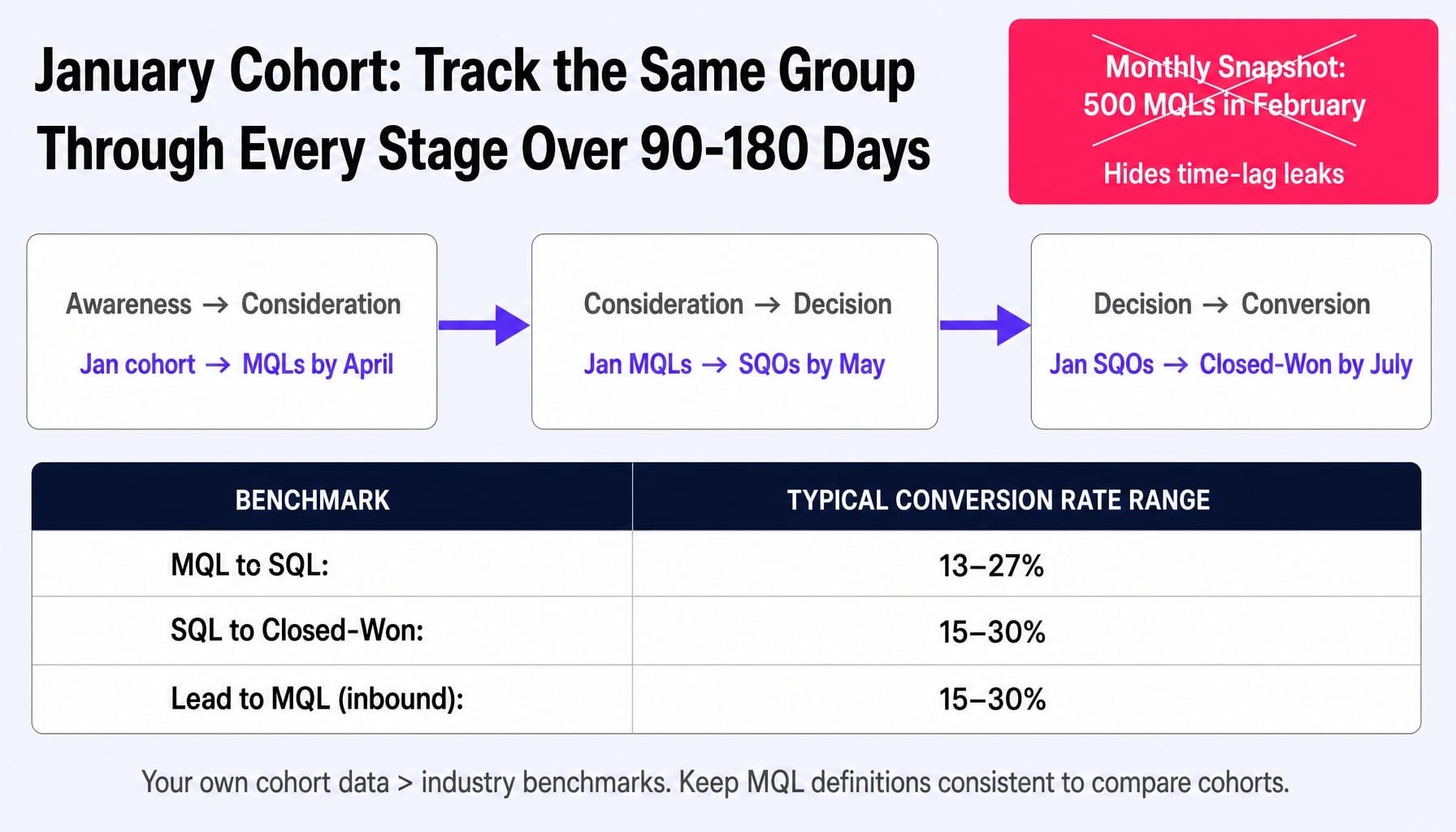
- Awareness → Consideration: % of January Cohort that became MQLs by April.
- Consideration → Decision: % of January MQLs that became SQOs by May.
- Decision → Conversion: % of January SQOs that became Closed-Won by July.
Benchmark Ranges for Mid-Market B2B SaaS:
- MQL to SQL: 13-27%
- SQL to Closed-Won: 15-30%
- Lead to MQL (from inbound): 15-30%
These are directional starting points. Your own historical cohort data is far more valuable. The critical caveat is that your definitions must remain consistent. If you change your MQL criteria mid-quarter, you can't compare cohort performance. Using a tool like Gong can then help you analyze sales conversations to understand why deals are stalling at specific stages.
Read more: SaaS Marketing Benchmarks 2026: Metrics by GTM Motion, Stage, and Channel
Accounting for the Dark Funnel in B2B SaaS
Even with perfect cohort measurement, your funnel data is incomplete. The uncomfortable truth is that B2B buyers conduct the majority of their research in channels that don't generate trackable touchpoints. This is the dark funnel.
It's where your real Awareness and early Consideration activity happens:
- A CTO hears about your product on a podcast, Googles your brand name, and requests a demo. Your attribution model credits "Organic Search," but the real driver was the podcast.
- A VP of Marketing sees a peer recommend your tool in a private Slack group, visits your site directly, and signs up. Your model credits "Direct Traffic," but the driver was word-of-mouth.
Don't try to track the untrackable. The practical response is twofold:
- Add a "How did you hear about us?" free-text field to your demo request and signup forms. Cross-reference this self-reported attribution with your system's data. You'll be surprised how often they differ.
- Use community intelligence tools like Common Room to surface signals from public Slack channels, forums, and social media, giving you a glimpse into these conversations.
Accept that your attribution model is a partial picture. Build your strategy around directional accuracy, not the illusion of perfect precision.
Post-Sale Funnel Architecture: Why Expansion Revenue Is a Marketing Motion
In B2B SaaS, the funnel doesn't end at conversion. For healthy companies, 60-80% of lifetime value comes from expansion—seat additions, plan upgrades, and cross-sells. Yet most marketing teams hand off the account to Customer Success and never touch it again. This is a massive structural revenue leak.
Expansion is a marketing motion, not just a CS function. Marketing owns the content, messaging, and campaigns that drive the behaviors leading to expansion:
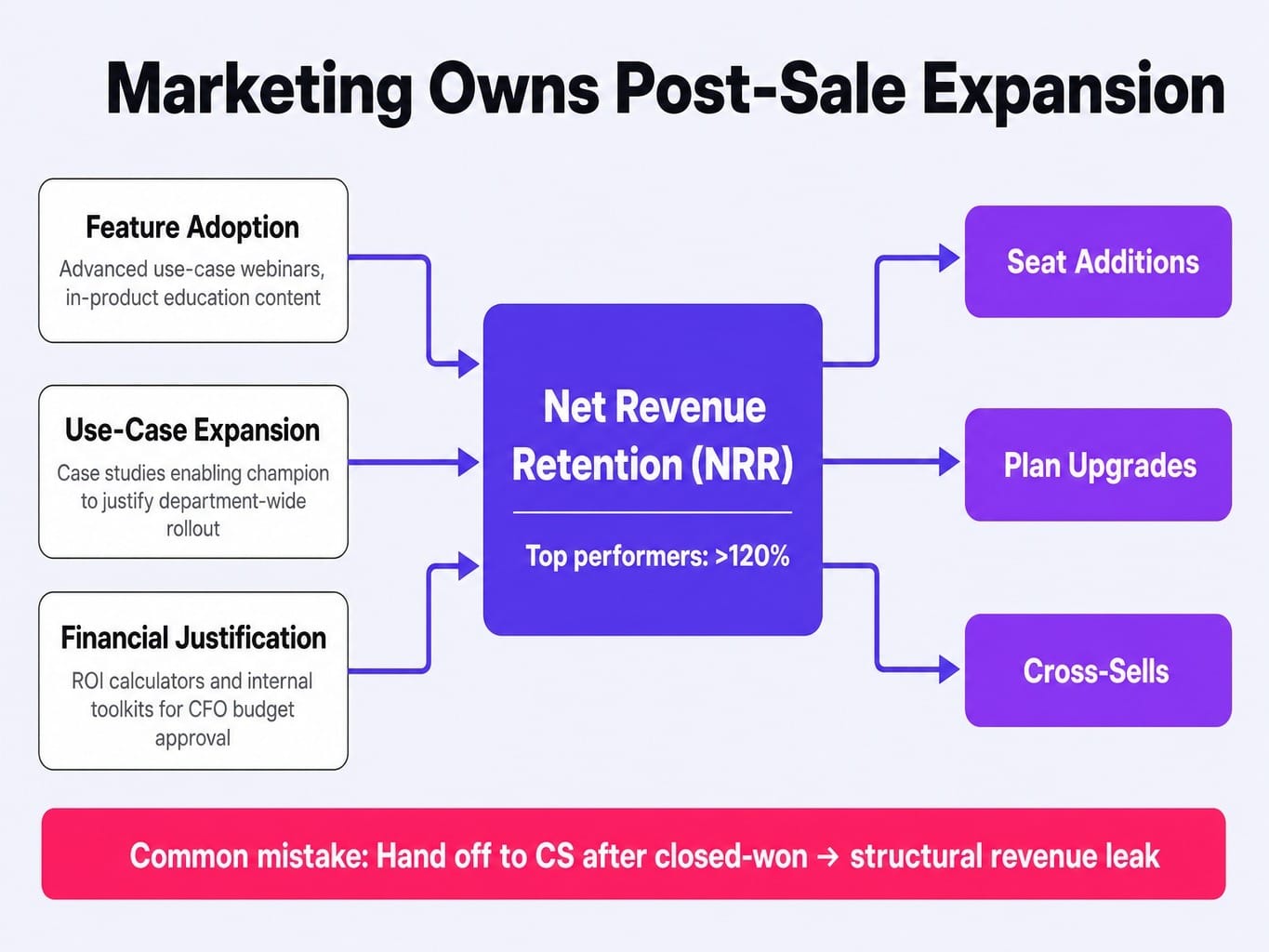
- Feature Adoption: Creating "advanced use case" webinars that show existing customers how to get more value from the product.
- Use-Case Expansion: Developing case studies that help an internal champion justify a rollout from their department to the entire organization.
- Financial Justification: Building ROI calculators and internal toolkits that a champion can take directly to their CFO to get budget for a plan upgrade.
The ultimate metric for this post-sale funnel is Net Revenue Retention (NRR). Top-performing SaaS companies maintain NRR above 120%, meaning their existing customer base is a net-positive growth engine even before acquiring new logos. This is where the CFO buyer truly enters the picture, and marketing must architect financial justification directly into post-sale content to succeed.
Read more: 2026 SaaS Churn Rate Benchmarks: Data by Segment & Why Most Comparisons Mislead
When You Know What's Broken but Can't Ship the Fix Fast Enough
Across every section, a clear tension emerges. You can see your funnel leaks. You know your lead scoring is stale. You recognize the opportunity in post-sale expansion. The problem isn't diagnosis; it's the latency between identifying what needs to change and actually shipping the fix.
A pricing page that leaks high-intent prospects stays broken for a month while the team debates copy. A lead scoring model that sales has complained about for two quarters remains untouched because no one has the bandwidth to rebuild it. Your MQL-to-SQL conversion rate stays flat because the optimization backlog grows faster than your team can execute.
This is the execution gap Spike AI is built to close. Where other tools give you another dashboard diagnosing the problem, Spike AI provides the execution to fix it.
Every week, our platform identifies the single highest-impact bottleneck constraining growth across your entire funnel—whether it's on your website, in your content, or in your ads—and deploys the fix. This weekly shipping cadence replaces sporadic, heroic pushes with a system of continuous, compounding improvement. It closes the gap between knowing what's broken and seeing it fixed.
See how Spike AI identifies and fixes your highest-impact funnel bottleneck every week
Conclusion
The most important shift you can make is to stop treating the b2b saas marketing funnel as a conceptual framework to understand and start treating it as a measurement and execution architecture to operate.
Most teams can name their funnel stages. The teams that win are the ones who can measure cohort-based conversion between them, build stage definitions around real-time buying signals, and, most importantly, close the gap between diagnosis and action every single week. They don't have more sophisticated diagrams; they have a higher rate of improvement.
Audit your current funnel against three questions:
- Can you measure conversion between every stage on a time-based cohort?
- Is your lead scoring model validated against closed-won data from the last 90 days?
- Does your marketing team own a content and campaign strategy for post-sale expansion?
If the answer to any of these is no, that's where you start.
Frequently Asked Questions
What is the difference between a demand gen funnel and a lead gen funnel in B2B SaaS?
A lead gen funnel optimizes for capturing contact information (gated content, MQL volume) to pass to sales. A demand gen funnel optimizes for creating buying intent before capture, using ungated content and brand presence so prospects are already sales-ready when they raise their hand. In practice, modern SaaS teams need both: demand gen to build the dark funnel pipeline that lead gen can't track, and lead gen to efficiently capture and route the hand-raisers who emerge from it.
How do you build a B2B SaaS funnel that supports both self-serve and sales-assisted motions?
Design two parallel paths that share Awareness and Consideration stages but diverge at Decision. Self-serve prospects trigger PQL thresholds via product usage, tracked in tools like Amplitude. Sales-assisted prospects trigger SQOs via demo requests, tracked in your CRM. The key is defining the handoff trigger: at what usage threshold or company size does a self-serve user get routed to sales, and at what deal size does a sales prospect get offered a self-serve onboarding path?
What attribution model works best for a multi-touch B2B SaaS funnel?
No single model is perfect. For SaaS with sales cycles over 60 days, a linear or U-shaped (position-based) model provides a more balanced view than first- or last-touch alone. It credits the initial awareness touchpoint and the final conversion touchpoint while still giving weight to mid-funnel interactions. A practical approach is to run two models in parallel (e.g., first-touch and linear) and compare them quarterly to understand which channels are consistently being under- or over-credited by each view.
How does product-led growth change the B2B SaaS marketing funnel?
PLG compresses the funnel by moving the "Decision" stage earlier. Users sign up and experience the product's value before a traditional sales conversation. This creates a new, critical stage between signup and revenue: Activation. It also replaces the MQL with the PQL (Product Qualified Lead)—a user whose in-product behavior, not form-fills, signals buying intent. Marketing's role shifts from purely generating leads to driving in-product activation and expansion.
What benchmarks should I use for each stage of a B2B SaaS funnel in 2026?
While benchmarks vary significantly by deal size and motion, here are directional ranges for mid-market SaaS: Visitor to Lead (1-3%), Lead to MQL (15-30%), MQL to SQL (13-27%), SQL to Opportunity (50-70%), and Opportunity to Closed-Won (15-30%). For post-sale, a healthy Net Revenue Retention (NRR) is 100-130%. Your own cohort data is more valuable than any industry average. If you don't have it, start tracking it now; 90 days of clean data is better than any report.