B2B SaaS Marketing News: 5 Shifts Reshaping Growth Teams in 2026

TL;DR
- AI search engines are cannibalizing top-of-funnel traffic by answering informational queries directly. Adapt by optimizing for brand citations (AEO) and creating depth content that forces a click.
- The MQL is being replaced by signal-based selling. Prioritize accounts showing intent surges across the buying committee, not individuals filling out forms.
- The coordination cost of fragmented martech stacks is now a primary bottleneck. Consolidate around platforms that unify data and execution to reclaim operational bandwidth.
- In response to the dark funnel, smart B2B SaaS companies are shifting budget toward brand to compress sales cycles and increase close rates on the demand you do capture.
- A regulatory squeeze from both privacy laws and AI content rules is constraining old playbooks. The winning response is a shift to first-party data and expert-validated, AI-assisted content workflows.
Most of what passes for B2B SaaS marketing news is trend-spotting dressed up as insight. You've read the roundups: AI is big, personalization matters, content is king. Yet despite record martech spending and a flood of new tools, the fundamental metrics aren't moving. Average B2B website conversion rates remain stuck at around 2%, a figure that hasn't meaningfully budged in years. This isn't a failure of strategy; it's a failure to see the real shifts happening underneath the noise.
The news that actually matters isn't about new features. It's about foundational changes in how buyers find, evaluate, and purchase software—changes that are actively breaking established marketing playbooks.
This is not another trend listicle. It is a focused analysis of the five structural shifts reshaping the B2B SaaS marketing landscape in 2026. We will cover:
- How AI search is cannibalizing top-of-funnel traffic.
- Why signal-based selling is replacing the MQL.
- The martech consolidation wave and its impact on marketing ops.
- The counterintuitive budget shift from demand gen to brand.
- The combined regulatory pressure from privacy and AI content rules.
Each one has a concrete implication for how your growth team should allocate time, budget, and execution capacity.
AI Search Is Cannibalizing B2B SaaS Top-of-Funnel Traffic
The single biggest structural change in B2B SaaS marketing today is that AI search engines like Google's AI Overviews and research tools like Perplexity are intercepting the informational queries your content strategy was built on. This isn't a future threat; it is an active pipeline leak. For years, the playbook was to rank for "what is [category]" or "best [category] software" to capture prospects at the top of the funnel. Now, AI is answering those questions directly, and the click never reaches your website.
Consider a SaaS company that built its entire demand engine on ranking for these queries. They see their traffic drop 30% in six months, even though their rankings are stable. The team's response is to publish more content, but the decline continues because the problem isn't volume—it's that the system for delivering prospects has fundamentally changed.
What Zero-Click Search Actually Means for Your Pipeline
Zero-click search isn't just a traffic problem; it's a pipeline problem. When an AI Overview answers a prospect's question, you lose more than a pageview—you lose the first touch in your marketing attribution model. The content you created is being consumed and used to inform a buying decision, but your system never gets the credit. Most teams conflate declining organic traffic with declining rankings, but the actual failure mode in an AI Overview environment is stable rankings with collapsing click-through rates. Your rank-tracking dashboard gives you false confidence while your pipeline silently empties.
I saw this firsthand in a controlled test. We ran two identical landing pages for 90 days. One relied on organic search traffic, the other on direct and referral. Despite stable rankings, the organic page lost 34% of its click-through volume from Google because AI Overviews began answering the exact queries that previously drove traffic. Your content is feeding the machine, but the machine is no longer feeding your funnel. This dynamic primarily affects definitional queries ("what is..."), comparison queries ("X vs. Y"), and feature-level queries ("does Z do..."), the very building blocks of most B2B SaaS content funnels.
How B2B SaaS Teams Are Adapting to AI-Mediated Discovery
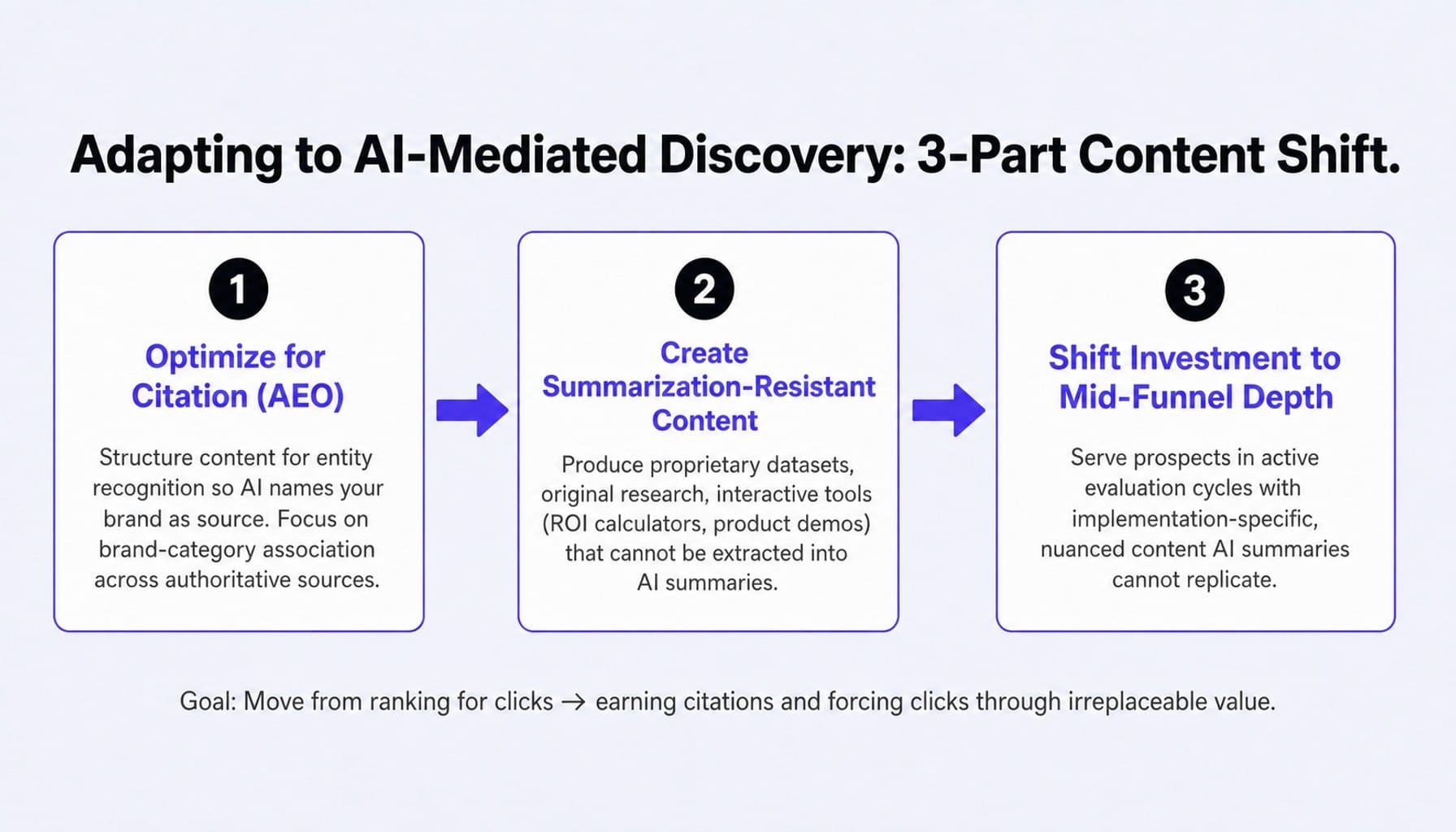
The winning response is not to fight the zero-click reality but to adapt your execution system to it. This involves a three-part shift in how content is designed and deployed.
First, teams are optimizing for citation, not just clicks. This is the core of Answer Engine Optimization (AEO). The goal is to structure content so that AI systems are forced to name your brand as the source. This means focusing on entity recognition—consistently associating your brand name with your category across authoritative sources—so that when an AI answers a question about your market, it mentions you.
Second, they are creating content that resists summarization. An AI can summarize "7 tips," but it cannot replicate a proprietary dataset, an original research report, or a well-designed interactive tool like an ROI calculator. These assets force a click because the value cannot be extracted and redeployed in a summary. Tools like Navattic that create interactive product demos serve a similar function; the experience itself is the content.
Finally, investment is shifting from top-of-funnel breadth to mid-funnel depth, serving prospects who are already in an active evaluation cycle and are seeking nuanced, implementation-specific answers that AI summaries can't provide.
Signal-Based Selling Is Replacing the MQL
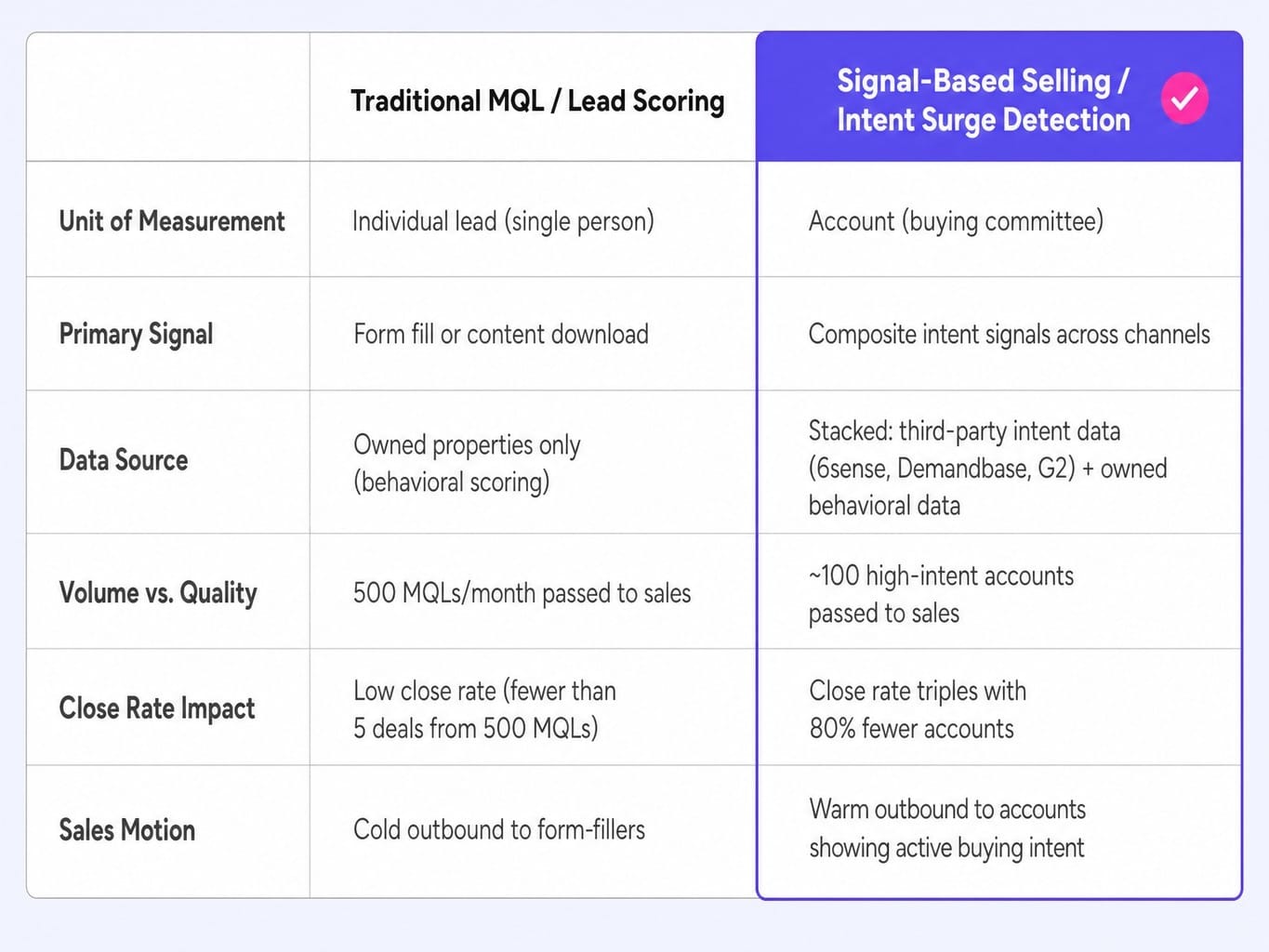
The Marketing Qualified Lead (MQL) as a primary metric is functionally obsolete for most B2B SaaS companies. The teams generating the most pipeline in 2026 have stopped obsessing over form fills and are instead prioritizing accounts based on a composite of intent signals. The problem with the MQL was that it measured a single action (like a content download) from a single person, while modern B2B buying involves a committee of people conducting anonymous research across the web.
The shift to signal-based selling isn't just a change in terminology; it's a fundamental change in the marketing execution system. Consider a SaaS company passing 500 MQLs to sales each month but closing fewer than five deals. The system is producing activity, but not results. When they switch to a signal-based model—tracking intent surges from third-party data, identifying multi-threaded engagement from the same account, and applying negative ICP scoring to filter out noise—their close rate triples, even as the number of accounts passed to sales drops by 80%.
From Lead Scoring to Intent Surge Detection
Operationally, this means your marketing system stops scoring individual leads and starts detecting accounts that are heating up. Instead of a simple lead score, you're building a signal layer. It's crucial to understand that intent signals and behavioral scoring are not the same thing. Intent data from platforms like 6sense or Demandbase captures research activity happening outside your owned properties (e.g., reading reviews on G2), while behavioral scoring tracks engagement within them (e.g., visiting your pricing page). A robust system stacks these signals.
Read more: B2B Lead Scoring: How to Build a Model That Doesn't Break in 90 Days
This powers a more effective GTM motion: warm outbound. Sales teams are no longer making cold calls; they are reaching out to accounts that have already demonstrated buying intent, with messaging tailored to the specific signals detected. The operational backbone for this shift often involves tools like Clay and Apollo.io, which automate the process of detecting signals, enriching account data, and triggering personalized outreach sequences. This requires a different SDR-AE handoff SLA, a different attribution model, and a different way of thinking about what marketing's primary job is: not generating leads, but identifying and accelerating opportunities.
The Martech Consolidation Wave Is Reshaping Marketing Ops
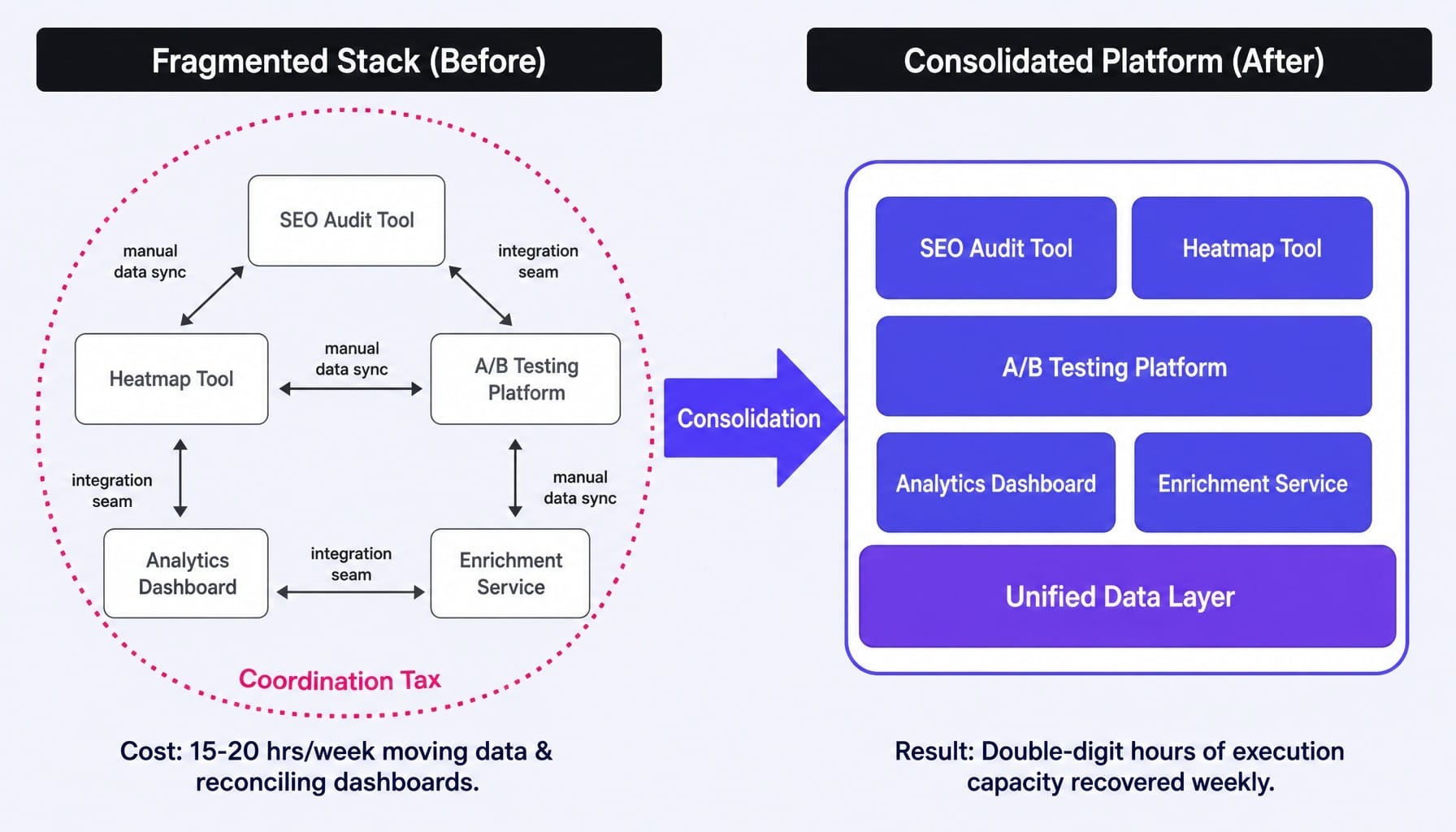
The era of the 50-tool martech stack is ending. The bottleneck for most lean marketing teams is no longer a lack of tool capabilities; it's the operational drag of managing a fragmented system. The coordination cost of keeping dozens of point solutions synchronized has finally exceeded the value they deliver individually. This isn't just a theory; it's happening in plain sight with moves like HubSpot's acquisition of Clearbit. What was once a best-in-class, standalone enrichment tool is now a native feature within a platform.
This trend has profound implications for how marketing teams function. The tools you rely on today might not exist as standalone products in 12 months, forcing disruptive migrations. More importantly, martech consolidation is forcing B2B SaaS marketing teams to choose between maintaining fragmented stacks that drain ops bandwidth and adopting platforms that can unify execution across channels without the coordination tax. The real cost isn't the software subscription; it's the 15-20 hours per week a small team spends just moving data between systems and reconciling dashboards. As is now widely recognized, martech consolidation doesn't necessarily mean fewer tools; it means fewer integration seams, which is where most operational friction originates.
For a lean team, replacing five point solutions—an SEO audit tool, a heatmap tool, an A/B testing platform, an analytics dashboard, and an enrichment service—with one or two integrated platforms can recover double-digit hours of execution capacity every single week. This isn't about finding a better tool; it's about building a better, more integrated marketing execution system.
Read more: Martech Stack Optimization: The Three-Layer Model Most Teams Miss | Spike AI
B2B SaaS Companies Are Shifting Budget from Demand Gen to Brand
In a year where every CFO is scrutinizing marketing ROI, the smartest B2B SaaS companies are doing something counterintuitive: increasing their brand spend. This isn't a retreat from accountability; it's a strategic response to the reality of the dark funnel. The most critical parts of the B2B buying journey—peer conversations in Slack communities, podcast mentions, and anonymous consumption of social content—happen in channels that traditional attribution models can't see.
The shift is from "demand generation" to "brand-to-demand." Brand investment creates the pre-existing trust and awareness that allows your demand generation efforts to convert at a higher rate. In fact, brand spend in B2B SaaS is often mislabeled as awareness spend, but the actual function it serves is compressing the consideration cycle by building that trust before a prospect ever hits your website. This shows up not in top-of-funnel volume but in shorter sales cycles and higher win rates. According to a joint study, 81% of B2B decision-makers say thought leadership content directly influences their purchasing decisions.
Imagine a SaaS company that cuts its brand podcast and community sponsorships to fund more paid search. Their cost-per-lead drops for a month, but then their sales cycle lengthens and close rates collapse. Why? Prospects are arriving cold, with no context or trust. When brand spend is reinstated, the metrics recover. The lesson is that brand and demand are not competing budget lines; they are sequential investments in a single revenue system.
Privacy Regulation and AI Content Rules Are Constraining SaaS Marketing Playbooks
B2B SaaS marketers are now operating under a regulatory squeeze from two directions at once. On one side, tightening privacy laws like GDPR and the deprecation of third-party cookies are eroding targeting capabilities. On the other, emerging AI content regulations, like the EU AI Act's transparency requirements, and Google's own quality filters are penalizing low-effort, AI-generated content.
The impact isn't abstract compliance risk; it's direct operational constraint. The playbook of scaling content production with high-volume, low-touch AI is breaking. A SaaS content team that was publishing 30 AI-generated blog posts a month might see an initial traffic bump, only to experience a 45% drop after a Google helpful content update because the posts lack original insight and operational depth.
The winning response is not to abandon AI or data-driven marketing. It's to build a more resilient execution system. This means shifting to a first-party data strategy to offset the loss of third-party signals. It also means moving from AI-replaced to AI-assisted content workflows, where human experts validate, enrich, and add proprietary insight to AI-generated drafts. As Google's own guidance makes clear, AI-assisted content is perfectly acceptable as long as it is helpful, reliable, and demonstrates expertise. The teams recovering from penalties are the ones who cut their volume to eight expert-reviewed posts per month and saw their traffic and authority rebound, proving that quality of execution, not quantity, is the sustainable path.
When the Landscape Shifts This Fast, Execution Speed Becomes the Differentiator
The five shifts detailed in this article—AI search cannibalization, the death of the MQL, martech consolidation, the rise of brand-to-demand, and new regulatory pressures—are not isolated trends. They are compounding forces that demand a fundamental change in how marketing teams operate.
Most teams reading this already sense these changes. The problem isn't a lack of strategy or awareness. It's a lack of execution capacity. A lean marketing team simply cannot manually re-architect its SEO strategy for AEO, build a new signal-based selling model, consolidate its martech stack, measure the dark funnel, and navigate AI content regulation all at once. The backlog grows, and the team remains stuck.
This is the execution gap Spike AI was built to close. Where other tools provide more dashboards and more data, Spike AI provides a unified marketing execution engine. It identifies the highest-impact move across your website, SEO, AEO, and ads, and then deploys the fix—every single week. Instead of wrestling with five fragmented tools, you direct a single, cohesive system that turns your backlog into a cadence of compounding improvements. You move from being an operator buried in tasks to an orchestrator approving high-impact releases.
If the landscape is shifting this fast, the only durable advantage is the ability to ship a response.
See how Spike AI turns your marketing backlog into weekly shipped improvements
The New Reality for B2B SaaS Marketing
The B2B SaaS marketing landscape in 2026 is not being defined by any single trend. It is being defined by the cumulative pressure of these simultaneous shifts, which collectively overwhelm teams still operating with manual, channel-siloed workflows.
AI is changing how buyers discover software. Signals are replacing leads as the unit of pipeline. Tools are consolidating under the weight of their own complexity. Brand investment is becoming the primary driver of demand efficiency. And regulation is constraining the shortcuts that once enabled scale.
The teams that thrive in this new environment will not be the ones who read the most news. They will be the ones who can ship the fastest, most cohesive response. The question for every marketing leader is no longer whether these shifts will affect your pipeline. It is whether your team's execution cadence can possibly keep pace with a landscape that no longer waits for quarterly planning cycles.
Frequently Asked Questions
How do you measure marketing-sourced pipeline accurately when so much buying happens in the dark funnel?
The most effective approach combines multi-touch attribution with self-reported attribution—asking prospects "How did you hear about us?" during the sales process. Teams using both methods consistently find that 30-50% of their pipeline originates from channels traditional attribution models completely miss, like podcasts and peer communities.
Is account-based marketing still worth the investment for mid-market SaaS companies?
Enterprise ABM platforms are often over-engineered for mid-market teams. Many are now getting better results from lightweight signal stacking using tools like Clay and Apollo.io combined with focused account research, rather than paying for complex platforms they can't fully operationalize and which create more work than they save.
How are B2B SaaS companies balancing PLG and sales-led motions in 2026?
The dominant pattern is a PLG-to-sales-led hybrid. Self-serve onboarding captures smaller teams, while product usage signals trigger sales engagement for high-value accounts ready for expansion. The key is defining the handoff threshold—at what point a product-qualified lead warrants a sales touch—to focus resources effectively.
What does warm outbound actually look like as a pipeline motion?
Warm outbound means only contacting accounts that have already shown intent, such as visiting your pricing page or being flagged by third-party intent data. The outreach references that specific signal, making it relevant and timely. Tools like Clay and Lavender help automate this by detecting signals and personalizing outreach at scale.
Should B2B SaaS marketers optimize specifically for AI search engines like ChatGPT and Perplexity?
Yes, but this is an extension of modern SEO, not a separate discipline. Google's guidance confirms that creating helpful, reliable, people-first content is the foundation. The key addition for AEO is structuring that content for passage-level extraction—ensuring each section can stand alone as a complete, citable answer.