The B2B SaaS Marketing Plan for 2026: Build Around Pipeline Math, Not Channel Tactics

TLDR
- Stop building marketing plans around channel tactics. Start by reverse-engineering your pipeline needs from your ARR target.
- Most plans fail due to execution bottlenecks—prioritization paralysis and latency—not poor strategy. Your plan must account for your team's actual shipping cadence.
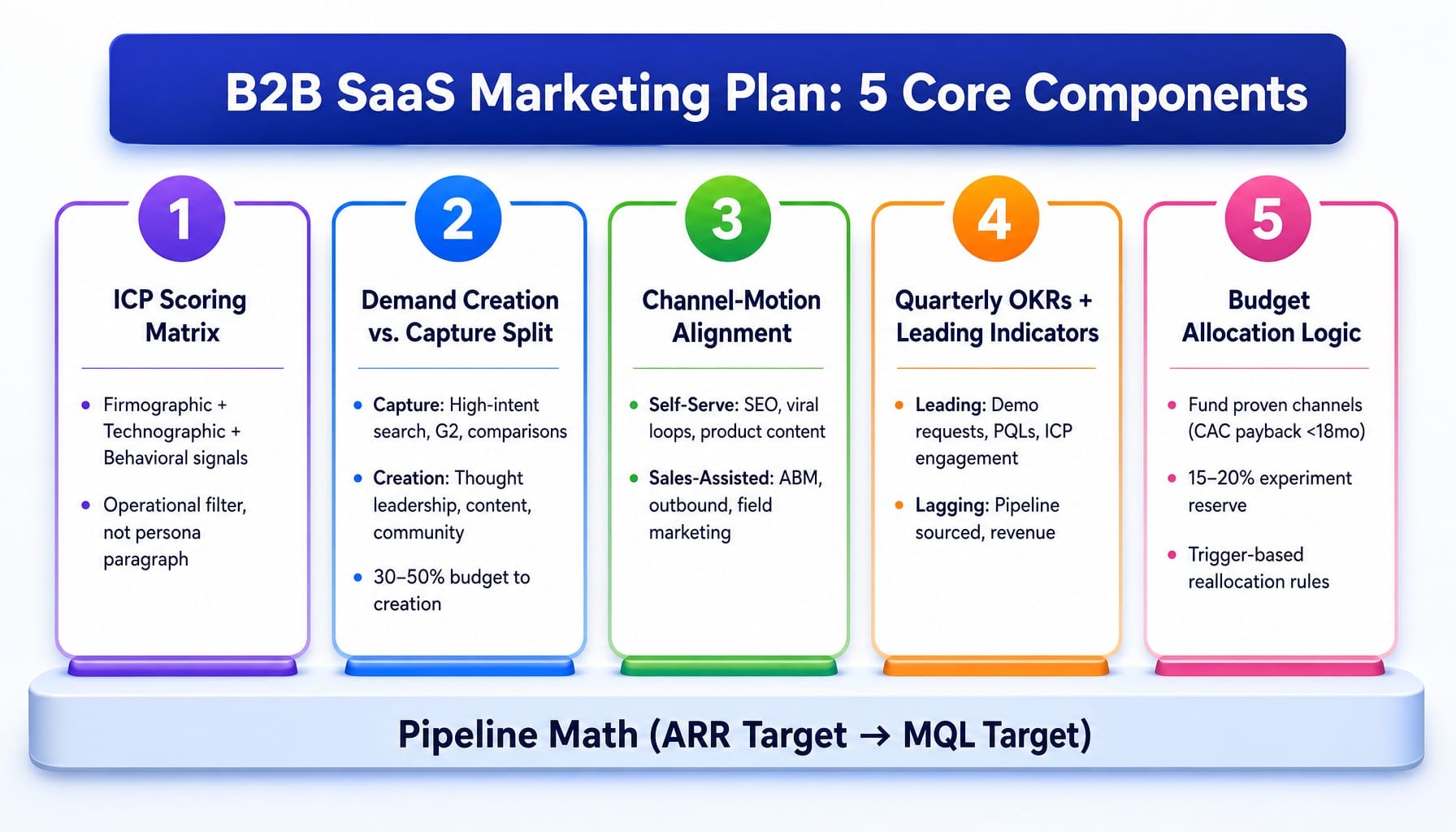
- A functional B2B SaaS marketing plan must include five core components: an operational ICP scoring matrix, an explicit demand creation vs. capture budget split, channel-motion alignment, quarterly OKRs with leading indicators, and trigger-based budget reallocation logic.
- If you run a hybrid model (PLG + Sales), your plan needs separate funnels, KPIs (PQLs vs. MQLs), and content strategies for each motion. A single-funnel plan will produce ambiguous results.
- For 2026, your content strategy must be built for AI-driven search. This means structuring content for extraction and citation in AI Overviews, not just for traditional SERP rankings.
It's January. Your three-person marketing team finalizes the annual plan: a 14-page Google Doc detailing strategies for SEO, paid search, content, ABM, and even a few partner webinars. It's ambitious, comprehensive, and approved.
By March, you've shipped two of the twenty planned initiatives. The document sits in a shared drive, last opened weeks ago. By Q3, you're back to running the same campaigns as last year, reacting to whatever feels most urgent. The plan didn't fail because the strategies were wrong. It failed because it was designed as a strategy document, not an execution system.
This is the central failure of most marketing plans. They list channels and tactics but ignore the two constraints that actually define performance: prioritization and velocity.
A B2B SaaS marketing plan that works is not a list of things you could do. It's a pipeline-backed execution framework that tells your team what to ship this week, not what to aspire to this year. This guide provides that framework. We'll cover how to build your plan on a foundation of pipeline math, the five components that actually matter, and how to plan for the realities of hybrid GTM motions and AI-driven search.
Why Most B2B SaaS Marketing Plans Stall Before Q2
A plan that ignores the physics of execution is a work of fiction. Before building a new one, we have to diagnose why the old ones decay. The failure isn't a lack of ideas or effort; it's a system-level breakdown in two specific areas. You'll likely recognize your own team here.
Prioritization Paralysis: Too Many Channels, No Impact Model
Most plans list every plausible channel—SEO, paid, content, ABM, events, partnerships—without a model for which one will move the pipeline most. The result is a marketing lead staring at 12 initiatives, a two-person team, and 80 available hours a week. The math doesn't work, and the plan never acknowledges it.
This isn't a strategy; it's a wishlist. It creates paralysis because every initiative feels equally important. Without an impact model that connects effort to pipeline, teams default to spreading effort thin across all channels, ensuring no single one gets the resources needed to generate a meaningful return. A functional plan doesn't just list channels; it uses an ICP scoring matrix and channel mix modeling to force a decision on where the single most-leveraged dollar or hour should go.
Read more: The Marketing Prioritization Framework That Replaces Gut Feel With Compounding Wins
Execution Latency: The Weeks Between Knowing and Shipping
Even when a team knows the highest-impact move, the system conspires against them. The time between identifying a needed change and deploying it—through internal discussions, design mockups, engineering tickets, and stakeholder approvals—stretches into weeks, sometimes months. A team identifies their pricing page is a conversion bottleneck in February; the fix doesn't ship until May.
A plan that assumes frictionless execution will always over-promise and under-deliver. It ignores the single greatest constraint on growth: the latency between insight and action. This isn't a people problem; it's a system problem. Your plan must treat your team's shipping cadence as a core planning variable. If you can only ship one significant website change per month, your plan can't be built on a foundation of weekly A/B testing.
Start With Pipeline Math, Not Channel Tactics
The most effective shift you can make is to stop building your plan around activities and start by reverse-engineering your revenue goal. Channels are an output of the math, not an input to the plan. A plan without a pipeline model is a plan without accountability—you can't know if marketing is working if you never defined what "working" means in financial terms.
The Pipeline Waterfall: From ARR Target to Channel Allocation
This model forces you to confront the numbers before you ever write a word about content strategy or paid search. You can model this in a spreadsheet, HubSpot Marketing Hub, or Google Looker Studio, but the thinking is what matters.
Let's walk through a real-world example for a Series A SaaS company:
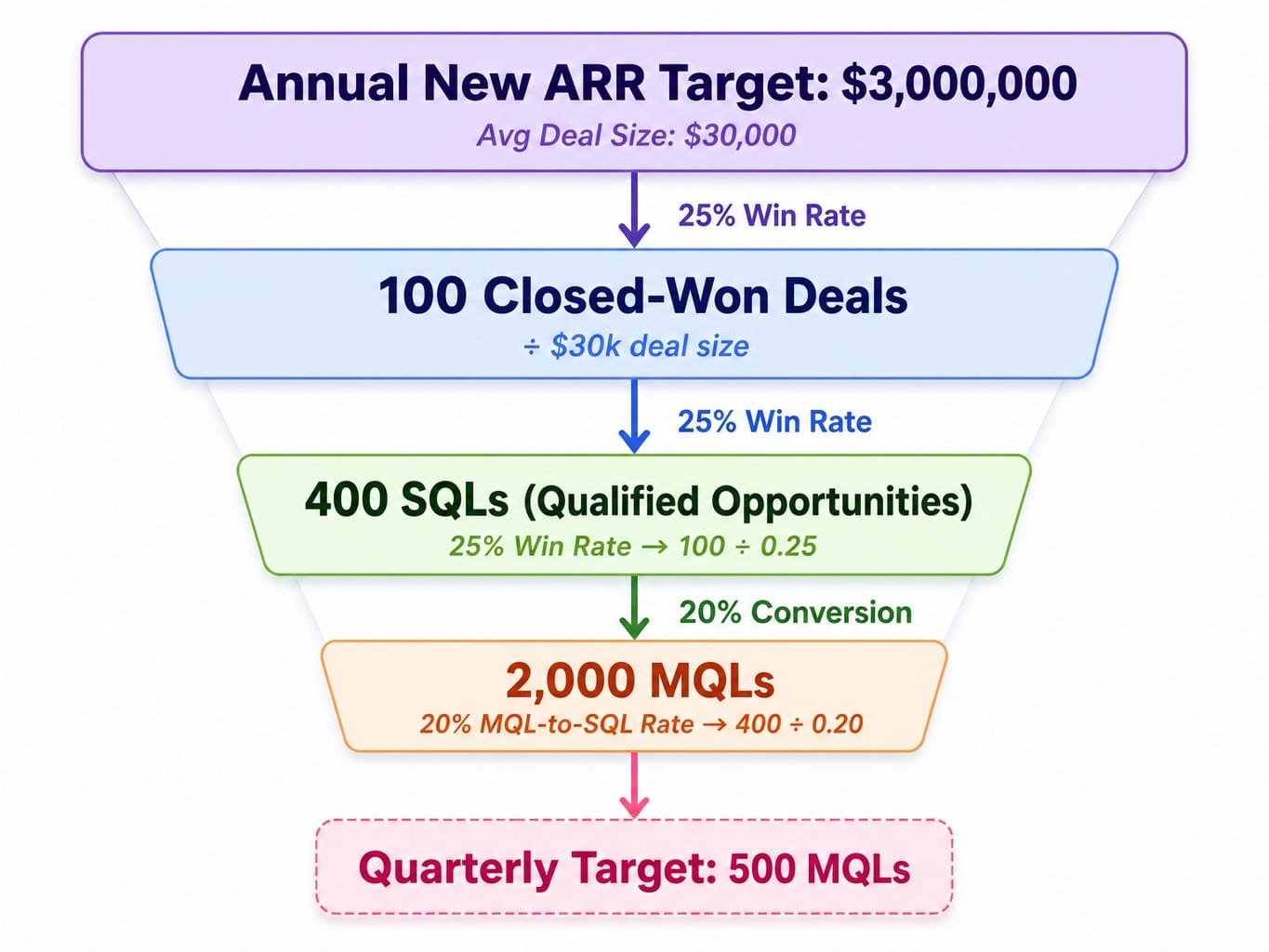
The marketing team's job is to deliver 2,000 MQLs this year, or 500 per quarter. Now, and only now, can you talk about channels. If your SEO-driven demo requests convert to MQL at 50% but you only get 100 per quarter, that's 50 MQLs. You need 450 more. Where will they come from? This math dictates whether you invest in content-led acquisition to grow organic leads or spin up an ABM program to target a list of 500 ideal accounts.
Why 'Do Everything' Plans Produce Nothing
When teams skip the pipeline math, they default to the "do a bit of everything" strategy. They run some Google Ads, publish two blog posts a month, send a newsletter, and dabble in LinkedIn ads. They spend $15,000 a month across five channels but can't tell you which one is actually generating pipeline. This happens because they lack a model to tell them where the marginal effort will produce the most return.
This approach feels busy but rarely moves the needle. It spreads resources too thin to achieve dominance in any single channel. Worse, it creates reporting chaos. Without clear targets for marketing-sourced vs. marketing-influenced pipeline, teams fall back on vanity metrics like traffic or MQL volume, obscuring the fact that the plan isn't contributing to revenue. If those numbers from the waterfall model feel intimidating, that's the point. A real plan forces you to confront the math.
Read more: How to Prioritize Marketing Channels With a Limited Budget And Resources (Framework for Lean Teams)
The Five Components That Belong in a B2B SaaS Marketing Plan
Once your pipeline math provides the targets, your plan needs an operational layer to turn those numbers into action. Forget the endless list of tactics. A robust B2B SaaS marketing plan template is built on these five, non-negotiable components. If your plan is missing them, it's a strategy deck, not an execution system.
1. ICP Scoring Matrix: Who You're Actually Marketing To
Most plans define their Ideal Customer Profile with a persona paragraph: "Sarah, the VP of Marketing at a mid-market tech company." This is descriptive but not operational. Your plan needs an ICP scoring matrix that marketing and sales use to qualify every lead and account. This matrix weights firmographic (company size, industry), technographic (what software they use), and behavioral (intent data) signals. Tools like Clearbit, 6sense, or Demandbase can provide the data, but your team must define the logic. An ICP isn't a description; it's a filter that dictates which accounts enter your ABM program and which leads get instant sales follow-up.
2. Demand Creation vs. Demand Capture Split
Your plan must explicitly allocate budget and effort between two distinct functions: capturing existing demand and creating new demand.
- Demand Capture: Converting buyers already searching for a solution (e.g., Google Ads on high-intent keywords, G2, comparison content).
- Demand Creation: Educating the 95% of your market that isn't actively buying today (e.g., thought leadership, content-led acquisition, community).
Most plans fatally over-index on capture, maxing out search budgets while wondering why growth has stalled. They've captured all the existing demand but created none. Your plan must allocate a protected portion of the budget (often 30-50%) to creation, acknowledging that its impact lives in the dark funnel and won't be measured by last-click attribution.
3. Channel-Motion Alignment: Matching Channels to Your GTM
Channel selection must follow your go-to-market motion, not precede it. A product-led growth motion with a $50/month price point cannot sustain the same channels as a sales-assisted motion closing $50k deals. This seems obvious, but look at your own marketing spend. I'd bet there's at least one channel you're funding where the unit economics, if you're being honest, just don't pencil out. The plan must map each channel to a specific motion:
- Self-Serve Motion: SEO, product-led content, viral loops.
- Sales-Assisted Motion: ABM, targeted outbound, field marketing.
Running LinkedIn ABM campaigns for a $29/month product is a recipe for failure. Channel selection is a math problem rooted in your marketing channel prioritization, not a matter of preference.
4. Quarterly OKRs With Leading Indicators
Annual goals are useless for course-correction. Your plan must break down the annual pipeline target into quarterly OKRs tied to leading indicators—metrics that predict future results. A lagging indicator is the $2M in marketing-sourced pipeline you hope to have at the end of the year. A leading indicator is the number of demo requests from ICP accounts this month, which predicts pipeline 60-90 days out. Your plan must define:
- Quarterly pipeline targets.
- The 2-3 leading indicators that signal you're on track (e.g., PQLs, ICP content engagement, stage-2 pipeline velocity).
- Trigger conditions for reallocating resources if you miss leading indicator targets for a month.
5. Budget Allocation Logic, Not Budget Wishlists
Your budget shouldn't be based on a percentage of revenue. It should follow a logic model built into your plan.
- Model: Calculate the blended CAC payback period for each proven channel.
- Allocate: Fund channels with payback under your threshold (e.g., 18 months) most heavily.
- Experiment: Reserve 15-20% of the budget for testing unproven channels.
- Reallocate: Build in trigger-based rules. Example: "If paid search CAC payback exceeds 22 months in Q1, its budget is reduced by 50% in Q2, and funds are shifted to the content program."
Budget allocation is a hypothesis, not a permanent commitment. Your plan must say so explicitly.
Building a Plan for Hybrid PLG and Sales-Assisted Motions
An increasing number of B2B SaaS companies operate a hybrid model: a self-serve, product-led growth funnel for smaller accounts and a high-touch, sales-assisted motion for enterprise. Yet their marketing plans often treat these as a single funnel, leading to misaligned content and ambiguous KPIs.
The marketing team is caught in the middle. The PLG motion is optimized for product signups and activation rate. The sales team needs marketing-sourced SQLs from high-value accounts. When the marketing plan uses a single MQL definition for both, you can't tell if you're succeeding at either.
Your 2026 plan must formally separate them. This means defining two distinct funnels:
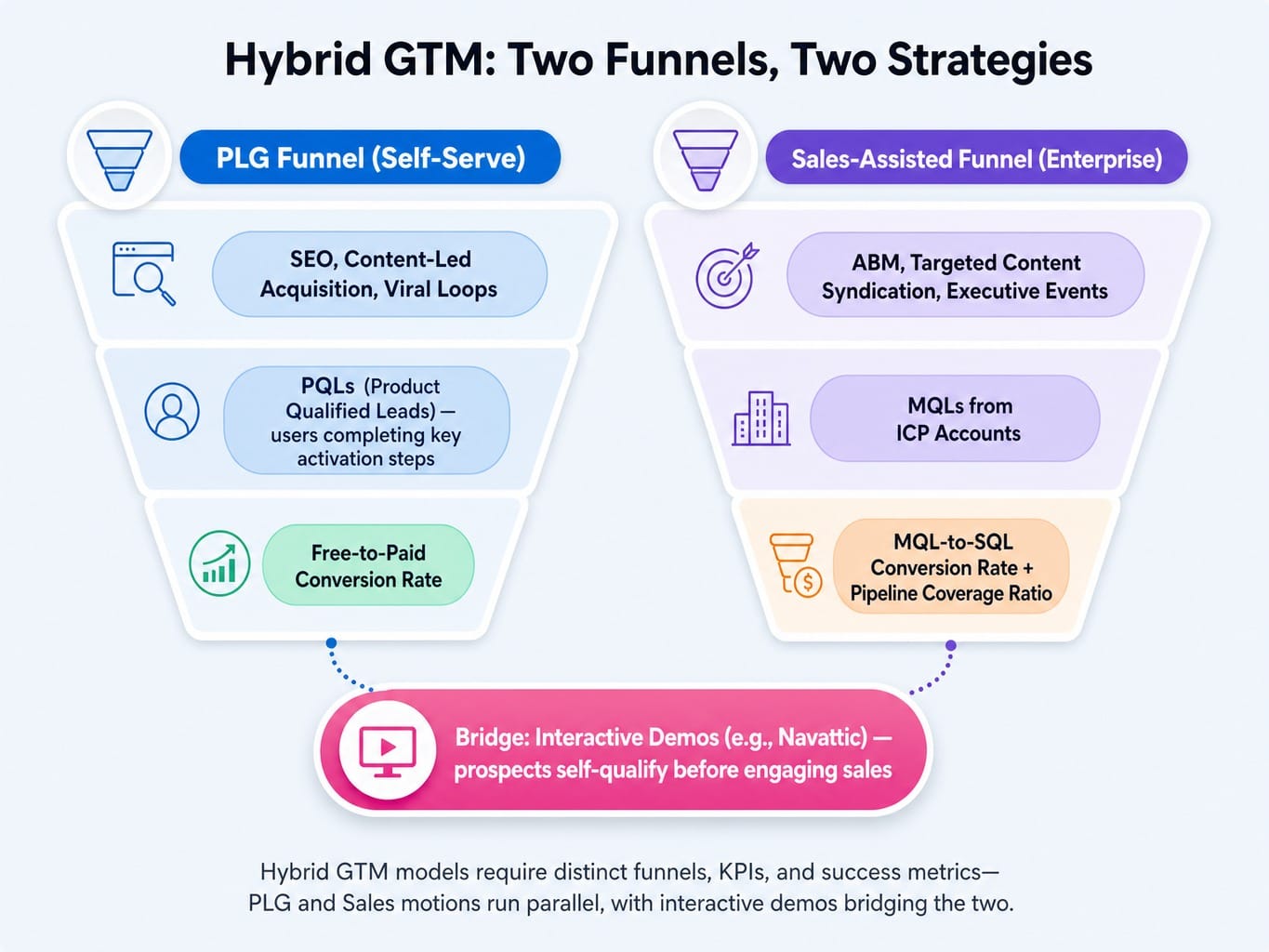
This dual-funnel approach clarifies marketing's role. You can use tools like interactive demos (e.g., Navattic) to create a bridge, allowing prospects to self-qualify before engaging sales. But the plan itself must acknowledge you're running two different businesses and give each the strategy it deserves.
Planning for AI-Driven Search and Zero-Click Visibility
Any saas marketing plan for 2026 that treats SEO as simply "ranking on page one" is already obsolete. AI Overviews, Bing Copilot, and Perplexity are increasingly the first point of contact for your buyers. If your content isn't structured for extraction and citation, you are invisible in this new discovery layer.
This doesn't mean abandoning SEO. It means evolving your content strategy for a dual outcome: traditional rankings and AI citation eligibility. As Google's own guidance suggests, Answer Engine Optimization (AEO) is the new dimension of SEO.
Consider a common failure: your "What is [Your Category]?" blog post ranks #3. But it never appears in the AI Overview because the direct answer is buried under 400 words of preamble about "today's fast-paced digital landscape." The AI skips you and cites a competitor whose article answered the question in the first sentence.
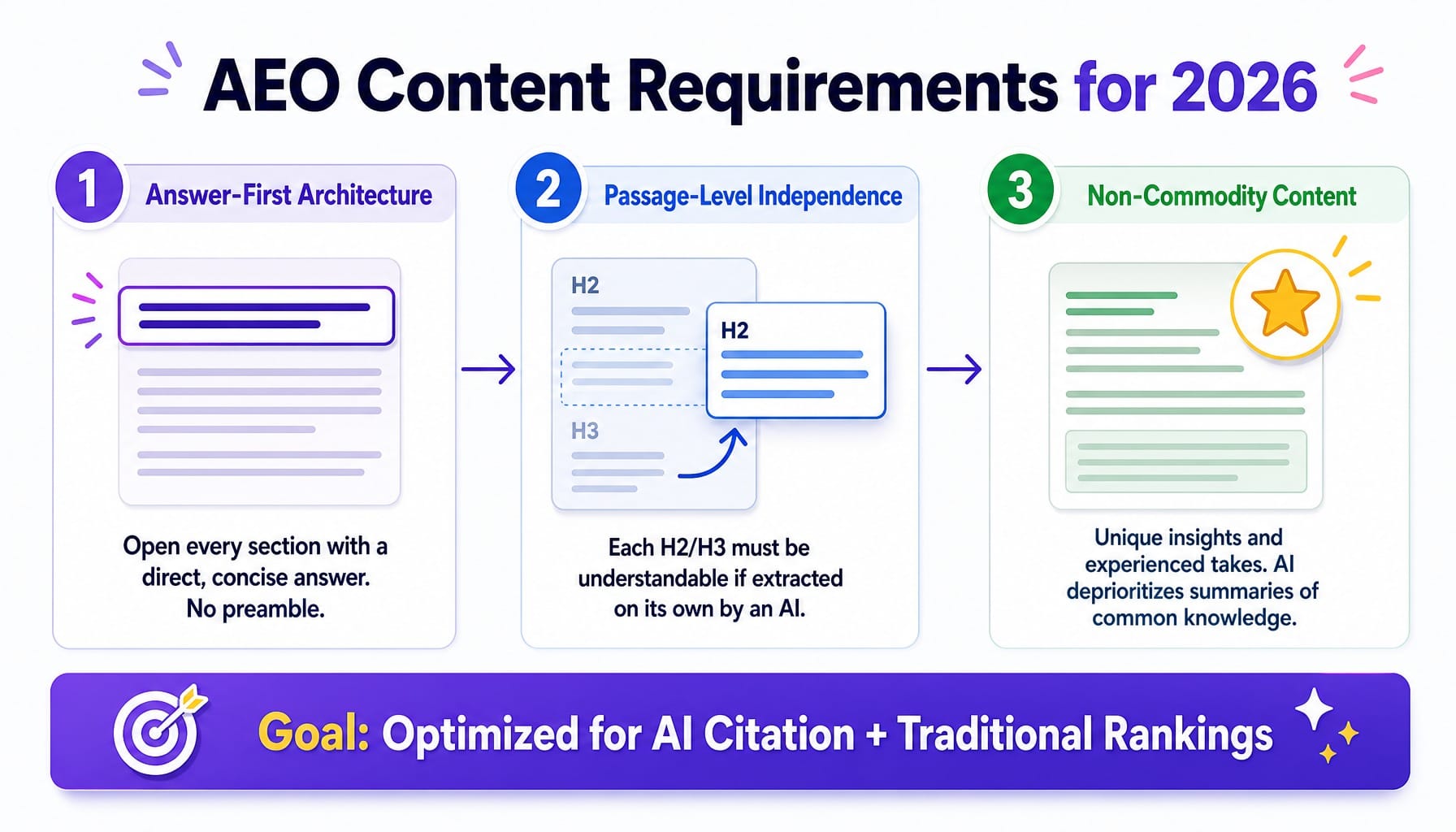
Your marketing plan's content section must include an explicit AEO component. This isn't a separate initiative; it's a structural requirement for all new content:
- Answer-First Architecture: Every section must open with a direct, concise answer.
- Passage-Level Independence: Each H2/H3 should be understandable if extracted on its own.
- Non-Commodity Content: AI prioritizes unique insights and experienced takes, not summaries of common knowledge.
Your plan must shift from optimizing for clicks to optimizing for citation.
When the Plan Is Ready but the Shipping Cadence Isn't
You can design the perfect B2B SaaS marketing plan—one grounded in pipeline math, with clear OKRs, hybrid-motion awareness, and a forward-looking AEO strategy. But it will still fail if your team can't ship changes fast enough to act on the insights it generates. The execution latency we diagnosed earlier is the silent killer of every great plan. The backlog grows, engineering tickets stall, and the weekly progress prescribed by the plan dissolves into quarterly pushes that never quite happen.
This is the execution gap Spike AI was built to close. We are not a planning tool; we are the execution engine that turns your plan into a weekly shipping cadence.
Instead of your plan's insights piling up in a backlog, Spike AI identifies the single highest-impact move across your website CRO, SEO/AEO content, or ads—and executes it. Every week. A pricing page tweak, a new headline test, an AEO-optimized content block—the change gets prioritized, deployed, and measured.
The marketer moves from an operator buried in tasks to an orchestrator approving weekly releases. This replaces the slow, expensive cycles of traditional CRO agencies and eliminates the internal dependencies that stall progress. Your plan provides the blueprint; Spike AI provides the engine.
See how Spike AI turns your marketing plan into a weekly shipping engine
Your Plan is an Execution System
A B2B SaaS marketing plan is not a strategy document you write in January and forget by March. It is a living execution system backed by pipeline math.
To build one that works, you must start with the numbers—what pipeline do you need to hit your ARR target? From there, build the five operational components: ICP scoring, a demand creation/capture split, channel-motion alignment, quarterly OKRs, and trigger-based budget logic. Account for modern realities like hybrid GTM motions and AI-driven search. Finally, you must solve for the constraint that kills every plan: execution velocity.
The teams that win in 2026 won't be the ones with the most creative strategies. They'll be the ones that ship the most high-impact changes per quarter. Your plan is the blueprint; your shipping cadence is the competitive advantage.
Frequently Asked Questions
What budget split should a Series A SaaS company use for marketing?
There's no universal ratio, but a sound starting model is: 60-70% on channels with proven CAC payback under 18 months, 15-20% on experimentation, and 10-15% on brand and long-term demand creation. This split shifts based on your GTM—PLG motions invest more in product and content, while sales-led motions fund more ABM and outbound. Re-evaluate quarterly based on actuals.
What is the difference between a SaaS marketing plan and a go-to-market plan?
A go-to-market (GTM) plan is a launch-focused document for entering a market or releasing a product, defining initial positioning, pricing, and channels. A marketing plan is an ongoing operational framework for generating and converting demand quarter after quarter. The GTM plan is the input; the marketing plan is the system that executes and scales its strategy over time.
How do you adjust a SaaS marketing plan when CAC payback exceeds 18 months?
First, diagnose the root cause. If acquisition cost is the problem, shift budget from high-cost paid channels to owned channels like SEO. If poor conversion is the issue, invest in CRO and sales enablement before increasing top-of-funnel spend. Your plan should have trigger-based reallocation rules built in, so this adjustment happens systematically at quarterly reviews, not as a panicked reaction.
How do you measure marketing plan effectiveness beyond MQLs?
Track metrics across three layers. Leading indicators (ICP-qualified traffic, demo requests), pipeline indicators (marketing-sourced pipeline, MQL-to-SQL rate, pipeline velocity), and revenue indicators (closed-won revenue, blended CAC payback, net revenue retention). MQLs alone are a vanity metric that measures activity, not business impact. True effectiveness is measured in pipeline and revenue.
Should a B2B SaaS marketing plan include community and ecosystem plays?
Include them only if your ICP actively uses communities and your product benefits from network effects. Community is effective for developer tools or horizontal SaaS where peer recommendations drive decisions. For high-ACV vertical SaaS with a narrow ICP, it rarely produces a measurable pipeline. Tie it to a specific demand creation or retention outcome, or leave it out of the plan.
What does a 12-month B2B SaaS marketing plan timeline look like?
Structure it as four quarterly sprints, not one annual marathon. Q1: Validate ICP scoring and launch high-confidence channels. Q2: Measure pipeline contribution, reallocate budget, and start demand creation plays. Q3: Double down on winning channels and cut underperformers. Q4: Model next year's pipeline using actual conversion data. Each quarter must end with a resource allocation decision.