
B2B SaaS Marketing in 2026: The Execution Gap Most Teams Never Close

TLDR
- Most B2B SaaS marketing teams don't have a strategy problem; they have an execution throughput problem. The gap is not in knowing what to do, but in the latency between insight and deployment.
- Growth stalls due to five specific constraints: the specialist gap, prioritization paralysis, channel fragmentation, tool overload, and cadence failure. These are system-level bottlenecks, not channel problems.
- Replace channel checklists with a marketing execution system built on two principles: channel-agnostic prioritization based on revenue impact and a consistent weekly shipping cadence that compounds results.
- Shift from traditional lead scoring (which conflates activity with intent) to signal-based marketing that stacks intent data, product usage, and firmographics to identify accounts with true buying intent.
- Acknowledge and measure the dark funnel—where 60-80% of the buyer journey happens—by supplementing tool-based attribution with self-reported attribution to get a true picture of what drives demand.
Imagine a three-person marketing team at a growth-stage B2B SaaS company. Their backlog has 47 items: website fixes, SEO improvements, and ad experiments. Each one is validated by data from HubSpot, Hotjar, or Ahrefs. Each one is approved in principle. Yet, in the last quarter, they've shipped exactly two changes. The backlog grows faster than they can execute.
This isn't a hypothetical. For most B2B SaaS marketing teams, this is a documentary. The defining problem in 2026 is not a lack of strategy or data. The gap is not between what teams know and what they should do. The gap is the latency between deciding to do something and that thing actually going live.
Most content on B2B SaaS marketing focuses on which strategies to add to your plan. This article focuses on why those strategies stall. We will diagnose the five execution constraints that paralyze growth, introduce a systems-level framework to replace the conventional channel checklist, and cover two emerging shifts—signal-based marketing and dark funnel attribution—that most guides ignore. The goal is to reframe marketing from a series of campaigns into an execution system that compounds.
Why Most B2B SaaS Marketing Fails at Execution, Not Strategy
At the $5M–$30M revenue stage, B2B SaaS marketing teams rarely fail because they chose the wrong channels or wrote the wrong content. They fail because the time between identifying a necessary change and deploying it stretches into weeks, choked by discussions, planning, approvals, and fragmented tools.
This failure manifests in three recognizable patterns:
- The Backlog Problem: Insights from analytics, CRO audits, SEO tools, and customer feedback accumulate faster than any lean team can act. The result is a perpetual, growing backlog of 'should-do' items that creates a constant, low-grade anxiety. The highest-impact ideas are buried under the weight of a hundred smaller ones.
- The Latency Problem: A single homepage copy change that should take an hour requires a design brief, a dev ticket, a stakeholder review, and a deployment window, consuming two to three weeks of coordination overhead. A growth marketer at a Series B company might identify a dozen high-impact changes, but the operational friction means they only ship one per month. This latency is the silent killer of marketing momentum.
- The Tool-Disappointment Problem: Teams invest in HubSpot, 6sense, and SEMrush expecting execution leverage but get dashboards and reports instead. The tools are brilliant at identifying problems—they just don't solve them. Despite massive investment in CRO and analytics, average B2B website conversion rates remain stuck around 2%. More data has not produced more results because the gap between what a tool surfaces and what gets shipped remains entirely on the marketer's plate.
The industry's obsession with 'which strategies to use' misdiagnoses the core issue. The constraint is not strategic knowledge; it's execution throughput.
The Five Execution Constraints That Stall B2B SaaS Growth
Before building a marketing system, you must diagnose the constraints limiting your throughput. These are not channel or budget problems; they are system-level bottlenecks. According to Gartner, B2B buyers spend only 17% of their purchase journey meeting with suppliers, making marketing execution—not just sales enablement—the primary lever for growth. Any constraint on that execution is a direct constraint on revenue.
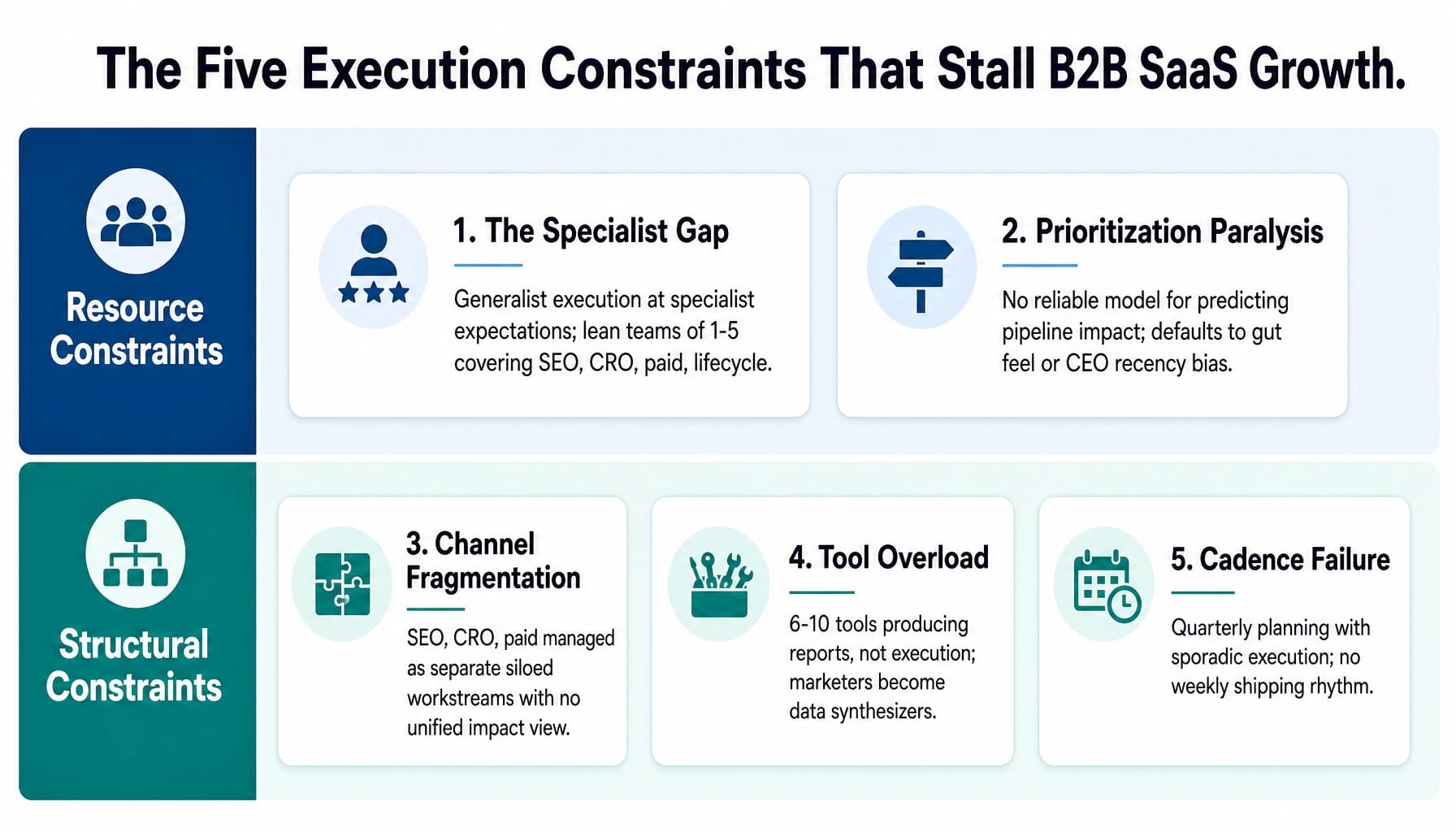
Resource Constraints: The Specialist Gap and Prioritization Paralysis
These constraints stem from what the team lacks in bandwidth and decision-making clarity.
First is the specialist gap. A lean marketing team of one to five people is expected to perform across SEO, CRO, paid search, and lifecycle marketing—roles that each require deep domain expertise. A solo marketing lead at a $10M ARR company is simultaneously the SEO strategist, landing page designer, and ad buyer. The result is generalist execution at specialist expectations, with no function receiving the depth it requires to be truly effective.
Second is prioritization paralysis. With fifteen things that could be improved and no reliable model for predicting which one will move qualified pipeline most, teams default to gut feel, recency bias, or whatever the CEO mentioned last. An ICP scoring matrix should inform this process, but most teams lack the bandwidth to build and maintain one. The consequence is scattered effort across all channels with insufficient depth in any, diluting impact and burning out the team.
Read more: The Marketing Prioritization Framework That Replaces Gut Feel With Compounding Wins
Structural Constraints: Channel Fragmentation, Tool Overload, and Cadence Failure
These constraints are embedded in how the work is organized and executed.
First, channel fragmentation. SEO, CRO, and paid search are managed as separate workstreams with separate tools. There is no unified view of where the highest-impact move lies—is it a CRO fix on the pricing page, an SEO update to a pillar page, or a new ad creative? Tools like Dreamdata offer multi-touch attribution but still leave execution siloed. Because no one owns the holistic system, effort spreads thin across all channels instead of being concentrated on the single most important action.
Second, tool overload. The average B2B SaaS marketing team uses 6-10 tools, each producing its own reports and recommendations. The output is more homework, not more execution. The marketer becomes a data synthesizer, spending their time consolidating insights rather than acting on them.
Finally, cadence failure. Most marketing teams operate in quarterly planning cycles with sporadic execution in between. There is no weekly shipping rhythm. Contrast this with how product teams ship: in sprints, with a defined cadence. Marketing has not adopted this discipline, so improvements happen in unpredictable bursts followed by long periods of stagnation.
Building a B2B SaaS Marketing System, Not a Channel Checklist
Conventional B2B SaaS marketing advice presents a menu of channels—content, SEO, paid ads, ABM—and implies success comes from choosing the right mix. This is wrong. The channel mix matters far less than the system that decides what to prioritize, ships changes consistently, and compounds results. The difference between teams that make four meaningful changes per quarter and teams that make four per week is not their strategy; it's their operating system.
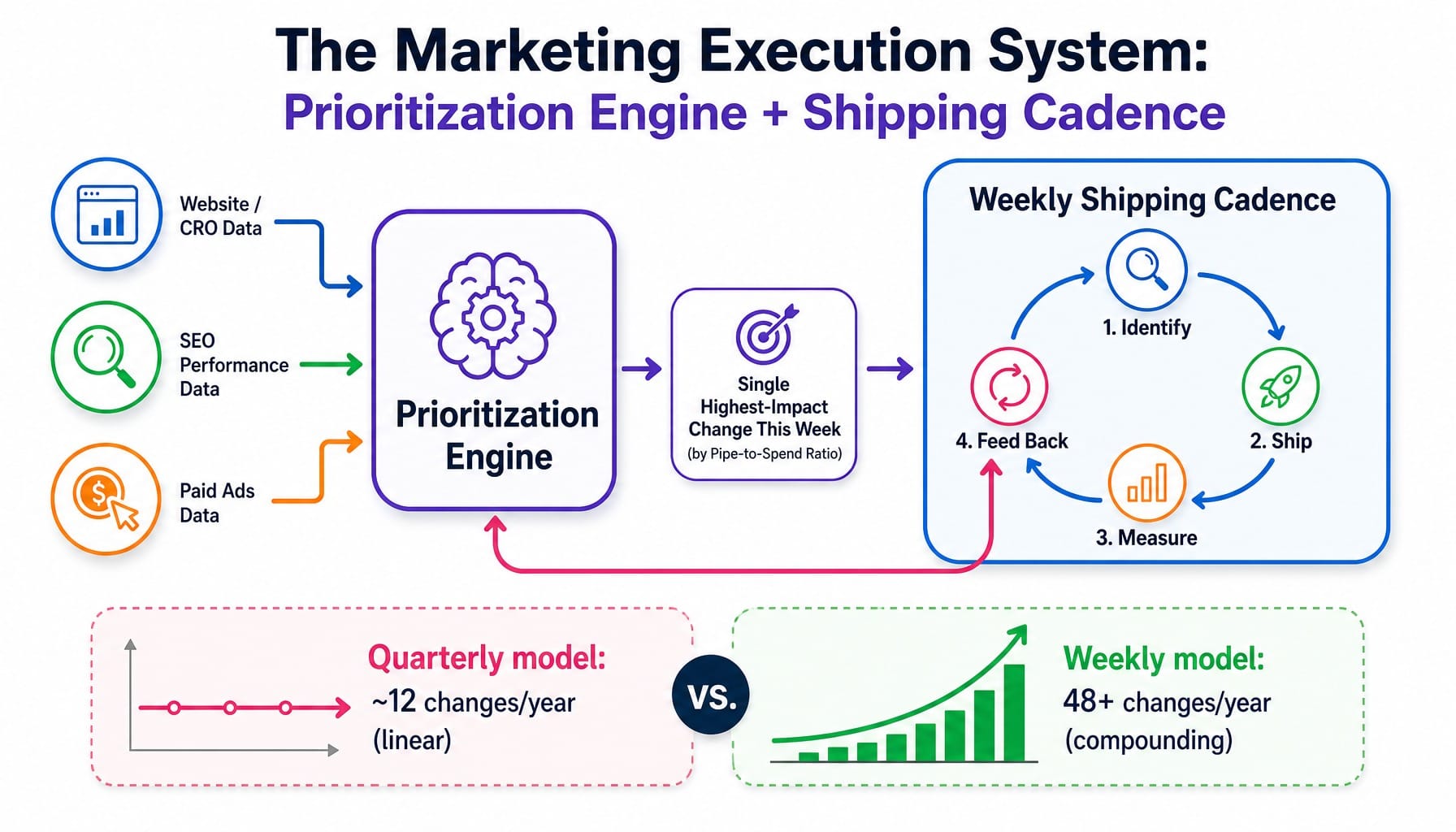
A marketing execution system has two core components: a prioritization engine and a shipping cadence. A team that previously ran quarterly 'optimization sprints'—reviewing analytics, creating a list of 20 changes, and shipping three before priorities shifted—can transform its output by adopting a weekly model. By identifying, shipping, and measuring one highest-impact change every week, they can achieve 48+ compounding improvements per year, dwarfing the impact of 12 sporadic ones.
Prioritization Logic: Revenue Impact Over Channel Loyalty
Most B2B SaaS teams prioritize work by channel ownership: the SEO person works on SEO, the ads person works on ads. This means the highest-impact move—which might be a CRO fix on the pricing page—goes unshipped because it falls between ownership boundaries.
A true execution system is channel-agnostic. Each week, the team should ask one question: "What single change across our website, SEO, and ads will move the most qualified pipeline?" Then they ship that—regardless of which "channel" it belongs to. The governing metric is the pipe-to-spend ratio, not vanity KPIs like organic traffic or ad impressions. The challenge, of course, is that this requires a unified view across channels. While tools like Dreamdata for attribution and Clay for signal enrichment offer pieces of the puzzle, they still leave the final prioritization decision to a human operator juggling multiple dashboards. This is the exact point where an integrated system becomes necessary.
Read more: How to Prioritize Marketing Channels With a Limited Budget And Resources (Framework for Lean Teams)
The Weekly Shipping Cadence: How Compounding Actually Works
Compounding in marketing is not a metaphor; it's a measurable operational outcome of a consistent weekly shipping cadence. A 1% conversion rate improvement shipped every week doesn't just add up; it compounds to a 67% cumulative improvement over a year. But let's be honest, this only works if the cadence is maintained. One missed week doesn't just lose that week's gain—it breaks the feedback loop that informs the next week's prioritization.
This is a stark contrast to how most B2B SaaS teams operate, with bursts of activity followed by weeks of maintenance mode. The result is linear progress at best. A weekly "marketing sprint," borrowed from product development, changes the game. Each week has a single deliverable: identify the highest-impact change, ship it, measure the result, and feed that data into the next week's prioritization queue. Just as product teams use sprint velocity as a health metric, marketing teams must adopt shipping velocity.
Where Signal-Based Marketing Replaces Traditional Lead Scoring
The execution system described above is only as good as the data feeding its prioritization engine. This is where traditional lead scoring fails. A B2B SaaS company using HubSpot might assign 10 points for a whitepaper download and 5 for a pricing page visit. The problem? A competitor's analyst scores the same as a VP of Marketing evaluating solutions. Traditional MQL models conflate activity with intent.
Signal-based marketing is the replacement. Instead of scoring actions, teams stack signals:
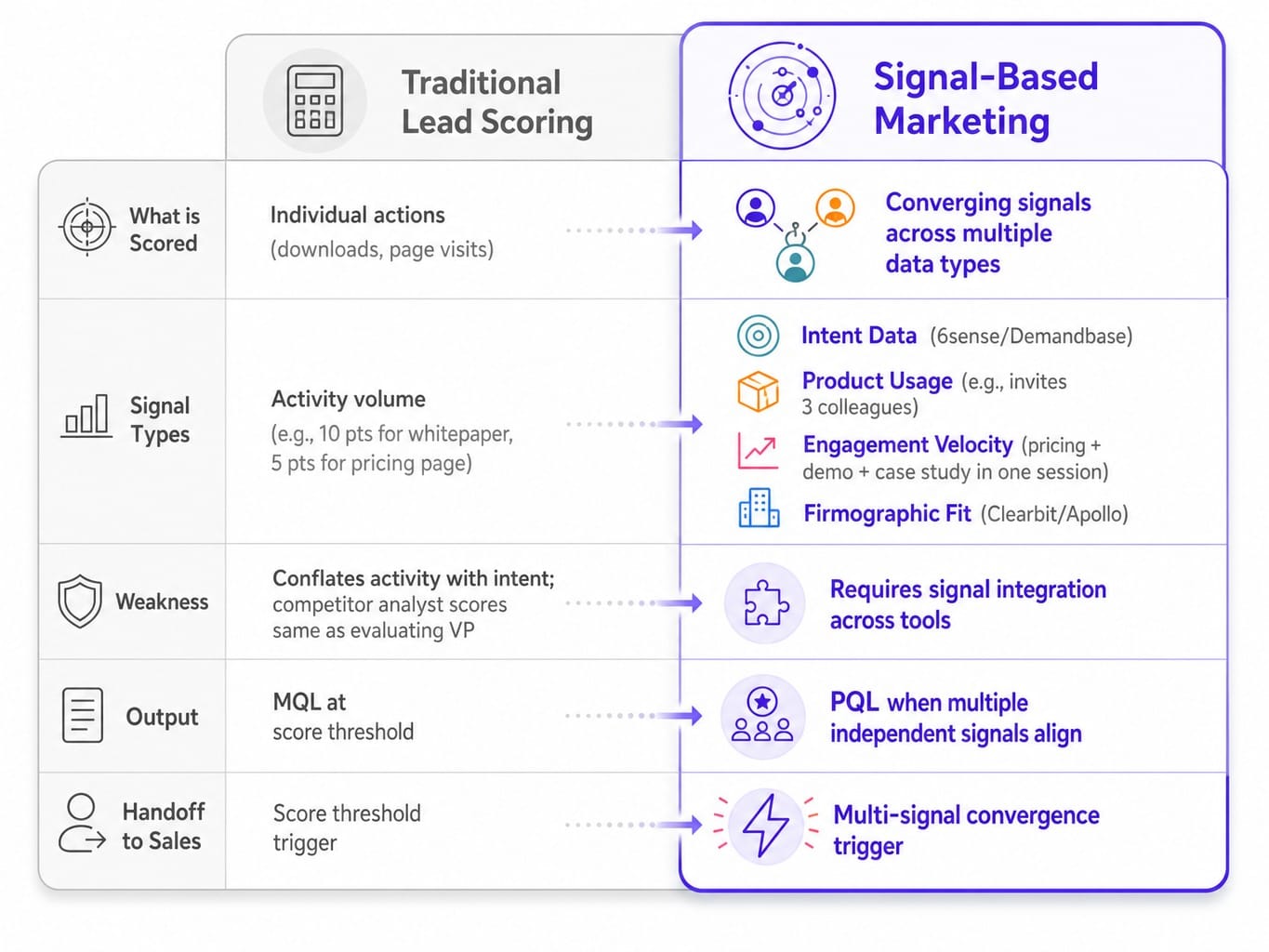
- Intent Data: A company showing a spike in research on a topic, captured by tools like 6sense or Demandbase.
- Product Usage: A user in a freemium trial who invites three colleagues.
- Engagement Velocity: A prospect who visits the pricing page, watches a demo video, and reads a case study in the same session.
- Firmographic Fit: A company that matches the ICP, identified via Clearbit or Apollo.io.
The shift is from "did they do enough things?" to "do the signals converge on buying intent?" This redefines the SDR-marketing SLA. Marketing no longer hands over leads at a score threshold; it surfaces accounts when multiple independent signals align, creating true product-qualified leads (PQLs).
The Dark Funnel and What It Means for B2B SaaS Attribution
Between 60% and 80% of the B2B buyer journey happens in channels marketing tools cannot track: Slack communities, private LinkedIn DMs, podcast conversations, and word-of-mouth. This is the dark funnel. Most teams know it exists but have no framework for it, so they over-attribute revenue to the last trackable touchpoint—usually a Google ad—and under-invest in the channels that actually drove the decision.
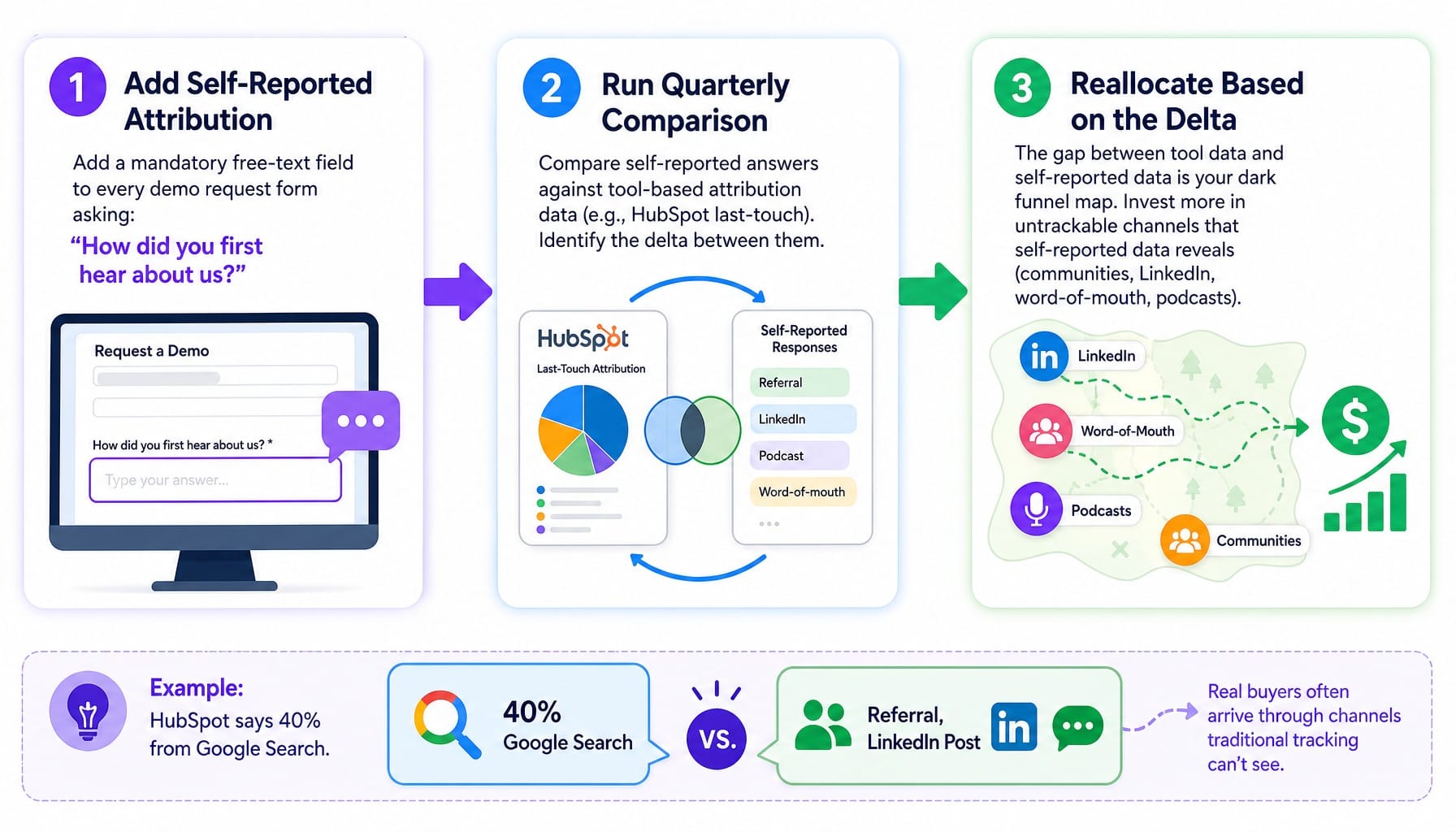
Consider this: a Head of Growth sees that 40% of demo requests list 'Google Search' in HubSpot. But when sales asks "how did you first hear about us?" in discovery calls, the answer is "a colleague mentioned you" or "I saw your CEO's LinkedIn post." The attribution data and reality are misaligned.
The fix is surprisingly low-tech. Add a mandatory, free-text "How did you hear about us?" field to every demo request form. Run a quarterly self-reported attribution analysis and compare it to your tool-based model. The delta between them is your map of the dark funnel, showing which untrackable channels—like communities, which tools like Common Room try to illuminate—deserve more investment. If your attribution model is wrong, your prioritization model is wrong, and your execution system ships the wrong things.
When the Execution Gap Is the Growth Constraint, the System Needs to Change
This article has built a specific tension: B2B SaaS marketing teams know what to do but cannot ship fast enough. The five constraints—the specialist gap, prioritization paralysis, channel fragmentation, tool overload, and cadence failure—are structural. They cannot be solved by hiring one more person or adding one more tool.
The prioritization-and-cadence framework is the right model, but implementing it manually requires a team with cross-channel expertise, unified data visibility, and the discipline to maintain a weekly shipping rhythm. This is where the system itself needs to change.
Spike AI is the execution layer built to run this exact framework autonomously. It identifies the highest-impact move across your website, SEO, and ads each week, then executes it—without engineering tickets, agency briefs, or coordination overhead. The system this article describes—unified prioritization, weekly shipping, and compounding measurement—is what Spike AI was built to run. We turn your marketing backlog into a weekly release cadence, closing the execution gap for good.
See how Spike AI turns your marketing backlog into a weekly shipping cadence
The Shift from Strategy to Throughput
The single most important belief shift for any B2B SaaS marketer is this: your primary role is not strategy selection; it's managing execution throughput. Lean teams already know which channels matter and what their buyers need. The real constraint is the latency between insight and deployment, compounded by fragmented tools and the absence of a consistent shipping cadence.
The teams that will outperform their peers in 2026 are not the ones with the most sophisticated strategy decks. They are the ones that ship the most high-impact changes per week and let compounding do the rest. The question is no longer "what should we do?" but "how fast can we ship?"
Frequently Asked Questions
How should a B2B SaaS company allocate its marketing budget across channels?
Allocation should follow revenue attribution, not industry benchmarks. Start with 60% on the channel producing the most pipeline, 25% on the next-highest performer, and 15% on experimental channels with a 90-day evaluation window. Most importantly, revisit this allocation monthly based on your pipe-to-spend ratio, not annually.
When should a B2B SaaS startup invest in account-based marketing?
ABM is premature until three conditions are met: your average contract value exceeds $25K ARR, the typical buying committee involves three or more stakeholders, and you have enough closed-won data to build a reliable ICP scoring matrix. Before then, the targeting is too broad and the cost per account too high.
How does product-led growth change the role of B2B SaaS marketing?
PLG shifts marketing's primary job from generating MQLs to reducing time-to-value inside the product. Marketing becomes responsible for self-serve onboarding, in-product education, and converting free users to paid. The key metric shifts from MQL volume to product-qualified leads (PQLs) and freemium-to-paid conversion rate.
How do you measure marketing-sourced pipeline versus marketing-influenced pipeline?
Sourced pipeline counts deals where marketing created the first touchpoint (e.g., an inbound demo from organic search). Influenced pipeline counts deals where marketing touched the account at any point before close. Sourced measures demand creation; influenced measures deal acceleration. Track both separately in a tool like HubSpot or Dreamdata to maintain clarity.
What content formats produce the highest ROI for B2B SaaS marketing in 2026?
Format matters less than specificity. A 1,200-word comparison page targeting a high-intent keyword ('alternative to [competitor]') will always outperform a 4,000-word thought leadership piece. The highest-ROI formats are consistently comparison pages, interactive product demos (via tools like Navattic or Storylane), and ungated, data-rich research reports that earn authority and backlinks.